Thursday, October 1, 2026
Home Blog Page 6938

Mozambique Is at a Crossroads as a New President Is Sworn In

0
Mozambique Is at a Crossroads as a New President Is Sworn In


Decades ago, Mozambique’s liberation party, Frelimo, easily attracted adoring crowds. The promise of salvation from Portuguese colonizers, and a life with jobs and housing for all, was an easy sell in a southern African nation that was suffering under racist rule.

But when Daniel Chapo of Frelimo became president on Wednesday, he assumed the leadership of a country more dissatisfied with his party than at any point during its 50 years of independence. Tens of thousands of people took to the street after the October election, which voters, international observers, opposition leaders and rights groups have roundly criticized as fraudulent.

The country of 33 million has been roiled by political chaos since the vote. And now, Frelimo’s grip on power is being tested like never before at a time when Mozambique faces urgent economic and social crises, analysts say. Two of the three opposition parties boycotted the inauguration and the opening of Parliament on Monday.

The anger among voters exploded into huge street protests in the past several months that led to clashes with the police. At least 300 people have been killed.

Mr. Chapo and his party had likely hoped that the inauguration on Wednesday would help move the country toward reconciliation and stability. But early signs suggested a difficult path toward unity.

The police quickly moved to disperse a few dozen peaceful protesters about two blocks from the inauguration in the capital, Maputo. The demonstrators fled when officers marched toward them with barking dogs lunging on leashes.

Officers fired several rounds of live ammunition to quell the demonstrations. But the show of force only angered the protesters, who yelled, “They won’t govern,” referring to Frelimo.

“We’re going to burn Mozambique,” said Angelina Chissano, one of the protesters in the capital on Wednesday.

Such demonstrations offered a glimpse of the new reality that Frelimo must contend with.

“Frelimo became used to seeing themselves as the chosen party,” said Gabriel Muthisse, a former top party official who remains an active member. “They believed that elections were only a formality for the people to confirm their leadership. Over the past five, 10 years, things are showing that that is false.”

After taking the oath of office, Mr. Chapo attempted to extend a hand to Mozambicans. He vowed to cut state spending by downsizing the government and reducing expensive perks that ministers receive. (The government is often criticized for spending lavishly on officials, while failing to meet many citizens’ basic needs.)

“I know many of us feel that leaders are distant, inaccessible and disconnected from the real concerns of the people,” Mr. Chapo said. “This will change.”

Mr. Chapo appeared to be taking a page out of his rival’s playbook. Venâncio Mondlane, the opposition leader, is seen by many to be the true champion of ordinary Mozambicans. The fiery populist claims to have won the election and has drawn a huge following, particularly from disaffected young voters.

When Mr. Mondlane, 50, returned to Mozambique last week after a self-imposed exile, the police responded with deadly force against supporters who took to the streets to greet him.

Mr. Mondlane has called for continued protests, though this week has not attracted the mass demonstrations that shut down the capital and other cities in previous months.

In an interview in Maputo, Mr. Mondlane said that he had communicated with Mr. Chapo through a mutual friend. He expressed hope that the president would negotiate a resolution to end the political crisis and accept reforms put forward by him in a recent proposal. On top of amending the constitution and overhauling government institutions, those reforms include building three million houses for poor Mozambicans and creating a half-billion-dollar fund for startups led by women and young people.

“You must give the people something very crucial and something tangible,” Mr. Mondlane said. “I don’t know if all the items that are in my proposal will be satisfied or not. But I think that we will begin a platform of dialogue.”

Protests were still needed, he added, because to ensure that reforms will happen, “you must put the government under pressure.”

Mr. Chapo, 48, emerged last year as Frelimo’s surprise presidential candidate. Unlike others in the party, he did not lobby for the nomination. He entered public office just 10 years ago, but came face to face with the country’s troubled political history long ago.

When he was 5, he said, his family was kidnapped by guerrilla forces fighting Frelimo during Mozambique’s 16-year civil war. A lawyer by training, he served as a provincial governor before running for the presidency for the first time last year as a member of Frelimo.

Branquinho João da Costa, a 43-year-old doctor living part time in Maputo, recalled his grade school days when the glory of Frelimo was drilled into him and his classmates through freedom songs. “It’s very difficult to be completely disconnected from Frelimo,” he said.

Many Mozambicans are now disgruntled with the party over accusations of corruption and its failure to address rising prices, which Mr. da Costa called “a new kind of slavery for the people.” He said the Frelimo of his childhood was more in touch with the party’s socialist roots, and that it was led then by officials who cared less about wealth and power.

“The real aim of Frelimo was serving people,” Mr. da Costa said. “Now many of them, they fight to get political positions just to steal from us.”

Frelimo no longer has the luxury of ignoring such criticism, some party members say. The past few months have been a warning, said Alsácia Sardinha, who was sworn in this week for her third term as a member of Parliament for Frelimo.

“We have to reinvent ourselves to respond to the demands of the people,” she said. That reinvention includes the party policing its own government against wrongdoing, she added.

Mr. Muthisse, the former Frelimo official, said that Parliament can no longer rubber stamp laws put forward by the president. The party needs to focus on reforming institutions, like the electoral commission and the courts, in order to regain public trust, he said.

That reform should be at the center of negotiations with the opposition, Mr. Muthisse said.

“Everybody has to bring ideas,” he said, “so that in the next elections, we all believe.”


What concerns does the use of AI in news raise? | Regulation

0
What concerns does the use of AI in news raise? | Regulation


Today on The Stream, AI’s role in news raises concerns about journalistic integrity, deepfakes, misinformation, and accountability in content creation.

As artificial intelligence transforms news production, it offers both innovation and ethical challenges. While AI can streamline content and analyse data, it also raises concerns about misinformation, deepfakes, and accountability. How can the news industry maintain integrity and public trust? This episode explores the potential risks of AI in journalism and the need for robust ethical frameworks to ensure accuracy and transparency in the digital age.

Presenter: Anelise Borges

Guests:
Joe Amditis – Center for Cooperative Media
Glen Mulcahy – AI and media trainer
Jana El Messelmani – Digital humanist


South Korea impeached president arrested after investigators scale walls

0
South Korea impeached president arrested after investigators scale walls


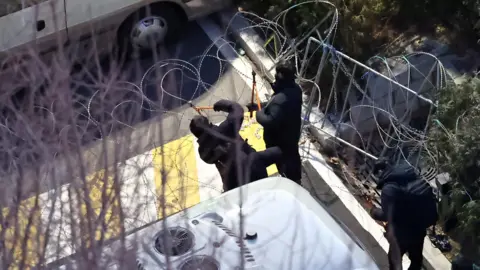
Reuters Police officers cut a wire fence set up at the entrance to the official residence of impeached South Korean President Yoon Suk Yeol, as authorities seek to execute an arrest warrant, in Seoul, South Korea, January 15, 2025.Reuters

Investigators and police braved freezing temperatures and cut through barbed wire to reach Yoon

Yoon Suk Yeol has become South Korea’s first sitting president to be arrested after investigators scaled barricades and cut through barbed wire to take him into custody.

Yoon, 64, is being investigated on charges of insurrection for a failed martial law order on 3 December that plunged the country into turmoil.

He has also been impeached by parliament and suspended – but will only be removed from office if the Constitutional Court upholds the impeachment.

However, Yoon’s dramatic arrest on Wednesday brings to an end a weeks-long standoff between investigators and his presidential security team.

Investigators from the Corruption Investigation Office for High-ranking Officials (CIO) failed to arrest him on 3 January after being locked in a six-hour stand-off with his security detail.

But just before dawn on Wednesday, a much larger team of investigators and police arrived at his residence in central Seoul, armed with ladders to climb over buses blocking its entrance and bolt cutters to remove barbed wire.

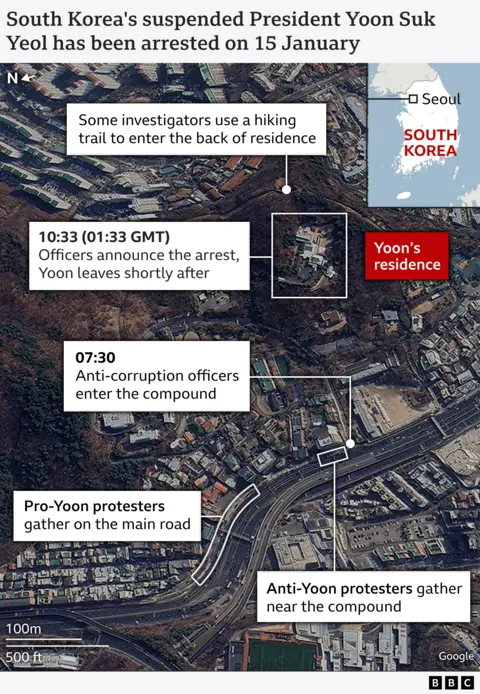
Other officers in the arrest team, which numbered around 1,000, scaled walls and hiked up nearby trails to reach the presidential residence.

After several hours, authorities announced that Yoon had been arrested.

In a three-minute video released just before his arrest, the 64-year-old leader said he would co-operate with the investigators, while repeating previous claims that the warrant was not legally valid.

“I decided to appear before the CIO, even though it is an illegal investigation, in order to prevent any unsavoury bloodshed,” he said, adding that he witnessed officials “invade” his home’s security perimeter with fire equipment.

On Wednesday afternoon, investigators said Yoon had remained silent throughout questioning.

A graphic detailing how Yoon's arrest unfolded

Yoon’s lawyers have said his arrest was “illegal” because the CIO, as an anti-corruption agency, has no power to investigate the insurrection allegations against Yoon. They also claim the warrant was issued by the wrong jurisdiction.

The same court later dismissed an injunction filed by President Yoon to invalidate the arrest warrant, which the authorities maintain is lawful.

The opposition Democratic Party’s floor leader, Park Chan-dae, said Wednesday’s arrest showed that “justice in South Korea is alive”.

This arrest “is the first step toward restoring constitutional order, democracy and the rule of law”, he said during a party meeting.

The country is currently being led by Finance Minister Choi Sang-mok as acting president. He was thrust into power after the first acting president, Han Duck-soo, was also impeached by parliament, where the opposition has a sizeable majority.

What’s next for Yoon?

The clock has started ticking for investigators.

Under the current warrant, they can hold Yoon for up to 48 hours from the point of arrest, after which they need a new warrant to detain him while he continues to be investigated.

If that warrant is granted, they can detain him for up to 20 days before he is brought to trial. Without a new warrant, Yoon must be released.

Late on Wednesday, local media reported Yoon was questioned in the CIO’s office until 21:40 before being taken to Seoul Detention Centre, approximately 5km (3 miles) away in Uiwang, Gyeonggi Province.

Pro-Yoon supporters continued to protest against the arrest outside the CIO’s office.

They had gathered outside his house since before dawn on Wednesday, along with those opposing him.

The anti-Yoon crowd blasted out a “congratulations and celebrations” song when his arrest was announced, cheering and clapping at what they see as a success for law enforcement.

Yoon’s supporters, however, were dismayed. “We are very upset and angry. The rule of law has broken down,” one of them told the BBC.

Meanwhile, reports emerged that a man set himself on fire near the CIO’s office – although it is not known whether the incident is related to Yoon’s arrest.

The contrasting scenes between these two camps on Wednesday reflect deepening polarisation within the country, which has long been marked by stark divisions between conservatives and progressives.

The political saga has also pit two branches of executive power against each other: law enforcement officers armed with a legal arrest warrant and presidential security staff, who say they are duty bound to protect the suspended president.

As the former president faces questioning over the charges, the nation remains gripped by uncertainty, with no clear resolution to the widening political divide.

How things got to this point

South Korea has been gripped by political turmoil since Yoon’s stunning but short-lived martial law declaration on 3 December, which saw many MPs climb fences and break barricades to enter the National Assembly to vote down the order.

The president said he was protecting the country from “anti-state” forces that sympathised with North Korea, but it soon became clear that he was spurred by his own political troubles.

Yoon has been a lame duck president since the opposition won the general election last April by a landslide – his government has been reduced to vetoing bills proposed by the opposition.

Watch: President Yoon addresses South Korea before his arrest

An unprecedented few weeks followed, with parliament voting to impeach Yoon, his subsequent suspension and authorities launching a criminal investigation over the attempt.

Several of the country’s top leaders – including former defence minister Kim Yong-hyun, who reportedly suggested the martial law declaration – and Yoon’s political aides have since also resigned.

Tens of thousands of South Koreans have also braved freezing temperatures and taken to the streets in recent weeks, with some showing their support for Yoon and others calling for him to be removed from office.

All this while Yoon has remained holed up in his residence, refusing to comply with multiple summonses to appear for questioning, a defiant stance that led the authorities to arrest him.

Separately, the Constitutional Court has begun a trial to decide if he should be permanently removed from office, with observers saying it could deliver a ruling as early as February. Its next hearing is due to take place on Thursday.

Additional reporting by Rachel Lee in Seoul

Watch: BBC correspondent reports from between groups of protesters in Seoul


Israel and Hamas Work on Final Details of Gaza Cease-Fire Deal, Officials Say

0
Israel and Hamas Work on Final Details of Gaza Cease-Fire Deal, Officials Say


Mediators rushed on Wednesday to clinch a deal between Israel and Hamas on a cease-fire that would release hostages held in Gaza, after more than a year of devastating war that has killed tens of thousands of Palestinians and destroyed much of the enclave.

Neither Israel nor Hamas has publicly endorsed the agreement, and Israeli and U.S. officials have said that they were waiting for a final response from Hamas. The Palestinian group said on Tuesday that the negotiations had entered their “final stages.”

Negotiators and mediators in Qatar were attempting to address outstanding issues, according to two officials familiar with the matter, who spoke on condition of anonymity to discuss sensitive diplomacy.

Those issues included maps of how Israeli forces would redeploy inside Gaza during the cease-fire, as well as lists of Palestinian prisoners slated for release in exchange for Israeli and foreign hostages, one of the officials said.

Israel has also demanded a system to prevent armed fighters from returning to northern Gaza. Mediators are also trying to iron out details on inspections of the hundreds of thousands of displaced Palestinians who would be expected to head to northern Gaza from the south, where many have been displaced, in the event of a truce, the official said.

The latest round of talks is being held in Qatar, a key mediator alongside Egypt and the United States. Majed al-Ansari, the spokesman for the Qatari Foreign Ministry, said on Tuesday that the two sides had overcome major disagreements.

But in order to implement the deal, Hamas’s negotiating team in Doha must also obtain the consent of the group’s commanders in Gaza, including Mohammad Sinwar, whose brother Yahya led the group before being killed by Israel in October.

Hamas officials did not respond to questions about whether Mr. Sinwar had responded to the proposal.

In Israel, some hard-line members of Prime Minister Benjamin Netanyahu’s government have also voiced opposition to the deal. But on Wednesday, Gideon Saar, the Israeli foreign minister, said he believed that a majority would sign off on an agreement if it came to a vote in the cabinet.

Months of shuttle diplomacy have failed to end the war in Gaza, which began after Hamas launched a surprise attack on Israel on Oct. 7, 2023 that killed 1,200 people and saw 250 taken hostage. Around 105 captives were later released in a weeklong cease-fire in November 2023 in exchange for 240 Palestinian prisoners.

Israel and Hamas have since held numerous rounds of indirect talks, all of which ultimately collapsed amid mutual recriminations. Officials familiar with the negotiations have expressed cautious optimism while noting that there is always a chance that the discussions will founder.

The current deal is broadly similar to a three-phase cease-fire framework publicized by President Biden in late May, according to several officials familiar with the talks. Israel and Hamas would first observe a six-week cease-fire in which Hamas would release women, older men, and ill hostages in exchange for the release of Palestinians jailed by Israel.

Under that proposal, Israel and Hamas would then declare a “permanent cessation of hostilities,” Israeli forces would withdraw from Gaza and the remaining living hostages would be swapped for Palestinian prisoners. But the details have been a major point of contention: Hamas has demanded Israel commit to ending the war, which Israel has resisted.


In Pursuing Canal, Trump Could Push Panama Closer to China

0
In Pursuing Canal, Trump Could Push Panama Closer to China


As Panama’s president laid a wreath to honor those who died protesting the American occupation 60 years ago, the ceremony attendees were resolute.

The commemoration this month came just days after President-elect Donald J. Trump falsely claimed China was controlling the Panama Canal and suggested he could use military force to retake the waterway.

The threat rippled through a country still haunted by the events of 1964, when students trying to plant the Panamanian flag in the U.S.-occupied canal zone were met with deadly force.

“My brother did not die for nothing,” said Carlos E. Bonilla Cacó, whose brother was killed in the demonstrations that sparked the movement leading Panamanians to regain sovereignty.

The country’s leader agreed.

In the foothill near the Panama Canal Authority’s office, President José Raúl Mulino was firm. “The canal is and will continue to be Panamanian,” he said.

The statement directly challenged Mr. Trump, who some analysts say is only posturing to press Panama to lower fees for American goods traversing the canal, a subject he has recently railed against.

But former American officials warn that he may alienate Panama at a time when China is trying to woo the country as an ally and expand its influence in Latin America.

“Trump’s saber rattling could dampen the Panamanian government’s desire to broaden the relationship with the U.S. economically” said Ramon Escobar, who until September served on the National Security Council and is currently the managing director at Actum, a global consultancy firm.

He “may end up pushing them away at a time when there is a real opportunity to get Panama back into our orbit,” Mr. Escobar said.

The canal was constructed by the United States in the early 20th century, but Panama took back full control in 1999 and has since operated the waterway through the Panama Canal Authority.

Today, Panama holds special strategic significance for China because of the canal, but Beijing has been working to expand its influence in Latin America, and among developing countries more broadly. It has portrayed itself as an alternative to what it calls American hegemony and bullying, casting itself as a more sympathetic, fellow developing country.

And with significant investments in port construction worldwide, China is positioning itself to influence global commerce and monitor international activities.

Specifically, U.S. officials have grown increasingly concerned about two seaports at each end of the Panama Canal, which have been operated for decades by CK Hutchison Holdings, a company based in Hong Kong.

While CK Hutchison is a publicly listed conglomerate whose largest owner is a Hong Kong billionaire family, Beijing could still use its national security laws to force the company to assist in intelligence-gathering or military operations.

Panamanian officials argue, however, that China doesn’t pose a risk. The canal is open to the public, they say, and any Chinese interference would be visibly obvious.

“Anyone can use a satellite to see what is going in and out of the port,” Ilya Espino de Marotta, the deputy administrator of the Panama Canal, said in an interview last week. “The canal runs through the country, along national roads and is visible to the public.”

During his first administration, Mr. Trump did bring up the Panama Canal internally, indicating that he sees the waterway as unfinished business, said John Feeley, who served as U.S. ambassador to Panama from 2015 until 2018.

In June 2017, Mr. Trump met with the Panamanian president at the time, Juan Carlos Varela, and complained that the U.S. Navy was paying too much to traverse the canal — about $1 million annually, Mr. Feeley said. (That cost is so minuscule it would be akin to a rounding error in the Pentagon’s budget, analysts say.)

But Mr. Trump never brought up China’s presence or supposed influence over the canal even though just weeks previously Panama had broken off relations with Taiwan and aligned with Beijing, said Mr. Feeley, who attended the White House meeting between the leaders.

The former ambassador said he tried to get the White House to focus on China’s rising influence in Panama, but the issue never grew to a level of serious alarm.

At the time, China was promising to invest in big-ticket infrastructure items in Panama, including a canal bridge, as part of its Belt and Road Initiative. Through the initiative Beijing has increased its influence globally by investing in seaports, roads and trains from Kenya to Sri Lanka and, most recently, Latin America. Critics say Beijing uses the program to saddle foreign governments with failing projects or unsustainable debt in order to wield China’s leverage.

Mr. Feeley said he tried to get American companies to bid on such projects to counter China. But the U.S. Embassy in Panama City never got the White House’s backing to persuade American companies to bid, he said.

“It’s not that we are losing to China in Latin America; in most cases we aren’t even showing up to the commercial battlefield,” Mr. Feeley said.

Latin American governments like Panama’s have complained that when they put out bids for expensive infrastructure projects, the United States is often absent, forcing them to rely on others from Europe to China to get the work done.

“The U.S. isn’t bidding on big infrastructure projects here, but China is,” said Giulia de Sanctis, the president of the Panamanian Association of Business Executives. “Are we supposed to tell them now: ‘It’s time to get out of Panama; Trump doesn’t like you.’ Would anyone feel safe investing here then?”

The Panama Canal Authority has said that while the United States built the canal for military purposes, the Panamanians developed it into a major hub of global trade.

Once the U.S. military handed it over, the authority invested more than $5 billion to widen the waterway and accommodate the giant cargo ships that travel from the United States to East Asia, its most popular route.

“If it wasn’t for our investment, the canal would be irrelevant on the scale of global trade,” said Ms. Espino de Marotta.

“Our neutrality is our greatest business asset, and it enables us to be a route for global commerce,” she said. At the Atlantic entrance of the canal, three ports are separately operated by companies based in Hong Kong, Taiwan and the United States, she said.

“These ports have been managed by Hong Kong since 1997, throughout Trump’s first administration,” she added. “Trump never said a thing about it then, so why now?”

Some Panamanians are reluctant to allow China to invest further in the country. Although Mr. Varela shifted Panama’s diplomatic recognition to China from Taiwan and entered into several business agreements with Beijing, subsequent governments have sought to scale back these commitments.

Ramón Martínez, who served as the minister of commerce after Mr. Varela stepped down, expressed his discomfort with the political and economic agreements made by the earlier administration with China. He said he halted a free-trade agreement with China that was under negotiation. The bridge over the canal that China pledged to build was also paused.

Mr. Martínez emphasized that for Panama, its most important ally will always be the United States.

Last week, hundreds of tourists gathered on a terrace at the Miraflores Visitors Center, giving them a bird’s-eye view of the Panama Canal. They waved as a towering cruise ship squeezed its way through the canal.

“At first it made me laugh, the insanity of it all,” said Jacqueline Williams of Mr. Trump’s threats against Panama as she waved to a passing cruise ship. The 67-year-old nonprofit educator was visiting the canal from New York City.

“But then you think: This is a guy who idolizes Putin,” she said, referring to the Russian president. “Trump said on the campaign trail he wanted to restore peace to the world, but now he is threatening military expansionism.”

Alex E. Hernández contributed reporting from Panama City, Vivian Wang from Beijing and Emiliano Rodríguez Mega from Mexico City.


Choice for Energy Secretary Has Been an Evangelist for Fossil Fuels

0
Choice for Energy Secretary Has Been an Evangelist for Fossil Fuels


Chris Wright, Donald J. Trump’s pick to lead the Department of Energy, landed the job during his first encounter with the past and future president.

The founder and chief executive of Liberty Energy, a fracking services company based in Colorado, Mr. Wright was among about 20 oil and gas executives whom Mr. Trump gathered at his Mar-a-Lago resort in Florida in April. Mr. Wright had not met Mr. Trump before but caught his attention by making what two people in the room described as a forceful case for fossil fuels.

“Want to be my energy secretary?” Mr. Trump asked, seemingly in jest, according to those present. Days after the election, though, Mr. Trump chose Mr. Wright to lead the agency.

On Wednesday, Mr. Wright will appear before the Senate Energy and Natural Resources Committee. It will be the first of three confirmation hearings this week for Mr. Trump’s picks to run the agencies at the center of his plan to increase the production and use of coal, oil and gas.

Mr. Wright has been an evangelist for that cause. On podcasts and in speeches, he frequently makes a moral case for fossil fuels, arguing that the world’s poorest people need oil and gas to realize the benefits of modern life.

He also has distorted climate science, researchers and activists said. For example, Mr. Wright inaccurately claimed on a podcast last year that a top United Nations scientific body had found that climate change “is a slow-moving, modest impact two or three generations from now.”

In fact the scientific body, the Intergovernmental Panel on Climate Change, has recommended that nations make an immediate and drastic shift away from fossil fuels to prevent the planet from crossing a critical global warming threshold.

Meg Bloomgren, a spokeswoman for Mr. Wright, said in a statement that he had spent his career focusing on improving lives, “including studying and determining that climate change is real and a problem we must solve together with relentless U.S. innovation and technology solutions.”

Democrats on Tuesday offered mixed impressions of Mr. Wright.

Senator John Hickenlooper of Colorado described him as smart and thoughtful on energy issues but said he remained concerned about how Mr. Wright and other cabinet choices would address climate change.

Senator Sheldon Whitehouse of Rhode Island said Mr. Trump’s picks were “here to loot our public treasury and pollute our public spaces.”

He noted that the Mar-a-Lago event was where Mr. Trump had asked oil industry leaders to raise $1 billion for his campaign and had promised that companies would save far more than that when he eliminated climate regulations, according to people present. “Trump’s big donors want payback,” Mr. Whitehouse said.

Senator Mike Lee, the Utah Republican who leads the Senate Energy and Natural Resources Committee, said the hearings would be an opportunity to discuss what he called the Biden administration’s energy policy failures.

“With high energy prices hurting Americans and restrictive policies limiting access to public lands and critical resources, it’s essential to prioritize domestic energy production and restore trust in public land management,” Mr. Lee said.

On Thursday, Mr. Lee’s committee will hear from Douglas J. Burgum, the Republican former governor of North Dakota, whom Mr. Trump has tapped for the Interior Department. Also on Thursday, the Senate Committee on Environment and Public Works will consider Lee Zeldin, a former United States representative from Long Island, to head the Environmental Protection Agency.

If confirmed to head the Department of Energy, Mr. Wright would help oversee approvals of liquefied gas export terminals, which the Biden administration has tried to slow, angering Republicans.

Mr. Wright graduated from the Massachusetts Institute of Technology and did graduate work on solar energy at the University of California, Berkeley. In 1992, he founded Pinnacle Technologies, which created software to measure the motion of fluid beneath the Earth’s surface. The software helped bring about a commercial shale gas revolution.

Mr. Wright started Liberty Energy in 2011, and the company has worked with others on geothermal energy and small, modular nuclear reactors.

Mr. Wright holds 2.6 million shares in the company, which are worth more than $55 million based on the current stock price. A recent Securities and Exchange Commission filing put his compensation last year at $5.6 million.

Mr. Wright filed a separate document with the S.E.C. after Mr. Trump tapped him for energy secretary, indicating that he intended to step down from Liberty Energy. A transition official, who spoke on condition of anonymity because the financial disclosures were not yet public, said Mr. Wright intended to divest his holdings once confirmed.

Democrats sought to delay Mr. Wright’s hearing because they had not received his financial disclosure statements, documents typically made public before confirmation proceedings. Republicans declined to delay the hearings.

Senate officials said Mr. Wright’s disclosures had become available to lawmakers late on Tuesday, though they were not yet publicly available online at the Office of Government Ethics.


Tunisia’s revolution 14 years on: ‘The emperor has no clothes’ | Arab Spring

0
Tunisia’s revolution 14 years on: ‘The emperor has no clothes’ | Arab Spring


Fourteen years ago, on January 14, 2011, Tunisians filled Habib Bourguiba Boulevard, the central thoroughfare of Tunis, with cries of freedom and dignity as they celebrated the ousting of dictator Zine El Abidine Ben Ali. He had fled the country and announced his resignation after 28 days of relentless civil disobedience expressed by public square “occupations” in almost every city of the country, triggered by the haunting self-immolation of fruit seller Mohamed Bouazizi in the town of Sidi Bouzid.

The Tunisian people’s victory against their longtime oppressor and his suffocating, corrupt regime was so remarkable, so spectacular that it inspired a wave of Arab uprisings across the region.

In major cities from Yemen to Morocco, millions of freedom-hungry denizens joined the Tunisian “occupiers” of the Bourguiba Boulevard to celebrate the ouster of their fiercely authoritarian regime and call for their own liberation. With the Tunisian people’s perceived achievement of “karama” (dignity) and “hurriyya” (freedom) a new movement was born that placed the entire region on a revolutionary trajectory of “tahrir” (emancipation).

More than a decade later, the legacy of these uprisings, which came to be known as the “Arab Spring”, is mixed at best. One Arab country, Syria, which began its own revolutionary journey right after Tunisia on March 30, 2011, armed rebels managed to oust dictator Bashar Al-Assad only last month, after 14 years of devastating war and loss. In other Arab Spring countries, including Tunisia, the revolution came faster but has been short-lived with authoritarianism, oppression and conflict re-entering the picture soon after the initial successes of the revolting masses.

All this, of course, does not take away from the moral and political valour of the 2011 uprisings. The moral symbolism of these revolutions – as the remarkable victories of once muted peoples against some of the most coercively guarded states in the world – has staying power.

The new social and political patterns of public life that emerged on the back of these revolutions have endured in Tunisia and the rest of the Arab region.  The body politic of the state before 2011 was dominated by political decay of delegitimised rulers and undermined by excessive coercion and executive power and by exclusionary practices. These revolutions emboldened peoples of the region to demand a say over the nature of their governance and permanently changed how we talk about and analyse Arab postcolonial state-society relations.

To this day, January 14, 2011, stands as a historic moment that ignited a moral flame, a cry for freedom as it were, for the multitudes populating the Arab geography. It insinuated itself in the hearts, minds and imaginations of Arab youth gripped by the clamour of a better future. Tunisia’s revolution and those that followed it in Egypt, Libya, Bahrain, Syria and Yemen drew inspiration, confidence and moral vigour from the meltdown of whole authoritarian apparatuses previously thought immune to sudden, people-powered overthrow.

However, it cannot be denied that the banners of freedom and dignity erected on the ruins of fallen regimes soon gave way to counterrevolutions.

After the overthrow of authoritarian rulers in 2011, the allure of revolution swiftly lost its shine in most Arab Spring countries. This has not transpired as a result of the idea of revolution itself having fallen into disfavour among the Arab publics that were “square occupiers”. It certainly was not because ideological rivals of the revolution, including those championing electoral democracies (or even those rooting for “Islamic democracy”, such as Tunisia’s Rachid Ghannouchi), were given sufficient time to prove or disprove their worth. Rather, swings in the counterrevolutionary pendulum from Tunisia to Egypt resulted in “the revolutionaries” being forced into a defensive stance and pressed to give up their “revolutionary” demands. Indeed, with the passage of time, revolutions and revolutionaries have gradually degenerated in every setting.

In places like Egypt, Libya, Tunisia and Yemen with their newly acquired freedoms, political parties began to deviate from the original purposes of their democratic beginnings. Rekindling of old forms of political polarisation, economic and social rifts, armed militias and systemic tensions involving deep state actors and civilian protagonists was what led to this deviation. Meanwhile, the wealth gap between the haves and the have-nots that had framed the original cries for freedom and dignity remained intact. This multifaceted crisis tolled the near-death knell of true revolutionary transformation, ie a complete rupture with the ousted authoritarian systems.

The result has been the formation of so-called Arab Spring quasi-democracies that are said to be “hybrid regimes”, with mixed brands of authority, having very few of the ideals the Arab street had called for during the Arab Spring uprisings.

Today, the jails of some of these “democracies” are populated with political  activists accused of “conspiracy to subvert state power” – coercive charges that many thought were confined to the dustbin of history after the 2011 revolutions. Rule of law, which was one of the core demands of the uprisings, has been abandoned, and the law itself is being mobilised against actors who should be contributing to the nation from an open public square, if not a democratic parliament. Rather than using their know-how for the benefit of the state, they are rotting in jail cells for the crime of intimidating the powers who secured control of the state after the revolutions. Such purges are putting doubt in the minds of the people about whether a revolution that would bring about a complete break from the traditional authoritarian practices of the past would ever be feasible.

Under such democratic reverses, where the freedom of association, participation, contestation and expression is in constant jeopardy, elections themselves inevitably lose credibility.  Low voter turnouts speak to this democratic degeneration in elections held in places like Algeria, Egypt and Tunisia.

In many Arab Spring states, the political opposition has the same democratic shortcomings and weaknesses as the ruling powers, resulting in a belief by many voters that elections are futile however fair and free they may be on the surface. Intra-party democracy remains weak, if not absent. Those who lead political parties and civil society organisations tend to cling to power and baulk at democratic alternation of leadership positions. As a result, those who made the 2011 revolutions possible – the people – are losing interest in the electoral process.

Of course, culpability for the democratic degenerations since the 2011 revolutions is not to be placed on deep states or domestic political leaders alone.

Arab authoritarianism has been revitalised and revolutionary fervour culled in more than one case in the past 14 years through pacts that post-uprising Arab governments have made with Western powers and institutions from the United States and the European Union to the International Monetary Fund (IMF). For example, in countries like Lebanon and Egypt, the IMF played a key role in keeping authoritarianism alive by providing governments with funds, slashing any hopes their people might have held for new leaders or revolutionary, long-lasting solutions to their economic and political woes.

The Arab street has not forgotten the August  2013 Rabaa massacre, which saw security forces kill hundreds of supporters of ousted President Mohamed Morsi, who had been democratically elected. They are also not indifferent to or unaware of the Western-facilitated Israeli genocide in Gaza and Arab states’ inability to put an end to it for 15 long months.

The Arab publics are very much aware that their states with experienced or would-be despots at the helm are now no more than terror or migration watchmen. They protect borders and seek to ensure the elusive “stability” that is of mutual interest to regional and Western leaders.

This is, perhaps, the most consequential and enduring legacy of the Tunisian revolution and the wider Arab Spring. The “emperor” is not defeated, sure. But he is exposed. Just as the vain emperor in the famous Danish folktale, the nakedness of Arab states and their rulers has become impossible to conceal. There are no clothes. There is no cover. There is no “democracy”, bargain politics, power-sharing or free citizenship. The uprisings have built a new state-public relationship in the Arab world and let the cat out of the bag: The emperor has no clothes.

Fourteen years after Tunisia’s revolution, democracy is still missing in Tunisia and in the wider Arab world. But so are all the emperors’ clothes, and the Arab peoples have taken note. The revolutions’ legacies live on.

The views expressed in this article are the author’s own and do not necessarily reflect Al Jazeera’s editorial stance.


SpaceX rocket launches private missions to the Moon

0
SpaceX rocket launches private missions to the Moon


Two lunar landers built by private companies in the US and Japan have left Earth aboard a SpaceX rocket as part of a rideshare to the Moon.

The Falcon 9 took off from the Kennedy Space Center in Florida at 01:09 local time (06:09 GMT) on Wednesday, carrying landers belonging to America’s Firefly Aerospace and Japan’s ispace.

The landers will eventually separate once they reach the Moon’s orbit and conduct independent explorations.

They are the latest in a growing number of commercial missions to the Moon.

Firefly’s rover, Blue Space, is expected to take about 45 days to reach the Moon, once it has separated from the SpaceX rocket.

It will then drill, collect samples and also take X-ray images of the Earth’s magnetic field to “advance research for future human missions on the Moon and provide insights into how space weather impacts the planet”, according to SpaceX.

Meanwhile, ispace’s Resilence lander will take up to five months to reach the Moon’s surface, where it will deploy a rover for exploration and attempt to scoop up loose surface material known as regolith.

Nasa is backing the endeavour, which, if successful, will be its biggest commercial delivery to the Moon so far.

Intuitive Machines last year became the first commercial outfit to put a lander on the Moon, a feat only previously accomplished by the US, the Soviet Union, China, India and Japan.

Separately, SpaceX is also conducting its seventh orbital flight test of its Starship rocket, which is due to take off from Texas at 16:00 local time (22:00 GMT).


Missile Attack Prompts Emergency Power Cuts in Ukraine

0
Missile Attack Prompts Emergency Power Cuts in Ukraine


Ukraine’s national electricity operator introduced emergency power cuts on Wednesday after the country came under what the energy minister called a “massive” missile attack.

Air-raid sirens wailed at around 5:45 a.m. in the capital, Kyiv, as most of the country was put on alert for missile launches. As people huddled in shelters into a third hour and the air force warned of incoming cruise missiles, the energy minister, Herman Galushchenko, announced emergency steps.

“Due to the massive attack, the transmission system operator is applying preventive restriction measures,” Mr. Galushchenko, wrote in a statement on Facebook.

Emergency power shutdowns were applied in six regions across the country, including Kharkiv in the northeast and Zaporizhzhia in the south, according to Ukrenergo, the national electricity operator.

Russian forces have repeatedly targeted Ukrainian energy infrastructure in campaigns to black out, and wear down, the country in wintertime.

The scale of the assault on Wednesday was not immediately clear. It came a day after Moscow threatened to retaliate for what it said was Ukraine’s use of Western-made long-range rockets to strike inside Russia.


Olympic champion Zheng ousted as Australian Open 2025 delivers first shock | Tennis News

0
Olympic champion Zheng ousted as Australian Open 2025 delivers first shock | Tennis News


Zheng exits after second round loss to unseeded Siegemund as former champions Sabalenka and Osaka battle through.

Zheng Qinwen has become the first big name to exit the women’s draw at the Australian Open after the Olympic champion was stunned by Laura Siegemund while top seed Aryna Sabalenka made heavy weather of her second-round match before going through.

Jessica Pegula, who lost to Sabalenka in last year’s US Open final, safely advanced while Tokyo Olympics champion Belinda Bencic moved on after a brief spell of rain delayed proceedings on the outer courts on the fourth day.

China’s Zheng had been bidding to emulate compatriot Li Na’s 2014 triumph at Melbourne Park but her hopes evaporated at John Cain Arena, where unseeded German Siegemund pulled off a stunning 7-6(3), 6-3 victory.

The fifth seed left the court looking like she was about to burst into tears while world number 97 Siegemund was beaming from ear to ear after a famous win.

“I knew I just had to play more than my best tennis – you have nothing to lose so I told myself to swing free,” Siegemund said on court.

“She’s an amazing player, she’s one of the best players now. But I know I can play and I wanted to make it a tough fight.”

Zheng said it was just not her day.

“I had a lot of chances to break her in the first set, but you know in that moment maybe my concentration wasn’t there,” the 22-year-old said.

“At the same time, I felt she was playing really good. It’s tennis, nothing more.”

Belarus' Aryna Sabalenka hits a return against Spain's Jessica Bouzas Maneiro during their women's singles match on day four of the Australian Open tennis tournament in Melbourne on January 15, 2025. (Photo by WILLIAM WEST / AFP) / -- IMAGE RESTRICTED TO EDITORIAL USE - STRICTLY NO COMMERCIAL USE --
Defending champion Aryna Sabalenka had to dig deep against Jessica Bouzas Maneiro during their second-round match, January 15, 2025 [William West/AFP]

Sabalenka is bidding to become the first woman to win three straight titles at Melbourne Park since Martina Hingis, from 1997 to 1999, and while the Belarusian beat Jessica Bouzas Maneiro 6-3, 7-5, she did not have it all her own way.

After easing through the first two games of the match on Rod Laver Arena, Sabalenka twice swapped breaks with the world number 54 before taking control for a 5-2 lead and closing out the opening set on serve.

The three-time Grand Slam champion’s serve came under intense pressure in the next set and she found herself trailing 4-1 as an inspired Bouzas Maneiro began hitting stinging winners on both sides of the court.

Sabalenka found a spark from somewhere and fought back from 5-2 to level at 5-5 and fired a backhand winner to break again in the next game before wrapping up the contest to extend her win streak at the hardcourt major to 16.

“She played incredible tennis today and it was a really tough one,” Sabalenka said.

“I mean, I expected this tennis from her, so I’m really glad that I was able to win this match.

“In the second set … I wasn’t rushing too much after 5-2, I was like, ‘OK, whatever, we just leave this second set and we move on. And yeah, I was able to turn it around.

“I’m super happy with the win in straight sets, especially against someone like her, who makes you work for every point.”

American seventh seed Pegula beat Belgian Elise Mertens 6-4, 6-2 on Margaret Court Arena while Bencic beat Suzan Lamens 6-1, 7-6(3) after Olga Danilovic stunned 25th seed Liudmila Samsonova 6-1, 6-2.

Former world number one Osaka, the 2019 and 2021 champion in Australia but now unseeded, stormed back to defeat 20th seed Karolina Muchova 1-6, 6-1, 6-3.

Japan's Naomi Osaka celebrates after victory against Czech Republic's Karolina Muchova during their women's singles match on day four of the Australian Open tennis tournament in Melbourne on January 15, 2025. (Photo by Paul Crock / AFP) / -- IMAGE RESTRICTED TO EDITORIAL USE - STRICTLY NO COMMERCIAL USE --
Naomi Osaka celebrates after beating Karolina Muchova, January 15, 2025 [Paul Crock/AFP]