Thursday, October 1, 2026
Home Blog Page 6939

Estimated Gaza Toll May Have Missed 25,000 Deaths, Study Says

0
Estimated Gaza Toll May Have Missed 25,000 Deaths, Study Says


Deaths from bombs and other traumatic injuries during the first nine months of the war in Gaza may have been underestimated by more than 40 percent, according to a new analysis published in The Lancet.

The peer-reviewed statistical analysis, led by epidemiologists at the London School of Hygiene and Tropical Medicine, used modeling in an effort to provide an objective third-party estimate of casualties. The United Nations has relied on the figure from the Hamas-led Ministry of Health, which it says has been largely accurate, but which Israel criticizes as inflated.

But the new analysis suggests the Hamas health ministry tally is a significant undercount. The researchers concluded that the death toll from Israel’s aerial bombardment and military ground operation in Gaza between October 2023 and the end of June 2024 was about 64,300, rather than the 37,900 reported by the Palestinian Ministry of Health.

The estimate in the analysis corresponds to 2.9 percent of Gaza’s prewar population having been killed by traumatic injury, or one in 35 inhabitants. The analysis did not account for other war-related casualties such as deaths from malnutrition, water-borne illness or the breakdown of the health system as the conflict progressed.

The study found that 59 percent of the dead were women, children and people over the age of 65. It did not establish what share of the reported dead were combatants.

Mike Spagat, an expert on calculating casualties of war who was not involved in this research, said the new analysis convinced him that Gaza casualties were underestimated.

“This is a good piece of evidence that the real number is higher, probably substantially higher, than the Ministry of Health’s official numbers, higher than I had been thinking over the last few months,” said Dr. Spagat, who is a professor at Royal Holloway College at the University of London.

But the presentation of precise figures, such as a 41 percent underreported mortality, is less useful, he said, since the analysis actually shows the real total could be less than, or substantially more. “Quantitatively, it’s a lot more uncertain than I think comes out in the paper,” Dr. Spagat said.

The researchers said their estimate of 64,260 deaths from traumatic injury has a “confidence interval” between 55,298 and 78,525, which means the actual number of casualties is likely in that range.

If the estimated level of underreporting of deaths through June 2024 is extrapolated out to October 2024, the total Gazan casualty figure in the first year of the war would exceed 70,000.

“There is an importance to war injury deaths, because it speaks to the question of whether the campaign is proportional, whether it is, in fact, the case that sufficient provisions are made to to avoid civilian casualties,” said Francesco Checchi, an epidemiologist with an expertise in conflict and humanitarian crises and a professor at the London School of Hygiene and Tropical Medicine who was an author on the study. “I do think memorializing is important. There is inherent value in just trying to come up with the right number.”

The analysis uses a statistical method called capture-recapture analysis, which has been used to estimate casualties in other conflicts, including civil wars in Colombia and Sudan.

For Gaza, the researchers drew on three lists: The first is a register maintained by the Palestinian Ministry of Health, which mainly comprises the dead in hospital morgues and estimates of the number of unrecovered people buried in rubble. The second is deaths reported by family or community members through an online survey form the ministry established on Jan. 1, 2024, when the prewar death registration system had broken down. It asked Palestinians inside and outside Gaza to provide names, ages, national ID number and location of death for casualties. The third source was obituaries of people who died from injuries that were published on social media, which may not include all of the same biographical details and which the researchers compiled by hand.

The researchers analyzed these sources to look for individuals who appear on multiple lists of those killed. A high level of overlap would have suggested that few deaths were uncounted; the low amount they found suggested the opposite. The researchers used models to calculate the probability of each individual appearing on any of the three lists.

“Models enable us to actually estimate the number of people who have not been listed at all,” Dr. Checchi said. That, combined with the listed number, gave the analysts their total.

Patrick Ball, director of research at the Human Rights Data Analysis Group, and a statistician who has conducted similar estimates of violent deaths in conflicts in other regions, said the study was strong and well reasoned. But he cautioned that the authors may have underestimated the amount of uncertainty caused by the ongoing conflict.

The authors used different variations of mathematical models in their calculations, but Dr. Ball said that rather than presenting a single figure — 64,260 deaths — as the estimate, it may have been more appropriate to present the number of deaths as a range from 47,457 to 88,332 deaths, a span that encompasses all of the estimates produced by modeling the overlap among the three lists.

“It’s really hard to do this kind of thing in the middle of a conflict,” Dr. Ball said. “It takes time, and it takes access. I think you could say the range is larger, and that would be plausible.”

While Gaza had a strong death registration process before the war, it now has only limited function after the destruction of much of the health system. Deaths are uncounted when whole families are killed simultaneously, leaving no one to report, or when an unknown number of people die in the collapse of a large building; Gazans are increasingly buried near their homes without passing through a morgue, Dr. Checchi said.

The authors of the study acknowledged that some of those assumed dead may in fact be missing, most likely taken as prisoners in Israel.

Roni Caryn Rabin and Lauren Leatherby contributed reporting.


South Korea President Yoon Is Detained for Questioning Over Martial Law

0
South Korea President Yoon Is Detained for Questioning Over Martial Law


President Yoon Suk Yeol became the first sitting South Korean leader to be detained for questioning by criminal investigators on Wednesday, striking a deal with massed law enforcement officials and ending a weekslong standoff over his declaration of martial law that thrust the country into a political crisis.

Mr. Yoon’s security guards successfully blocked the investigators from detaining him on Jan. 3, when they made their first attempt to serve a court-issued detention warrant. Since then, the country has been gripped by fears that a violent clash might occur if both sides refused to back down.

But when the investigators returned on Wednesday with far more police officers, some of them carrying ladders to scale barricades, Mr. Yoon’s bodyguards put up no obvious resistance.

Mr. Yoon will now face questioning from officials investigating his declaration of martial law on Dec. 3. The investigators can now question him for 48 hours and then could apply for a separate court warrant to formally arrest him.

In a video message released shortly after his detention, Mr. Yoon said he agreed to subject himself to questioning in order to prevent a “bloody” clash between his bodyguards and the police. But he called the investigation and warrant to detain him illegal.

The opposition-led National Assembly had raced to vote down Mr. Yoon’s martial law decree last month, and has since accused him of committing insurrection by sending armed troops into the Assembly to seize the legislature and to detain his political enemies.

At the same time as the criminal investigation, the country’s Constitutional Court is deliberating whether the Assembly’s vote on Dec. 14 to impeach Mr. Yoon was legitimate and whether he should be formally removed from office.

Police buses started massing before dawn on Wednesday outside the hilltop presidential compound where Mr. Yoon has been holed up since his impeachment. He was the first South Korean leader to place his country under military rule since the country began democratizing in the late 1980s.

Investigators and police officers gathered at the main gate of Mr. Yoon’s residence, carrying ladders to get over barricades of buses that blocked the road. They reached the entrance to Mr. Yoon’s residence, where they held discussions with the president’s security guards and lawyers.

Around 8:30 a.m., Seok Dong-hyeon, a lawyer who ​serves as Mr. Yoon’s spokesman, posted on Facebook that the president had not yet been arrested and that his legal team was negotiating with investigators over the possibility of Mr. Yoon voluntarily submitting himself for questioning.

The investigators have been braced for a repeat of the standoff that occurred on Jan. 3, when they first visited Mr. Yoon’s residence to serve a detention warrant. Then, they were outnumbered by presidential security agents and had to beat an embarrassing retreat after a standoff that lasted five and a half hours.

On Wednesday morning, with Mr. Yoon’s lawyers, lawmakers from his party and personnel from the presidential security service standing outside the compound gates, it appeared that he and his supporters were gearing up to resist the renewed effort for his detention. Live footage of the street leading up to his compound in the morning showed a tense standoff in below-freezing temperatures, with some shoving and physical struggles at one point.

Since the first attempt to detain Mr. Yoon, his security guards had fortified the compound by deploying more buses and razor wire to block gates and walls. Mr. Yoon has vowed to “fight to the end” to return to office and said he wouldn’t surrender to a court warrant that he considers illegal.

South Korea’s acting president, Deputy Prime Minister Choi Sang-mok, warned government agencies involved in the standoff against violence.

“All the people and the international community are watching this,” he said in a statement. “We cannot tolerate physical violence for any purposes because it will irreparably damage the trust of the people and our international reputation.”

The effort to take in Mr. Yoon and force him to answer to accusations of insurrection is the first time in South Korean history that the authorities have tried to detain a sitting president. The unfolding events have gripped the country, with news and social media channels livestreaming coverage. There are fears of a violent clash if neither side backs down.

A day before, the Constitutional Court began a hearing on whether to unseat Mr. Yoon, who did not show up for the proceedings. His lawyers said he feared the investigators would detain him if he left his presidential compound.

During the last attempt to serve the warrant, the Presidential Security Service, a government agency assigned to protect the president and his family, outnumbered the Corruption Investigation Office for High-ranking Officials, or C.I.O., which sought to detain him with the help of the police. It deployed 200 bodyguards and soldiers to block 100 C.I.O. agents and police officers.


Australia warns of ‘strongest possible action’ if citizen killed in Ukraine | Russia-Ukraine war News

0
Australia warns of ‘strongest possible action’ if citizen killed in Ukraine | Russia-Ukraine war News


Prime Minister Anthony Albanese says gov’t working to verify report that volunteer fight was killed by Russian forces.

Australian Prime Minister Anthony Albanese has pledged to take the “strongest possible action” against Russia if it is confirmed that Russian forces killed a Melbourne school teacher in their captivity in Ukraine.

Albanese made the remarks on Wednesday after Seven News reported that Oscar Jenkins, who volunteered to fight with Ukrainian forces, was believed to have been killed.

Australia’s Department of Foreign Affairs and Trade has said it has not verified the report, which cited unnamed sources in Ukraine, but officials have “grave concerns” for Jenkins’ welfare.

“We call upon Russia to immediately confirm Oscar Jenkins’s status, we remain gravely concerned,” Albanese told reporters in Tasmania.

“We’ll await the facts to come out. But if there has been any harm caused to Oscar Jenkins, that’s absolutely reprehensible and the Australian government will take the strongest action possible.”

Australian Minister for Foreign Affairs Penny Wong said earlier that officials were making “urgent enquiries” about Jenkins and “all options” were being considered in terms of a diplomatic response, including the possible expulsion of the Russian ambassador.

“My thoughts are with Mr Jenkins’s family. They’ve lived with the fear and uncertainty of a loved one in the middle of a foreign war for many months. I know these reports will be devastating to them, and they are in my thoughts, and I’m sure the thoughts of many Australians,” Wong told ABC Radio.

Wong said that Australia had had a “difficult relationship” with Russia for many years, citing Russia’s full-scale invasion of Ukraine in 2022 and the downing of Malaysian Airlines flight MH17 by a Russian-made missile in 2014 with the loss of 298 people, including 38 Australians.

“We have maintained, Australia has maintained diplomatic relations with Russia through that period under different governments. However, we will consider all options once we have ascertained the facts and once we can verify what has actually occurred here with Mr Jenkins,” Wong said.

Video that circulated on social media last month showed Jenkins dressed in combat uniform while being interrogated and hit across the head by an unseen man speaking Russian.

The 32-year-old is believed to be the first Australian held as a prisoner of war by Russian forces in Ukraine.

Not including Jenkins, at least six Australians are believed to have been killed in Ukraine since Russia launched its invasion.

If his death is confirmed, Jenkins would be the first Australian prisoner of war killed by a foreign power since Horace William “Slim” Madden died in captivity in North Korea in 1951.


Mozambique to get new president amid swirl of protest

0
Mozambique to get new president amid swirl of protest


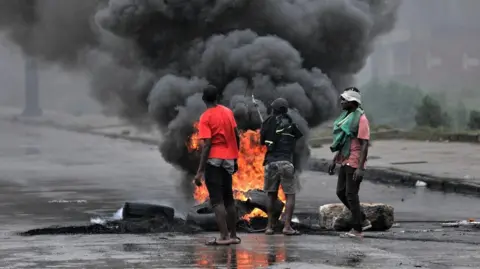
EPA A group of men stand on a road in front of burning tyres - with thick black smoke billowing upwards.EPA

Mozambicans who say the election was stolen have been protesting for months

A “national strike” is being threatened as Mozambique’s president-elect is sworn in on Wednesday, more than three months since disputed elections.

Daniel Chapo, who is 48, took 65% of votes in a poll that opposition leaders, electoral observers and the public at large said was doctored.

The outcome sparked a wave of demonstrations – some peaceful but others violent – leading to chaos, including killings and vandalism.

Chapo’s biggest rival is Venâncio Mondlane. Last week, he returned from self-imposed exile. He spent time in South Africa where he says he survived an assassination attempt.

He is now calling on Mozambicans to take to the streets, once more, on inauguration day “against the thieves of the people”.

Both of Mozambique’s leading opposition parties – Renamo and MDM – say they are boycotting Wednesday’s swearing-in ceremony because they too do not recognise Chapo as the rightful winner.

Even those in Mozambique who do wish the president-elect well openly question his legitimacy.

“Chapo is someone I admire greatly,” civil society activist Mirna Chitsungo tells the BBC.

“I worked with him for four years – I am familiar with his willingness to act, his openness to dialogue, and his readiness to follow recommendations from civil society on the ground.

“However, he is assuming an illegitimate power. This stems from a fraudulent electoral process… He is taking power in a context where the people do not accept him.”

‘He will face many enemies’

In addition to winning over a hostile public, Chapo will also have to deliver the economic turnaround and halt to corruption that he promised on the campaign trail.

“Chapo will face many enemies because it looks like Mozambique is run by cartels, including cartels of books, cartel of medicines, cartel of sugar, cartel of drugs, cartel of kidnappings, mafia groups,” says analyst and investigative journalist Luis Nhanchote.

“He needs to have a strong team of experts, willing to join him in this crusade of dismantling the groups meticulously,” he adds.

“But first, he has to calm down Mozambicans and do all in his power to restore peace in the country.”

Daniel Francisco Chapo was born on 6 January 1977 in a place called Inhaminga, Sofala province, the sixth of 10 siblings. These were the years of Mozambique’s civil war, and the armed conflict forced his family to move to another nearby district.

His secondary schooling in the coastal city of Beira was followed by a law degree from Eduardo Mondlane University then a master’s degree in development management from the Catholic University of Mozambique.

Now married to Gueta Sulemane Chapo, with whom he has three children, Chapo is also said to be a churchgoing Christian and enthusiast of basketball and football.

Many current and former colleagues describe Chapo as humble, hardworking and a patient leader.

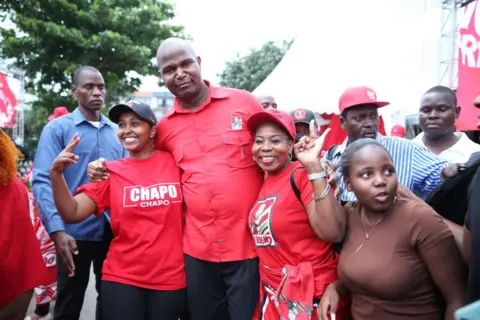
AFP Daniel Chapo celebrates his victory with supporters in Maputo in December. They are wearing red, the colour of his Frelimo party. Two woman put their arms around the politician and make the 'peace' sign with their hands.AFP

With Daniel Chapo (centre) Frelimo extends its 50-year run as the only party to have governed Mozambique since independence

Ahead of becoming the ruling Frelimo party’s presidential candidate he had been a radio and television host, a legal notary, university lecturer and provincial governor before rising to the post of general secretary in Frelimo.

Speaking at his recent birthday celebrations, Chapo himself acknowledged the daunting challenge awaiting him as president.

“We must recover our country economically… it’s easy to destroy, but building is not an easy task.”

National reconciliation, creating more jobs, reforming electoral law and decentralising power are top of his agenda, he said.

But how successful can he be without the country behind him?

At the very least he will mark a change from outgoing President Felipe Nyusi, whom Ms Chitsungo says many Mozambicans will be happy to see the back of.

“Chapo is a figure of dialogue and consensus, not one to perpetuate Nyusi’s violent governance style. He has the potential to negotiate with Mondlane.

“While Chapo may not fully satisfy all of Mondlane’s demands, I believe he could meet at least 50% of them,” adds Ms Chitsungo.

Mondlane – a part-time pastor and independent candidate who insists he was the true winner of the polls – is reported to be sheltering in one of the capital city’s hotels. It is not known what security protection he has there, nor who is paying for it.

He alleges that last week while touring a market in Maputo a vendor in his vicinity was shot, echoing the murder of two of his close aides in October.

As the mastermind of nationwide protests against the disputed election result, he has come to be seen by many as a voice for the voiceless. Yet, at present, the president-elect’s camp is not engaging him publicly.

Nonetheless, listening to the public’s grievances and demands, and sometimes ignoring the commands of his ruling Frelimo party, will be key to Chapo’s success, analysts have told the BBC.

Finding some way of engaging constructively with Mondlane would undoubtedly provide a boost, it seems.

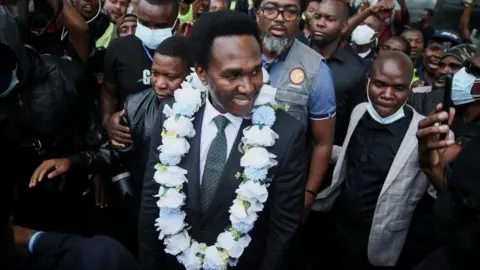
Reuters Venancio Mondlane comes outside the terminal building at the Maputo International Airport wearing a white garland around his next and surrounded by journalists and supporters.Reuters

Venâncio Mondlane is the biggest thorn in the president-elect’s side

Winning the public over may also require Chapo to say no to “fat salaries for the elite and fringe benefits, some of which are 10 times higher than Mozambique’s minimum wage”, argues Mr Nhachote.

Plus, if Chapo is to have any chance at bringing an end to the broader political crisis, he will require support from others to make lasting, structural change, argues prominent clergymen Rev Anastacio Chembeze.

“Perhaps we should remain sceptical of one single person to solve the challenges of Mozambique – change must start within the system itself.

“We should strive for a separation of powers within the state apparatus, the international monopolies have huge interests in the country, and we have serious ethical issues within the political elites to address it.”

Once in the office Chapo is advised to sack the country’s Police Chief Bernadino Rafael, analysts have told the BBC. He denies any wrongdoing but is regarded by some as the mastermind of the brutal response to the post-election protests.

They say they want him replaced with a successor who “respects human rights” and follows legal and international standards. Another suggestion analysts have touted is for a new attorney-general to be brought in.

Notably, Chapo will be the first president of Mozambique who did not fight in the independence war.

“He is part of the new generation. Part of his background is completely different from his predecessors – he was born in a country liberated by them,” says Mr Nhachote.

“If he wants to make a real mark on history, he has to challenge those past icons. If he can’t [manage that], I am sure that he will only run for one term.”

You may also be interested in:

Getty Images/BBC A woman looking at her mobile phone and the graphic BBC News AfricaGetty Images/BBC


What We Know About the Proposed Gaza Cease-Fire Agreement

0
What We Know About the Proposed Gaza Cease-Fire Agreement


After more than 15 months of nearly uninterrupted fighting in Gaza, diplomats trying to broker a cease-fire between Israel and Hamas expressed cautious hope on Tuesday that a deal could finally be within reach.

But that optimism was tempered — by the uncertainty of whether both sides would ultimately agree, by what details could still change and by the experience of months past in which cease-fire talks repeatedly collapsed.

“We believe that we are at the final stages, but until we have an announcement — there will be no announcement,” Majed al-Ansari, the foreign ministry spokesman for one of the mediating countries, Qatar, told reporters on Tuesday.

Here’s what we know about the potential cease-fire agreement.

The U.S. secretary of state, Antony J. Blinken, said on Tuesday that Israel and Hamas were “right on the brink” of agreeing to a deal to pause the fighting in Gaza and release hostages held there in exchange for Palestinians held in Israeli jails.

He and diplomats from other mediating countries, including Qatar and Egypt, have for months failed to reach a breakthrough in talks, but they have made progress quickly in recent weeks.

Mediators “managed to minimize a lot of the disagreements between both parties,” Mr. al-Ansari said, adding that they were focused on “the final details of reaching an agreement.”

“On Sunday, the United States, Qatar and Egypt put forward a final proposal,” Mr. Blinken said. “The ball is now in Hamas’ court.”

Officials in both the Israeli government and Hamas have suggested that they are ready to move forward if the other side signs off.

On Monday, a Hamas official said a deal was possible in the coming days as long as Israel did not suddenly change its positions. On Tuesday, an Israeli official said Israel was ready to close the deal and was waiting for Hamas to make a decision.

Hamas officials negotiating in Qatar must obtain the consent of the group’s remaining military commanders in Gaza for the deal. Those commanders include Mohammad Sinwar, whose brother led the group before being killed by Israel in September. Because of their need to to keep their locations secret, communicating with them can be difficult, causing delays.

It was still not clear whether Mr. Sinwar had conveyed his position toward the cease-fire proposal to Hamas leaders in Qatar.

Given the sensitive, continuing negotiations, officials have been wary of describing the proposed agreement except in broad terms.

The framework of the deal was heavily inspired by previous proposals discussed in May and July, said one diplomat familiar with the talks, speaking on condition of anonymity to discuss the volatile negotiations. Those proposals detailed a three-stage cease-fire in which Israeli troops would gradually withdraw from Gaza, as Hamas released hostages in exchange for Palestinians jailed by Israel.

Israeli officials hope to secure the release of at least some of the approximately 100 hostages who have been held in Gaza since the Hamas-led attack on southern Israel in October 2023 that started the war. About 35 of the remaining hostages are presumed dead by the Israeli authorities.

Hamas leaders want to end Israel’s military campaign, secure the entry of materials for reconstruction and gain the freedom of Palestinian prisoners held in Israel.

During the first phase of the proposed cease-fire — which would last roughly six weeks — Hamas would release 33 named hostages, most of whom Israel believes are alive, said an Israeli official, who requested anonymity to discuss the sensitive talks. Israel is willing to release hundreds of Palestinian prisoners in exchange, the official said, but the number depends on how many of the hostages are still alive.

Some officials have suggested that the change in U.S. administrations, set to take place on Jan. 20, put pressure on Israel and Hamas to accelerate their decision-making after months of delay.

The incoming U.S. president, Donald J. Trump, has warned that there will be “all hell to pay” unless the hostages are freed by the time he becomes president. Steve Witkoff, his pick for Middle East envoy, has also made trips to Qatar and Israel.

The talks have also gained momentum since Israel reached a separate cease-fire agreement with the Lebanese militant group Hezbollah, which began firing rockets into Israel immediately after the Hamas-led attack of October 2023. Battered badly by its escalating conflict with Israel, Hezbollah agreed to a cease-fire with Israel in November, a deal that helped isolate Hamas.


Biden Will Remove Cuba From List of State Sponsors of Terrorism

0
Biden Will Remove Cuba From List of State Sponsors of Terrorism


President Biden will remove Cuba from a list of state sponsors of terrorism, U.S. officials announced on Tuesday, as a part of a deal that is expected to free protesters jailed during a sweeping 2021 crackdown by the Communist government.

The decision by Mr. Biden is the latest in a number of environmental, immigration and foreign policy decisions taken in the final days of his presidency before President-elect Donald J. Trump returns to the White House. Removing Cuba would typically raise expectations of normalized relations between Washington and Havana.

But Mr. Biden’s decision is only the latest in a series of conflicting U.S. approaches to Cuba by different administrations. The Obama administration made the decision to remove Cuba from the list. But days before Mr. Trump left office in 2021, his administration placed Cuba back on it.

Mr. Biden’s move could help Cuba’s battered economy. Major banks had stopped doing business with Cuba because it was too much trouble to make sure that the country satisfied all the requirements to legally do business there.

It is unclear if Mr. Trump will reverse Mr. Biden’s decision.

The U.S. officials, speaking on the condition of anonymity to preview Mr. Biden’s action, said the United States was removing Cuba from the list as part of an effort, pushed by the Catholic Church, to free jailed protesters.

They were detained after the government imposed a brutal crackdown following one of the largest demonstrations in Cuba since the Communist government took power roughly six decades ago by protesters angry over the nation’s spiraling economic decline.

Human rights groups say some of those arrested during and after the protests have been tortured and that many have been sentenced to long prison terms after unfair trials.

Many experts have long criticized Cuba’s inclusion on the list of state sponsors of terrorism.

“The statute that creates the terrorism list specifies giving material support to terrorists or harboring terrorists who are actively engaged in terrorism while you are harboring them,” said William LeoGrande, a Cuba expert at American University. “Cuba just hasn’t done those things.”

Several U.S. fugitives do reside in Cuba, but they should not count because they were Americans, were involved in politically motivated violence in the United States, and were not international terrorists, Mr. Leogrande said.


Dozens of Bodies Recovered From Illegal Mine in South Africa

0
Dozens of Bodies Recovered From Illegal Mine in South Africa


The South African authorities said on Tuesday that they had pulled dozens of dead miners from a shuttered gold mine where they were working illegally until a blockade during which the police at one point cut off access to food, water and other supplies.

As of Tuesday evening, the police reported recovering 51 bodies and extracting 106 miners who were still alive. The death toll could rise as the government continues the delicate operation, which began on Monday, to get all the miners out.

The authorities moved in after a monthslong standoff that drew criticism from human rights groups but praise from some South Africans, who view illegal miners as dangerous criminals.

It was unclear on Tuesday how many miners remained underground, but activists and the authorities estimated that there could be hundreds.

The blockade of the mine, near Stilfontein, a town about two hours south of Johannesburg, was part of a national campaign to root out illegal miners, who are known locally as Zama Zamas.

In an effort to force the miners near Stilfontein above ground, officers last year began cutting off their supplies by guarding every known access point to the mine and pulling up or severing ropes used to ferry goods underground, images distributed by the police showed.

The recovery operation began this week in the wake of a court challenge filed by a civil society group and amid reports of horrendous conditions in the mine, which is more than a mile deep.

Cellphone video of conditions underground released by an advocacy group, Mining Affected Communities United in Action, showed dozens of dead bodies wrapped in plastic and the bony, emaciated frames of miners who were still alive. The video was taken last week by one of the miners, the organization said.

“Brutal,” said Meshack Mbangula, an activist with the mining group. “Ruthless toward the Zama Zamas and community.”

As the mining industry shrank in South Africa and mine owners began to abandon unprofitable sites, Zama Zamas started digging through what remained, without legal permits.

The miners have drawn heavy criticism from some South Africans, who accuse them of perpetuating criminal networks of illicit metals trading and fueling crime in the areas where they operate. There is also ill will because many of them are undocumented immigrants.

The South African authorities said they believed that the miners near Stilfontein were choosing to stay underground to avoid arrest, a contention disputed by human rights organizations, which said some of the routes out of the mine had been cut off.

“We are not sending help to criminals,” a minister in the president’s office, Khumbudzo Ntshavheni, said at a news conference last year. “We are going to smoke them out. Criminals are not to be helped; they are to be persecuted.”

The controversy surrounding Stilfontein taps into deeper questions about wealth inequality in South Africa and the exploitative history of the mining industry.

Mines were the beating heart of the economy during apartheid, with the Black majority relegated to menial, low-paying labor while white-owned and foreign entities reaped immense profits. Today, that imbalance largely persists. Some Black-owned companies have broken into the industry, but the wealth has generally remained in the hands of a relatively small elite.


Ukraine launches largest air attacks on Russia since start of war | Russia-Ukraine war News

0
Ukraine launches largest air attacks on Russia since start of war | Russia-Ukraine war News


The Russian military says the attacks will not go unanswered and launches more projectiles towards Ukraine.

Ukraine’s military has claimed its largest air attacks yet on Russian territory since the start of the war nearly three years ago as Donald Trump prepares to take the presidency in the United States.

The Russian Defence Ministry on Tuesday said it will retaliate for the large-scale missile and drone attacks overnight, and accused Ukraine of again using missiles supplied by the US and the United Kingdom.

The Russian military said most of the projectiles were shot down, with attacks targeting multiple cities and industrial sites.

The Russian cities of Saratov and Engels were reportedly hit, with some damage caused to factories in the area. Some schools were forced to switch to remote learning while several airports were forced to temporarily halt air traffic.

Ukrainian forces had attacked the same region last week as well, claiming to have struck an oil depot serving an airbase for Russian bomber planes. The attack caused a large fire that had only been put out a day before the latest strikes.

Ukraine’s military said Tuesday that it also hit points in Bryansk, Tula and Tatarstan, with a chemical factory that makes rocket fuel and ammunition for Russia’s army among the targets.

Ukraine first started using US-made ATACMS ballistic missiles and British Storm Shadow projectiles to strike targets inside Russia in late November last year.

Russia, which has said it wants talks but will not back away from its demands on Ukraine, has warned that the move could significantly increase tensions. Moscow also launched a new intermediate-range hypersonic ballistic missile known as Oreshnik at Ukraine that it said was ready to use again.

A day before the latest Ukrainian strikes on Russia, NATO chief Mark Rutte said Ukraine is currently not strong enough to “negotiate from a position of strength”, something the incoming US president said he wants to see.

Trump said that he would solve the war before taking office while he was campaigning for re-election. He has stopped saying that after his election, and his Ukraine envoy has discussed a 100-day timeframe, former US diplomat William Courtney said.

“I think any specific prediction is kind of risky because no one can fully know how these things will turn out, but President-elect Trump now seems to be more supportive of Ukraine than he was prior to the election,” the adjunct senior fellow at the Rand Corporation told Al Jazeera.

Courtney said that with its latest attacks on Russia, Ukraine may be trying to show Trump that “it has some fight left in it, that it can carry the fight to Russia and have serious military effect”.

Meanwhile, Russia continues to push deep inside eastern Ukraine while Kyiv persists with its military offensive inside the Russian territory of Kursk, where this week it captured the first North Korean soldiers fighting for Moscow alive.


Gaza ceasefire: What can we expect?

0
Gaza ceasefire: What can we expect?


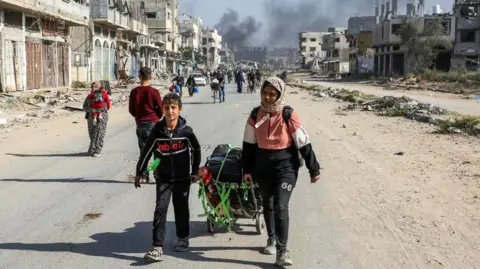
Reuters Displaced Palestinians walk along road in Gaza (file photo)
Reuters

Almost all Gaza’s population has been displaced by the war

Israel and Hamas are thought to be close to agreeing a deal which could halt the war in Gaza and see the release of Israeli hostages and Palestinian prisoners.

The BBC’s US partner CBS has been told by Arab, US and Israeli officials that an agreement has been reached in principle and, if all goes well, will be finalised by Israel and Hamas this week.

It would be the most dramatic breakthrough in 15 months of war, which began when the armed Palestinian group Hamas attacked Israel in October 2023.

What could be in a ceasefire deal between Israel and Hamas?

It is hoped that a ceasefire deal will mean an agreement to stop the war which has been raging in Gaza.

It is also expected to see an exchange of hostages and prisoners.

Hamas seized 251 hostages when it attacked Israel in October 2023. It is still holding 94 captive, although Israel believes that only 60 are still alive.

Israel is expected to release about 1,000 Palestinian prisoners, some jailed for years, in return for the hostages.

How would the ceasefire work?

This ceasefire is expected to happen in three stages, once a deal is announced.

Details are still being ironed out. Until an agreement is finalised, it is subject to change.

First stage

A Palestinian official told the BBC that in the first stage, 34 hostages – expected to be civilians – would be exchanged for Palestinian prisoners.

Three hostages would be released straight away, with the rest of the exchange taking place over six weeks.

During this stage, Israeli troops would also begin pulling out of populated areas in Gaza.

The Palestinian official said detailed negotiations for the second and third stages would begin on the 16th day of the ceasefire.

Second stage

In the second stage, the remaining hostages – soldiers and reservists – would be released, in return for a number of Palestinian prisoners.

Of the 1,000 Palestinian prisoners Israel is thought to have agreed to release, about 190 are serving sentences of 15 years or more. An Israeli official told the BBC that those convicted of murder would not be released into the occupied West Bank.

During this stage, Israel would also allow displaced people now in the south of Gaza to return to the north.

Almost all of Gaza’s 2.3m population have had to leave their homes because of the fighting.

Third stage

The third and final stage would involve the reconstruction of Gaza – something which could take years.

The Israeli official said Israeli forces would remain in a buffer, or security, zone inside Gaza during any ceasefire.

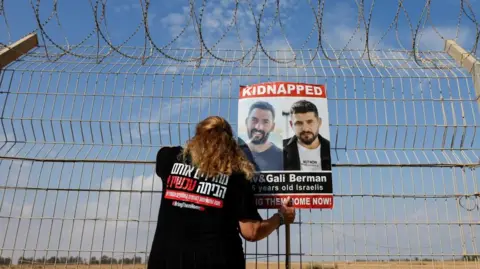
Reuters Israeli woman holds poster of Israeli hostages while looking through fence towards Gaza (file photo)Reuters

Hamas is still holding dozens of hostages, seized in its attack on Israel in October 2023

What are the unanswered questions about the deal?

Getting to this point has taken months of painstaking indirect negotiations, not least because Israel and Hamas completely distrust each other.

Hamas wanted a complete end to the war before it would release the hostages, something which was unacceptable to Israel.

The ceasefire will in effect pause the war while its terms are carried out.

However, it is unclear whether it will mean the war is over for good.

One of Israel’s key war aims has been to destroy Hamas’s military and governing capabilities. Although Israel has severely damaged it, Hamas still has some capacity to operate and regroup.

It is also unclear which hostages are alive or dead or whether Hamas knows the whereabouts of all those who remain unaccounted for.

For its part, Hamas has demanded the release of some prisoners which Israel says it will not free. This is believed to include those who were involved in the 7 October attacks.

It is also not known whether Israel will agree to pull out of the buffer zone by a certain date, or whether its presence there will be open-ended.

Any ceasefire is likely to be fragile.

Ceasefires between Israel and Hamas which have halted previous wars have been shaken by skirmishes and eventually broken down.

The timetable and complexity of this ceasefire means even a small incident could turn into a major threat.

What happened on 7 October 2023 and what has happened in Gaza?

Hundreds of Hamas-led gunmen launched an unprecedented attack on southern Israel, bursting through the border fence and targeting communities, police stations and army bases.

About 1,200 people were killed and more than 250 hostages were taken back to Gaza. Hamas also fired thousands of rockets into Israel.

Israel responded with a massive military campaign, first by air and then a ground invasion. Since then, Israel has attacked targets across Gaza by land, sea and air, while Hamas has attacked Israel with rockets.

Israel’s offensive has devastated Gaza and led to severe food shortages, with aid struggling to reach those most in need. More than 46,600 people – the majority of them civilians – have been killed by Israel’s attacks, according to Gaza’s Hamas-run health ministry.


Saudi Arabia and Sports Network DAZN Close to Deal

0
Saudi Arabia and Sports Network DAZN Close to Deal


Saudi Arabia, long on the lookout for a global platform to showcase its sporting ambitions, is nearing the end of its search.

The Gulf kingdom is close to acquiring up to a 10 percent stake in DAZN, a sports-only network that has been privately funded by the billionaire businessman Len Blavatnik, according to three people familiar with the discussions who spoke on condition of anonymity because no deal has been announced. Saudi has in recent years moved from a standing start to becoming the biggest investor across the sports industry — buying into an array of leagues, teams and stars to upend the economics of many sports.

The deal, which will lead Saudi Arabia, through a unit of its sovereign wealth fund, to spend more than a billion dollars, has been under discussion for at least a year, according to the three people, as the cash-hemorrhaging business and the Saudis forged a closer link.

The network, which is available as a streaming platform and on cable networks worldwide, is already the biggest partner for Saudi Arabia’s growing portfolio of sports properties, including its soccer league, tennis championships and top-tier boxing events.

Sports has been a key area for Saudi Arabia ever since its de facto leader, Crown Prince Mohammed bin Salman, announced plans in 2016 to pivot the country away from its reliance on oil by diversifying its economy amid simultaneous efforts to liberalize the conservative Muslim nation.

Those efforts have resulted in billions of dollars being poured into sports, providing opportunities for businesses like DAZN, which is poised to break even after years of losses that total more than $5 billion. As part of its investment, Saudi Arabia will get a partner with a large footprint across multiple continents. It will not only provide a platform for live sports and other sports-based programming, but also act as a billboard for Saudi Arabia. The wealth fund; Surj Sports Investment, the vehicle being used for the purchase; and DAZN declined to comment.

One of the plans, according to the people familiar with the discussions, is for DAZN, which is largely a subscription service, to broadcast content from Saudi Arabia for free. Such a move would follow DAZN’s announcement last month that it would broadcast FIFA’s Club World Cup for free next summer.

An investor like Saudi Arabia is unlike most market participants, said Gill Hind, director of TV at Enders Analysis, a research firm focusing on the media, entertainment and telecoms sectors. For the kingdom, financial success matters less than the increased visibility for the sports properties it owns, including its top soccer league.

“It’s a very different proposition for the Saudis,” Mr. Hind said. “They’re doing it for different reasons than would be typical for other investors.”

The Saudi Arabian investment into DAZN follows months of speculation. Late last year, the investment fund denied that it wanted to own a stake in the broadcaster.

The billionaire businessman Len Blavatnik has been privately funding DAZN.Credit…Rick Maiman/Bloomberg News

DAZN recently announced that it was paying about $1 billion to broadcast a new World Cup for clubs owned by soccer’s governing body, FIFA. Several other networks either declined to bid or offered multiples less than DAZN for the event, which will take place in the United States this summer. Saudi Arabia has cultivated a close relationship with FIFA and, in particular, its president, Gianni Infantino. Shortly after DAZN’s deal was announced, Saudi Arabia was awarded the rights to host FIFA men’s World Cup in 2034.

Saudi officials have also been involved in talks for years about acquiring a stake in Qatar’s BeIN Media Group, owner of another of the world’s largest sports networks. Those talks have taken place against the backdrop of an ongoing legal battle between Saudi Arabia and Qatar, which is seeking billions of dollars in damages after accusing the larger Gulf kingdom of orchestrating a yearslong piracy campaign against the network.

“BeIn Media Group is considering a number of strategic options,” the company said in a statement, echoing comments it first made in 2022. The dispute first flared during a vicious disagreement between Qatar and its regional neighbors in 2017, dragging on despite a normalization of relations with Saudi Arabia.

DAZN, based in London, is owned by the Moscow-raised Mr. Blavatnick. A citizen of both the United States and Britain, he has spent years accumulating sports rights but has also incurred mammoth financial losses during the process. DAZN’s most recent set of accounts is listed as overdue, according to Companies House, Britain’s companies registry.

Those losses haven’t stopped the company from spending. In addition to being one of the top rights holders in markets where it operates, it has also been acquiring other businesses. In December it bought Foxtel in Australia from Rupert Murdoch’s News Corp. in a deal worth about $2.1 billion.