


Biden will be remembered as the American president who oversaw the genocide of Gaza, says Omar H. Rahman.
Biden will be remembered for genocide in Gaza | #AJOPINION

Ukraine strikes Russia overnight, claiming largest attack of war so far

Ukraine struck several targets deep inside Russia on Tuesday in what it says is its “most massive” attack of the war so far.
Ammunition deports and chemical plants were hit across several regions, some of which were hundreds of kilometres from the border, according to the General Staff of Ukraine’s Armed Forces.
Sources in Ukraine’s SBU intelligence agency told the BBC the overnight attack was a “painful blow” to Russia’s ability to wage war.
Russia said it had shot down US-supplied Atacms missiles as well as UK-made Storm Shadow cruise missiles, and vowed to respond to the attack.
At least nine airports in central and western Russia temporarily halted traffic, while the strikes prompted schools in the southwestern Saratov region to close.
Strikes in the border region of Bryansk caused explosions at a refinery, ammunition depots and a chemical plant said to produce gunpowder and explosives, a Ukrainian security source told the BBC.
But Kyiv also struck far deeper into the country, with the General Staff claiming to have hit targets up to 1,100km (700 miles) from the border.
In the western region of Saratov, officials reported a “massive” drone attack.
Two industrial plants in the cities of Engels and Saratov were damaged, regional governor Roman V. Busargin wrote on Telegram.
Students were taught online on Tuesday after local schools were closed.
Last week, Kyiv said it had struck an oil storage facility in Engels – prompting a days-long effort to tackle the blaze and Busgarin to declare a state of emergency.
Officials in the western region of Tula also reported an overnight attack, where regional governor Dmitry V. Milyaev Russian said air defences had shot down 16 drones.
There were no casualties, he said, although falling debris had damaged some cars and buildings.
Elsewhere, a gas storage site near Kazan was struck in a drone attack in the southwestern region of Tatarstan, local officials said, without reporting any casualties.
Moscow also launched dozens of drones across Ukraine overnight, with multiple air raid alerts in and around Kyiv.
Ukraine’s Air Force said it had shot down around 60 of the 80 drones involved in the attack, which caused no casualties.
Ukraine is trying to push back, however it can, against Russian military advances on the ground, with a week to go until President-elect Donald Trump’s inauguration.
Trump has said he is preparing to meet Vladimir Putin upon his return to the White House.
He has expressed scepticism about US military and financial support for Kyiv, and promised to prioritise negotiating an end to the war.
He has not made clear how he plans to do that.
In a First, the E.P.A. Warns of ‘Forever Chemicals’ in Fertilizer

For the first time, the Environmental Protection Agency has warned that “forever chemicals” present in sewage sludge that is used as fertilizer can pose human health risks, saying in a study on Tuesday that, in some cases, the risks could exceed the agency’s safety thresholds “sometimes by several orders of magnitude.” The agency maintained, however, that the general food supply was not at risk.
A growing body of research has shown that the sludge can be contaminated with manmade chemicals known as per- and polyfluoroalkyl substances, or PFAS, which are used widely in everyday items like nonstick cookware and stain-resistant carpets. The chemicals, which are linked to a range of illnesses including an increased risk of cancer, do not break down in the environment, and, when tainted sludge is used as fertilizer on farmland, it can contaminate the soil, groundwater, crops and livestock.
Last year, The New York Times reported that 3M, which for decades has manufactured PFAS, found as early as 2000 that the chemicals were turning up in sludge samples from municipal wastewater plants across the country. In 2003, 3M told E.P.A. of its findings.
The E.P.A. has for decades encouraged the use of sludge from treated wastewater as inexpensive fertilizer with no limits on how much PFAS it can contain. But the agency’s new draft risk assessment sets a potential new course. If finalized, it could mark what could be the first step toward regulating PFAS in the sludge used as fertilizer, which the industry calls biosolids. The agency currently regulates certain heavy metals and pathogens in sewage sludge used as fertilizer, but not PFAS.
The Biden administration has tackled PFAS contamination elsewhere, setting limits on PFAS in drinking water for the first time and designating two kinds of PFAS as hazardous under the nation’s Superfund cleanup law. Those rules came after the agency said in 2023 that there is no safe level of exposure to those two PFAS.
The new E.P.A. assessment “provides important information to help inform future actions by federal and state agencies,” as well as sewage treatment plants and farmers, “to protect people from PFAS exposure,” Jane Nishida, the E.P.A. acting administrator, said in a statement.
It’s unclear what further steps the incoming Trump administration might take. President-elect Trump has been hostile to regulations; however, he spoke on the campaign trail of “getting dangerous chemicals out of our environment,” and concerns about PFAS contamination in fertilizer have reached some deeply red states.
The E.P.A.’s risk study comes as farmers across the country have been discovering PFAS on their land.
In Maine, the first and only state that is systematically testing its farmland for PFAS, dozens of dairy farms have been found to be contaminated. In Texas, a group of ranchers sued the provider of sludge fertilizer last year after a neighboring farm used the fertilizer on its fields. County investigators found several types of PFAS in the ranchers’ soil, water, crops and livestock, and the ranchers have since sued the E.P.A., accusing the agency of failing to regulate PFAS in biosolids. In Michigan, state officials shut down a farm where tests found particularly high concentrations in the soil and in cattle that grazed on the land.
The E.P.A. said its analysis did not suggest the general food supply was at risk. Sewage sludge is applied to less than 1 percent of the fertilized acreage of agricultural land a year, it said, a number that roughly aligns with industry data. And, not all farms where sewage fertilizer was used would present a risk.
Still, studies have found that, because PFAS is so persistent in the environment, tainted sludge applied years or even decades ago can continue to be a source of contamination. More than 2 million dry tons were used on 4.6 million acres of farmland in 2018, according to the biosolids industry. Farmers have obtained permits to use sewage sludge on nearly 70 million acres, or about a fifth of all U.S. agricultural land, the industry said.
The E.P.A. hasn’t changed its policy of promoting sludge fertilizer, which has benefits along with the risks. It is rich in nutrients, and spreading it on fields cuts down on the need to incinerate it or put it in landfills, which would have other environmental costs. Using sludge fertilizer also reduces the use of synthetic fertilizers that are based on fossil fuels.
The agency said in its new assessment that at farms that used contaminated sludge, the highest human risks involved drinking milk from pasture-raised cows raised on a contaminated farm, from drinking contaminated water, from eating eggs from pasture-raised hens or beef from cattle raised on contaminated land, or from eating fish from lakes and ponds contaminated with runoff.
Particularly at risk were households that live near or relied on products from a contaminated source, for example milk or beef from a family farm contaminated with PFAS from sewage sludge, the agency said. It said in certain conditions, risks exceeded the E.P.A.’s acceptable thresholds by several orders of magnitude.
The general public, which is more likely to buy milk from a grocery store that sources its produce from many farms, was at less risk, the agency said. For its assessment, the E.P.A. focused on the two most commonly detected types of forever chemicals, called PFOA and PFOS, though many others exist.
The Food and Drug Administration does not set limits on PFAS levels in food. Since 2019, however, the agency has tested nearly 1,300 samples and said the vast majority were free of the types of PFAS the agency is able to test for.
Some public health experts and advocacy groups have questioned the testing methodology, and the agency itself says that “PFAS exposure from food is an emerging area of science and there remains much we do not yet know.” Last year, Consumer Reports said it had detected PFAS in some milk, including organic brands. Packaging is another source of PFAS in food.
The National Association of Clean Water Agencies, which represents wastewater treatment plants across the country, said the findings reinforced that sludge fertilizer was not a risk to the public food supply. Sludge providers have argued that they should not be held responsible for PFAS contamination, saying the chemicals are simply passed onto them.
“Ultimately, the manufacturers of these chemicals must bear the responsibility and cost to remove these chemicals” from their products and environment, said Adam Krantz, the group’s chief executive.
In the absence of federal action, states have started to take their own measures. Maine banned the use of sewage sludge on agricultural fields in 2022 and remains the only state to have done so. In December, a Texas lawmaker introduced a bill that would place limits on levels of certain kinds of PFAS in sewage sludge applied to farmland. Oklahoma lawmakers have also introduced a bill that would place a moratorium on the use of sludge on farmland.
An outright ban on the use of sludge as fertilizer would bring its own problems. Wastewater sludge still needs somewhere to go. Since Maine’s ban, some wastewater treatment plants say they have been forced to ship sewage sludge out of state.
Environmental experts say what’s important is limiting the amount of PFAS that ends up in wastewater and sewage in the first place. That could come from phasing out the use of PFAS in everyday products, or requiring manufacturers to treat polluted wastewater before sending it to municipal wastewater treatment plants.
Lebanon’s PM-designate Nawaf Salam promises to ‘rescue, reform and rebuild’ | Israel attacks Lebanon News

Salam says he is reaching out across the political spectrum in nod to Hezbollah, which opposed his nomination.
Lebanon’s prime minister-designate, Nawaf Salam, has pledged to “rescue, reform and rebuild” the crisis-hit country, and he has extended an olive branch to Hezbollah, which did not back his nomination.
In his first speech in the role on Tuesday, Salam said he was reaching out across the political spectrum after winning the backing of more than half of Lebanon’s parliamentarians.
“My hands are extended to all to set off together on this mission,” said Salam, who was serving as president of the International Court of Justice before his designation as prime minister.
“I am not of those who exclude but those who unite,” he said, calling for a “new chapter” in Lebanon.
The newly elected president, Joseph Aoun, asked him to form a new government on Monday.
Salam’s nomination highlights the weakened position of Iran-backed Hezbollah after a devastating war with Israel and the toppling of its ally Bashar al-Assad in Syria last month.
Hezbollah had supported caretaker Prime Minister Najib Mikati to remain in office.
Salam said he would “extend the authority of the Lebanese state across all its territory” and “work seriously to completely implement UN Resolution 1701”, which calls for Hezbollah to withdraw from southern Lebanon.
Referring to Israel, Salam said he would work to “impose the complete withdrawal of the enemy from the last occupied inch of our land”.
In a country grappling with its worst financial crisis since 2019, he pledged to work towards forming a government that could “build a modern and productive economy”.
In religiously diverse Lebanon, nominating a premier does not guarantee a new government will be formed imminently.
The process has previously taken weeks or even months due to deep political divisions and horse-trading.
But Salam’s designation as prime minister is viewed with hope by some after the 14-month Israel-Hezbollah war, which killed 4,000 people and injured more than 16,000. A United States-brokered, 60-day truce came into effect in November.
Six bodies pulled up as rescue continues


 EPA
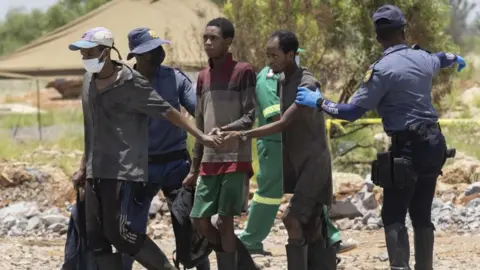
EPASix more bodies have been pulled up from a South African mine as efforts continue for a second day to help scores of illegal miners still thought to be at least 2km (1.2 miles) underground, a national umbrella body for NGOs, Sanco, has told the BBC.
Eight people came out alive on Tuesday adding to the 26 rescued on Monday after they were hoisted up the disused mine shaft in a cage operated by a crane at the surface. Nine bodies were recovered on Monday.
The men have been underground since police operations targeting illicit mining started last year across the country.
Last week a court ordered the government to facilitate a rescue operation that had been long-delayed.
This story contains a video that some people may find distressing.
Last year, arguing that the miners had entered the shaft in Stilfontein deliberately without permission, the authorities took a hard line, blocking food and water supplies.
In November, one government minister said: “We are going to smoke them out.”
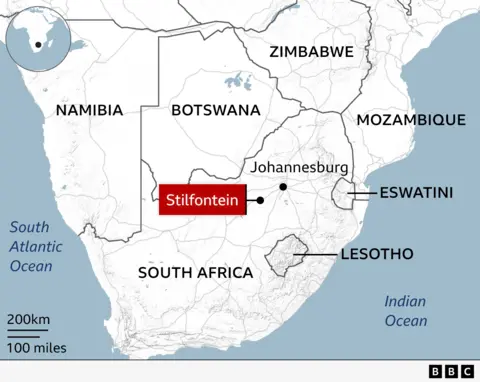
More than 100 of the illegal miners, known locally as “zama zamas”, have reportedly died underground since the crackdown began at the mine some 145km (90 miles) south-west of Johannesburg.
The authorities however, have not confirmed this figure as it is yet to be “verified by an official source”, a spokesperson told the BBC.
On Monday disturbing videos emerged showing the dire situation at the disused gold mine.
In one of the films, which the BBC has not independently verified, corpses wrapped in makeshift body bags can be seen. A second shows the emaciated figures of some miners who are still alive.
Hundreds are thought to be still in the mine while more than 1,000 have surfaced in the past few months.
In one of the videos released by a trade union, the General Industries Workers of South Africa (Giwusa), dozens of shirtless men can be seen sitting on a dirty floor. Their faces have been blurred. A male voice off camera can be heard saying that the men are hungry and need help.
“We’re starting to show you the bodies of those who died underground,” he says.
“And this is not all of them… Do you see how people are struggling? Please we need help.”
In the other video, a man says: “This is hunger; people are dying because of hunger.” He then puts the death toll at 96 and begs for help, food and supplies.
The union says the footage was filmed on Saturday.
In a briefing held on Monday near the site of the rescue operation, Giwusa leadership, alongside community figures, said the videos shared “painted a very dire picture” of the situation underground.
“What has transpired here has to be called what it is; this is a Stilfontein massacre. Because what this footage does is show a pile of human bodies, of miners that died needlessly,” Giwusa president Mametlwe Sebei said.
He blamed the authorities for what he described as a “treacherous policy” that was deliberately pursued.
The department of mineral resources, leading the rescue effort, told the BBC that Monday’s operation included lowering down a cage that is then hoisted up once loaded with people.
This structure is designed to hold six or seven people, depending on their weight, according to Giwusa. It has been going down the shaft every hour.
More South Africa stories from the BBC:
 Getty Images/BBC
Israel and Hamas Are Said to Be Nearing Agreement on Cease-Fire Deal

Israel and Hamas are engaging in another round of talks in Qatar on Tuesday as they near an agreement for a cease-fire in Gaza and the release of hostages, according to a diplomat and a Palestinian in touch with Hamas leaders.
The new talks were a sign that the negotiations, mediated by Qatar, Egypt and the United States, were making progress after months of failed attempts to achieve a breakthrough.
If Hamas and Israel conclude a deal, it would bring some respite to Palestinians in Gaza, who have endured miserable conditions in displacement camps and relentless bombardments by Israel, and for the families of hostages abducted from Israel, who have worried for more than a year about the fate of their loved ones.
The diplomat said the talks would focus on addressing outstanding issues, while the Palestinian said they would center on details of how to implement an agreement.
Both the diplomat and the Palestinian spoke on condition of anonymity to discuss sensitive diplomacy.
Past rounds of talks have seen hopes rise only to be dashed days later, with Israel and Hamas each blaming the other for the impasse.
The emerging agreement, the diplomat said, was heavily inspired by previous proposals discussed in May and July.
How Mexico Cracked Down on Its Immigration Chief to Defuse a US Migrant Crisis

The Americans were not happy.
The migrant situation at the border was out of control, they said, and Mexico was not doing enough to stop it, according to officials from both countries.
In fact, the crisis was worse than Mexican officials had been led to believe by their own immigration chief, Francisco Garduño Yáñez.
The revelation in October 2023 led Mexico’s defense secretary at the time to fly into a rage at an emergency meeting, officials with knowledge of the encounter said.
“You fooled me,” the defense secretary, Luis Cresencio Sandoval González, yelled at Mr. Garduño, according to two people familiar with the incident.
The defense secretary regularly briefed Mexico’s then-president, Andrés Manuel López Obrador. But, Mr. Sandoval had learned days earlier from the Americans that the migrant crisis was more dire than he realized.
“You hid information from me, making me lie to the president,” the defense secretary lashed out.
It was a tense chapter in U.S.-Mexico relations, according to five Mexican and American officials privy to bilateral talks on migration, and Mr. Garduño, 76, had landed in the middle of it. Beyond being accused of mismanaging and minimizing the migrant crisis, he is separately facing criminal charges in connection with a fire at a migration detention center that killed 40 people in 2023.
Now, as Mexico stands on the precipice of what are expected to be contentious border discussions with the incoming Trump administration, the same Mexican official blamed for mismanaging the migrant crisis, Mr. Garduño, will be a pivotal player in those negotiations. The American president-elect has vowed to begin mass deportations of undocumented immigrants as soon as he takes office.
The Defense Ministry, Mr. Garduño and the agency he led, the National Migration Institute, did not respond to several requests for comment.
Controlling the Mexico-U.S. border is a sprawling endeavor, involving thousands of government agents from both countries. The issue is often used as a political cudgel. U.S. House Republicans accused the Biden administration of failing to control the border and voted to impeach his homeland security secretary, Alejandro Mayorkas.
In Mexico, Mr. Garduño was the one in the cross hairs.
A former director of Mexico’s prison system, he has been criticized for relying on troops to help manage migrant flows. Mr. Garduño’s agency has also been accused of essentially waving migrants through to the northern border for bribes. In interviews, migrants said they had to pay Mexican migration agents to travel through the country to reach the United States.
In 2022, the British Embassy also commissioned a classified report on Mexico’s migration system, a copy of which was obtained by The New York Times. It found systemic corruption in the government’s handling of migrants, including extortion, sexual abuse and collusion with criminal organizations to kidnap migrants for ransom.
In a 2022 interview, Mr. Garduño defended his performance, saying he had fired nearly half of the agency’s employees for extorting migrants. His agency had issued documents to nearly two million migrants from 2018 to 2022, he said, helping to regularize their presence in the country.
It is “a humanitarian policy of integration and brotherhood,” he said.
But interviews with officials from both countries have laid bare the discontent of American officials with how Mexico was handling migration.
In 2023, President Biden’s popularity was slipping ahead of the 2024 elections. Migration was a top concern among American voters. So the president dispatched Secretary of State Antony J. Blinken and Mr. Mayorkas for an emergency meeting in Mexico City that October.
They told Mr. López Obrador that American border agents had encountered nearly 220,000 migrants at the southern U.S. border that September — one of the largest flows ever recorded, officials with knowledge of the meeting said.
Border patrol agents were overwhelmed. The freight trains from Mexico to the United States had no security. Corrupt conductors, the Americans said, were stopping or slowing the trains to allow migrants to hop on.
They asked Mexican officials to move more aggressively to break up large groups of migrants heading to the U.S. border and to end visa-free travel for countries whose nationals used Mexico to enter America illegally, officials said.
The reality that the American delegation revealed was grimmer than the one presented by Mr. Garduño’s agency, which gave daily briefings to the Mexican administration on the number of migrants intercepted in southern Mexico.
Three officials working on migration and were privy to those figures said the numbers rarely correlated with the data presented by the U.S. Customs and Border Protection and the government of Panama, which many migrants pass through to reach Mexico.
The Mexican military reported that it and the migration agency encountered five million migrants from 2018 to 2024, but Mexico’s Interior Ministry reported about half that number in that time. The 2023 numbers varied widely as well; the migration agency reported nearly 1.5 million encounters that year, whereas the Interior Ministry reported about 500,000.
“Mexico’s government is blurring the picture by issuing two widely divergent numbers, without even explaining the divergence,” said Adam Isacson, a director at the Washington Office on Latin America, a research institute. “It’s confusing, it undermines the government’s credibility, and it makes it harder to anticipate emerging trends.”
After the U.S. delegation returned to Washington, Mr. López Obrador called the emergency meeting of Mexico’s most senior security and migration officials on Oct. 13, 2023. It was held in Tapachula, a city on the border with Guatemala and a funnel for migrants entering Mexico.
The city’s refugee agency was about to collapse, with about 7,000 migrants a day flooding its offices to register as asylum seekers — a fast track to receiving a migrant permit.
The permits were sort of a golden ticket: They allow asylum seekers to study, work and get access to basic services. Though asylum seekers are supposed to stay in the state where they apply, many use the Mexican permits to navigate to the U.S. border without being detained, officials say.
At the emergency meeting, the interior secretary at the time, Luisa María Alcalde Luján, zeroed in on the permits, officials said.
She grilled Mr. Garduño about whether his agency was handing out the permits but allowing asylum seekers to head north toward the U.S. border, according to four officials with knowledge of the meeting, two in attendance.
Yes, Mr. Garduño replied.
As Ms. Alcalde berated him, Mr. Garduño looked down at his lap and fell silent, officials with knowledge of the encounter said.
She then announced to the room that she was stripping Mr. Garduño of the ability to hand out new migration permits without the approval of other government branches.
Ms. Alcalde did not respond to requests for comment.
As soon as the migrant permits stopped, thousands of asylum seekers in Mexico were plunged into legal limbo.
The move made them “easier prey for criminal groups,” said Dana Graber Ladek, the Mexico chief of mission for the International Organization for Migration. It left “migrants with basically no option to be able to work legally in the country,” she added.
Eventually, Mexico restarted issuing the migration permits, but today they are a trickle of what they once were: Only about 3,500 permits were issued last year, compared with nearly 130,000 in 2023.
After the meeting, Mr. Garduño quickly moved to demonstrate that his agency was capable of controlling migrant flows, officials said.
His agents made it harder for migrants to reach the U.S. border and stepped up security on the trains many used to travel north. The number of migrants encountered at the U.S.-Mexican border dropped from September to November by nearly 13 percent, according to November 2023 statistics from the U.S. Customs and Border Protection.
But just as the numbers trended down, a leak prompted high-level officials to call another emergency migration meeting in Mexico.
The Mexican treasury secretary temporarily stopped funding parts of the government in November 2023, including Mr. Garduño’s agency, because of budgetary constraints. But instead of lobbying the treasury to release funds, as other officials did, Mr. Garduño proactively halted his agency’s operations.
On Dec. 1, he sent a memo ordering his agency to pause deportation flights that carry undocumented migrants, withdraw personnel from checkpoints and shut down the busing program that had relieved pressure on the northern border.
The memo was swiftly leaked and went public.
Migrants rushed to the U.S. border, many unhindered by Mexican migration agents. That December, U.S. Customs and Border Protection registered the highest number of migrant encounters on the border in history: nearly 250,000 migrants.
Overwhelmed American border patrol agents shut land border crossings in Lukeville, Ariz., and San Diego. The U.S. border protection agency suspended several railway crossings in Texas.
Mexico’s government, trying to contain the fallout, publicly pledged more funds to its migration agency. Mr. Blinken flew back to Mexico City, on Dec. 27 — with an even larger delegation.
The next month, January 2024, after Mexico and the United States cooperated to enforce stricter measures, the migrant flow at the U.S. border was cut in half.
The pressure from Washington has continued to work; unlawful border crossings have declined. Last June, Mr. Biden issued an executive order to essentially block undocumented migrants from receiving asylum at the border.
Mexico has deployed National Guard troops to immigration checkpoints and bused migrants farther south, exhausting their efforts to head north. The authorities have also broken up migrant caravans so they no longer reach the U.S. border.
In October, Claudia Sheinbaum was sworn in as president of Mexico. She named a new immigration chief, but said Mr. Garduño would continue to advise the government to create a “profound transformation” of its migration agency and to help weather the storm after Mr. Trump takes office Jan. 20.
Mr. Garduño still faces criminal proceedings over the migration center fire. Several Mexican and American officials said they thought he would resign after the tragedy. But he has been a confidante of Mr. López Obrador for decades.
Mr. Garduño is not under arrest, but every two weeks, he must check in with the prosecuting judge.
Emiliano Rodríguez Mega and Paulina Villegas contributed reporting.
The British Public Dislikes Elon Musk. He Can Still Sway Politics.

While many of Mr. Musk’s posts, particularly those on grooming gangs, originated in the ecosystem of far-right bloggers and activists, they are also tempting to mainstream politicians in search of a cudgel to use against their opponents. And they appeal to editors and broadcasters looking for a good story.
“The British press and the broadcasters, to a degree, fell all over themselves to give Elon Musk publicity,” said David Yelland, a former editor of Rupert Murdoch’s tabloid, The Sun. “In the print press, they did it because they are extremely hostile to Keir Starmer. This is plain old Fleet Street bias.”
Claire Enders, a London-based media researcher and founder of Enders Analysis, likened Mr. Musk to Mr. Murdoch, the insurgent media baron from Australia who upended the London newspaper industry in the 1970s. “We just have a new Murdoch,” she said. “He’s American, he’s a multibillionaire, and he’s close to Trump.”
Mr. Musk, however, is not interested in taking over the British press so much as discrediting it. He claims the news media was complicit in a coverup of abuses against young girls. The truth is, British newspapers across the political spectrum did cover these crimes, if not immediately, then energetically, as the scale of the abuses became apparent in the late 2000s and early 2010s. The Times of London published a major investigation of the scandal, and the slow response to it by the police, in 2011.
“It’s been on the front page of every paper and led the 6 o’clock news for years,” said Raheem Kassam, who covered the scandal as editor of the British outpost of the right-wing news outlet, Breitbart News. “The idea that there is a media blackout on this, and we needed Elon Musk to uncover it, is nonsense.”
Young people mark Coming of Age Day in Japan | Arts and Culture News

Japan’s Coming of Age Day is a sure sign of winter, arriving after New Year celebrations and before the cherry blossom parties of early spring.
The national holiday is held on the second Monday of January. People turn out to admire the elaborate outfits young people don to celebrate the transition from childhood to adulthood. Although the age of adulthood has been lowered from 20 to 18, many of the participants are still 20 years old.
The men usually wear sober black suits, but the women are resplendent in kimonos woven in lustrous patterns — often of flowers — and a bright array of colours, many with elaborately constructed hairdos and fancy handbags.
Throngs of young people milled about on Monday on the streets of Yokohama, a city that forms part of Greater Tokyo. The women wore fur muffs to keep off the chill. There were many wide smiles and self-conscious poses, selfies, and hugs.
Judge clears way for Trump election interference report

President-elect Donald Trump would have been convicted of illegally trying to overturn the result of the 2020 presidential election – which he lost – if he had not successfully been re-elected in 2024, according to a Department of Justice report released to Congress.
“The admissible evidence was sufficient to obtain and sustain a conviction at trial,” the report by Special Counsel Jack Smith said.
Smith is “deranged” and his findings are “fake”, Trump said after the report was released.
Trump was accused of pressurising officials to reverse the 2020 result, knowingly spreading lies about election fraud and seeking to exploit the riot at the US Capitol on 6 January 2021. He denied any wrongdoing.
Trump, who was president at the time of the alleged crimes, subsequently spent four years out of office – but was successfully re-elected to the White House in November. He will return to the presidency next week.
After his success in the 2024 vote, the various legal issues that he had been battling have largely evaporated.
Although Jack Smith – the special counsel who investigated him in this and one other case – has resigned from his post ahead of Trump’s return, the path was cleared by a judge for the first part of his report to be released.
The 137-page document was sent to Congress after midnight on Tuesday.
The judge, Aileen Cannon, ordered a hearing later in the week on whether to release the second part of the report – which focuses on separate allegations that Trump illegally kept classified government documents at his home in Florida.
Posting on his Truth Social website, Trump maintained his innocence, taunting Smith by writing that the prosecutor “was unable to get his case tried before the election, which I won in a landslide”.
Trump added: “THE VOTERS HAVE SPOKEN!!!”
Smith was appointed in 2022 to oversee the US government investigations into Trump. Special counsels are chosen by the Department of Justice (DoJ) in cases where there is a potential conflict of interest.
In the interference case, Trump was accused of conspiring to overturn the result of the 2020 election, which he lost to Joe Biden.
These are detailed by Smith in his report, which accuses Trump of “unprecedented efforts to unlawfully retain power” through a variety of methods, including “threats and encouragement of violence against his perceived opponents”.
Both this case and the separate classified documents case resulted in criminal charges against Trump, who pleaded not guilty and sought to cast the prosecutions as politically motivated.
But Smith closed the cases after Trump’s election in November, in accordance with DoJ regulations that forbid the prosecution of a sitting president.
The report explains: “It has long been the department’s interpretation that the [US] Constitution forbids the federal indictment and prosecution of a sitting president, but the election results raised for the first time the question of the lawful course when a private citizen who has already been indicted is then elected president.”
But the document goes on to say: “But for Mr Trump’s election [in 2024] and imminent return to the presidency, the office assessed that the admissible evidence was sufficient to obtain and sustain a conviction at trial.”
There has been a legal back-and-forth over the material related to the cases.
Last week, Judge Cannon put a temporary stop on releasing the whole Smith report, over concerns that it could affect the cases of two Trump associates charged with him in the classified documents case.
Walt Nauta, Trump’s personal aide, and Carlos De Oliveira, the property manager at Mar-a-Lago, are accused of helping Trump hide the documents.
Unlike Trump’s, their cases are still pending – and their lawyers argued that the release of Smith’s report could prejudice a future jury and trial.
