Thursday, October 1, 2026
Home Blog Page 6942

Biden Will Deliver Final Foreign Policy Speech on Monday

0
Biden Will Deliver Final Foreign Policy Speech on Monday


President Biden kicks off his final week in office on Monday with a robust defense of his foreign policy, arguing in a speech to be delivered in the afternoon that America has become stronger on his watch.

With just seven days left until he hands over the White House to President-elect Donald J. Trump, Mr. Biden hopes to use his remaining time to frame his historical legacy as a transformational leader who bolstered the United States at home and abroad even in just one term.

The effort gets underway at 2 p.m. on Monday with a speech at the State Department focused on what he sees as his successes in the international arena. He plans to say that he strengthened U.S. alliances both in Europe in the face of Russian aggression as well as in the Asian-Pacific amid the rise of China. At the same time, he plans to argue that America’s adversaries — particularly Russia, China and Iran — are all weaker than when he came to office.

“He’s going to ask the question: is America stronger than we were four years ago? And he’s going to answer the question with a definitive yes,” Jake Sullivan, his national security adviser, said in a preview on “State of the Union” on CNN on Sunday. “Our alliances are stronger, as I said before. Our enemies and competitors are weaker. We kept the nation out of war. Every element of American power is stronger today.”

The speech will be the first this week aimed at presenting the best case for Mr. Biden’s presidency as it comes to an end. He will deliver a broader televised farewell address to the nation in prime time on Wednesday evening, much as many presidents have done. He will also deliver speeches this week on his conservation record and at a farewell ceremony for the commander in chief at Joint Base Myers-Henderson Hall.

On foreign policy, Mr. Biden has presided over a tumultuous time and Mr. Trump blamed him for the wars in Ukraine and Gaza, although no U.S. troops are directly involved on the ground in either place. Some critics said the perception of a world aflame and spinning out of Mr. Biden’s control contributed to the erosion of his political popularity at home and ultimately his withdrawal from the election under pressure.

“The fact that Biden is handing the presidency back to his predecessor is in part a reflection of his foreign policy shortcomings,” said Peter Rough, director of the Center on Europe and Eurasia at the Hudson Institute and a former aide to President George W. Bush.

“For most of his time in office, Biden has been on the defensive, first in Ukraine and then in Gaza,” Mr. Rough continued. “The president’s 1990s-era liberal internationalism may have been well intentioned, but it always felt out of step to me with the power politics of the 2020s.”

Still, a new Gallup poll released on Monday showed that America’s standing in Europe has improved strikingly under Mr. Biden. Of 30 NATO allies surveyed, approval of U.S. leadership rose in all but four since 2020, Mr. Trump’s last year in office. Approval ratings rose by double digits in 20 of the 30 countries. In Germany, for instance, approval of U.S. leadership rose from just 6 percent under Mr. Trump to 52 percent under Mr. Biden.

In pulling U.S. troops out of Afghanistan and extricating America from a the longest war in its history, Mr. Biden finally accomplished what his two predecessors wanted to but did not. But the chaotic nature of the withdrawal did considerable damage to both his and the country’s standing in the world.

Mr. Biden rallied much of the world to stand up to Russia’s unprovoked full-scale invasion of Ukraine and reinvigorated NATO after ties frayed under Mr. Trump, even admitting two new members, Sweden and Finland. He steered tens of billions of dollars worth of American arms to Ukraine that helped thwart Moscow’s attempt to take over the country.

But Mr. Biden was criticized from two different directions; some complained he was too reticent to deliver more powerful weapons for fear of escalating with a nuclear superpower, while others complained that he was investing too much American treasure in someone else’s war. And after its initial stunning success, Ukraine’s defense has stalled and Mr. Trump is now promising to end the war with what are expected to be concessions to President Vladimir V. Putin of Russia.

The war in Gaza that followed the Hamas terrorist attack on Israel on Oct. 7, 2023, was the other dominating crisis of Mr. Biden’s tenure. He stood staunchly by Israel and provided weapons for its all-out assault on Hamas, but eventually grew frustrated with Prime Minister Benjamin Netanyahu of Israel who rebuffed American pressure to do more to curb civilian casualties and relieve humanitarian suffering.

Even now, in his final days, Mr. Biden is straining to seal an elusive cease-fire agreement that would end the fighting and result in the release of Israeli hostages held in Gaza, including a few with American citizenship. Mr. Sullivan said Sunday that U.S. negotiators were “very, very close” to a deal, but it was not clear it could be finalized by next Monday when Mr. Trump takes over.

As with Ukraine, Mr. Biden faced criticism from both directions. From one side, he was accused of not doing more to stop the killing of civilians and called “Genocide Joe” at protests. From the other side, he was faulted for putting pressure on Israel to restrain itself in the face of an existential terrorist threat.


Iran releases dual German national as it attends talks with European powers | Politics News

0
Iran releases dual German national as it attends talks with European powers | Politics News


Tehran and the E3 countries of France, Germany and the UK hold consultations on Iran’s nuclear programme and other issues.

Tehran, Iran – Iran has released a dual German national as its diplomats held more consultations with European counterparts on sanctions and how to manage ramped-up tensions.

Iranian-German rights activist Nahid Taghavi was released from prison in Iran and is back in Germany, according to her daughter Mariam Claren, who posted a picture of herself and her mother on X on Monday.

The Iranian judiciary and the Foreign Ministry did not immediately comment on her release.

The 70-year-old was arrested in Iran’s capital, Tehran, in October 2020 and sentenced to 10 years in prison after being convicted of forming a group “with the purpose of disrupting national security” and “spreading propaganda against the establishment”.

Amnesty International described Taghavi as a “prisoner of conscience” and detention as “arbitrary”, saying she spent a long time in solitary confinement despite health conditions and several short medical leaves.

Reacting to the news on Monday, German Foreign Minister Annalena Baerbock said it is a “great moment of joy that Nahid Taghavi can finally embrace her family again”.

Her release comes in a week filled with developments on prisoners involving Iran and the West.

Both Switzerland and France summoned Iranian envoys to protest their nationals being in prison, a day after Iran reported the “suicide” of a Swiss national in a jail in Semnan, some 180km (112 miles) east of Tehran.

Italian journalist Cecilia Sala was released by Iran last week after spending three weeks in detention in Tehran’s Evin prison. Italian Prime Minister Giorgia Meloni personally visited United States President-elect Donald Trump at his Mar-a-Lago residence in Florida to negotiate a resolution.

The 29-year-old writer and podcaster was arrested for “violating the laws of the Islamic Republic” after entering Iran on a regular journalist visa.

Her arrest came three days after Italy detained Iranian national Mohammad Abedini at the behest of the US, which accuses him and another Iranian national of transferring drone technology to Iran.

That technology, Washington alleges, was linked with a drone attack on a US military base in Jordan last year that killed three American soldiers.

Abedini arrived in Tehran on Sunday, officials confirmed, while maintaining that his case was not directly linked with the arrest or release of the Italian journalist.

In mid-December, Iran sentenced Iranian-American journalist Reza Valizadeh to 10 years in prison for “collaborating with the hostile US government”.

Talks in Geneva

Meanwhile, Iran and three major European powers, Germany, France and the United Kingdom, began more diplomatic talks in Geneva, Switzerland on Monday afternoon.

Iranian Foreign Ministry spokesman Esmail Baghaei told reporters earlier in the day that a main focus for Tehran is lifting sanctions.

The meetings cannot be described as amounting to “negotiations” and are rather a continuation of “consultations” held in December, he said. Baghaei added that a “wide range” of topics will be discussed in Geneva, including the nuclear issue.

The first Trump administration imposed sweeping US sanctions on the Iranian economy in the aftermath of its 2018 unilateral withdrawal from Iran’s nuclear deal with world powers, the Joint Comprehensive Plan of Action (JCPOA).

The European Union has also imposed waves of sanctions on Iran amid the war in Ukraine, with the West accusing Iran of arming Russia. Tehran denies being an arms supplier to the war, saying it only sent some drones months before Russia invaded Ukraine in February 2022.

Iran’s bilateral relations with Germany have also been deteriorating, with Taghavi’s release coming months after the death of another imprisoned German-Iranian dual national sparked a diplomatic row between Berlin and Tehran.

At the end of October, Baerbock ordered the closure of all three Iranian consulates in Germany after Iranian state media reported that German-Iranian prisoner Jamshid Sharmahd, who was sentenced to death in 2023 for charges related to “terrorism”, died right before his execution.


Gaza ceasefire hopes rise as pressure grows on Hamas and Israel

0
Gaza ceasefire hopes rise as pressure grows on Hamas and Israel


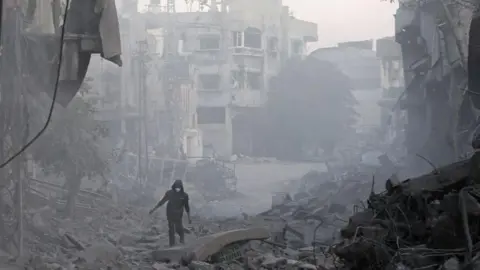
AFP A man walks through the rubble of buildings destroyed in Israeli air strikes at Bureij refugee camp, in central Gaza (12 January 2025)AFP

US President-elect Donald Trump has threatened that “all hell” will break loose if the hostages are not released before he takes office

The outline of the Gaza ceasefire and hostage release deal currently being discussed by Israel and Hamas at indirect talks in Doha has been on the table since May. So why is there fresh anticipation that it could work, after being frozen for eight months of the war?

There are several things that have shifted – both politically and on the ground.

The first is the election of Donald Trump as the next US president.

He has threatened that “all hell” would break loose if the hostages were not released before he took office on 20 January.

Hamas may well read that as a sign that even the flimsy brakes the Biden administration used to try and rein in the Israeli government would be lifted, though it is hard to imagine what that might mean for a territory already so shattered by 15 months of war.

Israel too is feeling the pressure from the incoming president to end the conflict in Gaza, which threatens to interfere with Trump’s hopes to secure a wider regional deal, and his desired image as a president who ends wars.

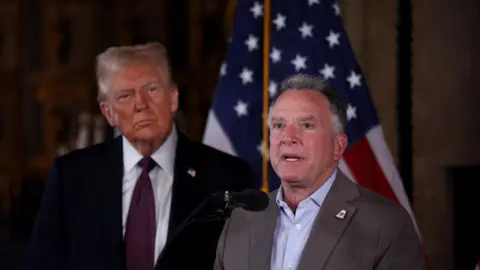
Reuters US President-elect Donald Trump (L) watches as his Middle East envoy Steve Witkoff (R) speaks at a news conference at Mar-a-Lago, Florida, US (7 January 2025)Reuters

Trump’s new Middle East envoy, Steve Witkoff, joined the talks in Doha over the weekend

On the other hand, Israeli Prime Minister Benjamin Netanyahu faces continued pressure from his far-right coalition allies to continue the war.

But Trump could also be an asset for him in persuading his allies to swallow the deal and stay in the government; the new US president and the man he picked as Israeli ambassador are seen as supportive of Israel’s settlements in the occupied West Bank, which Israel’s far-right Finance Minister, Bezalel Smotrich, has said he wants to annex.

But after a meeting with the prime minister last night, Smotrich appeared unconvinced, writing on social media that the current deal was “a catastrophe” for Israel’s national security and that he would not support it.

Some in Israel, though, believe that both Smotrich and his far-right ally, National Security Minister Itamar Ben-Gvir, see their current role in Israel’s government as their best chance to cement control over the West Bank, especially with Trump returning to the White House, and that they are unlikely to follow through with their threats to quit.

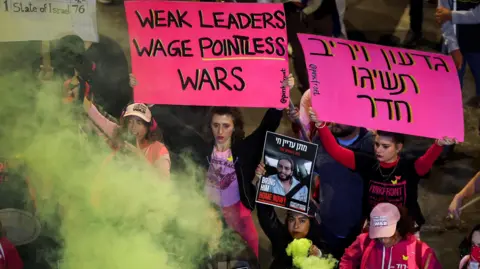
Reuters People protest against the Israeli government's failure to bring home hostages held by Hamas in Gaza, at a demonstration in Tel Aviv, Israel (11 January 2025)Reuters

Hostages’ families protested against the Israeli government’s failure to agree a deal in Tel Aviv on Saturday

The second thing that has shifted is growing pressure on Netanyahu from his own military establishment.

Key figures are widely reported to have challenged him repeatedly on the dwindling military goals in continuing the war, after the killing of the top Hamas leadership, and the decimation of Gaza.

Last week, 10 Israeli soldiers were killed in Gaza, shining a fresh spotlight on the costs of the war to Israel, and on the perennial question of whether the “total victory” over Hamas that Netanyahu has promised is achievable.

Some analysts now suggest that Hamas is rebuilding faster than Israel is defeating it, and therefore Israel needs to reconsider its strategy.

And there’s a third – regional – shift playing into the shift in expectations here too: the weakening and erosion of Hamas allies in Iran’s “Axis of Resistance”, from Hezbollah in Lebanon to Bashar al-Assad in Syria, along with killing of Hamas leader Yahya Sinwar in Gaza.

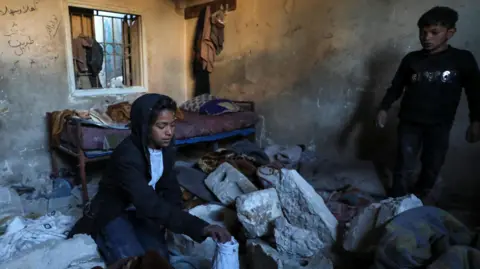
Reuters Palestinians search for their belongings inside a school sheltering displaced people after it was hit by an Israeli strike, in Gaza City, northern Gaza (13 January 2025)Reuters

Palestinians in Gaza, most of whom have been displaced, are desperate for an end to the devastating war

For all these reasons, now is seen as the best chance in months to bridge the gaps between Israel and Hamas and bring an end to the war.

What has not shifted in the eight months since they were last negotiating are the gaps between them.

Key among them is a direct conflict between the key concern of Hamas, which wants to end the war, and that of Israel, which wants to keep the door open to resuming the conflict, whether for political or military reasons.

The deal, as outlined by President Joe Biden in May, is divided into three phases, with a permanent ceasefire only coming into effect in phase two.

Success now will likely depend on whether guarantees can be found to allay Hamas fears that Israel will pull out of the deal after the first phase of hostage releases.

Questions over how to administer territory that Israel pulls back from are also unclear at this stage.

But the web of diplomacy criss-crossing the region over the past week, and the fact that Netanyahu has sent the heads of Israel’s security agencies to the talks in Doha, along with a key political adviser, are encouraging signs.

So too is the departure for Doha of the Palestinian detainee co-ordinator, Qadoura Fares.

The deal is not yet done – and talks have fallen apart before.

This old deal is fuelling fresh hopes partly because negotiations are taking place in a new regional context, with growing pressures both internally and from key allies abroad.


Talks on Gaza Cease-Fire and Hostage Releases: What to Know

0
Talks on Gaza Cease-Fire and Hostage Releases: What to Know


High-level cease-fire talks appeared to be gaining momentum on Monday as Arab and American mediators pressed for an agreement to halt the fighting in Gaza and release hostages held by Hamas before President-elect Donald J. Trump assumes office on Jan. 20.

It was still unclear whether the parties had reached resolution on central disputes that have proved insurmountable in previous rounds of negotiations, but officials briefed on the talks have expressed cautious optimism in recent days about the possibility of concluding a deal.

For months, repeated rounds of talks have seen hopes rise only to be dashed days later, with both Israel and Hamas blaming the other for the impasse.

If a deal is achieved, it would bring some respite to Palestinians in Gaza, who have endured miserable conditions in displacement camps and relentless bombardments by Israel, and the families of hostages taken from Israel, who have suffered for months wondering about the fate of their loved ones.

  • The lead mediators in the talks are Qatar and Egypt, shuttling messages between Israel and Hamas. The Qatari prime minister, Sheikh Mohammed bin Abdulrahman bin Jassim Al-Thani, and the director of Egypt’s General Intelligence Service, Maj. Gen. Hassan Rashad, have been the top officials representing their countries in the negotiations.

  • David Barnea, the chief of Israel’s foreign intelligence service, Mossad, is one of Israel’s main negotiators, alongside Ronen Bar, the head of the Shin Bet, a domestic security service, and Maj. Gen. Nitzan Alon of the Israeli military. Ophir Falk, a foreign policy adviser to Prime Minister Benjamin Netanyahu, has also participated in important meetings related to the negotiations.

  • Khalil al-Hayya, a senior Hamas official based in Doha, is the militant group’s chief negotiator and has interfaced with Qatari and Egyptian officials about the details of a possible agreement.

  • The United States has used its leverage to encourage Israel and Hamas to sign on to a deal. Bill Burns, the C.I.A. director, and Brett McGurk, a senior White House official, have crisscrossed the Middle East, pressing for a breakthrough in the talks. Steve Witkoff, Mr. Trump’s Middle East envoy, has also made trips to Qatar and Israel, meeting with top officials there.

Israeli officials hope to secure the release of at least some of the roughly 100 hostages who have been held in Gaza since the Hamas-led attack on southern Israel on Oct. 7, 2023, that ignited the ensuing war in the territory.

Hamas leaders want to achieve an end to the war in Gaza, which has severely weakened the group’s armed wing and government, led to the displacement of nearly two million people, and reduced cities to rubble. Hamas officials have also said they are seeking a complete Israeli withdrawal from Gaza, the return of displaced people in the south of the enclave to the north, and the entry of materials for reconstruction.

  • A major obstacle to the success of the talks has been the permanency of a cease-fire. While Hamas has demanded a comprehensive end to the war, Mr. Netanyahu has said he wants a “partial” deal that will allow Israel to resume the war after freeing hostages.

  • Israel has been demanding vague language in the text of an agreement that leaves room for a resumption of fighting at some point, according to a Palestinian familiar with the matter and two Israeli officials. Mr. Netanyahu has feared that his right-wing coalition partners could take down his government and jeopardize his political future if he agrees to a deal that ends the war in Gaza, analysts say.

  • Hamas has not suggested it would be willing to compromise on its demand to end the war. Last week, Osama Hamdan, a senior Hamas official, told a gathering in Algeria that there must be “an absolute end to the aggression.”


Why fire hydrants and water supply failed during Los Angeles wildfires | Water News

0
Why fire hydrants and water supply failed during Los Angeles wildfires | Water News


California’s Los Angeles continues to grapple with the wildfires that broke out on January 7. The wildfires, which have killed 24 people, are presenting a range of challenges for authorities and firefighters attempting to extinguish them.

Here is a look at the latest state of the fires, and what is hindering the efforts of firefighters.

What is the current status of the LA wildfires?

The fires have burned 16,300 hectares (40,300 acres) and destroyed more than 12,300 structures, according to the California Department of Forestry and Fire Protection (Cal Fire).

Three fires are still actively burning, according to Cal Fire. The first and largest fire, which is burning in the Pacific Palisades, is at 13 percent containment, Cal Fire says. The Eaton fire, which is affecting Altadena, is 27 percent contained. The Hurst fire is 89 percent contained.

Containment is a term firefighters use to represent how much of a control line has been placed around a fire, which could then allow firefighters – at least in theory – to contain its spread. Containment does not equal safety.

What are the main challenges surrounding the wildfires?

Santa Ana winds and dry conditions have made it difficult for firefighters to extinguish the blaze. Under extreme wind conditions, it is unsafe for helicopters to fly too close to the ground, Joe Ten Eyck, wildfire/urban-interface fire programmes coordinator for the International Association of Fire Fighters, told The Washington Post. Last week, firefighting helicopters had to be temporarily grounded on Tuesday when the winds were particularly strong.

The wildfires have also stoked anxiety about insurance among those California homeowners who have lost their property. A week into the fires, California Insurance Commissioner Ricardo Lara invoked moratorium powers, suspending all policy cancellations and refusals for renewal for one year.

Issues with a low water supply have also proven to be a hindrance in firefighting efforts.

Why did the fire hydrants run dry?

The rescue efforts in Palisades were hindered by low pressure in the water supply at elevated areas.

Los Angeles receives its water supply from 114 tanks in total, all of which were fully filled before the fires. However, the three water tanks in the elevated Palisades were unable to be refilled due to high demand.

On the morning of January 8, Janisse Quinones, the chief executive of the Los Angeles Department of Water and Power, told reporters that water tanks in Palisades had been depleted.

“We pushed the system to the extreme,” she said, adding that “four times the normal demand was seen for 15 hours straight, which lowered our water pressure.”

The fire started in the Pacific Palisades neighbourhood at 10:30am (18:30 GMT) on Tuesday, according to Cal Fire. Two of the one million-gallon tanks, located at an elevation in the Palisades, ran out late on Tuesday.

By 3am (11:00 GMT) on Wednesday, the third tank had also run out, Quinones said. Water reserves were located at a lower elevation, which made it difficult to refill the high-elevation tanks.

Quinones said fire hydrants are built to extinguish fires from one or two houses at once, not hundreds of them.

On the night of January 9, firefighters stopped tapping into fire hydrants at all. On January 10, Democrat California Governor Gavin Newsom called for an independent investigation into the water shortages during the wildfires.

What really happened to the water supply?

Republican President-elect Donald Trump has blamed Newsom for damage caused by the fires.

On January 8, he wrote on his Truth Social platform that Newsom “refused to sign the water restoration declaration put before him that would have allowed millions of gallons of water, from excess rain and snow melt from the North, to flow daily into many parts of California, including the areas that are currently burning in a virtually apocalyptic way”.

The lack of water has also been criticised by others. Los Angeles Fire chief Kristin Crowley said during a local news interview: “When firefighters arrive at a hydrant, they expect water to be available.”

However, others have dismissed Trump’s allegations that California’s water policy is to blame. Instead, the shortages happened because Los Angeles is simply not designed to bear a fire incident as large and intense as the one that is ongoing in Palisades and elsewhere, they said.

Southern California has ample water stored, said Mark Gold, the water scarcity solutions director at the Natural Resources Defense Council and a Southern California Metropolitan Water District board member.

“It doesn’t matter what’s going on at the Bay-Delta or the Colorado [River] or Eastern Sierra right now,” Gold said. “We have all this water in storage right now. The problem is, when you look at something like firefighting, it’s a more localised issue on where your water is. Do you have adequate local storage?”

Large urban fires can cause damage to water pipes, causing them to leak great amounts of water, Andrew Whelton, an engineering professor at Purdue University told The Associated Press news agency.

When are the Santa Ana winds going to stop?

These hot, dry gusts blow from the interior of the region towards the coast and offshore. They dry out vegetation, making it very flammable.

On the night of January 7, gusts up to 100mph (160km/h) were recorded at higher elevations, according to AccuWeather meteorologist Danielle Ehresman.

While the winds slowed down by January 9, they are expected to intensify again until Wednesday evening, with officials warning that the strongest gusts are expected on Tuesday.

A red flag warning is in place until 6pm local time (02:00 GMT) on Wednesday.

Mountainous areas with elevation are expected to experience gusts between 25mph (40km/h) and 40mph (95km/h) in the coming days, and speeds could reach up to 70mph (112km/h).

Several measures are being taken at the federal and local levels to address the crisis. Private companies are also chiming in with solutions.

The Federal Emergency Management Agency (FEMA) authorised the use of federal funds to address the emergency on January 7.

Local hotels are offering discounts to those evacuating due to the wildfires. Ride-hailing applications, LA Metro and telecommunications providers are also offering limited free services to those affected by the fires in the area.

How many firefighters are in LA?

There are about 14,000 firefighters from California and eight other states, alongside Canada and Mexico, on the ground. Additionally, 1,400 fire engines and 84 aircraft have been deployed as part of the wildfire response.

INTERACTIVE-LA fires - Palisades Eaton Hurst Fire Map Jan 13-1736746451

What challenges will Los Angeles face from the wildfires?

Stephen Pyne, emeritus professor at Arizona State University’s School of Life Sciences, said wind is the first challenge to overcome.

“The fires are not over, and they won’t end until the winds die down – not just the Santa Ana winds over and down the mountains, but the local winds that will move in as the Santa Anas retreat,” he told Al Jazeera.

“The knock-on effects will last for years,” Pyne added.

Cleanup after the fire, he said, will be a long and expensive process. He noted that modern houses are filled with toxic plastic and electronics.

What is even more alarming is that California has become more susceptible to fires, and fire season has stretched longer. Newsom said in a video he posted on X on January 8 that there is no longer a fire “season” in California. “It’s year-round in the state of California.”


German-Iranian woman Nahid Taghavi released from prison in Iran

0
German-Iranian woman Nahid Taghavi released from prison in Iran


German-Iranian woman Nahid Taghavi has been released from prison in Iran, her daughter says.

“It’s over. Nahid is free! After more than four years as a political prisoner in the Islamic Republic of Iran my mother… was freed and is back in Germany,” Mariam Claren wrote on X.

Taghavi, 70, was arrested in Tehran in October 2020 and sentenced to 10 years in prison the following August after being convicted of forming a group “with the purpose of disrupting national security” and “spreading propaganda against the system”.

Amnesty International said the charges, which she denied, were apparently related to a social media account about women’s rights and that the trial was grossly unfair.

Responding to a photograph of Taghavi and her daughter embracing at an airport on Sunday, German Foreign Minister Annalena Baerbock wrote: “A great moment of joy that Nahid Taghavi can finally embrace her family again.”

There was no immediate comment from the Iranian judiciary.

Amnesty International said Taghavi’s health deteriorated considerably while she was detained at the notorious Evin prison – in Iran’s capital Tehran – where it said conditions were “cruel and inhuman” and the medical care was “inadequate”.

She spent seven months in solitary confinement between her arrest and conviction, during which time she was forced to sleep on the floor, it said.

Taghavi also suffered from herniated discs, osteoporosis, diabetes and high blood pressure, according to her daughter.

In July 2022, Taghavi was granted urgent medical leave from prison for treatment for back and neck problems. However, she was sent back to Evin four months later.

A fellow inmate at Evin, Nobel Peace Prize winner Narges Mohammadi, warned in June 2023 that Taghavi’s life was “in danger”, saying she was in such severe pain that “she can barely get out of her bed”.

Taghavi was allowed medical leave another two times during 2024.

The first began in January and lasted several weeks but she was recalled to prison before she had completed her medical treatment, the second began at the end of September. During those periods she had to wear an electronic ankle tag and had to remain within 1km (less than a mile) of her home in Tehran.

Amnesty said Taghavi had flown back to Germany on Sunday.

“Words cannot describe our joy,” Taghavi’s daughter said in a separate statement published by the human rights group on Monday.

“At the same time, we mourn the four years that were stolen from us and the horror she had to endure in Evin prison.”

Amnesty called on Iran to release the dozens of other dual nationals, and many other non-violent political prisoners, who it said were being arbitrarily detained.

Taghavi’s release comes months after the death of another imprisoned German-Iranian dual national sparked a diplomatic row between Berlin and Tehran.

At the end of October, Baerbock ordered the closure of all three Iranian consulates in Germany after Iranian state media reported that Jamshid Sharmahd – a US-based dissident who was sentenced to death in 2023 following a trial that rights groups said was unfair – had been executed.

However, the Iranian judiciary’s spokesman claimed days later that Sharmahd had “died before the sentence was carried out”. His family said she did not trust anything said by Iranian authorities and demanded an international investigation.


What an Upended Mideast Means for Trump and U.S. Gulf Allies

0
What an Upended Mideast Means for Trump and U.S. Gulf Allies


When Donald J. Trump was last president of the United States, the wealthy monarchies of the Persian Gulf had a mostly harmonious relationship with his administration. As Mr. Trump prepares to return to the White House, the leaders of those Gulf countries have generally welcomed him back.

But this time around, the Gulf states and Mr. Trump appear to be diverging on several cornerstone issues, like Israel and Iran. Differences over energy policies could also be a source of friction.

It is unlikely that there will be major tensions or ruptures with U.S. allies in the Gulf. But Mr. Trump will be encountering a region that has seen drastic shifts since Israel launched its war on Gaza in response to the Hamas-led attack of Oct. 7, 2023, in which the Israeli authorities say about 1,200 people were killed and about 250 taken hostage.

The war in Gaza, in which at least 45,000 people have been killed, according to health officials in the enclave, has rippled across the region. In Lebanon, the Iran-backed militant group Hezbollah has been battered by more than a year of fighting against Israel. And in Syria, rebels toppled the regime of Bashar al-Assad.

Now, while Mr. Trump is filling his cabinet with Iran hawks and staunch defenders of Israel, Gulf leaders have publicly been urging a softer stance on Iran and a tougher line on Israel.

They have also been calling on the United States to stay engaged with the region.

For now, the Trump administration has appeared eager to engage with the Gulf powerhouses of Saudi Arabia, Qatar and the United Arab Emirates.

In December, Mr. Trump’s pick as his envoy to the Middle East, Steve Witkoff, was in the Emirati capital, Abu Dhabi, where he attended a Bitcoin conference along with Eric Trump, the president-elect’s son. He also went to Riyadh, Saudi Arabia, where he met with Crown Prince Mohammed bin Salman, Axios reported.

Here’s a closer look at the issues facing Mr. Trump as he navigates an evolving relationship with his traditional Gulf allies.

One of the clearest calls in the Gulf for Mr. Trump to avoid an isolationist agenda came from Prince Turki al-Faisal, the former head of Saudi Arabia’s intelligence services.

In an open letter to the U.S. president-elect published in November in The National, an Abu Dhabi-based newspaper, Prince Turki referred to an assassination attempt against Mr. Trump and expressed his belief that “God spared your life” in part so Mr. Trump could continue the work he had started in the Middle East during his first term. That mission was to bring “PEACE, with capital letters,” he wrote.

During his first term, Mr. Trump’s administration brokered the Abraham Accords that saw several Arab countries establishing ties with Israel.

A similar message to Prince Turki’s was delivered a few days later by Anwar Gargash, an adviser to Sheikh Mohammed bin Zayed, the U.A.E. president, at a conference in Abu Dhabi.

With the Gulf surrounded by an increasingly turbulent region, Mr. Gargash said, American leadership and partnership remained essential. “We need robust leadership that balances humanitarian concerns with strategic interests,” he said.

On Israel, the most striking shift in messaging in the Gulf has come from the de facto leader of Saudi Arabia, the crown prince. Speaking at an Arab League summit in Riyadh recently, Prince Mohammed for the first time called the Israeli military campaign in Gaza a “genocide.”

Just before the war in Gaza erupted in October 2023, Saudi Arabia appeared to be on the verge of forging diplomatic relations with Israel without fulfilling its longstanding precondition for doing so — the establishment of a Palestinian state. Such a deal would have reshaped the Middle East.

Under one plan, Saudi Arabia would normalize relations with Israel in exchange for stronger defense ties with the United States and American support for a civilian nuclear program in Saudi Arabia.

But recent statements by Prince Mohammed suggest that any deals are a long way off.

In addition to his statement referring to genocide in Gaza, he has also made it clear that Saudi Arabia will not establish diplomatic relations with Israel until a Palestinian state is created. That is still a distant prospect given strong opposition to such a state within the government of Prime Minister Benjamin Netanyahu of Israel.

“I think that the crown prince wanted to make his position clear and beyond any shadow of a doubt,” said Ali Shihabi, a Saudi businessman who is close to the kingdom’s ruling family.

The United Arab Emirates — a signatory to the Abraham Accords — has also signaled a hardened stance toward Israel.

The U.A.E. foreign minister, Sheikh Abdullah bin Zayed, told his Israeli counterpart last week that the Emirates would “spare no effort supporting Palestinians.”

Despite Saudi Arabia’s public stance on the status of a normalization deal, U.S. diplomats have indicated that the kingdom may be privately open to advancing one under a second Trump presidency — contingent upon a permanent cease-fire in Gaza and a tangible commitment by Israel toward a path to Palestinian statehood.

“All of that is ready to go if the opportunity presents itself with a cease-fire in Gaza as well as understandings on a pathway forward for the Palestinians,” the departing U.S. secretary of state, Antony J. Blinken, said on Wednesday. “So, there’s tremendous opportunity there.”

During Mr. Trump’s first term, both Saudi Arabia and the United Arab Emirates championed his administration’s hawkish stance on Iran, seeing Tehran as a dangerous rival in the region.

They cheered when Mr. Trump withdrew the United States from a nuclear deal with Iran and hailed his decision to authorize the assassination of Qassim Suleimani, the general who directed Iran’s militias and proxy forces around the Middle East, in January 2020.

But the dynamics of the region have changed since Mr. Trump’s first term.

Saudi Arabia and Iran reached an accord in March 2023 that reduced tensions in the Persian Gulf and opened the door to high-level diplomatic contacts.

Bahrain, after years of tension with Iran, has made overtures to the Iranian government, with King Hamad bin Isa al-Khalifa saying there was “no reason to delay” the resumption of diplomatic relations. The tiny island kingdom also condemned Israel’s targeting of Iran last October, when a shadow war between the two countries broke out into the open with tit-for-tat attacks.

For Saudi Arabia, the goal is clear: to create a stable regional environment conducive to Prince Mohammed’s dream of diversifying the oil-dependent Saudi economy. For Iran, decades of economic and political isolation, compounded by rising domestic unrest, have made reconciliation with Riyadh a necessity.

There are also indications that Iran might be open to negotiating with Mr. Trump. Many former officials, pundits and newspaper editorials in Iran have openly called for the government to engage with Mr. Trump.

So far, Mr. Trump, too, appears open at least in charting a different course from the “maximum pressure” campaign of his first term. In November, Elon Musk, a close adviser to Mr. Trump, met with Iran’s ambassador to the United Nations, Iranian officials said.

“We have to make a deal because the consequences are impossible,” Mr. Trump said in September, referring to the threat of Iran’s pursuing nuclear weapons.

While the Gulf Cooperation Council countries — Bahrain, Kuwait, Oman, Qatar, Saudi Arabia and the United Arab Emirates — appear open to Mr. Trump’s transactional approach to diplomacy, they could find themselves at odds with his economic policies.

A central promise of his campaign was to bolster U.S. oil and gas production, a move that could hurt Gulf economies.

If the United States increases oil production, as Mr. Trump has pledged, producers in the Gulf would have less scope to raise output without prompting a price drop.

“Increased U.S. oil exploration and production will lower prices and jeopardize the oil-driven economies of the Gulf,” Bader al-Saif, an associate fellow at the London-based research institute Chatham House, said in a recent report.

Mr. Trump is also expected to accelerate liquefied natural gas projects, reversing President Biden’s freeze on permits and increasing U.S. exports, particularly to Europe.

Qatar, one of the largest producers of the gas alongside the United States, would most likely be most affected, but it has so far played down its concerns.


Russia and Ukraine Battle Inside Kursk, With Waves of Tanks, Drones and North Koreans

0
Russia and Ukraine Battle Inside Kursk, With Waves of Tanks, Drones and North Koreans


Five months after Ukrainian forces swept across the border in the first ground invasion of Russia since World War II, the two armies are engaged in some of the most furious clashes of the war there, fighting over land and leverage in the conflict.

The intensity of the battles recalls some of the worst sieges of eastern Ukraine over the past three years, including in towns like Bakhmut and Avdiivka, names that now evoke memories of mass slaughter for soldiers on both sides.

The fighting, in the Kursk region of Russia, has taken on a layer of significance for the territory’s potential to play a role in any cease-fire negotiations. Facing the prospect of an unpredictable new U.S. president — who has vowed to end the war swiftly, without clarifying the terms — Ukraine hopes to use Russian territory as a bargaining chip.

Russia, relying on North Korean reinforcements, hopes to knock that territory out of Ukraine’s grasp.

“Here, the Russians need to take this territory at any cost, and are pouring all their strength into it, while we are giving everything we have to hold it,” said Sgt. Oleksandr, 46, a leader of a Ukrainian infantry platoon. “We’re holding on, destroying, destroying, destroying — so much that it’s hard to even comprehend.”

He and other soldiers, asking to be identified by only a first name or call sign in accordance with military protocol, said that waves of attacking North Korean infantry had made the battles far more ferocious than before.

“The situation worsened significantly when the North Koreans started arriving,” said Jr. Sgt. Oleksii, 30, a platoon leader. “They are pressuring our fronts en masse, finding weak points and breaking through them.”

Russia, with the help of an estimated 12,000 North Koreans, has retaken about half of the territory it lost over the summer. Its assaults over the past week have further eaten into the territory held by Ukraine.

But Ukrainian forces have also gone on the attack in recent days, seeking to secure an area west of Sudzha, a small town in Russia about six miles from the border that has become the anchor for Ukrainian forces, which seized about 200 square miles in August.

“If they keep pressing us and we don’t push back, the enemy will feel a sense of superiority,” said Andrii, 44, a military intelligence officer. “When someone keeps hitting you, and you don’t hit back, the attacker will feel psychologically comfortable, even relaxed.”

The Russians have largely thwarted the assault, but fighting goes on and the situation remains unpredictable, soldiers said.

The intensity of the battles could be glimpsed on the road approaching the Russian border: A steady stream of tanks, armored personnel carriers and other vehicles rolled past broken down and blown-up equipment.

Russian bombs and rockets exploded with thunderous force in border villages, and Ukrainian missiles could be seen streaking across the sky in the opposite direction.

Tens of thousands of drones hunted targets, too. They have transformed the battlefield, although Ukraine has improved its electronic warfare abilities, limiting the effectiveness of drones that rely on radio signals. Russia has now flooded the theater with drones guided by ultrathin fiber-optic cables, with a flying range of more than 10 miles.

The best current defense against them is a shotgun, Ukrainian soldiers said.

The renewed fighting comes against a deeply uncertain political backdrop. The U.S. president-elect, Donald J. Trump, spent months on the campaign trail questioning American military assistance to Ukraine. He has said he wants to bring the war to a swift end, but has not indicated how.

Russian forces have been on the offensive for more than a year in eastern Ukraine, making steady advances despite staggering losses.

With its incursion, Ukraine aims to create a buffer zone to protect hundreds of thousands of civilians in the city of Sumy, less than 20 miles from the border with Russia. Ukraine also wants to ease pressure on the eastern front by drawing Russians back onto their own land.

President Volodymyr Zelensky said the campaign had sent a powerful message to the world that Ukraine can do more than play defense.

“It’s one of our wins, I think one of the biggest wins, not just last year, but throughout the war,” Mr. Zelensky said on Thursday in Germany, while meeting representatives of nations providing military support to Ukraine.

Still, some military analysts have cautioned that Ukraine’s Kursk campaign could leave its forces increasingly stretched and losing ground in its own eastern Donbas region.

Many soldiers fighting in Kursk believe that the painful losses in eastern Ukraine would have been even worse without their campaign.

“We have to understand the Russians use their most elite soldiers and best reserves in this area,” said Capt. Oleksandr Shyrshyn, 30, a battalion commander in the 47th Mechanized Brigade. “Considering what they could be doing in other parts of Ukraine, it is good.”

He was still bleary-eyed after a battle, a few days earlier, to thwart a large Russian assault.

The Russians attacked Ukrainian positions in six waves, employing more than 50 tanks, armored personnel carriers and other vehicles.

While dozens of enemy soldiers were killed and injured and a large amount of the Russian equipment destroyed, Captain Shyrshyn said, the Russians advanced a couple of miles.

“When the first wave comes, we focus on it, deal with it, and then the next one comes,” he said. There is no time to redirect artillery or other resources as the next wave moves in from a different line of attack.

“We fall behind,” he said. “Then the next wave comes, and one of them manages to reach the required section and accomplish its task.”

It remains difficult, he said, to see how so many in the West view the war in Ukraine like a video game and refuse to see the threat Russia poses to the world.

He acknowledged the decline in Ukrainian morale over nearly three years of war, but said most soldiers still understood why they must fight. “Stopping will mean our death, that’s all,” he said.

North Korea’s entry into the war, some Ukrainian soldiers said, should alarm European nations and their allies.

The North Korean troops have fought as a disciplined, dedicated and fearless force, they said, typically moving in large formations on foot, even through minefields while under heavy artillery fire and being stalked by drones. The Ukrainian authorities on Saturday said that their forces captured two North Korean soldiers and that they were the first to be taken alive so far.

Sgt. Oleksandr, the platoon leader, said the carnage in Kursk was as terrifying as anything he had witnessed since joining the army in 2014.

“You look and can’t fully grasp where you are, seeing every day how many people we destroy,” he said.

He compared it with Bakhmut, when machine gunners had to be regularly replaced because they could not handle the pace of killing. “After two hours of laying down so many people, they couldn’t take it mentally,” he said.

“It’s the same here now,” he said, sharing a cellphone video showing the aftermath of a recent assault. The field was littered with bodies, torn and twisted and piled in ways that made it hard to count the dead.

“The worst is for the infantry,” he said. “When you’re sitting there, and they’re coming at you, and everything is flying at you.”

Anastasia Kuznietsova contributed reporting.


Seoul says 300 North Korean soldiers killed, 2,700 wounded fighting Ukraine | Russia-Ukraine war News

0
Seoul says 300 North Korean soldiers killed, 2,700 wounded fighting Ukraine | Russia-Ukraine war News


Casualties among North Koreans assisting Russia ‘have surpassed 3,000’, according to South Korea’s intelligence agency.

Some 300 North Korean soldiers have been killed while fighting in Russia’s war against Ukraine, a South Korean legislator has said.

Added to the 300 deaths are about “2,700 injuries”, Lee Seong-kweun told reporters on Monday, after a briefing from Seoul’s National Intelligence Service (NIS).

“The deployment of North Korean troops to Russia has reportedly expanded to include the Kursk region, with estimates suggesting that casualties among North Korean forces have surpassed 3,000,” Lee said.

The NIS analysis also revealed that the North Korean soldiers have “a lack of understanding of modern warfare” and are being used by Russia in a manner leading to “the high number of casualties”, the legislator added.

The statement from the South Korean politician comes days after Ukrainian President Volodymyr Zelenskyy said Kyiv had captured two North Korean soldiers, releasing a video of the injured fighters being interrogated.

Zelenskyy said Kyiv is “ready to hand over” the captured North Korean soldiers in exchange for Ukrainian prisoners of war held in Russia.

Seoul has previously claimed North Korean leader Kim Jong Un has sent more than 10,000 soldiers as “cannon fodder” to help Moscow fight Kyiv, in return for Russian technical assistance for Pyongyang’s heavily sanctioned weapons and satellite programmes.

Russia has neither confirmed nor denied their presence.

No desire to defect

The NIS said the two captured soldiers have not expressed a request to defect or resettle in South Korea, according to two legislators who attended Monday’s briefing.

The agency said it was willing to discuss the matter with Ukrainian authorities if the soldiers eventually do ask to go to South Korea.

About 34,000 North Koreans have defected to capitalist rival South Korea to avoid economic hardship and political suppression at home, mostly since the late 1990s.

Koo Byoungsam, spokesperson of South Korea’s Ministry of Unification that handles inter-Korean affairs, said facilitating the asylum of the North Korean soldiers would require “legal reviews, including on international law, and consultations with related nations”.

“There’s nothing we can say at the current stage,” Koo said.

Moreover, the soldiers, reportedly from North Korea’s elite Storm Corps, have been ordered to kill themselves rather than be taken prisoner, Lee said.

“Notably, memos found on deceased soldiers indicate that the North Korean authorities pressured them to commit suicide or self-detonate before capture,” he said.

He added that some of the soldiers had been granted “amnesty” or wanted to join North Korea’s governing Workers’ Party, hoping to improve their lot by fighting.

One North Korean soldier who was about to be captured shouted “General Kim Jong Un” and attempted to detonate a grenade, Lee said, adding that he was shot and killed.


Dalit woman in India alleges rape by 64 men over five years

0
Dalit woman in India alleges rape by 64 men over five years


An 18-year-old Dalit woman from the southern India state of Kerala has accused 64 men of sexually abusing her since she was 13 years old.

Police have arrested 28 people in connection with the case so far – the men are in custody and have not made any public statement.

The accused, who range between 17 and 47 years of age, include the woman’s neighbours, sports coaches and her father’s friends, police told the BBC.

The woman reported the alleged abuse after a team of counsellors working under a government scheme visited her house.

Police have registered about 18 cases under India’s various crime laws as well as the Scheduled Castes and Scheduled Tribes (Prevention of Atrocities) Act – which is a law to prevent crimes against people belonging to lower castes and tribes in India.

Dalits lie at the bottom of the Hindu caste hierarchy and face widespread discrimination in India despite laws to protect them.

Cases have also been registered under the Protection of Children from Sexual Offences Act, since the abuse took place when the woman was a minor, senior police official Nandakumar S told BBC Hindi.

More cases are expected to be registered in the coming days as the police are still investigating the matter. A 25-member team has been set up.

Police say that the alleged abuse began when the girl was 13 years old. Her neighbour allegedly molested her and took sexually explicit photographs of her, the News Minute website reported.

Her neighbour allegedly sexually abused her again when she was 16 years old, recorded videos of the abuse and shared it with several others who continued to assault the woman over many years.

A lawyer who heads the district’s Child Welfare Committee (CWC) told the Indian Express newspaper that the woman was an athlete and attended various sports camps, which could have facilitated further abuse.

Police say that the woman was allegedly gangraped three times in the past five years.

Her alleged abusers reportedly used her father’s phone number to contact her and the woman stored their contacts in the phone. The police are now using the phone to trace the accused.

The woman’s family was reportedly unaware of the alleged abuse.

The matter came to light when a team of counsellors visited the woman’s home last month. The counsellors alerted the CWC about the matter and the woman was asked to appear before the committee along with her mother.

“She was given counselling, and she opened up before a psychologist, narrating the sexual abuse she has been facing since the age of 13,” the CWC chief told the Indian Express.

He added that the woman had been shifted to a shelter associated with the CWC for her protection.

The woman’s allegations have sent shockwaves across the country. She is expected to give a detailed statement about the alleged abuse to a woman police officer.

Additional reporting by Imran Qureshi, BBC Hindi