



Here’s what you need to know.
Biden speaks with Israel’s Netanyahu, urges ‘immediate ceasefire’ in Gaza | Israel-Palestine conflict News

United States President Joe Biden has spoken to Israeli Prime Minister Benjamin Netanyahu about the ongoing talks for a ceasefire in Gaza and stressed the “immediate need” for a truce, as well as the return of Israeli captives held in the Palestinian enclave.
The call on Sunday came as Biden pushes for a deal to stop the fighting before President-elect Donald Trump returns to the White House on January 20.
The negotiations, mediated over the past year by the US, Egypt and Qatar, have repeatedly stalled at moments when they seemed close to a deal. Still, in recent days, US officials have expressed hope of sealing an agreement.
The latest round is taking place in the Qatari capital, Doha, with the head of Israel’s Mossad foreign intelligence agency, David Barnea, as well as Biden’s top Middle East adviser, Brett McGurk, both attending the talks.
Barnea’s presence, confirmed by Netanyahu’s office, means high-level Israeli officials who would need to sign off on any agreement are now involved in the talks.
McGurk has been working on final details of a text to be presented to both sides, Biden’s national security adviser, Jake Sullivan, told CNN’s “State of the Union”. But he said he would not predict whether a deal can be reached by January 20, the day of the inauguration.
“We are very, very close,” he said. “Yet being very close still means we’re far because until you actually get across the finish line, we’re not there.”
The White House said the ongoing talks in Doha are for a deal based on the phased ceasefire that Biden had announced in May of last year, which was later endorsed unanimously by the United Nations Security Council.
Biden “stressed the immediate need for a ceasefire in Gaza and return of the hostages with a surge in humanitarian aid enabled by a stoppage in the fighting under the deal”, the White House said.
For his part, Netanyahu thanked Biden for his lifelong support of Israel, according to the White House readout. The Israeli prime minister has previously signalled that he is committed only to the first phase of the ceasefire agreement, which envisions the release of some captives in exchange for a weeks-long halt in fighting.
Hamas, however, has insisted on a full Israeli troop withdrawal from the largely devastated territory, but Netanyahu remains intent on destroying the group’s ability to fight in Gaza.
Issues in the talks have included which captives would be released in the first part of a phased ceasefire deal, which Palestinian prisoners would be released and the extent of any Israeli troop withdrawal from population centres in Gaza.
Al Jazeera’s Hamdah Salhut, reporting from Jordan, said the Israeli negotiating team in Qatar is expected to stay in the country for at least another day “in order to hammer out final details for a potential deal”.
She noted that the Israelis and Hamas have traded blame for the delay in reaching a deal, while there is disagreement among Netanyahu’s coalition about a ceasefire.
“Members of the far-right have said they would vote against it and Netanyahu has even spoken to members of the far-right, including Finance Minister Bezalel Smotrich to try to warm them up to the idea of a deal,” she said. “There is a school of thought in Israel that Netanyahu has prolonged the war and not agreed to a deal because he fears it could result in the collapse of his government. But nonetheless, these talks are still ongoing as mediators are scrambling to get a deal.”
The talks come as Israel continues its relentless bombardment of the Gaza Strip, particularly the north of the enclave, which has been subject to a brutal siege for more than 100 days. Medical sources in Gaza say 5,000 people have been killed or are missing due to the ongoing attacks.
Israel’s campaign in Gaza has killed more than 46,000 Palestinians, the majority women and children, and displaced more than 90 percent of the territory’s population from their homes. The brutal war, which some UN experts describe as “genocide”, began in the aftermath of the Hamas-led attack on Israel on October 7, 2023, in which Palestinian fighters killed 1,200 people and took some 250 others captive.
Just one brief ceasefire has been achieved in 15 months of war, in the earliest weeks of fighting.
LA fires death toll rises to 24 as high winds expected

Weather forecasters in California are warning fierce winds which fuelled the infernos around Los Angeles are expected to pick up again this week, as fire crews on the ground race to make progress controlling three wildfires.
Officials warned that after a weekend of relatively calm winds, the notoriously dry Santa Ana winds would pick up again from Sunday night until Wednesday, reaching speeds of up to 60mph (96km/h).
Ahead of the wind’s uptick, some progress has been made in stopping the spread of the deadly Palisades and Eaton fires, which are burning on opposite ends of the city. Local firefighters are being assisted by crews from eight other states, as well as Canada and Mexico, who continue to arrive.
The LA County medical examiner updated the death toll on Sunday to 24, while officials said earlier at least another 16 remain missing.
Sixteen of the dead were found in the Eaton fire zone, while eight were found in the Palisades area.
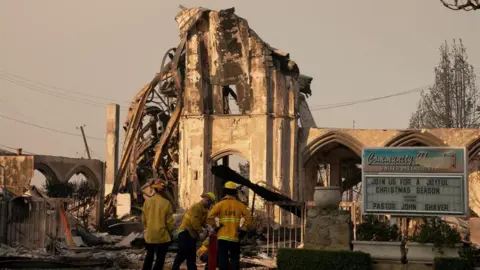
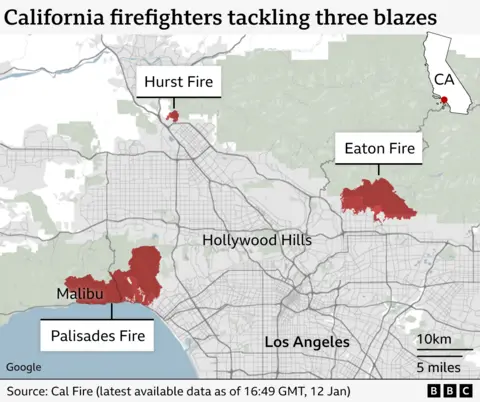
Three conflagrations continue to burn around Los Angeles.
The largest fire is the Palisades, which has now burnt through more than 23,000 acres and is 13% contained.
The Eaton fire is the second biggest and has burnt through more than 14,000 acres. It is 27% contained.
The Hurst fire has grown to 799 acres and has been almost fully contained.
The wildfires are on track to be among the costliest in US history.
On Sunday, private forecaster Accuweather increased its preliminary estimate of financial losses from the blazes to between $250bn-$275bn.
While crews have managed to start containing the largest fires, authorities have warned the incoming wind event could lead to “potential disastrous wind conditions”, with the whole of LA County put under fire threat.
“Unfortunately, we’re going right back into red flag conditions with some potential disastrous wind conditions between now and Wednesday, with the peak winds expected to be on Tuesday,” Pasadena fire chief Chad Augustin told the BBC.
“While we’re making some progress, the end is not even close yet,” he said.
The National Weather Service has issued a rare ‘particularly dangerous situation’ alert for Tuesday, warning of “extreme fire behaviour” – running from 04:00 local time, until midday on Wednesday.
Kristin Crowley, the fire chief for the city of LA, called for residents near evacuation zones to be prepared to flee if an order is issued, and to stay off the roads as much as possible in order to not hinder crews.
Despite the dire forecast, all schools except those in mandatory evacuation zones would reopen on Monday, the LA Unified School District announced.
Topanga Canyon resident Alice Husum, 67, told the BBC a new fire that began in the area overnight was quickly contained, but that she and her neighbours are all “dreading Tuesday” when the wind speeds are likely to peak.
But Ms Husum, who has stayed behind despite evacuation orders, notes that the forecast “is a little better than the 100 mile-gusts that were hammering us” earlier in the week.
New fires continued to flare up on Sunday, threatening communities in the San Fernando Valley and near Nasa’s Jet Propulsion Laboratory (JPL).
On Sunday, firefighters were able to quickly stop the spread of new fires in the Angeles National Forest, which surround the facility that is at the heart of the US space programme and contains top secret technology.
At least 29 people have been arrested for looting in mandatory evacuation zones. Two people were caught posing as firefighters in order to steal from evacuees.
Los Angeles County Sheriff Robert Luna said in a news conference Sunday he had requested more National Guard troops to bolster the 400 already in the area. California Governor Gavin Newsom has since announced that 1,000 additional members of the National Guard would be deployed.
“When I was out there in the Malibu area, I saw a gentleman that looked like a firefighter. And I asked him if he was okay because he was sitting down. I didn’t realise we had him in handcuffs,” Sheriff Luna told reporters.
“We are turning him over to LAPD because he was dressed like a fireman, and he was not. He just got caught burglarising a home. So those are issues that our front-line deputies and police officers are dealing with.”
There are now 14,000 firefighters in the southern California region, being assisted by 84 aircrafts and 1,354 fire engines, said Sheriff Luna.
Evacuation numbers have dropped, with around 105,000 residents still under mandatory evacuation orders and 87,000 under evacuation warnings.
Deanne Criswell, the administrator of the Federal Emergency Management Agency (Fema), told CNN on Sunday that a significant threat remained.
“I know that so many people probably want to get back into the area and check on their homes, but with winds picking back up, you never know which way they’re going to go,” she said.
LAPD Chief Jim McDonnell said that limited access had been allowed to evacuated residents over the weekend, but that his officers are once again barring all residents from returning.

 Reuters
Officials have issued repeated orders for drone operators to not fly near fire zones, and are now seeking information after a drone crashed into a vital plane.
The FBI has shared photos of the small drone which on Thursday collided with a plane known as a “Super Scooper”, one of the world’s most affective firefighting aircrafts, briefly grounding it.
The drone ripped a 3-by-6-inch (8-by-15cm) hole in the plane.
 FBI
FBIOfficials have also warned of scammers seeking to take advantage of victims, and issued a stern warning that anyone caught price gouging will be prosecuted.
Meanwhile the spat between California Governor Newsom and President-elect Donald Trump continues.
Trump, who takes office on 20 January and has been invited by the governor to come tour the fire damage, on Saturday blamed “incompetent” politicians for “one of the worst catastrophes in the history of our country”.
Newsom, who is a Democrat, has in turn attacked Trump for sharing “inexcusable” misinformation about the fires.
With additional reporting from Regan Morris
Battling Militants Backed by Islamic State in Mozambique

For more than seven years, an insurgency backed by the Islamic State has raged across Cabo Delgado, Mozambique, completely upending life in this coastal province rich with natural resources. John Eligon, The New York Times Johannesburg bureau chief, traveled across the province to speak with people trying to rebuild their lives.
UK’s Starmer touts plan to ‘turbocharge’ living standards with AI | Technology

British Prime Minister says AI has the potential to ‘transform the lives of working people’.
British Prime Minister Keir Starmer is set to unveil a 50-point plan to turn the United Kingdom into a “world leader” in artificial intelligence (AI) and deliver a “decade of national renewal”.
The AI Opportunities Action Plan, set to be outlined in a speech by Starmer on Monday, will create dedicated AI growth zones to “turbocharge growth” and “boost living standards”, the Department for Science, Innovation and Technology and the Prime Minister’s Office said in a joint statement on Sunday.
The growth zones, the first of which will be established in Culham, Oxfordshire, will have faster planning approvals for data centres and better access to the energy grid, the statement said.
The blueprint, which adopts all 50 recommendations made by venture capitalist Matt Clifford in a report commissioned by the Labour Party government last year, also proposes a 20-fold increase in state-owned AI computing capacity as well as the establishment of a National Data Library and a dedicated AI Energy Council.
“Artificial Intelligence will drive incredible change in our country. From teachers personalising lessons, to supporting small businesses with their record-keeping, to speeding up planning applications, it has the potential to transform the lives of working people,” Starmer said.
“But the AI industry needs a government that is on their side, one that won’t sit back and let opportunities slip through its fingers. And in a world of fierce competition, we cannot stand by.”
Starmer’s announcement comes as his Labour government is haemorrhaging support after just six months in office amid sluggish economic conditions.
The UK economy recorded 0 percent growth during the third quarter of 2024, raising fears the country could be headed for its second recession in the span of a year.
Starmer’s government has estimated that AI could be worth 47 billion pounds ($57m) in economic gains each year over a decade, based on an analysis by the International Monetary Fund that found the technology could boost productivity by as much as 1.5 percentage points a year.
The UK ranks third in AI prowess globally, after China and the United States, according to the 2023 Global AI Vibrancy Ranking compiled by Stanford University.
“Our plan will make Britain the world leader. It will give the industry the foundation it needs and will turbocharge the Plan for Change,” Starmer said, referring to six milestones he has set out for his government, including raised living standards for households and reduced hospital waiting lists.
“That means more jobs and investment in the UK, more money in people’s pockets, and transformed public services. That’s the change this government is delivering.”
Moment kitesurfing Olympian rescues drowning woman

Video shows the moment that Olympic kitesurfer Bruno Lobo rescues a woman who appeared to be drowning at sea.
The athlete was practising with a new camera, while kitesurfing off the coast of São Luís in Brazil when he heard someone screaming.
Lobo, who is also an orthopaedic doctor, helped the woman onto his back and used his kite to carry her to the shore.
The woman appeared to meet friends on the shoreline and walk off the beach. “I only did my duty” and was “in the right place at the right time” Lobo said in a self-filmed video on Instagram.
The athlete said he wanted to use the opportunity to warn people on social media that “the sea is really very dangerous” and “the tide can pull you out to sea”.
This Part of Mozambique Was Like Paradise. Now It’s a Terrorist Hotbed.

In October, we traveled to the Cabo Delgado Province in northern Mozambique to understand how terrorists who claim an affiliation with the Islamic State have gained a foothold and wreaked havoc on Muslims and Christians alike.
Officials in the region and in the West say they are deeply concerned that if the Islamic State affiliate known as ISIS-Mozambique is not contained, then the loosely linked Islamic State network that has been gaining ground in pockets of Africa could become a bigger global threat.
What locals call “the war” has robbed the region of what was a largely peaceful life of fishing and farming.
Nearly 6,000 people have been killed and up to half of the province’s 2.3 million people have been displaced. Finding food and shelter has become a daily struggle in a province rich with natural resources like rubies, gas and timber.
Since our visit, the country has grown only more tense. After a disputed presidential election, Mozambique has been engulfed in the worst election-related violence since a long-running civil war ended in 1992. Tens of thousands of people have taken to the streets across the country to protest a result that many believe was rigged by the governing party, Frelimo. Nearly 300 people have been killed during the protests, according to Decide Electoral Platform, a civil society organization.
On top of that, Cabo Delgado and Nampula province to the south took a direct hit from Cyclone Chido in mid-December, killing as many as 120 people, displacing tens of thousands, and leaving many without food and clean water.
There is little doubt that the insurgency is at its weakest, diplomats and security analysts say, down to a few hundred fighters from several thousand. That is mostly because international troops, led by the Rwandan military, have picked up the slack for Mozambique’s ill-equipped and ill-trained armed forces.
But insurgents have now broken into small groups scattered across the dense forests of a province roughly the size of Austria, turning the conflict into a game of Whac-a-Mole, security experts said. Attacks are smaller than in the past. But they were more frequent in 2024 than in 2023, and have spread to previously unaffected areas.
“The government is doing the best it can,” Valige Tauabo, the governor of the province, said in an interview.
Where the Insurgency Began
Our Cessna 206 landed on an airstrip in Mocimboa da Praia, a sleepy fishing village that was the birthplace of the insurgency. A Rwandan soldier in battle gear surveilled us from the control tower.
Because of the high risk of ambushes, we had chartered a flight from the provincial capital, Pemba, a luxury few residents can afford.
We hopped into a sedan that wove around barricades set up by the Rwandan military and made our way into the village.
In October 2017, more than two dozen insurgents raided a police station in Mocimboa da Praia and killed two officers in the first attack of the insurgency.
Back then, the group called itself Al Shabab (analysts say it is unaffiliated with the Shabab in Somalia). Researchers say it had begun forming around 2005, when the teachings of extremist clerics from neighboring Tanzania to the north began infiltrating the mosques and madrassas in Cabo Delgado.
To win recruits, the extremists told the locals that while they struggled in poverty, their land was rich in natural resources. Lucrative natural gas reserves that had attracted some $24 billion in foreign investment, including nearly $5 billion from the United States, were nearby, off the coastal town of Palma.
Resentment of the government grew with multiple reports of the Mozambican military assaulting or killing civilians in Palma.
But the insurgents’ early message quickly got lost in their brutality.
In March 2020, Islamist militants gathered village residents on a soccer field in Mocimboa da Praia and warned them not to associate with the government, or “we’re going to decapitate everyone,” recalled Sanula Issa.
Only a couple of weeks later, Ms. Issa said, she was startled awake early one morning by gunfire and shouts of, “Allahu akbar!”
She raced to the beach with her husband and three children, she said, and tried to pile into boats with others. But the insurgents grabbed her husband and decapitated him with a machete, said Ms. Issa, 33, wiping away tears with a pink head scarf.
“They are evil,” said Ms. Issa, who once cooked rice for sailors. “They ruined people’s lives — innocent people.”
But it is not as though the locals turned to the government.
“Our dislike goes both ways,” said Rabia Muandimo Issa, who is no relation to Sanula Issa. She lost her brother and sister, and her home in Mocimboa da Praia, in an insurgent attack five years ago. “We don’t see good coming either from the government or the insurgents.”
A Displacement Crisis
For most of his 20 years, Muinde Macassari had a comfortable life in a shack near the ocean, fishing with his family. But since insurgents stormed his seaside village of Quiterajo two years ago, he has been sleeping on blankets in his aunt’s yard in Pemba, sharing a tent with two relatives.
The heat in the tattered tent becomes oppressive, and rain trickles through the torn canvas.
Hundreds of thousands of people have returned to their communities, only to find that their jobs, homes and stability are now gone.
Hundreds of thousands of others, like Mr. Macassari, live displaced in unfamiliar communities.
More than 80,000 displaced people are now crowding into Pemba, which had previously held about 200,000 residents. Aid organizations say Mozambique’s conflict does not get the assistance it needs because it is overshadowed by other global crises.
Mothers with children wrapped to their backs crowd clinics for child malnutrition treatment. Displaced people cram into the low-slung homes of family, friends and good Samaritans, using bedsheets as dividing walls.
Mr. Macassari sleeps outside because his aunt’s squat, two-bedroom concrete home is already full with 10 people.
He had been kidnapped by the insurgents, he said, forced to wash their clothes and stand guard, but says he was never sent into battle. He slept in the forest on an uncomfortable bed made of coconut tree leaves and ate just occasional portions of rice, corn and cassava.
Mr. Macassari said he understood some of the grievances the extremists preached — about the political elite riding around in fancy cars while everyone else was poor. But if the insurgents’ complaints are with the government, Mr. Macassari wondered, “why then are they killing innocent people?”
He escaped one night, using a bathroom break as an excuse, he said. He ran through the bush until he made it to a nearby village.
A Sour Homecoming
When insurgents captured Cheia Cassiano during an attack on Mocimboa da Praia in early 2020, they offered him a choice: You can join us, or we can kill you.
Over the next year, Mr. Cassiano, now 37, said the insurgents forced him to run, lift weights, fire a gun — and attack villages. They preached their message loudly: The war will not end until the end of the world; men should wear pants and women long skirts; everyone needed to pledge fealty to Islam, not the government.
“I was anxious,” Mr. Cassiano said. “Within the insurgency, when you don’t perform according to the plan, they can kill you.”
The insurgents seized control of Mocimboa da Praia in August 2020 and held it for a year, until troops from Rwanda and countries in southern Africa drove them out. It was the longest the insurgents had occupied a town over the course of the conflict.
Mocimboa da Praia emptied out during the occupation in 2020. But in 2022, residents began returning and life in many ways seems to have returned to normal. A market in the center of town buzzes at night with street vendors and growling motorcycle taxis. Fishermen gather around a sandy cove at sunrise, preparing nets and wooden boats, and drying out fish on tarps. Teams compete on dirt soccer fields.
But with just a little probing, it is easy to find deep physical and mental scars.
The steeple of the Catholic church in the center of town stands tall, but most of the building has been reduced to rubble. Next door, an elementary school is mostly gutted, with faded writing on a chalkboard reminding parents of a deadline, now years old, to enroll their children. A hospital infirmary is just a metal skeleton.
Where statues once stood of two of Mozambique’s liberation heroes, Eduardo Mondlane and Samora Machel, there are just broken foundations.
Many residents returned after the fighting to find empty patches of dirt where their homes made of red clay and thin logs once stood.
Mr. Cassiano, who joined the fighters after he was kidnapped, said his house had been burned down. He has rebuilt it and now sells fish for a living, but carries a visible scar of the conflict: He is missing his right hand. He said that he got into a dispute with his fellow insurgents over a bicycle he took from a village they raided. They accused him of stealing the bike from a group leader, he said, and, in accordance with their interpretation of Shariah law, chopped off his hand.
Trying to Heal
At a community center next to a displacement camp in Mocimboa da Praia, children in an art therapy workshop sometimes draw stick figures without heads, or sculpt mounds of clay into rifles.
One recent day, children sat in a circle singing, keeping the rhythm by slapping rock-filled plastic bottles on the ground.
“Children have the right to play,” they sang, “and to live as a child.”
One 12-year-old said she was only 8 when she was kidnapped by insurgents from Mocimboa da Praia and sexually assaulted multiple times while in captivity. She was once beaten for not putting on her hijab properly. She escaped into the bush with several women, and says she ate sand to stay alive.
She acted erratically when she returned home, said her aunt and uncle, whom she lives with because her parents were killed in an insurgent attack.
“I have seen people killed!” she would scream in sudden outbursts, her aunt said.
She is now back in school, and said she has begun to recover by spending time with other child survivors who gather at the center, run by the Foundation for Community Development, a local nonprofit. As we sat on the ground speaking, she stared downward, tracing the sand with a twig. The horrific things she has experienced, she said, are now motivation for her life ahead.
“I want to be a nurse,” she said, “to help other people in my community.”
Barcelona hand Real Madrid latest El Clasico hammering to claim Supercopa | Football News

Barcelona hammered rivals Real Madrid 5-2 in a wild Spanish Super Cup Clasico final in Saudi Arabia on Sunday to win the first trophy of the Hansi Flick era.
Kylian Mbappe put Madrid ahead, but a dominant Barcelona hit five in response before their goalkeeper Wojciech Szczesny was sent off in the second half.
Madrid were hoping to avenge their 4-0 home defeat by Barcelona in October’s LaLiga Clasico but instead were left battered and bruised by their archrivals in Jeddah.
After Mbappe’s opener, Lamine Yamal levelled and Robert Lewandowski sent Barcelona ahead from the penalty spot, with Raphinha bagging a brace and Alejandro Balde also on target.

Rodrygo Goes pulled one back for Madrid with a free-kick but they could not capitalise further on their numerical advantage in a humiliating defeat for the European champions.
“It’s really nice, it had been a season since we won a trophy. It’s always special and, on top of that, in a Clasico against Real Madrid,” Barcelona defender Jules Kounde told Movistar.
“We had a lot of calm and patience, knowing that if we applied the plan we would win.
“I’m very proud and happy with the team… right after the red card, we got together and said we were going to have to suffer, sit back, but we had a big advantage and this can’t escape us.”
‘Bad defending’ cost Real Madrid the game
Real Madrid coach Carlo Ancelotti said his team’s poor defending was the main reason for the heavy defeat.
“We defended badly and that cost us the game – they found their goals quite easily,” Ancelotti told Movistar.
“We’re sad, like all our fans, it’s disappointing, and we don’t have to hide that… we have to look forwards, there’s nothing else we can do.”

Both coaches opted to maintain the same lineups they started with in the semifinals.
Yamal issued Madrid an early warning with a curling effort from the right which forced Thibaut Courtois into a fine save.
The Belgian goalkeeper also produced a strong stop to keep a Raphinha header at bay after the Brazilian evaded Lucas Vazquez with ease.
Despite Barcelona’s opening salvo, it was Real Madrid who took the lead in the fifth minute with Mbappe’s brilliant goal on the counterattack.
The French forward, frustrated numerous times by the offside flag in the league defeat by the Catalans, broke loose on the halfway line after Vinicius won the ball back and, after bursting into the area, clipped past Szczesny.
Barcelona bounce back from a goal down
It took a stunning individual goal from 17-year-old Yamal to level the scoreline, with the Spanish winger cutting in from the right before stroking home a low finish inside the near post in a similar style to former Barca great Lionel Messi, with whom he is often compared.
Barcelona kept pushing and moved ahead through Lewandowski’s penalty after Eduardo Camavinga arrived late and carelessly clattered Gavi.
Raphinha soon added Barcelona’s third with a header from Kounde’s cross from deep, and they grabbed their fourth before half-time on the break.
Yamal and Raphinha combined and the latter slipped in Balde, who slotted past Courtois.

Barcelona continued in the same vein after the break and Raphinha netted the fifth with a neat dribble and finish after Marc Casado played him in.
The Catalans were reduced to 10 men when Mbappe sped in at the other end, rounding goalkeeper Szczesny, who brought him down outside the area and after a VAR review was dismissed.
Rodrygo, who earlier hit the post, rifled home the free-kick past Szczesny’s replacement Inaki Pena.
Bellingham and Mbappe leave Real questions for Madrid
Mbappe brilliantly teed up Jude Bellingham but the England international was denied by a superb Kounde challenge in stoppage time.
The French forward also came close to scoring again himself on a fine individual display but Pena tipped away his effort.
“He was the best [Madrid player],” said Ancelotti, noting an improvement after Mbappe’s hit-and-miss start to life at the club, following his switch from Paris Saint-Germain.
Barcelona brought on midfielder Dani Olmo for his first appearance since he was registered to play for the club on a temporary basis, a controversial issue which overshadowed the semifinals earlier in the week.
However, their five-star display offered a host of other talking points as Barca won a record-extending 15th Spanish Super Cup.

Inside the Chinese factories fuelling the company’s success

 Xiqing Wang/BBC
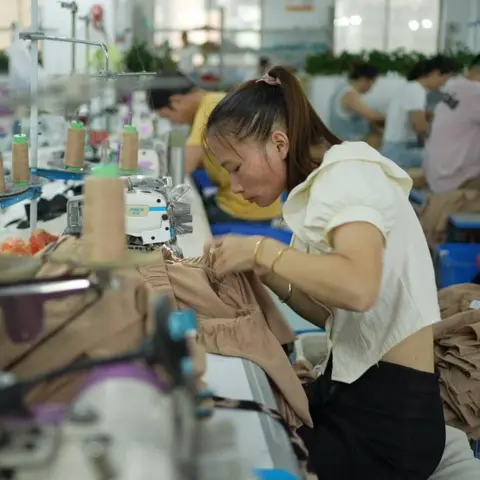
The hum of sewing machines is a constant in parts of Guangzhou, a thriving port on the Pearl River in southern China.
It rattles through the open windows of factories from morning until late at night, as they finish the t-shirts, shorts, blouses, pants and swimwear that will be shipped to fill wardrobes in more than 150 countries.
This is the sound of Panyu, the neighbourhood known as the “Shein village”, a warren of factories that power the world’s largest fast fashion retailer.
“If there are 31 days in a month, I will work 31 days,” one worker told the BBC.
Most said they only have one day off a month.
The BBC spent several days here: we visited 10 factories, spoke to four owners and more than 20 workers. We also spent time at labour markets and textile suppliers.
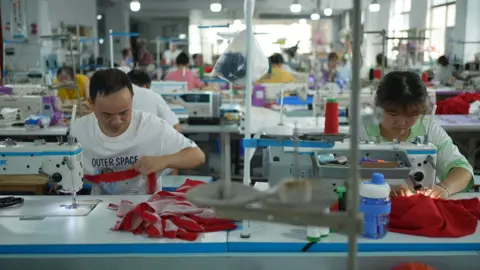
We found that the beating heart of this empire is a workforce sitting behind sewing machines for around 75 hours a week in contravention of Chinese labour laws.
These hours are not unusual in Guangzhou, an industrial hub for rural workers in search of a higher income; or in China, which has long been the world’s unrivalled factory.
But they add to a growing list of questions about Shein, once a little-known Chinese-founded company that has become a global behemoth in just over five years.
Still privately-owned, it is estimated to be worth about £36bn ($60bn) and is now eyeing a listing on the London Stock Exchange.
Its meteoric rise, however, has been dogged with controversy about its treatment of workers and allegations of forced labour.
Last year it admitted to finding children working in its factories in China.
The company declined to be interviewed but told the BBC in a statement that “Shein is committed to ensuring the fair and dignified treatment of all workers within our supply chain” and is investing tens of millions of dollars in strengthening governance and compliance”.
It added: “We strive to set the highest standards for pay and we require that all supply chain partners adhere to our code of conduct. Furthermore, Shein works with auditors to ensure compliance.”
Shein’s success lies in volume – the inventory online runs into the hundreds of thousands – and deep discounts: £10 dresses, £6 sweaters, prices that hover below £8 on average.
Revenue has soared, outstripping the likes of H&M, Zara and the UK’s Primark. The cut-price sales are driven by places like the Shein village, home to some 5,000 factories, most of them Shein suppliers.
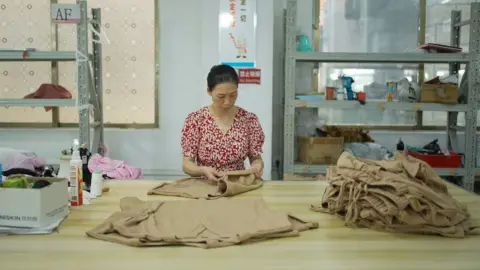
The buildings have been hollowed out to make way for sewing machines, rolls of fabric and bags brimming with cloth scraps. The doors to their basements are always open for the seemingly endless cycle of deliveries and collections.
As the day passes, the shelves fill up with warehouse-bound, clear plastic bags labelled with a now-distinctive five-letter noun.
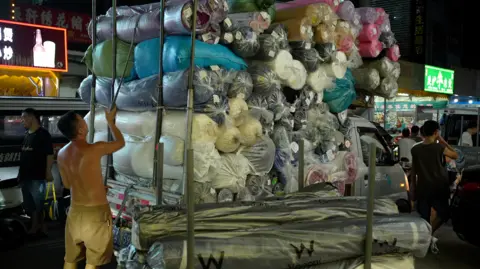
But even past 22:00, the sewing machines – and the people hunched over them – don’t stop as more fabric arrives, in trucks so full that bolts of colour sometimes tumble onto the factory floor.
 Xiqing Wang/ BBC
 Xiqing Wang/ BBC
“We usually work, 10, 11 or 12 hours a day,” says a 49-year-old woman from Jiangxi unwilling to give her name. “On Sundays we work around three hours less.”
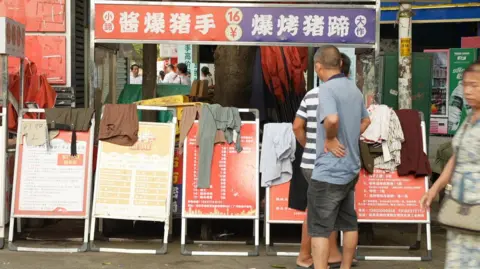
She is in an alleyway, where a dozen people are huddled around a row of bulletin boards.
They are reading the job ads on the board, while examining the stitching on a pair of chinos draped over it.
This is Shein’s supply chain. The factories are contracted to make clothes on order – some small, some big. If the chinos are a hit, orders will ramp up and so must production. Factories then hire temporary workers to meet the demand their permanent staff cannot fulfil.
The migrant worker from Jiangxi is looking for a short-term contract – and the chinos are an option.
“We earn so little. The cost of living is now so high,” she says, adding that she hopes to make enough to send back to her two children who are living with their grandparents.
“We get paid per piece,” she explains. “It depends how difficult the item is. Something simple like a t-shirt is one-two yuan [less than a dollar] per piece and I can make around a dozen in an hour.”
Examining the stitching on the chinos is crucial for making that decision. All around her, workers are calculating how much they will get paid to make each piece of clothing and how many they can make in an hour.
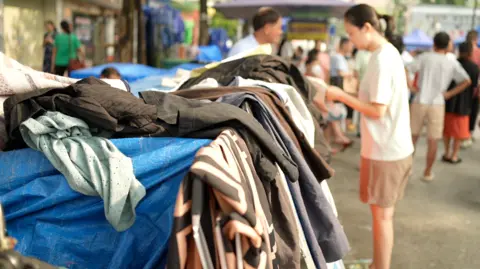
The alleys of Panyu function as labour markets, filling up in the mornings as workers and scooters rush past the breakfast dumpling cart, the cups of steaming soybean milk and the hopeful farmer selling chicken and duck eggs.
 Xiqing Wang/ BBC
 Xiqing Wang/BBC
Standard working hours appear to be from 08:00 to well past 22:00, the BBC found.
This is consistent with a report from the Swiss advocacy group Public Eye, which was based on interviews with 13 textile workers at factories producing clothes for Shein.
They found that a number of staff were working excessive overtime. It noted the basic wage without overtime was 2,400 yuan (£265; $327) – below the 6,512 yuan the Asia Floor Wage Alliance says is needed for a “living wage”. But the workers we spoke to managed to earn anywhere between 4,000 and 10,000 yuan a month.
“These hours are not unusual, but it’s clear that it’s illegal and it violates basic human rights,” said David Hachfield from the group. “It’s an extreme form of exploitation and this needs to be visible.”
The average working week should not exceed 44 hours, according to Chinese labour laws, which also state that employers should ensure workers have at least one rest day a week. If an employer wants to extend these hours, it should be for special reasons.
 Xiqing Wang/BBC
While Shein’s headquarters are now in Singapore, there is no denying the majority of its products are made in China.
And Shein’s success has drawn the attention of Washington, which is increasingly wary of Chinese firms.
In June, Donald Trump’s pick for US Secretary of State, Marco Rubio, said he had “grave ethics concerns” about Shein’s “deep ties to the People’s Republic of China”: “Slave labour, sweatshops, and trade tricks are the dirty secrets behind Shein’s success,” he wrote.
Not everyone would agree with Rubio’s choice of words to describe the conditions at Shein’s suppliers. But rights groups say that the long working hours, which have become a way of life for many in Guangzhou, are unfair and exploitative.
The machines dictate the rhythm of the day.
They pause for lunch and dinner when the workers, metal plates and chopsticks in hand, file into the canteen to buy food. If there is no more space to sit, they stand in the street.
“I’ve been working in these factories for more than 40 years,” said one woman who spent just 20 minutes eating her meal. This was just another day for her.
Inside, the factories we visit are not cramped. There is enough light and industrial-sized fans have been brought in to keep workers cool. Huge posters urge staff to report underage workers – likely a response to finding two cases of child labour in the supply chain last year.
 Xiqing Wang/BBC
 Xiqing Wang/BBC
The BBC understands that the company is keeping a closer eye on its suppliers ahead of plans to go public on the London Stock Exchange.
“This is about their reputation,” says Sheng Lu, a professor in Fashion and Apparel Studies at the University of Delaware. “If Shein can successfully achieve an IPO then it means they are recognised as a decent company. But if they are to keep the confidence of investors, they have to take some responsibility.”
One of the biggest challenges Shein faces is accusations that it sources cotton from China’s Xinjiang region.
Once touted as among the world’s best fabric, Xinjiang’s cotton has fallen out of favour after allegations that it is produced using forced labour by people from the Muslim Uyghur minority – a charge that Beijing has consistently denied.
The only way to get around this criticism is to be more transparent, Prof Sheng says.
“Unless you fully release your factory list, unless you make your supply chain more transparent to the public, then I think it’s going to be very challenging for Shein.”
A major advantage, he adds, is that Shein’s supply chain is in China: “Very few countries have a complete supply chain. China has this – and nobody can compete.”
Aspiring rivals like Vietnam and Bangladesh import raw materials from China to make clothes. But Chinese factories rely entirely on local sources for everything, from fabric to zippers and buttons. So it’s easy to make a variety of garments, and they are able to do it quickly.
 Xiqing Wang/BBC
That especially works for Shein whose algorithm determines orders. If shoppers repeatedly click on a certain dress, or spend longer looking at a wool sweater, the firms knows to ask factories to make more – and fast.
For workers in Guangzhou, this can be a challenge.
“Shein has its pros and cons,” one factory owner told us. “The good thing is the order is eventually big, but profit is low and it’s fixed.”
Shein, given its size and influence, is a hard bargainer. So factory owners have to cut costs elsewhere, often resulting in lower staff wages.
“Before Shein, we produced and sold clothes on our own,” said an owner of three factories. “We could estimate the cost, decide the price and calculate the profit. Now Shein controls the price, and you have to think about ways to reduce the cost.”
When orders peak, however, it’s a bonanza. The company ships around one million packages a day on average, according to data from ShipMatrix, a logistics consultancy firm.
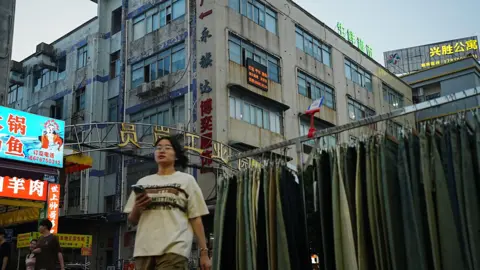 Xiqing Wang/ BBC
“Shein is a pillar of the fashion industry,” said Guo Qing E, a Shein supplier.
“I started when Shein started. I witnessed its rise. To be honest, Shein is an awesome company in China. I think it will become stronger, because it pays on time. This is where it is most trustworthy.
“If payment for our goods is due on the 15th, no matter whether it’s millions or tens of millions, the money will be paid on time.”
Shein, with its gruelling hours and sometimes lower wages, may not be a source of comfort to all its workers. But it is a source of pride for some.
“This is the contribution we Chinese people can make to the world,” said a 33- year-old supervisor from Guangdong, who didn’t want to give her name.
It’s dark outside and workers are filing back into factories after their dinner for the final stretch. She admits the hours are long, but “we get on well with each other. We are like a family”.
Hours later, after many workers head home for the night, the lights in several buildings stay on.
Some people work until midnight, one factory owner told us. They want to earn more money, he said.
After all, in London, Chicago, Singapore, Dubai and so many other places, someone is hunting for their next bargain.
Read more of our China coverage
Druse Leader Aims to Secure Place for Syrian Minorities

As Western diplomats explore establishing ties with the rebels who took power in Syria, a religious minority has been conducting its own diplomatic push to ensure protections for its members as the country rebuilds.
A representative of the group, the Druse, recently went to Washington to meet with lawmakers, members of the Biden and Trump administrations and diplomats to plead their case.
“We are very worried about the future,” Sheikh Muwafaq Tarif said in an interview in Washington, where he urged U.S. officials to prioritize protections for Syria’s 1.2 million Druse as part of their engagement with the country’s new government.
In December, after a long civil war, a coalition of Syrian rebels toppled President Bashar al-Assad and established an interim government. The rebellion put an end to a brutal regime, but for Western nations there remained a problem: The Islamist group that led the uprising once had ties to Al Qaeda and the Islamic State, and as a result was officially designated as a terrorist organization.
The rebel leaders have forsworn their old alliances and have pledged to build a Syria that is tolerant of other beliefs. And Western officials, eager for reconstruction to begin, have expressed their openness to working with the Islamist group now in power, Hayat Tahrir al-Sham.
But members of Syrian minority groups like the Druse, who practice an offshoot of Shiite Islam and can also be found in Lebanon, Israel and Jordan, remain skeptical. The spiritual leader of the Druse in Syria, Sheikh Hikmat al-Hajari, expressed wariness in a recent interview with a German broadcaster over the promises of tolerance offered by Syria’s de facto leader, Ahmad al-Shara.
Sheikh Tarif, his counterpart in Israel, suggested that Mr. al-Shara was not moving quickly enough.
“He is speaking nicely,” Sheikh Tarif said. “What I hear is that the West is excited and they like what he says. But there is a lot of fear among minorities. We want the statements to be borne out by actions.”
Mr. al-Shara has sought to distance himself from his group’s jihadist roots, promising to draft a new constitution, expressing relatively moderate political positions and seeking to reassure Syria’s minorities. In the Sweida district in the south, for example, a Druse woman was recently appointed governor.
But some observers have suggested that Mr. al-Shara may be engaged in mere posturing to open the flow of foreign aid. Already, some moves his new government has made — like sweeping changes to textbooks — have raised concerns within Syria about his professed commitment to religious diversity.
Sheikh Tarif said that in his meetings with Western officials, he was pressing for much-needed economic assistance for Syria, and for sanctions imposed on the country to be lifted — but only conditioned on proof that the new government is keeping its commitments. He said he has also been trying to position the Druse community in Syria and throughout the Middle East as key partners for Western nations aiming to influence outcomes in the country and region.
For centuries, the Druse have survived across the Middle East in part by integrating politically in the countries where they live, even while keeping their religious practices distinct. In Syria, they have played a significant historical role, leading a revolt against French rule in 1925 that came to be seen as the nation’s first nationalist uprising.
“The Druse paid a high price for Syria’s independence,” Sheikh Tarif said.
When the uprising against the Assad regime began in 2011, some Druse aligned with the rebel groups, though the community’s support was mixed, with concern that jihadist groups fighting the regime would prove hostile to their beliefs. Druse fighters did take part in the rebel offensive that deposed Mr. al-Assad.
In Israel, the Druse community of about 150,000 people that Mr. Tarif leads has in recent years protested the far-right government’s adoption of a law that marginalizes minorities. “There is a lot to improve,” he said. But Mr. Tarif dismissed criticism of the Israeli military’s recent moves to seize territory in Syria near its border, saying Israel was acting to ensure it own security.
He noted that Druse commanders and soldiers had lost their lives fighting as members of the Israeli military in the conflicts set off by the Hamas-led attack on Israel on Oct. 7, 2023, and recalled the deaths last summer of 12 young Druse in the Israeli-controlled Golan Heights who were killed by a Hezbollah rocket from Lebanon.
Given their presence in several nations, Sheikh Tarif said, the Druse consider themselves a potential bridge. “We can show how to live in peace,” he said.
