Thursday, October 1, 2026
Home Blog Page 6944

How to Protect Your Home From Wildfires

0
How to Protect Your Home From Wildfires


The wildfires that began in and around Los Angeles last week spread with terrifying speed, forcing many people to flee the flames with little warning. As firefighters work to contain the blazes, the disaster serves as a reminder of the dangers of climate change, which has been found to increase both the severity and frequency of wildfires.

Last year, there were more than 8,000 wildfires in California, according to the California Department of Forestry and Fire Protection — roughly 800 more than in 2023. If you live in an area prone to wildfires, what can you do to minimize their threat to your home and the wider community?

First, it’s important to understand how fires spread. According to Doug Green, who runs a community wildfire program at the research institute Headwaters Economics, wildfires typically spread in any of three ways: flame contact, when a flame touches combustible material; radiant heat, when the heat of a fire raises the temperature high enough for a material to ignite; and ember generation, when a piece of burning debris ignites material.

“Why the embers are so problematic is that they can travel long distance,” said Yana S. Valachovic, a fire scientist at the University of California. “They can travel up to a mile or more.”

In the event of wildfires near you — and assuming you’re not in an urgent situation that requires immediate evacuation — be sure to close all windows and skylights. “You want to shut your structure down so that it’s not going to create more openings for embers to come in,” Ms. Valachovic said. “That also means actually closing the cat and dog door if you have those, because wind can push those doors open.”

Embers can also enter through vents. Consider installing special fire defense vents, or wrapping aluminum foil over vents in the event of a fire.

You should also clear your home’s exteriors of combustible material, especially any that is close to or touching it. “There’s been lots of science and research that has shown that by limiting the amount of flammable vegetation, bark, mulch and other items within that first five feet, you can significantly lower the risk of your home igniting,” Mr. Green said.

As for longer-term solutions, there are a number of modifications you can make to reduce your vulnerability to fire. For one, consider replacing the roof, gutters, fences or deck with nonflammable materials, such as metal or tile.

Wooden fences are especially troublesome in a fire. “Wooden fences become great wicks or fuses for fire to travel down along the property lines,” said Ms. Valachovic, who recommended replacing your fence with something nonflammable. “In the short term, you can tie your gates open so they’re not along that connection line,” she said.

Modifications like these can be expensive, though they don’t always have to break the bank. An analysis by Headwaters Economics looked at the costs of retrofitting a 2,000-square-foot home for wildfire resistance and found that minimal modifications can cost as little as $2,000. (A full upgrade, however, can cost as much as $100,000, the institute found.)

Educate yourself on how your home is susceptible to fires. Mr. Green recommends contacting your local fire department, which may offer to visit your property and spot any vulnerabilities. “Most of them will happily come out and take a look at your property,” Mr. Green said. “They’re the ones who are probably the most knowledgeable with the vegetation and the fire conditions and the operations in your community.”


Italian Justice Ministry Moves to Release Iranian Man Sought by the U.S.

0
Italian Justice Ministry Moves to Release Iranian Man Sought by the U.S.


Italy’s justice minister has requested the revocation of the arrest of an Iranian man sought by the United States for allegedly providing material used in a drone attack that killed three American soldiers, the Italian government announced on Sunday.

Mohammad Abedini Najafabadi, 38, was arrested last month in Milan and the U.S. Justice Department had asked for his extradition. He was charged with illegally providing material used in the attack by an Iranian-backed militia on a military base in Jordan.

On Sunday, the Italian Justice Ministry said it did not have the grounds to extradite him. Soon after the announcement, Iranian state media and Mr. Abedini’s lawyer said he was free, but the Italian government has not yet confirmed that.

The Italian ministry’s request for the arrest to be revoked came just days after Iran freed an Italian reporter, Cecilia Sala, who had been arrested in Iran three days after Mr. Abedini was detained. She was arrested on accusations of violating the laws of the Islamic Republic, though the Iranian government never provided details.

While the Italian government never confirmed any connection between the two cases, Prime Minister Giorgia Meloni said last week that Ms. Sala’s release was the result of a diplomatic “triangulation” with the United States and Iran.

Shortly after Italy’s announcement, IRNA, Iran’s state news agency, said that the man “will return to his country in a few hours.”

In Sunday’s government statement, Italy’s Justice Ministry said that according to the extradition treaty between Italy and the United States, a person could be extradited only for crimes that are punished in both countries. Mr. Abedini’s case, they said, did not fit the criteria.

One of the crimes that he is accused of — conspiring to export sophisticated electronic components in violation of U.S. export control and sanctions laws — is not punished in Italy, the ministry said.

Italy’s Justice Ministry also said that it had not received evidence to justify another accusation leveled against Mr. Abedini: that he allegedly provided material support to a foreign terrorist organization. The Justice Ministry said that it knew only that Mr. Abedini produced and traded technologies with Iran that had potential, but not exclusive, military use.

Leily Nikounazar contributed reporting.


Russia claims to have seized new villages in eastern Ukraine | News

0
Russia claims to have seized new villages in eastern Ukraine | News


Russia claims it has captured two villages in eastern Ukraine where its forces have been steadily advancing for months, as Ukraine’s president urged allies to deliver all the weapons they have promised to send to Kyiv.

The Russian Defence Ministry said on Sunday that soldiers have captured the village of Yantarne in the eastern Donetsk region, about 10km (six miles) southwest of Kurakhove, a key logistics hub that Moscow claimed to have seized last week – a day after Russia’s army said it had also taken new territory northwest of Kurakhove.

The Defence Ministry added that soldiers had also captured the village of Kalinove in the northeastern Kharkiv region.

The village is on the western bank of the Oskil River, which for a long time formed the front line between the two armies in the region.

A Ukrainian official, quoted by the AFP news agency, said on Thursday that Russian forces had managed to establish a bridgehead on the western bank after crossing the river.

Russia’s army has spent months making attempts to cross the river, which also cuts through Kupiansk, a city recaptured by Ukraine in its 2022 counteroffensive.

Separately, the Russian Defence Ministry said that over the past 24 hours, Russia’s forces have carried out strikes on Ukrainian military airfields, personnel and vehicles in 139 locations using the air force, drones, missiles and artillery.

Ukrainian air defences downed 60 out of 94 drones launched by Russia overnight, according to the Ukrainian air force.

It said that 34 drones were “lost”, in reference to Ukraine’s use of electronic warfare to redirect Russian drones.

Falling drone fragments damaged houses in the Kharkiv, Sumy and Poltava regions, but no one was hurt, the air force said.

In the southern Kherson region, three people were injured by drones on Sunday, regional authorities said, and about 23,000 households were left without electricity after Russian shelling damaged power equipment in the city.

The attack targeted the Dniprovskyi district along the Dnipro River, an area of Kherson that is regularly shelled by Russian forces on the opposite bank.

Kherson’s governor, Oleksandr Prokudin, said Kherson city and about 50 settlements in the surrounding region had been shelled by Russian forces over the past 24 hours.

“The Russian military shelled social infrastructure and residential areas of the region’s settlements, in particular, damaging two multistorey buildings and eight private houses,” Prokudin said on Telegram.

In the Russian-controlled section of the Kherson region, a Ukrainian drone attacked a car, killing a 76-year-old woman outside her house, Russian-installed Governor Vladimir Saldo said on Telegram.

Zelenskyy appeals to allies

In a statement on Sunday, Ukraine’s President Volodymyr Zelenskyy called on allies to honour all promises to supply Ukraine with weapons, including those to counter Russian air attacks.

Zelenskyy said that over the past week, Russian forces had launched hundreds of attacks on Ukraine and nearly 700 aerial bombs and more than 600 attack drones were used.

“Every week, the Russian war continues only because the Russian army retains its ability to terrorise Ukraine and exploit its superiority in the sky,” Zelenskyy said on the Telegram messaging app.

“The decisions made at the NATO summit in Washington, as well as those adopted during the Ramstein meetings regarding air defences for Ukraine, have still not been fully implemented,” Zelenskyy said.

Ukraine’s leader this week said he had discussed with partners and the United States the possibility of granting Ukraine licences to produce air defence systems and missiles.

Task force for oil spill

Meanwhile, Russian officials said an emergency task force arrived in Russia’s southern Krasnodar region on Sunday as an oil spill in the Kerch Strait from two storm-stricken tankers continues to spread a month after it was first detected.

The task force, which includes Emergency Situations Minister Alexander Kurenkov, was set up after Russian President Vladimir Putin on Friday called on authorities to ramp up the response to the spill, calling it “one of the most serious environmental challenges we have faced in recent years”.

Kurenkov said that “the most difficult situation” had developed near the port of Taman in the Krasnodar region, where fuel oil continues to leak into the sea from the damaged part of the Volgoneft-239 tanker.

Kurenkov was quoted as saying by Russian state news agency RIA Novosti that the remaining oil will be pumped out of the tanker’s stern.

In response to Putin’s call for action, Ukraine’s Foreign Ministry spokesman Heorhii Tykhyi accused Russia of “beginning to demonstrate its alleged ‘concern’ only after the scale of the disaster became too obvious to conceal its terrible consequences”.

“Russia’s practice of first ignoring the problem, then admitting its inability to solve it, and ultimately leaving the entire Black Sea region alone with the consequences is yet another proof of its international irresponsibility,” Tykhyi said on Friday.

The Kerch Strait is an important global shipping route, providing passage from the inland Sea of Azov to the Black Sea. It has also been a key point of conflict between Russia and Ukraine after Moscow annexed the peninsula in 2014.

In 2016, Ukraine took Moscow to the Permanent Court of Arbitration, where it accused Russia of trying to seize control of the area illegally. In 2021, Russia closed the strait for several months.

Mykhailo Podolyak, an adviser to Zelenskyy’s office, described the oil spill last month as a “large-scale environmental disaster” and called for additional sanctions on Russian tankers.


Mayotte hit by floods and mudslides from second storm Dikeledi

0
Mayotte hit by floods and mudslides from second storm Dikeledi


The French Indian Ocean territory of Mayotte has been hit by further heavy rains, leading to flooding and mudslides, one month after Cyclone Chido devastated large parts of the islands and left dozens dead.

The archipelago was put on the highest state of alert as another storm passed by on Sunday morning. Authorities warned of violent winds, flash floods and landslides.

Videos on social media show downed power lines and some flooding. Local TV reported that the southern village of Mbouini, the only settlement left untouched by Cyclone Chido, was under water.

The latest storm, Dikeledi, made landfall in northern Madagascar on Saturday, killing at least three people.

The storm passed approximately 100 km (62 miles) south of Mayotte around 09:00 GMT on Sunday, according to forecaster Météo-France.

“Extremely heavy rains are beginning to trickle down,” François-Xavier Bieuville, the prefect of Mayotte, told French news channel BFMTV.

They were causing the first floods “and relatively significant mudslides” across the territory, he added.

The prefect said it was likely the island would remain on red alert until Monday evening, since heavy rain was expected to continue even after the storm had passed.

At least 14,500 people have taken refuge in emergency shelters set up to protect them from the storm, BFMTV reported.

As of Sunday afternoon, the storm was moving away from Mayotte, Météo-France reported. The system is expected to slowly intensify over the next 24 hours to tropical cyclone status while approaching the coast of Mozambique.

The current forecast does not predict landfall in Mozambique, but the Nampula region is still expected to experience “very degraded conditions”, the forecaster said.

Mozambique is also recovering from Cyclone Chido, which killed 120 people in the country.

In Mayotte, one of the poorest parts of France, many residents live in shanty towns.

Officially the archipelago has 320,000 residents, but authorities estimate about 100,000 to 200,000 undocumented migrants may also be living there.

On 14 December, Cyclone Chido became the worst storm to hit Mayotte in 90 years, bringing winds of up to 260 km/h (160mph) and flattening areas where people lived in shacks with metal roofs.

Initial reports said several hundred people had been killed, but the toll was later revised down to 39.


Israeli Security Chiefs Join Critical Talks for a Cease-Fire in Gaza

0
Israeli Security Chiefs Join Critical Talks for a Cease-Fire in Gaza


Israeli security and policy chiefs were expected to arrive in Qatar on Sunday for high-level talks about a proposed cease-fire deal in Gaza that would see hostages released in the final days of President Biden’s term and before Donald J. Trump takes office.

Biden administration officials have been pressing for a deal that would become part of the departing president’s legacy, and Mr. Trump has warned that “all hell will break out in the Middle East” if Hamas does not release the hostages before he is inaugurated on Jan. 20.

Lower-level negotiations have been underway in recent weeks after months of deadlock.

While some progress has been made, disagreements remain on several key points, including the timing and extent of Israel’s redeployments and withdrawal from Gaza and its willingness to ultimately end the war, according to several officials and a Palestinian familiar with the matter. They were speaking on the condition of anonymity because the talks are being held in secrecy and they were not authorized to discuss details publicly.

Representatives of the departing and incoming U.S. presidents have been cooperating on the issue, the Biden administration has said, while Qatar and Egypt are mediating between Israel and Hamas.

Steve Witkoff, Mr. Trump’s intended Middle East envoy, met Prime Minister Benjamin Netanyahu in Israel on Saturday. On Friday, Mr. Witkoff was in Doha, the capital of Qatar, and met the Qatari prime minister, Sheikh Mohammed bin Abdulrahman bin Jassim Al-Thani, for talks that focused on efforts to reach a cease-fire in Gaza, according to Qatar’s Foreign Ministry.

Mr. Netanyahu’s office announced late Saturday that he had discussed the issue with Israel’s security chiefs and with negotiators from both the departing and incoming American administrations. He also instructed Israel’s top negotiators — including David Barnea, the head of the Mossad intelligence agency — to leave for Qatar with the goal of advancing a deal, Mr. Netanyahu’s office said.

Disagreements between Israel and Hamas remain on the fundamental issue of the permanency of a cease-fire, with Mr. Netanyahu still unwilling to declare an end of the war as part of a three-phase agreement that was laid out by Mr. Biden last May.

Israel is insisting on a vaguer formula that leaves room for ambiguity, according to the Palestinian familiar with the matter and two Israeli officials. Another official familiar with the matter said the Americans were supposed to provide mediators with a guarantee that the United States would work to bring the war to an end, though Israel has not agreed to any exact phrasing.

Hamas is also demanding detailed maps from Israel showing where it will withdraw to, but Israel has not provided them, according to the officials and the Palestinian familiar with the matter. They added that disagreements remain about the timing of an Israeli troop withdrawal from the Philadelphi Corridor, a strip of land abutting Gaza’s border with Egypt.

Nearly 100 hostages who were seized during the Hamas-led attack in southern Israel on Oct. 7, 2023, remain in Gaza, out of roughly 250 who were taken. Israel believes at least a third of the remaining hostages are dead.

Israel and Hamas have both shown signs of wanting to resolve the outstanding issues, as pressure mounts from the United States and the Israeli public. Last week Hamas representatives indicated that the group had approved an Israeli list of 34 hostages to be released in the first stage of an agreement.

But Israel said last week that it had not received any information from Hamas regarding the status of the hostages appearing on the list, which includes those it considers the most vulnerable and urgent cases — women and children, men over 50 and several sick or injured hostages.

Israel has demanded a list from Hamas of which hostages remain alive. Without that, Israeli officials say, there can be no agreement on how many Palestinian prisoners Israel would be willing to release in exchange for them. As of Sunday morning, Israel had not received a list of live hostages, according to one of the officials familiar with the matter.

The body of one of the hostages whose name appeared on the list of 34 — Youssef Ziyadne, 53, an Arab citizen of Israel — was located last week by Israeli forces in a tunnel in Gaza along with the remains of his son, Hamza Ziyadne, who was also captured during the 2023 attack.

The Israeli military brought the remains of both men back to Israel for burial.


Brazil’s Mafia-Run Animal Lottery Was Invincible. Online Games Changed That.

0
Brazil’s Mafia-Run Animal Lottery Was Invincible. Online Games Changed That.


Taiza Carine da Costa got her first taste of gambling when she was just 9.

Growing up in the rundown fringes of Rio de Janeiro, Ms. Costa’s godparents would send her down the block, a few coins in hand, to bet on a popular lottery that, though illegal, has been a staple of life in Brazil for over a century.

The habit stuck and, as an adult, she would bet daily on the game, in which players place wagers on animals represented by sets of numbers. Like many Brazilians, whenever she dreamed of a creature, she saw it as a sign to bet on the lottery, known as “jogo do bicho” — or animal game — in Portuguese.

“If I dream, I bet,” said Ms. Costa, 37, a clothing vendor.

But, lately, Ms. Costa is turning to a different game of chance that is at her fingertips around the clock: a digital slot machine offering big rewards if she can draw three matching symbols.

Tigrinho, or Little Tiger in Portuguese, mimics a popular Chinese slots game and has led the way as mobile betting apps have exploded in popularity since Brazil legalized digital gambling in 2018. Ms. Costa plays Little Tiger every day and her gambling — and her losses — have picked up as a result. She estimates she has lost roughly $80,000 over two years on the app.

“It’s hard to stop,” she said.

Online betting games, from digital casinos to soccer wagers, have sparked a fever in Latin America’s largest nation, fueling a fierce debate — like elsewhere in the world — over how to regulate the booming industry and shield lower-income people who often pile on debt or lose big chunks of meager earnings betting.

The gambling frenzy is also threatening Brazil’s animal lottery, which has links to murderous mobs and has been an unshakable part of popular culture since it was created in Rio de Janeiro in the 1800s and took off across the country.

While decades of crackdowns have failed to stamp out the lottery and the criminal gangs that run it, the analog game now appears to be in the throes of an existential crisis as fewer Brazilians are willing to physically place bets with a local bookie.

Digital alternatives — offering bigger jackpots and infinite chances — now draw over $23 billion in wagers each year, about ten times more than the animal lottery, according to the Legal Games Institute, a nonprofit that studies gambling in Brazil.

While the analog game has six draws per day, online gambling is nonstop.

“The Brazilian gambler now has a casino in his pocket,” said Magno José Santos de Souza, the institute’s president.

The animal lottery, on the other hand, “hasn’t been able to renew its base,” said Luiz Antônio Simas, a Rio historian who has written a book about the game.

The game was created in the 1890s by a baron seeking to draw more visitors to his newly-created zoo in the Vila Isabel neighborhood of Rio. People with admission tickets were entered into a raffle, with an animal drawn at the end of each day.

The lottery soon became more popular than the zoo itself, and similar games of chance began popping up across the city. Fearing the game would hurt government lotteries, authorities banned it three years after it was created.

But the lottery’s advance was unstoppable. Before long, bookies taking bets outside bars and newspaper stands became a fixture across Brazil, with the game reaching even the most remote corners of the Amazon rainforest.

By the 1970s, the animal lottery had grown into a multimillion dollar business fueling bloody disputes among Rio’s mafias, as they wrestled for territorial control. The gambling bosses eventually divvied up the city — and the country — into zones.

To protect their illicit dealings, lottery kingpins bribed judges, politicians and police officials. In working-class areas of Rio, they won hearts and minds by buying local soccer teams, funding lavish Carnival parades and handing out Christmas presents.

“They built this playful, fun facade,” said Fábio Corrêa, a federal prosecutor in Rio de Janeiro who leads a task force combating organized crime. “They wanted to create this image of Good Samaritans.”

Over the years, the authorities repeatedly tried to crack down on the mafia-run lottery and, in 1993, they finally had a breakthrough: a judge sentenced 14 lottery bosses to six years in prison. But, before long, many of the game’s most powerful kingpins were out, free to expand their empires.

On a recent afternoon in the neighborhood of Vila Isabel, the birthplace of the animal lottery, three bookies — each manning a different corner — took bets from regulars. Few of them looked younger than 50.

“I always bet on the pig or the tiger,” said Germano da Silva, 71, a retired publicist. Digging into his wallet, he pulled out an old ticket that won him $450 the week before. “My children don’t know how to play,” he added. “Whenever they want to bet, they come to me.”

For newcomers, the lottery’s rules can seem daunting. Players bet on combinations of two-, three- or four-digit numbers, which are linked to any one of 25 animals, from a cow to a monkey. Wagers start at a few cents, but payoffs can reach into the thousands of dollars.

Most animal lottery players, though, are not placing bets in the hopes of getting rich, according to Mr. Simas, the historian. “They want to win a little money for a beer at the end of the day,” he said. “Playing the game is part of street culture.”

In Brazil, a deeply superstitious country, bets in the animal lottery have long been drawn from dreams, lucky animals, or the dates of big life events like birthdays, deaths or marriages.

“Each person has their favorite play,” said Nena Coelho, a 60-year-old secretary who was betting on the dog, inspired by a stray that had followed her friend home.

While most gambling, including casinos and slot machines, is barred in Brazil, lawmakers legalized digital games but delayed drafting concrete oversight rules. Experts say the lag has opened the door for thousands of unregulated platforms, some of them fraudulent, to flood Brazil.

This echoes the experiences of countries like Britain and the United States, where legislators, eager to capture tax revenues, were quick to legalize digital gambling but were later left racing to impose regulations, said Lia Nower, director of the Center for Gambling Studies at Rutgers University.

“Most legislators don’t have a real awareness that this is potentially addictive,” Ms. Nower said.

Digital games were an instant hit in Brazil, a nation of 203 million with one of the world’s highest rates of internet use. Platforms promising a fast path out of poverty quickly gained popularity among low-income people in a country marked by deep inequality.

Colorful and childlike, the apps were often promoted by social media influencers who told followers that they could win tens of thousands in cash on sites that turned out to be rigged. (Some were later arrested, accused of tricking fans into betting on unauthorized platforms.)

Brazil’s government estimates that nearly a quarter of the population started gambling online over the last five years. Brazilians now spend about $3.5 billion each month on online wagers, with sports betting making up a huge segment in soccer-crazy Brazil, according to figures from the country’s central bank.

Rushing to bring the sector under control, Brazilian authorities began enforcing a new law this month requiring betting companies to pay a fee and comply with federal rules on fraud, responsible marketing and money laundering.

The animal lottery remains illegal, but the shift to digital betting has opened new revenue streams.

Lottery bosses are using legal betting sites to launder money amassed from illicit activities like the animal lottery, the authorities say.

“They are infiltrating the digital space,” Mr. Corrêa said. “They want to give an air of legality to activities that, at the end of the day, are illegal in origin.”

But even as many move on from the animal lottery, there are still those who are not quite ready to let go.

Matheus Resende, 30, remembers his father teaching him how to calculate odds and craft bets. “He’s the Google of the animal lottery,” said Mr. Resende, a beverage distributor from Rio.

These days, Mr. Resende is one of millions of Brazilians placing digital wagers on soccer games. Still, he has a soft spot for the animal lottery and, every week, he stops by his local bookie too.

He knows about the game’s criminal links, he says, but he’s still sad to see it fading away.

“It’s a family tradition,” he said. “So there’s a certain nostalgia there.”


Syria Faces Big Challenge in Seeking Justice for Assad Regime Crimes

0
Syria Faces Big Challenge in Seeking Justice for Assad Regime Crimes


There seem to be no limits to the dark revelations laid bare by the downfall of Syria’s 54-year Assad regime.

Prisons have emptied, exposing the instruments of torture used on peaceful protesters and others considered opponents of the government. Stacks of official documents record thousands of detainees. Morgues and mass graves hold the gaunt, broken-bodied victims, or at least some of them.

Many others have yet to be found.

For these and many other atrocities, Syrians want justice. The rebel alliance that overthrew President Bashar al-Assad last month has vowed to hunt down and prosecute senior regime figures for crimes that include murdering, wrongly imprisoning, torturing and gassing their own people.

“Most Syrians would say they can only achieve closure to bring this dark 54-year era to an end when they bring these guys to justice,” said Ayman Asfari, chairman of Madaniya, a network of Syrian human rights organizations and other civic groups.

But even assuming that the new authorities can track suspects down, accountability will be hard to achieve in a country as vulnerable, divided and battered as Syria. The experiences of other Arab countries whose despotic regimes collapsed testify to the challenges: None of those countries — not Egypt, not Iraq, not Tunisia — succeeded in securing comprehensive, lasting justice for the crimes of earlier eras.

Syria faces some distinctive hurdles. The country’s new de facto leaders come from the country’s Sunni Muslim majority, while the senior ranks of the deposed regime were dominated by Alawites, a religious minority. That means prosecutions for Assad-era abuses could risk fueling Syria’s sectarian tensions.

The justice system was for years little more than a tool for Mr. al-Assad, making it ill equipped to handle sweeping, complex human rights violations. Many thousands of Syrians could be implicated, more than can possibly be prosecuted, raising questions about how to handle lower-level officials.

And after years of war, sanctions, corruption and mismanagement, it is an enormous task just to sort through the damage while transitioning to a new government.

Nine in 10 Syrians live in poverty. Cities lie in ruins. Homes have been destroyed. Tens of thousands of people were unjustly detained for years or decades. Hundreds of thousands were killed in the fighting. Many are still missing.

Syrians will need time and many discussions to design a sound accountability process, said Nerma Jelacic of the Commission for International Justice and Accountability, which has been gathering evidence against Syrian regime figures for years.

“These are things that take time, and they never happen overnight,” she said.

But there is enormous pressure on Syria’s new leaders to begin punishing the old, and the transitional authorities in the capital, Damascus, have promised to do so.

“We will not relent in holding accountable the criminals, murderers and security and military officers involved in torturing the Syrian people,” Ahmed al-Shara, Syria’s de facto leader, said in a post on Telegram in December. He added that they would soon publish “List No. 1” of senior officials “implicated in the torture of the Syrian people.”

Hunting down such figures will be difficult, if not impossible. Mr. al-Assad has found refuge in Russia, which is unlikely to give him up. Many of his top associates have melted away, with some reportedly in hiding in Lebanon or the United Arab Emirates.

Still, Syrian human rights groups in exile began laying the groundwork more than a decade ago, gathering evidence for prosecutions that were mounted in other countries — and someday, they hoped, in their own.

But Fernando Travesí, executive director of the International Center for Transitional Justice, which has worked with such Syrian groups, cautioned that, before beginning prosecutions in Syria, the authorities should first earn citizens’ trust by building a state that meets their needs.

Doing so would avoid the missteps of a country like Tunisia, where a lack of economic progress in the years after the 2011 Arab Spring revolution left many people embittered and disenchanted. By 2021, Tunisians had turned on their fledgling democracy, throwing their support to a president who has grown increasingly authoritarian. Efforts to bring members of the feared security services and regime cronies to justice are now functionally suspended.

“Any process of truth, justice and accountability needs to be coming from institutions that have some legitimacy and credibility with the population, otherwise it’s a waste of time,” Mr. Travesí said. Providing crucial services, he added, would encourage Syrians to view government as “not a tool for repression; it’s taking care of my needs.”

The transitional government can take basic yet vital steps such as helping refugees who left years ago obtain new identification, adjudicating what should happen to property that was stolen or occupied during the war, and providing stable electricity and running water. It will need to deliver humanitarian aid and economic improvements, though those may only be possible with the help of other countries.

And it must do all this in an evenhanded way, or Syrians might see accountability efforts as selective or politically driven. After the overthrow of Saddam Hussein in Iraq in 2003, the United States-led occupation and successive governments purged and blacklisted even junior functionaries in the former ruling party without due process, which analysts said undermined faith in the new system.

“The only way to heal the wounds with the other communities is to make sure they’re fairly represented,” Mr. Asfari said.

The Syrian authorities are signaling that they understand. They have vowed repeatedly to respect minority rights and have promised amnesty to rank-and-file soldiers who were forced to serve in Mr. al-Assad’s military. Most government employees have been allowed to stay on to keep institutions running.

Any prosecution “has to be a good process, otherwise it’ll look like score-settling,” said Stephen J. Rapp, a former international prosecutor and former U.S. ambassador for global justice who has worked on Syrian abuses for more than a decade. “And that can play a key role in reconciling a society and defusing efforts to settle scores, for instance, against the children of parents who committed these crimes.”

In an added complication, some of the documents that will be crucial to mounting any prosecutions have been damaged in the chaos following Mr. al-Assad’s downfall, with regime prisons and intelligence agency archives ransacked, looted or burned, said Ms. Jelacic of the Commission for International Justice and Accountability.

Because Syria remains under wartime sanctions, her group and others trying to safeguard these papers for future use in court cannot operate across much of the country, further jeopardizing their efforts.

The wartime mass graves and torture devices are only the most glaring evidence of abuses overseen by Mr. al-Assad and his father, Hafez.

Nearly every Syrian, in some sense, has been wronged by the former regime. So it is not enough to prosecute individuals for crimes committed during the civil war, say veterans of justice efforts in other countries that underwent political transitions.

Mr. Rapp called for a “larger truth-telling process” that could help “really begin to understand the system of state repression that was Syria for the last 54 years, and this machinery of murder that was Syria” since 2011.

One model could be the post-apartheid Truth and Reconciliation Commission in South Africa, which heard testimony from victims and perpetrators of rights violations, offered reparations to victims, and in some cases granted amnesties.

Ms. Jelacic said Syria would need a broader reckoning with the Assad regime’s legacy that “doesn’t contribute to the divisions, but that it contributes to healing.”

Before trials begin, experts said, Syria should overhaul its police and court systems and build a legal framework to handle rights violations, perhaps creating a special tribunal to prosecute the most serious crimes. An equally urgent priority is finding out what happened to the estimated 136,000 people who remain missing after being arrested by the Assad regime and identifying bodies uncovered in mass graves.

But Syria cannot wait too long to prosecute former regime officials. Slow-moving official justice leaves room for angry people to take matters into their own hands, which could set off cycles of violence and deepen sectarian divisions. Already, scattered revenge killings and threats against minorities who were favored by the Assad regime have been reported.

After Tunisia’s revolution, lengthy delays in bringing cases against former security officials added to citizens’ sense that their new democracy was bankrupt.

Lamia Farhani, a Tunisian lawyer who has long sought justice for her brother’s fatal shooting while he protested the previous regime in 2011, said that her country’s disillusionment had permitted the current president, Kais Saied, to dismantle its democracy.

“We had a nascent democracy that failed at the first storm,” she said. “And all this happened because there was no real reconciliation.”


Before and after photos show scale of destruction from LA wildfires | Climate Crisis News

0
Before and after photos show scale of destruction from LA wildfires | Climate Crisis News


The death toll from the wildfires ravaging the Los Angeles area has risen to 16 as firefighters struggled to contain the blaze that threatens the city’s most famous landmarks.

New evacuation orders were placed as firefighters raced against time to stop the fires from spreading before potentially strong winds returned.

The fires that began on Tuesday just north of downtown Los Angeles have scorched tens of thousands of acres and more than 12,000 structures.

Firefighters for the first time made progress on Friday afternoon on the Eaton Fire north of Pasadena, which has burned more than 7,000 structures, a term that includes homes, apartment buildings, businesses, outbuildings and vehicles.

No cause has been determined for the largest fires and early estimates indicate the wildfires could be the nation’s costliest ever. A preliminary estimate by AccuWeather put the damage and economic losses so far between $135bn and $150bn.

Below are some of the satellite images showing the widespread destruction:

INTERACTIVE-LA fires - Palisades Eaton Hurst Kenneth Fire Map Jan 12-1736664920


Trump threats cast ominous shadow over icy fjords of Greenland

0
Trump threats cast ominous shadow over icy fjords of Greenland


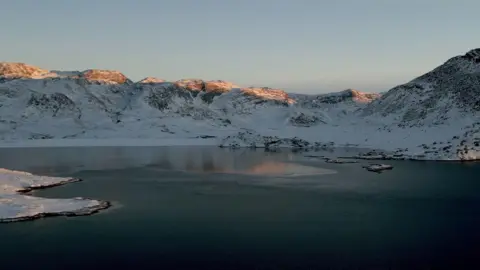
BBC A drone image of a fjord with snow covered mountains in the backgroundBBC

The sun is rising over the ice-covered mountains of Nuuk fjord and we are travelling along one of the world’s last wild frontiers.

But there are shadows gathering here and across the rest of the frozen spaces of Greenland.

With Donald Trump about to become president of the United States, his refusal to rule out taking Greenland by force is reverberating through conversations across the island.

“He’s welcome to come visit for sure,” says the skipper of the converted fishing boat taking us east. Conscious that he needs to do business with people of all political hues, he asked not to be named, but used a phrase I hear repeatedly here.

“Greenland belongs to Greenlanders. So, Trump can visit but that’s it.”

The waters are flat calm as we pull into the isolated settlement of Kapisillit – population about 40 – where a few hunters are setting out to shoot seals.

It’s -16C (3F), and with wind chill effect feels more like -27C.

But near the harbour I meet a local church elder, Kaaleeraq Ringsted, 73, a great-grandfather, who is out drying fillets of cod caught in the fish-rich waters beside his front door.

When I ask about President-elect Trump buying or invading Greenland, he chuckles at first. Then his tone becomes serious.

Kaaleeraq Ringsted wearing a black jacket and hat smiling in front of some fish with a fjord in the background

Kaaleeraq Ringsted says he wants to preserve his way of life for his children

“It is not acceptable that he says this. Greenland is not for sale.”

Then he tells me how he learned to fish and hunt here with his father and grandfather, and how he wants to preserve this life for his children and grandchildren.

Crossing the bay, the boat nosed through the broken surface ice. Two eagles perched on a rock, scanning for fish in the clear waters.

We were heading to the farm of Angutimmarik Hansen who keeps sheep as well as hunting seals, wildfowl and rabbits.

All of his winter feed for the sheep needs to be imported from Denmark, a reminder of how a harsh climate defines the possibilities of life here.

Inside his front door is a rack of hunting rifles. He notices me looking at them.

“Those are in case there’s an invasion,” he jokes.

Angutimmarik Hansen wearing goggles and a beanie holding a small child on his shoulders with his wife standing beside him smiling

Angutimmarik Hansen (r) insists Greenland is not for sale

But his attitude to the bellicose rhetoric from Mar-A-Lago is far from relaxed.

“What a stupid person in the world like Trump,” he says. “Never will we sell Greenland.”

This little farm is about 3,000 miles (4,828km) from Florida where the incoming US president gave his now infamous press conference last week.

“But Trump is not the USA. We can work with the people of the USA,” Mr Hansen says.

The Trump effect went into overdrive with the arrival in Greenland of Donald Trump Jr, hot on the heels of his father’s pronouncements. He flew into the capital Nuuk on the family’s 737 jet – Trump Force One – and stayed for four hours and thirty-three minutes, meeting some locals and offering only polite remarks.

“It’s been incredibly nice to meet people, and people were very happy to meet with us,” he said, after lunch at a local hotel. “Dad will have to come here.”

Then it was back to the sunnier climes of Florida.

Reuters A plane with the words 'Trump' on the side at an airport in Greenland with snow and ice on the tarmacReuters

Donald Trump Jr visited Nuuk for several hours last week

Trump Jr was welcomed by local businessman Jorgen Boassen, who once campaigned for the president-elect.

He told local media that he was Trump’s “biggest fan” and that “of course they are interested in our country, and they are welcome to come and see what our country is like. It is also about opening up for trade and cooperation.”

The city of Nuuk is the world’s most northerly capital. It has a thriving civil society and a robust press. And there is some satisfaction here that the Trump comments have propelled the debate about Greenland’s independence onto the international stage.

There must be a Greenland that is nobody’s colony, say campaigners like Kuno Fencker, an MP with the governing coalition and member of the local parliament’s Foreign and Security Committee.

We meet by the harbour, under the bronze statue of Hans Egede, the 18th century missionary widely seen here as the man who opened the way to colonisation.

Kuno Fencker standing beside a body of water wearing a blue jacket and sun shining on side of his face

Kuno Fencker wants Greenland to negotiate directly with the US, rather than through Denmark

“Donald Trump is a politician,” says Mr Fencker.

“He’s a hard businessman, and we know his rhetoric, and that rhetoric is something we have gotten used to since 2019, and it’s just a matter of talking to a peer, an ally, on how we can solve things here in the Arctic and also in Nato.”

Mr Fencker offers the central argument of pro-independence campaigners.

“What is necessary here is that Greenland as a sovereign state should negotiate directly with the United States and not Denmark doing that for us.”

Independence from Denmark could come at a significant financial cost.

Greenland receives subsidies from Copenhagen worth roughly a fifth of its GDP every year. Mr Fencker suggests, as have other leading figures here, that the island would negotiate with America and Denmark for support.

“We are not naïve in regard to that. We need support in defence, security, and also economic development. We want a sustainable and self-sufficient economy.”

The editor of the local newspaper Sermitsiaq, Maasana Egede, admits he was worried by the implied threat of force from Donald Trump, but wants to see how reality matches the rhetoric.

As for independence, Mr Egede has been frustrated by what he sees as a polarised debate in the media – local and international.

“We are very much telling this story that it has to be about independence or not independence. But there’s all of this story that is in between, that people want independence, but not at any cost. There’s a living standard that has to be maintained. There’s trade that has to be maintained. There are living ways that have to be maintained.”

There is an expectation that at some point – not in the immediate future – there will be a vote in favour and Denmark will accept the result.

The island’s Prime Minister, Mute Egede, addressed a joint press conference with the Danish Prime Minister, Mette Frederiksen, in the wake of the latest Donald Trump comments.

“We do not want to be Danish, we do not want to be American, we want to be Greenlandic,” he said. The Danish PM took care not to offend anybody, least of all the incoming US president.

“The debate on Greenlandic independence and the latest announcements from the US show us the large interest in Greenland,” she said. “Events which set in motion a lot of thoughts and feelings with many in Greenland and Denmark.”

Getty Images Denmark's Prime Minister Mette Frederiksen and Chairman of Naalakkersuisut in Greenland Mute B Egede hold a press conference in CopenhagenGetty Images

Greenland’s Prime Minister, Mute Egede (l), spoke alongside Danish Prime Minister, Mette Frederiksen

Ms Frederiksen knows well how deep feelings run in Greenland. Memories of injustice and racism remain fresh here among the indigenous Inuit people.

Scandals like the campaign to insert IUDs (Intrauterine devices) to prevent pregnancies in thousands of Inuit women and girls in the 1960s and 70s, haunt the relationship between Greenland and Denmark.

It’s not known how many of these procedures were carried out without the permission of those involved, but the numbers are considerable. The aim was to reduce the Greenlandic population.

Maliina Abelsen is a former finance minister in Greenland’s government, and now a consultant for companies and organisations working on the island. She’s also worked for UNICEF Denmark and leading Greenland businesses, like the seafood group, Royal Greenland.

Ms Abelsen believes far more needs to be done to address the injustices of the past.

Maliina Abelsen sitting at a table wearing a blue shirt with a yellow cup in front of her

Maliina Abelsen says the pain of the past must be fully acknowledged so Greenlanders can heal

“I think a lot of people are saying, maybe also the Danish government and state have said, ‘Oh well, you know this happened in the past. This is so many years ago. How are we going to be responsible for that? It’s time to move on.’

“But you cannot move on if you have not been healed, and if you have not been acknowledged to what happened to you. That is a job that we have to do together with Denmark, not something Greenland can do on its own.”

And despite her own high profile in civil society and business, Maliina Abelsen says that when it comes to racism – for example jokes about Inuit people – she “can speak for most Greenlanders, that we have all experienced that in our life”.

The issues of self-determination and facing the past are intimately intertwined.

Now the intervention of Donald Trump has placed both before the eyes of the world.

But the message we heard – from the remote settlements on the fjord to the capital city Nuuk – is that Greenland’s destiny must be decided here, among people whose voices have been too long overlooked.

With additional reporting by Adrienne Murray and Kostas Kallergis.


Bills and Lions Give NFL Fans in Canada Reason to Cheer

0
Bills and Lions Give NFL Fans in Canada Reason to Cheer


About a decade ago, Mike Smith tried to capture the sour mood of the patrons in his neighborhood bar, Joe Kool’s. For years, their favorite sports teams endured winless seasons, playoff droughts and epic collapses, so he designed a T-shirt that included a map of southern Ontario with London in the middle and lines connecting to Buffalo, Cleveland, Detroit and Toronto. Above it were the words “The Epicentre of Losing” and a red arrow pointing at London.

Since then, London has morphed into an epicenter of winning, sort of. The Toronto Maple Leafs haven’t won a Stanley Cup since 1967, but have made the playoffs for eight straight seasons (losing in the first round almost every time). Though the Cleveland Browns last won an N.F.L. title the year the Beatles invaded America, the crosstown Guardians have made the American League playoffs six times since 2016.

The real turnarounds, though, are the Buffalo Bills and the Detroit Lions, traditionally two of the N.F.L.’s sad sacks. They convincingly won their divisions this season and, as the playoffs start this weekend, are serious Super Bowl contenders, something that delights their fans in southern Ontario, which separates the two cities.

“There’s a mutual respect and sympathy among Bills and Lions fans,” said Charlie Smith, who runs Joe Kool’s with his father. “Rust Belt cities don’t get a break, which is why I’m happy for both teams.”

A four-hour drive apart just past London, the cities have much in common, from shuttered factories to gutted neighborhoods to faded histories. The Bills’ founding owner, Ralph Wilson, was close with the Ford family, which still owns the Lions. Wilson kept his office in Detroit, and for years the Bills and the Lions played preseason games. In 2022, the Bills played a home game in Detroit because of snowstorms in Buffalo.

The teams also share a dubious distinction: no Lombardi Trophies. The Lions are one of four teams that have never played in the Super Bowl. Before last season, they had won just one playoff game in 65 years, and their last N.F.L. title was in 1957, two months after the Soviet Union launched the first Sputnik satellite. The Bills won two A.F.L. titles in the 1960s and played in four consecutive Super Bowls in the 1990s, but lost each time.

After long fallow periods, both teams now have high-powered offenses and gritty defenses that appeal to Canadian fans living between Buffalo and Detroit. That explained the nervous hope masquerading as optimism at Joe Kool’s.

“The rust bucket teams never sleep,” said Ross Cockburn, the longtime bartender, who began rooting for the Bills when O.J. Simpson was their running back. “If the Bills and Lions are in the Super Bowl, it’ll end in a tie.”

Last Sunday, the Bills played their second-stringers and lost to the New England Patriots to end the regular season. But they had already won their fifth straight A.F.C. East Division crown and were saving their strength for the Denver Broncos, whom they will face this Sunday.

The real tension began when the Lions faced the Minnesota Vikings, two teams with 14-2 records and no Super Bowl titles, later last Sunday. After a tight first half, the Lions ran away with the game, locking up the N.F.C. North Division title and earning a bye this weekend as the conference’s top seed.

“This year, I keep pinching myself,” said Darren Pyne, a Lions fan who did not want to jinx his team and left Joe Kool’s at halftime to go home and watch the second half in his “fortress of solitude.”

Canadian fans have other reasons to cheer. The Vikings, the Kansas City Chiefs, the Pittsburgh Steelers and the Seattle Seahawks, all teams popular north of the border, had double-digit win totals this year, and all but the Seahawks qualified for the postseason.

Their success comes as the N.F.L. expands into international markets in search of new fans and revenue. More than a decade ago, the Bills played six regular-season games over six years in Toronto, an experiment that unnerved fans in Buffalo. Not only did their team lose five of those games, but they saw them as a prelude to the team’s moving.

The games, though, were not well received in part because they lacked tailgating and were played indoors. The Bills are building a new stadium in Orchard Park, N.Y., ensuring they will stay put. But Toronto remains part of the Bills’ home market. About 10 percent of the team’s season-ticket holders are Canadian, and last year the Bills hired a new executive to expand the team’s presence in Ontario, including finding corporate sponsors and media partners.

“Ultimately, we’re doing whatever we can to theoretically erase the border and make sure people in southern Ontario and Toronto feel like they can be part of the Bills organization, or as close as possible,” said Pete Guelli, the team’s chief operating officer.

The Lions, the Seahawks and the Vikings are developing Canada as a market. About 5 percent of the Lions’ season-ticket holders are Canadian, mostly from Windsor, across the border from Detroit. The team has broadened its outreach, doubling its email list of Canadian fans in the past three years. Before Christmas, the Lions held a watch party in London with the team’s cheerleaders and Roary the mascot entertaining more than 3,000 fans.

London is roughly equidistant between Buffalo and Detroit and, with the success of the Bills and the Lions, has turned into an N.F.L. demilitarized zone. For years, fans in London received television signals that let them watch Browns and Lions games. But the league’s digital streaming package allows them to follow the Bills as well.

The ubiquity of the N.F.L. is one reason Reid Collins, 9, became a Bills fan. Wearing a Josh Allen jersey, he and his father, John, watched the Bills on televisions at the Dawghouse Pub, a 10-minute drive from Joe Kool’s. After following the Bills in the 1990s, “I had stopped watching them, but he got me into it again,” John Collins said. “It’s nice he picked it up.”

As at Joe Kool’s, there was a mix of N.F.L. fans at the Dawghouse, with patrons wearing Chargers, Cowboys, Giants and Packers caps and jerseys. With 14.5 million fans nationwide, the N.F.L. has more than two dozen corporate sponsors in Canada, two media packages and its own online store. The Super Bowl is the highest-rated program most years. Nearly three dozen Canadians play in the league.

“As long as the N.F.L. has been around, there’s been fans in Canada,” said Gavin Kemp, the general manager of the league’s office in Toronto.

As popular as the N.F.L. is, hockey remains king. Had the Canadian national team made it to the final round of the World Junior Championships last week, Joe Kool’s would have been packed with hockey fans. Instead, just one television showed the title game between the United States and Finland.

For the next few weeks, though, the N.F.L. will be front and center at Joe Kool’s, and throughout Canada. Bill Haddow, Charlie Smith’s 95-year-old grandfather, who attended the Lions’ title game in 1957 and had season tickets for many years, can’t wait.

“I’m nervous now because we’ve never been in this position,” he said.