Thursday, October 1, 2026
Home Blog Page 6951

Putin Gets a Snub in the Vast Wine Cellars of a Former Soviet Republic

0
Putin Gets a Snub in the Vast Wine Cellars of a Former Soviet Republic


Hermann Goering, Hitler’s right-hand man, survived the cut. His bottles of wine — part of a collection seized by the Soviet army as a trophy at the end of World War II and deposited in a labyrinthine underground cellar in Moldova — are still on display.

A gift of 460 bottles given in 2013 to then Secretary of State John Kerry when he visited the former Soviet republic is also there, kept in his name in a cubbyhole in the vast system of tunnels. (The State Department reported their value as $8,339.50, which might explain why Mr. Kerry chose to leave them behind.)

But President Vladimir V. Putin of Russia, who twice visited the cellars operated by the state-owned Cricova Winery, has been banished. His wine bottles, along with his photograph, have been removed from view in the vast complex of underground tunnels that twist and turn over 75 miles under vineyards north of the Moldovan capital, Chisinau.

After Mr. Putin began a full-scale invasion of Moldova’s neighbor, Ukraine, in 2022, the winery “got lots of questions that we could not answer about why he was still here,” said Sorin Maslo, the director.

Mr. Putin’s wine collection, a gift to him from Moldova’s former communist president, has not been destroyed, Mr. Maslo said. The bottles, he added, had been moved to a dark, sealed-off corner of the cellar so that “nobody has to deal with him.”

For a country that takes viniculture very seriously, the banishment of Mr. Putin’s bottles sent a blunt divorce message in a long-strained relationship that Moldova recently declared doomed by irreconcilable differences.

It was part of a decisive rupture that in October led voters to endorse, albeit by a tiny majority, changing Moldova’s Constitution to lock in the country’s exit from Moscow’s sphere of influence and align more closely with Europe.

That course was first set in 2006 when Russia, previously Moldova’s biggest wine export market, imposed a two-year ban on imports from Cricova and other Moldovan wineries during an early tiff between Moscow and Chisinau.

The ban, Russia claimed at the time, was needed to protect consumers from impurities, but it was widely seen as retaliation for demands by Moldova that Russia stop supporting the breakaway Moldovan region of Transnistria.

Russia lifted the ban on Moldovan wine the following year but reimposed it in 2013 after Moldova expressed a desire to forge closer ties with the European Union.

The 2006 embargo forced Moldova’s winemakers to look West for markets and convinced them that “the future for us is definitely not Russia,” said Stefan Iamandi, the director of the National Office for Vine and Wine in Chisinau. Russia, which once accounted for 80 percent of Moldovan wine sold abroad, today buys 2 percent, with more than 50 percent going to the European Union. That has meant moving away from sugary “semisweet” wines produced to suit Soviet palates, to high quality wines that regularly win international prizes.

Georgia, another former Soviet republic, was hit by a similar ban in 2006, prompting its winemakers, too, to start looking West.

Wine has for centuries played an outsize role in Moldova’s relationship with Russia, both lubricating and at times poisoning ties between what, until the collapse of the Soviet Union in 1991, were two parts of the same country.

Moldova has traces of grape cultivation stretching back thousands of years, and started exporting wine to Russia in large volumes in the 14th century. This trade expanded dramatically during the Soviet Union when vineyards in Moldova and Georgia provided much of the wine consumed in Russia.

Moldovan wine enjoyed a particularly good reputation. That became a curse when the last Soviet leader, Mikhail Gorbachev, identified alcoholism as one of the Soviet Union’s most serious problems in 1985 and overzealous Communist Party officials ordered that vineyards in Moldova, Georgia and Crimea be destroyed. Moldova ripped up some vines but left most intact, arguing that it needed grapes to make fruit juice.

Before that, Moscow and Moldova bonded over booze.

In 1966, when Yuri Gagarin, a Russian cosmonaut and the first man in space, visited what was then a Soviet republic called Moldavia, he spent two days at the Cricova Winery, where, like other visitors, he was offered wine tastings.

Legend has it that he tasted so much he had to be carried away in a stupor.

Mr. Maslo said that is not true, insisting “Gagarin was not drunk” and was just happy at the quality of the wine.

Unlike Mr. Putin, Mr. Gagarin has not been canceled and is still celebrated in Cricova’s underground cellar with a photograph and a plaque. Displayed proudly on the wall is the handwritten thank-you note he left at the end of his 1966 visit: “In these cellars is a great abundance of wonderful wine,” he wrote. “Even the most fastidious person will find here wine to their liking.”

There is certainly a lot to choose from. The vast wine cellar, housed in the shafts and meandering tunnels of a former limestone mine, holds 1.2 million bottles. The tunnels, lined with wine racks, barrels and large wooden casks, are part of a sprawling subterranean city. It has a wine shop for tourists, tens of thousands of whom visit each year, a movie theater and opulent tasting and banqueting halls for visiting dignitaries.

Tunnels dug for limestone miners have become streets, each one named after type of wine — Cabernet, Pinot Noir, Champagne and local varieties like Feteasca. There are street signs and traffic lights. Electric buggies transport winery workers and visitors around the labyrinth. The temperature is constant at around 55 degrees Fahrenheit, and the humidity of the air is always the same.

Also unchanging is the tedious labor of a team of workers who spend each day deep underground methodically turning bottles of sparkling wine stored neck down in high racks. The motion ensures that sediment gathers at the neck and can be easily removed before final bottling. All the bottle-turners are women because men, Cricova’s management decided, get bored too easily and take too many breaks.

Lybov Zolotko, who trained for the job by twisting her wrists in a bucket of sand, said she turns at least 30,000 bottles a day. It is boring work, she conceded, “but you get used to it” — and it pays a steady salary in a country where stable jobs are hard to come by.

Another Moldovan winery, Milestii Mici, has even longer tunnels — they stretch 150 miles — but Cricova has had far more high-profile visitors, including Mr. Putin, who celebrated his 50th birthday in its cellars; President Volodymyr Zelensky of Ukraine; and Angela Merkel, when she was still chancellor of Germany.

Tatiana Ursu, employed at Cricova for 30 years, has hosted a stream of dignitaries in the underground tasting rooms and banquet halls. Particularly warm, she said, was a 2002 visit by Mr. Putin, who was on excellent terms with Moldova’s president at the time, Vladimir Voronin, Europe’s first democratically elected Communist Party head of state after the collapse of communism.

The visit used to be a source of pride for the winery, Ms. Ursu added, but “not so much any more” given that the seemingly mild-mannered man she met in 2002 — who had only been in the Kremlin two years when he visited — has since turned against Moldova.

Mr. Voronin gave the Russian president a bottle of wine in the shape of a crocodile, she recalled.

Mr. Putin and others in the Russian delegation did not drink too much and left a good impression on their Moldovan hosts, Ms. Ursu recalled.

“They were all friends back then. It was a different time,” she said.


Why are Donald Trump’s allies cheering for Pakistan’s Imran Khan? | Imran Khan News

0
Why are Donald Trump’s allies cheering for Pakistan’s Imran Khan? | Imran Khan News


Islamabad, Pakistan – When Richard Grenell, a close confidante of Donald Trump, the incoming United States president, demanded the release of Pakistan’s jailed former Prime Minister Imran Khan last November during protests in Islamabad, the post went viral.

In another since-deleted tweet the same day, Grenell wrote, “Watch Pakistan. Their Trump-like leader is in prison on phony charges, and the people have been inspired by the US Red Wave. Stop the political prosecutions around the world!”

With both tweets garnering hundreds of thousands of views, on December 16, a day after Trump nominated him as a presidential envoy for special missions, Grenell repeated his demand for Khan’s release. This time, the post racked up more than 10 million views.

The message gained further momentum when Matt Gaetz, another Republican and a former Trump nominee for attorney general, also wrote, “Free Imran Khan”.

The posts on X (formerly known as Twitter) were seen as a significant boost for Khan’s Pakistan Tehreek-e-Insaf (PTI) party, which has been advocating for their leader’s release since August 2023.

But many commentators said they were sceptical about this interest in Khan shown by Trump allies translating into meaningful pressure on Pakistan to release the ex-premier. And some pointed out a deep irony in the PTI, the country’s most popular political party, trying to lobby the US for help – less than three years after it accused Washington of a role in Khan’s removal.

Complex relationship

Khan’s government was removed from office in April 2022 through a parliamentary no-confidence vote after nearly four years in power.

He alleged a US-led conspiracy, in collusion with Pakistan’s powerful military, as the cause of his removal, rallying his supporters to protest nationwide. Both the US and the Pakistani military have strongly denied these allegations.

Since then, Khan and his party have faced a wave of crackdowns. Khan has been imprisoned since August 2023 on dozens of charges and convictions. His party’s symbol – a cricket bat – was banned from Pakistan’s national election last February, forcing its candidates to contest as independents.

Meanwhile, since Khan’s removal, relations between Pakistan and the US appear to have marginally improved, with the Biden administration appointing Donald Blome as US ambassador to Pakistan in May 2022, after the post was vacant since August 2018.

Throughout the crackdown on Khan and the PTI, US officials have largely refrained from commenting, calling it an internal matter for Pakistan. However, influential Pakistani diaspora groups in the US, the majority of whom support Khan and the PTI, have campaigned extensively among American politicians to seek relief for Khan.

“The vocal advocacy of the Pakistani diaspora in the US, particularly around the release of Imran Khan, adds layers of complexity to this relationship,” Hassan Abbas, a professor at the National Defense University in Washington, DC, told Al Jazeera.

Their efforts led the US Congress to hold a hearing on the “future of democracy” in Pakistan in March last year, prompted by bipartisan calls for President Biden and Secretary of State Antony Blinken to scrutinise Pakistan’s controversial elections in February 2024.

Months later, in October, more than 60 Democratic legislators urged Biden to leverage Washington’s influence over Islamabad to secure Khan’s release. Then, just days before the US election on November 5, Atif Khan, a senior PTI leader in the US, met Trump’s daughter-in-law Lara Trump to discuss concerns about Khan’s incarceration.

On January 22, two days after the new Trump administration takes office, another congressional hearing is expected on Capitol Hill regarding the November protests in Islamabad, during which at least 12 PTI workers died. The PTI blames the authorities for the casualties.

So far, Islamabad has dismissed the significance of the comments coming from Trump allies. Last month, the Pakistani foreign office said the country seeks relations based on “mutual respect, mutual interest, and noninterference in each other’s domestic affairs.”

“As for anyone making statements in their individual capacity, we would not like to comment on that,” said Mumtaz Zahra Baloch, the foreign office spokesperson, during a media briefing.

Rana Ihsaan Afzal, spokesperson for Pakistan Prime Minister Shehbaz Sharif, said the government views remarks from individuals like Grenell or Gaetz as opinions of “private American citizens.”

“Government does not respond to individual citizens’ remarks. We look forward to working with the new administration, and only if there is agitation at the government level will there be a need to issue a formal response,” Afzal told Al Jazeera.

Khan as knight in shining armour?

Syed Mohammad Ali, a non-resident scholar at the Middle East Institute, described PTI supporters’ campaigning for US support as “kind of ironic”.

“From pushing the idea of US intervention to topple the PTI government, the PTI-supporting diaspora is now wooing the incoming US administration to have a stronger role in what is happening in Pakistani politics,” Ali told Al Jazeera.

“But leaving aside that irony, it does show that for overseas Pakistanis sitting far from the country, many of them see Imran Khan as their knight in shining armour.”

Trump, who in his first term criticised Pakistan for providing “nothing but lies and deceit,” later developed a rapport with Khan during the latter’s premiership from 2018 to 2022.

The two first met in Washington in July 2019 and again in Davos in January 2020, where Trump called Khan his “very good friend.”

By contrast, relations between Khan and Biden were frosty. Khan often criticised Biden for never contacting him after assuming the presidency in November 2020.

Former Pakistani ambassador to the US, Husain Haqqani, acknowledged the Pakistani diaspora’s effectiveness in mobilising support. “They have persuaded individuals in both parties to call for Khan’s release,” he told Al Jazeera.

However, Haqqani, a senior fellow at the Hudson Institute, cautioned that Pakistan remains a low priority for Trump’s foreign policy.

“It is naive for PTI supporters to think they can find leverage with US officials this way. Apart from one or two statements, there’s no sign of a broader policy shift,” Haqqani said.

Ali, who is also a lecturer at Johns Hopkins University, emphasised the disconnect between US domestic politics and foreign policy.

“The Trump administration may adopt a more transactional approach. Pakistan has benefitted in the past during Republican regimes, but currently, it isn’t a significant player in US plans,” he said.

Haqqani noted that US leverage often involves sanctions and economic pressures, but Pakistan, no longer a major aid recipient, offers limited options for influence.

“Pakistan used to be a leading recipient of US aid post-9/11. But in recent years, aid has drastically reduced. Issues like Pakistan’s nuclear and missile programs, its relationship with China, and alleged support for militants are what concern the US,” he said.

“And Khan isn’t particularly useful on any of those fronts.”


Thousands of acres on fire in LA

0
Thousands of acres on fire in LA


BBC Treated image showing a firefighter tackling a blaze next to a map of Los AngelesBBC

Wildfires are raging in several areas of Los Angeles, with high winds and extremely dry conditions fuelling their progress across thousands of acres of land.

Firefighters are so far unable to contain them, with one fire official telling the BBC on Thursday that they are still rapidly expanding and “zero progress” has been made in containing them.

The largest fire, in the Pacific Palisades area where many celebrities live, is the most destructive fire in the history of Los Angeles. More than 1,000 buildings have already been destroyed.

On Wednesday, a fire broke out in the Hollywood Hills area, overlooking the world-famous Hollywood.

It’s a rapidly changing situation – these maps and pictures chart how the fires have spread, where they are located and what they look like from space.

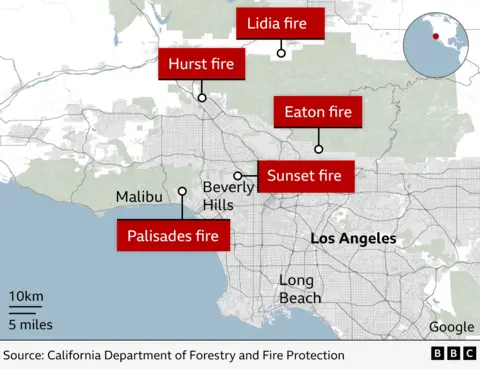
Map showing location of five fires around Los Angeles

Seven fires are currently being tackled.

The Palisades fire was first reported at 10:30 (18:30 GMT) on Tuesday, and grew in just 20 minutes from a blaze of 20 acres to more than 200 acres, and by Wednesday night was approaching 16,000 acres. At least 30,000 people have so far been ordered to leave their homes.

The Eaton fire grew to cover 1,000 acres within the first six hours of breaking out. It started in Altadena in the hills above Pasadena at around 18:30 local time on Tuesday. By Wednesday night, five deaths had been reported and it had spread to more than 10,000 acres.

The Hurst fire is located just north of San Fernando. It began burning on Tuesday at around 22:10 local time, growing to 850 acres, according to local officials. It has triggered evacuation orders in neighbouring Santa Clarita.

The Woodley fire broke out in Woodley Park at approximately 06:15 local time on Wednesday. The LA Fire Department (LAFD) says it has now been contained.

A Olivas fire erupted in Ventura County, northwest of Los Angeles, and was burning across about 11 acres of land, though has also now been contained.

The Lidia fire broke out at around 14:00 on Wednesday in the mountainous Acton area north of Los Angeles, and grew to cover almost 350 acres. As of 21:00, it had been 40% contained.

The Sunset fire broke out at around 18:00 in the Hollywood Hills, a residential neighbourhood overlooking the historic Hollywood area of the city. It currently covers around 50 acres and is 0% contained. A mandatory evacuation order is in place.

How did the Palisades fire spread?

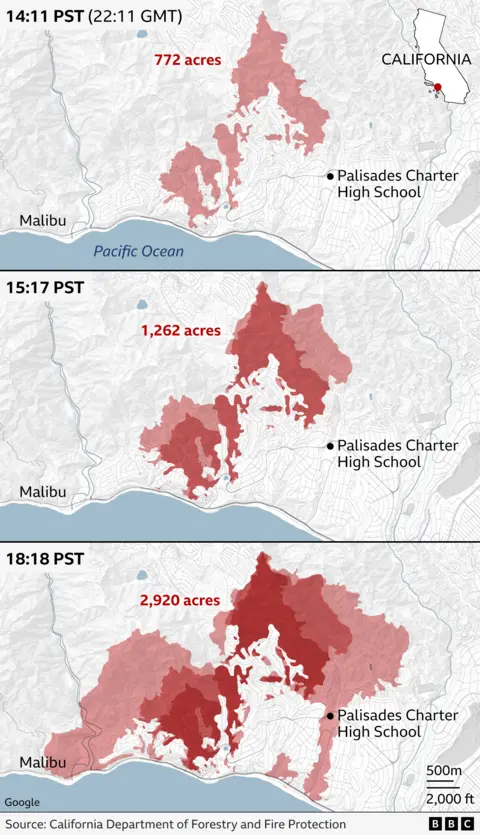
Map showing three stages of the development of the Palisades fire

The map above shows how rapidly the Palisades fire spread, intensifying in a matter of hours. At just after 14:00 on Tuesday it covered 772 acres and within four hours it had expanded approximately to its current size.

Thousands of people have been forced to evacuate, as more than 1,400 firefighters try to tackle the blaze.

How does the Palisades fire compare in size with New York and London?

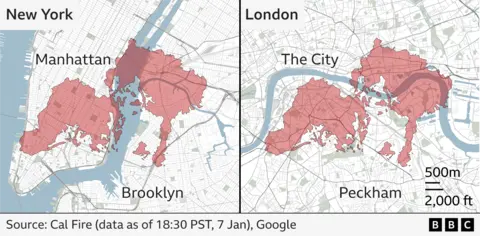
Maps showing the size of the Palisades fire when superimposed on to maps of New York (L) and London (R)

To give an idea of the size of the Palisades fire, we have superimposed it on to maps of New York and London.

As you can see, it is comparable in size with the central area of UK’s capital, or with large areas of lower Manhattan and Brooklyn.

How the fires look from space

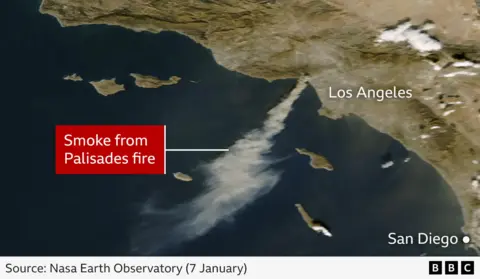
Smoke from the Palisades fire seen drifting out to sea off the California coast

Another indication of the scale of the Palisades fire comes from Nasa’s Earth Observatory.

The images captured on Tuesday show a huge plume of smoke emanating from California and drifting out to sea.

Effects of the Eaton fire

The Palisades fire is not the only one to have a devastating effect on neighbourhoods of Los Angeles.

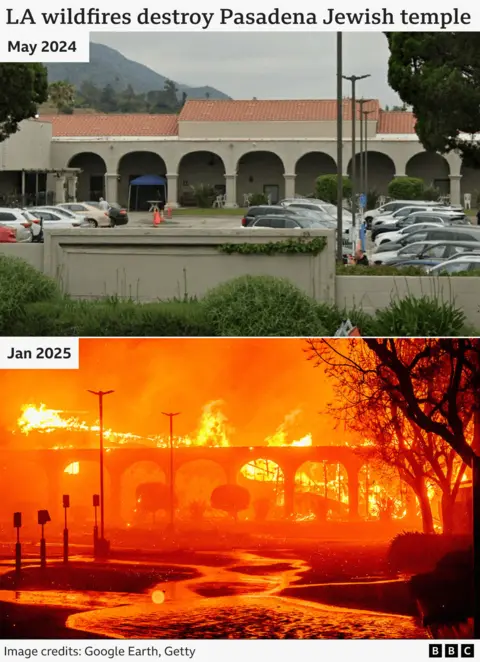
Satellite images show the extent of the destruction caused by the Eaton fire in the neighbourhood of Altadena.

The images below show the Jewish Temple in Pasadena before and during the Eaton fire.

Before and after images of the Jewish Temple in Pasadena

The Jewish Temple and Centre’s website says it has been in use since 1941 and has a congregation of more than 400 families.


Top Iranian General Admits ‘Big’ Defeat in Syria

0
Top Iranian General Admits ‘Big’ Defeat in Syria


Iran’s top ranking general in Syria has contradicted the official line taken by Iran’s leaders on the sudden downfall of their ally Bashar al-Assad, saying in a remarkably candid speech last week that Iran had suffered a major defeat but would still try to operate in the country.

An audio recording of the speech, given last week by Brig. Gen. Behrouz Esbati at a mosque in Tehran, surfaced publicly on Monday in Iranian media, and was a stark contrast to the remarks of Iran’s president, foreign minister and other top leaders. They have for weeks downplayed the magnitude of Iran’s strategic loss in Syria last month, when rebels swept Mr. al-Assad out of power, and said Iran would respect any political outcome decided by Syria’s people.

“I don’t consider losing Syria something to be proud of,” said General Esbati according to the audio recording of his speech, which Abdi Media, a Geneva-based news site focused on Iran, published on Monday. “We were defeated, and defeated very badly, we took a very big blow and it’s been very difficult.”

General Esbati revealed that Iran’s relations with Mr. al-Assad had been strained for months leading to his ouster, saying that the Syrian leader had denied multiple requests for Iranian-backed militias to open a front against Israel from Syria, in the aftermath of the Hamas-led attack of Oct. 7, 2023.

Iran had presented Mr. al-Assad with comprehensive military plans on how it could use Iran’s military resources in Syria to attack Israel, he said.

The general also accused Russia, considered a top ally, of misleading Iran by telling it that Russian jets were bombing Syrian rebels when they were actually dropping bombs on open fields. He also said that in the past year, as Israel struck Iranian targets in Syria, Russia had “turned off radars,” in effect facilitating these attacks.

For over a decade, Iran backed Mr. al-Assad by sending commanders and troops to help it fight against opposition rebels and the Islamic State terrorist group.

Under Mr. al-Assad, Syria was Iran’s regional command center from which it supplied weapons and money to its network of regional militias, including Hezbollah in Lebanon and Palestinian militants in the West Bank. Iran also controlled airports, warehouses and operated missile and drone manufacturing bases in Syria.

The rebel coalition has now taken over much of Syria and is trying to form a government. General Esbati said in his speech that Iran would look for ways to recruit insurgents in whatever shape the new Syria takes.

“We can activate all the networks we have worked with over the years,” he said. “We can activate the social layers that our guys lived among for years; we can be active in social media and we can form resistance cells.”

He added, “Now we can operate there as we do in other international arenas, and we have already started.”

The general’s comments have stunned Iranians, for both their unfiltered content and the speaker’s stature. He is a top commander of Iran’s Armed Forces, the umbrella that includes the military and the Revolutionary Guards Corps, with a record of prominent roles including commander in chief of the Armed Forces’ cyber division.

In Syria, he supervised Iran’s military operations and coordinated closely with Syrian ministers and defense officials and with Russian generals — outranking even the commander in chief of the Quds Forces, Gen. Ismail Ghaani, who oversees the network of regional militias backed by Iran.

Mehdi Rahmati, a prominent analyst in Tehran and expert on Syria, said in a telephone interview that General Esbati’s speech was significant because it showed that some senior officials were parting from government propaganda and leveling with the public.

“Everyone is talking about the speech in meetings and wondering why he said these things, especially at a public forum,” Mr. Rahmati said. “He very clearly laid out what happened to Iran and where it stands now. In a way it can be a warning for domestic politics.”

General Esbati said the fall of the Assad regime was inevitable given the rampant corruption, political oppression and economic hardship that people faced, from lack of power to fuel to livable incomes. He said Mr. al-Assad had ignored the warnings to reform. Mr. Rahmati, the analyst, said that the comparison to Iran’s current situation was hard to miss.

Despite the general’s assertions about activating networks, it remains unclear what Iran can realistically do in Syria, given the public and political opposition it has faced in the country and the challenges of land and air access. Israel has warned that it would decimate any Iranian efforts it detects on the ground in Syria.

And while Iran has the experience of operating in Iraq after the U.S. invasion in 2003 — including sowing unrest — the geography and political landscape of Syria differ greatly, presenting more challenges.

An Iranian member of the Revolutionary Guards who spent years in Iraq as a military strategist alongside senior commanders said in a telephone interview that General Esbati’s comments about Iran recruiting insurgents might be more aspirational than practical at this stage. He said that while General Esbati had admitted a serious defeat, he had also sought to boost morale and pacify conservatives demanding that Iran act more forcefully.

The Guards official, who asked that his name not be used because he was discussing sensitive issues, said Iran’s policy had not yet been finalized but that a consensus had emerged in meetings he had attended where strategy was debated. He said Iran would benefit if Syria descended into chaos because Iran knew how to thrive and secure its interests in a turbulent landscape.

In Iran, the Revolutionary Guards have the authority to set regional policy and overrule the foreign ministry.

Supreme Leader Ayatollah Ali Khamenei, who has the last word on key state matters, has said in at least two speeches since Mr. al-Assad’s fall that resistance was not dead in Syria, adding that Syria’s youth would reclaim their country from the ruling rebels, whom he called stooges of Israel and the United States. President Masoud Pezeshkian and Foreign Minister Abbas Araghchi have been more conciliatory, saying they favor stability in Syria and diplomatic ties with the new government.

The tensions surrounding these competing views on Syria preoccupied officials enough that they embarked on a campaign of damage control with the public last week. Senior military commanders and pundits close to the government gave speeches and held question-and-answer sessions with audiences in mosques and community centers in several cities.

General Esbati’s speech, on Dec. 31 at the Valiasr mosque in central Tehran, addressed rank and file of the military and constituents of the mosque, according to a public notice of the event, titled, “Answering questions about Syria’s collapse.”

The session started with General Esbati telling the crowd he left Syria on the last military plane to Tehran the night before Damascus fell to rebels. It ended with him answering questions from audience members. He offered his most sobering assessment on Iran’s military capability in fighting Israel and the United States.

Asked whether Iran would retaliate for Israel killing Hezbollah’s longtime leader, Hassan Nasrallah, he replied that Iran already did, referring to a missile barrage last fall. Asked whether Iran planned to carry out a third round of direct strikes on Israel, he said that “the situation” couldn’t realistically handle another attack on Israel right now.

Asked why Iran would not fire missiles at U.S. military bases in the region, he said that would invite bigger retaliatory attacks on Iran and its allies by the United States, adding that Iran’s regular missiles — not its advanced ones — could not penetrate advanced U.S. defense systems.

Despite those assessments, General Esbati said that he wanted to assure everyone not to worry: Iran and its allies, he said, still had the upper hand on the ground in the region.


Can Trump Change the Name of the Gulf of Mexico?

0
Can Trump Change the Name of the Gulf of Mexico?


President-elect Donald J. Trump said Tuesday that he planned to change the name of the Gulf of Mexico to the “Gulf of America,” one of several foreign policy proposals that left world leaders reeling.

“It has a beautiful ring,” he said of the proposed name change for the body of water that borders several U.S. and Mexican states.

Mr. Trump’s proposal was met with derision in Mexico and glee by late-night comedians, although supporters such as Representative Marjorie Taylor Greene, Republican of Georgia, vowed to make it a reality.

The gulf’s name first appeared on maps used by Spanish explorers in the 16th century, well before the founding of the United States.

On Wednesday, President Claudia Sheinbaum of Mexico displayed a map from 1607 that included the Gulf of Mexico. It also labeled North America as “Mexican America.”

“Why don’t we call it Mexican America? It sounds pretty, no?” Ms. Sheinbaum said.

Mr. Trump, as president, could press for changes to geographical names as they are used in the United States.

There is a precedent: In 2015, President Obama used his executive powers to change the name of an Alaska mountain from “McKinley” to “Denali.” Mr. Trump has vowed to reverse that decision.

But whether other countries would honor any change is a different story.

“Today, there is no formal international agreement or protocol in place for naming maritime areas,” said John Nyberg, the director of the International Hydrographic Organization, which works to standardize and chart marine boundaries, in an email.

The national geographic naming authority of the U.S. is the U.S. Board on Geographic Names, he added.

The U.S. Board on Geographic Names, part of the United States Geological Survey, says on its website that it only considers name changes for “compelling” reasons. “Generally,” it adds, “the most important policy regarding names is local use and acceptance.”

The body of water that separates Iran from Saudi Arabia has long been a source of tension. Iran wants it called the “Persian Gulf,” while Saudi Arabia prefers “Arabian Gulf.”

The U.S. Navy has used the term “Arabian Gulf,” to avoid friction with an important ally, but the U.S. Board on Geographic Names has mandated use of the “Persian Gulf” for official business.

Contention also exists around the name of the sea that is bordered by Japan, North Korea, South Korea and Russia. Japan refers to it as the Sea of Japan while South Korea maintains that it has been called the East Sea for centuries.

The body of water that borders Brunei, China, Malaysia, the Philippines, Taiwan and Vietnam — commonly known as the South China Sea in the English-speaking world — is also disputed. Different countries have proposed their own names for the sea to highlight their own territorial claims to certain islands.

Emiliano Rodríguez Mega contributed reporting.


Thursday Briefing

0
Thursday Briefing


Here’s what you need to know.


Japanese crime boss admits to conspiring to sell nuclear material to Iran | Crime News

0
Japanese crime boss admits to conspiring to sell nuclear material to Iran | Crime News


Takeshi Ebisawa faces a maximum punishment of life in prison after pleading guilty to six counts in a Manhattan court.

A Japanese crime boss has pleaded guilty to conspiring to sell nuclear material from Myanmar to Iran along with drug trafficking and weapons offences, authorities in the United States have said.

Takeshi Ebisawa, 60, a member of the yakuza, entered a guilty plea to six counts in federal court in Manhattan on Wednesday, the US Department of Justice said in a statement.

He is set to be sentenced on April 9.

According to prosecutors, Ebisawa in 2020 told an undercover agent for the Drug Enforcement Administration (DEA) and a DEA source that he had acquitted a large quantity of thorium and uranium that he wished to sell.

In response to Ebisawa’s repeated inquiries, the undercover agent agreed to help Ebisawa broker the sale of the nuclear materials to an associate who was posing as an Iranian general, prosecutors said.

Ebisawa then offered to supply the undercover associate with plutonium that would be even “better” and more “powerful” than uranium for making nuclear weapons, according to prosecutors.

A powdery yellow substance that Ebisawa’s co-conspirators showed to undercover agents was later determined in a laboratory analysis to contain detectable quantities of uranium, thorium and plutonium, the Justice Department said.

Ebisawa also conspired to broker the purchase of US-made surface-to-air missiles and heavy-duty weaponry to arm multiple ethnic armed groups in Myanmar, and to accept large quantities of heroin and methamphetamine as partial payment for the arms, according to prosecutors.

US officials said they conducted Ebisawa’s arrest and prosecution in cooperation with law enforcement partners in Indonesia, Japan and Thailand.

“Today’s plea should serve as a stark reminder to those who imperil our national security by trafficking weapons-grade plutonium and other dangerous materials on behalf of organized criminal syndicates that the Department of Justice will hold you accountable to the fullest extent of the law,” said Assistant Attorney General Matthew G Olsen of the Justice Department’s National Security Division.

Ebisawa, who was previously charged in 2022 with international drug trafficking and firearms offences, faces possible life imprisonment for the most serious of the charges.


The man who could become Canada’s future PM

0
The man who could become Canada’s future PM


Watch: Pierre Poilievre’s leadership: four key moments in opposition

At 20 years old, Pierre Poilievre already had a roadmap for Canada.

Canada’s Conservative Party leader – now 45 – laid out a low-tax, small government vision for the country in an essay contest on what he would do as prime minister.

“A dollar left in the hands of consumers and investors is more productive than a dollar spent by a politician,” he stated.

Poilievre is one step closer to making his vision a reality, and even gave a nod to the essay in a recent interview with conservative psychologist and commentator Jordan Peterson.

For months, Poilievre’s Conservatives have enjoyed a large lead over the struggling Liberals in national surveys, suggesting they would win a majority government if an election were held today.

Now Prime Minister Justin Trudeau has announced he’s standing down, and with an election likely to be called soon, Poilievre is promising a return to “common sense politics”.

For Canadians frustrated with a sluggish economy and a housing and affordability crisis, he is offering an alternative to what he has labelled as Trudeau’s “authoritarian socialism”.

A win would make him part of a wave of populist leaders on the right who have toppled incumbent governments in the west.

While it has invited comparisons to Donald Trump – and he has fans like Elon Musk and others in the US president-elect’s orbit – Poilievre story is very much a Canadian one.

A Calgarian with his eyes set on Ottawa

Poilievre was born in Canada’s western province of Alberta to a 16-year-old mother who put him up for adoption. He was taken in by two school teachers, who raised him in suburban Calgary.

“I have always believed that it is voluntary generosity among family and community that are the greatest social safety net that we can ever have,” he told Maclean’s Magazine in 2022, reflecting on his early life.

“That’s kind of my starting point.”

As a teenager, Poilievre showed an early interest in politics, and canvassed for local conservatives.

Poilievre was studying international relations at the University of Calgary when he met Stockwell Day, who served as a cabinet minister under former Conservative Prime Minister Stephen Harper.

At the time, Day was seeking the leadership of the Canadian Alliance – a right-wing party with Alberta roots that became part of the modern-day Conservatives in a 2003 merger – and he tapped Poilievre to help with campus outreach.

“He impressed me from the start,” Day told the BBC in an interview. “He seemed to be a level-headed guy, but full of energy and able to catch people’s attention.”

Day’s leadership bid was successful, and he set out for Ottawa with Poilievre as his assistant. Some time after, Poilievre walked into his office on a cold winter night to ask his opinion about potentially running for office.

Poilievre went on to win a seat in Ottawa in 2004 at the age of 25, making him one of the youngest elected Conservatives at the time. He has held that seat since.

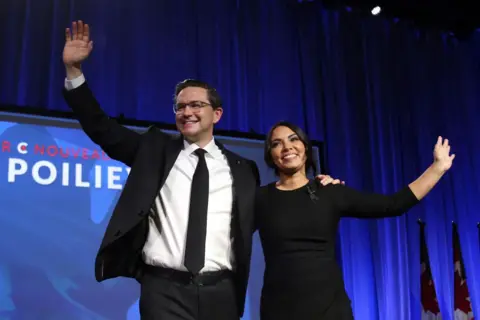
Getty Images Canada's Conservative Party newly elected leader Pierre Poilievre (L) and his wife Anaida wave to supporters during the Conservative Party Convention at the Shaw Centre, Ottawa, Canada on September 10, 2022.Getty Images

Pierre Poilievre with his wife, Anaida, have two young children

From “Skippy” to party leader

In Ottawa, Poilievre was given the nickname Skippy by peers and foes alike due to to his youthful enthusiasm and sharp tongue.

He built a reputation for being “highly combative and partisan”, said Randy Besco, an assistant professor of political science at the University of Toronto.

Behind the closed doors of Conservative caucus meetings, Poilievre showed his diplomatic side, Day said.

“Pierre was always good at saying, ‘Okay, you know what? I hadn’t thought of that,’ or he would listen and say: ‘Have you thought of this?'” said Day.

Still, confrontational politics became a cornerstone of Poilievre’s public persona. After becoming Conservative leader in 2022, he would target Trudeau with biting remarks as a way to connect with disaffected voters.

It has landed him in trouble at times. In April, he was expelled from the House of Commons for calling the prime minister a “wacko”.

Poilievre told the Montreal Gazette in June that he is a fan of “straight talk”.

“I think when politesse is in conflict with the truth, I choose the truth,” he said. “I think we’ve been too polite for too long with our political class.”

His combative style has also been divisive, and he has been criticised for oversimplifying complex issues for political gain.

While Canadians have been open to the opposition leader’s message as a change from Trudeau’s brand of progressive politics, just over half of them hold an unfavourable opinion of him, according to the latest polls.

Poilievre has also had to shift his sights since Trudeau’s resignation announcement, to get ahead of the inevitable match-up between him and the next Liberal leader.

Poilievre on populism, immigration and Trump

The Conservative leader has been described as a “soft” populist for his direct appeals to everyday Canadians and criticism of establishment elites, including corporate Canada.

He came out in support of those who protested vaccine mandates during the 2021 “Freedom Convoy” demonstrations that gridlocked Ottawa for weeks.

He has pledged to deliver “the biggest crackdown on crime in Canadian history”, promising to keep repeat offenders behind bars.

On social matters, Poilievre has rarely weighed in – something Prof Besco said is typical of senior Conservatives, who see these topics as “a losing issue”.

While Poilievre voted against legalising gay marriage in the early 2000s, he recently said it will remain legal “full stop” if he is elected.

The Conservatives also do not support legislation to regulate abortion, though they allow MPs to vote freely on the issue.

“I would lead a small government that minds its own business,” Poilievre said in June.

Amid a public debate in Canada in recent months on immigration, the party has said it would tie levels of newcomers to the number of new homes built, and focus on bringing in skilled workers.

Poilievre’s wife, Anaida, arrived in Canada as a child refugee from Caracas, Venezuela.

The Conservative leader has pushed for the integration of newcomers, saying Canada does not need to be a “hyphenated society”.

One of his major promises – to cut Trudeau’s national carbon pricing programme, arguing it is a financial burden for families – has raised questions over how his government would tackle pressing issues like climate change.

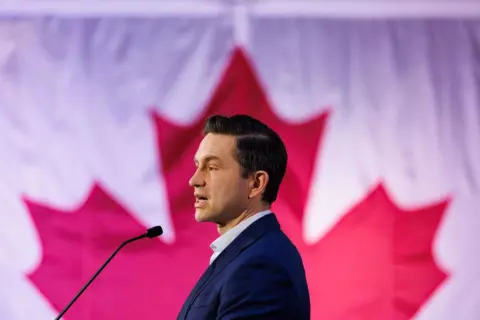
Getty Images Pierre Poilievre, leader of Canada's Conservative Party, speaks during a news conference in Toronto, Ontario, Canada, on Tuesday, Dec. 17, 2024.Getty Images

Poilievre has promised Canadians a return to “common sense politics” and “small government”

Canada also faces the threat of steep tariffs when Trump takes office later this month, with the US-Canada relationship expected to be a major challenge.

Poilievre has pushed back at Trump’s comments suggesting Canada become a 51st US state, vowing to “put Canada first”.

He has not stepped much into foreign policy otherwise, with his messaging focused instead on restoring “the Canadian dream”.

Above all, Poilievre says he wants to do away with “grandiosity” and “utopian wokesim” that he believes has defined the Trudeau era, in favour of the “the things that are grand and great about the common people”.

“I’ve been saying precisely the same thing this entire time,” he told Mr Peterson.


Who Is Hussain Sajwani, the Developer Behind Trump’s $20 Billion Data Center Pledge?

0
Who Is Hussain Sajwani, the Developer Behind Trump’s  Billion Data Center Pledge?


When President-elect Donald J. Trump called Hussain Sajwani to the lectern at Mar-a-Lago on Tuesday to promise a $20 billion investment in the United States, it was a moment for the Dubai developer to savor. For more than a decade, his company, DAMAC Properties, has helped generate millions for the Trump Organization through a partnership in the Middle East.

Those ties appear to have helped open a broad opportunity for Mr. Sajwani as he moves to diversify his empire into the multibillion-dollar market of building data centers needed to meet fast-growing demands for cloud computing and artificial intelligence.

“For the last four years, we’ve been waiting for this moment,” Mr. Sajwani said on the stage. “We’re very, very excited now with his leadership and his open strategy and policy to encourage businesses to come to the U.S.”

The announcement deepens Mr. Trump’s ties with Mr. Sajwani. But it also highlights what critics say are conflicts of interest as Mr. Trump continues to hold on to his real estate business as he prepares for a second term in the White House.

DAMAC Properties is part of the DAMAC Group, one of the biggest developers in Dubai, a city in the United Arab Emirates known for its larger-than-life real estate projects, like a palm-tree-shaped island and the Burj Khalifa, the world’s tallest skyscraper.

Mr. Sajwani, who is sometimes called the Donald of Dubai, leveraged his company into a major player in the Middle East’s luxury real estate market with acquisitions and projects starting in the mid-1990s, when Dubai began allowing foreigners to buy property there.

In 2002, he founded DAMAC Properties to build luxury towers along Dubai’s waterfront that quickly sold out. Mr. Sajwani sealed branding deals with Versace, Fendi and other fashion houses for his properties.

But the company also faced lawsuits in 2010, including one by a German investor who claimed that certain properties had not been delivered on time. That suit was rejected by a Dubai court. In 2011, DAMAC settled three disputes with Egypt over investments there, including one in which a Cairo court had sentenced Mr. Sajwani to jail in absentia.

On its website, the company promotes luxury villas, apartments and hotels from Saudi Arabia to London. During his remarks at Mar-a-Lago on Tuesday, Mr. Sajwani said DAMAC had delivered 47,000 homes and had 33,000 more in the pipeline.

DAMAC said in a news release Tuesday that it was also planning a condo project in Miami valued at an estimated $1 billion, and that it “continues to look for strategic real estate opportunities in the U.S.”

In 2013, Mr. Sajwani teamed up with the Trump family to build the first Trump-branded golf course in the Middle East. Mr. Trump agreed to manage a golf course as part of a DAMAC development.

Under the deals, the Trump Organization licenses the Trump name to DAMAC, which paid Mr. Trump $2 million to $10 million even before the golf courses were built, according to financial disclosure forms filed in May 2016. In 2017, Mr. Trump earned $141,433 in management fees from the deals, according to his financial disclosure from that year.

The Trump International Golf Club opened in 2017, during Mr. Trump’s first term, and is the centerpiece of DAMAC Hills, a gated complex of luxury homes selling for up to $4 million each.

A second Trump-affiliated golf course that DAMAC intended to build inside a resort has been delayed. The project drew scrutiny in 2018 when DAMAC tapped a company controlled by the Chinese government to build part of it.

Mr. Trump’s sons Donald Jr. and Eric attended the wedding of Mr. Sajwani’s daughter in 2018, and during Mr. Trump’s first term, Mr. Sajwani was a familiar face at Mar-a-Lago. Last week, he attended a New Year’s Eve celebration, posting a picture on X of himself next to Mr. Trump and Elon Musk.

If Mr. Trump has profited greatly from his dealings with DAMAC, Mr. Sajwani is set to benefit from his yearslong investment in the president-elect.

In 2021, Mr. Sajwani set up a digital unit, Edgnex Data Centres, a subsidiary of DAMAC, to meet surging global demand for data centers.

Edgnex has sought to expand rapidly across the Middle East, Asia and Europe, and has operations in 10 countries, including Saudi Arabia, which has trained its sights on becoming a dominant player in A.I.

North America has been a blank spot in Edgnex’s portfolio — until Mr. Trump’s announcement that Mr. Sajwani would pour “at least” $20 billion into the United States.

Edgnex said it would develop data centers in eight states, including Texas and Indiana, and is aiming to create data processing capacity that could eclipse projects built by Microsoft and Amazon.

Mr. Trump said he would use the government’s powers once in office to grant DAMAC “expedited reviews” of any federal environmental questions that might emerge, a benefit that Mr. Trump added would be offered to any company planning to invest $1 billion in the United States.


Who Could Replace Justin Trudeau as Canada’s Prime Minister?

0
Who Could Replace Justin Trudeau as Canada’s Prime Minister?


After 12 years leading the Liberal Party of Canada, Prime Minister Justin Trudeau on Monday said he was stepping down. His resignation sets off a succession battle in which some of the party’s most prominent faces will vie to replace him.

In Canada’s political system, the leader of the Liberal Party, as the head of the largest party in the House of Commons, is also prime minister; when Mr. Trudeau’s replacement as party leader is chosen, they will assume the position as well.

That politician will take the party to general elections to face the Conservatives and their leader, Pierre Poilievre, who are dominating public opinion polls. Elections must be held no later than October, but the government, under its new prime minister, is expected to fall long before then through a vote in the House of Commons.

Mr. Trudeau said the Liberal Party would choose his successor through a vote by its members, a relatively small portion of Canada’s population. While no one has yet announced their candidacy to succeed Mr. Trudeau, here are some possible contenders.

The resignation last month of Chrystia Freeland, the former deputy prime minister and finance minister, incited widespread speculation that she would start her own bid to run the Liberal Party.

Ms. Freeland had a successful career in Canada as a senior editor at The Globe and Mail in Toronto and as an international journalist working as a correspondent and newsroom leader for the Financial Times and Reuters. Ms. Freeland, who was born and raised in Alberta, returned to Canada to join Mr. Trudeau’s Liberals in 2013. She is married to a reporter on the Culture desk of The New York Times.

After the Liberals subsequently came to power, she played important roles in resolving several major issues for Mr. Trudeau, in particular negotiating the successor to the North American Free Trade Agreement during the first Trump administration.

On Monday, Mr. Trudeau had kind words for Ms. Freeland, although he declined to share what transpired between them. People familiar with the events surrounding her departure said that Mr. Trudeau had attempted to fire her over a video call and offered her a minister-without-portfolio position, which she declined.

Mélanie Joly has been Canada’s top diplomat since 2021. Mr. Trudeau encouraged her to take the next step in her political career by accepting the foreign affairs role despite her own hesitations: Ms. Joly was concerned about how the job might affect her fertility treatments.

Ms. Joly has brought her own brand of pragmatic diplomacy to the role, reinforcing the importance of Canada working with leaders who have opposing views on foreign policy.

“There’s that movement — which I am profoundly against — which is if you don’t engage with countries, you’re sending a message that you’re strong,” she told The Times. “I think that to be strong is to be able to have the tough conversations.”

Ms. Joly has led Canada’s Indo-Pacific Strategy, but has also confronted challenges. She expelled six Indian diplomats from Canada, and contended with Chinese and Indian foreign interference allegations.

Mr. Trudeau’s team had privately been pursuing Mark Carney, the former governor of the Bank of Canada who also led the Bank of England, to take over for Ms. Freeland as finance minister. Mr. Carney and Ms. Freeland are longtime friends, and he is the godfather of one of her children.

Those efforts to pursue Mr. Carney unraveled after Ms. Freeland’s public rift with Mr. Trudeau and her resignation from cabinet. Since then, Canadian news outlets reported, Mr. Carney has been calling Liberal members of parliament to ask for their support and advice if he were to make a leadership run.

During his time as governor of the Bank of England, Mr. Carney earned a reputation for sermonic talks that veered into the political, including his views on the financial dangers of climate change. In his recent book, “Values,” Mr. Carney offered a withering critique of capitalism and a proposition that markets ought to serve citizens.

Christy Clark was until 2017 the leader of the British Columbia Liberal Party, a smaller party not directly affiliated with the national Liberal Party and which is considered to be politically further to the right.

Ms. Clark served as premier of British Columbia from 2011 to 2017. She left politics that year after her minority government lost a confidence vote.

Ms. Clark, a former radio show host and vocal critic of Mr. Trudeau, has said she would be interested in leading the national Liberals but has not yet confirmed her candidacy.

Dominic LeBlanc, a longtime friend of Mr. Trudeau who became finance minister when Ms. Freeland resigned, was viewed as a front-runner in the leadership race. But he put rumors of a campaign to a rest two days after Mr. Trudeau’s resignation, announcing that he would not seek the nomination. Instead, Mr. LeBlanc said that he intends to run as a member of Parliament under the new Liberal leader in the next federal election.

Mr. LeBlanc was first elected to Parliament in 2000.