Thursday, October 1, 2026
Home Blog Page 6952

As Trump talks up trade war with China, fears rise for rare earths supply | Mining

0
As Trump talks up trade war with China, fears rise for rare earths supply | Mining


Taipei, Taiwan – As United States President-elect Donald Trump gears up for a second trade war with China once he takes office on January 20, the rare earth minerals essential to the production of electronics, vehicles and weapons are one resource expected to be caught up in the fray.

While rare earths are plentiful across the earth’s surface – despite what their name suggests – China controls about 70 percent of their production and 90 percent of processing, according to estimates by the US Geological Survey and the International Energy Agency.

The 17 elements, which include scandium, promethium and yttrium, are used to make everything from smartphones, semiconductors, and EV batteries, to F-35 fighter jets, drones, wind turbines, radar systems and nuclear reactors.

The vulnerability of rare earth supply chains has been a growing concern for governments worldwide in an era of heightened geopolitical tensions.

Last month, China banned exports of gallium, germanium and antimony to the US after the administration of President Joe Biden announced its latest curbs on the sale of advanced chips and machinery to the country.

The move was widely viewed as symbolic as the US has other sources of gallium and germanium.

But it nonetheless marked an escalation in Beijing’s use of rare earths as a tool for geopolitical advantage after declaring rare earths property of the state in October and banning the export of technologies used for extracting and separating the materials late last year.

It also recalled the Chinese government’s decision in 2010 to briefly ban exports of such minerals to Japan amid a maritime border dispute between the sides.

trump
US President-elect Donald Trump speaks during a news conference at Mar-a-Lago in Palm Beach, Florida, the United States, on January 7, 2025 [Evan Vucci/AP]

With Trump pledging to impose a swath of new trade restrictions on China – ranging from a 10 percent tariff on Chinese goods over Beijing’s failure to curb fentanyl exports, to a 60 percent tariff for unfair trade practices – Beijing could further restrict rare earths to respond in kind.

Even if the Chinese government did not retaliate with export bans, Trump’s tariffs would potentially make the minerals much more expensive to obtain.

“Looking ahead 12–18 months, the global geopolitical landscape is rife with wildcards that could in an instant materially impact the outlook for supply chains and the economies they serve,” Ryan Castilloux, a rare earths expert at Canada-based research and advisory firm Adamas Intelligence, told Al Jazeera.

Washington is particularly concerned about rare earths such as neodymium, praseodymium, dysprosium, and terbium, Castilloux said, which are used to make powerful neodymium magnets – also known as NdFeB magnets.

Rare earths and finished products such as rare-earth magnets, which are multiple times stronger than standard magnets, are considered a “vulnerability for US manufacturers and the defence industry” because the US and its allies have yet to develop an alternative source than China, Castilloux said, although projects to produce the minerals are under way elsewhere, including three US states and Estonia.

Washington has made the establishment of a “sustainable mine-to-magnet supply chain” a top priority.

In March, Danielle Miller, acting deputy assistant secretary of defence for industrial base resilience, said efforts to build such a pipeline capable of supporting all US defence requirements by 2027 were “on track”.

Despite plentiful reserves of rare earths in numerous countries, from Angola and Australia to Brazil, Canada and South Africa, expanding the supply chain beyond China is a challenging undertaking.

China has been able to maintain dominance of the industry thanks to its economies of scale, government subsidies, and its accumulation of massive stockpiles that have allowed it to undercut competitors with “irrationally low prices”, said Neha Mukherjee, a senior analyst for critical minerals at Benchmark Mineral Intelligence.

rare earths
Samples of rare earth minerals on display at the Mountain Pass Rare Earth facility in Mountain Pass, California, the United States, on June 29, 2015 [David Becker/Reuters]

Rare earths are by-products of mining other minerals such as iron ore, and they are not produced in predictable quantities. As a result, quantities and therefore prices of different rare earths can vary greatly among the 17 minerals.

Mukherjee said China is focused on keeping rare earth prices stable to support its domestic EV industry, even if doing so comes at the expense of the mining sector.

China’s near-monopoly and unbeatable prices have historically made operating rare earth mines and processing facilities an unattractive proposition for many investors.

“They’re discouraging anyone from becoming a competitor. It just doesn’t make viable economics to develop a mine when you can buy the semi-processed materials at a competitive rate,” Mike Walden, senior director of TechCet, a consulting firm specialising in electronics supply chains, told Al Jazeera.

The timeline is also long, taking 10-20 years from exploration to construction, Walden added.

A watershed moment for US efforts to secure rare earth supplies was the reopening of the Mountain Pass Mine in California’s Mojave Desert – first discovered in the 1870s – by MP Materials in 2018.

The company has since opened a magnet factory in Texas.

Other rare earth-related facilities outside China include a mine in Yellowknife, Canada, a magnet recycler in the US state of Texas, and a rare earth magnet factory in the US state of South Carolina, with more projects in development across North America.

Since 2022, the US Department of Defence and the Department of Energy have awarded more than $440m to rare earth companies, with additional tax credits provided by the Inflation Reduction Act.

Such projects could help the US weather the storm if China cut off exports of rare earths, although the country could still struggle to achieve total self-reliance, said Walden.

“The key point here is there are operational facilities in North America. Is it enough to necessarily support all North American demand? The answer to that is no. Is it enough to support the strategic demand of North America? The answer to that appears to be yes,” he said, referring to Washington’s priority areas such as defence and energy.

China mining
A mining machine at the Bayan Obo mine containing rare earth minerals in Inner Mongolia, China on July 16, 2011 [Reuters/Stringer]

Even as mines have been opened or reopened outside of China, rare earth minerals are still sent there for processing in many cases, analysts said.

China controls 99 percent of the processing of heavy rare earths, a subset of rare earths that are less abundant but nevertheless critical to the production of EVs, wind turbines, and fibre optic cables.

North America is not the only region trying to play catch-up. In January, Brazil’s first rare earth mine at Serra Verde opened for commercial production after 15 years in development.

Europe has rare earth processing facilities in France, Estonia, and Germany, but has yet to open any mines despite holding massive rare earth deposits in Sweden, Finland, Norway and Spain.

Australia also has significant mining and processing facilities in operation, and the government is pouring hundreds of millions into developing more.

Benchmark Mineral Intelligence’s Mukherjee said that such initiatives are still not enough to reduce dependence on China.

“There’s a dire need for a circular economy. There’s a dire need for recycling facilities. There’s a dire need for processed midstream and upstream facilities to develop in the US, and there should be a lot of funding redirected that way,” she said.

Some of the hesitation – particularly in Europe – has been due to the environmental costs associated with rare earth mining and processing, including the separation and removal of the radioactive materials uranium and thorium.

Mining and processing produce large quantities of waste rock and can unleash residual concentrations of rare earths, radionuclides, heavy metals, and acids into the surrounding air, soil and groundwater, according to a 2021 Canadian study.

Australia’s Lynas Rare Earths, the largest rare earth processing company outside of China, was subject to large protests in Malaysia in 2019 over the toxic waste produced by their rare earth processing facilities there.

lynas
A truck carrying rare earths travels towards Lynas Rare Earths’ Mount Weld processing plant, northeast of Perth, in Western Australia, Australia, on August 23, 2019. [Melanie Burton/Reuters]

Analysts say some of these concerns could be overcome with new technology and automation to meet the higher environmental standards demanded by many governments, but this would take time and money.

The industry could, ironically, get a further boost if Beijing were to block its exports, said Adamas Intelligence’s Castilloux.

“The last time China limited rare earth exports, it resulted in years of demand destruction as many end-users looked to reduce their consumption or switch to alternatives in the years to follow,” he said.

“A restriction on magnet exports, even if short-lived, would likely hypercharge government investments into alternative supply chains at home and abroad.”

With days to go until Trump re-enters the White House, there is significant uncertainty about how he might approach the rare earth industry.

During his first presidency, he issued an executive order declaring rare earths to be a national emergency due to the US’s reliance on a “foreign adversary” to acquire them.

Trump is widely expected to roll back environmental regulations that create barriers to opening and operating mines, but he has also expressed opposition to key funding initiatives such as the Inflation Reduction Act and the Bipartisan Infrastructure Law.

Some analysts have expressed concern that Trump could invoke the International Emergency Economic Powers Act to impose tariffs on mineral imports like rare earths, or direct the Secretary of Commerce to open a Section 232 investigation into the national security implications of such imports, like he did for aluminium in 2018, despite their critical importance to the economy.

In the meantime, the industry is preparing for a bumpy road ahead, said Walden, and stockpiling resources accordingly.

“There have been preparations. Everyone’s anticipating, not at cooling off, but actually further escalating. So a tit-for-tat: retaliation, next step, retaliation, next step,” he said.


Moment friends abandon house as Palisades fire closes in

0
Moment friends abandon house as Palisades fire closes in


Tanner Charles and his friend were at home trying to make his house as fire-proof as possible when the Palisades blaze started closing in. They filmed the moment they were forced to leave, running down a street with multiple burning homes.

The Palisades fire, one of several burning in Los Angeles, exploded in size late Tuesday as powerful winds hit northwest Los Angeles. It has already at least 1,000 buildings and forced more than 30,000 residents to evacuate.

President Joe Biden approved a major disaster declaration for California on Wednesday, which will allow residents to have immediate access to funds and resources for their recovery.


Israeli Soldiers on Vacation Are Being Investigated for War Crimes in Gaza

0
Israeli Soldiers on Vacation Are Being Investigated for War Crimes in Gaza


An Israeli reservist left Brazil in a hurry this week after a Brazilian judge ordered an investigation into whether he committed war crimes in Gaza.

Israeli consular officials helped the soldier, Yuval Vagdani, fly out of the country on Sunday after the order became public. It was prompted by a criminal complaint filed by a Belgium-based non-profit group, the Hind Rajab Foundation, which “focuses on offensive legal action against perpetrators, accomplices, and inciters of war crimes and crimes against humanity in Palestine.”

On Wednesday, the Israeli military announced that it would no longer identify soldiers by name in the media, “fearing the arrest of soldiers abroad.”

Mr. Vagdani was deployed in Gaza after the Oct. 7, 2023 attacks by Hamas, which triggered Israel’s invasion of the territory in a campaign aimed at defeating and destroying Hamas.

According to the Hind Rajab Foundation complaint, Mr. Vagdani posted videos and photos to social media from Gaza showing that he had destroyed civilian homes and other buildings. The group claims those actions were a systematic attempt to impose unbearable living conditions on the civilian population, in violation of international law. (The Times has not independently verified that evidence.)

A Brazilian judge determined that the allegations should be investigated, and referred the matter to the federal police. Several similar criminal complaints have been filed against vacationing Israeli soldiers in recent months, including in Cyprus, Sri Lanka, Argentina and Chile.

Mr. Vagdani, whom the Times was unable to reach for comment, arrived in Israel on Wednesday.

In an interview with Kan, Israel’s public broadcaster, he acknowledged posting the video of a building being blown up. “That’s what they saw and wanted to investigate me about,” he said. “They turned it from one house into 500 pages, they thought I’d murdered thousands of children and who knows what.”

Mr. Vagdani also told Kan he was at the Nova music festival near the Gaza border on Oct. 7, 2023 and escaped the massacre there.

Israeli officials downplayed the seriousness of the cases, noting that none of the criminal complaints had led to arrests. “We understand that part of this phenomenon is driven by pro-Palestinian activists and based on open source intelligence,” said Lt. Col. Nadav Shoshani, a spokesman for the Israeli military.

The open source methods in question are social media posts, which pro-Palestinian groups are now using as evidence to request criminal charges against the soldiers when they travel abroad.

The combination of social media and international tourism — plus a very old body of law — could open up a new arena in international criminal law.

Universal jurisdiction, one of the oldest principles of international law, holds that certain crimes are so serious that any country in the world can bring a criminal case against the perpetrators. In the 18th century, that rule was used for crimes like piracy; in recent times, it has been used to prosecute genocide and war crimes.

Israel relied on universal jurisdiction to prosecute Adolf Eichmann, a senior Nazi official, for crimes against humanity committed during the Holocaust. Spain relied on it to demand the extradition of Augusto Pinochet, the former Chilean dictator, to face charges of torture and other crimes. And in more recent examples, several European countries have relied on the principle to try Syrian officials for war crimes and crimes against humanity. Belgium has prosecuted Rwandans accused of involvement in the 1994 genocide in its courts.

For decades, those cases have been relatively rare, and tended to target senior officials. “There has been this tendency to focus on the higher levels in order to maximize impact, and also because at the higher levels sometimes actually the conduct is better documented than the lower levels,” said Yuval Shany, a professor of international law at Hebrew University in Jerusalem.

It was once difficult for a local prosecutor to obtain evidence of a war crime allegedly committed in another country. That changed with social media. “Technology comes to bridge the gap, because once you have filmed, documented yourself committing a war crime, it’s much easier to prosecute you, even in a court which is half the world away,” Mr. Shany said.

Experts say Israeli soldiers have uploaded videos and other images of themselves in Gaza saying and doing things that could be interpreted as evidence of serious crimes, including destroying civilian homes and property, and calling for the expulsion or extermination of Palestinians.

While social media clips can be taken out of context or misinterpreted — and Israel has accused Hamas of using civilian infrastructure for military purposes — “some of them do look very bad,” Mr. Shany said. “There is this potential degree of accountability that we have not seen before in wars, simply because it was too difficult to generate evidence.”

However, while social media evidence is compelling, it is unlikely to be enough on its own to secure a successful prosecution, said Rebecca Hamilton, a law professor at American University and former lawyer in the office of the prosecutor for the International Criminal Court: “A social media post doesn’t make a war crimes case.”

The Hind Rajab Foundation claims to have compiled evidence against about a thousand Israeli soldiers. It also tracks their foreign travels on social media as they post about their vacations, and then promptly files criminal complaints with the countries they are visiting.

Dyab Abou Jahjah, the chairman of the Hind Rajab Foundation, said that soldiers who uphold international law have nothing to fear from his organization. “We are not organizing a witch hunt against Israeli soldiers,” he said. “We file cases against soldiers against whom we have evidence that they are individually responsible for war crimes.”

Unlike more senior leaders, lower-level soldiers do not usually have diplomatic immunity, or the resources to research which jurisdictions may leave them vulnerable to war crimes complaints.

Of course, an NGO filing a criminal complaint is not the same thing as a prosecutor actually pressing charges, much less an arrest or conviction.

The Israeli government has taken actions that suggest it is concerned about the criminal complaints. The government, which insists that its forces in Gaza have acted in accordance with international law, has formed an interagency team to assess legal risk for soldiers and reservists abroad. And the ministry of foreign affairs recently issued a public warning to Israelis that their posts on social media could be used to bring legal actions against them in other countries.

These cases may not need to see a courtroom, or even result in arrests, to have an impact. The prospect that soldiers might be unable to travel abroad without risking prison is one that the public may find difficult to tolerate.

Traveling abroad is tremendously important to Israelis, said Mr. Shany. “So I think there is this idea that this is actually an unacceptable risk, and that the government-slash-military has to make it go away.”

Isabel Kershner and Aaron Boxerman contributed reporting from Israel, Ephrat Livni contributed reporting from Washington, D.C., and Jack Nicas contributed reporting from Brazil.


Thank you for being a subscriber

Read past editions of the newsletter here.

If you’re enjoying what you’re reading, please consider recommending it to others. They can sign up here. Browse all of our subscriber-only newsletters here.

I’d love your feedback on this newsletter. Please email thoughts and suggestions to interpreter@nytimes.com. You can also follow me on Twitter.


What Trudeau’s Resignation Means for Canada

0
What Trudeau’s Resignation Means for Canada


By suspending Parliament and promising to resign, the prime minister bought the Liberals time. But Canada will now face Donald Trump with a lame duck in charge.


France Far-Right Party Embraces Jean-Marie Le Pen as a Visionary

0
France Far-Right Party Embraces Jean-Marie Le Pen as a Visionary


For years, France’s main far-right party tried to distance itself from the long trail of inflammatory and derogatory comments made by Jean-Marie Le Pen, its founding president.

His daughter, who took the party reins in 2011, kicked him out. It changed its name, from National Front to National Rally. And the party — long run by Mr. Le Pen, who called Hitler’s gas chambers “a detail” of history — has made a point of decrying antisemitism.

But when Mr. Le Pen died on Tuesday at 96, the party nuzzled him deeply in its fold, its leaders celebrating him as a visionary, an “immense patriot” and a “courageous and talented politician.”

“He will remain the one who, in the storms, held in his hands the small flickering flame of the French Nation,” the National Rally said in a statement, adding that his “will and unwavering tenacity” had shaped the party into an “autonomous, powerful and free” force.

There was nothing in the statement to indicate disagreement with Mr. Le Pen’s views or his caustic remarks. At most, it said he had been “unruly and sometimes turbulent,” often fond of controversy.

Jean-Yves Camus, an expert on the far right at the Jean-Jaurès Foundation, said that the strategy of Marine Le Pen, Mr. Le Pen’s daughter and successor, “was always to set herself apart without taking full stock” of her father’s unsavory legacy. It was too early to tell whether she might yet do so now, he said.

“A venerable age had taken the warrior but given us back our father” Ms. Le Pen, who is no longer party president but still a top lawmaker and leading force in the party, said in a short tribute on Wednesday. “Death has taken him back.”

So far, the party does not appear to be headed down a path of deep introspection. Instead, Mr. Camus said, it seems to be trying to “re-inject” a new version of Mr. Le Pen into France’s collective memory, safe in the knowledge that there will be no more racist or antisemitic outbursts from him.

But Renaud Labaye, the National Rally’s general secretary in the lower house of Parliament, said the party had already weighed in on Mr. Le Pen’s past.

“It was precisely his expulsion — an act made all the stronger by the fact that it was initiated by his daughter and that he was the party’s founder — that underlined the fact that his excesses and reprehensible positions were firmly condemned by the party,” Mr. Labaye said.

For decades, Mr. Le Pen was a pariah of French politics, considered so odious that many opponents refused to debate him. That had much to do with the party’s history: Its founders in 1972 included former Nazi soldiers, collaborators with the wartime Vichy regime and onetime members of a group that carried out deadly attacks meant to thwart Algeria’s struggle to free itself from French colonial rule.

Mr. Le Pen’s openly racist, antisemitic and anti-gay comments cemented the public’s perception of the party.

Mr. Le Pen, who was in paratrooper units in two colonial wars to suppress the independence movements in Vietnam and Algeria, once said that races “do not have the same abilities, nor the same level of historical evolution,” and he was repeatedly convicted of making antisemitic comments and publicly downplaying the Holocaust. He once compared homosexuality to pedophilia.

In 2002, after Mr. Le Pen surprised many by making it to the second round of the presidential election, left-wing parties called on their members to vote for his conservative opponent, Jacques Chirac. This was the most famous use of a strategy known in French politics as a “republican front,” which has since been used multiple times to stop the far right from taking power.

In that 2002 election, Mr. Le Pen won less than 18 percent of the vote. But when his daughter took over, she began what became known as an “undemonization” strategy, to cleanse the party’s image and broaden its appeal.

She distanced herself from her father’s antisemitic statements, declaring concentration camps “the height of barbarity.” She ousted her father from the party in 2015, when he was its honorary president, and said his repeated Holocaust denial showed that “his goal is to cause harm” to the party. Three years later, she renamed it.

Now the National Rally — after riding successive waves of fear and anger over unchecked immigration, rising inflation and deadly terrorism — is no longer on the fringes of French politics, with some of its policies more widely accepted.

Last summer, during a snap election, another republican front between left-wing and centrist parties prevented a far-right victory. Still, a record 124 National Rally lawmakers now sit in the powerful lower house of Parliament, making it the largest single opposition party.

Though Ms. Le Pen has softened some of the party’s initial hard-line stances, its bedrock focus on identity and its eagerness to change the French Constitution to restrict the rights of foreigners mark it in France as a far-right party, according to experts. Party members argue, for instance, that French people should have priority over even legal migrants in areas like certain social benefits and subsidized housing. That runs counter to the French constitution and Republican ideals, set during the revolution of 1789, which make all people equal, Mr. Camus said.

Many experts have characterized Ms. Le Pen’s “undemonization” campaign as mere marketing, and in the election last summer, many National Rally candidates were castigated for past racist or antisemitic remarks.

Some analysts said the party had no choice but to recognize Mr. Le Pen’s integral role in building its long-lasting, stable and successful movement, which is still dominated by his family.

But the party’s glowing remembrance of Mr. Le Pen was also a way to recast his image — and its own, some experts said.

“Paying tribute to Le Pen ‘undemonizes’ the party even further” by portraying him as an excessive but prescient politician, unfairly condemned for warning about the dangers of immigration, said Nicolas Lebourg, a historian who specializes in the far right.

“People who voted for the first time last year have almost no memory of him,” Mr. Lebourg said.

The tributes, from the party and others, are also evidence that Mr. Le Pen’s ideas — like drastically stemming immigration — are increasingly part of the mainstream.

“The importance that Jean-Marie Le Pen has had in our political life is the consequence of long years of denial and powerlessness on the migration issue,” wrote François-Xavier Bellamy, the leader in the European Parliament of the mainstream conservative Republican party, which historically despised Mr. Le Pen and was thrown into turmoil last year when its then-leader advocated an alliance with the National Rally.

“Those who insult him even in death refuse to first look at their failures,” Mr. Bellamy said.

In an interview with The New York Times in 2018, Mr. Le Pen assessed his own influence: “My ideas have made progress, even in the programs of my opponents,” he said. “That’s why my struggle was not without value.”

Even in death, however, he retains many political enemies, especially on the left. Crowds of hundreds gathered in several cities across France to celebrate his death Tuesday night.

“No, he was not a ‘great servant of France,’” wrote Manuel Bompard, national coordinator for the far-left party France Unbowed. “He was an enemy of the Republic.”

And Mélanie Vogel, a Green party senator, said on X: “His ideas, the danger they represent for our democracies are very much alive. Let us finally defeat his heirs.”

Mr. Le Pen’s long life and political career encompassed the sweep of postwar French history. Even the Élysée Palace, home and office of the French president, who has fought to keep the far right out of power, acknowledged as much, noting in a statement Mr. Le Pen’s five runs for president, his seven terms as a lawmaker in the European Parliament and his roles as a municipal and regional councilor.

“A historic figure of the extreme right,” the statement said, “he played a role in the public life of our country for almost 70 years, which is now a matter for history to judge.”

Ségolène Le Stradic contributed reporting.


Rebel leader tells Al Jazeera they’re ‘fighting for survival’ in DR Congo

0
Rebel leader tells Al Jazeera they’re ‘fighting for survival’ in DR Congo


M23 leader Bertrand Bisimwa has told Al Jazeera that the rebel group’s fight in eastern DR Congo is one for survival.


Where is the territory and who controls it?

0
Where is the territory and who controls it?


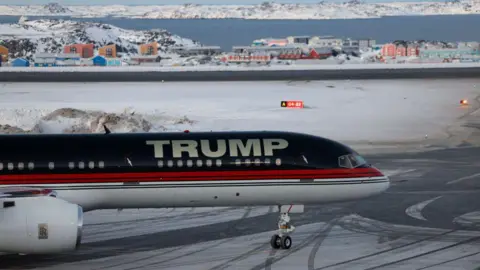
Getty Images An aircraft carrying President-elect Donald Trump's son, Donald Trump Junior, arrives in Nuuk, Greenland on 7 January 2025. Colourful buildings and snow are visible in the background.Getty Images

An aircraft carrying President-elect Donald Trump’s son, Donald Trump Junior, arrives in Nuuk, Greenland on 7 January 2025

US President-elect Donald Trump has repeated his intention to take control of Greenland, the Arctic territory controlled by Denmark.

Why is Trump talking about this – and why now?

Where is Greenland?

Greenland, the world’s largest island, is located in the Arctic.

It is the world’s most sparsely populated territory. About 56,000 people live there, mostly indigenous Inuit people.

About 80% of its territory is covered by ice, meaning most people live on the south-western coast around the capital, Nuuk.

An autonomous territory of Denmark, it is also home to Danish and US military bases.

The economy is mainly based on fishing. Large subsidies from the Danish government account for about a fifth of GDP.

In recent years, there has been increased interest in Greenland’s natural resources, including mining for rare earth minerals, uranium and iron. These may become more accessible as global warming leads to some of the ice covering Greenland to melt.

What is Greenland’s status?

Located geographically within North America, Greenland has been controlled by Denmark – nearly 3,000km (1,860 miles) away – for about 300 years.

The island was governed as a colony until the mid-20th Century. For much of this time, it remained isolated and poor.

In 1953, it was made part of the Kingdom of Denmark and Greenlanders became Danish citizens.

In 1979, a referendum on home rule gave Greenland control of most policies within the territory, with Denmark retaining control over foreign affairs and defence.

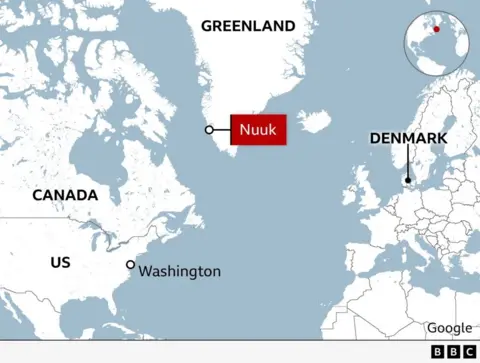
A map showing Greenland’s location relative to Canada, the United States, and Denmark, with Nuuk highlighted as the capital of Greenland. An inset globe marks Greenland’s position in the Arctic region.

Why does Greenland matter to the US?

The US has long maintained a security interest in Greenland. After Nazi Germany occupied mainland Denmark during World War II, the US invaded Greenland, establishing military and radio stations across the territory.

After the war, US forces remained in Greenland. Pituffik Space Base, formerly known as Thule Air Base, has been operated by the US ever since.

In 1951, a defence agreement with Denmark granted the US a significant role in the defence of the territory, including the right to build and maintain military bases.

“If Russia were to send missiles towards the US, the shortest route for nuclear weapons would be via the North Pole and Greenland,” said Marc Jacobsen, an associate professor at the Royal Danish Defence College.

“That’s why the Pituffik Space Base is immensely important in defending the US.”

China and Russia have begun building up their Arctic military capabilities in recent years, according to an Arctic Institute paper. The paper called for the US to further develop its presence in the Arctic to counter its rivals.

On Wednesday, Danish Foreign Minister Lars Lokke Rasmussen said Denmark was open to discussions with the US, adding that Washington had “legitimate” interests in the region.

“We see a Russia that is arming itself. We see a China that is also starting to take an interest,” Rasmussen said.

Trump is also likely interested in the mining potential across Greenland’s vast landmass, Mr Jacobsen added.

“Today, of special interest are the rare earth minerals, which have not yet been mined but are in the southern part of Greenland. These are immensely important in all kinds of technologies, from cell phones to wind turbines.”

Does the US want full control of Greenland?

Trump has claimed that control of Greenland is essential to US national and economic security.

Though the president-elect’s rhetoric may seen unusual, for over a century a succession of US presidents have tried to gain control of Greenland.

“The US has tried a few times to push the Danes out of Greenland and take it over as part of the US, or at least to have full security tutelage of Greenland,” said Lukas Wahden, the author of 66° North, a newsletter on Arctic security.

In 1867, after buying Alaska from Russia, US Secretary of State William H Seward led negotiations to buy Greenland from Denmark, but failed to reach any agreement.

In 1946, the US offered to pay $100m (equivalent to $1.2bn; £970m today) for the territory, judging that it was vital for national security, but the Danish government refused.

Trump also tried to buy Greenland during his first term. Both Denmark and the Greenlandic government rejected the 2019 proposal, saying: “Greenland is not for sale.”

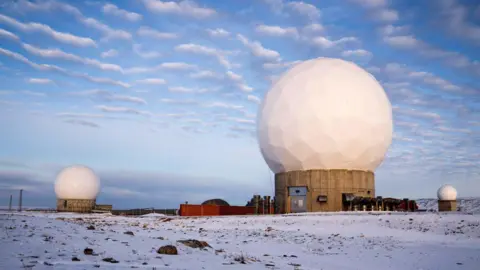
Getty Images A remote Arctic landscape in northern Greenland, featuring the Pituffik Space Base (formerly Thule Air Base). The image shows three massive white geodesic radar domes positioned on a snow-covered plain. The largest dome is centrally located on a concrete structure, surrounded by other domes.Getty Images

Pituffik Space Base, formerly known as Thule Air Base, has been operated by the US since World War Two

What do the people of Greenland think?

Kuno Fencker, a member of the Inatsisartut, the Greenlandic parliament, said on Wednesday that he didn’t see Trump’s comments as a threat.

Fencker, who supports Greenlandic independence, told the BBC that a sovereign Greenland could choose to co-operate with the US on defence.

But when Trump first raised the idea of buying Greenland in 2019, many locals told the BBC they were opposed to the proposal.

“This is a very dangerous idea,” said Dines Mikaelsen, a tour operator who was born and raised in Tasiilaq, east Greenland.

“He’s treating us like a good he can purchase,” said Aleqa Hammond, Greenland’s first female prime minister.

“He’s not even talking to Greenland – he’s talking to Denmark about buying Greenland.”


Israeli Strike in West Bank Kills 3, Including Children, Official Says

0
Israeli Strike in West Bank Kills 3, Including Children, Official Says


An Israeli drone strike killed three cousins, including two children, in the West Bank on Wednesday, according to the local Palestinian governor and a relative, as growing violence threatens to further destabilize the Israeli-occupied territory.

The attack struck the courtyard of the cousins’ home in the town of Tamoun, said Ahmed Asad, the Palestinian governor of the Tubas region. He identified the dead as two young children, Rida Basharat and Hamza Basharat, and Adham Basharat, a young adult.

Mr. Asad said that Israeli officials later informed their Palestinian counterparts that all three were dead.

The Israeli military said it launched a drone strike in Tamoun against a “terrorist cell,” but did not immediately comment on reports in Palestinian media that two children were killed. It later released a statement saying that “due to various reports regarding the results of the strike, the incident is under review.”

Their immediate families could not immediately be reached, but Mamun Abu Muhsin, a member of their extended family, confirmed their deaths in a phone interview on Wednesday night after he said their bodies were returned by Israeli forces.

Violence has spiraled in the West Bank for the past year and a half, as Israel has fought wars with armed groups like Hamas in Gaza and Hezbollah in Lebanon. Israeli forces have escalated raids in Palestinian cities in the West Bank — operations that can last for days at a time — bulldozing roads and engaging in shootouts with Hamas and Palestinian Islamic Jihad militants.

Wednesday’s aerial bombardment came in the wake of a Palestinian shooting attack two days earlier that killed three Israelis, including two women in their 70s. Israeli officials quickly vowed retribituion for the deadly attack.

“We are witnessing accelerating attempts to advance Palestinian terrorism in Judea and Samaria,” said Israel Katz, the Israeli defense minister, on Wednesday, using the biblical names for the West Bank, which the Israeli government considers disputed, not occupied, territory. He said that Israel would “respond accordingly” to protect its citizens, roughly 500,000 of whom live in settlements in the West Bank.

More than 800 Palestinians have been killed by Israeli forces in the occupied West Bank since October 2023, in the wake of the Hamas-led attack that prompted the war in Gaza, according to the Palestinian Authority Health Ministry. It is unclear how many were combatants, but the numbers include some civilians, including women and children killed by Israeli security forces.

About 50 Israelis were killed by Palestinians in militant attacks in the West Bank over the same time, according to the United Nations. Shin Bet, Israel’s internal security agency, has said that it thwarted more than a thousand attacks in 2024, including hundreds of shooting attacks.

The Palestinian Authority, which administers some parts of the territory under Israeli occupation, also launched its own operation against Palestinian militants in Jenin in December. Several Palestinian officers have been killed, as well as some civilians, including a young woman and a teenage bystander.


Justin Trudeau’s Political Career in Photos

0
Justin Trudeau’s Political Career in Photos


The image of Prime Minister Justin Trudeau receiving a vaccine against the coronavirus, like those of other world leaders, was meant to convey a reassuring public health message. It also put prim and buttoned-up politicians in the rare, if sometimes awkward, position of showing more skin.

When Mr. Trudeau rolled up his sleeve, it exposed his tattoo: an image of a globe inside a Haida raven, an Indigenous symbol.

Mr. Trudeau was Canada’s second-youngest leader when he took power in 2015. The heir to the political legacy left by his father, who served as prime minister for about 15 years, Mr. Trudeau burst onto the world stage and captured Canada’s imagination, with a head of flowing hair and signature cool socks.

He was a magnet for the cameras and, at times, appeared in the society pages nearly as often as in the news sections. Being so heavily photographed also, of course, had its down sides. His tattoo, initially praised by Indigenous people in British Columbia, later became a source of scorn after the government approved a natural oil and gas project near their traditional fishing grounds.

On Monday, after almost a decade in office, Mr. Trudeau, who became deeply unpopular among many voters unhappy over pocketbook issues, stepped down as leader of the Liberal Party and his role as prime minister will soon end. Here are some of the images that defined his career.

Credit…Andy Clark/Reuters

Prime Minister Pierre Elliott Trudeau greeting his sons, from left; Justin, Sacha and Michel, after returning home from a foreign trip. Michel, Mr. Trudeau’s youngest brother, died in an avalanche while backcountry skiing in British Columbia in 1998. Grief shattered his father’s life, Mr. Trudeau wrote in his 2014 memoir: “From the time we buried Michel until his own passing two years later, my father was never the same man.”

Vjosa Isai contributed reporting from Toronto.


Italy Says Cecilia Sala, Journalist Detained by Iran, Has Been Released

0
Italy Says Cecilia Sala, Journalist Detained by Iran, Has Been Released


Cecilia Sala, an Italian journalist who was detained last month in Iran while on a reporting trip, was released and on her way back to Italy on Wednesday, the Italian government said in a statement.

Ms. Sala, who had a journalist visa, was arrested on Dec. 19 on charges of violating the laws of the Islamic Republic of Iran, but officials there have not provided any further details.

“The plane that is taking journalist Cecilia Sala home took off a few minutes ago from Tehran,” the Italian government announced Wednesday morning, adding that “thanks to intense work on diplomatic and intelligence channels, our compatriot has been released by the Iranian authorities.”

Ms. Sala, 29, had been held for 20 days and told her family that she was kept in an isolation cell, with only two blankets and constant light, her family has said.

Fars, a news agency affiliated with Iran’s Islamic Revolutionary Guards Corps, also reported the news of Ms. Sala’s release, citing Italy’s prime minister.

On Wednesday Ms. Sala’s partner, Daniele Raineri, said she had called him and told him, “I am free.”

“I am so happy,” Mr. Raineri said as he prepared to go to the airport to greet Ms. Sala. He said the wait was “excruciating” but that Italy had done “exceptional work.”

It was unclear how Italy obtained the release of Ms. Sala.

She was taken into custody three days after the police in Milan arrested Mohammad Abedini Najafabadi, a 38-year-old Iranian, on behalf of the United States. Mr. Abedini was accused by the United States of providing drone components to the Revolutionary Guards — the country’s primary military force.

The Iranian authorities said on Dec. 25 they expected “the Italian government to prevent the violation of the human rights of the Iranian citizen who has been unjustly accused by the United States.”

Iran has often jailed foreigners and dual nationals to extract concessions from their countries, including prisoner swaps, but Iranian officials said on Monday that there had been no connection between Mr. Abedini’s arrest and Ms. Sala’s.

On Wednesday, Mr. Abedini’s lawyer in Italy, Alfredo De Francesco, did not respond to questions about developments on Mr. Abedini’s case. He said he was happy about Ms. Sala’s release and now needed to focus on his client’s case.

Ms. Sala’s visit to Iran was her first since 2021, and since then, much had changed in the country. A new president had been elected, its shadow war with Israel had moved into the open, and Bashar al-Assad, the president of Syria and a longtime ally, had recently been ousted.

Ms. Sala, 29, a writer and podcaster, set out to document the shifting atmosphere. She interviewed a standup comedian, and she photographed women in cafes and on the streets who were not wearing head scarves, posting a selection of images on Instagram last month and describing them as “Tehran’s new faces and new streets.”

On Dec. 19, as she prepared to leave her hotel for a meeting at about midday, her phone was disconnected from the internet, a person close to the family said. For 24 hours, her family did not hear from her, until after the plane on which Ms. Sala was supposed to depart took off without her. Then, they received a phone call. “I was arrested,” Ms. Sala told her family. “I am not wounded.”

The news of Ms. Sala’s detention became public about a week later, on Dec. 27, after she received a visit from Italy’s ambassador to Iran. The detention of Ms. Sala dominated media coverage in Italy, and President Sergio Mattarella mentioned her case in his end of year message.

Mr. Raineri said that Ms. Sala’s plane was scheduled to land in Rome on Wednesday.

Prime Minister Giorgia Meloni of Italy called Ms. Sala’s parents on Wednesday to tell them that she was returning, according to the government statement.

Leily Nikounazar contributed reporting.