

Thursday, October 1, 2026
Home Blog Page 6953

Europe will not allow attacks, says France, after Trump Greenland threat

0
Europe will not allow attacks, says France, after Trump Greenland threat


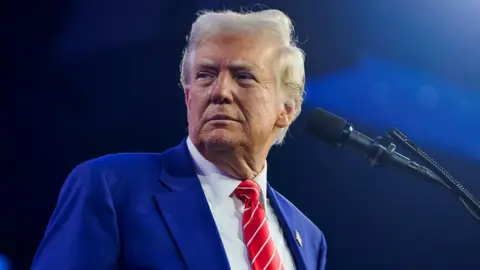
Reuters Donald Trump stood on a podiumReuters

Donald Trump said Greenland was “critical” for the US’s national and economic security (file photo)

France has said the European Union will not allow other nations to attack its “sovereign borders”, after US President-Elect Donald Trump refused to rule out using military force to seize Greenland.

On Tuesday, Trump reiterated his desire to acquire the autonomous Danish territory, saying it was “critical” for national and economic security.

French Foreign Minister Jean-Noël Barrot told French radio “there is obviously no question that the European Union would let other nations of the world attack its sovereign borders, whoever they are”.

Barrot said he did not believe the US was going to invade the vast Arctic island, but he was clear the EU should not let itself be intimidated.

Denmark, a long-time US ally, has repeatedly made clear that Greenland is not for sale and that it belongs to its inhabitants.

Greenland’s prime minister, Mute Egede, is pushing for independence and has also made clear the territory is not for sale. He was visiting Copenhagen on Wednesday.

Trump made the remarks at a free-wheeling news conference at his Mar-a-Lago estate in Florida, less than two weeks before he is sworn in for his second term as president.

Asked if he would rule out using military or economic force in order to take over Greenland or the Panama Canal, Trump said: “No, I can’t assure you on either of those two.

“But I can say this, we need them for economic security.”
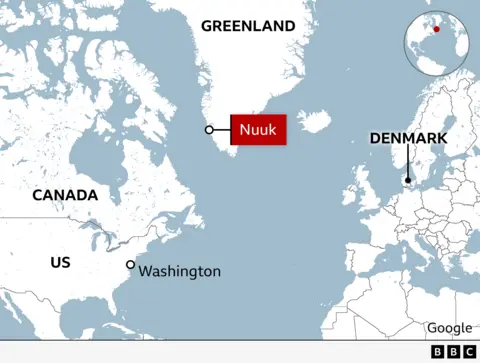
Map of Greenland next to North America and Europe

Greenland has been home to a US radar base since the Cold War and has long been strategically important for Washington.

Trump suggested the island was crucial to military efforts to track Chinese and Russian ships, which he said are “all over the place”.

“I’m talking about protecting the free world,” he told reporters.

Speaking to France Inter radio, Barrot said: “If you’re asking me whether I think the United States will invade Greenland, my answer is no.

“Have we entered into an era that sees the return of the survival of the fittest? Then the answer is yes.

“So, should we allow ourselves to be intimidated and overcome with worry, clearly not. We must wake up, build up our strength.”

Danish Prime Minister Mette Frederiksen told Danish TV on Tuesday that “Greenland belongs to the Greenlanders” and that only the local population could determine its future.

However, she stressed Denmark needed close co-operation with the US, a Nato ally.

Reuters A Trump private plane on a landing strip in GreenlandReuters

Donald Trump JR visited Greenland on Tuesday in what he called a “personal day trip”

Greenland, which is the largest island in the world but has a population of just 57,000, has wide-ranging autonomy, although its economy is largely dependent on subsidies from Copenhagen and it remains part of the kingdom of Denmark.

It also has some of the largest deposits of rare earth minerals, which are crucial in the manufacture of batteries and high-tech devices.

Danish Broadcasting Corporation senior international correspondent Steffen Kretz, who has been reporting in Greenland’s capital, Nuuk, said most of the people he had spoken to were “shocked” by Trump’s suggestion he could use military force to take control of the territory.

While a majority of people in Greenland hoped for independence in the future, he said there was widespread acknowledgment that it needed a partner who could provide public services, defence and an economic foundation, as Denmark did now.

“I have yet to meet a person in Greenland who is dreaming of the island becoming a colony for another outside power like the USA.”

Kretz told the BBC that while the Danish government had sought to “downplay” any confrontation with Trump, “behind the scenes I sense the awareness that this conflict has the potential to be the biggest international crisis for Denmark in modern history”.

The president-elect’s son, Donald Trump Jr, paid a brief visit to Greenland on Tuesday, in what he described as a “personal day trip” to talk to people.

He then posted a photo with a group of Greenlanders in a bar wearing pro-Trump caps.


With Stakes High, Lebanese Lawmakers to Try Again to Choose a President

0
With Stakes High, Lebanese Lawmakers to Try Again to Choose a President


Lebanon’s deeply divided Parliament is set Thursday to try to elect a new president, potentially ending a yearslong political vacuum and ushering in a degree of stability for a country reeling from its bloodiest war in decades.

For more than two years, the tiny Mediterranean nation has been paralyzed by political gridlock and led by a weak caretaker government through a series of upheavals, including a historic economic collapse, a destructive war between Israel and the Lebanese militant group Hezbollah and the collapse of the Assad regime in neighboring Syria.

Lebanon’s election of a president would be the first step in forming a full-fledged government with a mandate to steady the country. But, despite the urgency, it remains unclear whether anyone will be elected at all.

The country’s Parliament is fractured along sectarian lines and lawmakers have failed in 12 previous votes to elect a new president since October 2022, when Michel Aoun stepped down from the office at the end of his six-year term.

The vote on Thursday could be no different. Lebanon is facing diplomatic pressure by the United States and other foreign donors who have hinged postwar financial support on the election of a president. But it is not clear that the leading candidate, Joseph Aoun, the U.S.-backed commander of the Lebanese military (and unrelated to the former president), will receive enough votes to be elected.

“This election is about Lebanon basically reaching a necessary milestone in its much-needed recovery,” said Lina Khatib, an associate fellow at Chatham House, a London-based research organization. “However, the reality is that Lebanon’s various political stakeholders are nowhere near reaching the consensus needed to agree on who will be the next president — even in this very critical period.”

“The stakes are higher than ever,” said Ms. Khatib.

The 14-month war between Israel and Hezbollah has left swathes of the country in ruin with little money to finance reconstruction. The World Bank estimates that the war has cost $8.5 billion in damages alone. Lebanon’s security situation also remains volatile, and the government that eventually takes shape will need to steer the country through a fragile 60-day cease-fire that diplomats hope will become permanent.

For over two years, Lebanon’s stalemate has paralyzed state institutions and exacerbated the country’s already crippling economic malaise. Hezbollah, the dominant political force in Lebanon, has long been considered one of the main stumbling blocks by many in the country. The group scuttled a bid last year to elect a top International Monetary Fund official as Lebanon’s president by walking out of the vote.

In the run-up to the coming election, Hezbollah appears to be showing some signs of flexibility, although it remains to be seen how the vote will play out. On Sunday, a senior official in the group, Wafiq Safa, signaled that it would not veto Mr. Aoun’s candidacy as many feared.

“They have calculated that they are still powerful, but they will have to make some concessions,” said Paul Salem, the vice president for international engagement at the Middle East Institute in Washington. “Now, they need massive and large-scale foreign aid, and they also need a legitimate state within which to exist — within which to protect themselves.”

“The first building block is to elect a president,” said Mr. Salem.

The Lebanese Parliament’s 128 members elect a president via a secret ballot, a process marred in recent years by walkouts. In the first round, a two-thirds majority is required, an outcome that analysts have called unlikely for Thursday. In subsequent rounds, however, a simple majority will suffice.

If a president is elected on Thursday, he would then appoint a prime minister, in consultation with Parliament, who will then be tasked with forming the government. That is likely to be a long process, and the resulting executive body will ultimately be left with the herculean task of reviving the crisis-hit nation.

The Parliament speaker, Nabih Berri, a key Hezbollah ally, said in an interview with local media last week that he was determined to elect a president on Thursday. He has pledged to keep voting open until a candidate is agreed upon.

Mr. Berri conceded however that there was not yet any consensus on who that candidate would be, marking a departure from previous elections where stakeholders normally reach an informal agreement before the vote itself.

Amid the mounting uncertainty, Lebanon’s prime minister, Najib Mikati, who has become the beleaguered face of the country’s caretaker government, struck an optimistic tone on Tuesday during a speech in Beirut.

“It is our destiny to overcome difficulties together and to face all the crises that confront us hand in hand,” he said.


Why Does Trump Want the Panama Canal? Here’s What to Know

0
Why Does Trump Want the Panama Canal? Here’s What to Know


President-elect Donald J. Trump on Tuesday refused to rule out using military force to retake the Panama Canal, which was returned by the U.S. to that country’s control decades ago.

Last month, Mr. Trump falsely accused Panama of allowing Chinese soldiers to control the vital shipping route, which connects the Atlantic and Pacific Oceans, and of overcharging American ships.

He has also claimed Panama charges U.S. vessels “exorbitant prices,” and warned that if they are not reduced after he takes office next month, he will demand that the United States be granted control of the canal “in full, quickly and without question.”

While it is unclear what prompted Mr. Trump’s recent obsession with the Panama Canal, some Republicans have long objected to a decades-old treaty that turned the shipping lane over to Panamanian control. When Ronald Reagan ran for president, he said the people of the United States were the canal’s “rightful owners” and brought audiences to their feet with the line: “We bought it; we paid for it; we built it.”

After a failed attempt by the French to construct a canal, it was ultimately built by the United States between 1904 and 1914. And the U.S. government managed the canal for several decades.

The U.S. also played a role in the creation of the state of Panama. At the beginning of the 20th century, the isthmus of Panama was part of Colombia. When Colombia rejected a proposed canal treaty, the U.S. government encouraged a rebellion. Colombia’s northern provinces eagerly seceded, forming the Republic of Panama. The United States Navy then kept Colombian troops from suppressing the rebellion.

U.S. control of the canal created significant tensions with Panama. In 1964, anti-American riots broke out in the U.S.-controlled canal zone.

The riots led to the renegotiation of the Panama Canal treaties. In 1977, U.S. President Jimmy Carter and the Panamanian leader Omar Efraín Torrijos signed the Torrijos-Carter Treaties. The agreements guaranteed the permanent neutrality of the Panama Canal. After a period of joint custody, the treaties called for the United States to relinquish control over the canal by the year 2000.

Panama took full control in 1999, and has since operated the canal through the Panama Canal Authority.

Mr. Carter, who died on Dec. 29, always considered the treaties to be signature achievements, and they figured prominently in his obituary.

“Through a bizarre accident of timing, we now have one president fantasizing about taking back the canal at just the time the world recognizes the canal transfer as an important part of a late president’s legacy,” said James Fallows, who was Mr. Carter’s speechwriter at the time and accompanied the president on that 1978 trip to Panama.

In a statement of rebuke to Mr. Trump last month, President José Raúl Mulino of Panama wrote “every square meter of the Panama Canal and its adjacent area belong to PANAMA.”

Mr. Mulino also said U.S. vessels are not being overcharged. Rates being charged to ships and naval vessels, he insisted, are “not on a whim.”

Panamanian officials said all countries are subject to the same fees, though they would differ based on ship size. They are established in public meetings by the Panama Canal Authority, and take into account market conditions, international competition, operating and maintenance costs, Mr. Mulino said.

Rates have gone up recently, however. That’s because starting in 2023, Panama experienced severe drought, driven by a combination of El Niño and climate change, which Mr. Trump has called a hoax. With water levels at Gatun Lake, the principal hydrological reserve for the canal, at historically low levels, authorities reduced shipping through the canal to conserve the lake’s fresh water.

A Trump spokeswoman said that because the United States is the biggest user of the canal, the increase in fees hits its ships the most.

Chinese soldiers are not, as Mr. Trump has claimed, “operating” the Panama Canal.

“There are no Chinese soldiers in the canal, for the love of God,” Mr. Mulino said in a speech Thursday. “The world is free to visit the canal.”

A Hong Kong-based firm, CK Hutchison Holdings, does manage two ports at the canal’s entrances. And some experts have said that does raise valid competitive and security concerns for the United States.

Ryan C. Berg, the director of the Americas program at the Center for Strategic and International Studies, a Washington think tank, noted that CK Hutchison would likely have data on all ships coming through the Panama Canal. China has been using its shipping and maritime operations to gather foreign intelligence and conduct espionage.

“China exercises, or could exercise, a certain element of control even absent some military conflagration,” Mr. Berg said. “I think there is reason to be worried.”

Mao Ning, a spokeswoman for the Chinese foreign ministry, said Tuesday that China “will as always respect Panama’s sovereignty” over the Panama Canal.

China is the second-largest user of the Panama Canal after the United States. In 2017, Panama cut diplomatic ties with Taiwan and recognized the island as part of China, a major win for Beijing.

Not easily.

Mr. Mulino has made clear the Panama Canal is not for sale. He noted that the treaties established permanent neutrality of the canal and “guaranteeing its open and safe operation for all nations.” And the Senate ratified the Panama Canal treaties in 1978.

Mick Mulvaney, Mr. Trump’s former chief of staff, suggested that the provocations were merely part of a negotiating tactic to get rates down.

“You know, I don’t envision American troops going in to retake the canal, but you got to think that someone is out there scratching their head going, ‘Is Donald Trump crazy enough to do something like that?’” Mr. Mulvaney said Tuesday on “The Hill” on NewsNation.

Mr. Berg said the neutrality agreement made it unlikely that Panama would even be able to grant special rates to the United States. And, he noted, Mr. Mulino is “incredibly pro-American” and likely eager to help the incoming Trump administration deal with issues like illegal immigration.

“President Mulino is going to be a great ally with the United States,” Mr. Berg said. “We should not want this to devolve into some kind of political fight because we’re going to need President Mulino on a number of other issues.”

But there is, as Mr. Trump has threatened, a military option. Mr. Trump could as president order an invasion of Panama. Under the terms of its constitution, Panama has no army. But experts dismissed Mr. Trump’s threat on Tuesday as empty intimidation.

“If the U.S. wanted to flout international law and act like Vladimir Putin, the U.S. could invade Panama and recover the canal,” said Benjamin Gaden, director of the Wilson Center’s Latin America Program in Washington. “No one would see it as a legitimate act, and it would bring not only grievous damage to their image, but instability to the canal.”


In Tibet, Earthquake Survivors Face Freezing Weather Conditions

0
In Tibet, Earthquake Survivors Face Freezing Weather Conditions


Rescuers working in subzero conditions and bracing winds searched the rubble on Wednesday after a strong quake in Tibet toppled thousands of houses in a remote area near the northern foothills of Mount Everest. Tens of thousands of residents were being transferred to safety while dozens were being treated for injuries.

At least 126 people have died and 188 were injured in the quake, which struck on Tuesday morning in Dingri County, near one of Tibet’s most historic cities, in western China, state media reported. The quake was China’s deadliest since December 2023, when 151 people were killed in a magnitude 6.2 temblor in the northwestern provinces of Gansu and Qinghai.

The area has since recorded 660 aftershocks, some exceeding a magnitude of 3.0, Chinese state media said. Survivors and rescuers have had to brave freezing temperatures, as the mercury dropped to a low of minus 18 degrees Celsius or 0 Fahrenheit at night. Recent aerial images near the epicenter showed frozen lake surfaces, and temperatures are expected to remain low for the next three days, which could narrow the window for rescuing survivors.

The true extent of the damage was hard to determine independently. Tibet is one of the most inaccessible and underdeveloped parts of China. Security has been heightened for decades because of tensions between Beijing and Tibetans, many of whom have struggled to maintain their cultural identity and religious traditions in a country dominated by Han Chinese. Foreign journalists are forbidden from traveling independently in the region.

Much of the relief effort is focused on warding off the cold. The state broadcaster showed video footage of rescuers setting up tents draped with an insulated layer and rigging them with light panels powered by generators as displaced residents draped in blankets huddled on cots and chairs.

Zhang Guoqing, the vice premier, visited hospitals and tent camps on Monday night. He instructed rescue teams to focus on finding remaining survivors, delivering medical care for the infirm, and ensuring that the displaced have enough food and warmth to survive the frigid winter.

Rescuers have pulled out more than 400 survivors from the rubble overnight. More than 30,000 people were relocated to safety.

Chinese state media reported that road obstructions have been cleared, and electricity has resumed in most surrounding towns and villages. The state broadcaster showed footage of soldiers digging through rubble with gloved hands and shovels.

Li You contributed research in Beijing.


Russia gained 4,000sq km of Ukraine in 2024. How many soldiers did it lose? | Border Disputes News

0
Russia gained 4,000sq km of Ukraine in 2024. How many soldiers did it lose? | Border Disputes News


Russia this week claimed to have captured the resource-rich town of Kurakhove in eastern Ukraine, as its forces ground forward in the region nearly three years into the war.

Even as Ukraine launched a new offensive in Russia’s Kursk, leaving residents shaken, Moscow’s forces have continued to make slow gains in eastern Ukraine. That attritional war appears to be taking a toll on the morale of Ukrainian forces who face manpower struggles in the face of relentless attacks from Russia.

Now, stunning new numbers are pointing to a sharp escalation in the costs the war is imposing on both sides in Europe’s biggest conflict since World War II. Russia gained Ukrainian territory twice the size of Mauritius in 2024, experts say. But how many soldiers did it lose in the process?

How much Ukrainian territory did Russia grab in 2024?

Russian forces gained 4,168 square kilometres (1,609 square miles) of Ukrainian land in 2024, according to geolocated evidence collected by the Washington, DC-based Institute for the Study of War (ISW).

That’s twice the size of the Indian Ocean nation of Mauritius and five times the area of New York City.

Russian territorial gains in 2024 largely comprise fields and small settlements in Ukraine, apart from territory it regained from Ukraine in Kursk, according to the ISW.

Additionally, Russia gained Avdiivka, Selydove, Vuhledar, and Kurakhove, four mid-sized settlements, the ISW reported.

How many soldiers did Russia lose? What Ukraine says

As of December 30, 2024, 427,000 Russian soldiers died or were injured in the war in 2024, according to Ukraine’s Commander-in-Chief Colonel General Oleksandr Syrskii.

In a release published on January 2, Ukraine’s Defence Ministry placed Russia’s losses last year at 430,790 soldiers.

Based on the more recent number, the Russian losses in 2024 amount to an average of 1,180 per day, and about 103 losses per square kilometre gained.

According to Ukraine, the Russian losses increased towards the end of the year. The Defence Ministry said the highest losses came in November, with 45,720 losses, and December, with 48,670 losses. It is unclear how many of these Russian soldiers were killed and how many were injured and therefore removed from the battlefield.

How many soldiers did Russia lose? What others say

According to the independent Russian website Mediazona, at least 31,481 Russian soldiers are confirmed to have died between January 1, 2024, and December 17, 2024.

Mediazona uses open-source research to compile the names of Russian soldiers killed, verifying the information through obituaries, posts by relatives, statements from local authorities and other public reports.

The Mediazona website says that the numbers for 2024 are “preliminary conclusions,” stating that: “2024 appears set to become the war’s deadliest year. While this can’t yet be proven conclusively, as casualty data emerges with considerable delay.”

Al Jazeera has not been able to independently verify these numbers.

“It seems likely that Russian deaths are in the 100,000-plus [range],” Timothy Ash, an associate fellow in the Russia and Eurasia programme at Chatham House, a London-based think tank, told Al Jazeera.

However, in an interview with French news outlet Le Monde, published on December 17, Ukrainian commander Syrskii said that the number of Russian troops in Ukraine also appeared to be constantly increasing.

Oleg Ignatov, a senior analyst at Crisis Group, said that comments like Syrskii’s raise questions – how are Russian troop numbers in Ukraine growing if Moscow is suffering such devastating losses?

“We don’t know whether [this is because] the Russian recruitment model is good, or there are not as many [Russian] casualties [as is claimed],” he said.

Why is it difficult to verify death tolls?

In part, this is because those numbers wield immense propaganda value for both sides.

“There is a war of narratives from both sides. Both sides use numbers trying to demonstrate its successes on the ground and to undermine the other side. These narratives are part of the war,” Ignatov told Al Jazeera.

On December 8, Ukrainian President Volodymyr Zelenskyy announced in a Telegram post that 43,000 Ukrainian soldiers had died in the battlefield since the beginning of the war in February 2022. The last time he had announced a death toll for Ukrainian soldiers was in February 2024, when he said 31,000 Ukrainian troops were killed. This would mean, 12,000 Ukrainian soldiers died in the battlefield over about 10 months in 2024.

However, neither Russia nor Ukraine regularly publishes statistics about the number of soldiers lost in the war.

This is because they want to avoid giving the other party insight into how effective their military operations have been, Marina Miron, a researcher at the Department of War Studies at King’s College London, told Al Jazeera in October.

This is not an uncommon wartime strategy: During World War II, for instance, each side underreported their casualties by half and exaggerated enemy casualties by two to three times, said Miron.

There are other factors as well. The death of a soldier is only confirmed once the body has been found, after which the concerned defence ministry sends a death notification to the family.

Miron told Al Jazeera in October that if a government does not officially accept a soldier as dead, it avoids needing to pay the families of the deceased.

Is the number of Russian deaths a record?

Regardless of exactly how many Russian soldiers have lost their lives in the war, and especially in 2024, experts are unanimous in concluding that the casualty figures for Russia are in record numbers – the highest since World War II. During World War II, an estimated 8.7 million Soviet military personnel were killed – by far the highest for any country. Of the 15 Soviet republics, Russia lost the most soldiers – an estimated 6.7 million.

In the Soviet-Afghan war, which lasted 10 years, the Soviet army suffered about 15,000 casualties. During the Vietnam War, which lasted 20 years, the US Army lost 58,220 soldiers.

“Russian losses in Ukraine seem to be many multiples of this,” Ash said.

“The impact on Russian society will be felt for years to come. Think of the human cost and then healthcare and economic cost of that – on the workforce,” he said. That, Ash added, “partly explains current tight labour markets in Russia and high wage-price inflation”.

“Russia already had a terrible demographic mix and this war has made it much worse.”

What about the territorial gains in 2024? Were they significant?

Experts say that the territorial gains made by Russia and Ukraine are of limited strategic importance to either country.

“Ukraine can survive and prosper economically without the land Russia currently occupies, but what is important therein is security for the rest of Ukraine. That’s why the terms of the peace are so important for Ukraine,” Ash said.

“For Russia, the land captured makes little positive impact economically or strategically,” he added.

In fact, Ash argued, the occupied Ukrainian territory “will be a huge burden to the Russian economy to fund reconstruction”.

“And this is at a time when the Russian economy is starved of resources due to sanctions,” he said.

Ignatov added that the accession of territory by either side was not central to the war. Instead, “it’s a war of attrition – casualties, material, infrastructure is what matters”.

Neither side, he said, appears “interested in ceasefire so far”. As its manpower losses mount, Ignatov suggested that Moscow might face a challenge in 2025. “We don’t know how sustainable the Russian recruitment model is and we don’t know if Russia has to mobilise this year,” he said.


Bulldozer used to make path for firefighters in California

0
Bulldozer used to make path for firefighters in California


A bulldozer was used to clear nearly 200 abandoned cars, making way for firefighters battling the Palisades wildfire in California.

KTLA reporter Gene Kang was on Sunset Boulevard and Palisades Drive, which was packed with abandoned vehicles.

A firefighter noted the vehicles had been left without their keys and blocking an evacuation route, preventing fire crews from accessing the area.


At a Beloved Lebanese Market, the ‘Destruction Is Painful’

0
At a Beloved Lebanese Market, the ‘Destruction Is Painful’


The business owners arrived one by one, but all were united in their mission on a chilly December morning: Salvage anything from the pulverized market in this hillside city in southern Lebanon.

A photo studio operator and his son trudged through debris and twisted metal to recover dust-coated negatives and camera lenses. A clothes shop proprietor dragged a garbage bag holding leggings, retrieved from under mangled rebar. And an optical store owner stood atop crushed concrete slabs that were once the rooftop of his business’s building.

“Everything is gone,” said Raed Mokaled, 58, who, along with the eyeglasses business, co-owned a gold and watches store in the same building with his brother. “An orange ball of fire took out everything.”

Israel conducted intense air raids and then began a ground invasion into south Lebanon in late September to retaliate against Hezbollah, the Lebanese militant group that had been attacking it in solidarity with Hamas after the Oct. 7, 2023, terror attacks on Israel. A fragile 60-day truce, signed in November, has suspended the conflict between Israel and Hezbollah.

In the city of Nabatieh, which shares its name with the surrounding governorate where Hezbollah largely held sway, Israeli strikes obliterated the historic market on Oct. 12, at the height of the war. Another strike hit the nearby municipal building a few days later, killing at least 16 people, including the city’s mayor, according to Lebanese officials.

Israel said it had attacked Hezbollah targets in the area, but its claim could not be independently confirmed. Amnesty International said it did not find any evidence of a military target at the city’s headquarters.

The strikes across the governorate, which borders both Israel and Syria, have left behind scenes of desolation and ruin that many Lebanese say are unlike any they have seen. A World Bank report estimated the Nabatieh governorate incurred $1.5 billion in economic losses during the war with Israel.

On a recent morning, two weeks after the cease-fire, reporters with The New York Times arrived in the market as residents and business owners came to survey and deal with the wreckage. One by one, they said, they drove across rutted and bombed-out roads to arrive at the centuries-old market they fondly called the souk. Once a bustling center for vendors and shoppers from across Lebanon, it was now a shell of its glorious past.

Iconic shops, like the decades-old sweets store, were wiped out. Collapsed walls, shattered glass and twisted steel lay everywhere. Instead of the fragrant herbs and fresh produce that many people once sought in the market, a smoky and charred smell still swirled in the air.

Mannequins perched atop the mound of rubble and wires. Receipts, CDs and tattered sneakers littered the scorched pavements.

“This is a catastrophe,” said Niran Ali, 58, while standing amid the wreckage.

For 16 years, she co-owned a children’s clothing shop in the market and used it to support her family of four. Now, almost everything — about $100,000 in goods, she said — was gone.

“The destruction is painful to look at,” she said. “Our only hope is with God.”

Just across the street, Abed Al Raouf Farhat, 34, inspected the damage to his father’s photo studio. The strikes hadn’t entirely crumbled the building, but left it marred with deep cracks, exposed beams and a leaking roof. Inside, thick dust coated everything: the damaged photocopier, the cameras, the wooden photo frames.

Mr. Farhat’s father, Hamzah, opened the Amal Photo Studio Lab in 1982. Since then, generations of families across Nabatieh had been coming to take wedding and graduation photos. The elder Mr. Farhat, who is 65, also trained young photographers — including his own son, who has since gone to work as a photographer and videographer across the Middle East and Africa.

With the damage from the latest strikes, Mr. Farhat said, an establishment that was a symbol of community and collective memory has become a grim reminder of the war’s heavy toll. “Everything is gone,” Mr. Farhat said. “But my dad and Nabatieh are still standing, and he will start again from zero.”

The photo studio’s story — and the larger market’s — is closely intertwined with the city’s tumultuous past. Israel attacked Nabatieh in 1974 and 1978 and occupied it for three years beginning in 1982 following its invasion of southern Lebanon in retaliation for the Palestine Liberation Organization’s shelling of northern Israel. It also bombarded Nabatieh in 1993, 1996 and during the monthlong 2006 war as it clashed with Hezbollah in the region.

Hezbollah is a dominant force in Nabatieh, which has a majority Shiite population, though the group doesn’t have unanimous public backing. In several streets across the city, images of Hassan Nasrallah, the Hezbollah leader assassinated by Israel in September, are pasted on walls and electricity poles.

When Israel attacked the market in 2006, business owners said the Iran-backed group gave them some money to rebuild. This time — with Hezbollah weakened, its military abilities and infrastructure degraded and its ally in Syria deposed — no one had approached them to make assessments or lend support, several business owners said.

Hezbollah announced in late December that it had a program to rebuild the southern villages pummeled by Israeli raids. Hezbollah officials said priority would be given to families whose homes were completely or partly destroyed, but didn’t say when or if businesses would get financial support.

Hezbollah also said the task of reconstruction was a national one and that the state — over which it holds significant power — also had a responsibility to help citizens rebuild.

“Every few years, we lose everything,” said Khalil Tarhini, 67, whose lingerie and underwear shop was flattened. When his shop was damaged in 2006, Hezbollah, he said, gave him $18,000 in compensation — a fraction of the more than $100,000 he lost, he said. He had to sell his property to rebuild the business, he said.

“We will be back, but it will take a while,” Mr. Tarhini said as he stared at bulldozers clearing debris where his shop once stood.

For now, the slow and grueling process of rebuilding has begun. Across Nabatieh, advertisements and signs in Arabic declare, “We will rebuild together,” or, “It will come back better.”

Hassan Jamal Sabboury and his family returned to the city from the capital, Beirut, hours after the cease-fire took effect in late November.

What he found, he said, brought him to tears. The gas station and carwash, which his grandfather first built decades ago, were gone. His apartment down the street, which he had outfitted with plush, cream-colored furniture, was ravaged.

But the strikes didn’t hit the fuel tanks underground, he said, allowing him the chance to restart somewhere.

“We are staying strong and resilient,” he said as he managed workers moving debris and mixing cement. He hoped the gas station would reopen in a month.

Mr. Mokaled, who ran the glasses business, was not so lucky.

When he and his family returned to the market, they realized they had lost goods worth hundreds of thousands of dollars. Glasses, eyewear repair kits and gold cleaning equipment were wrecked. Out of 1,200 watches in the store, they were able to recover just over 100, he said. His home was also hit in a strike, and he was now staying in a one-bedroom guesthouse.

Despite an overwhelming sense of disbelief, he said, he had no choice but to rebuild. He and his brother have rented another store and plan to restart the optical business on a smaller scale.

“Life has to go on,” he said, his face pale and drawn. “If you stop, that means you are dead.”


Taiwan Suspects a Chinese-Linked Ship of Damaging an Internet Cable

0
Taiwan Suspects a Chinese-Linked Ship of Damaging an Internet Cable


Taiwan is investigating whether a ship linked to China is responsible for damaging one of the undersea cables that connects Taiwan to the internet, the latest reminder of how vulnerable Taiwan’s critical infrastructure is to damage from China.

The incident comes as anxiety in Europe has risen over apparent acts of sabotage, including ones aimed at such undersea communication cables. Two fiber-optic cables under the Baltic Sea were severed in November, prompting officials from Sweden, Finland and Lithuania to halt a Chinese-flagged commercial ship in the area for weeks over its possible involvement.

In Taiwan, communications were quickly rerouted after the damage was detected, and there was no major outage. The island’s main telecommunications provider, Chunghwa Telecom, received a notification on Friday morning that the cable, known as the Trans-Pacific Express Cable, had been damaged. That cable also connects to South Korea, Japan, China and the United States.

That afternoon, Taiwan’s Coast Guard intercepted a cargo vessel off the northern city of Keelung, in an area near where half a dozen cables make landfall. The vessel was owned by a Hong Kong company and crewed by seven Chinese nationals, the Taiwan Coast Guard Administration said.

The damaged cable is one of more than a dozen that help keep Taiwan online. These fragile cables are susceptible to breakage by anchors dragged along the sea floor by the many ships in the busy waters around Taiwan.

Analysts and officials say that while it is difficult to prove whether damage to these cables is intentional, such an act would fit a pattern of intimidation and psychological warfare by China directed at weakening Taiwan’s defenses.

Taiwan said the cargo vessel it intercepted had registered under the flags of both Cameroon and Tanzania. “The possibility of a Chinese flag-of-convenience ship engaging in gray zone harassment cannot be ruled out,” the Coast Guard Administration said on Monday in a statement.

Such harassment, which inconveniences Taiwanese forces but stops short of overt confrontation, has a desensitizing effect over time, according to Yisuo Tzeng, a researcher at the Institute for National Defense and Security Research, a think tank funded by Taiwan’s defense ministry. That puts Taiwan at risk of being caught off guard in the event of a real conflict, Mr. Tzeng said.

Taiwan experiences near-daily incursions into its waters and airspace by the People’s Liberation Army. Last month, China sent nearly 90 naval and coast guard vessels into waters in the area, its largest such operation in almost three decades.

China has also deployed militarized fishing boats and its coast guard fleet in disputes around the South China Sea region, and stepped up patrols just a few miles off the shore of Taiwan’s outer islands, increasing the risk of dangerous confrontations.

Such harassment has been a “defining marker of Chinese coercion against Taiwan for decades, but over the last couple years has really stepped up,” said Gregory Poling, the director of the Asia Maritime Transparency Initiative at the Center for Strategic and International Studies.

And in situations like this one and the recent damage to the cables under the Baltic Sea, it is difficult for the authorities to calibrate their response when a ship’s true identity is uncertain.

“Do you deploy a Coast Guard vessel every time there is an illegal sand dredger or, in this case, a ship that is registered to a flag of convenience and has Chinese ties damages a submarine cable?” Mr. Poling asked.

Ship tracking data and vessel records analyzed by The Times show that the ship may have been broadcasting its positions under a fake name.

Taiwan said the ship appeared to use two sets of Automatic Identification System equipment, which is used to broadcast a ship’s position. On Jan. 3, at the moment that Taiwan said the cable was damaged, a ship named Shun Xing 39 was reporting its AIS positions in the waters off Taiwan’s northeastern coast.

About nine hours later, at around 4:51 p.m. local time, Shun Xing 39 stopped transmitting location data. That was shortly after the time that the Taiwan Coast Guard said it had located the ship and requested that it return to waters outside of Keelung port for an investigation.

One minute later, and 50 feet away, a ship called Xing Shun 39, which had not reported a position since late December, began broadcasting a signal, according to William Conroy, a maritime analyst with Semaphore Maritime Solutions, who analyzed AIS data on the ship-tracking platform Starboard.

In the ship-tracking database, both Xing Shun 39 and Shun Xing 39 identify themselves as cargo ships with a class A AIS transponder. Typically, a cargo ship equipped with this class of transponder would be large enough to require registration with the International Maritime Organization and obtain a unique identification number known as an IMO number. Xing Shun 39 has an IMO number, but Shun Xing 39 does not appear in the IMO database. This suggests “Xing Shun 39” is the ship’s real identity and “Shun Xing 39” is fake, according to Mr. Conroy.

The Taiwan Coast Guard has publicly identified the vessel as Shun Xing 39.

Vessel and corporate records show that Jie Yang Trading Ltd, a Hong Kong-based company, took over as the owner of Xing Shun 39 in April 2024.

The waves were too large to board the cargo vessel to investigate further, the Taiwan Coast Guard Administration said. Taiwan is seeking help from South Korea because the crew of the cargo vessel said it was headed to that country, the administration said.

In 2023, the outlying Matsu Islands, within view of the Chinese coast, endured patchy internet for months after two undersea internet cables broke. These fiber optic cables that connect Taiwan to the internet suffered about 30 such breaks between 2017 and 2023.

The frequent breakages are a reminder that Taiwan’s communication infrastructure must be able to withstand a crisis.

To help ensure that Taiwan can stay online if cables fail, the government has been pursuing a backup, including building a network of low-Earth orbit satellites capable of beaming the internet to Earth from space. Crucially, officials in Taiwan are racing to build their system without the involvement of Elon Musk, whose rocket company, SpaceX, dominates the satellite internet industry, but whose deep business links in China have left them wary.


US bans medical debt from credit reports as Biden nears exit | Health News

0
US bans medical debt from credit reports as Biden nears exit | Health News


Consumer Financial Protection Bureau says change will strike $49bn in medical debt from credit reports.

Consumers in the United States will no longer have medical debt appear on their credit reports under changes that will make it easier for millions of Americans to obtain loans.

The new rule means that lenders will be barred from using medical information in their lending decisions, the Consumer Financial Protection Bureau (CFPB) said on Tuesday.

Under the change, an estimated $49bn in medical debt will be struck from the credit reports of more than 15 million Americans, the CFPB said.

The consumer watchdog said that its research showed that medical debt is a poor predictor of whether a loan will be repaid and that it expects the change to result in the approval of approximately 22,000 additional mortgages every year.

“People who get sick shouldn’t have their financial future upended,” CFPB Director Rohit Chopra said in a statement.

“The CFPB’s final rule will close a special carveout that has allowed debt collectors to abuse the credit reporting system to coerce people into paying medical bills they may not even owe.”

US Vice President Kamala Harris said the rule “will help more Americans save money, build wealth, and thrive”.

The measure comes less than two weeks before US President Joe Biden is set to hand over control of the White House to US President-elect Donald Trump.

It is unclear if the rule, which takes 60 days to come into effect, will survive in its current form under Trump, who has pledged to slash government regulations and roll back much of Biden’s agenda.

A number of Republicans expressed concerns that the proposed change would weaken the accuracy of credit reports.

The Consumer Data Industry Association and other trade groups representing financial institutions opposed the change, while the American Medical Association backed the measure.


Freed from prison but still fears for his life

0
Freed from prison but still fears for his life


A prominent Nigerian atheist, who has just been freed after serving more than four years in prison for blasphemy, is now living in a safe house as his legal team fear his life may be in danger.

Mubarak Bala, 40, was convicted in a court in the northern city of Kano after, in a surprise move, he pleaded guilty to 18 charges relating to a controversial Facebook post shared in 2020.

“The concern about my safety is always there,” he told the BBC in an exclusive interview as he tucked into his first meal as a free man.

Nigeria is a deeply religious society and those who may be seen as having insulted a religion – whether Islam or Christianity – face being shunned and discriminated against.

Blasphemy is an offence under Islamic law – Sharia – which operates alongside secular law in 12 states in the north. It is also an offence under Nigeria’s criminal law.

Bala, who renounced Islam in 2014, said there were times during his incarceration that he felt he “may not get out alive”. He feared he could have been targeted by guards or fellow inmates in the first prison he was in, in Kano, which is a mainly Muslim city.

“Freedom is here, but also there is an underlying threat I now have to face,” he said. “All those years, those threats, maybe they’re out there.”

He could have been inside for much longer if it was not for an appeals court judge who reduced the initial 24-year sentence last year, describing it as “excessive”.

Walking out of the prison in the capital, Abuja, Bala looked tired, but cheerful dressed in a white T-shirt, khaki shorts and flip-flops. He emerged with his beaming lawyer by his side.

“Everything is new to me. Everything is new,” he said as he took in his new-found liberty.

Bala, an outspoken religious critic, was arrested after a group of lawyers filed a complaint with the police about the social media post.

He then spent two years in prison awaiting trial before being convicted in 2022.

At the time Bala’s guilty plea baffled many, even his legal team, but he stands by his decision, saying that it relieved the pressure on those who stood by him, including his lawyers, friends and family.

“I believe what I did saved not only my life, but people in Kano,” he said.

“Especially those that were attached to my case, because they are also a target.”

His conviction was widely condemned by international rights groups and sparked a debate about freedom of speech in Nigeria.

His detention also sent shockwaves across Nigeria’s small atheist and humanist communities, and his release has come as a relief to many, but there are still concerns.

“It’s thanks and no thanks,” said Leo Igwe, the founder of the Humanist Association of Nigeria.

“Thanks, that he’s out, thanks that he’s a free man. But no thanks, because there is a dent on him as if he committed a crime. For us at the Humanist Association, he committed no crime.”

As for Bala, he is keen to catch up on lost time – including getting to know his young son who was just six weeks old when he was imprisoned. But he said he had no regrets.

“My activism, my posting on social media, I always knew the worst would happen, When I made the decision to come out, I knew I could be killed. I knew the dangers, and I still decided to do it.”