Thursday, October 1, 2026
Home Blog Page 6955

Syria’s Main Airport Handles First International Flights Since Fall of Assad Regime

0
Syria’s Main Airport Handles First International Flights Since Fall of Assad Regime


Syria’s main airport handled its first international flights on Tuesday since the fall of the government of former President Bashar al-Assad last month, as the new leaders press to reassert a semblance of normalcy in the war-weary country.

One Qatar Airways plane landed following a direct flight from Doha to the Syrian capital, Damascus. Jordan’s Civil Aviation Authority announced that it had also sent an initial flight to Damascus on Tuesday morning as a “message of support” to its northern neighbor, the first trip there by its national carrier in 13 years.

Another flight affiliated with Syria’s national carrier took off on Tuesday for the United Arab Emirates carrying 145 passengers, according to Syrian state media. Video shared by Syrian media showed people on board waving Syrian flags and singing nationalist songs.

Syria’s new Islamist leaders have pledged to convene a committee to draft an inclusive constitution for the country. They have urged civil servants to return to work to get the machinery of government up and running, and they insist that Syria no longer poses any threat to its neighbors.

But the country remains under a host of international sanctions imposed during the regime of Mr. al-Assad. And the new interim government is run by Hayat Tahrir al-Sham, which many countries have blacklisted as a terrorist group for its erstwhile ties to Al Qaeda, although it broke with the group several years ago.

Western leaders have responded to the new administration with a mix of optimism and caution, fearing that Hayat Tahrir al-Sham could impose Islamist rule on the country or generate a new wave of domestic turmoil. They have called for an inclusive political transition.

“Europe will support, but Europe will not be a patron of new Islamist structures,” said Annalena Baerbock, Germany’s foreign minister, during a visit to Damascus last week.

The sanctions are one of the greatest obstacles for Syria’s new administration as it tries to chart a path forward. As soon as Mr. al-Assad fled the country in December, one of the first requests of Ahmed al-Shara, the leader of the rebel coalition that overthrew the government, was for the United States and others to begin easing restrictions.

On Monday, the Biden administration lifted some restrictions on humanitarian aid to Syria. Still, it kept strict sanctions in place, a reflection of how Western governments are carefully calibrating their approach to the new leaders.

Asaad Hassan al-Shibani, Syria’s new foreign minister, welcomed the Biden administration’s decision to loosen the restrictions. Mr. al-Shibani and other newly minted Syrian officials have been on a regional tour to soothe Arab states that have been wary of Hayat Tahrir al-Sham’s rise, including the United Arab Emirates.

At a news conference in Jordan on Tuesday after a meeting with Ayman Safadi, the Jordanian foreign minister, he called for the remaining sanctions to be lifted immediately, arguing that Mr. al-Assad’s downfall had removed any reason to keep them in place.

“Those economic sanctions are now being wielded against the Syrian people, even as the reason they were imposed is no more,” Mr. al-Shibani said. “They should have been canceled as soon as the previous regime was toppled.”

Syria and Jordan agreed to establish a joint commission to tackle security affairs along their shared border, Mr. Safadi said. Jordan has long expressed concerns about the smuggling of weapons and drugs from Syrian territory, particularly captagon, an illegal stimulant that was illicitly trafficked by close associates of Mr. al-Assad.

Mr. al-Shibani pledged that the new Syrian government would end captagon smuggling, which analysts say put immense profits into the coffers of senior officials in Mr. al-Assad’s government.

The threat of smuggling “shall not return and we are ready to cooperate intensively on this matter,” Mr. al-Shibani said.


Justin Trudeau’s Trying to Save His Party. Is He Hurting Canada?

0
Justin Trudeau’s Trying to Save His Party. Is He Hurting Canada?


Justin Trudeau’s announcement on Monday that he would resign was the last card that Canada’s deeply unpopular prime minister, who had set his party on course to lose a national election, had left to play.

The political levers he has pulled will give Mr. Trudeau’s Liberal Party a chance to reinvent itself without him. But they will also leave Canada weakened as it braces for President-elect Donald J. Trump, who has threatened the country with tariffs that could cripple its economy.

It appears to be a gamble that Mr. Trudeau is willing to take.

To allow his party’s thousands of members to choose his successor, a lengthy process that will involve campaigning, Mr. Trudeau suspended Parliament until March 24. A general election is expected to follow.

Holding a party leadership election before a general one is par for the course in countries with parliamentary systems like Canada’s. Suspending Parliament to hold such an election is far less common. By doing so, Mr. Trudeau wards off the likely collapse of his minority government and gives the Liberals time to choose a leader unburdened by his dismal poll numbers.

But it means that in two weeks, when Mr. Trump returns to the Oval Office, Mr. Trudeau will be leading Canada as a lame duck, weakening the country’s hand in crucial negotiations with its closest ally.

“The prime minister stepping down means it will be hard for him to carry any meaningful mandate in negotiating with the U.S., and it doesn’t signal any unity within Canada,” said Xavier Delgado, a senior program associate at the Canada Institute of the Wilson Center, a Washington-based foreign policy research institute. “It’s not a great time for Canada to be in this situation.”

Mr. Trudeau’s opponents wanted a quick general election, which would let a new government with a fresh mandate — presumably led by Pierre Poilievre, whose Conservative Party has a commanding lead in polls — spearhead Canada’s response to Mr. Trump as soon as possible.

Mr. Trump has threatened to slap punishing tariffs on Canadian goods that could send the country’s economy into a recession and upend the North American trade pact established over the past few decades. (It would also be injurious to the U.S. economy; the two nations are each other’s biggest trading partners.)

The president-elect has persistently suggested that Canada should become part of the United States, calling it the “51st state.” He repeated his menacing joke on social media on Monday, after Mr. Trudeau’s resignation announcement: “Many people in Canada LOVE being the 51st State,” Mr. Trump said in a post on Truth Social, promising no tariffs if Canada “merged with the U.S.”

When Mr. Trudeau became the Liberals’ leader, the party was in shambles. In the 2011 national elections, it finished third for the first time in its history. Mr. Trudeau, who assumed its leadership in 2013, is widely credited with raising it from the dead and leading it back into government two years later.

“The Liberal Party, such as it is, has been the Justin Trudeau party for more than a decade,” said Shachi Kurl, president of the Angus Reid Institute, a research center. That has made it hard for the party to let go of him and for Mr. Trudeau to relinquish control, Ms. Kurl said.

But finally, on Monday morning, after weeks of pressure from within the party to resign, Mr. Trudeau acknowledged that his time was up.

“I truly feel that removing the contention around my own continued leadership is an opportunity to bring the temperature down,” he told reporters gathered in the freezing cold outside his Ottawa residence.

“It’s become obvious to me with the internal battles that I cannot be the one to carry the Liberal standard into the next election,” he added. Until the Liberals choose their new leader, Mr. Trudeau said, he will stay on in that role and as prime minister.

The party’s internal election process, which will last several weeks, will allow a handful of hopefuls to reintroduce themselves to the public, no longer as Trudeau associates but as individuals vying for the party’s and the country’s leadership.

“I think the Liberals are now clinging to the idea that there is no longer a path forward for him, but there is absolutely a path forward for someone else,” Ms. Kurl said.

Still, with the Conservatives leading the Liberals by 25 percentage points in recent surveys, the path that Mr. Trudeau bequeaths his successor is likely to be treacherous.

“Sixty or 90 days are not a long time to reinvent a party after 10 years in power,” Ms. Kurl said. “How many more rabbits are in the hat? How many more pivots are there?”

For many Canadians, Mr. Trudeau’s departure was a necessary condition if they were going to consider voting for the Liberals.

David Coletto, who leads Abacus Data, a polling company, said early research on Monday suggested that Canadians felt relief at the news of Mr. Trudeau’s resignation, and that his departure had the potential to shift attention away from his unpopularity.

“People are saying they feel relieved and optimistic about the prime minister stepping down,’’ he said. “That’s a signal to me that there’s potentially an opportunity for the Liberals to rebuild the relationship with Canadians.” But it is far from certain that this will happen, he cautioned.

While Mr. Trudeau’s departure can only improve the Liberals’ situation, analysts said, the country is unlikely to benefit from being practically leaderless as Mr. Trump takes office.

As the new president begins to push through his agenda — which has Canada in its cross hairs, with Mr. Trump having complained about border security, Canadian military spending and a trade imbalance — Canada will be trying to sort out who’s in charge.

“Canada would be strongest in dealing with the United States if it could unify around the message for its leader — and that would apply to any country,” said Mr. Delgado of the Wilson Center’s Canada Institute.

Others were less concerned, suggesting that Canada’s dealings with the Trump administration would be a long game.

Gerald Butts, a former top adviser to Mr. Trudeau who is now vice president at Eurasia Group, a consulting firm, said no leader would be able to cut a deal with Mr. Trump on Day 1.

“Nothing irreparably bad will happen in the next three months,” Mr. Butts said. “We’re going to have Trump for four years; the next three months are not going to be the whole story.”


Jean-Marie Le Pen, Rabble-Rousing Leader of French Far Right, Dies at 96

0
Jean-Marie Le Pen, Rabble-Rousing Leader of French Far Right, Dies at 96


Jean-Marie Le Pen, the founding father of France’s modern political far-right who built a half-century career on rants of barely disguised racism, antisemitism and neo-Nazi propaganda, has died. He was 96.

His death was confirmed on X by Jordan Bardella, the current president of the party Mr. Le Pen founded. In a statement to the news agency Agence-France Presse, Mr. Le Pen’s family said that he died on Tuesday at a hospital in Garches, west of Paris.

In April 2024, with Mr. Le Pen in frail health after suffering a second heart attack within a year, a French court granted his daughters legal guardianship, giving them the right to make decisions in his name.

An arm-waving reactionary with the swagger of a circus pitchman making outrageous claims, Mr. Le Pen ran unsuccessfully for the French presidency five times, making it to a runoff in 2002, riding waves of discontent and xenophobia and raising specters of a new fascism as he excoriated Jews, Arabs, Muslims and other immigrants — anyone he deemed to be not “pure” French.

Mr. Le Pen’s youngest daughter, Marine Le Pen, succeeded him as leader of the National Front in 2011 and rose to prominence on a tide of populist anger at the political mainstream. She was defeated in France’s presidential elections three times — in 2012, placing third with 17.9 percent of the vote behind François Hollande and Nicolas Sarkozy; in 2017, with 33.9 percent, losing to the centrist Emmanuel Macron; and in 2022, with 41.5 percent, defeated again by Mr. Macron.

But that year’s elections also sent a record number of representatives from the party, renamed National Rally, to Parliament — 89 in all — testimony to the success of Ms. Le Pen’s efforts to normalize it and moderate its message in some regards.

By then it had became the leading opposition party, no longer an outcast widely viewed as a threat to the republic, and in 2024 the National Rally backed Mr. Macron’s bill restricting immigration, an embarrassment for the French president.

Political analysts said voters in successively increasing numbers had embraced Ms. Le Pen’s right-wing messages that sought to exploit economic insecurity among the middle classes and resentment toward immigrants, themes pushed for years by her father.

Trying to soften some of the toxic rhetoric of her father, whom she expelled from the party in 2015, Ms. Le Pen offered to accede to civil unions for same-sex couples, to accept unconditional abortions and withdraw the death penalty from her platform. And she publicly rejected Mr. Le Pen’s antisemitism.

Ms. Le Pen announced the party’s name change, to the National Rally, in 2018, although it decided to keep its logo of a red, white and blue flame. The rebranding was a further effort to move away from the policies associated with her father, who remained a longtime member of the European Parliament.Mr. Le Pen would have none of his daughter’s reforms. In 2016, he founded and became president of the Jeanne Committees, named after Joan of Arc, a new far-right political party that embodied his longstanding ideologies.

He insisted that “the races are unequal,” that anyone with AIDS was “a kind of leper” and that “Jews have conspired to rule the world.” He called America “a mongrel nation,” dismissed Hitler’s gas chambers as “a detail” of history and said that the wartime Nazi occupation of France was “not especially inhumane.”

In fact, 76,000 Jews in France were deported to death camps during the Nazi occupation from 1940 to 1944, with collaboration by France’s Vichy government. Only 2,500 survived. In 1944, a Nazi convoy rolled into the village of Oradour-sur-Glane and rounded up and massacred 642 residents in the worst atrocity of the war in France. Thousands more civilians were killed by the German Army as the war neared an end.

Millions were repulsed by Mr. Le Pen’s statements. He was challenged by historians, denounced across the French political spectrum, including by mainstream conservatives, and convicted at least seven times of inciting racial hatred or distorting the historical record.

But with his daughter’s successes, many analysts have come to recognize the influence of some of Mr. Le Pen’s views, especially on immigration. He always had a strong core of followers, particularly in the country’s south. His prominence reflected not only the shock waves of his oratory but also a political drift to the right in France and other parts of Europe during economic downturns and periods of rising inflation, crime and unemployment, as fears rose with the influx of immigrants from Africa and the Middle East.

Mr. Le Pen’s most notable success in presidential races came in 2002, when he defeated the Socialist candidate, Prime Minister Lionel Jospin, in the initial round of voting, then came in second in the general election, trounced by the incumbent, President Jacques Chirac. But he won nearly 18 percent of the ballots.

His supporters were hardly a mass of antisemitic neo-fascists; many were just blue-collar workers, shopkeepers, unemployed young people and others facing bleak futures in a nation whose tight job markets, underperforming schools, housing shortages and glib politicians had left them frustrated and angry.

Mr. Le Pen had been a street fighter in his youth, and as the receding hair turned frosty he kept the pugnacious look of a brawler: the burly shoulders and jutting chin, the narrow eyes behind tortoise-rimmed spectacles, a grim mouth for the bad news and raised fists to deliver it forcefully. But the voice had range: needling, charming, whispering, condemning.

He first appeared on the political scene in 1956, winning a National Assembly seat as a member of the anti-tax movement led by Pierre Poujade. From 1972, when he forged an alliance of extremist groups and founded his National Front party, to 2011, when he retired, he was the acknowledged leader of the far right in French politics, and his vociferous, sometimes violent followers were the principal opposition to the nation’s mainstream conservatives.

His platform flowed from a central idea — that France was in need of purification because it had strayed from its Gallic and Roman Catholic roots in what he called “the natural order, which is family, homeland, teaching and respect for the living world.” He thus opposed the European Union, all income taxes, the immigration of “foreigners,” particularly Arabs and Muslims, and same-sex marriage, euthanasia and abortion.

Mr. Le Pen championed law and order, calling for the restoration of the guillotine and 200,000 new prison cells, a strong national defense, traditional culture and the ascendancy of “common” folk. He proposed isolating anyone with H.I.V. and contended that France’s news media were corrupt and that “elite” politicians were “on the payroll of Jewish organizations.”

He insisted that he was not a racist, fascist or antisemite, though he shared the rhetoric of neo-Nazis, drew followers from reactionary elements and spoke often and crudely of racial characteristics. Some of his earliest colleagues in the National Front had been collaborators with the Nazis during the war.

A French court in 1987 convicted Mr. Le Pen of Holocaust denial for saying that Nazi gas chambers were “a detail” in history. He repeated the comment a decade later, and was convicted by a German court. In 2003, 2005, 2008 and 2011, he was convicted of inciting racial hatred against Muslims. In 2012, he was convicted of condoning war crimes for saying, in a 2005 newspaper interview, that “the German occupation was not especially inhumane.” His numerous convictions resulted in many heavy fines but no jail time.

Jean-Marie Le Pen was born on June 20, 1928, in La Trinité-sur-Mer, a seaside village in Brittany, to Jean Le Pen and Anne-Marie Hervé. His father, a fisherman, was killed when his boat was blown up by a mine in 1942. His mother was a seamstress of local ancestry. The boy was raised Roman Catholic and attended a Jesuit school in Vannes and a lycée at Lorient.

Mr. Le Pen earned a law degree at the University of Paris, where he was active in right-wing politics, joined street brawls against Communist students and was repeatedly arrested. He claimed to have lost his left eye in an election brawl, but it was only damaged; he lost its vision later through illness.

As a Foreign Legion paratrooper in Indochina in 1954, Mr. Le Pen fought against the Communist-dominated Viet Minh. Later, as an intelligence officer in Algeria during its war of independence, he was accused of torturing members of the Algerian Front de Liberation Nationale. He was not prosecuted and denied the allegations of witnesses, but lost lawsuits against publications that cited them.

Mr. Le Pen became one of the youngest members of the National Assembly in 1956, but after campaigning against France’s withdrawal from Algeria, he lost the seat in 1962, when the colony achieved independence.

In 1960, he married Pierrette Lalanne. Besides Marine, they had two other daughters, Marie-Caroline and Yann, and were divorced in 1987. In 1991, he married Jeanne-Marie Paschos. Complete information on his survivors was not immediately available.

His family’s Paris apartment was destroyed by a bomb in 1976, but no one was home, no one was seriously injured and the crime was never solved, although there was speculation that Mr. Le Pen had been targeted by political enemies. His right-wing ideas stirred such heavy opposition that more than one million people took part in street rallies against him. In 1977, he unexpectedly inherited $7 million and a castle near Paris after the death of Hubert Lambert, a political supporter. Mr. Le Pen also had homes in Paris and his hometown, La Trinité-sur-Mer.

He ran for president in 1974, 1988, 1995, 2002 and 2007. Except for his surprising showing in 2002, when he received 16.9 percent of the votes and forced a runoff in a second round that raised his total to 17.8 percent of the ballots, the results were not remarkable.

But his daughter, Marine, matched his best performance on her first try. She had played down criticism of Jews but attacked Muslim immigrants for supposedly failing to assimilate French values.

In a 2018 memoir, “Son of the Nation,” the first of a prospective two volumes (from his birth to his becoming a founder of the National Front in 1972), Mr. Le Pen defended the Vichy government that collaborated with the Nazis in World War II and accused the wartime general and later president, Charles de Gaulle, of “helping make France small.” It was a best seller in France.

Adam Nossiter contributed reporting.


Israeli settler attacks against Palestinians in the occupied West Bank | Israel-Palestine conflict

0
Israeli settler attacks against Palestinians in the occupied West Bank | Israel-Palestine conflict


NewsFeed

Israeli settlers have carried out a series of arson attacks across the occupied West Bank after Palestinian gunmen killed three Israelis near an illegal settlement.


Scores dead in Shigatse as magnitude 7.1 earthquake hits Tibet

0
Scores dead in Shigatse as magnitude 7.1 earthquake hits Tibet


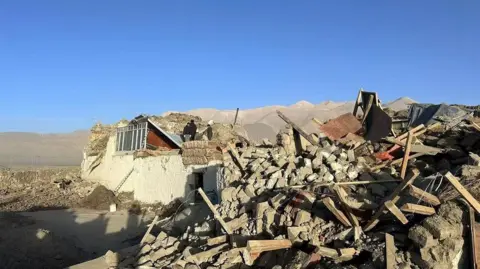
Reuters People standing atop a collapsed house, next to a pile of rubble. In the backdrop are mountains.Reuters

More than 1,000 buildings have been damaged by the earthquake

At least 95 people have been confirmed dead and 130 are injured after a major earthquake struck the mountainous Tibet region on Tuesday morning, Chinese state media say.

The earthquake that hit Tibet’s holy Shigatse city around 09:00 local time (01:00 GMT) had a magnitude of 7.1 and a depth of 10 kilometres (six miles), according to data from the US Geological Survey, which also showed a series of aftershocks in the area.

Tremors were also felt in neighbouring Nepal and parts of India.

Earthquakes are common in the region, which lies on a major geological fault line.

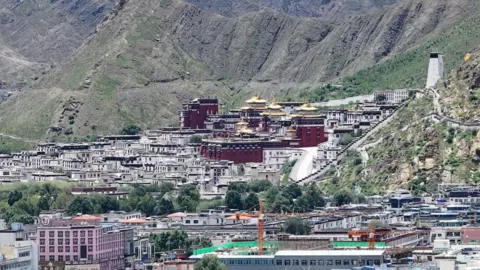
Shigatse is considered one of the holiest cities of Tibet. It is the traditional seat of the Panchen Lama, a key figure of Tibetan Buddhism whose spiritual authority is second only to the Dalai Lama.

Tibetan Gedhun Choekyi Niyima who was identified as the reincarnated Panchen Lama was disappeared by China when he was six years old. China then chose its own Panchen Lama.

The current Dalai Lama fled Tibet to India in 1959 and has since been seen as an alternative source of power for Tibetans who resent Beijing’s control of the region. Many believe China will also choose its own Dalai Lama when the current one dies.

Tuesday’s earthquake is one of the deadliest China has seen in recent years.

Videos published by China’s state broadcaster CCTV showed destroyed houses and collapsed buildings, as rescue workers waded through debris and handed out thick blankets to locals.

Temperatures in Tingri county, near the earthquake’s epicentre, are around -8C (17.6F), and will drop to -18 this evening, according to the China Meteorological Administration.

Both power and water in the region have been disrupted.

Watch: Surveillance footage shows the moment a powerful earthquake strikes China’s Tibet region.

Sitting at the foot of Mount Everest, Tingri county is a popular base for climbers preparing to ascend the world’s tallest peak.

Everest sightseeing tours in Tingri, originally scheduled for Tuesday morning, have been cancelled, a tourism staff told local media, adding that the sightseeing area has been fully closed.

There were three visitors in the sightseeing area who have all been moved to an outdoor area for safety, they said.

Chinese state media reported the earthquake as having a slightly lesser magnitude of 6.8, causing “obvious” tremors and leading to the damage of more than 1,000 houses. There have been several strong aftershocks.

Getty Images Buildings and a monastery in Shigatse city, against a backdrop of green mountainsGetty Images

Shigatse is considered one of the holiest cities of Tibet

Jiang Haikun, a researcher at the China Earthquake Networks Center, told CCTV that while another earthquake of around magnitude 5 may still occur, “the likelihood of a larger earthquake is low”.

Since China annexed Tibet in the 1950s, it has kept a tight control over the autonomous region, including its media and internet access.

A hotel resident in Shigatse told Chinese media outlet Fengmian News that he was jolted awake by a wave of shaking. He said he grabbed his socks and rushed out onto the street, where he saw helicopters circling above.

“It felt like even the bed was being lifted,” he said, adding that he immediately knew it was an earthquake because Tibet recently experienced multiple smaller quakes.

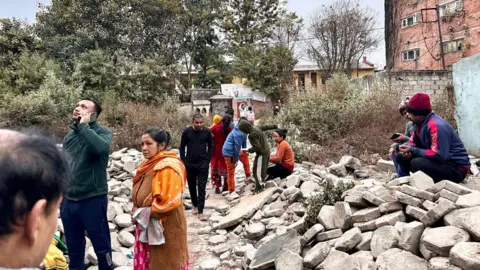
Getty Images Nepalese residents gathering outdoors in a neighbourhoodGetty Images

Tremors were also felt in Nepal, which has not reported casualties so far

The Chinese air force has launched rescue efforts and drones to the affected area.

Chinese president Xi Jinping has also called for all-out search and rescue efforts to minimise casualties and resettle affected residents.

While strong tremors were felt in Nepal, no major damage or casualties were reported, an official from the National Emergency Operations Centre told BBC Newsday – only “minor damages and cracks on houses”.

The region, which lies near a major fault line of the Indian and Eurasian tectonic plates, is home to frequent seismic activity. In 2015, a 7.8 magnitude earthquake near Kathmandu, the capital of Nepal, killed nearly 9,000 people and injured over 20,000.

The tremors on Tuesday morning, which sent many Kathmandu residents running out of their houses, brought back memories of that deadly disaster.

“In 2015, when the earthquake hit, I could not even move,” Manju Neupane, a shop owner in Kathmandu, told BBC Nepali. “Today the situation was not scary like that. But, I am scared that another major earthquake may hit us and we will be trapped between tall buildings.”


Syria’s New Rebel Government Orders Changes to School Curriculum, Worrying Some Syrians

0
Syria’s New Rebel Government Orders Changes to School Curriculum, Worrying Some Syrians


References to the ousted President Bashar al-Assad and his father, who ruled Syria before him, have been removed, as have images of pre-Islamic gods. The definition of a martyr has been changed, and it now means someone who has died for God, not one’s country. A Roman-era queen has been taken out of some textbooks.

Just weeks after a coalition of rebels toppled the Assad regime, the interim government they have set up in Damascus has moved quickly to order a raft of changes to the country’s school curriculum. The modifications cover subjects ranging from English and history to science and Islamic studies.

The move has been criticized by teachers and other Syrians who object not only to the nature of some of the changes but also to the fact that they were decided upon so quickly, with no transparency and no guidance from teachers and the general public.

Critics say that the changes, and the unilateral way in which they were ordered, are worrying signs of how the new Syrian government plans to govern a diverse country.

Some of the changes, which were detailed in nine pages released by the Education Ministry on social media last week, have been broadly welcomed, like removing glorification of the Assad regime from textbooks.

But some Syrians question why other changes were a priority, given the more pressing issues, like insecurity, sectarian tensions and an economic crisis, that still confront the country.

“The modifications should be restricted to only the things that involved the previous regime,” Rose Maya, 45, a high school French teacher, said at a small protest against the changes outside the Education Ministry on Sunday. “But there is no need for all the other changes.”

Ms. Maya was joined by about two dozen other people — among them teachers, students, doctors and artists — holding signs expressing various objections to the changes. Next to her was another teacher, Muayid Muflih, with a sign that read: “Power belongs to the people, not over the people.”

Mr. Muflih said that until recently he taught about nationalism, a subject that was widely seen as serving the agenda of the Assad regime. It has now been eliminated completely from the curriculum.

Ms. Maya, referring to Nazir Mohammad al-Qadri, the education minister, said that “as an interim minister he shouldn’t make changes.” And she said there needed to be transparency regarding the committees the ministry said it formed to review textbooks and suggest the changes. “There should be teachers involved,” she said.

The ministry has defended the changes and pushed back against suggestions that the alterations were Islamist, or a nod to Salafism, a conservative branch of Sunni Islam to which many of the country’s new leaders belong.

“The modifications were needed after the liberation of Syria,” Mr. al-Qadri said in an interview on Sunday. “These modifications were not changes to the curriculum but modifications of some of the slogans and symbols that used to glorify the previous regime.”

Mr. al-Qadri was part of the education ministry in Idlib, the province in northwest Syria run by the Islamist rebel group that now heads the interim government, Hayat Tahrir al-Sham.

Specialized committees involving both members of the Hayat Tahrir al-Sham-led government in Idlib Province and members of the Assad-era education ministry reviewed the textbooks and suggested changes, he said.

Mutasem Syoufi, executive director of the Day After, a nonprofit group, said that the interim government was trying to impose its vision not just on the political system of Syria but also its public life. The Day After was founded in 2012 by members of the Syrian opposition to plan for a transitional phase in Syria after the eventual fall of the Assad regime.

“The changes are a clear reflection of a very narrow reading of Islam, and again it reminds us of the background of the group which is in charge of Syria today,” he said. “There is no inclusive viewpoint.”

The speed with which the curriculum changes were made suggests they had been prepared before the interim government took power, Mr. Syoufi said.

Across Syria, even as people celebrate the toppling of a brutal and autocratic regime, there is some trepidation about the future of the country under a government headed by Islamist rebels.

Syria’s de facto new leader, Ahmed al-Shara, recently said it could take two to three years to draft a new constitution and up to four years to hold elections, alarming some Syrians who have expressed fear that they have traded one authoritarian leader for another.

Several people at the protest questioned why removing a Roman-era queen was such a priority for the new Syrian leadership, which is already overwhelmed with suddenly running a whole country, and rebuilding the state.

On page 19 in the third-grade Islamic Studies textbook a reference to Zenobia, a queen in the Roman colony of Palmyra, in present-day central Syria, has been removed. An ambiguous notation in the ministry’s list of changes has been read by many as proof that it sees her as a fictional person.

Mr. al-Qadri said she had not been removed from history textbooks. He said she had been deleted from the Islamic Studies textbook because she had lived and ruled in a pre-Islamic period.

“We don’t deny that Zenobia was present in history,” he said. But, he said, “we object to her inclusion in this book.”

The deletion of the female leader from the textbook has nevertheless worried some Syrians, who see it as an attack on the storied history of Syria.

“If we teach this generation that she was a fictional character, then we lose our connection to the past,” Ms. Maya said. “It means that we don’t have a past. And those that don’t have a past don’t have a future.”

Such changes, some Syrians say, should await the writing of a constitution and elections. They should also be part of a broader dialogue between different parts of Syrian society, made up of various religions, sects and ethnicities, they said.

“Their focus at this point should be just enforcing security and making it clear how they came into power and what their plans are,” said Malak Muhammad Suleiman, a dentist.

Another of the curriculum changes that has Syrians worried concerns the translation of a verse of the Quran. The final verse in the first chapter of the Muslim holy book refers to “those who are astray.”

In the previous first-grade Islamic studies book, the phrase was defined as “those who have moved away from the right path.” Under the new government’s changes, the phrase is now defined as “Christians and Jews.”

Manwella al-Hakim, a 60-year-old abstract painter and observant Muslim who wears the hijab, held up a sign at the protest objecting to this new interpretation.

“We don’t want things that will divide us,” she said. “Syria has always had all the religions and all the beliefs.”

Near her, Ziyad al-Khoury, a 61-year-old retired journalist, held up two signs, one of which read: “I am a Christian and not astray.”

Mr. al-Khoury said he was shocked when he first heard of the change.

“It felt like a message from the new government that we aren’t part of this country,” he said.


Gunman at Honduran Consulate in Georgia Kills One and Injures Another

0
Gunman at Honduran Consulate in Georgia Kills One and Injures Another


A gunman was arrested after killing a security guard and injuring another person outside the Honduran consulate near Atlanta on Monday afternoon, officials said.

A suspect was taken into custody at the scene, and the police believe there are no other threats to the public, said Emily Heenan, the spokeswoman for the city of Doraville, Ga., which is about 16 miles northeast of Atlanta.

Before the shooting, the gunman tried to enter the consulate building with a weapon, which is not allowed, Foreign Minister Eduardo Enrique Reina of Honduras said in a statement. He added that the security guard who was killed was of Mexican nationality and worked for a private security company.

On Monday night, Mr. Reina said in a social media post that the authorities in Atlanta now thought that the gunman, who was initially believed to be Honduran, was of Puerto Rican origin. Mr. Reina said in his post that the gunman was the partner of a Honduran citizen who was completing paperwork at the consulate.

Officials have not publicly released the suspect’s name.

The authorities did not say whether they knew the motive for the attack. Investigators are confident that the gunman acted alone, Ms. Heenan said.

The Doraville Police Department received calls around 2:30 p.m. about gunshots fired just outside the Consulate General of Honduras, which is at 6755 Peachtree Industrial Boulevard and is one of 14 Honduran consulates in the country. The security guard was declared dead at the scene. Another person who was injured was taken to a hospital, Ms. Heenan said.

Witnesses told Spanish-language news outlets that the guard had used pepper spray against the gunman before he opened fire. They said that the gunman had fired his weapon several times, striking the security guard, who still managed to secure the door to the consulate.

In remarks made on Monday, the Honduran foreign minister, Mr. Reina, praised the guard for having potentially saved the lives of those inside.


7.1-Magnitude Earthquake Strikes China’s Tibet Region Near Nepal Border

0
7.1-Magnitude Earthquake Strikes China’s Tibet Region Near Nepal Border


Dozens of people were killed and hundreds of buildings were toppled after a 7.1-magnitude earthquake struck a region near one of Tibet’s holiest cities, close to the Himalayan border with Nepal on Tuesday. Tremors were felt in Nepal.

The quake struck shortly after 9 a.m. at a depth of 6.2 miles in Dingri County in Tibet, Chinese state media reported. The state-run news agency Xinhua said at least 53 people had died and that rescue teams were deployed to locate more victims. Xinhua published video of police removing rubble and lifting debris.

China’s state broadcaster reported that more than 1,000 houses had collapsed in Dingri County.

Several aftershocks were felt in the area, including in Nepal. The quake had a magnitude of 7.1, according to the United States Geological Survey, though it was measured as 6.8 by the China Earthquake Networks Center.

The nearest city to the earthquake’s epicenter was Shigatse, the second-largest city in Tibet, with a population of 640,000. Shigatse is regarded as a holy site as the seat of the Panchen Lama, one of the most senior figures in Tibetan Buddhism.

A tourist not far from Shigatse who spoke to The Times said she was in her hotel room when the earthquake started shaking her building. She said the electricity went out and that she and a friend squatted between the beds. When the shaking stopped, they ran out of the building.

The tourist, who only have her surname, Xu, shared a video showing several single-story brick buildings with collapsed walls.

The Himalayan region is prone to powerful earthquakes. In 2015, a quake in Nepal with a magnitude of 7.8 killed nearly 9,000 people. In Kathmandu, Nepal’s capital, residents streamed out of their homes in the morning as the earthquake rattled buildings.

“Based on the magnitude of the earthquake, there could be some damages in mountains of eastern Nepal,” said Lok Bijaya Adhikari, a senior seismologist at Nepal’s National Earthquake Monitoring and Research Center.

Most residents from Nepal’s high mountain regions such as Everest, Makalu, Rolwaling and Kanchenjunga have migrated to lowland areas to avoid the extreme cold of winter.

“Although most people migrate to lower land during winter season, some are still there,” said Ang Tshering Sherpa, the former chief of the Nepal Mountaineering Association. “There’s always risk of avalanche and glacial lake outburst floods after earthquakes.”

Berry Wang contributed reporting.


Russia-Ukraine war: List of key events, day 1,048 | Russia-Ukraine war News

0
Russia-Ukraine war: List of key events, day 1,048 | Russia-Ukraine war News


Here are the key developments on the 1,048th day of Russia’s invasion of Ukraine.

Here is the situation on Tuesday, January 7:

Fighting

  • Russia’s Ministry of Defence has claimed to have captured the village of Dachenske, south of Pokrovsk, another major city in the Donetsk region of eastern Ukraine, that its troops are targeting.
  • Ukrainian police said a Russian drone strike targeted a bus in a Kherson neighbourhood on Monday, killing one person and injuring eight others.
  • Ukrainian President Volodymyr Zelenskyy said that Russia has suffered heavy losses amid the five-month incursion by Ukrainian forces into the Kursk region, with nearly 15,000 killed. The occupation of the southern Russian region has allowed Kyiv’s troops to establish a buffer zone, forcing Moscow to divert military units away from front-line areas in eastern Ukraine, he added.
  • Several dozen Ukrainian soldiers have deserted while training in France, a French army official told the AFP news agency. The troops are now subject to a disciplinary regime “imposed by the Ukrainian command”.

Politics and diplomacy

  • French President Emmanuel Macron has called on Ukraine to have “realistic” expectations regarding territory as its fight against the Russian invasion heads towards a fourth year, saying he saw no “quick and easy solution” to the conflict.
  • Moldovan authorities have summoned a Russian diplomat amid concern that the situation in Transnistria is worsening. The breakaway region risks a complete electricity blackout after Russia cut gas supplies.
  • US President-elect Donald Trump’s incoming Ukraine envoy, retired Lieutenant-General Keith Kellogg, has postponed a fact-finding trip to Kyiv and other European capitals until after Trump’s inauguration on January 20, according to sources.
  • The patriarch of Russia’s Orthodox Church, celebrating Christmas alongside Kremlin leader Vladimir Putin, said that the Western world despises Russia and its “alternative path of civilised development”.


Russia claims capture of Ukrainian front-line town of Kurakhove

0
Russia claims capture of Ukrainian front-line town of Kurakhove


Russia claims that its forces have captured the front-line town of Kurakhove in eastern Ukraine’s Donetsk region.

The town has borne the brunt of Russian advances in recent months and is a stepping-stone to the key logistical hub of Pokrovsk.

Ukraine has not acknowledged the fall of Kurakhove, which is 35km (21 miles) south of Pokrovsk.

Fierce fighting has also been under way in Russia’s Kursk region in recent days after Ukraine launched a counter-attack on Sunday.

An image taken from social media and supplied by the Reuters news agency appears to show a soldier holding up a Russian flag in Kurakhove. The image has not been verified by the BBC.

Viktor Trehubov, spokesperson for Ukraine’s Khortytsia group of forces, told Reuters news agency that, as of Monday morning, Ukrainian forces were still engaging Russian troops inside Kurakhove.

Kurakhove is linked to Pokrovsk by roads that are part of the infrastructure to move troops and supplies along the front line.

The taking of Kurakhove would allow the Russians to go north to attack Pokrovsk from a new direction, analyst Roman Pohorily said.

Russia’s defence ministry also claimed on Monday that the village of Dachenske, which about 8km south of Pokrovsk, had been captured by its forces.

Kyiv’s forces are reportedly suffering from manpower shortages and have been losing ground in the east of Ukraine in recent months, as Russian troops advance.