A top U.S. envoy who helped broker the cease-fire between Israel and Hezbollah issued reassurance on Monday that Israel would withdraw fully from southern Lebanon, as called for in the fragile 60-day truce deal that paused the bloodiest war between the two sides in decades.
Speaking to reporters in Beirut, the Lebanese capital, the envoy, Amos Hochstein, said that Israeli troops had pulled out on Monday from the southern town of Naqoura. In a statement, the Lebanese military said it had redeployed in the town, after the Israeli withdrawal.
“These withdrawals will continue until Israeli forces are fully out of Lebanon,” Mr. Hochstein said after meeting with senior Lebanese officials. “There’s been much progress in recent days, and I expect to see additional progress being made in the days to come.”
Although the truce reached in late November continues to hold, there is growing frustration among Lebanese and Israeli officials about the pace at which the cease-fire agreement is being carried out, with the deadline fast approaching for the terms to be fulfilled.
Mr. Hochstein did not specify when Israeli troops would withdraw completely from Lebanon, and it remains uncertain whether the cease-fire agreement will be fully in place by the end of the 60-day period.
The deal ended a 14-month conflict between Israel and Hezbollah, a powerful militant group in Lebanon that began firing rockets into Israel in support of the Hamas-led attack on Israel on Oct. 7, 2023. Hezbollah and Hamas are backed by Iran, part of its network of regional proxies.
After Israel went on the offensive against Hezbollah in September last year, the violence killed nearly 4,000 people in Lebanon and displaced over a million others. The fighting has also seriously weakened Hezbollah, with much of its leadership wiped out.
Under the terms of the cease-fire, Israeli troops have until Jan. 26 to pull out of Lebanon. Hezbollah militants are required in tandem to withdraw to north of the Litani River in southern Lebanon, and the Lebanese military is expected to deploy in force along the border.
So far, however, the Israeli military has withdrawn from just three of the dozens of areas in southern Lebanon where it continues to hold positions, a figure that includes the Monday withdrawal from Naqoura, where a U.N. peacekeeping mission is based.
Amid accusations of cease-fire violations by both sides, Lebanon has also reported to the U.N. Security Council that Israel had launched over 800 “ground and air attacks” since the cease-fire came into effect.
In turn, Israel’s defense minister, Israel Katz, accused Hezbollah and the Lebanese state on Sunday of failing to meet the terms of the cease-fire agreement, warning that Israel may be “forced to act” if progress is not made.
“This is not an easy process to implement; it’s a difficult process,” Mr. Hochstein conceded at the news conference on Monday.
Hezbollah’s new leader, Naim Qassem, threatened in a speech on Saturday that his group might begin attacking Israel again if the country’s troops did not fully withdraw from southern Lebanon before the 60-day period ends.
“When we decide to do something, you will see it directly,” he said.
An American man was killed when a Mexican police officer opened fire on the car he was driving in Ciudad Juárez, across the border from El Paso, Texas, the Mexican authorities said on Monday.
A regional prosecutor in the state of Chihuahua, Carlos Manuel Salas, said the shooting occurred on Sunday as the officer was accompanying a staff member from the prosecutor’s office, who was serving a warrant. The two were on foot when a Mustang with New Mexico license plates suddenly accelerated in their direction, according to Mr. Salas. He said the officer opened fire as the driver tried to flee.
Mr. Salas said the officer was in custody and that the shooting, which was captured on video by a passenger in the car, would be investigated by the internal affairs division of the state prosecutor’s office. At a news conference, Mr. Salas described the incident as “regrettable” and urged the public to refrain from drawing conclusions until the investigation was complete.
But he appeared to offer a defense of the officer, whose name was not released. According to Mr. Salas, the vehicle was traveling at high speed and skidded as it approached the officer, almost hitting him. The driver was wearing a hood, he said.
“Why would you accelerate?” he asked. “Why would you drive at that speed?”
Mr. Salas argued that if something similar happened in another country, including the United States, the police would also likely respond with force.
The authorities did not identify the man who was killed, describing him only as a nursing assistant from El Paso. But Mexican news outlets reported that his name was Julián Alfredo Rodríguez Medina. News reports said the man and at least one of the two passengers in the car had family members who lived nearby.
In an interview with the news outlet El Diario, a man who identified himself as a brother of the driver, and who said he had been in the car, asked state officials to bring charges against the officer.
The man, who identified himself only as Jorge A. R., said he and the other men in the car had been out to get something to eat when they were fired on. He said they had not posed a threat and that they were at a considerable distance from the officer when he opened fire.
“At no time did we make any threats to him, nor did we yell at him, nor did we skid the car,” El Diario quoted the man as saying.
Mr. Salas, the prosecutor, said American officials had been notified about the shooting in accordance with protocol. A spokesman for the United States Embassy said in a statement that officials were “closely monitoring local authorities’ investigation into the reported killing.”
The incident is the latest in a string of violent deaths of Americans in Mexico.
Last week, a 62-year-old man from Rockford, Ill., was shot at a highway checkpoint in the state of Zacatecas that his family said was being run by a criminal organization. Days earlier, two American citizens and a Mexican national were shot dead in the state of Durango in an ambush that also left an American teenager critically injured.
Mexico’s president, Claudia Sheinbaum, has pledged to rein in the violence that has racked much of the country. While officials often point to fights between drug-trafficking cartels as the cause of the bloodshed, experts say violence involving the police is also not uncommon.
The shooting of the American on Sunday generated heated debate after the video recorded by the passenger was posted on social media. Many called for harsh consequences for the detained officer, and some commenters made death threats.
On Monday, the authorities announced an arrest in the Durango shooting, which occurred on Dec. 27. They identified the suspect as Iram Uranga Armendáriz, and they said the shooting had stemmed from a dispute over a debt related to a land deal.
Mr. Uranga has been accused of shooting two of the men in the head, then the two others — including the teenager — from behind as they tried to flee on foot. The teenager, Jason Peña, a 14-year-old from Chicago, was said to be in critical condition at a Houston hospital on Monday.
Their venom destroys blood-clotting factors, and victims die slow, gruesome deaths, bleeding in the brain, eyes and mouth.
Identifying the attacker can help tailor treatment. But many people never see the snake that bites them or, if they do, cannot identify it. To the untrained eye, venomous snakes may look indistinguishable from harmless ones.
The names don’t make it any easier. Green mambas are green, but black mambas are pale gray to dark brown; they are so-named because the inside of the mouth is black. They are better recognized by their coffin-shaped head and unnerving smile.
Some scientists are building A.I. models to identify snakes, so that anyone with a smartphone might be able to distinguish them.
About a third of snakebites are in children. They occur less often among pregnant women, but the outcomes — which include spontaneous abortion, ruptured placentas, abruption, fetal malformations and death to both mother and fetus — can be catastrophic.
Often the victims are farmers. The loss of a breadwinner devastates families.
Ruth Munuve’s husband worked as a driver in Nairobi and came home to the family farm every other weekend. He was bitten on a Saturday in April 2020, at age 42, while walking through the brush on his way home from a night out.
Two hospitals scrambling to treat Covid patients turned him away. By the time he died two days later, his body had swelled to double its size, a hallmark of a puff adder bite, said his sister, Esther Nziu.
Ms. Munuve now grows maize and cowpeas, mostly for food, and sells green grams. Ms. Nziu has five children of her own, but she is doing her best to help raise her brother’s four children.
Money is tight, but the women still paid to fortify the house. “I don’t want anybody else to be bitten by snakes,” Ms. Nziu said.
Amnesty International welcomed the transfer but said Guantanamo would remain a ‘glaring, longstanding stain’ on human rights in the US.
The United States has transferred 11 Yemeni detainees from its notorious Guantanamo Bay detention centre to Oman after holding them for more than two decades without charge as part of Washington’s so-called “war on terror”.
“The United States appreciates the willingness of the government of Oman and other partners to support ongoing US efforts focused on responsibly reducing the detainee population and ultimately closing the Guantanamo Bay facility,” the US Department of Defense said in a statement on Monday evening.
The US-based Center for Constitutional Rights (CCR) said that among the 11 detainees transferred to Oman this week, was Sharqawi al-Hajj, who had undergone repeated hunger strikes and hospitalisations at Guantanamo to protest his 21 years in prison, which came after two years of detention and torture by the CIA.
“Our thoughts are with Mr Al Hajj as he transitions to the free world after almost 23 years in captivity. His release is hopeful for him and for us,” said Pardiss Kebriaei, a lawyer at CCR who represents al-Hajj.
Just 15 detainees now remain at Guantanamo, down from a peak of almost 800 in the aftermath of the September 11, 2001 attacks by al-Qaeda when then-US President George W Bush set up the Guantanamo prison camp to hold suspects indefinitely and without charge and disallowing legal challenges to their detention.
Hundreds of mostly Muslim men were seized from dozens of countries as part of the US’s so-called “war on terror”, which also involved the US invasions of Afghanistan and Iraq, and covert military operations elsewhere around the world.
Conditions at Guantanamo Bay and the treatment of detainees have long prompted outcries from human rights groups and United Nations experts who have condemned the prison as a site of “unparalleled notoriety”.
Welcoming the release of the 11, Amnesty International said the “military detention facility at Guantanamo Bay is a glaring, longstanding stain on the human rights record of the United States”.
In the past month, US authorities have released several prisoners from Guantanamo, including Tunisian national Ridah bin Saleh al-Yazidi who had been held at the prison since it opened in 2002 without ever being charged. Also released was Mohammed Abdul Malik Bajabu who was arrested in Kenya in 2007, and two Malaysian men who had been held for 18 years without charge.
Successive US administrations had been called on to close Guantanamo or, at least, release all those detainees never charged with a crime. Outgoing President Joe Biden had pledged before his election in 2020 to try to shut down Guantanamo, but it remains in operation just weeks before he leaves office.
Biden administration officials said they were working on identifying suitable countries willing to take detainees from Guantanamo who were never charged with a crime.
CCR said that of the 15 men who remain at Guantanamo, six are uncharged and three of those have been cleared for transfer from the US.
The Defense Department said that the nine other detainees include two who have been convicted and sentenced, and seven who have been charged in relation to the 2000 bombing of the USS Cole naval ship as well as the September 11, 2001 attacks and the 2002 bombings on the resort island of Bali.
Shatha al-Sabbagh was ambitious and loved journalism, according to her mother
Warning: This story contains distressing details.
Just before New Year, 21-year-old Shatha al-Sabbagh was out buying chocolate for her family’s children from a shop in Jenin, in the occupied West Bank.
The “fearless” journalism student – who wanted to shed light on the suffering of the Palestinians – was with her mother, two young nephews and another relative.
“She was laughing and saying we’ll be up all night tonight,” her mother recalls.
Then she was shot in the head.
For Shatha’s mother Umm al-Motassem, the pain is still raw. She stops to take a breath.
“Shatha’s eyes were wide open. It looked like she was staring at me while lying on her back with blood gushing from her head.
“I started screaming, ‘Stop shooting! My daughter is dead. My daughter is dead.'”
But the shooting lasted for around 10 minutes. Shatha died in a pool of her own blood.
Shatha’s family holds the Palestinian Authority’s (PA) security forces fully responsible for her killing, saying their area is controlled by the PA.
“It couldn’t have been anyone other than PA… because they have such a heavy presence in our neighbourhood – no-one else could come or go,” she told the BBC.
But the PA blames “outlaws” – the term they use for members of the Jenin Battalion, made up of fighters from armed groups including Palestinian Islamic Jihad (PIJ) and Hamas.
The PA exercises limited self-rule in the Israeli-occupied West Bank.
It launched a major security operation in the refugee camp in Jenin last month targeting the armed groups based there, which they see as a challenge to their authority. Nearly four weeks on, it continues.
The Jenin Battalion is accused of blowing up a car in the camp and carrying out other “illegal activities”.
“We have confiscated large numbers of weapons and explosive materials,” says the PA’s Brig Gen Anwar Rajab.
“The aim is to clear the camp from the explosive devices that have been planted in different streets and alleyways… These outlaws have crossed all red lines and have spread chaos.”
Gen Rajab also accuses Iran of backing and funding the armed groups in the camp.
The Jenin Battalion denies links to Iran. In a recent video posted on social media, spokesman Nour al-Bitar said the PA was trying to “demonise” them and “tarnish their image”, adding that fighters would not give up their weapons.
“To the PA and President Mahmoud Abbas, why has it come to this?” he asked, holding shrapnel from what he claimed was a rocket-propelled grenade fired at the camp by security forces.
Getty Images
Mourners and journalists carry the body of Shatha al-Sabbagh outside a hospital in Jenin
The PA, led by President Abbas, was already unpopular among Palestinians dissatisfied by its rejection of armed struggle and its security co-ordination with Israel.
This anger intensified with the PA’s crackdown on the armed groups in the camp, which has been unprecedented in its ferocity and length.
Israel sees those groups as terrorists, but many Jenin locals consider them to be a form of resistance to the occupation.
“These ‘outlaws’ that the PA is referring to – these are the young men who stand up for us when the Israeli army raids our camp,” says Umm al-Motassem.
At least 14 people have been killed in the crackdown, including a 14-year-old, according to the Palestinian health ministry.
Now many Jenin locals say they fear the PA as much as they fear Israel’s military raids. Shatha al-Sabbagh’s death has only renewed their contempt.
Before she was killed, Shatha shared several posts on social media showing the destruction from the PA operation in Jenin – as well as Israeli raids on the camp last year.
Other posts showed pictures of armed young men who were killed in the fighting, including her brother.
Her killing was condemned by Hamas, which identified her brother as a slain member of the group’s armed wing, the Izzedine al-Qassam Brigades.
The group described her “murder… in cold blood” as part of an “oppressive policy targeting the Jenin camp, which has become a symbol of steadfastness and resistance”.
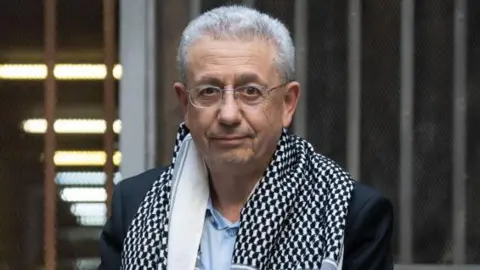
Mustafa Barghouti, who leads the political party Palestinian National Initiative, sees the fighting in Jenin as a consequence of the divisions between the main Palestinian factions – Fatah, which makes up most of the PA, and Hamas, which has governed Gaza since 2007.
“The last thing Palestinians need is to see Palestinians shooting each other while Israel crushes everyone,” he says.
Getty Images
Mustafa Barghouti
Inside the camp, residents say daily life has ground to a halt.
Water and electricity supplies have been cut off and families suffer from a lack of food, bitterly cold weather and relentless gun battles.
Locals who spoke to us asked for their names to be changed, saying they feared reprisals by the PA.
“Things are dire here. We can’t move freely in the camp,” says Mohamed.
“All the bakeries, the restaurants and shops are closed. The restaurant I work in opens for a day and closes for 10. When it is open, no-one comes.
“We need milk for the children, we need bread. Some people can’t open their doors because of the continuous shooting.”
The UN humanitarian agency, the OCHA, has called for an investigation into what it describes as human rights violations by the PA forces.
Gen Rajab said some of the “outlaws” who had “hijacked” the Jenin camp had been arrested and that others with pending cases would be brought to justice.
But Mohamed describes the PA’s operation – with innocent people caught in the crossfire – as “collective punishment”.
“If they want to go after outlaws, that doesn’t mean they should punish the whole camp. We want our lives back.”
Even going out to get food or water is a risk, says 20-year-old Sadaf.
“When we go out, we say our final prayers. We prepare ourselves mentally that we may not come back.
“It’s very cold. We’ve taken down the doors in our home to use as firewood just to keep warm.”
The BBC has heard similar accounts from four residents in the camp.
My conversation with Sadaf is interrupted by the sound of gunfire. It is unclear where it is from or who is firing. It starts and stops several times.
“Warning shots maybe,” she suggests, adding it happens sometimes when PA forces are changing shifts.
Sadaf continues describing the camp, with “rubbish filling the streets and almost going into homes”. More gunfire can be heard.
Sadaf’s mother joins the call. “Listen to this… Can anyone sleep with this sound in the background?
“We sleep in shifts now. We’re so scared they might raid our homes. We’re as scared of this operation as we are when the Israeli soldiers are here.”
People say security forces have deliberately hit electricity grids and generators, leaving the camp in a blackout.
The PA again blames “outlaws” – and insists it has brought in workers to fix the grid.
Getty Images
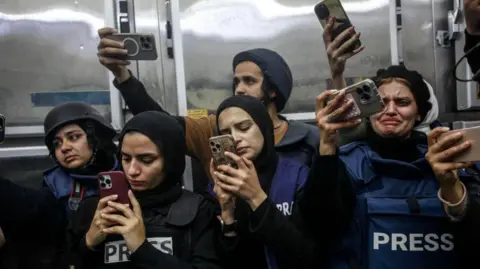
Palestinian journalists mourned Shatha al-Sabbagh, the journalism student shot dead
The armed groups want to “use the people’s suffering to pressure the PA to stop the operation”, says Gen Rajab. He says the security operation will continue until its objectives are met.
Gen Rajab says the PA’s goal is to establish control over the Jenin camp and ensure safety and stability.
He believes stripping the armed groups of control would take away Israel’s excuse to attack the camp.
At least 36 Palestinians were killed – 21 from Jenin governorate – according to the Palestinian health ministry.
Analysts say that the PA is trying to reassert its authority in the West Bank and show the US it is capable of taking a role in the future governance of Gaza.
“What would be the harm in that?” says Gen Rajab.
“Gaza is part of the Palestinian state. Gaza and the West Bank are not separate entities. There’s no Palestinian state without Gaza. The president [Mahmoud Abbas] has said that and that is our strategy.”
But Barghouti says this approach is an “illusion”. “All you need is to listen to what [Benjamin] Netanyahu says,” he adds.
Under the Israeli prime minister’s vision for a post-war Gaza, Israel would control security indefinitely, and Palestinians with “no links to groups hostile to Israel” – so none of the existing major Palestinian political parties – would run the territory.
But the US, Israel’s major ally, wants the PA to govern Gaza after the war. Netanyahu has previously ruled out a post-war role for the internationally backed PA.
For the residents of Jenin camp, there has been no let-up in the violence and loss.
“The PA say they’re here for our safety. Where’s the safety when my daughter was killed? Where’s the safety with the non-stop shooting?” Umm al-Motassem cries.
“They can go after the ‘outlaws’ but why did my daughter have to die? Justice will be served when I know who killed my daughter,” she says.
The Biden administration on Monday lifted some restrictions on humanitarian aid to Syria but kept sweeping sanctions in place just weeks after rebel forces toppled the Assad family’s 50-year authoritarian grip on the country.
The authorization by the Treasury Department is a sign of how Washington is taking tentative steps to navigate its approach to Hayat Tahrir al-Sham, the main rebel faction that took down the government in Damascus. The group was once an affiliate of Al Qaeda and, although it has broken with the organization, it remains a designated a terrorist group by the U.S. government.
The decision by the Treasury, which lasts for six months, allows humanitarian groups to operate more freely without running afoul of U.S. sanctions, including by helping to provide basic services such as electricity, energy, water and sanitation.
During Syria’s civil war, which began in March 2011, the United States and its allies routinely looked to apply economic pressure on the now-ousted President Bashar al-Assad, his inner circle and the country’s economy writ large, leaving Syria as one of the Treasury’s “most comprehensively sanctioned jurisdictions,” according to a news release by the department.
The United States across three administrations slapped increasingly punitive sanctions on Syria, to such an extent that some analysts questioned whether they had become counterproductive and overly harmful to civilians.
“The end of Bashar al-Assad’s brutal and repressive rule, backed by Russia and Iran, provides a unique opportunity for Syria and its people to rebuild,” Wally Adeyemo, the deputy Treasury secretary, said in the statement. “During this period of transition, Treasury will continue to support humanitarian assistance and responsible governance in Syria.”
Sanctions remain one of the most pressing concerns for Syria’s new administration as it tries to chart a path forward. As soon as Mr. al-Assad fled the country in December, one of the first requests of Ahmed al-Shara, the leader of the rebel coalition that overthrew the government, was for the United States to begin easing restrictions.
Syria’s new foreign minister, Asaad Hassan al-Shibani, echoed those calls over the weekend.
“These sanctions constitute a barrier and an obstacle to the rapid recovery and development of the Syrian people, who await services and partnerships from other countries,” he told reporters. “We reiterate our calls for the United States to lift these sanctions, which have now become against the Syrian people rather than what they previously were: imposed sanctions on the Assad regime.”
On Monday, a new Qatari airplane landed in Damascus laden with humanitarian aid, part of a broader push by Arab nations to airlift assistance into Syria as the country continues to grapple with a dire humanitarian crisis.
European nations have also sent tens of millions of dollars in humanitarian assistance since the Assad government fell last month. These contributions, however, represent only a fraction of what Syria needs to recover and rebuild after more than a decade of war.
Experts say that U.S. sanctions affect humanitarian operations by cutting the country off from money it desperately needs for reconstruction and economic development. Not only do families and relief organizations struggle to send money home or provide assistance, but the International Monetary Fund and the World Bank also cannot offeraid.
NEW DELHI: Trade unions on Monday pressed for increasing minimum EPFO pension 5 times to Rs 5,000 per month, immediate constitution of the 8th Pay Commission and higher taxes on super rich in the upcoming 2025-26 Budget. In their pre-budget meeting with FM Nirmala Sitharaman, trade union leaders also demanded an increase in income tax exemption limit to Rs 10 lakh per annum, social security scheme for gig workers and restoration of old pension scheme for govt employees. Talking to reporters after the meeting TUCC national general secretary S P Tiwari said govt should stop all privatisation and corporatisation of PSUs and impose an additional 2% tax on super rich to fund social security for informal workers. Tiwari also demanded that agriculture workers be extended social security and their minimum wages should also be fixed. agencies
Prime Minister Justin Trudeau of Canada said on Monday that he would step down in the coming months, bowing to an angry electorate at a time of uncertain economic prospects and political infighting.
The announcement, which came amid a gridlocked Parliament, left Canada in political flux just as the incoming Trump administration has vowed to impose punishing tariffs on Canadian imports.
“It’s time for a reset,” Mr. Trudeau told reporters outside his residence on a frigid morning in Ottawa, the capital. Mr. Trudeau said that he had suspended Parliament until March 24 and that he would stay on as Liberal Party leader and prime minister until his replacement had been chosen through a nationwide party election.
“I truly feel that removing the contention around my own continued leadership is an opportunity to bring the temperature down,” he said.
Mr. Trudeau, 53, who rose to power nearly a decade ago and quickly became seen as a progressive icon, is the latest leader in the West to be swept aside by a mood of anti-incumbency, a backlash against immigration and anger at the lingering effects of a spike in inflation during the Coronavirus pandemic. Although inflation in Canada has receded to below 2 percent, unemployment remains high, at above 6 percent.
General elections must be held by October, a timetable that Mr. Trudeau referred to on Monday.
“It’s become obvious to me with the internal battles that I cannot be the one to carry the Liberal standard into the next election,” he said.
Mr. Trudeau has faced weeks of mounting pressure from inside his party’s ranks.
In December, Mr. Trudeau’s deputy prime minister and finance minister, Chrystia Freeland, abruptly stepped down, issuing a stinging rebuke of his leadership and stewardship of the country. Ms. Freeland, who had been a close ally of the prime minister, accused Mr. Trudeau of having engaged in “costly political gimmicks” and being ill-prepared to face the challenge posed by Mr. Trump.
Her resignation incited a growing chorus of voices from Liberal parliamentarians asking him to step aside for the sake of the party, and let someone else lead the party in general elections.
Mr. Trudeau also had been under pressure from a resurgent Conservative Party, which in recent surveys has drawn a commanding double-digit lead over the Liberal Party. The Conservative leader, Pierre Poilievre, posted a video on social media on Monday promoting an alternate vision of governing: “ax the tax,” referring to Trudeau’s unpopular carbon tax, “build the homes,” “fix the budget” and “stop the crime.”
The upheaval comes as Canada is debating how best to deal with Mr. Trump’s pledge to impose tariffs that would upend a trade agreement among Canada, the United States and Mexico. (Mr. Trump has also threatened tariffs on Mexico and says he wants both countries to address the flow of drugs and undocumented migrants into the United States).
Tariffs would be potentially ruinous for Canada’s economy, which is heavily dependent on exports, particularly of oil and automobiles. The United States and Canada are each other’s biggest trading partners.
Mr. Trudeau visited Mr. Trump at Mar-a-Lago, his private club and residence in Florida, in late November, and his government had been in talks to address the president-elect’s concerns about border security in hopes that he would reconsider his tariff threat.
The talks do not appear to have been fruitful. In early December, Mr. Trump mocked Mr. Trudeau in a social media post, describing the Canadian prime minister as “Governor Justin Trudeau of the Great State of Canada.”
On Monday Mr. Trump responded to Trudeau’s resignation by again suggesting that Canada should become America’s “51st state,” saying on social media that if Canada merged with the U.S. that taxes would decrease and that there would be no tariffs.
Among possible replacements for Mr. Trudeau are Ms. Freeland, the former deputy prime minister and finance minister; Dominic LeBlanc,who became finance minister when Ms. Freeland resigned; Mélanie Joly, Canada’s top diplomat since 2021; and Mark Carney,the former governor of the Bank of Canada, who also led the Bank of England.
Mr. Trudeau, whose government has been hamstrung by its lack of a majority in Parliament, said on Monday that the legislative body had been “totally seized by obstruction, and filibustering and a total lack of productivity.”
In his comments in French, he painted an even starker picture of a Parliament that “no longer functions.”
The suspension of Parliament, a process known as prorogation, will give his party time to pick a new leader, which Mr. Trudeau said would be through a “robust, nationwide, competitive process.” A new — and perhaps more popular leader — could put the Liberals on firmer footing in the upcoming national election.
Suspending Parliament wipes out all pending legislation but does not affect the government’s day-to-day operations.
Mr. Trudeau spent a decade building a political brand around being a feminist, an environmentalist, and an advocate for refugees and Indigenous people, pursuing the same message of change and hope as Barack Obama. But analysts say Mr. Trudeau’s brand, which appears antithetical to Mr. Trump’s, is no longer working for him.
“He caught a wave on his way in, and when you catch a wave, it can lift you up,” Darrell Bricker, a seasoned pollster and chief executive of Ipsos Public Affairs, said. “But on the other side, if you don’t get off, it will ground you.”
An Ipsos poll, published in late December, found that the Liberals trail the Conservatives by 25 percentage points.
Although the next election must be held by October, a vote could be called or forced earlier.
The Liberal government under a new prime minister could be short lived. And shortly after the new session begins, the Liberal government is likely to face a vote of confidence. It would likely lose such a vote, as it only commands a minority of the seats in Parliament and it has lost the support of all other parties. That would prompt a federal election.
The prime minister also has the power to dissolve Parliament at any time, which would also prompt an election.
New Delhi: Global central banks remained active in the gold market in November 2024, collectively adding 53 tonnes of the precious metal to their reserves, according to the World Gold Council.
This sustained buying trend reflects the growing preference for gold as a stable and secure asset amidst global economic uncertainties.India’s year-to-date purchased 73 tonnes of gold with total gold reserves of 876 tonnes as on November end, making it the second-largest buyer of 2024 after Poland, the WGC said.
The National Bank of Poland (NBP) emerged as the largest buyer of gold in November, increasing its reserves by 21 tonnes to reach a total of 448 tonnes. Gold accounts for nearly 18 per cent of Poland’s total reserves, just shy of its 20 per cent target. With year-to-date purchases of 90 tonnes, NBP has maintained its position as the top gold buyer of 2024.
The Central Bank of Uzbekistan also made significant additions, increasing its reserves by 9 tonnes after a hiatus since July.This brings its year-to-date net purchases to 11 tonnes, with total holdings now at 382 tonnes.
Similarly, the Reserve Bank of India continued its gold acquisition streak, adding 8 tonnes in November.Other notable buyers included the National Bank of Kazakhstan, which added 5 tonnes, reversing its status to a net purchaser for the year, with total reserves now at 295 tonnes.
The People’s Bank of China (PBoC) resumed gold buying after a six-month pause, adding 5 tonnes and bringing its total holdings to 2,264 tonnes, representing 5 per cent of its reserves. The Central Bank of Jordan increased its holdings by 4 tonnes in November, marking its first addition since July and lifting its total reserves to 73 tonnes.
The Central Bank of Turkey added 3 tonnes and continued its liquidity management efforts through gold-for-lira swap agreements with domestic banks.Meanwhile, the Czech National Bank extended its buying streak to 21 consecutive months, purchasing nearly 2 tonnes and increasing its total holdings to just over 50 tonnes.
The Bank of Ghana, as part of its domestic gold purchase program, added 1 tonne in November, bringing its total reserves to 29 tonnes.However, some central banks reduced their gold holdings during the month. The Monetary Authority of Singapore was the largest seller, reducing its reserves by 5 tonnes to a total of 223 tonnes, with year-to-date net sales reaching 7 tonnes.
Additionally, the Bank of Finland announced a significant reduction in December, selling about 10 per cent of its gold holdings. This brought its reserves to 44 tonnes, the lowest level since 1984, as part of a strategy to manage exchange rate risks.