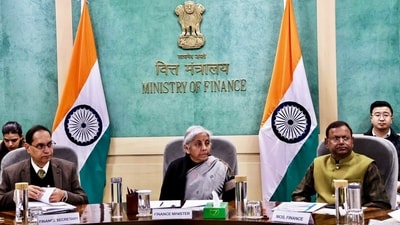
Finance Minister Nirmala Sitharaman on Monday concluded month-long consultations with various stakeholders, including representatives of the industry and social sectors, as part of the budget preparation exercise.
Finance minister Nirmala Sitharaman has concluded the eighth pre-budget consultation with stakeholders for the upcoming Union Budget 2025-26(Ministry of Finance – X)
The consultations started on December 6, 2024, the Finance Ministry said in a statement.
“In the course of the in-person consultations, more than 100 invitees across 9 stakeholder groups, including experts and representatives from farmer associations & agriculture economists; trade unions; education & health sector; MSME; trade & services; industry; economists; financial sector & capital markets; as well as, infrastructure, energy and urban sector, participated in the meetings,” it said.
In the course of the consultations, Sitharaman expressed gratitude to the participants for sharing valuable suggestions and assured experts and representatives that their suggestions would be carefully examined and considered while preparing the Union Budget 2025-26, it said.
Additionally, from January 10, 2025, citizens may share their valuable suggestions and ideas for the Union Budget 2025-26 on the MyGov platform, it said, adding, citizens are encouraged to actively participate in this annual initiative, aimed at making the Budget-making process more inclusive with the spirit of ‘Jan Bhagidari’.
The Ministry of Finance and MyGov eagerly look forward to receiving innovative and constructive suggestions from citizens across the country.
To submit the suggestions, citizens can visit the MyGov platform (www.mygov.in) and contribute towards building a Viksit Bharat, it said.
Union Minister for State for Finance Pankaj Chaudhary; Finance Secretary and Secretary DIPAM, Tuhin Kanta Pandey; Economic Affairs Secretary, Ajay Seth; Financial Services Secretary, M Nagaraju; Secretaries of Ministries concerned, Chief Economic Adviser, V Anantha Nageswaran, and senior officers from the Ministry of Finance and Ministries concerned were also present during relevant meetings.
Union Budget 2025-26 is likely to be tabled in Parliament on February 1.
This would be the eighth straight Budget of Sitharaman and second full budget of the Modi 3.0 government, which will give policy direction for achieving the goal of Viksit Bharat (developed India) by 2047.
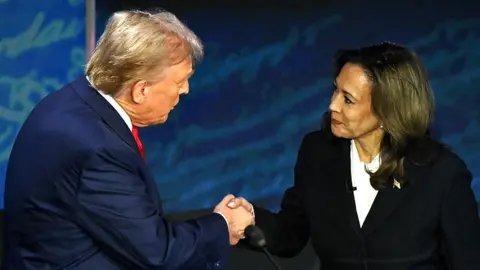
Trump and Harris went head-to-head in a presidential debate in Philadelphia in September
Four years to the day after a mob of Donald Trump’s supporters violently besieged the US Capitol, Congress will gather to formally certify his re-election.
With Trump’s victory secured, the biggest obstacle currently facing lawmakers this year is a major snowstorm. Vice-President Kamala Harris, who Trump defeated in the 2024 election, will preside over the event as required by the US Constitution.
But the shadow of 6 January 2021 lingers over Monday’s proceedings, despite Trump and his allies’ campaign to recast the attack as a “day of love.”
Heavy security is in place in Washington DC, and the current president, Joe Biden, has vowed there will be no repeat of the violence four years ago, which led to several deaths and millions of dollars’ worth of damage.
The certification, scheduled for 13:00 on Monday, is normally a symbol of America’s commitment to the peaceful transfer of power despite partisan disagreements.
But this time, it has become an emblem of Trump’s extraordinary political comeback and his complete takeover of the Republican Party.
Trump celebrated the moment on Truth Social, writing: “Congress certifies our great election victory today – a big moment in history.”
House Speaker Mike Johnson has vowed to go ahead with the certification in spite of the weather, telling Fox News: “Whether we’re in a blizzard or not, we’re going to be in that chamber making sure this is done.”
Harris, meanwhile, has vowed to “perform my constitutional duty as Vice President to certify the results of the 2024 election.”
“This duty is a sacred obligation – one I will uphold guided by love of country, loyalty to our Constitution, and unwavering faith in the American people,” she said in a video statement.
Ordinarily there would be little need for a vice-president to declare such an intention. The US Constitution requires the certification of a presidential election on 6 January, and for the vice-president to oversee the vote.
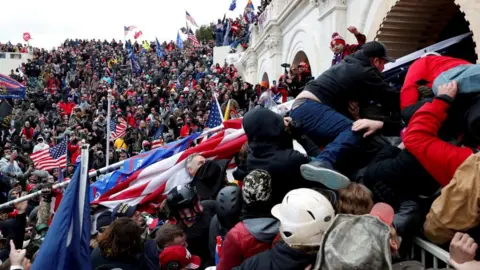
But last time the US Congress gathered to certify the election of a US president, the vote was delayed for several hours because rioters, animated by a false belief that the 2020 election was stolen from Trump, smashed through windows, beat their way through lines of police officers, crashed the US House chamber, and ransacked the office of then-Speaker Nancy Pelosi.
In a speech in Washington DC that day, before the violence broke out, Trump told a crowd to “fight like hell” but also asked them to “peacefully” make their voices heard.
Lawmakers, including Republicans, were forced to cower in the basement and Capitol staffers hid wherever they could find shelter. Trump’s vice-president at the time, Mike Pence, was whisked into hiding as rioters erected a gallows on the Capitol grounds and called for his hanging because he refused to inaccurately certify the results in Trump’s favour.
In the aftermath, Capitol Hill custodial workers worked furiously to clean up shattered windows, trashed corridors, and even human waste, an experience one described as “degrading.” Congressional staffers spent the next several months reckoning with the trauma of the attack.
The riot caused nearly $3m (£2.4m) in damage, injured over 100 police officers, and shocked America’s political system.
In the immediate wake of the attack, which millions of Americans watched unfold on television and social media, there was little debate over who deserved blame.
The US House of Representatives impeached Trump on charges he incited the riot, but the US Senate did not achieve the two-thirds vote required to convict him. Then-Senate Majority Leader Mitch McConnell, a Republican, explicitly blamed Trump, saying rioters “did this because they had been fed wild falsehoods by the most powerful man on Earth – because he was angry he’d lost an election”.
Trump himself faced federal charges for allegations that he attempted to subvert the 2020 election, to which he pleaded not guilty. But the Department of Justice (DoJ) was forced to drop the case once he was elected, due to protocols that prevented the prosecution of a sitting president.
As Trump sought a return to power, he and his allies have worked to dramatically change the narrative around the riot and its cause.
Trump said there was “nothing done wrong at all,” at an October 2024 presidential campaign forum.
He has called the people convicted by the DoJ “hostages” and “political prisoners.” And his new vice-president, JD Vance, refused to acknowledge in a presidential debate that Trump lost the 2020 election.
Americans now have starkly divided perspectives on the day. A January 2024 Washington Post/University of Maryland poll suggested that a quarter of Americans believed a conspiracy theory that the FBI instigated the attack. While a majority of Americans believed 6 January 2021 was an attack on democracy, only 18% of Republicans thought so, the poll indicated.
Reuters
Trump’s supporters rioted at the Capitol this time four years ago
Trump captured all seven of the country’s swing states during the 5 November presidential vote, giving him a resounding victory in the electoral college, the mechanism that decides who takes the presidency.
It will be Harris’s job on Monday to read out the number of electoral college votes won by each candidate.
Trump’s second term will begin after he is inaugurated on 20 January. For the first time since 2017, the president’s party will also enjoy majorities in both chambers of Congress, albeit slender ones.
It represents a stunning political comeback from his electoral defeat in 2020, and a criminal conviction in 2024 – a first for a current or former US president.
Trump’s pledges after returning to office include pardoning people convicted of offences over the attack. He says many of them are “wrongfully imprisoned”, though has acknowledged that “a couple of them, probably they got out of control”.
Conversely, Biden has called on Americans never to forget what happened.
“We must remember the wisdom of the adage that any nation that forgets its past is doomed to repeat it,” Biden wrote in the Washington Post over the weekend.
For Trump’s Republican Party, the new Senate Majority Leader John Thune has signalled a desire to move on, telling the BBC’s US partner CBS News: “You can’t be looking in the rearview mirror.”
NEW DELHI: In November 2024, central banks globally added a combined total of 53 tonnes of gold to their reserves, with the Reserve Bank of India (RBI) contributing 8 tonnes, according to the World Gold Council (WGC). In 2024, central banks, particularly those from emerging markets, continued to be avid buyers of gold, to achieve a stable and secure asset combating global economic uncertainty. WCG’s report, ‘Central bank gold statistics November 2024’ stated, “Assessing the final act of 2024, central banks around the world continued to play a leading role in the demand for gold. November represented another solid month of gold buying as central banks collectively added a net 53 tonnes to global official holdings.” The report suggests that the decline in gold prices following the US election may have encouraged some central banks to escalate their gold purchases in November. For India, the RBI’s additional 8 tonnes in November raised its total gold holdings to 876 tonnes. This brings the RBI’s year-to-date gold purchases to 73 tonnes, securing its position as the second-largest buyer of gold in 2024, behind Poland. Poland’s National Bank (NBP) emerged as the largest buyer in November, adding 21 tonnes to its reserves. This brings Poland’s total purchases for the year to 90 tonnes, with overall holdings now reaching 448 tonnes. The Central Bank of Uzbekistan made a notable addition of 9 tonnes to its gold reserves in November, marking its first purchase since July. The bank’s total year-to-date net purchases now stand at 11 tonnes, with total holdings rising to 382 tonnes. Kazakhstan’s central bank also increased its gold reserves by 5 tonnes, marking its second consecutive month of buying. As a result, the bank is now a net purchaser, holding a total of 295 tonnes of gold. Meanwhile, the People’s Bank of China resumed its gold purchases after a six-month hiatus. The bank added 5 tonnes in November, bringing its year-to-date net purchases to 34 tonnes and total holdings to 2,264 tonnes, or 5 per cent of its total reserves. Other countries also made significant gold purchases in November. The Central Bank of Jordan reported a 4-tonne rise in its reserves, the first monthly increase since July, bringing its year-to-date net purchases to nearly 2 tonnes and total holdings to 73 tonnes. Turkey’s central bank increased its gold reserves by 3 tonnes, while also engaging in reverse swap agreements (gold for lira) with domestic commercial banks to manage liquidity. The Czech National Bank added almost 2 tonnes in November, marking its 21st consecutive month of gold buying. Its year-to-date net purchases now total almost 20 tonnes, with total holdings exceeding 50 tonnes. The Bank of Ghana continued its domestic gold purchase programme, adding 1 tonne in November. This brings its year-to-date net purchases to 10 tonnes, lifting total gold holdings to 29 tonnes. The Bank of Ghana also launched the Ghana Gold Coin to the public in November, as part of efforts to stabilise the economy and promote investment in the country’s gold reserves. In contrast, the Monetary Authority of Singapore was the month’s largest seller, reducing its gold reserves by 5 tonnes. Its year-to-date net sales now total 7 tonnes, leaving its overall gold holdings at 223 tonnes.
As Israeli and Hamas officials continued indirect talks on Monday for a cease-fire and hostage release deal, Hamas representatives indicated that the group had approved an Israeli list of 34 hostages to be released in the first stage of an agreement, conveying a sense of momentum.
But the Israeli government quickly dampened any notion that Hamas’s acceptance of the list constituted a significant breakthrough toward ending the war in Gaza.
Here’s what we know about the list of hostages and the state of the talks, after months of false starts and failed rounds.
What Hamas is saying
A Hamas representative briefed on the negotiations told The New York Times on Monday that if a deal is reached, Hamas agrees to release the 34 hostages whose names appear on a list that Israel provided via mediators. The representative spoke on the condition of anonymity because the talks are being held in secrecy.
The United States has long been pushing for a deal and is trying to facilitate one with the help of Qatar and Egypt, the two main countries mediating between Israel and Hamas.
The Reuters news agency reported on Sunday night that Hamas had approved the list presented by Israel. The report cited an unnamed Hamas official who added that any hostage deal was contingent upon Israel agreeing to a timetable for withdrawal from Gaza and a permanent cease-fire, in line with Hamas’s longstanding demands.
Prime Minister Benjamin Netanyahu of Israel has refused to openly declare any willingness to end the war, vowing to eradicate Hamas as a military force and governing power in Gaza.
Roughly 100 hostages are still being held in Gaza out of some 250 people taken captive during the Hamas-led attacks in October 2023 that prompted the war. At least a third of the captives are presumed to be dead, according to Israel.
A weeklong truce in November 2023 allowed for the release of 105 hostages in exchange for some 240 Palestinian prisoners and detainees in Israel. Only a few hostages have been rescued alive by Israeli forces, and the bodies of dozens of others have been recovered. Israeli soldiers accidentally killed three hostages whom they misidentified as fighters.
Subsequent efforts to reach a cease-fire have faltered amid gaps in the two sides’ demands, with each side blaming the other for thwarting efforts to reach a deal.
What Israel says
Israel sent the original list of hostages to be released in the first phase of any deal to the mediators in July 2024, according to a statement released on Monday by Mr. Netanyahu’s office.
But the list has since been updated because three of those who originally appeared on it — Hersh Goldberg-Polin, an American-Israeli dual citizen, and two Israeli women, Carmel Gat and Eden Yerushalmi — were killed by their captors in late August. The newer version of the list was published by the BBC on Monday, and Mr. Netanyahu’s office appeared to confirm its authenticity.
In this latest round of talks, Israel has demanded information from Hamas about which hostages remain alive. Without that, Israeli officials say, there can be no agreement on how many Palestinian prisoners Israel would be willing to release in exchange for them.
“As yet, Israel has not received any confirmation or comment by Hamas regarding the status of the hostages appearing on the list,” Mr. Netanyahu’s office said in its statement, adding, “Israel will continue to act relentlessly for the return of all of our hostages.”
The Hamas representative who spoke to The Times said the group would not give Israel details on the status of the 34 hostages on the list without getting some things in return.
The list includes 10 women, five of them soldiers; 11 older male hostages aged between 50 and 85; two young children who Hamas previously said had been killed in an Israeli airstrike, but whose deaths have not been confirmed by the Israeli authorities; and other male hostages whose release Israel considers urgent.
In addition to Israel’s demand for information on the status of the hostages, other sticking points remain in the negotiations, according to Israeli and Hamas officials. An Israeli official familiar with the matter, who was not authorized to discuss the negotiations publicly, said on Monday that the talks were progressing and that the sides were closer than they have been in a while. But the official cautioned that they have also been at a similar point before.
Lucknow: Lucknow’s Chaudhary Charan Singh International Airport (CCSIA), managed by Adani Airport Holdings Limited (AAHL), has continued to clock a robust growth in passenger traffic with the handling of more than 5.21 million flyers during the first nine months of the current financial year (April-December, 2024).
While 4.34 million passengers used the airport to fly on domestic routes, over 0.87 million travelled on international flights, strengthening the airport’s position as a travel hub with world-class facilities and services in Uttar Pradesh, according to a statement issued by AAHL, a subsidiary of Adani Enterprises, the flagship company of the globally diversified Adani Group,
During the first nine months, there was an 11 per cent increase in air traffic movements, reaching 38,953, compared to 35,190 air traffic movements in the same period of FY 2023-24. Compared to the first nine months of FY 2023-24, CCSIA saw a growth of over 5.7 per cent in total passenger traffic during FY 2024-25.
Delhi, Mumbai, and Bengaluru were the top three domestic destinations for CCSIA, while Muscat, Dammam, and Dubai were the preferred international destinations. This growth highlights the steadily increasing demand for air travel from Lucknow and underscores the city’s importance for travellers from neighbouring regions, the company said.
A spokesperson for the Lucknow airport said: “The passenger traffic figures and growth at Chaudhary Charan Singh International Airport in the first nine months of 2024-25 are in line with trends in the civil aviation industry. CCSIA confirms its commitment to seamless connectivity and world-class service standards at the newly inaugurated Terminal 3.
With a focus on security and safety, CCSIA ensures a smooth and convenient experience for all passengers. As CCSIA continues to achieve new milestones, it remains dedicated to exceeding passenger expectations and setting new benchmarks of excellence in the aviation sector.”
CCSIA operates over 140 flights daily, with an average of more than 21,500 passengers travelling daily. Recently, CCSIA inaugurated new flights by AirAsia Malaysia (Berhad) from Lucknow to Kuala Lumpur and Air India Express from Lucknow to Bangkok (Suvarnabhumi Airport). Currently, CCSIA connects 29 domestic and 10 international destinations.
Meanwhile, cargo operations also saw significant growth. In the first nine months of FY 2024-25, cargo operations increased by over 7 per cent, with 16,655 metric tons (MT) handled, compared to 15,597 metric tons during the same period last year.
This includes 12,700 metric tons of domestic and 4,161 metric tons of international cargo. The growth was driven by an increase in domestic flights connecting different parts of the country, as well as flights to international destinations like Dammam, Riyadh, Manila, and Muscat, the company statement added.
Prime Minister Justin Trudeau of Canada is set to step down as Liberal Party leader on Monday morning, according to an official familiar with his plans who was not authorized to discuss them publicly.
Here’s what to know about Mr. Trudeau’s rise and fall, and what could happen next.
What will happen if Mr. Trudeau resigns?
If he steps down as party leader, he will no longer be prime minister. But how he might step down matters.
Mr. Trudeau has two options: He can say that he will step down when the party has a new leader, some weeks or months in the future.
Or he can step down immediately. In that case, the party would appoint an interim leader, who then could not run for the leadership under Liberal Party rules.
The next step would be to head to a federal election under the new Liberal leadership. Canada’s next election must be held by October 2025, but a vote could be called or forced earlier.
The next federal election could be set off at any point through two means. Mr. Trudeau has the power to dissolve Parliament at any time, and that would lead to an election. Or, if the opposition were to defeat the Liberal government through a confidence motion or vote down a budget bill, the government would fall, and an election would follow.
Prime Minister Pierre Elliott Trudeau, after returning from a foreign trip in 1983, greeted his sons, from left, Justin, Michel and Sacha.Credit…Andy Clark/Reuters
Who is Justin Trudeau?
Mr. Trudeau grew up in the spotlight as the son of Pierre Elliott Trudeau, a Canadian prime minister. In 2015, at age 43, Mr. Trudeau became Canada’s second-youngest leader after his Liberal Party won a strong parliamentary majority. Mr. Trudeau was savvy with social media and enjoyed a long political honeymoon after his election. (He also had good hair.)
In 2017, Mr. Trudeau came under pressure to stand up to Donald J. Trump, the newly elected U.S. president. As Mr. Trump restricted immigration, Mr. Trudeau restated Canada’s openness to asylum seekers, proclaiming, “Diversity is our strength.”
During his time in office, Mr. Trudeau prioritized two issues. One was climate change. The other was reconciliation with Indigenous people, over the generational harms from a system of boarding schools that were rife with abuse. He also followed through on a pledge to legalize marijuana.
In 2019, the Liberals maintained their hold on power with Mr. Trudeau as their leader, but by a narrower margin, and they failed to secure a majority in Parliament. The Liberals needed support from smaller parties to advance Mr. Trudeau’s legislative agenda.
During the coronavirus pandemic in 2020, Mr. Trudeau became the first Group of 7 leader to isolate himself, after his wife, Sophie Grégoire Trudeau, tested positive for Covid-19. (The couple are now separated.) The next year, when his approval ratings were still relatively high, he called a snap election, saying he wanted a strong mandate for his party to lead Canada out of the pandemic and into economic recovery.
Voters returned him to office in 2021, but the Liberals failed again to win a majority of votes in Parliament. Mr. Trudeau has since faced intense criticism from the Conservative opposition for some of his pandemic and recovery policies.
Asylum seekers preparing to cross into New York State from Canada last year.Credit…José A. Alvarado Jr. for The New York Times
Why is his government unpopular?
Economy: Canada’s post-pandemic inflation spiked to 8 percent, though it has since receded below 2 percent. Unemployment remains high, around 6.4 percent. The Conservative opposition has hammered Mr. Trudeau’s carbon-tax program.
Housing: The cost of housing in many major Canadian cities has become untenable. An economic analysis this year found that in Toronto, Vancouver and Montreal, prices would have to plummet, or incomes would have to improbably soar, to restore affordability.
Immigration: In October, Mr. Trudeau said he was tightening Canada’s immigration policies after the country welcomed nearly three million people over three years, straining health care and other services. “In the tumultuous times as we emerged from the pandemic, between addressing labor needs and maintaining population growth, we didn’t get the balance quite right,” he said.
Scandals: In 2018, Mr. Trudeau was accused of groping a reporter in 2000, an allegation he rejected. A federal ethics commissioner in 2019 ruled that Mr. Trudeau tried to circumvent, undermine and discredit his former justice minister and attorney general, Jody Wilson-Raybould, in connection with a criminal case against SNC-Lavalin, a multinational engineering and construction firm based in Montreal. That same year, images surfaced of Mr. Trudeau wearing blackface or brownface as a student in the 1990s and as a teacher at a private prep school in 2001.
Infighting: Mr. Trudeau’s hold on power slipped in September when the left-leaning New Democratic Party deprived Liberals of guaranteed support needed to pass legislation. Last month, Chrystia Freeland, the deputy prime minister and finance minister, resigned abruptly, a stinging rebuke to Mr. Trudeau.
Pierre Poilievre, the leader of the Conservative Party, wants Mr. Trudeau to call an election immediately.Credit…Cole Burston for The New York Times
Who are the top contenders to succeed him?
Conservatives: Pierre Poilievre has led the Conservative Party since 2022, branding himself as the anti-Trudeau, practical and down-to-earth. He supported a blockade of Canada’s capital, Ottawa, in 2022 led by truckers who opposed vaccine mandates and pandemic restrictions. Mr. Poilievre has been eyeing the top government spot since at least 1999, when as a university student he wrote an essay that won a cash prize about what he would do as prime minister.
Liberals: After her resignation last month, there was widespread speculation that Chrystia Freeland,the former deputy prime minister and finance minister, would start her own bid to run the Liberal Party. Other contenders include Dominic LeBlanc,who became finance minister when Ms. Freeland resigned; Mélanie Joly, Canada’s top diplomat since 2021; and Mark Carney,the former governor of the Bank of Canada, who also led the Bank of England.
As President-elect Donald Trump prepares to return to the White House, his proposals on issues such as immigration, taxes, and trade have sparked furious discussion.
But two weeks away from returning to one of the world’s most powerful political offices, Trump remains animated by past grievances, laying out a plan of attack against political rivals, critics and a loss in the 2020 election that he has never accepted.
Much of his rhetoric has focused on the events of January 6, 2021, when a mob of his supporters stormed the US Capitol in an effort disrupt the certification of the election results. Monday marks the fourth anniversary of that riot.
Speaking to a crowd of supporters on December 22, Trump took time during his remarks to rail against the January 6 Committee, a Congressional panel that probed Trump’s efforts before, during and after the riot.
“The unselect committee of political thugs, J6 committee, what they did is so illegal,” he told the audience.
But Trump’s focus on January 6 is not limited to his critics. He has also pledged to offer a full pardon for rioters who took part in the violent attack on the Capitol, an event that many of his critics describe as an insurrection.
What was January 6, how many people have been charged in relation to the riot, and how could Trump use his presidential powers to release those convicted from prison? We tackle these questions and more in this brief explainer.
What was January 6?
Following his loss to Joe Biden in the 2020 election, Trump forcefully promoted the false claim that the election had been “rigged” and stolen from him through massive fraud.
That effort went beyond rhetoric, and included a scheme to replace officials who cast ballots in the Electoral College based on the popular vote in their respective states with a separate batch of pro-Trump electors.
On January 6, 2021, Trump held a rally in the capital of Washington, DC, where he railed against the election results and urged his supporters to “fight like hell”.
“When you catch somebody in a fraud, you’re allowed to go by very different rules,” he said.
Trump ended the speech by urging his followers to march to the Capitol building to “peacefully and patriotically make your voices heard” as Congress met to certify the election results.
For the next several hours, a mob of Trump’s supporters, some of them armed, assaulted police trying to hold back the crowd and stormed the building in an effort to stop Trump’s loss from being certified.
One of the rioters, Ashli Babbitt, was shot and killed by a police officer as she tried to breach the House chamber.
How many people have been charged in connection to the riot?
According to the US Department of Justice (DOJ), more than 1,488 people had faced criminal charges in connection to the attack on the Capitol as of August 6, 2024, the latest available data.
Those figures included people from all 50 states and the capital of Washington, DC. About 547 defendants had been charged with assaulting, resisting, or impeding officers or employees, including 163 people who were charged with assault with a deadly weapon.
What has Trump said about the participants?
Trump has characterised those charged and imprisoned for their actions on January 6 as victims of political persecution, calling them “patriots” and “political prisoners” and promising to use the powers of presidential pardon to release them from prison when he returns to the White House.
In a social media post in March, Trump said one of his first acts as president would be to “Free the January 6 Hostages being wrongfully imprisoned!”
What has Trump said about politicians critical of his role on January 6?
Trump has taken a much less lenient approach towards political rivals who have overseen efforts to bring attention to his efforts to overturn the 2020 election and criticised his actions on January 6.
In July, Trump shared a post on his social media website Truth Social saying that former Republican Representative Liz Cheney, one of two Republican members of a US House of Representatives probe into January 6 and Trump’s efforts to overturn the election, should face “televised military tribunals” for acts of “treason”.
In another post, Trump shared an image of 15 lawmakers, including members of the January 6 probe, and said that they “should be going to jail” instead of former Trump strategist Steve Bannon, who served a four-month prison sentence in 2024 for defying a subpoena in the congressional investigation into January 6.
What do Americans think about the events of January 6?
A December 2023 Washington Post-University of Maryland poll found that about 55 percent of US adults believe that January 6 was an assault on US democracy that should “not be forgotten”.
But Republican voters are much less likely to agree with that sentiment, and more than two-thirds continue to believe that Biden’s election in 2020 was illegitimate, according to polls. Republicans are also more likely to say that Trump was not responsible for the violence that occurred on January 6, with just 14 percent holding him responsible compared with 53 percent of US adults.
Why is this important?
While the majority of people in the US continue to view January 6 and Trump’s role in the events of that day unfavourably, those negative feelings did not prevent him from beating Democratic rival Kamala Harris in the 2024 election.
Now, as Trump prepares to return to the White House, some see Trump’s continued insistence that he was the true winner of the 2020 election and his stated desire to prosecute his political rivals as evidence that he will pursue a more vindictive and antidemocratic agenda than during his first term in office.
Vinay Hiremath, the India-origin co-founder of Loom, sold his startup for $975 million to an Australian software company in 2023. In a blog post, he has written that he has “no idea” what to do with his life.
Vinay Hiremath, Indian-origin co-founder of Loom, dropped out of college after two years.(Instagram/vhmth)
“I am rich and have no idea what to do with my life,” the title of his blog post read.
“Life has been a haze this last year. After selling my company, I find myself in the totally un-relatable position of never having to work again. Everything feels like a side quest, but not in an inspiring way. I don’t have the same base desires driving me to make money or gain status. I have infinite freedom, yet I don’t know what to do with it, and, honestly, I’m not the most optimistic about life,” Hiremath wrote in a long post.
Who is Vinay Hiremath?
Hiremath’s journey started at the University of Illinois where he dropped out two years into college. Following this, he had a short stint at Facebook as a software engineering intern for four months.
Vinay Hiremath’s first big break as an engineer came in August 2012 when he joined a startup called Backplane. This is where Hiremath says he learned how to “hack”. This is also where he met Shahed Khan, with whom he went on to develop Loom, a video messaging company, reported Forbes.
After spending a little over a year there, in September 2013, Vinay Hiremath joined another startup called Upthere, where he enhanced his technical skills and knowledge before finally co-founding Loom with Shahed Khan and Joe Thomas in 2015. He was the head of engineering at his startup for over four years before getting promoted to chief technology officer in April 2020.
What is Loom?
Loom is a video-messaging platform that describes itself as “the easiest screen recorder you’ll ever see” but also “so much more than a screen recorder”. It has over 25 million users across 400,000 companies worldwide. Loom allows users to record and share AI-powered videos with their teammates and customers.
In 2023, Loom was acquired by Australian software company Atlassian for $975 million.
What more for Vinay Hiremath?
Apart from being a successful engineer and entrepreneur, Vinay Hiremath describes himself as an investor who is willing to offer help to founders he “vibes” with “for free and for no allocation”.
According to the about section of his blog vinay.sh, he is a “big fan of capitalism”. He is also into cold plunge, sauna therapy and meditation. He also likes to “ride motorcycles, box, lift weights, travel, throw parties, and meet people from all walks of life.”
US President Joe Biden has announced a ban on new offshore oil and gas drilling along most of America’s coastline, two weeks before Donald Trump takes office.
The ban covers the entire Atlantic coast and eastern Gulf of Mexico, as well as the Pacific coast off California, Oregon and Washington and a section of the Bering Sea off Alaska.
It is the latest in a string of last-minute climate policy actions by the Biden administration ahead of Trump’s return to the White House.
Trump has vowed to revoke the ban “immediately” when he takes office, but he may find it difficult to reverse under US law.
During his campaign, Trump pledged to “unleash” domestic fossil fuel production in a bid to lower gas costs, despite the US already seeing record high extraction rates.
Announcing the new drilling ban, Biden said: “My decision reflects what coastal communities, businesses, and beachgoers have known for a long time: that drilling off these coasts could cause irreversible damage to places we hold dear and is unnecessary to meet our nation’s energy needs.
“It is not worth the risks.”
In a radio interview, Trump branded the ban “ridiculous”.
“I’ll unban it immediately,” he said. “I have the right to unban it immediately.”
Trump has previously said he will reverse Biden’s conservation and climate change policies.
For the new drilling ban, Biden is taking the action under the Outer Continental Shelf Lands Act of 1953, which allows US presidents to withdraw areas from mineral leasing and drilling.
The law does not grant presidents the legal authority to overturn prior bans, according to a 2019 court ruling. It means a reversal would likely require an act of Congress, which is now controlled by Trump’s Republicans.
The law also does not allow presidents to revoke any areas already leased for offshore drilling.
Trump – despite being in favour of more oil and gas exploration and repeatedly deploying his tag line “Drill, baby, drill” during campaigning – has used the law himself to protect waters off the coast of Florida in 2020.
At the time, this was seen as an effort to garner votes from the state ahead of the 2020 US election, and the protection was due to expire in 2032. Biden’s decision will protect the same area with no expiry date.
The new offshore drilling ban covers more than 625 million acres (253 million hectares) of waters.
After it was reported last week that Biden would introduce the policy, Trump’s incoming press secretary Karoline Leavitt called it “a disgraceful decision”.
She said the move was “designed to exact political revenge on the American people who gave President Trump a mandate to increase drilling and lower gas prices”.
Environmental groups, however, welcomed the move.
Joseph Gordon, from conservation organisation Oceana, said: “This is an epic ocean victory.
“Our treasured coastal communities are now safeguarded for future generations.”
An oil and gas industry trade group said Biden’s decision would harm American energy security and should be reversed by Congress.
Mike Sommers, president of the American Petroleum Institute, said: “We urge policymakers to use every tool at their disposal to reverse this politically motivated decision and restore a pro-American energy approach to federal leasing.”
In 2017, during his first term in office, Trump tried to reverse former President Barack Obama’s protection of 125 million acres (50.6 million hectares) of the Atlantic and Arctic Oceans.
It is expected that Trump – whose inauguration ceremony takes place on 20 January – will still seek to challenge Biden’s move. A final legal decision could be made by the Supreme Court, which currently has a majority of Republican judges.
Environmentalists and Democrats had been calling on Biden to introduce the ban because of concerns that any new drilling would threaten US ambitions to cut its greenhouse gas emissions and tackle climate change.
The International Energy Agency estimates that global oil and gas demand needs to fall by 5% annually to limit global temperature rise to 1.5C, which is seen as crucial to help avoid the most damaging impacts.
NEW DELHI: India’s services sector growth reached a four-month high in December, driven by a surge in new business inflows on strong demand conditions, and a reduction in inflationary pressures, according to a monthly survey released on Monday. The seasonally adjusted HSBC India Services Business Activity Index rose to 59.3 in December, up from 58.4 in November, marking the strongest expansion since August. In the Purchasing Managers’ Index (PMI) framework, a reading above 50 indicates growth, while below 50 signals contraction. The survey highlighted strong demand conditions, with plenty of new business inflows driving higher output and prompting firms to hire more workers. Ines Lam, economist at HSBC, said, “India’s services companies expressed strong optimism in December as business activity growth surged to a four-month high. Forward-looking indicators such as new business and future activity suggested that the strong performance will likely continue in the near future.” While panellists reported increased costs for food, labour, and materials, the overall rise in input costs slowed, leading to a softer increase in selling prices. Lam noted that the easing of input price inflation supported positive business sentiment. “Strength in the services PMI stands in contrast with the growing signs of a slowdown in the manufacturing industry,” Lam said, quoted by news agency PTI. India’s manufacturing sector showed growth slowing to a 12-month low in December, with weaker expansions in new orders and production.
Employment and business outlook
Service providers remained optimistic about growth over the next 12 months, though overall sentiment dipped slightly from November’s six-month high. Rising capacity pressures, upbeat forecasts, and rising new business supported continued job creation, with employment growth remaining among the sharpest recorded since data collection began in December 2005. “The rate of employment growth softened from November, but was sharp and among the strongest seen since data collection began in December 2005,” the survey reported. The private sector also posted faster growth, the HSBC India Composite Output Index climbed to 59.2 in December, up from 58.6 in November. Composite PMI indices are calculated as weighted averages of the manufacturing and services PMI indices, with the weights based on the relative size of the manufacturing and service sectors, as indicated by official GDP data. Strong new business inflows in the services sector offset a slight slowdown in manufacturing, strengthening aggregate sales, according to the survey. The HSBC India Services PMI, compiled by S&P Global, is based on responses from approximately 400 service sector companies.