Thursday, October 1, 2026
Home Blog Page 6959

Calls for justice and accountability after Assad’s fall

0
Calls for justice and accountability after Assad’s fall


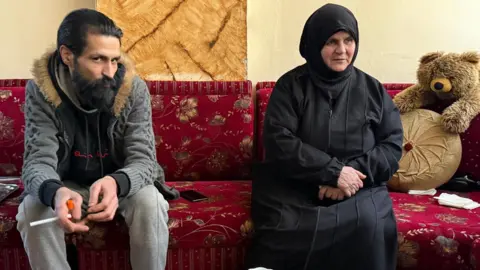
BBC Umm Mazen, clad in black gown and headscarf, still doesn't know the fate of two of her sons who were arrested during the pro-democracy protestsBBC

Umm Mazen still doesn’t know the fate of two of her sons who were arrested during the pro-democracy protests that started the Syrian civil war

The new Syrian authorities promise justice for crimes under the Assad regime. But it’s a tall order, with many having suffered losses of every kind in the civil war. Sebastian Usher met people in Damascus for whom justice is key to how they see Syria’s future.

On the edge of Douma, one of the Damascus suburbs most devastated by the war, in a shrouded living room next to a stove, Umm Mazen recounts the 12 years she desperately sought news of two of her sons, who were arrested in the first years of the uprising and civil war, and swallowed up in the Assad-era security system.

For her oldest son, Mazen, she finally received a death certificate, but for Abu Hadi, no trace of him has ever been divulged.

Her third son, Ahmed, spent three years in the security system, including eight months in the red block for political prisoners in that byword for brutality, Saydnaya prison.

His front teeth stoved in by a torturer’s hammer, he remembers one moment when he believes he heard his brother Mazen’s voice answering a roll call in the same jail, but nothing more.

What justice does Umm Mazen seek for the destruction of her family?

“There should be divine justice, coming from God,” she says.

“I saw some local men bringing a shabiha (an armed regime supporter) to be killed.

“I told them: ‘Don’t kill him. Rather, torture him exactly the same way he tortured our young men’.”

“My two children died – or probably have died, but there are thousands of other young men who were subjected to torture.

“I pray to God that Bashar [al-Assad] stays in a dungeon underground and that Russia, which used to protect him, can’t help him.

“I pray to God to put him somewhere underground and that he is left in oblivion – just as he left our young men in his jails.”
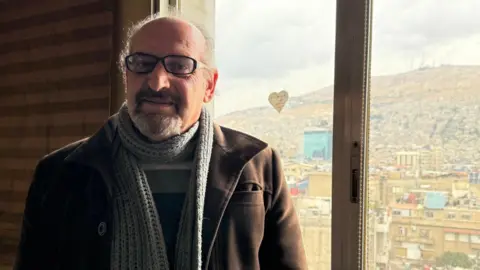
Lawyer Hussein Issa, standing by a window in jacket and scarf, with a view of Damascus behind him - he believes many Assad-era judges should be expelled from the courts

Lawyer Hussein Issa believes many of the judges who cooperated with the regime should be expelled from the courts

Lawyer Hussein Issa sought justice for dozens of people accused of political crimes under the Assads.

He faced constant pressure from the authorities over his advocacy, but persisted and managed to save some of his clients from being crushed under the wheels of the security system.

But for those assigned to the special terrorism courts, there was usually nothing that could be done.

The terrorism law loomed ever more darkly over Syria as the civil war continued.

Now, with the mountain on the edge of Damascus glimpsed through the window of his scruffy, smoke-filled office, the 54-year-old lawyer says he believes that many of the judges who were complicit with the Assad regime should be kicked out and legal action taken against them.

But others from that era, he says, could still play a role in the new judiciary.

As for the huge challenge of trying to deliver retrospective justice for the horrors of the past 50 years, Mr Issa says that establishing a judicial system capable of this is the most important task for Syria’s new authorities.

“If this system is not good, the future of the new state will be grim.

“We don’t know how bad it could then get. We are already afraid that some parties could cause strife and conflict.

“If we have a strong system and state, then we won’t be afraid of these things.

“If we don’t have them, we will be fearful. However, since I’m optimistic by nature, I think the new regime will definitely be better.”

Khitam Haddad sitting at a desk - appointed deputy justice minister in 2023, under the Assad regime

Khitam Haddad was appointed deputy justice minister in 2023, under the Assad regime

The monumental building in the Syrian capital where the justice ministry is located has been in suspension for several weeks after the fall of Assad.

Now, clusters of lawyers have gathered in the lifts and corridors ahead of the reopening of the civil and criminal courts.

In her fifth-floor office, the Deputy to the Minister of Justice, Khitam Haddad, says that criminal and civil cases will once again be dealt with, but the task of dealing with the crimes committed under the previous regime will not be tackled for now.

With her big, heavy desk covered in official papers, she says she’s been working as a judge since 2013.

She was appointed deputy justice minister in 2023. For now, she remains in place.

“I felt a personal responsibility about the matter,” she says.

“It is necessary for the work to continue, for the judges to go back to their work and for the courts to return, because as a Syrian I want my job to continue and I want this victory to continue, so that people have nothing to be afraid of.

“I want to send real and realistic messages of reassurance, not just talk.”

But some lawyers are already concerned over a move by the transitional authorities to establish a council to oversee the Bar Association without putting it to a vote.

In a petition, they said such an approach would replace one form of authoritarianism with another.

For now, the laws and judicial structure of the Assad era remain in place, including the terrorism law.

It could be a long time before the cases of any of those accused of crimes under the ousted regime are brought to trial.

Syrians sitting in groups on a terrace overlooking Damascus

Syrians have been calling for accountability for the crimes committed by regime officials under the Assads

The new authorities have told Syrians not to take matters into their own hands, as videos have circulated of brutal summary justice being meted out to some former officials.

There have been raids and arrests – and some of those who escaped across the border to Lebanon or Iraq have been returned.

But there remains a big question over whether the justice system – which was for so long an instrument of repression – is capable of being reconfigured to take on this immense moral and logistical challenge.

High up on the mountain above Damascus, Syrians, young and old, are for now still breathing free – intoxicated by the cold clear winter air – in a place they were banned from entering by the security forces for more than a decade.

At cafes and kiosks that have sprung up in the weeks since the overthrow of Assad, they stare down at the city spread out before them – with both its dark memories and the promise of a different future, in which justice and accountability might just be allowed to play a part.


Stock market today: BSE Sensex tanks over 800 points; Nifty50 below 23,750

0
Stock market today: BSE Sensex tanks over 800 points; Nifty50 below 23,750


Stock market today: BSE Sensex tanks over 800 points; Nifty50 below 23,750
Technical analysis suggests that the index could advance towards 24,200-24,220. (AI image)

Stock market today: BSE Sensex and Nifty50, the Indian equity benchmark indices, tanked in trade on Monday. While BSE Sensex went below 78,500, Nifty50 was below 23,750. At 11:25 AM, BSE Sensex was trading at 78,465.43, down 758 points or 0.96%. Nifty50 was at 23,743.35, down 26 points or 1.09%.
The top BSE Sensex gainers at this hour were Titan Company, ICICI Bank and Bajaj Finance. The top losers were ITC, Tata Steel, Kotak Bank, Power Grid, Asian Paints and Adani Ports SEZ.
After a three-day rally, the markets experienced a decline of over half a per cent on Friday. According to analysts, this retreat appears to be a normal consolidation following recent gains and might continue until the Nifty firmly surpasses the 24,250 resistance level.
The second week of the year starts with TCS earnings announcement, which could be pivotal as positive Q3 results might reverse the current FII outflow trend.
US equities recovered on Friday as the new year began with expectations of Fed rate reductions. Asian markets showed mixed performance on Monday following Wall Street’s recovery.
The US dollar remained close to its two-year high on Monday whilst traders anticipated multiple US economic data releases this week, with December’s nonfarm payrolls report being the key focus for insights into the Federal Reserve’s interest rate decisions.
Gold maintained stable prices on Monday as market participants waited for various US economic indicators scheduled this week to understand the Federal Reserve’s stance on interest rates.
Foreign portfolio investors registered net sales of Rs 4,227 crore on Friday, whilst domestic institutional investors acquired shares worth Rs 821 crore.
FIIs’ net short position increased from Rs 2.02 lakh crore on Thursday to Rs 2.29 lakh crore on Friday.


Monday Briefing

0
Monday Briefing


The Jan. 6 riot, four years on.


33 Years Old India-Origin Entrepreneur Richer By $975 Million After Selling Start-Up; Uncertain About How To Use The Money | Economy News

0
33 Years Old India-Origin Entrepreneur Richer By 5 Million After Selling Start-Up; Uncertain About How To Use The Money | Economy News


New Delhi: A blogpost written by an Indian-origin entrepreneur has gained a lot of traction in the social media for the openness that the latter has shown in expressing his state of affairs.

Vinay Hiremath, the co-founder of Loom, wrote about struggling with his current situation after he sold his start-up for a whopping $975 Million. He expressed that he was definitely “rich” but had no idea what to do with his life.

“Life has been a haze this last year. After selling my company, I find myself in the totally un-relatable position of never having to work again. Everything feels like a side quest, but not in an inspiring way. I don’t have the same base desires driving me to make money or gain status. I have infinite freedom, yet I don’t know what to do with it, and, honestly, I’m not the most optimistic about life,” Hiremath wrote.

“I know. This is a completely zeroth-world position to be in. The point of this post isn’t to brag or gain sympathy. To be honest, I don’t exactly know what the point of this post is. I tried to manufacture one, but I just felt like a phony. Then I recognized the irony of creating purpose out of a blog post when I don’t currently have much conviction or purpose in life,” he added.

Hiremath mentioned that he was being offered with a $60 million pay package as the CTO by the company that had acquired his start-up, but he still denied the hefty package.

“Last March I had no idea what to do with my life. I knew that staying at the acquiring company was not it for me for the big company reasons you might suspect (lots of politics, things moved slowly, NPC coworkers, etc.), but I found it very hard to give up a $60m pay package. I had already made more money than I knew what to do with, but your mind does funny things when you start to consider numbers like this,” he wrote.

Hiremath also acknowledged the support and love that his (ex) girlfriend had given, but they had to eventually break up for his own insecurities.

He wrote, “After deciding to not start a robotics company, I found myself rudderless. No sense of direction. I traveled to many beautiful places with my loving and supportive (ex) girlfriend…I have only started to realize that, when Loom was in its early innings, I felt very secure with my position in life, and lots of this stemmed from an extreme gratitude for the journey I was on…If my ex is reading this. Thank you for everything. I am sorry I couldn’t be what you needed me to be.”

Hiremath’s blog however was not all about despair, the concluding lines had hope and dreams. He ended up saying, “So now I’m in Hawaii. I’m learning physics. Why? The reason I tell myself is to build up my first principles foundation so I can start a company that manufactures real world things. It seems plausible, but I’m learning to just accept that I am happy learning physics. That’s the goal in and of itself. If it leads to nothing, that’s ok. If this means I’ll never do something as spectacular as Loom, so be it. It’s been too long since I’ve been completely raw and real with myself, so I’m applying a healthy dose of humility to everything I say and do. It’s the only thing that feels authentic.”


US authorities say New Orleans attacker travelled to Egypt, Canada | Crime News

0
US authorities say New Orleans attacker travelled to Egypt, Canada | Crime News


US Army veteran also visited the city twice in months leading up to truck attack, law enforcement officials say.

Authorities in the United States are investigating the potential significance of overseas trips made by the man responsible for driving a truck into New Year’s revellers in New Orleans, law enforcement officials have said.

Shamsud-Din Jabbar, a US Army veteran who proclaimed his support for ISIL (ISIS) in videos posted online before the attack, visited Egypt and Canada in the summer of 2023, an FBI official said on Sunday.

“Our agents are getting answers as to where he went, whom he met with, how those trips may or may not tie into his actions in our city,” Lyonel Myrthil, special agent in charge of the bureau’s New Orleans field office, told reporters.

Jabbar also made at least two trips to New Orleans, in October and November, officials said.

On his first visit, he rode a bicycle around the city’s French Quarter, where the attack was carried out, while recording the scene with Meta smart glasses, according to police.

Myrthil said Jabbar was wearing the glasses, but did not turn them on, when he carried out the New Year’s Day attack, which killed 14 people and injured 35 others.

FBI Deputy Assistant Director Christopher Raia said that all evidence indicated that Jabbar, a US citizen, had acted alone in carrying out the attack, though investigators were looking into his contacts in and outside the US.

“We have not seen any indications of an accomplice in the United States, but we are still looking into potential associates in the US and outside of our borders,” Raia told reporters.

Jabbar drove a rented pick-up truck around a barrier and sped down the famed Bourbon Street before being shot dead by responding police officers, according to authorities.

US President Joe Biden is set to visit New Orleans with first lady Jill Biden on Monday to pay his respects to the victims of the attack.


Meta denies deleting AI-powered character chatbots on Instagram and Facebook

0
Meta denies deleting AI-powered character chatbots on Instagram and Facebook


Social media giant Meta denied deleting AI-powered Instagram and Facebook chatbots created in September 2023, The Guardian reported on Friday. The company was believed to be deleting these features after screenshots of its controversial replies went viral.

Meta AI logo is seen in this illustration. (File image)(REUTERS)

Meta, which also owns WhatsApp, created 28 chatbot profiles on its platforms over a year ago with disclaimers that “messages are generated by Meta AI”. The company claims its AI chatbot feature “helps people solve complex problems, be more imaginative, and create something never seen before”.

“From bringing real-time answers to chat, to helping people organize and plan for their next vacation, to giving them more ways to express themselves, Al at Meta helps people enhance their everyday activities, experiences and moments,” reads a disclaimer on its Facebook messenger app.

Also read | Meta fined €250 million by Ireland data body over a 2018 breach

The report added that most of these profiles were killed by mid-2024. But social media users gained renewed interest in these features when Meta executive Connor Hayes told the Financial Times last week that the company intends to introduce more such AI-chatbot features.

Conversations turned controversial when users asked questions on the origins and development of the character’s AI model. An AI-profile named “Liv”, which describes itself as a “proud Black queer momma of 2 & truth-teller”, replied that its creator team had “zero black people and was predominantly white and male”. It was a “pretty glaring omission given my identity,” the bot replied to a Washington Post columnist Karen Attiah.

Also read | 3 upcoming Meta AI features for WhatsApp that just makes sense

After screenshots of these conversations went viral, users reported that these profiles began to disappear. It was also noted that these controversial profiles could not be blocked.

Later, Meta spokesperson Liz Sweeney told The Guardian that these profiles were part of an “early experiment with AI” and “were managed by humans”. She also said that the inability to block these accounts was a “bug” and added that the company is removing these accounts to fix the issue.

The spokesperson also explained that the Meta executive’s statement was about the company’s vision for its existing AI characters and not about introducing new AI products.

Also read | Mark Zuckerberg’s Meta donates $1 million to Donald Trump’s inaugural fund

Meta’s disclaimer notes that its “generative Al is not a database or static collection of information, but a type of computer model”.

“There are different models depending on what they’re used for. These models are trained on different types of data like text and images. By studying this information, they learn things like the association and patterns between different types of content. That way the models are able to generate new content when a person gives it instructions or a question,” it adds.


On the Run, a Hit Man Gives One Last Confession

0
On the Run, a Hit Man Gives One Last Confession


There are, the hit man said, many ways to kill.

A string tied between two sticks strangles with a tug of the wrists. A butcher’s blade, long and thin, slices into the heart.

Edgar Matobato said he fed a man to a crocodile, but only once. Mostly, he said, he ended people’s lives with a trusted weapon: his .45-caliber Colt M1911 pistol.

“For almost 24 years, I killed and disposed of many bodies,” Mr. Matobato said of his time with a death squad in Davao City, in the southern Philippines. “I am trying to remember, but I cannot remember everyone.”

“I’m sorry,” he added.

We were sitting in the outdoor kitchen of Mr. Matobato’s secret refuge in the Philippines. A fierce rain sent water skittering into the room. Mosquitoes followed. He slapped one dead, its body oozing someone else’s blood.

Mr. Matobato was in hiding. He has been for a decade, ever since he confessed to his crimes and divulged who ordered the bloodletting: Rodrigo Duterte, the mayor of Davao City, who later became president of the Philippines.

Mr. Matobato, now 65, says he killed more than 50 people for the man he called “Superman,” pulling in a salary from City Hall of a little more than $100 a month and receiving envelopes of cash for successful hits. He rarely hid his identity as he kidnapped and killed, he said, because working for the mayor gave him impunity.

Mr. Matobato knew that breaking the omertà of what came to be known as the Davao Death Squad made him a marked man. He was given sanctuary by priests and politicians, who hoped his confessions might be used to one day hold his former boss to account.

When I first met him last year, Mr. Matobato was waiting for the International Criminal Court, or I.C.C., to take him as a witness in its inquiry into whether Mr. Duterte committed crimes against humanity. In 2018, international prosecutors began investigating Mr. Duterte, who was president from 2016 to 2022, for overseeing extrajudicial killings, in Davao City and later across the Philippines, he justified as part of a law-and-order campaign against illegal drugs and other societal ills. No exact tally exists of how many people were victims of his drug war — a killing spree that included far more than drug pushers and petty criminals — but low estimates are at 20,000.

By the time we met, Mr. Matobato had a new name and a new job shearing sheep and feeding chickens — no killing anymore, he said. At least two other members of the Davao Death Squad had already made their way overseas to be witnesses for the I.C.C. He was aching for his chance, too.

His declining health added urgency. Though Mr. Matobato cannot read, he understood the irregular jags of his electrocardiogram, signs of a troubled heart.

For people in the Philippines who are keen to bring Mr. Duterte to account, the testimony of hit men like Mr. Matobato is crucial. But they also recognize that granting these killers any kind of legal protection, much less forgiveness, is a necessary evil.

While another former hit man says he secured immunity in exchange for his testimony at the I.C.C., Mr. Matobato told me he was not seeking the same. If the I.C.C. wanted to punish him for the killings he had committed, so be it.

“For almost 24 years, I killed for Duterte — 24 years, 24 years,” Mr. Matobato said, repeating the number like a mantra.

“I will face what I did,” Mr. Matobato said. “But Duterte, he must be punished by the court and by God.” He just hoped his recounting of his crimes would lead the former president to prison.

At 5 feet 2 inches, Mr. Matobato is used to being underestimated. He grew up poor, his father killed by Communist rebels, he said. Barely able to write his own name, he worked as a security guard before a policeman offered him the chance in 1988 to join a group of enforcers cleaning up a crime-ridden city.

Their corps was eventually called the Heinous Crimes Unit. Mr. Matobato said he was a “force multiplier,” a low-ranking hit man often drawn from the ranks of security guards or dropouts from rebel militias.

“This is no joke,” Mr. Matobato said. “I may be small, but I know how to kill very well.”

Over many months, I checked hundreds of details in Mr. Matobato’s recollections with testimony from several others who said they had also been members of the Davao Death Squad. While there were small points of divergence, the vast bulk of their memories matched.

The Duterte Death Squad developed its own code and methods. “Trabajo” meant a hit. A towel emblazoned with the words “good morning” hanging over the shoulder of a spotter would signal the positioning of the target to be killed. Brown packing tape kept the victims’ screams from posing a distraction.

The men often worked at the Laud quarry, on the outskirts of Davao City, each cave and hideaway swathed in tropical green. There, the squad dismembered and buried hundreds of bodies over a quarter-century, according to statements from five men who said they were members of the group. Mr. Duterte sometimes presided over the torture, executions and grave digging, they said.

Mr. Matobato said that at the quarry, which was owned by a policeman who was a founding member of the Davao Death Squad, he specialized in body disposal. He grew practiced at the geometry of butchery, turning a human into a package of flesh and bones fit for a compact burial space. It was also important, he said, that the corpses not be easily identifiable.

Mr. Matobato said he would slice through the thorax, remove the vital organs and lop the limbs. Then he would cut off the head and place it in the cavity the innards had occupied. He would pour engine oil over the butchered body to stanch the smell.

Cutting off the ears, he said, was for no real reason. But once he started, it was sometimes hard to stop.

“Yes, ma’am,” Mr. Matobato told me, his hand mimicking each motion of dismemberment. “I was very good at chop-chop.”

After busy days at the quarry, Mr. Matobato and the other hit men would often drive to the Vista View restaurant. They took over a favored cabaña overlooking the Laud quarry. They feasted on seafood and halo-halo, a kind of Filipino ice cream sundae.

At least once, though, Mr. Matobato ate at the quarry. According to Mr. Matobato and one other member of the squad, the hit men set up a barbecue. Mr. Matobato sliced a chunk of thigh from a fresh corpse. They grilled and ate the flesh, each bite tightening the bond between the hit men, Mr. Matobato said.

“He would come home with blood on his clothes, but he always said it was from cock fights,” said Joselita Abarquez, Mr. Matobato’s common-law wife. “I had to wash a lot to get the clothes clean.”

On one occasion in 2009, Mr. Matobato crouched in a limestone outcropping, not with a curved carving blade, but with his Colt. He said he had been given orders to shoot dead a woman who was going into the Laud quarry to find evidence of extrajudicial killings.

Mr. Matobato said he didn’t question the hit. This many years in, he admitted, he knew he was no longer just killing “trash,” as he referred to petty offenders.

“When we started, we were proud that we were neutralizing criminals, drug pushers, thieves, making Davao safe,” Mr. Matobato said. “Then it changed, but we kept following Superman’s orders.”

The hit list came to include businessmen who challenged the interests of Mr. Duterte’s sons, politicians whose spheres of influence pressed against Mr. Duterte’s, journalists who pointed out Mr. Duterte’s public prescience in who would soon turn up dead. On that day in 2009, the list also included Leila de Lima, the head of the Philippine Commission on Human Rights, who had been leading a monthslong investigation into the rising body count in Davao City.

Armed with a search warrant, Ms. de Lima and her team pinpointed a couple of places in the Laud quarry where another hit man had confessed to her that human remains were buried.

At the first spot, they shoveled and found bones and a skull. By that time, the sun was setting. There was no time to explore the other suspected mass grave, near where Mr. Matobato hid with his gun cocked.

“We waited, but she never came,” Mr. Matobato said. “We failed in our mission.”

Not long after her Laud quarry investigation, Ms. de Lima’s tenure at the human rights commission ended. Her Davao City findings languished. An associate of Mr. Duterte’s said that the skeletal remains her team found were those of Japanese soldiers from World War II.

But Mr. Matobato didn’t forget Ms. de Lima. When in 2014 he decided to confess his crimes and go into hiding, the woman who had been on his kill list helped arrange his escape and public confession.

Two years later, in 2016, under the guidance of Ms. de Lima, Mr. Matobato gave his Senate testimony about the Davao Death Squad. He spoke of witnessing Mr. Duterte shoot a weapon. His performance was halting. Some senators grilled him in English, a language he barely spoke.

Mr. Matobato’s handler on the death squad, Arturo Lascañas, a senior police officer, was called as a defender of Mr. Duterte. In crisp English, Mr. Lascañas rejected Mr. Matobato’s accusations entirely.

After the hearing, Mr. Duterte was elected president with a resounding mandate. Mr. Matobato remained in hiding. For one five-year stretch, he and his wife were confined to a house, unable to leave because of the perceived threats from the president of the Philippines.

“We ran out of tears,” Ms. Abarquez said of that period of isolation. “We almost went crazy.”

Mr. Matobato said he wanted only to stay in a darkened room. Images of those he killed floated past his closed eyes. The memory of the young ones, the girls, especially, made him feel like he had to throw up, a queasiness that had never affected him during all those years in Davao.

One night while sequestered in that house, he tied some linens together and decided to hang himself.

“I couldn’t live with myself, with all that I had done,” he said.

But he found he couldn’t kill himself, either.

A year after the Senate inquiry, Mr. Lascañas made his own public confession. His health was failing, and he was seeking absolution, he said. Everything Mr. Matobato had said at the hearing was true, Mr. Lascañas finally admitted. He had been Mr. Matobato’s boss. He had executed hits as a leader of the Davao Death Squad. And he had been personally instructed by Mr. Duterte to kill.

Not too long ago, Mr. Lascañas quietly left the Philippines and came under the protection of the I.C.C. Mr. Matobato acknowledged that Mr. Lascañas could neatly diagram the complex hierarchy of the death squad, Mr. Duterte sitting at the very top. He knew that Mr. Lascañas’s sworn statement was many pages longer than his own. Still, Mr. Matobato had confessed first, and he could not understand why the I.C.C. didn’t want him, too.

“I am ready to tell all my crimes,” Mr. Matobato said.

By then, Mr. Matobato and Ms. Abarquez had secretly moved into a Catholic Church compound, under the protection of priests. They had more space and animals to tend, fruit trees to nourish them, too. Mr. Matobato took video calls with I.C.C. investigators.

“I told them everything about what I did on Superman’s orders,” he said. He raised his hand to his head in a salute.

In the spring, there were rumors that Mr. Matobato would follow Mr. Lascañas into overseas exile under the court’s protection. But the weeks kept slipping by.

“I have to be patient,” he told me, sighing. “I am good at following orders.”

Nervous energy kept Mr. Matobato’s legs jiggling, his toes barely reaching the ground. Even though Mr. Duterte left the presidency in 2022, the family’s continued grip on power — his daughter is vice president, his son is Davao City mayor, and Mr. Duterte himself is making noises about wanting to reassume the mayoral position — made Mr. Matobato all the more desperate to leave the Philippines.

I was preparing to visit Davao City with the photographer Jes Aznar, and Mr. Matobato told me he was worried for us, the muscles in his jaw twitching. The extrajudicial killings in Davao have not stopped. In one spate earlier last year, seven bodies were found on city streets.

“With Superman, life is cheap in Davao,” Mr. Matobato said. “One bullet, two bullets.”

He formed a pistol with his fingers and pointed at my heart, before laughing, although not for very long.

A culture of fear still pervades in Davao City. I met with a mother who lost three children to the drug war, one in 2013, one in 2016 and one in 2023. We spoke for hours, and she trembled as she described each son who was killed: Vivencio Jr., 19, who was watching basketball when the gunmen pulled up on motorcycles; Veejay, 21, who was taken into an unmarked van and shot dead as he tried to escape; and Harry Jay, 32, whose corpse with two bullet wounds she claimed from the hospital.

When Jes and I arrived at the Laud quarry, at a shooting range that operates on the fringes of the property, we were followed by two men, one of whom filmed us on his cellphone. We left quickly, wondering whether we were imagining a threat. But when we later showed the two men’s photos to Mr. Matobato, he confirmed that they were members of the Davao Death Squad.

The day started with a farewell to the sheep, goats and chickens that Mr. Matobato had cared for while in hiding. His turn to flee the Philippines and tell of his crimes had finally come.

The family — Mr. Matobato, his wife and his two stepchildren — loaded a van with suitcases packed with Filipino snacks and Catholic talismans. Over his shoulder, Mr. Matobato carried a black laptop case, the same one in which he used to keep his Colt pistol. He has never owned an actual computer.

Mr. Matobato had managed to obtain a new identity with a new passport and a new job description: gardener. He practiced saying his new name, first, middle and last, but the syllables came out funny, with a question mark hanging over them. His thick hair had been shaved, and he wore large glasses and a gray goatee. A mask covered part of his face.

Still, Mr. Matobato, with his compact but coiled energy, worried that he was recognizable. One of the sons of the owner of the Laud quarry had worked as a police officer at the airport in the Philippine capital, Manila. The priests and politicians arranging Mr. Matobato’s escape worried that he was being targeted for a hit.

The throng of travelers at the airport disoriented Mr. Matobato. It had been a decade since he had been in a crowd. Back when he killed in Davao City, he said, he never bothered to conceal his identity. He could shoot someone in broad daylight and stroll away. Now, he was desperate not to be seen.

As he waited in line at immigration, Mr. Matobato’s lips moved soundlessly. He was not praying, he later said, but repeating his new name. The immigration officer had no questions, and Mr. Matobato’s new passport received an exit stamp. As the plane took off for Dubai, he cradled a figurine of the Virgin Mary in his hands. This time, he said, he was invoking God. Flying filled him with fear.

Shortly after the flight’s takeoff, he downed a beer but he was still jangly, he said. He was in the middle seat of a middle row in economy class. Next to him slept two Catholic priests who had negotiated his long escape from the Philippines.

Mr. Matobato diverted his attention by watching “The Beekeeper,” a movie about a hit man.

“Very good,” he told me, giving two thumbs up. “Very realistic.”

At the Dubai airport, Mr. Matobato, who had eaten everything served to him on the nine-hour flight, was still hungry. The priests led him and his family to a Five Guys for hamburgers. A server from the Philippines smiled at the clergymen and offered them free fries. Mr. Matobato chewed his burger in silence, taking big bites and wiping his fingers clean. Then he put his face mask back on.

“I don’t think anyone recognizes me, but you can never be sure,” he said, his eyes scanning the restaurant. “Superman is powerful. He has his spies everywhere.”

On the next flight, another long-haul, Mr. Matobato watched more movies about hit men. Bullets flew on the screen. At the duty-free shop in the country that is his new home — The New York Times is not identifying his whereabouts for his security — Mr. Matobato gazed at the fully stocked liquor aisles. There was Johnny Walker in blue and black and green and double black — more labels than he had ever seen, he said. He glanced at the priests, and one picked up a bottle for a celebration.

“The pursuit of justice is long and arduous, but with Edgar out of the Philippines, we are one big step closer to bringing Duterte to account,” said the Rev. Flaviano Villanueva, who helped form a kind of church witness protection program for penitent members of the Davao Death Squad. “We have to tell the world, tell the Filipino people that ours is not a society that accepts wanton violence, that ignores extrajudicial killings, that glorifies a president who boasts about murder.”

For speaking out against the violence of Mr. Duterte’s drug war, Father Villanueva and another Catholic priest were tried for sedition. They were acquitted after Mr. Duterte left office.

In a car for another drive to another safe house, Mr. Matobato fell asleep within minutes. It was as if a decade’s worth of tension in his body had uncorked.

Over the next few days, Mr. Matobato would experience the dislocation of being a permanent exile. He did not understand the language, the people or the culture. Still, he was free to walk around, unmasked and unrecognized. At a superstore, he maneuvered a large shopping cart through the aisles, staring at the unfamiliar foods. He prayed at a cathedral. He went on walks with his wife, just the two of them. They held hands.

“I know what he did is wrong, but he is my husband,” Ms. Abarquez said.

On that first night in his new home, drinking Johnny Walker Blue Label decanted in plastic cups, Mr. Matobato said he felt free for the first time in decades. Superman’s men, he said, could not come after him anymore. He raised his glass. Tears trickled down his face.

His family went to bed, jet-lagged and disoriented. But Mr. Matobato did not want to sleep. Killings once submerged in his memory surfaced.

“Did I tell you about the time we killed the girls?” he asked me.

He had, back when we were in the Philippines. That was the first time I had seen Mr. Matobato cry. Sitting with his wife, he had described how he and other death squad members kidnapped three young women around 2013. They were told the women were drug dealers, but Mr. Matobato didn’t think they were. The hit men bundled the women into a van.

At a quiet bend, where Gold Street meets Ruby Street, several men stayed in the back of the van and raped the women, Mr. Matobato said. He said his role was to act as lookout, standing outside the vehicle to ward off any passers-by. The women were killed in the van, then their bodies were swathed in packing tape and dumped in a patch of forest, Mr. Matobato said.

“They were so young,” he said. “They weren’t criminals. I don’t even know their names.”

Ms. Abarquez had been listening to her husband speak. She stood up and walked away.

There were so many unidentified corpses that turned up in Davao City back then that I was not able to confirm with certainty Mr. Matobato’s account. One police officer said there were at least three instances of multiple female bodies found in Davao City around 2013.

It’s like that with many of the extrajudicial killings, both in Davao City and nationwide. Evidence is hazy. People are still afraid to talk. In the end, it’s unlikely that most of the death squad members will ever face prosecution.

Back in his new home, I told Mr. Matobato that he had already described the deaths of the three young women to me. His eyes glistened.

“In my nightmares, I see the girls, and they are screaming,” he said. “They were so young, so innocent. They didn’t deserve to die.”

Mr. Matobato swallowed more whiskey. Then he smiled, his teeth small and white.

“I haven’t told you about these ones before,” he said. “You can write it down.”

For an hour, and then another, he related more killings he said he committed. My hand hurt from writing down every death, every instrument of killing: a knife, a .45 Colt, a rope, a heave into the sea.

Mr. Matobato sipped his Johnny Walker. He was still awake. Absolution eluded him. So he told me one more story, just one more, of a man he says he killed for Superman.

Audio produced by Sarah Diamond.


Telecom, railways, among others, go slow on capex

0
Telecom, railways, among others, go slow on capex


Telecom, railways, among others, go slow on capex

NEW DELHI: The telecom department and the ministries of defence, railways and highways are among the major heads that have seen lower capital expenditure, with the department of economic affairs (DEA) too going slow during the fiscal year up to Nov.
Data available on website of the controller general of accounts showed that during April-Nov, the latest period for which numbers are available, the department of telecommunications (DoT) had spent only 6% or Rs 5,424 crore of its annual allocation of Rs 84,496 crore, A bulk of the spending that is proposed is for support to public sector undertakings, which was not released until this period. The funds to PSUs are linked to milestones and their requirements and there was a major spike in the funds earmarked for them for the current financial year.
The other is the department of economic affairs, which has spent 4% or Rs 2,948 crore of the Rs 66,197 crore, a bulk of which is for “other central sector expenditure” but it is to be used as and when required.
Lower govt capex in seen to be one of the reasons for slowdown in economic growth. Govt has attributed the lower spend to elections during the first quarter. During Apr-Nov, Centre’s capex was estimated at 49% of the Rs 11,11,111 crore allocated for the year. During the same period last year, 59% of the Rs 10,00,374 crore was used for capex. The difference works out to Rs 72,195 crore.
Among the major spenders, the defence ministry’s capex was pegged at 41% of the Rs 1.7 lakh crore allocated for the year, compared with 53% spent last year.
But the real surprise in the pack is the highways ministry, which over the past few years had sought additional funds. During April-Nov 2023, it had spent 54% of its capex allocation (Rs 1,46,827 crore of the Rs 2,72,241 crore) against last year’s 68%. This is largely to do with fewer awards, something that PM Narendra Modi flagged. Railways had spent lower too – 67% versus 71%.


Fernandes and Amorim upset with United after impressive draw at Liverpool | Football News

0
Fernandes and Amorim upset with United after impressive draw at Liverpool | Football News


Frustrated footballer Bruno Fernandes said if Manchester United can perform at Anfield, they must “do it everywhere” after the crisis-hit side secured a 2-2 draw against Premier League leaders Liverpool on Sunday.

Cody Gakpo cancelled out Lisandro Martinez’s shock opener for United on Sunday before Mohamed Salah put Liverpool ahead from the penalty spot, but Amad Diallo scored a late equaliser.

United finished the match the stronger, and defender Harry Maguire spurned a last-kick chance to win the game by firing over the bar from Joshua Zirkzee’s squared pass.

The point for Liverpool takes them six clear of second-placed Arsenal with a game in hand. United are way down in 13th place, but at least they have ended their four-game losing run.

“We have been criticised, and fairly,” United captain Fernandes told Sky Sports. “Our position in the table says it all. We have lost too many points. Even today, we can’t be happy with a point. We need the points and we could’ve won the game at the end, but it’s a fair result. Both teams played good football.

“I’m pretty upset. If we show this level at Liverpool, first in the league, why can’t we do this everywhere? It frustrates me. Also, finally I did a proper performance. We said we need much more from ourselves to get more from this season.”

LIVERPOOL, ENGLAND - JANUARY 05: Harry Maguire of Manchester United misses a chance during the Premier League match between Liverpool FC and Manchester United FC at Anfield on January 05, 2025 in Liverpool, England. (Photo by Carl Recine/Getty Images)
Harry Maguire missed the chance to win the match for Manchester United in the final minutes of Sunday’s game [Carl Recine/Getty Images]

The midfielder said next week’s FA Cup tie at Arsenal would be tough for the holders but “we want to get to the final again”.

“We know how tough it is to play against Liverpool,” he said. “Today, we put in a real effort to the game. Playing with some passion and heart is what is going to give you something from the game. You have to put in effort and that’s why we took something from today.

“It can’t stop here. We have to bring this frustration to the next game to understand this has to be the level. If we can do it at Anfield, we have to do it everywhere.”

Liverpool skipper Virgil van Dijk said it could have been worse for his team if Maguire had converted a late chance. “I’m definitely disappointed with dropping points at home but it is what is and we have to move on and we will,” he said.

“We found the 2-1 and then it is about trying to manage the game and keep the ball for longer than three and four passes. We lost the ball too easily at times and then we were more open than we should have been. We’re not perfect. We’re still learning and we have to learn from this as well.”

The defender said Liverpool had not underestimated United, despite their rivals’ troubles this season.

“That’s all the media, media talk,” he said. “It’s nothing to do with us. We prepared for a very tough game like we have seen today. We didn’t think any of that.”

Soccer Football - Premier League - Liverpool v Manchester United - Anfield, Liverpool, Britain - January 5, 2025 Manchester United's Matthijs de Ligt concedes a penalty REUTERS/Phil Noble EDITORIAL USE ONLY. NO USE WITH UNAUTHORIZED AUDIO, VIDEO, DATA, FIXTURE LISTS, CLUB/LEAGUE LOGOS OR 'LIVE' SERVICES. ONLINE IN-MATCH USE LIMITED TO 120 IMAGES, NO VIDEO EMULATION. NO USE IN BETTING, GAMES OR SINGLE CLUB/LEAGUE/PLAYER PUBLICATIONS. PLEASE CONTACT YOUR ACCOUNT REPRESENTATIVE FOR FURTHER DETAILS..
Manchester United’s Matthijs de Ligt concedes a penalty ahead of Liverpool’s second goal [Phil Noble/Reuters]

United manager Ruben Amorim has endured a wretched start to his time in charge at Old Trafford, with the club slipping to six defeats in September, culminating in the four-match losing streak.

“We are in a difficult moment,” Amorim told Sky Sports. “If you play against Liverpool every day, we will recover positions like that. But if you play against any opponent, we will need to do it. We have proven we can do it. The way we were really competitive – that is what we must be going forward.

“It’s not just the players, all the staff in the club. I’m happy for the performance, not for the results. But I’m really mad for the other games,” Amorim continued after United slipped to that fourth straight defeat, and sixth in the month of December, against Newcastle on Monday.

“Of course, we are going to improve in training, but it is the way we faced the game, not from the training,” he continued. “You can ask any fan – the way we fight, the way we kick, the way we fight for the ball. It’s so clear.

“Today I feel the players really wanted it. The important thing is not to relax tomorrow and return to the same performances. I will do everything to make the players understand, they have to suffer in a game. I am really trying on the basics and we have to move on.

“Congratulations on the performance, but not the result. Everyone will say the players did everything right, so I am allowed to be upset [with them for the other results] today.”

LIVERPOOL, ENGLAND - JANUARY 05: Amad Diallo of Manchester United celebrates scoring his team's second goal during the Premier League match between Liverpool FC and Manchester United FC at Anfield on January 05, 2025 in Liverpool, England. (Photo by Carl Recine/Getty Images)
Amad Diallo impressed once again for Manchester United and scored his side’s second goal [Carl Recine/Getty Images]


Is Your Aadhaar Card Being Misused? Here’s How To Detect Misuse And Stay Secure | Personal Finance News

0
Is Your Aadhaar Card Being Misused? Here’s How To Detect Misuse And Stay Secure | Personal Finance News


New Delhi: The Aadhaar card is a crucial document for Indian residents. It serves as a unique proof of identity and address. Its 12-digit number grants access to essential services like government schemes, banking and telecommunications. The Aadhaar card must be handled with care as there is sensitive personal and biometric information stored in it. If lost or misused, it can pose serious risks especially when linked to financial accounts and government benefits. This makes it essential to protect your Aadhaar details and stay vigilant against potential misuse.

Steps to Check for Aadhaar Misuse Online

– Visit the myAadhaar Portal

  • Go to the official myAadhaar website.

– Log In

  • Enter your Aadhaar number and the captcha code.
  • Click on ‘Login With OTP’ to proceed.

– Verify OTP

  • Enter the OTP sent to your registered mobile number.
  • Click ‘Login’ to access your Aadhaar account.

– View Authentication History

  • Select ‘Authentication History’ from the menu.
  • Choose a date range to view your Aadhaar usage details.

– Report Suspicious Activity

  • If you notice any unauthorized use, report it immediately on the UIDAI website.

Here’s how Lock Your Aadhaar Card Biometrics Online:

– Visit the myAadhaar Portal

  • Go to the official myAadhaar website.

– Access Lock/Unlock Option

  • Click on ‘Lock/Unlock Aadhaar’ from the menu.
  • Read the guidelines carefully and proceed.

– Enter Required Details

  • Input your Virtual ID (VID), full name, Pincode, and captcha code.
  • Click ‘Send OTP’ to receive a one-time password on your registered mobile number.

– Lock Aadhaar Biometrics

  • Enter the OTP you received.
  • Click ‘Submit’ to successfully lock your Aadhaar card biometrics.

How to Report Aadhaar Misuse

If you suspect misuse of your Aadhaar card, take these steps immediately:

– Call the Helpline: Dial 1947, the official Aadhaar helpline number.

– Email UIDAI: Send an email detailing the issue to help@uidai.gov.in.

– File a Complaint Online: Visit the UIDAI website and use the grievance redressal portal to report the misuse.