Ukrainian forces have been launching counteroffensives in Kursk in an effort to hold on to seized territory.
The Ukrainian military has launched a new offensive in the Kursk region of Russia as Moscow’s forces continue to push deep inside eastern Ukraine.
The Russian Ministry of Defence confirmed in a statement on Sunday that Ukrainian forces launched new attacks amid their incursion into Russia that began with a surprise assault in August.
Andriy Kovalenko, a senior official with Ukraine’s National Security and Defense Council, appeared to confirm the operation in a Telegram post.
“In the Kursk region the Russians are deeply concerned. They were attacked on multiple fronts, which came as a surprise to them,” he said.
Andriy Yermak, the head of Ukrainian President Volodymyr Zelenskyy’s office, suggested the attack had been successful.
“Kursk region, good news, Russia is getting what it deserves,” he wrote on Sunday.
The Russian Defence Ministry said a Ukrainian counterattack began on Sunday morning which included two tanks, a barrier vehicle, and 12 armoured combat vehicles with soldiers who were heading to the Russian settlement of Berdin.
Most of them were destroyed, according to the ministry, which also released aerial footage of what it said was an explosives-laden drone taking out a self-propelled artillery unit of the Ukrainian armed forces in Kursk.
The ministry said its soldiers killed 340 members of the Ukrainian armed forces over the past day.
The Russian military claims that Ukraine has lost more than 49,000 servicemen in Kursk since the start of its offensive in August, along with 273 tanks, 44 rocket launch systems, and hundreds of other vehicles and munitions.
Ukraine claims Russia lost 430,000 soldiers in 2024, and that North Korean soldiers brought to Kursk have recently taken heavy casualties on the front lines of the Russian territory.
Russian forces have been gradually pushing back Ukrainian soldiers out of seized areas in Kursk, but they have not been able to fully repel the offensive.
Zelenskyy has said territory held in Kursk could play a considerable role in future “peace” talks. Russian President Vladimir Putin has said he is ready for talks but also remains prepared to carry on with the war for much longer.
Russian forces continue to push deep inside Ukrainian territory as well, having gradually taken over significant areas in the eastern part of the country.
Advancing at an accelerating rate in recent months, they are continuing with an attempt to take the Ukrainian city of Pokrovsk in the Donetsk oblast.
New Delhi: Union Minister of Textiles Giriraj Singh stated that the textile ministry is committed to helping the industry to reach the market size of USD 300 billion in year 2030 and provide employment to 6 crore persons in textile value chain, the Ministry stated in a release on Sunday.
Textiles Minister Singh inaugurated the new permanent campus of the Indian Institute of Handloom Technology at Fulia, Nadia, West Bengal. The new campus of the institute has been constructed using state-of-the-art technology in a sprawling campus of 5.38 acres of land with the expenditure of Rs 75.95 crores.
The building is having modern infrastructure consisting smart classes, digital library, and modern and well equipped testing laboratories. The new campus will be a model learning place and will serve as Center of excellence in the field of handloom and Textile technology and cater to the educational needs of the students from West Bengal, Bihar, Jharkhand and Sikkim.
Talking to ANI on December 7, Singh stated, “The Textile Department has decided that India’s textile market will grow to USD 300 billion from the current USD 176 billion. Last October, exports of textiles rose by 11 per cent and that of garments by 35 per cent. I hope under the leadership of PM Modi we will touch new heights.”
Meanwhile, Textiles exports from India during October were about 11.56 per cent higher at USD 1,833.95 million, compared to the same month last year. At the same time, apparel exports registered a significant growth of 35.06 per cent during the same period October at USD 1,227.44 million, the Confederation of Indian Textile Industry said in a report, citing government data.
Cumulative exports of textiles and apparel in October 2024 increased by 19.93 per cent compared to October 2023. During April-October, Indian textiles exports registered a growth of 4.01 per cent over the previous year while apparel exports registered a growth of 11.60 per cent during the same time, data showed.
India’s textile industry is on the brink of expansion, with total textile exports projected to reach USD 65 billion by FY26, according to Invest India, which is the central government’s investment promotion and facilitation agency.
According to Invest India, the domestic textile market, valued at around USD 165 billion in 2022, includes USD 125 billion from domestic sales and USD 40 billion from exports. Projections indicate that the market will grow at a compound annual growth rate (CAGR) of 10 per cent to reach USD 350 billion by 2030.
Watch: Tributes paid to ‘great man’ Carter at start of state funeral in Georgia
Americans have been gathering to remember Jimmy Carter as a nearly week-long state funeral gets under way for the 39th US president.
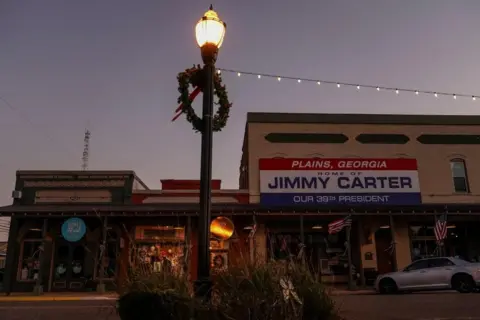
Saturday’s procession from Carter’s home in Plains, Georgia, to Atlanta marked the beginning of the six-day public goodbye for the statesman, who passed away last month aged 100.
Carter will be flown to Washington DC on Tuesday where he will lie in state at the US Capitol before a service on Thursday that will feature remarks from former American presidents.
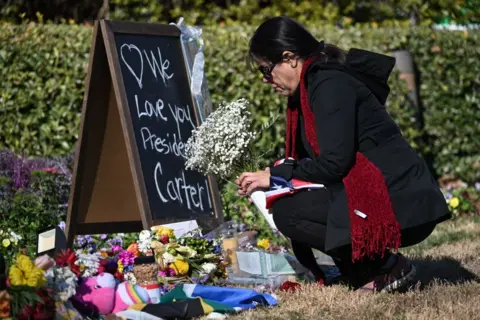
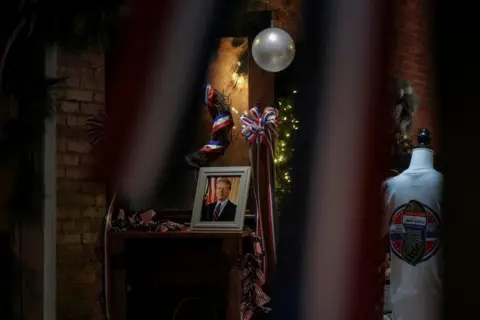
Mourners from the state of Georgia and around the world have gathered in Atlanta to pay their respects.
Reuters
Among those who came on Saturday was Heather Brooks, an Atlanta resident and “great admirer” of the Democrat.
“[I] found him to be always kind, relatable, just an awesome individual who has done so much for the world, not just America,” Ms Brooks told the BBC.
She said she had met Carter a handful of times and described him as “powerful yet so humble”.
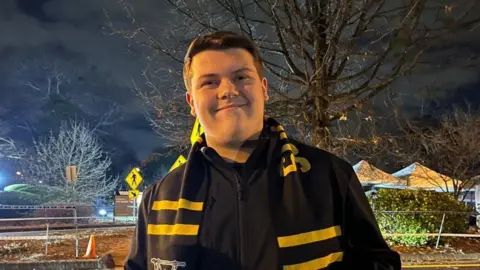
High school student Ethan Cyganiewicz’s family drove five hours overnight, arriving in Atlanta at four in the morning on Sunday. He described the gravity he felt while paying his respects to President Carter.
“You just feel the majesty of the moment. You’re like in the presence of a man who sat behind the Resolute Desk in the Oval Office. It surely is something,” the 15-year-old told the BBC.
Ethan Cyganiewicz
Ethan said he thought Carter was “average” as president, but valued his humanitarian work and humility.
“He was the last president that actually cared about the American people,” Ethan said.
Paige Alexander, the head of the Carter Center, told the BBC that the ex-president should be remembered for his “sincerity and integrity”.
“I mean, at the end of the day, you have a politician who would say during a debate, you know, ‘the Honourable President [Gerald] Ford and I disagree on these issues’,” Ms Alexander said. “You don’t hear that now.”
The grassy area outside the Carter Center has been overflowing with flowers, handwritten tributes and bags of peanuts, a reference to Carter’s early years as a peanut farmer in Plains.
Reuters
Those who knew the former president well, like Jill Stuckey, a long-time friend of the Carter family, said she will miss his – and his wife Rosalynn’s – commitment to helping others.
That’s something Ms Stuckey said the couple was committed to “until the day they passed”.
“I don’t know how we’re going to get used to a world without President Carter,” she told the BBC.
On Saturday the motorcade passed the Methodist church where the Carters married in 1946, and the home where they lived and died.
The former president will be buried there alongside Rosalynn, who died in late 2023 aged 96.
The procession also stopped in front of Carter’s boyhood home and family farm just outside Plains. The site is now part of Jimmy Carter National Historical Park, which rang the old farm bell on Saturday 39 times to honour the 39th president.
The motorcade then stopped at the Georgia state capitol building for a moment of silence led by Georgia Governor Brian Kemp.
Mourners will be able to visit Carter at the presidential library on 5 January and 6 January before he is flown to Washington DC on 7 January.
For two days he will lie in state at the US Capitol Rotunda, where the public will be able to pay their respects.
His life will be commemorated at Washington National Cathedral on 9 January in a service attended by several former presidents.
Reuters
On top of the political praise Carter is expected to receive in the coming days will be the personal tributes from his extended family.
For Jason Carter, the former president’s grandson, it is the personal connection he had with people that he will especially miss.
“I think for many people in the country he was a beacon of love and respect and I think that’s worth celebrating,” the former Georgia state senator told the BBC.
For much of her life, Sumaya Ainaya spent weekend and summer nights on Mount Qasioun, which overlooks the city of Damascus, joined by other Syrians drinking coffee, smoking hookah and eating corn on the cob roasted on grills nearby.
But soon after the Syrian civil war erupted in 2011, the military under President Bashar al-Assad closed the mountain to civilians. Suddenly, instead of families and friends shooting fireworks into the sky, soldiers with tanks and artillery launchers were firing at rebel-held areas below.
This New Year’s Eve, weeks after a coalition of rebels ousted the Syrian regime, Ms. Ainaya, 56, and her family returned to Mount Qasioun with snacks, soda and scarves to protect from the winter chill — and reclaimed a favorite leisure spot.
“Thank God, we’ve returned now — we feel like we can breathe again,” said Ms. Ainaya, an Arabic literature graduate and a mother of four, standing along a ridge and pointing out several Damascus landmarks.
“We feel like the city has returned to us,” said her son Muhammad Qatafani, 21, a dental student.
Across Damascus, as in much of the country, Syrians are reclaiming, and in some cases embracing anew, spaces and freedoms that had been off limits for years under the Assad regime. There were places ordinary Syrians were not allowed to go and things that they were not permitted to say when the Assad family was in power. The country, many said, increasingly felt as if it did not belong to them.
But with the newfound sense of freedom comes some trepidation about the future under a government formed by Islamist rebels, and whether with time it might institute new restrictions and limitations.
Many Syrians are watching each decision and announcement as a harbinger of how their new rulers may govern. Last week, Syria’s de facto new leader, Ahmed al-Shara, said it could take two to three years to draft a new Constitution and up to four years to hold elections, alarming Syrians who fear they may have traded one authoritarian leader for another.
For now, there is also a level of chaos under the interim government as it races to prioritize certain state-building measures over others. With many economic restrictions and regulations gone, men and boys sell smuggled gas from large water jugs on street corners. The city’s traffic is snarled, as few police officers are on patrol, and double parking is rife, residents said.
Despite the anxiety, people are returning to or rediscovering spaces across Damascus, the capital. Protest songs that could have landed someone in prison a month ago can be heard on the street.
“We weren’t seeing the city, Damascus, or any city, in all its details,” Yaman Alsabek, a youth group leader, said of his country under the Assad regime. “The public spaces — we stopped going to them because we felt they weren’t for us, they were for the regime.”
His organization, Sanad Team for Development, has begun to organize youth efforts to help clean the streets and direct traffic. “When Damascus was liberated and we felt this renewed sense of ownership, people came out to rediscover their city,” he said.
After last month’s stunning sweep by the rebels, icons of the Assad regime were torn down. Children play on the pedestals and plinths that once held towering statues of Mr. al-Assad, his father and his brother. Murals cover spaces where pro-regime slogans were emblazoned.
On a recent gray and drizzly day, it was standing room only in the auditorium that had been the headquarters of the ruling Baath party, which represented the Assad family’s totalitarian grip on political discourse. Hundreds of people gathered to hear a Syrian actress and activist, Yara Sabri, speak about the country’s thousands of detained and missing prisoners.
“We all decide on what it will look like and what we want it to be,” Ms. Sabri said of the country’s future.
Weeks ago, she had been in exile because of her activism. Now, a Syrian flag, with its new colors, hung over the lectern at which she spoke. Above the building’s entrance, the old Syrian flag and the Baath party flag were partly painted over.
Salma Huneidi, the event’s organizer, said the choice of venue was deliberate. “We consider this a victory,” she said. “This was a place that we couldn’t do any activities, and now we are not only holding activities, but important ones that expose the previous regime.”
An event to discuss the writing of a new Syrian Constitution was also held in the building recently.
“Syria feels bigger, the streets feel bigger — gone are the images that used to irritate us, the slogans that used to irritate us,” Ms. Huneidi said. “We used to feel so restricted before.”
Even the utterance of the word “dollar” could land someone in prison under Mr. al-Assad. Foreign-currency exchanges, which were banned for years under the Assad regime, have sprung up seemingly everywhere. Men walk through markets yelling: “Exchange! Exchange!” A seller hawking warm winter porridge offered stacks of Syrian pounds in exchange for crisp $100 bills.
Mohammad Murad, 33, sat in his car on a street corner, wearing a beanie with the colors of the new Syrian flag. A sign in his window said, “Dollars, euros and Turkish.”
Mr. Murad had long worked in currency exchange, but after the previous regime banned foreign currencies, his business went underground. If a customer needed dollars or euros, Mr. Murad said, he would go to the person’s house, bills hidden inside a sock.
In the new Syria, he said, he stands in line at the central bank to exchange $1,000 for stacks of Syrian pounds. When potential patrons come to his window to inquire about the exchange rate, he assures them he is offering the “best price.”
Across the street, the shelves of a small corner store look very different from only a few weeks ago, when shop owners had to smuggle foreign brands and hide them from most customers.
“I would only sell those brands to my regular customers that knew I sold smuggled goods, not to just anyone coming in,” said the owner, Hussam al-Shareef.
Syrian-made products now mingle openly with brands from Turkey, Europe and the United States. Customers walk in and freely ask for “Nescafe, the original.”
Three years ago, a police officer came into his shop and saw six Kinder chocolate eggs in a glass case in the back. Mr. al-Shareef was fined 600,000 Syrian pounds, or roughly $50, and sentenced to a month in jail. He has been fighting it in court ever since.
Back on Mount Qasioun, a man was peddling illegal fireworks smuggled from Lebanon. Hours later, they would light up the sky to ring in 2025.
Ali Maadi, 35, was busy setting up a stand to sell drinks, snacks and hookahs. Before the war, his family had a small but comfortable rest area along the mountain’s ridge. When he returned more than a week ago, he found that Syrian Army soldiers had used it as an outpost and had broken everything, including the bathrooms. He plans to slowly rebuild.
From two speakers in the back of his Peugeot, he was blasting a mix of Syrian protest and folk songs. The lyrics of one song said:
We want to adore, we want to love
We want to walk the path
We want to learn to be men and love Damascus
From our hearts and see Damascus up close.
Nearby, Aya Kalas, 28, and her soon-to-be fiancé, Khalid al-Qadi, 26, sat at a picnic table enjoying the view. She was 15 the last time she came to the mountain, she said.
“Any place you were banned from, you want to come back to it,” said Ms. Kalas, a beautician.
Damascus, where Ms. Kalas has lived her entire life, feels unrecognizable at times, she said.“There were entire streets you couldn’t walk along because a military officer or official lived there,” she said.
“We feel like seeing the country anew; we feel like tourists,” Mr. al-Qadi said. “It feels like it’s ours again.”
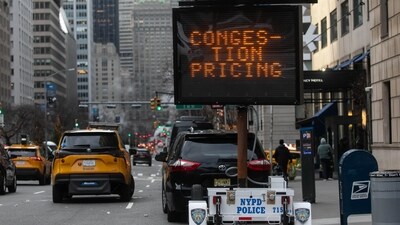
Congestion pricing has finally arrived in New York City, though its long-term future still remains uncertain.
New York’s controversial plan to charge drivers for entering Manhattan’s central business district came into effect on Sunday.(Bloomberg)
Drivers entering parts of Manhattan will be charged $9 during peak hours in a program following similar initiatives in London, Stockholm and Singapore that aims to reduce the worst traffic in the world. The first initiative of its kind in the US, congestion pricing promises to bring $15 billion to the Metropolitan Transportation Authority, the agency that runs the city’s century-old subway and commuter-rail lines, for desperately needed upgrades.
“We’re doing something to deal with the reality of the way that congestion is hurting our city and costing people time and money, that we’re protecting the interests of New Yorkers from a health standpoint,” Janno Lieber, the MTA’s chief executive officer, said late Friday after a judge ruled against New Jersey’s request to stop the program from starting on Sunday.
New York may present a model for developing additional revenue sources for transit, said Tiffany-Ann Taylor, vice president for transportation at the Regional Plan Association, which works to improve the economic health and quality of life in the region.
The debut follows years of political bickering and scores of legal challenges. That includes an unsuccessful 11th-hour attempt to block its implementation by neighboring New Jersey.
“We are disappointed that the courts are allowing congestion pricing to take effect,” Natalie Hamilton, a spokesperson for New Jersey Governor Phil Murphy, said in an emailed statement after the US Court of Appeals for the Third Circuit denied the state’s appeal. “We will continue fighting against this unfair and unpopular scheme.”
The Federal Highway Administration faces a Jan. 17 deadline to file additional information on efforts to mitigate the tolling plan’s potential effects on traffic and pollution in the Garden State.
A change in administrations in Washington three days later on Jan. 20 also looms large over the tolling plan. In November, President-elect Donald Trump called the charge a “regressive tax” and said it would be “virtually impossible” for New York City to come back if congestion pricing is in effect. Trump may seek a longer environmental review of the program through a legal suit or find a way to stop the tolling through administrative action, according to Brad Lander, New York City’s Comptroller.
The judge in the case, Leo Gordon, is also asking for additional filings beyond Inauguration Day.
Congestion pricing has taken a long and tortured path since it was proposed in 2007 by then-Mayor Michael Bloomberg, the founder of Bloomberg News parent Bloomberg LP. State lawmakers needed to craft legislation to kickstart a process filled with cycles of considerations and approvals, eventually approving the concept in 2019.
Then, a tolling structure had to be created. Rates needed to be high enough to discourage driving and shift motorists to public transit, but not so burdensome that they crippled local businesses and the broader economy. About three weeks before the plan was supposed to start last June, New York Governor Kathy Hochul said an initial $15 charge was too large and paused its launch.
Transit enthusiasts, environmental advocates and some business groups highlight the program’s goal of boosting public-transportation ridership, reducing air pollution and decreasing traffic in one of the world’s most congested urban areas. The MTA will use revenue raised from vehicles traveling south of 60th Street into the central business district to extend the Second Avenue subway to Harlem, modernize train signals from the 1930s and make more stations accessible.
About 1.3 million people take public transportation into the district for work compared with 143,000 who drive, according to the MTA.
“Several million people ride the subway every day, so fixing it is not optional,” said Danny Pearlstein, policy and communications director for Riders Alliance, a transit advocacy group. “It’s necessary for the future of the city and the state’s economy to thrive.”
Still, some elected officials in New York and New Jersey warn the new fee will hurt small businesses in the tolled zone and imposes another financial burden on their residents.
“Maybe fewer cars and trucks will go south of 60th street in Manhattan, which may help some fancy folks living in lower Manhattan, but what about the people here in northern New Jersey?” US Representative Josh Gottheimer, a Democrat of New Jersey, said during a news conference on congestion pricing. “What about all those people in the outer boroughs of New York?
Passenger cars with an E-ZPass will pay $9 once a day to enter the tolled area during peak hours, but will receive credits of between $1.50 and $3 if motorists already paid tolls on certain tunnels headed into Manhattan. Smaller trucks with an E-ZPass will pay $14.40 every time they enter the district during prime hours, with tunnel crossing credits of $3.60 to $7.20.
Passengers in for-hire vehicles like Uber and Lyft will pay a per-trip charge of $1.50 while riders in taxis will pay a 75-cent fee.
There’s no toll on the West Side Highway or the Franklin D. Roosevelt East River Drive, but motorists will pay the fee if they leave those highways and enter the district south of 60th Street. Discounts for low-income drivers, tax credits for low-income residents of the central business district, and disability exemptions for individuals who are unable to access public transportation will also be available.
While Hochul lowered congestion fees for the plan’s current iteration, they’re set to increase to $12 in 2028 and $15 in 2031.
If congestion pricing were paused again or terminated, the MTA’s combined capital budget deficit would balloon to almost $50 billion. Albany could force the MTA to scale back its infrastructure plans, which would delay needed improvements. Ultimately, lawmakers will need to increase existing levies or create new ones to raise the tens of billions required to update a transit system that suffered years of neglect.
The shop used to sell flowers and gardening gear to visitors from just down the road, where a tiny breakaway region of Moldova has for more than 30 years stood defiantly apart, with support from Russian troops.
Since the halt of gas from Russia on New Year’s Day, however, the store has been selling mostly electric heaters to freezing residents of Transnistria, the self-declared microstate in eastern Moldova.
The cheaper models have already sold out, a saleswoman said, but higher-end heaters are selling fast, as 350,000 inhabitants of Transnistria endure an energy crisis that has shut down factories, left Soviet-era apartment blocks without heating and hot water and raised questions about the survival of their go-it-alone, Russian-speaking enclave.
The situation is so bad that the region’s president, Vadim Krasnoselsky — who leads an entity unrecognized by all other countries, including Russia — tried to reassure his people on Thursday: “We will not allow a societal collapse.”
“It is difficult,” Mr. Krasnoselsky said, enumerating thousands of businesses, schools, farms and homes that were struggling without heat. Citizens had shown “great responsibility,” he said, by “going out into the forest to collect dead wood” to burn at home.
The crisis began on Jan. 1, when Russia’s energy giant Gazprom stopped pumping natural gas through Ukraine, its remaining major export route to Europe, after Ukraine refused to a renew a five-year gas transit deal.
In most places once dependent on Russian gas, like Hungary, the shutdown’s consequences were softened by alternative suppliers from the West. But Transnistria, a tiny sliver of territory built on unswerving loyalty to Russia, faces an existential crisis.
Dorin Recean, the prime minister of Moldova, which has long demanded that the region give up its claims of statehood, accused Russia of inducing an “impending humanitarian crisis.”
“By jeopardizing the future of the protectorate that it has backed for three decades in an effort to destabilize Moldova, Russia is revealing the inevitable outcome for all its allies — betrayal and isolation,” Mr. Recean said on Friday.
Distracted by the war in Ukraine and more cautious about investing resources, Russia has shown an increased willingness recently to cut its losses, most notably in Syria, where it stood on the sidelines last month as rebels toppled Moscow’s closest ally in the Middle East.
Alexandru Flenchea, a former deputy prime minister of Moldova who was responsible for trying to reintegrate Transnistria, said that Russia was not yet ready to abandon the region, valuing its use for exerting military and political pressure over Moldova.
Russia’s desire for leverage, Mr. Flenchea said, grew more acute in October when Moldovan voters narrowly endorsed changing the Constitution to lock the country’s exit from Moscow’s sphere of influence, aligning more closely with the West.
But, Mr. Flenchea added, Russia’s readiness to let Transnistria freeze without gas or its major source of revenue — the sale of electricity to Moldova from a gas-powered power station — suggested that the region was in serious trouble.
“The whole model in Transnistria relies on free Russian gas. No free Russian gas, the whole thing collapses,” he said. “But I don’t think Russia will let this happen soon. It still needs them.”
Others see Transnistria’s travails less as a sign of Russian retreat than of its determination to divert Moldova from its pro-European course.
Also cut off from Russian gas, Moldova has over the past week shifted to more expensive alternatives, including electricity from Romania. This saved Moldova from going cold but doubled the price of electricity for consumers, which could carry a heavy political price for the pro-Western government in elections this year.
Russia’s goal, said Vladislav Kulminski, a former government official now with the Institute for Strategic Initiatives, a Moldovan research group, “is to keep us in a gray zone by getting an election result that will bring to power a different government.”
”Everything has been thrown up in the air,” he said. “We don’t know what shape it will take when all the pieces fall to the ground.”
A retro police state with its own currency and passports — and a successful soccer team financed by local tycoons — Transnistria has an expansive security service, reinforced by Russians, and it has worked hard to control what people hear about.
Transnistria’s media outlets, echoing Russian talking points, blame Ukraine, the United States and Moldova’s government for the gas cutoff. Whispers that President Vladimir V. Putin of Russia might also be to blame are taboo.
The media blitz seems to be working.
“Putin would never abandon us,” said Grigory Kravatenko, a resident of Bender, an industrial town bordering Moldovan-controlled territory.
Asked whether Transnistria might be better off less aligned with Moscow, he added: “We are not for Russia. We are not for Moldova. We are not for Ukraine. We are for ourselves and we are all suffering.”
Cooking stoves kept working for a while after the Jan. 1 cutoff, thanks to gas that was still in the pipes. But now they, too, are spluttering.
A Transnistria resident who gave only her first name, Yulia, walking on Friday with her infant daughter down an abandoned railway track, said she was sure that Russia would soon come to the rescue. “Of course they won’t let us die,” she said.
Victor Ceban, an Orthodox Christian priest responsible for parishes along the zigzagging border, said he avoided talking about who was responsible. “Whatever you say to one person you become somebody else’s enemy,” he said.
In some places, the border is marked with concrete barriers manned by Russians in fatigues. But it is so unclear in other places that it is easy to stray into Transnistria. Waved through a checkpoint this past week by a soldier with a Russian flag on his shoulder, journalists asked people at a bus stop if they knew of Transnistria’s problems.
“Of course we do. This is Transnistria,” an elderly woman said.
Mr. Ceban, the priest, walking from home to home on Friday through the Moldovan-controlled village of Varnita, offered blessings ahead of Orthodox Christmas and prayers that his mostly geriatric flock would not suffer long without heat.
When Transnistria, the most prosperous part of Moldova when both were part of the Soviet Union, first broke away to form a renegade state in the early 1990s, the region boasted it would become a Russian-speaking version of Switzerland — a proudly independent haven from the turmoil gripping Moldova, which was deeply impoverished.
The breakaway region became a template for what has since been a drive by Russia to keep its influence in former Soviet lands by supporting separatists: first in Moldova, then in Georgia and in eastern Ukraine. In all three countries, local militants backed by Russian muscle declared their own microstates.
The deployment of Russia troops in Transnistria, originally as peacekeepers but still there decades after the fighting stopped, ensured that Moldova could never retake the territory by force and doomed diplomatic efforts.
Just as important to Transnistria’s survival, however, has been Russian gas, provided virtually free to keep a steel plant and other industries working — and to fuel the power station selling electricity to Moldova.
Moldova’s secretary of state for energy, Constantin Borosan, said that, before the current crisis, electricity generated in Transnistria had met about three-quarters of his country’s demand and provided about half of the separatist region’s budget.
“These people lived on subsidized gas from Russia,” he said. “Now it looks as if Russia has abandoned them.” He noted that Gazprom had ignored suggestions from Moldova that it could, using an alternate export route under the Black Sea, still get gas to Transnistria — if the Kremlin wanted.
“I don’t know what is going on in the head of Putin,” he said.
Whatever Russia’s intentions, it is causing widespread pain not only in Transnistria, but also to residents of Moldovan-controlled territory.
Alexandru Nichitenco, the mayor of Varnita, a village surrounded by Transnistria and dependent on its energy, said that most of its 5,100 inhabitants could no longer heat their homes. They faced disaster, he said, especially if the usual winter temperatures — typically many degrees below freezing — grip the country.
He said he did not blame Transnistria: “They can’t do anything. Moscow controls everything over there.”
Veronica Ostap, a mother in Varnita struggling to keep her family fed without a working stove, said she was waiting for her pay next week to buy an electric kettle. She was keeping one room warm with an electric heater so that her three young boys can sleep.
A Baptist Christian, she thanked God for keeping the temperature around zero, at least during the day. “The Lord is trying to help us,” she said.
Ruxanda Spatari contributed reporting from Chisinau, Moldova, and Nataliya Vasilyeva from Berlin.
NEW DELHI: The upcoming annual budget for FY26 could announce further measures to boost employment generation, CII said on Sunday, emphasising that job creation at a mass scale is important to engage the young population productively, and drive inclusive growth in the world’s most populous nation. The industry body has suggested a seven-point agenda to harness India’s demographic dividend, including an integrated national employment policy, support to labour-intensive sectors, and setting up an international mobility authority, among other targeted measures. With a median age of just 29 years, India is a young country, and is set to add 133 million people to its working-age population by 2050. The government could consider launching an internship programme in government offices in rural areas for the college-educated youth, CII said. It argued that this initiative would create short-term employment opportunities in government offices while bridging the gap between education and professional skills. The programme would also help augment the available manpower resources for the effective implementation of various rural programmes and government initiatives. CII has also proposed introducing a new provision under income tax rule in lieu of Section 80JJAA to encourage new employment. The new provision should continue as Chapter VIA deduction from gross total income, which is available even if a taxpayer opts for concessional tax regime. It has proposed an integrated national employment policy which could subsume under its ambit the slew of employment generating schemes currently in works by various ministries/states. In addition, the unified policy could also build on the single integrated employment portal — National Career Service (NCS) — wherein all the data can flow into this from various ministries and state portals. Highlighting that increasing women’s participation in the workforce, which currently is low, can further boost the Indian economy, CII said, new initiatives including the construction of dormitories using CSR funds, the formalisation of sectors like care economy, and establishing government-supported creches in industrial clusters could be taken to increase female labour force participation. Moreover, rolling out labour codes while ensuring social security coverage to the gig and platform workers would further strengthen the employment landscape. Many parts of the world are facing workforce shortages due to ageing populations, and India should leverage this opportunity. The government could consider setting up an international mobility authority under the Ministry of External Affairs. This authority could facilitate G2G collaborations for helping Indian youth tap the overseas employment opportunities. The authority could also work with the Ministry of Skill Development and Entrepreneurship to help develop skill development programmes aligned with global opportunities. In addition to technical skills, the programmes should also include cultural training, and foreign language skills. Chandrajit Banerjee, Director General, CII, said, “Coupled with higher employment, India also needs to ensure that productivity goes up. India’s Incremental Capital Output Ratio (ICOR) needs to trend down from its present level of 4.1. We need to establish metrics of measuring this. In fact, the Union Budget could set up an expert committee to study this in greater detail and recommend measures on way forward.”
In the late months of 1949, aspiring American writer William S Burroughs evaded gun and drug charges in the United States by bringing his family to Mexico where he planned to study while waiting out the statute of limitations on his crimes. Burroughs’ letters describe the early days after their arrival – settling in the fashionable Roma district of Mexico City, kicking his dope habit and immersing himself in the raucous expat community – with a kind of euphoria.
Two years later, Burroughs was once again deep in the grip of heroin and prone to violent, pistol-waving outbursts. His marriage was in shambles. His wife, Joan Vollmer, was lost in depression, illness and alcoholism, driven to deterioration by her own demons and the rigours of her unhappy, abusive relationship with husband “Bill”.
One stormy evening on September 6, 1951, the couple joined their usual coterie of literary drunks in an apartment above the rowdy bar they frequented. At first it was a typical get-together – lots of alcohol and drivel – but the situation changed abruptly when Burroughs produced a gun, announced “It’s time for our William Tell act”, and told Vollmer to place a glass on her head as a target. He then shot her in the temple.
Burroughs murdered his wife before going on to become one of the most influential figures in American literature. Vollmer – once a central personality in the emerging literary and cultural movement known as the Beat Generation – rests in a pauper’s grave on the edge of Mexico City to this day.
Now with the release of the movie Queer – an adaptation of Burroughs’ semi-autobiographical novel about a gay man immersed in the seedier side of Mexico City – there is renewed interest in the author, particularly his time in Latin America. Although it wasn’t published until 1985, Burroughs began early drafts of Queer shortly before shooting Vollmer, and many of its scenes were drawn directly from their tumultuous marriage and the toxic circumstances surrounding it.
With the book’s protagonist played by one of Hollywood’s leading actors, Daniel Craig, the film has brought a new wave of celebration to Burroughs’ work, accurately posing him as a pioneer in queer representation. But as groundbreaking as his writing may have been, a wall lined with mostly unmarked graves in Mexico City stands as a haunting reminder of a darker side to Burroughs’ legacy.
The Burroughs’ apartment at Jose Alvarado 37 in Mexico City where Bill once hosted fellow Beat writers [Nick Hilden/Al Jazeera]
The death of Joan Vollmer
When Burroughs and Vollmer arrived in the Roma district of Mexico City in 1949, the colonia was much as it is today: an upscale neighbourhood popular among visitors and expats with a noticeably prominent American presence, its quiet residential streets checkered with houses either whitewashed or brightly coloured, tree-lined avenues like Alvaro Obregon and Amsterdam bustling with restaurants and bars.
Back then the Americans were largely drawn to the now-defunct Mexico City College, where Burroughs enrolled under the pretext of studying Spanish, Mayan and Mesoamerican codices.
In fact, he was not studying much at all. Instead, he drank constantly, relapsed into the heroin habit he had been grappling with for a decade, and chased young sexual conquests with limited success through the queer bars along Campeche. Visits from fellow Beat Generation luminaires Alan Ginsberg and Jack Kerouac did little to inspire his scholarship, as the trio had a propensity for hanging around the park at Plaza Luis Cabrera where they whiled away the days getting high on heroin or peyote. This resulted in Burroughs’ withdrawal from school.
The Beats writers hung out and took drugs at the Plaza Luis Cabrera in Mexico City [Nick Hilden/Al Jazeera]
Burroughs carried a pistol through it all (“I always carry a gun,” he wrote to Jack Kerouac in 1949, two years before killing Vollmer), and his letters described how he would often draw it amidst drunken bar fights only to have it taken away by the bartender or police. Sometimes it was returned, sometimes it wasn’t.
Vollmer, meanwhile, was not doing well.
She and Burroughs had struck up their relationship four years earlier in New York City, where Vollmer played a foundational role in the early Beat movement: Her apartment was the meeting place for its most illustrious participants, who sought to push artistic and cultural boundaries through the exploration of form, improvisation, drugs, and sexual liberation. Vollmer was known for her sharp intellect and rhetorical skill, and helped to hone the Beats’ conceptual framework via long nights of Benzedrine-fueled conversation and art critique. But while Joan and Bill were drawn to one another on a cerebral level, their union was troubled from the start by two factors: Burroughs was gay and they were both raging drug fiends.
As a result, their years together were painfully fraught. According to friend Hal Chase (who introduced Kerouac to Neal Cassady, the prototype for the protagonist in On the Road), “the struggle between Joan and Bill seemed to be life and death.” Jealous of Burroughs’ queer pursuits, Vollmer would mock him sharply while he escaped into heroin addiction. However, she was addicted to speed to the point where she “got way off the beam” and landed in a psychiatric ward. William was no stranger to hospital stays, including various rehab programmes, and once, in a fit of Van Goghian madness, cut off the tip of his little finger after his heart was broken by an 18-year-old hustler.
By the time Burroughs and Vollmer arrived in Mexico – on the lam from Burroughs’ drug and gun possession charges in New Orleans with children in tow – the couple had kicked drugs in favour of a relentless drinking habit. By all accounts (and the most investigative version comes via an essay by Burroughs’ longtime friend James Grauerholz titled “The Death of Joan Vollmer Burroughs”), their life in Mexico City was not a happy one. They wasted much of their time in the notorious boozing hub of Bounty Bar (today a laid-back family restaurant called Krika’s). The apartment above was where Burroughs would soon shoot Vollmer.
Monterrey 122, the apartment above the Bounty Bar where William Burroughs shot and killed Joan Vollmer [Nick Hilden/Al Jazeera]
Then Burroughs took up heroin again, leading to violent disputes where Vollmer would throw out the drugs, drawing violence from Bill. He later inserted a depiction of such a scene in his novel, Junkie. A few months into their time in Mexico and roughly a year before her death, Vollmer filed for divorce, though it was never finalised.
By the last days of her life, she seemed to be falling apart.
“She had an incurable blood disease,” wrote Hal Chase in a letter describing his encounter with Vollmer a few days before the shooting. “She had open running sores, and knew she was dying. She was thin-haired … had lost some of her hair. ‘I’m not going to make it,’ she said.”
On the day of the shooting, Burroughs had just returned from South America where he had been travelling with his lover, Lewis Marker. A string of hurricanes had lashed the region, and much of Roma was flooded with up to a metre (3ft) of water. A group of expats was gathered at the third-floor apartment of John Healy at Monterrey 122, above the Bounty Bar where Healy worked. One witness reported that Vollmer was very drunk on ginebre and limonada – gin and lemon soda – but that they did not see William drinking and he did not seem drunk. Then he extracted from his travel bag a Czech-made “Star” .380 pistol.
“Put that glass on your head, Joanie,” Burroughs suggested, according to poet Eddie Woods, who was present in the room. “Let me show the boys what a great shot old Bill is.”
“So she did,” said Woods, “And she said with a giggle – and she turned her head, she is balancing the glass on her head, and she said – ‘I can’t watch this, you know I can’t stand the sight of blood.’”
Burroughs took aim at the glass and fired. A hole appeared in Vollmer’s temple and she slumped over, and the glass went spinning across the carpet undamaged.
At first Burroughs thought she was joking, but then Marker said Vollmer was hit. Burroughs cried out and leaped to her side, trying to revive her. According to Marker, the others sat in silence, “staring and not believing”.
In the ensuing media circus, it was initially reported that Burroughs had fessed up to the William Tell act gone wrong at the time of his arrest. But then at the behest of his lawyer, Burroughs changed his story and said the gun had gone off in a drunken accident while he was showing it to a friend. The lawyer bribed everybody relevant, and Burroughs was released after 13 days.
Burroughs being questioned by police [reprint from Magazine de Policia (no longer in publication)]
The couple’s children – son William Jr (who would die of alcohol-induced cirrhosis at 33, outliving his mother by just five years) and Vollmer’s daughter from a previous marriage – were sent to live with relatives in the US while Burroughs stayed in Mexico to fight his case. But a year later, his lawyer shot and killed the son of a government official, prompting both lawyer and client to flee the country once and for all, escaping to the US before the former broke for Europe and the latter began searching South America for yage – better known today as ayahuasca. Burroughs was then convicted of manslaughter in absentia and received a two-year suspended sentence.
Authorities buried Vollmer in a cemetery called Panteon Americano on the edge of town. In 1990, a posted notice called for her family to pay the long overdue fees associated with her internment, to no avail. So in 1993, Vollmer’s remains were exhumed and placed among the unmarked funerary nichos (display boxes) for the indigent. Burroughs ended up shelling out for a simple inscription: name, place and date of birth, place and date of death.
Vollmer’s is the only name on a wall of blank graves.
The final resting place of Joan Vollmer who was killed by her husband William Burroughs [Nick Hilden/Al Jazeera]
The appalling conclusion
At the time of the shooting, Burroughs was a nobody without a novel to his name. His claim to fame was not as a writer, but as a wife murderer.
Today, he is remembered as William S Burroughs, author of Naked Lunch, the avant garde masterpiece deemed one of the top 100 English novels by Time. Since its publication in 1959, the book’s fierce experimentation and willingness to deal with the most lurid subject matter has inspired dozens of writers and artists. The famously unfilmable novel was adapted for the screen by acclaimed director David Cronenberg in 1991, and now Queer has received the same treatment.
But despite his literary brilliance, Burroughs was also a fragile “megalomaniac” (his word, used in a letter to Ginsberg) who carried a gun to make himself feel like a big shot and jacketed himself with junk to cover up his manic insecurities. His writing played no small part in popularising heroin within the counterculture, and he had a disturbing taste for sex with underage partners.
William S Burroughs pictured at the 10th International Paris Book Fair on March 23, 1990 [Michel Lipchitz/AP]
While there has been much debate as to whether one can delineate between his work and his deeds – the age-old matter of separating art from artist – Vollmer’s shooting and the writing were, for Burroughs at least, two sides of a coin.
“I am forced to the appalling conclusion that I would have never become a writer but for Joan’s death,” he famously wrote in the introduction to Queer. “The death of Joan brought me into contact with the invader, the Ugly Spirit, and manoeuvred me into a lifelong struggle, in which I had no choice except to write my way out.”
It wasn’t always Burroughs’ intention to fuse the death to his work. While recognisable elements of Vollmer’s and Burroughs’ life together appeared throughout drafts of Junky and Queer, he neglected to cover the shooting, and explained in a 1955 letter to Ginsberg: “I suspect my reluctance is not all because I think it would be in bad taste to write about it. I think I am afraid.” But in the same letter, Burroughs attached a chapter of then-in-progress Naked Lunch that was obviously based on the incident – William Tell act and all – immortalising the scene in his most noted novel.
Whether or not Burroughs killed Vollmer purposefully has been debated ever since, even by those who best knew them. There were those, like Hal Chase, who distanced themselves from Burroughs after the shooting, then later suggested intent. Others, like Ginsberg (who was not present for but was still haunted by Vollmer’s death for the rest of his life and wrote about it in the poem “A Dream Record”) claimed that in fact she agreed to the William Tell act out of her own “death wish” – such was the extent of her diminishing health and mental wellbeing.
“Why indeed?” It was a question Burroughs considered himself via his correspondence with Ginsberg, seeming to find no answers. “I am afraid to go too deep into this matter.”
Witness Eddie Woods was more certain on the issue, explaining in an interview years later, “He was out of it, in shock that this happened. Again, to me, that’s evidence it was absolutely an accident. He was shocked that he had hit her, and he was trying to wake her up. This guy was out of it.”
The killing was featured in several Mexican newspapers and scandal sheets [reprint from Magazine de Policia (no longer in publication)]
American tradition
Like many Americans, Burroughs’ gun fixation was prompted by a combined sense of obligation and paranoia. “I have not only the right but the duty to carry a gun and to protect my person against any attack that might deprive my family of support,” he wrote to Ginsberg in January 1951, 10 months before shooting his wife.
This irony is persistent, as today the vast majority of American gun owners arm themselves for purported personal protection, even though gun ownership vastly increases the risk of violent death for one’s self or partner. When women in America are murdered – which has been happening with increasing frequency since 2014 – the killer is almost always a domestic partner or someone they know, and the weapon is almost always a gun. In Mexico, thousands of femicides occur each year, impunity rates for violence against women are frighteningly high, and such crimes are on the rise in North America and around the world.
Burroughs maintained his gun habit until his death in 1997 at the age of 83, with many legends of his propensity for pulling heat shared right up to the end. He even worked firearms into his creative process with the “shotgun art” he blasted in his later years.
Joan Vollmer in an undated photo taken by Allen Ginsberg [Courtesy of the Ginsberg Estate]
The junk virus
If, like so many Americans today, William Burroughs possessed a toxic affinity for firearms, he – again like too many of his contemporary compatriots – also endured a painful struggle with addiction and was aware of its damage. He may have been one of the godfathers of dope, to some degree responsible for injecting heroin into popular culture, but he was not its advocate. Quite the opposite.
“Naked Lunch is written to reveal the junk virus,” he wrote to Ginsberg in 1959. “Get off that junk wagon, boys.” At the time, he claimed he was done with opioids, but he was not. Never would be.
Opioid addiction has today reached endemic proportions in the US. In Burroughs’ day and on through the 1990s, heroin and its junk derivatives were primarily an underground scene with limited reach and effect. But since OxyContin mainstreamed opioids around the turn of the millennium, overdose deaths have skyrocketed to more than 80,000 per year.
“Junk is a bad deal, a nowhere route that never leads to anything but junk,” he wrote to Ginsberg in 1959. “If treated as a public health problem, [it] could be slowly eliminated with no penalizing of [people].” But that would never happen because “they don’t want anyone to kick.”
Burroughs was an outspoken critic of the American propensity for criminalisation and incarceration, with a particular vitriol for the targeting of what people were only just beginning to realise was a disease.
“Those bastards Stateside don’t want people to cure themselves,” he wrote. “They aim to incarcerate all undesirables, that is anyone who does not function as an interchangeable part in their anti-human Social Economic set up. Repressive bureaucracy is a vast conspiracy against Life.”
Inside Krika’s, which was once the Bounty Bar frequented by Burroughs. Vollmer was shot in the third-floor apartment above [Nick Hilden/Al Jazeera]
Art v the artist
Seventy-five years ago, William Burroughs sat at the crossroads of what are today among the US’s premier crises: opioids, guns and violence against women. As a consequence, Joan Vollmer was killed, and from her death – by Burrough’s own account – arose the perspective he drew from to create the fever dream chaos of his greatest work.
It’s a hard bargain to reconcile. Here is yet another male artist celebrated regardless of the wreckage of raked-over muses left in his wake. In the past, such issues tended to go overlooked, but that is no longer the case.
So can the art be separated from the artist? And is Burroughs’ work, widely appreciated for its hallucinatory prose and revolutionary form, tainted by its association with femicide and the rise of the junk virus?
It is easy to read Naked Lunch and enjoy losing oneself in its madness. But when one visits Panteon Americano and sees Joan Vollmer’s lone name amid dozens of unmarked stones – silent, no visitors, her husband too cheap or too cold to throw in a line of poetry (“How I miss Joan!” he wrote in one of his letters, but you see none of that feeling in her tomb inscription) – it becomes difficult to embrace the fiction over the reality.
There are no easy answers. Perhaps – to paraphrase Alan Ginsberg – it’s up to each of us to choose which darlings we kill and which we keep.
American writer William Burroughs smoking a cigarette and holding a walking stick about March 23, 1990 [Archive photo/AP]
New Delhi: After creating a world-class digital public infrastructure (DPI), India is taking giant strides in renewable energy which is another global transition sector, Tata Group Chairperson N. Chandrasekaran has stressed. The country reached 214 GW installed green energy capacity in 2024 and is firmly on track to meet its ambitious target of achieving 500 GW energy capacity from non-fossil fuels by 2030.
Addressing the NIT Trichy’s ‘Global Alumni Meet (GAM) 2025’ in Chennai, Chandrasekaran said our renewable-based electricity has reached 45 per cent, which was around 30 per cent last decade. “The reason it is not enough is because if you have to achieve the 1.5 degree target that was set in Paris, the global carbon emission has to reduce by 43 per cent this decade. Instead, between 2019 and 2024, we have gone in the other direction, it has increased by 3.3 per cent,” he told the gathering.
In a significant feat for the PM Surya Ghar Muft Bijli Yojana, the scheme has achieved more than 6.85 lakh installations and is set to surpass a decade’s solar growth in about a year. Since its launch in February this year, the scheme with 685,763 installations has already reached 86 per cent of what was installed in a decade before that.
According to Tata Group Chairperson, the digital infrastructure created in this country is ahead of anything that has happened anywhere else. “We have some phenomenal digital systems, whether it is our payment system, Aadhaar, healthcare, settlement systems, and retail banking systems. We have some of the finest digital systems. We have the talent too,” he noted.
Chandrasekaran further stated that despite a moderation in growth this year, India will continue to be the fastest-growing economy in the world. “Indian economy is very strong. Even with a moderation in growth this year, we will still continue to be growing better than any other country. We will be the fastest growing,” he emphasised.
2025 is going to be a ‘phenomenal year for AI’, with huge investments expected to happen in small language models (SLMs) during the year, while large language models (LLMs) will also be playing its role, Chandrasekaran said.
Tens of millions of Americans are bracing for a huge winter storm that could bring the heaviest snowfall and coldest temperatures in over a decade.
The storm, which started in the middle of the US, will move east in the next couple of days, the National Weather Service (NWS) said.
A state of emergency has been declared in the states of Kentucky and Virginia, andparts of the US unaccustomed to severe cold, including Mississippi and Florida, have been warned to expect treacherous conditions.
Forecasters say the extreme weather is being caused by the polar vortex, an area of cold air that circulates around the Arctic.
“For some, this could be the heaviest snowfall in over a decade,” the National Oceanic and Atmospheric Administration said.
AccuWeather forecaster Dan DePodwin said: “This could lead to the coldest January for the US since 2011.”
He added that “temperatures that are well below historical average” could linger for a week.
Those low temperatures will be on the east coast as well, where the storm is expected to reach by Sunday evening.
In the central US, there will be “considerable disruptions to daily life” and “dangerous or impossible driving conditions and widespread closures” into Sunday, according to the NWS.
Some areas of Kansas and Indiana could see at least 8in (20.3cm) of snow.
In parts of the Midwest, blizzards are possible.
“Whiteout conditions will make travel extremely hazardous, with impassable roads and a high risk of motorists becoming stranded,” the NWS warned.
Sleet and freezing rain is forecast for Missouri, Illinois, and swathes of Kentucky and West Virginia.
As the storm moves east, millions more Americans will see record low temperatures, forecasters said.
Cities including Washington DC, Baltimore and Philadelphia are preparing for snowy and icy conditions from Sunday into Monday. Snowfall of between 5-12in could be recorded in parts of Virginia.
Also on Sunday, portions of the southern US including Arkansas, Louisiana and Mississippi may see severe thunderstorms.
Private meteorologist Ryan Maue said: “It’s going to be a mess, a potential disaster. This is something we haven’t seen in quite a while.”
American, Delta, Southwest and United airlines are waiving change fees for passengers because of the potential flight disruptions.












![Joan Vollmer in an undated photo taken by Allan Ginsberg. [Courtesy of the Ginsberg Estate]](https://www.aljazeera.com/wp-content/uploads/2024/12/Joan-Vollmer-photo-by-Allan-Ginsberg-courtesy-of-the-Ginsberg-Estate-1734887630.jpeg?w=770&resize=770%2C569)


