Dozens of Israeli strikes pounded the Gaza Strip over the weekend as Israeli and Hamas officials resumed indirect cease-fire talks through mediators in Qatar.
Israel’s military said on Sunday that it had hit more than 100 targets across the enclave over the weekend, including sites from which militants had fired projectiles toward Israeli territory. It said the strikes had killed Hamas militants and that the military had taken measures to mitigate the risk of harming civilians. The claims could not be independently verified.
The Gaza health ministry said in a statement on Sunday that 88 Palestinians were killed in Israeli strikes over the last 24 hours. The Gaza Civil Defense, an emergency services agency, said that its crews had responded to multiple airstrikes on family homes on Sunday in which several people were killed and wounded.
Pressure has been mounting on both sides to reach a cease-fire agreement that would include the release of hostages held in Gaza before President-elect Donald J. Trump takes office on Jan. 20.
On Friday night, Hamas said its officials would resume meetings in the Qatari capital of Doha to reach a cease-fire deal. And Israel said last week that it was also sending a delegation of midlevel security officials to meet with mediators in Qatar.
Numerous earlier rounds of negotiations have faltered amid gaps in the two sides’ demands. And as hopes for a cease-fire deal between Israel and Hamas rise again, Palestinians and human rights organizations say the humanitarian situation in Gaza is getting even more desperate.
The Palestinian Red Crescent Society said on Sunday that overnight Israeli airstrikes near Al-Amal Hospital in the southern city of Khan Younis caused significant damage to several hospital facilities and killed one person.
And Gaza’s health ministry said on Sunday that the Indonesian Hospital in northern Gaza was no longer providing services to patients or the wounded — leaving the northern part of the enclave without any functioning hospitals amid constant bombardment.
Israel’s military has been mounting an offensive in northern Gaza for more than three months against what it says is a resurgent Hamas force.
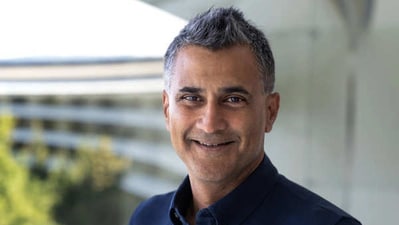
Indian-origin Kevan Parekh, who has been appointed as the new chief financial officer of Apple Inc. effective January 1, 2025, will receive an annual salary of $1 million ( ₹8.57 crore).
Indian-origin Kevan Parekh, who has been appointed as the new chief financial officer of Apple Inc.
Parekh, who joined Apple in June 2013, has previously held roles such as vice president of financial planning and analysis and vice president of finance for sales, marketing, and retail.
Prior to Apple, he served in senior leadership positions at Thomson Reuters and General Motors. He succeeds Luca Maestri as part of the company’s CFO transition plan.
Apple had announced on August 27, 2024 Parekh as its new chief financial officer. In a statement, Tim Cook, the company’s chief executive officer (CEO), said, “For more than a decade, Kevan has been an indispensable member of Apple’s finance leadership team, and he understands the company inside and out. His sharp intellect, wise judgment, and financial brilliance make him the perfect choice to be Apple’s next CFO.”
Born in 1972, Parekh holds a Bachelor of Science in Electrical Engineering from the University of Michigan and an MBA from the University of Chicago.
“As part of Apple Inc.’s (“Apple’s”) previously announced Chief Financial Officer transition plan, Apple’s Board of Directors appointed Kevan Parekh, 53, as Apple’s Senior Vice President, Chief Financial Officer, effective January 1, 2025. Mr. Parekh succeeds Luca Maestri in the role of CFO,” Apple said in Form-8K file with the United States Securities and Exchange Commission.
Apple also revealed added that Parekh’s annual compensation has been increased and now stands at $ 1 million.
“Mr. Parekh’s annual salary was increased to $1 million, effective January 1, 2025, and he is eligible to participate in the Apple Inc. Executive Cash Incentive Plan for fiscal year 2025 on the same basis as Apple’s other named executive officers, with a target opportunity of 175% of base salary based on his time in his respective roles for fiscal year 2025,” said Apple to SEC.
Tomiko Itooka, a Japanese woman born before the start of World War I and the sinking of the Titanic who was believed to be the oldest person in the world, died at a nursing home in Ashiya, Japan. She was 116.
In a statement released on Saturday, the mayor of Ashiya said Ms. Itooka passed away last Sunday. He did not give a cause, but local news media reports said she died peacefully of complications related to old age.
“I offer my deepest condolences,” said the mayor, Ryosuke Takashima. “Ms. Itooka gave us great courage and hope throughout her long life. I would like to express my gratitude once again.”
Ms. Itooka was born Tomiko Yano on May 23, 1908, in the city of Osaka, one of three children in a family that ran a clothing store. At that time, her country was a rising imperial power that had just defeated czarist Russia in war and was embarking on expansion into mainland Asia.
In the year of her birth, Japan signed an agreement with President Theodore Roosevelt’s secretary of state that averted conflict with the United States in exchange for Washington recognizing Japan’s annexation of the Korean Peninsula. During the span of her life, she saw her nation emerge as an Asian colonial empire, fall in fiery defeat in 1945 and rise again as an industrial giant and peaceful democracy.
Growing up in prewar Japan, she played volleyball in high school before marrying the owner of a textile company, Kenji Itooka, with whom she had two daughters and two sons. During World War II, she stayed in Japan to run the business while her husband went to Korea, then a Japanese colony, to oversee a factory there.
“She single-handedly managed a Japanese office and raised her children during this period,” according to the Gerontology Research Group, which keeps a database of the world’s oldest people.
In 1979, her husband died after 51 years of marriage. Ms. Itooka then moved to Ashiya, a city outside Osaka, where she remained an avid hiker into her 80s. At 100, she was said to be still ascending the stone steps of her local Shinto shrine without a cane.
When once asked by local news media for the secret of her longevity, she reportedly credited eating bananas and drinking Calpis, a Japanese dairy drink. Ms. Itooka is survived by one daughter, one son and an unknown number of her five grandchildren.
Miharu Nishiyama and Hisako Ueno contributed reporting.
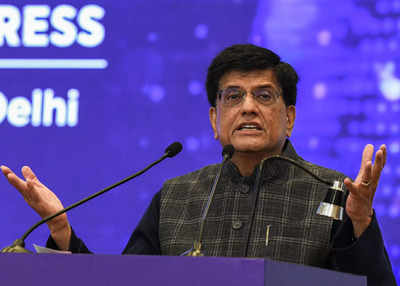
India is poised to achieve a remarkable milestone in its economic journey, with exports of goods and services projected to surpass $800 billion in the current fiscal year, said commerce minister Piyush Goyal on Friday. This anticipated figure not only marks a significant increase from the previous year’s total of $778 billion but also reflects the resilience of India’s export sector amid global economic uncertainties.
Exports to hit record $800 billion
“My estimate is that we will cross $800 billion in exports, another record given the world situation,” Goyal stated. He further noted that India’s diverse export basket and the rapid growth of services exports have contributed to this resilience. However, he acknowledged challenges faced by developing and least-developed countries due to forex crises, the Covid pandemic, and disruptions in shipping caused by the Red Sea crisis. Despite these issues, India has seen significant growth in exports of goods and services, even in sectors with government-imposed restrictions. The minister also highlighted that rising imports reflect robust economic activity, driven by demand for machinery, equipment, and intermediate goods. On relations with the United States, Goyal expressed optimism about engaging with the new administration. “We are looking forward to a deep and substantive engagement with the new US administration…we are looking forward to working with (Donald) Trump administration again,” he said, underlining the importance of bilateral cooperation in trade and economic growth.
Return of Indian startups from abroad
Goyal further assured that the government is dedicated to simplifying the process for start-ups seeking to relocate their domicile back to India from abroad. He stated that the ministry would consult with the National Start-up Advisory Council and gather feedback, “if any steps are required to make their journey back easier. We are open to ideas”. “It is a welcome sign and also very very satisfying that more and more start-ups come back home and register in India, list in India, and grow in India. India will be a preferred destination in the future,” he said. Initially, these start-ups registered abroad to benefit from easier access to international funding, higher valuations, and more relaxed regulations in various sectors. However, many are now considering listing in India after relocating. Goyal mentioned that the Department for Promotion of Industry and Internal Trade (DPIIT) has signed 50 MoUs with corporate entities, sharing their problem statements with start-ups to explore potential opportunities. The NSAC, which was formed in 2020, advises the government on fostering a strong start-up ecosystem, focusing on innovation, economic growth, and employment generation.
No new subsidies for electric vehicle sector
Earlier in the day, Goyal spoke to EV stakeholders and asserted that India’s electric mobility sector is “absolutely ready to fly” and no longer needs additional subsidies or incentives. He reviewed the progress in EV adoption, technological advancements, and challenges related to charging infrastructure and battery swapping. He further reaffirmed the government’s commitment to tackling these issues and promoting the rapid adoption of electric vehicles (EVs) in India. “After the interaction I can say that the electric mobility today is absolutely ready to fly. They do not need newer incentives or subsidies. The existing subsidies are available for some more time and will help them give that appropriate kick-start to the EV ecosystem. It’s a good economic case to move from ICE engine to electric engine,” Goyal said. The Minister highlighted key policy enablers, including the reduction of GST on EVs from 12 per cent to 5 per cent and on chargers/charging stations from 18 per cent to 5 per cent. He also urged commercial establishments and offices to set up EV charging equipment and called on industry bodies to raise awareness about the environmental benefits of EVs. Safety standards were a major discussion point during the meeting. The Bureau of Indian Standards (BIS) has already notified standards for three- and four-wheelers, with drafts for two-wheelers under review. Goyal urged stakeholders to submit their feedback promptly to finalise these standards. Regarding battery swapping, a system allowing EV users to exchange discharged batteries for charged ones, the Minister emphasised consumer choice. “It’s up to the consumer. Smart consumers will make smart choices,” he remarked.
Australia have beaten India by six wickets in the fifth Test of their five-match series and won back the Border-Gavaskar Trophy for the first time in a decade.
The hosts held their nerve to chase down their victory target of 162 after lunch on the third day of the final Test in Sydney on Sunday, prompting wild celebrations from their camp as they also sealed a spot in the World Test Championship final against South Africa at Lord’s in June.
Travis Head, who was 34 not out, and debutant Beau Webster, unbeaten on 39, got their team over the line to end the series on a high.
“It’s unreal, it’s been an amazing series,” Australia skipper Pat Cummins said shortly after the win.
“It felt like it was kind of seesawing throughout the whole series so to finish it 3-1, to hold the trophy, is an amazing feeling,” he added.
“I’m immensely proud, I absolutely love playing with these guys and it’s been a lot of fun along the way as well.”
India captain Jasprit Bumrah was unable to bowl in Australia’s second innings because of a back issue but his fellow pace bowlers Prasidh Krishna and Mohammed Siraj kept the match on a knife edge by removing four top-order Australian batters.
The match had been played on fast forward over the first two days with 15 wickets falling on Saturday, and Australia removed four more in the first hour on Sunday morning to dismiss India for 157.
The track retained some spice, and Krishna stood up in Bumrah’s stead and sent back opener Sam Konstas for 22, Marnus Labuschagne for six and Steve Smith for four before lunch.
Smith trudged off, head bowed, on 9,999 career runs, and was followed soon after the break by Usman Khawaja, who was caught behind off Siraj for 41 to leave Australia on 104-4.
The end of a topsy-turvy Test, where the momentum had shifted by the over, came almost as an anti-climax for another big crowd bathing in the sunshine at Sydney Cricket Ground.
Head and Webster got the job done with an unbroken fifth-wicket stand of 58, the latter continuing his nerveless debut by clubbing the winning runs with a straight four.
Travis Head (R) and teammate Beau Webster celebrate after winning the match on day three of the fifth Test at the Sydney Cricket Ground [David Gray/AFP]
“It was a little frustrating but sometimes you have to respect your body,” said Bumrah, who was named Player of the Series for his 32 wickets over the five matches.
“It was a great series. The whole series was well-fought and we were still in the match today. Our young players will take a lot of learnings for the future.”
The bulk of the Australian side has been together for years and beating India remained an elusive goal for many of them.
Only Smith, Nathan Lyon and Mitchell Starc were part of the squad that played in the last series win over their rivals a decade ago.
It was Cummins’ 20th win as captain.
“It is one that a few of us didn’t have. The boys have had their eye on it and it has lived up to the hype.
“We’ve spent a lot of time together as a group over the years, so we knew we weren’t at our best at Perth.
“But it was never as bad as it seems. So you stick tight and double down on what makes us a really good side.”
Australia handed out three debuts during the series – opener Nathan McSweeney who was axed after the first three Tests, the man who replaced him, Sam Konstas, and all-rounder Beau Webster in the fifth Test.
They also heavily relied on stalwarts such as Smith, Starc and Head.
“Always nice to have a squad,” said Cummins.
“The three debutants in this series fitted in well. They contributed at different times.
“There were some key moments when our mainstays really stood up. You need to do that to beat a side like India.”
Ready to defend their World Test Championship mace 👊
Australia qualify for the #WTC25 Final at Lord’s 🏏
OYO Rules For Unmarried Couples: OYO, an Indian multinational hospitality chain, has introduced a new policy allowing partner hotels to decline check-ins for unmarried couples. OYO, a prominent travel and hotel booking platform, has implemented the new policy in Uttar Pradesh’s Meerut with immediate effect.
Under the company’s new policy, all couples will be required to present valid proof of their relationship at the time of check-in, even for online bookings. The company explained that the policy change was driven by ground-level feedback and expressed its intention to expand the initiative to additional cities in the future.
The initiative is part of OYO’s program to reshape outdated perceptions and position itself as a brand offering safe and reliable experiences for families, students, business travellers, religious pilgrims, and solo adventurers.
It is worth noting that the company may reportedly extend the policy to other cities. Adding further, according to sources, travel booking giant OYO has previously received requests from civil society groups, particularly in Meerut, urging measures to address this issue.
How To Book Hotel Rooms Via Oyo App
Step 1: Open the Google Play Store and download the official OYO Rooms app.
Step 2: Open the app and sign in by entering your phone number. Verify your number using the OTP sent to you.
Step 3: Use the app’s search bar to enter your preferred area, location, or hotel.
Step 4: Select your check-in and check-out dates, specify the number of guests, and tap “Next.”
Step 5: Browse through the list of hotels that match your criteria and select one that fits your needs.
Step 6: Proceed to the payment section and choose to pay either online or directly at the hotel.
On Monday Vice-President Harris will certify Trump’s election victory against her
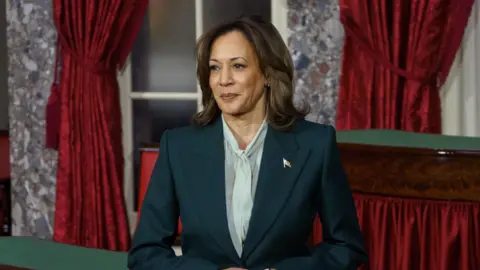
Exactly two months after her election loss to Donald Trump, Vice-President Kamala Harris will preside over the certification of her own defeat.
As president of the Senate, on Monday she will stand at the House Speaker’s rostrum to lead the counting of Electoral College votes, officially cementing her rival’s triumph two weeks before he returns to the White House.
The circumstances are painful and awkward for a candidate who decried her opponent as an urgent threat to American democracy, but Harris aides insist she will conduct her constitutional and legal duty with seriousness and grace.
It is not the first time a losing candidate will lead the joint session of Congress to count their opponent’s presidential electors – Al Gore endured the indignity in 2001 and Richard Nixon in 1961.
But it’s a fitting coda to an improbable election that saw Harris elevated from a back-up to the nation’s oldest president to the Democratic standard bearer – whose fleeting campaign provided a jolt of hope to her party before a crushing loss exposed deep internal faultlines.
Harris and her team are now deliberating her second act, and weighing whether it includes another run for the White House in 2028 or pursuing a bid for the governor’s mansion in her home state of California.
While recent Democratic candidates who lost elections – Al Gore, John Kerry, Hillary Clinton – have decided against seeking the presidency again, aides, allies and donors argue that the groundswell of support Harris captured in her unsuccessful bid and the unusual circumstances of her condensed campaign proves there’s still scope for her to seek the Oval Office.
They even point to Donald Trump’s own circuitous political path – the former and future president’s bookend wins in 2016 and 2024, despite losing as the incumbent in 2020.
But while many Democrats do not blame Harris for Trump’s win, some – stung by a bruising loss that has called the party’s strategy into question – are deeply sceptical of giving her another shot at the White House. A host of Democratic governors who coalesced behind the vice-president in 2024 but have ambitions of their own are seen by some strategists as fresher candidates with a much better chance of winning.
Reuters
Trump and Harris in their TV debate in September
Harris herself is said to be in no rush to make any decisions, telling advisers and supporters she is open to all the possibilities that await her after Inauguration Day on 20 January.
She is assessing the last few months, which saw her launch an entirely new White House campaign, vet a running-mate, lead a party convention and barnstorm the country in just 107 days. And aides point out that she remains the US vice-president, at least for another two weeks.
“She has a decision to make and you can’t make it when you’re still on the treadmill. It may have slowed down – but she’s on the treadmill until 20 January,” said Donna Brazile, a close Harris ally who advised the campaign.
“You can’t put anyone in a box. We didn’t put Al Gore in a box and it was obvious the country was very divided after the 2000 election,” said Brazile, who ran Gore’s campaign against George W Bush and pointed to his second life as an environmental activist. “All options are on the table because there’s an appetite for change and I do believe that she can represent that change in the future.”
But the nagging question that shadows any potential 2028 run is whether the 60-year-old can separate herself from Joe Biden – something she failed to do in the election campaign.
Her allies in the party say that Biden’s choice to seek re-election despite worries about his age, only then to ultimately drop out of the race with months to go, doomed her candidacy.
Though Trump swept all seven battleground states and is the first Republican in 20 years to win the popular vote, his margin of victory was relatively narrow while Harris still won 75 million votes, an outcome her supporters argue can’t be ignored as a currently faceless Democratic party rebuilds over the next four years.
On the other side, those close to Biden remain convinced he could have defeated Trump again, despite surveys showing he had been bleeding support from key Democratic voting blocs.
They point out that Harris fell short where the president didn’t in 2020, underperforming with core Democratic groups like black and Latino voters. Critics continue to bring up her 2019 campaign to become the Democratic presidential nominee, which sputtered out in less than a year.
“People forget that had there been a real primary [in 2024], she never would have been the nominee. Everyone knows that,” said one former Biden adviser.
The adviser, who spoke on condition of anonymity to discuss a sensitive matter, applauded Harris for reviving the Democratic base and helping key congressional races, but said Trump’s campaign successfully undercut her on critical campaign issues including the economy and the border.
Reuters
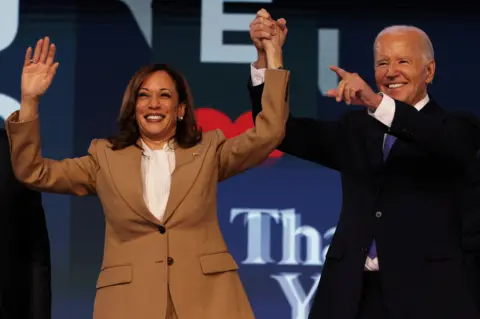
Biden and Harris at the Democratic National Convention in August, a high point for her campaign
Members of Trump’s team, however, including his chief pollster, have acknowledged that Harris performed stronger as a candidate than Biden on certain issues like the economy among voters.
Yet there’s no escaping that any Democratic primary contest for 2028 would be a tough fight, with rising stars like Michigan Governor Gretchen Whitmer, Illinois Governor JB Pritzker and California Governor Gavin Newsom already weighing presidential runs.
Some Democrats say that Harris would nonetheless start ahead of the pack, with national name recognition, a much-coveted mailing list and a deep bench of volunteers.
“What state party would not want her to come help them set the table for the 2026 midterm elections?” Brazile said. “She’s going to have plenty opportunities not only to rebuild, but to strengthen the coalition that came together to support her in 2024.”
Others have suggested she could step out of the political arena entirely, running a foundation or establishing an institute of politics at her alma mater, Howard University, the Washington-based historically black college where she held her election night party.
The former top state prosecutor could also be a contender for secretary of state or attorney general in a future Democratic administration. And she’ll need to decide if she wants to write another book.
For all of her options, Harris has told aides, she wants to remain visible and be seen as a leader in the party. One adviser suggested that she could exist outside the domestic political fray, taking on a more global role on an issue that matters to her, but that’s a difficult perch without a platform as large as the vice-presidency.
Reuters
Harris helps with emergency aid packages after Hurricane Helene in North Carolina
In the waning days of the Biden-Harris administration, she plans to embark on an international trip to multiple regions, according to a source familiar with the plans, signalling her desire to maintain a role on the world stage and build a legacy beyond being Biden’s number two.
For Harris and her team, the weeks since the election have been humbling, a mix of grief and resolve. Several aides described the three-month sprint that began when Biden dropped out as having begun with the campaign “digging out of a hole” and ending with their candidate more popular than when she began, even if she didn’t win.
“There’s a sense of peace knowing that given the hand we were dealt, we ran through the tape,” said one senior aide.
Following the election, Harris and her husband, Second Gentleman Doug Emhoff, spent a week in Hawaii with a small group of aides to relax and discuss her future.
During a staff holiday party at her official residence before Christmas, Harris recounted election night and how she delivered a pep talk to her family as the results became clear.
“We are not having a pity party!” she told the crowd of her reaction that night.
Advisers and allies say she is still processing what happened, and wants to wait and see how the new administration unfolds in January before staking out any position, let alone seeking to become the face of any so-called Trump “resistance”.
Democrats have found the resistance movement that took off among liberals in the wake of his 2016 win no longer resonates in today’s political climate, where the Republican has proven that his message and style appeals to a huge cross-section of Americans.
They have adopted a more conciliatory approach in confronting the incoming president’s agenda. As several Democrats put it: “What resistance?”
Though she’s kept a relatively low profile since her loss, Harris provided a glimpse of her mindset at an event for students at Prince George’s Community College in Maryland in December.
“The movements for civil rights, women’s rights, workers’ rights, the United States of America itself, would never have come to be if people had given up their cause after a court case, or a battle, or an election did not go their way,” she said.
“We must stay in the fight,” she added, a refrain she has repeated since her 2016 Senate win. “Everyone of us.”
EPA-EFE/REX/Shutterstock
Former US President Barack Obama campaigned with Kamala Harris
What that means is less clear. For some donors and supporters, staying “in the fight” could translate to a run for California governor in 2026, when a term-limited Gavin Newsom will step down and potentially pursue his own White House ambitions. The job, leading the world’s fifth-largest economy, would also put Harris in direct conflict with Trump, who has regularly assailed the state for its left-leaning policies.
But governing a major state is no small feat, and would derail any presidential run, as she would be sworn into office about the same time she would need to launch a national campaign.
Those who have spoken to Harris said she remains undecided about the governor’s race, which some allies have described as a potential “capstone” to her career.
She has won statewide office three times as California’s attorney general and later as a US senator. But a gubernatorial win would give her another historic honour – becoming the nation’s first black female governor.
Still, some allies acknowledge it would be difficult to transition from being inside a 20-car motorcade and having a seat across the table from Ukrainian President Volodymyr Zelensky to the governor’s mansion.
The private sector is another option.
“For women at other levels of office, when they lose an election, sometimes options are not as available to them compared to men, who get a soft landing at a law firm or insurance business, and it gives them a place to take a beat, make some money and then make decisions about what’s next,” said Debbie Walsh, director for the Center for American Women and Politics at Rutgers University.
“I don’t think that’s going to be a problem for Kamala Harris. I think doors will open for her if she wants to open them.”
But for Harris, who has been in elected office for two decades, and worked as a public prosecutor before that, an afterlife as governor may be the most fitting option.
“When you’ve had one client – the people – for the entirety of your career,” said one former adviser, “where do you go from here?”
The air is laced with cigarette smoke and Cantonese profanities as half a dozen taxi drivers hang out by their fire-engine-red cabs on a quiet corner of the gritty Prince Edward neighborhood of Hong Kong.
It is the afternoon handover, when day shift drivers pass their taxis to those working the night shift. They are surrendering wads of cash to a taxi agent, a matriarchal figure who collects rent for the vehicles, manages their schedules and dispenses unsolicited advice about exercising more and quitting smoking. The drivers wave her off.
There may be no harder task in this city of more than seven million than trying to change a taxi driver’s habits. Often grumpy and rushing to the next fare, cabbies in Hong Kong have been doing things their way for decades, reflecting the fast-paced, frenetic culture that has long energized the city.
But taxi drivers are under pressure to get with the times. Their passengers are fed up with being driven recklessly, treated curtly and, in many cases, having to settle fares with cash — one of the strangest idiosyncrasies about life in Hong Kong. The practice is so ingrained that airport staff often have to alert tourists at taxi ranks that they need to carry bills.
The government, both because of the complaints and to revitalize tourism, has tried to rein in taxi drivers. Officials ran a campaign over the summer urging drivers to be more polite. They imposed a point system in which bad behavior by drivers — such as overcharging or refusing passengers — would be tracked and could result in the loss of licenses.
In early December, the government proposed requiring all taxis to install systems to allow them to accept credit cards and digital payments by the end of 2025, and to add surveillance cameras by the end of 2026.
Predictably, many taxi drivers have opposed the idea of closer supervision.
“Would you want to be monitored all the time?” said Lau Bing-kwan, a 75-year-old cabby with thinning strands of white hair who accepts only cash. “The government is barking too many orders.”
Hold On to Your Seats
The new controls, if put in place, would signal the end of an era for an industry that has long been an anomaly in Hong Kong’s world-class transportation system. Every day, millions of people commute safely on sleek subways and air-conditioned double-decker buses that run reliably.
Riding in a taxi, by comparison, can be an adventure. Step into one of Hong Kong’s signature four-door Toyota Crown Comfort cabs and you will most likely be (what is the opposite of greeted?) by a man in his 60s or older with a phalanx of cellphones mounted along his dashboard — used sometimes for GPS navigation and other times to track horse racing results. Pleasantries will not be exchanged. Expect the gas pedal to be floored.
You will then reflexively grab a handle and try not to slide off the midnight-blue vinyl seats as you zip and turn through the city’s notoriously narrow streets. Lastly, before you arrive at your destination, you will ready your small bills and coins to avoid aggravating the driver with a time-consuming exit.
“When they drop you off, you have to kind of rush,” said Sylvia He, a professor of urban studies at the Chinese University of Hong Kong who, like many residents of this city, feels conditioned to walk on eggshells around a cabby. “I don’t want to delay their next order.”
To many cabbies, the impatience and brusqueness is a reflection of their harsh reality: when scraping by in a business with shrinking financial rewards, no time can be wasted on social niceties. Lau Man-hung, a 63-year-old driver, for instance, skips meals and bathroom breaks just to stay behind the wheel long enough to take home about $2,500 a month, barely enough to get by in one of the most expensive cities in the world.
“Some customers are too mafan,” said Mr. Lau using a Cantonese word that means causing trouble and annoyance. “They like to complain about which route to take. They tell you to go faster.”
An Industry’s Fragile Economics
Driving a cab used to be a decent way to make a living. But business has gotten tougher, made worse by the fallout of mainland China’s economic slowdown. The city has had trouble reviving its allure with tourists, while its bars and nightclubs, once teeming with crowds squeezed into narrow alleyways, now draw fewer revelers.
Even before the downturn, some owners of taxi licenses were struggling. Taxi licenses are limited by the government and traded on a loosely regulated market. Some owners suffered huge losses after a speculative bubble drove prices up to nearly $1 million for one license a decade ago, then burst.
Today, licenses are worth about two-thirds of their decade-ago high. Many businesses and drivers who own licenses are focused more on recouping losses than on improving service.
Tin Shing Motors, a family-owned company, manages drivers and sells taxi license mortgages and taxicab insurance. Chris Chan, a 47-year-old third-generation member of the company, says Tin Shing is saddled with mortgages bought when licenses were worth much more.
To chip away at that debt, Mr. Chan needs to rent out his taxis as much as possible. But he struggles to find drivers. Many cabbies have aged out, and young people have largely stayed away from the grueling work. Profit margins have dwindled, he added, especially with the cost of insurance almost doubling in recent years. Uber, despite operating in a gray area in Hong Kong, has also taken a chunk of customers away.
“It’s harder and harder to make money,” Mr. Chan said.
At the bottom are the drivers, about half of whom are 60 and older. Many cannot afford to retire. They have to make about $14 an hour to break even after paying for gas and the rent of their vehicles. To them, cash in hand is better than waiting days for electronic payments to clear.
A Blue-Collar Job Professionalizes
Tension between the public and taxi drivers plays out with mutual finger pointing. When the government introduced the courtesy campaign last year, a driver told a television reporter that it was the passengers who were rude.
In many ways, Hong Kong’s taxi drivers embody the high-stress, no-frills culture of the city’s working class. Their gruffness is no different from the service one gets at a cha chaan teng, the ubiquitous local cafes that fuel the masses with egg sandwiches, instant noodles and saccharine-sweet milk tea. Servers are curt, but fast.
“People tend to have one bad experience and remember it for the rest of their life,” said Hung Wing-tat, a retired professor who has studied the taxi industry. “Consequently, there is an impression among the public that all taxi drivers are bad when most of them just want to earn a living. They don’t want any trouble.”
Indeed, there are cabbies like Joe Fong, 45, who sees no value in antagonizing his customers and has tried to adapt to his passengers’ needs.
“Why fight?” Mr. Fong said. “We need each other. You need a ride and I need your money.”
Mr. Fong maximizes his income by splitting his time between driving a private car for Uber and a cab for a taxi fleet called Alliance. Mr. Fong has five cellphones affixed to his dashboard. He welcomes electronic payments, and he did not raise an eyebrow when Alliance installed cameras in all their taxis last year.
“I’m not like those old guys,” said Mr. Fong, who drives one of Hong Kong’s newer hybrid taxis made by Toyota, which look like a cross between a London cab and a PT Cruiser. “The world has changed. You have to accept it.”
OYO, a prominent travel booking platform, recently introduced a new check-in policy for its partner hotels, starting in Meerut, which will be effective this year.
Unmarried couples will no longer be allowed to check-in to Oyo hotels.(REUTERS)
According to the updated guidelines, unmarried couples will no longer be allowed to check-in, PTI reported.
All couples, including those with online reservations, will be required to provide valid proof of their relationship when checking in, as per the updated OYO guidelines.
The platform has given its partner hotels the discretion to decide whether to accept or deny couple bookings, based on the hotel’s judgment and local social norms, the company explained.
Ban on check-ins for unmarried couples to begin with Meerut hotels
OYO has given the directive to its partner hotels in Meerut to ensure this with immediate effect. Based on ground feedback, the company may expand this to more cities, people familiar with the policy change said.
“OYO has received feedback in the past from civil society groups, especially in Meerut urging action to address this issue. Additionally, residents from few other cities have petitioned for disallowing unmarried couples to check-in at OYO hotels,” they said.
According to Pawas Sharma, Region Head, OYO North India, the initiative is a part of OYO’s programme to transform its outdated perceptions and project itself as a brand capable of providing a safe experience for families, students, business, religious and solo travellers, the company said.
Additionally, the programme also aims to encourage longer stays and repeat bookings, enhancing customer trust and loyalty.
OYO has started pan-India initiatives such as joint seminars on safe hospitality with police and hotel partners, blacklisting hotels reportedly promoting immoral activities and initiating actions against unauthorised hotels using OYO branding, it added.
Nehammer says his People’s Party would not support measures that it believes would harm the economy or new taxes.
Austrian Chancellor Karl Nehammer has said he will resign after talks between the country’s biggest centrist parties on forming a government without the far-right Freedom Party (FPO) collapsed.
The announcement on Saturday comes a day after the liberal Neos party withdrew from the negotiations with Nehammer’s conservative People’s Party (OVP) and the Social Democrats (SPO).
“After the breakoff of the coalition talks I am going to do the following: I will step down both as chancellor and party chairman of the People’s Party in the coming days,” he said.
In a video posted to his social media accounts, the outgoing chancellor said “long and honest” negotiations with the centre-left failed despite a shared interest in fending off the gaining far right.
Nehammer emphasised that his party would not support measures that it believes would harm the economy or new taxes.
He said he would enable “an orderly transition” and railed against “radicals who do not offer a single solution to any problem but only live from describing problems”.
But other parties refused to govern in a coalition with the eurosceptic, Russia-friendly FPO and its leader Herbert Kickl, so President Alexander Van der Bellen in late October tasked Nehammer to form a coalition.
Nehammer’s announcement comes after he also failed to reach an understanding with the Neos party.
Neos leader Beate Meinl-Reisinger said progress was impossible and that “fundamental reforms” had not been agreed upon.
After the chancellor’s exit, the OVP is expected to convene to discuss potential successors.
The political landscape remains uncertain in Austria, with no immediate possibility of forming a stable government due to ongoing differences between the parties.
The president may now appoint another leader and an interim government as the parties try to find a way out of the deadlock.
The next government in Austria faces the challenge of having to save between 18 to 24 billion euros ($18.5-24.7bn), according to the European Commission.
The country’s economy has been in a recession for the past two years, is experiencing rising unemployment and its budget stands at 3.7 percent of gross domestic product – above the European Union’s limit of 3 percent.