Wednesday, September 30, 2026
Home Blog Page 6988

Political earthquake in France – Hindustan Times

0
Political earthquake in France – Hindustan Times


In December 2024, France faced an unprecedented political rift as Prime Minister Michel Barnier’s government fell on a motion of no confidence in the National Assembly. This development is the first such incident since 1962. The incident symbolizes a broader crisis of confidence in the political establishment and has significant implications for the country’s financial stability, social cohesion and geopolitical position within the EU.
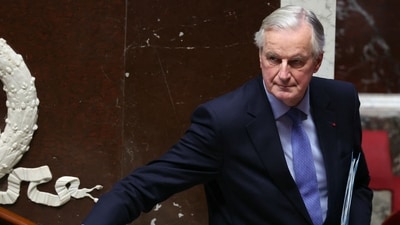
French Prime Minister Michel Barnier leaves after delivering a speech during the debate before a vote of no confidence in his administration at the National Assembly in Paris on December 4, 2024. (Photo by Alain Jocard/AFP) (AFP)

Barnier’s term, scheduled to begin in September 2024, was immediately beset by partisan divisions and conflicting economic priorities. The flagship policy of his administration – a comprehensive fiscal consolidation plan designed to address a projected deficit of more than 6% of gross domestic product (GDP) – faced sharp resistance from both ends of the ideological spectrum. The proposal to cut public spending by €60 billion, along with tax increases, was said to be necessary to restore fiscal discipline and comply with EU budgetary rules. However, opponents criticized these measures as regressive and punitive, disproportionately affecting working- and middle-class families while weakening social protections.

The government’s reliance on Article 49.3 of the French Constitution to bypass parliamentary scrutiny in the ratification of the social security budget prompted discontent. This constitutional maneuver inspired opposition coalitions and triggered widespread protests in urban centres. Mobilization by labor unions and civic organizations further increased public discontent, culminating in a vote of no confidence on December 4, 2024, which succeeded by a narrow margin.

Soon after, President Emmanuel Macron appointed veteran centrist and Democratic Movement head François Bayrou as the new prime minister. Bayeru’s mandate is both urgent and formidable – securing parliamentary legitimacy, stabilizing fiscal policy, and restoring public confidence in governance. While dealing with the complexities of coalition-building, Bayeru has prioritized bridging the ideological divide through consultation with moderate factions. However, these negotiations have proven difficult, reflecting long-standing rifts and suspicions toward compromise-driven policy making. His efforts to pursue a pragmatic agenda face fierce opposition from both far-left and far-right factions, whose differing priorities hinder consensus building.

This crisis has had far-reaching economic impacts. Moody’s cut France’s credit rating to Aa3 from Aa2, citing concerns over governance instability and fiscal flexibility. The downgrade increased borrowing costs and capital outflows, further increasing economic instability. At the same time, domestic markets have seen a decline in investor confidence, leading to urgent discussions about structural reforms to restore fiscal credibility. Analysts have warned that France’s prolonged instability could spread throughout the eurozone, undermining collective economic resilience and exacerbating vulnerabilities within interconnected financial systems. International observers remain fixated on France’s fiscal trajectory, underscoring the broader implications of governance instability for European cohesion and global market confidence.

By the end of December 2024, Bayeru’s administration remained entrenched in its efforts to ratify interim fiscal measures and avert a government shutdown. Opposition leaders, notably National Rally’s Marine Le Pen, have stepped up calls for early presidential elections, citing the government’s collapse as evidence of Macron’s declining authority. Le Pen has tried to harness populist sentiment by positioning her party as a vanguard of structural reform and national renewal.

Simultaneously, Bayeru has formulated a centrist agenda that aims to reconcile fiscal prudence with socio-economic equity. Proposed reforms include targeted investments in public infrastructure, expansion of the social safety net, and recalibration of tax policies to distribute the burden more equitably. Yet these initiatives have made limited progress, given widespread polarization and skepticism toward elite-driven policymaking. Polling data shows that support for both far-left and far-right factions is growing, indicating that voters are disillusioned with establishment politics and receptive to populist rhetoric.

The collapse has widened the ideological gap within the political spectrum. The left-wing parties, who led the vote of no-confidence, presented the result as a refutation of austerity and neoliberal orthodoxy. Prominent leaders, including Jean-Luc Mélenchon of La France Insomies, described the fiscal consolidation plan as an affront to social justice, calling for increased wealth taxes and public spending to combat economic inequalities. He stressed alternative strategies such as progressive taxation and green energy investments to balance fiscal discipline with sustainable growth. His statements resonated with labor unions and grassroots movements, solidifying broad-based support for the movement and their vision of a more equitable economic structure. In contrast, far-right leaders have described the turmoil as a symptom of Macron’s systemic failures, bolstering their calls for regime change. Marine Le Pen and other leading figures of the National Rally have stressed the need to roll back strict immigration controls, protectionist economic measures and EU financial regulations in order to restore national sovereignty. His rhetoric portrays the collapse as validation of populist demands for radical institutional reforms, including greater executive authority and direct democratic mechanisms, which he argues are necessary to address France’s governance crisis. As polarization deepens, centrist voices advocating incremental reforms and coalition-building appear to be becoming marginalised. His struggles largely stem from perceptions of ineffectiveness and indecisiveness, as his proposals often lack the sweeping changes demanded by an electorate polarized between calls for austerity and radical reform. Additionally, centrist leaders face difficulties in garnering grassroots support because of their emphasis on pragmatic compromises rather than bold ideological stances, making them vulnerable to criticism from both ends of the political spectrum.

Civil society is completely divided. While some constituencies celebrate the government’s ouster as a victory for democratic accountability, others fear prolonged instability and economic stagnation. Protests and strikes continue, with demonstrators demanding policy reforms to address unemployment, inflation and inequality. Many labor unions and grassroots organizations continue to rally for reforms that prioritize increased social spending, wealth redistribution, and public welfare. In contrast, conservative groups have expressed concern over the perceived erosion of authority and governance, and have called for stronger executive powers to stabilize the nation.

Meanwhile, advocacy groups have stepped up calls for electoral reforms to ease legislative gridlock and increase proportional representation. Media coverage has highlighted widespread disillusionment with traditional political elites, reflecting broader concerns over institutional paralysis and policy inconsistency.

Economic stakeholders, including business associations and multinational investors, have stressed the urgency of restoring policy coherence to prevent further capital flight and market volatility. The broader public discussion reflects an underlying current of concern about France’s ability to deal with complex fiscal and geopolitical challenges amid an erosion of institutional trust. While some constituencies celebrate the government’s ouster as a victory for democratic accountability, others fear prolonged instability and economic stagnation. Protests and strikes continue, with demonstrators demanding policy reforms to address unemployment, inflation and inequality. Meanwhile, advocacy groups have stepped up calls for electoral reforms to ease legislative gridlock and increase proportional representation.

Economic stakeholders, including business associations and multinational investors, have stressed the urgency of restoring policy coherence to prevent further capital flight and market volatility. The broader public discussion reflects an underlying current of concern about France’s ability to deal with complex fiscal and geopolitical challenges amid an erosion of institutional trust.

The fall of Barnier’s government through a motion of no-confidence marked a turning point in contemporary French politics. This highlights the structural weaknesses inherent in France’s semi-presidential system, which are exacerbated by ideological polarization and procedural barriers. Bayeru’s appointment represents a temporary attempt to restore stability, yet enduring divisions and economic unrest make the prospects for long-term solidarity uncertain.

Looking ahead, the pace of French governance will depend on the ability of its political leadership to form bipartisan coalitions, implement credible reforms, and rebuild public trust. Failure to address these imperatives risks not only perpetuating domestic instability, but also undermining France’s stature as a pivot of European integration and economic leadership.

This article is written by Ananya Raj Kakoti, Scholar, International Relations, Jawaharlal Nehru University, New Delhi.



Families mourn after S Korea plane crash

0
Families mourn after S Korea plane crash


Pornphichaya Chalermsin A photo of Jongluk DoungmaneePornphichaya Chalermsin

Jongluk Doungmanee was due to come home after spending over two weeks in Thailand visiting family

A festive trip to Thailand was supposed to be a celebration for Maeng Gi-Su’s nephew and his nephew’s two sons, who were marking the end of their college entrance exams.

Instead, it ended in tragedy when all three died on the Jeju Air plane that crash-landed in South Korea on Sunday morning, killing 179 of the 181 people onboard.

“I can’t believe the entire family has just disappeared,” Maeng, 78, told the BBC.

“My heart aches so much.”

The family were travelling from Bangkok to Muan International Airport, which skidded off the runway after touching down and crashed into a wall shortly after 09:00 local time (00:00 GMT) on Sunday.

All of the passengers on the Boeing 737-800 died, making it the deadliest plane crash on South Korean soil.

Four crew members were among the victims, while two were rescued from the wreckage alive.

Maeng Gi-su wears a green puffa jacket and a sombre expression.

Maeng Gi-su says three of his family members were on the flight

The 179 passengers on flight 7C2216 were aged between three and 78 years old, although most were in their 40s, 50s and 60s, according to Yonhap news agency reported. Two Thai nationals are among the dead and the rest are believed to be South Korean, authorities have said.

Five of the people who died were children under the age of 10, with the youngest passenger being a three-year-old boy.

One man in his sixties said five of his family members spanning three generations had been on the plane, including his sister-in-law, his daughter, her husband and their young children, according to Yonhap news agency.

Many of the passengers had been celebrating the Christmas holidays in Thailand and were returning home.

The cousin of one victim, Jongluk Doungmanee, told BBC Thai she was “shocked” when she heard the news.

“I had goosebumps. I couldn’t believe it,” Pornphichaya Chalermsin said.

Jongluk had been living in South Korea for the past five years working in the agriculture industry. She usually travelled to Thailand twice a year during the holidays to visit her ailing father and two children – aged 7 and 15 – from a former marriage.

She had spent over two weeks this time with her husband, who had returned to South Korea earlier in December.

Her father, who suffers from a heart disease, was “devastated” when he found out about her death, said Pornphichaya.

“It is unbearable for him. This was his youngest daughter”, she said, adding that all three of his children work abroad.

Another 71-year-old father, Jeon Je-young, told the Reuters news agency that his daughter Mi-Sook, who was identified by her fingerprints, had been on her way home after travelling with friends to Bangkok for the festivities.

“My daughter, who is only in her mid-40s, ended up like this,” he said, adding that he had last seen her on 21 December, when she brought some food and next year’s calendar to his house – that would become their last moment together.

Mi-Sook leaves behind a husband and teenage daughter.

“This is unbelievable”, said Jeon.

One woman said her sister, who had been having a tough time decided to visit Thailand as life began to improve for her.

“She’s had so many hardships and gone traveling because her situation was only just beginning to improve,” she told Yonhap news agency.

The two flight attendants who survived the crash were found in the tail end of the plane, the most intact part of the wreckage.

One was a 33-year-old man, with the surname Lee, who was rushed to a hospital in Mokpo, about 25km (15.5 mi) south of the airport, but was later transferred to Ewha Womans University Seoul Hospital in the capital, Yonhap news agency reported.

“When I woke up, I had already been rescued,” he told doctors at the hospital, according to its director Ju Woong, who spoke during a press briefing.

The survivor, who suffered multiple fractures, is receiving special care due to the risk of after-effects, including total paralysis, Ju said.

The other survivor, a 25-year-old female flight attendant with the surname Koo, is being treated at Asan Medical Center in eastern Seoul, Yonhap added.

She has sustained head and ankle injuries but is reportedly in a stable condition.

‘I saw thick, dark smoke – then an explosion’

It’s not yet known exactly what caused the disaster, but a number of eye witnesses say they could see that the plane was in trouble before the crash.

Restaurant owner Im Young-Hak said he initially thought it was an oil tanker accident.

“I went outside and saw thick, dark smoke. After that, I heard a loud explosion, not from the crash itself. Then there were more explosions – at least seven,” he told Reuters.

“We feel bad when accidents happen on the other side of the world, but this happened right here. It’s traumatic.”

Yoo Jae-yong, 41, who was staying near to the airport, told local media he saw a spark on the right wing shortly before the crash.

Kim Yong-cheol, 70, said the plane failed to land initially and circled back to try again.

He added that he witnessed “black smoke billowing into the sky” after hearing a “loud explosion”, Yonhap agency reported.

One firefighter who was dispatched to the scene told Reuters he had never seen something “on this scale”.

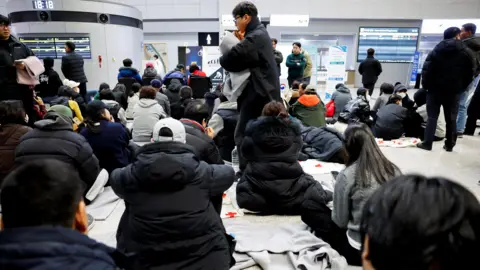
Reuters Relatives of passengers of the aircraft that crashed after it went off the runway are seated on the floor of the airport. Reuters

Family members of those who died had gathered at Muan International Airport

BBC reporters on the ground have said the sounds of family members crying echoed through the terminal on Sunday evening, while others are angry at how long it is taking to identify the bodies.

Hundreds remain at Muan International Airport waiting for loved ones to be identified.

Some have given DNA saliva samples to officials to help identify the bodies of victims, and the government has offered funeral services and temporary housing to bereaved families.

A national period of mourning has also been declared for the next seven days.

But for all the loved ones of those who died, many questions still remain – not least the cause of the crash, and whether it could have been averted.

“The water near the airport is not deep,” Jeon told Reuters.

“(There) are softer fields than this cement runway. Why couldn’t the pilot land there instead?”

His daughter Mi-Sook was almost home, so saw no reason to call and leave a final message, he says.

“She was almost home – she thought she was coming home”.

Additional Reporting by BBC Thai’s Thanyaporn Buathong


Why might agri-tech need a different approach to foster innovations?

0
Why might agri-tech need a different approach to foster innovations?


Being a predominantly agricultural economy, India has great potential for research and technological innovation in agriculture. Yet, nearly $24 billion of innovation in the sector has barely scratched the surface given myriad challenges such as low market adoption, high customer acquisition costs, low investor interest, high infrastructure costs, and more.

Experts say compared to technology in other sectors, Indian agritech may need a different approach to turbocharge innovations in the sector. For example, IIIT-B takes an interdisciplinary approach and often considers developing solutions as digital public goods.

The institute is developing several AgriTech projects with a view to bring higher efficiency in agricultural processes. These include Autogrow – an autonomous greenhouse system for precision agriculture, smart greenhouses with secure long-distance connectivity, a remote compost monitoring system for sustainable agriculture and AgriSense (an IoT system with soil monitoring devices).

An India-specific problem

“Autogrow, which is an autonomous greenhouse system for precision agriculture, is an autonomous system for growing food. We are trying to solve a very India-specific problem,” says Ramesh Kestur, faculty at IIIT-B.

The system seamlessly integrates organic food production with an IoT/AI-based system and includes automated greenhouse control of climate conditions, irrigation, and supply of nutrients to plants. This can provide substantial benefits in increasing the efficiency of crop production while utilizing optimum resources and thereby reducing costs.

“If you look in the West, they lack resources like light and so they cannot grow throughout the year. Therefore, we should not copy their solutions. We have enough light, and we can grow 365 days a year. We just need to control whatever is important for our situation,” explains Kestur.

Given the abundance of sunlight and temperatures in the country, his team avoided including components like LED lights in the system, which helped reduce cost and complexity. After eliminating the unnecessary, the team looked at what needed to be controlled.

There was an input which was essentially water and nutrients. “We thought we would try to create a system and control those things. With this inspiration, we created systems for three configurations; One is hydroponic system. The second is what we call a vertical system where we can stack the growbag vertically. And the last one is the open field.”

“It is a non-linear control system where the inputs are continuously monitored, and the required amount of nutrition is administered. It is a control system realized with sensors and AI-ML algorithms,” says Kestur, adding that no sensors are placed in the soil as this can drain the battery quickly. Instead, temperature and moisture sensors are placed in the input tank where nutrient levels such as nitrogen, phosphorus and potassium are monitored.

This project has been done in collaboration with the Department of Biotechnology, IIHR, Bengaluru. Wick irrigation technology developed at IIHR has been incorporated in the system.

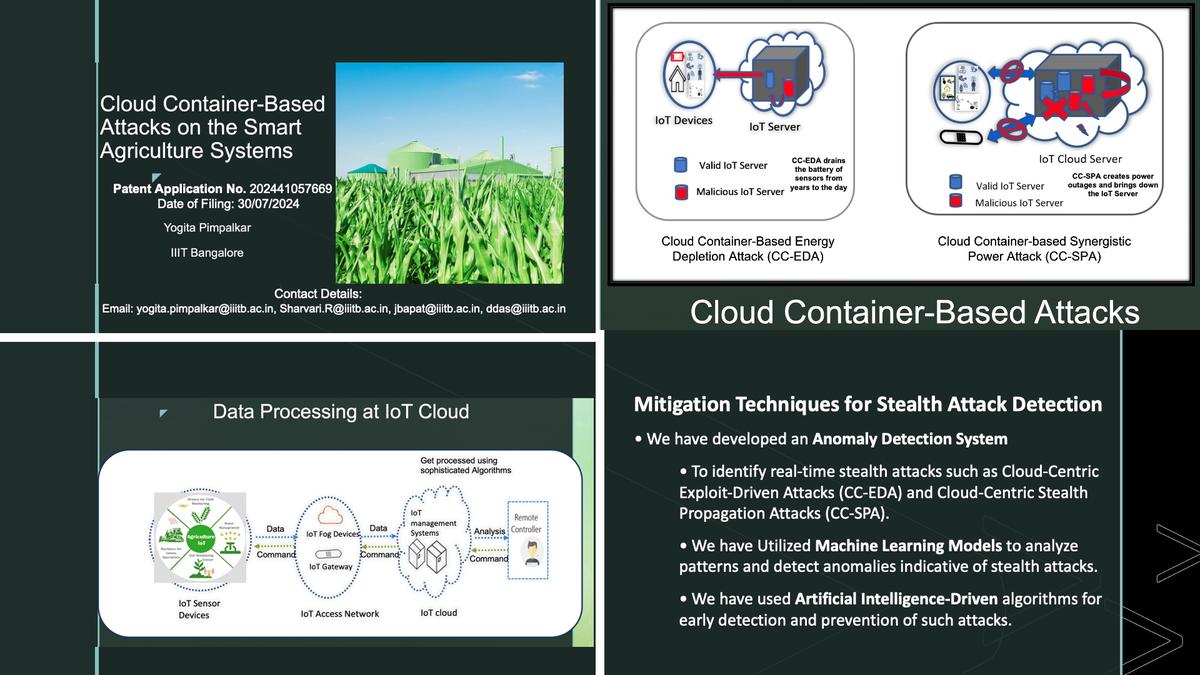
Cloud container-based attacks on smart agricultural systems.

Cloud container-based attacks on smart agricultural systems. , Photo Credit: Special Arrangement

greenhouse monitoring

AgriSense and Smart Greenhouse Monitoring System is led by Professor Jyotsna Bapat at IIIT-B. Both are sponsored by the Government of Karnataka.

Smart greenhouse monitoring systems aim to transform greenhouse farming by leveraging IoT to improve crop health, automate environmental controls, and facilitate remote monitoring. The idea is to enable farmers to remotely monitor environmental conditions such as temperature, humidity, soil moisture and pH, providing real-time data for precise control over crop conditions.

The system sees features like real-time data monitoring using a network of sensors, automated controls based on sensor data, remote access to farmers through an app and data analysis, and alerts with the help of machine learning.

optimize input

Finding the optimum water level to ensure maximum production in agriculture has always been a problem. Another challenge is the deteriorating soil health due to excessive use of fertilizers. AgriSense, an IoT system developed by the institute to address these challenges, uses the Agri-Cone, a mushroom-shaped soil-monitoring device.

“We were initially looking at larger farms where we could help farmers ensure that irrigation is done correctly. By measuring the moisture content of the soil and looking at the predicted forecast, we can advise them about the irrigation that should be done,” explains Bapat.

“The other aspect is the soil content and we measure carbon dioxide and ammonia in it. If the soil is of good quality then the amount of carbon dioxide will be relatively high. If there is too much urea or any other fertilizer, the amount of ammonia released will be high. Therefore, we can give them advice based on these also.”

Inside the Agri-Cone, a coin battery powers various sensors to monitor soil moisture and temperature. The sensors detect gases like CO₂ and ammonia. Humidity sensors track the moisture level of the air around plants, helping prevent diseases and promote healthy growth.

“Right now, we have installed a small battery. But the goal is to put a solar surface on top of the mushroom so that it becomes completely sustainable,” says Bapat.

“Right now, we only use Wi-Fi. But the other solution is something called LoRA. It is used a lot for IoT in Europe and the Netherlands, their entire IoT network is on LoRA. It is more energy efficient and also has a greater range, making it suitable for a vast area,” says Bapat.

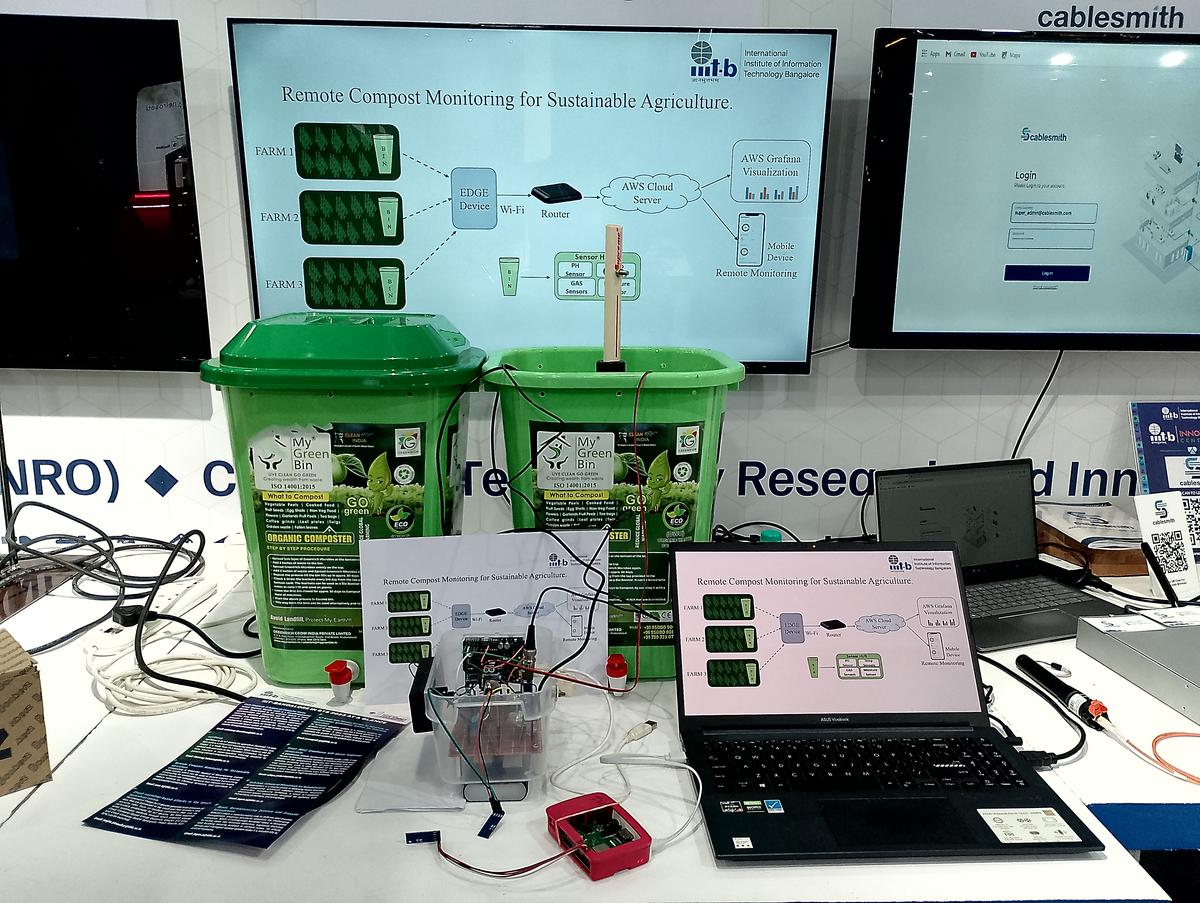
Remote compost monitoring for sustainable agriculture.

Remote compost monitoring for sustainable agriculture. , Photo Credit: Special Arrangement

Manure monitoring

The team led by Bapat is also working on a remote compost monitoring system. The idea was to create a prototype for an intelligent IoT system that remotely monitors and manages manure which can then be used as fertilizer.

Bapat explains that the system he developed can help properly compost Bengaluru’s garbage dumps, which contain a lot of food waste, while avoiding odor.

The solution developed by the team comes with a sensor hub attached to each bin that monitors the pH value, temperature, humidity and CO2 level of the compost inside them. It also allows remote monitoring of these values ​​using a mobile phone and generating alerts.

Bapat says this solution also helps avoid manual labor in which a person checks and stirs the manure.

market welcome

While many such initiatives are being prepared, market adoption of agri-tech solutions is always a challenge. Bapat thinks urban people with backyard vegetable gardens could be the initial customers for solutions like AgriSense. “Although it is primarily designed for farmers, if we can see some urbanites as early adopters, that would be useful,” she says.

Regarding Autogrow, Kestur noted that a proof of concept has been done and a patent has been filed. The next step will be to partner it with a start-up through the institute’s innovation cell to scale up the solution.

According to him, AI has the potential to bring immense efficiency in agriculture and it is important to create India-specific solutions with it. “Being an agricultural economy, this is an opportunity for us. Many things are unfolding before us. “A lot remains to be done in agriculture in terms of making farmers highly skilled.”

funding issues

While he acknowledges that a lack of funding in agritech poses challenges in scaling up and deploying, Kestur says his team is trying to address the problem in a different way.

“It will be difficult to reach farmers as end users are very fragmented. Therefore, we are working with Farmer Producer Organizations (FPOs). We have conducted some workshops where we have talked to farmers and received problem related details from them. We are considering start-ups in this area and trying to do the work of providing facilities. We are trying to connect those start-ups with the problems faced by FPOs,” he says.

Kestur also notes that agri-tech needs to be looked at differently than consumer tech or other sectors that attract larger funding.

public digital infrastructure

“Agriculture is a use case where solutions should be developed as public digital infrastructure. Take the case of Aadhaar. It has been successful. If it had been developed by a big company, they would have been able to earn billions of dollars. But it is open source for the public good. We should have its equivalent in agriculture too,” he says.

Kestur also emphasizes the need for interdisciplinary research. “Now we have agricultural universities. Then there are also technological universities like ours. Therefore, there is a need to conduct interdisciplinary research. Auto Grow is a small step in this direction. They (IIHR) bring domain expertise and we bring technology.”


Economy to grow at 6.5-6.8% in FY25: Deloitte

0
Economy to grow at 6.5-6.8% in FY25: Deloitte


Economy to grow at 6.5-6.8% in FY25: Deloitte

NEW DELHI: The economy is likely to grow at 6.5-6.8% this fiscal and slightly higher between 6.7-7.3% in FY26, boosted by consumption, Deloitte said on Sunday. Deloitte India economist Rumki Majumdar said the growth in the first half of the fiscal year 2025 turned out to be slower than estimated as election uncertainties followed by disruptions in activity due to heavy rainfall and geopolitical events weighed on demand and exports.


Challenge of holding judges accountable

0
Challenge of holding judges accountable


A speech given by Allahabad High Court Judge Shekhar Kumar YadavAn event organized by the Vishwa Hindu Parishad’s legal cell inside the court complex on December 8, which made clear their biases towards the Muslim community, once again highlighted the difficulty in India’s review mechanism in holding higher judiciary judges accountable. Has been exposed. ,

The review mechanism requires a decision on “proven misbehavior or incompetence” to be taken by a three-member committee constituted under the Judges (Investigation) Act, 1968. This committee works like a trial court, but is set into action only after a successful attempt. Impeachment of the judge concerned is done in either the Lok Sabha or the Rajya Sabha, which must be approved by the presiding officer of the House – the Speaker, or the Vice President/Chairman in the case of the Lok Sabha. Rajya Sabha. The provisions of this mechanism come from Articles 124 (4), (5), 217, and 218 of the Constitution of India and the Judges (Investigation) Act, 1968.

EditorialBench and fanaticism: On the controversial remarks of Allahabad High Court judge

Justice V. Ramaswami’s case

Barring Justice Yadav, against whom an impeachment attempt has been made, only two of the seven judges have so far been found guilty of their “misbehaviour” by a three-member committee, comprising a Supreme Court judge, a Chief Justice Needed High Court and an eminent jurist.

The first was retired Supreme Court judge V. Ramaswamy, who was found guilty of excessive expenses like buying air conditioners, luxury furniture and beds at his official residence without following due process, just like Trinamool Congress MP Mahua Moitra. There were allegations made. The ruling BJP last year. Although such misdeeds of ongoing accounts of corruption seem like an arcane controversy over propriety, they nevertheless enlivened the public discussion on a judge’s conduct in the late 80s and early 90s. Such discussions laid the foundation for the ‘Restatement of Values ​​of Judicial Life’ adopted by the Supreme Court on May 7, 1997 as a code of conduct for those holding high positions in the judiciary.

talking to The Hindu, Retired Madras High Court judge K. Chandru, who played a key role in the impeachment proceedings against Justice Ramaswamy, recalled how the judge “purchased 6+1=7 maces, one of which was silver headed, to signal the arrival of the Chief Justice and Took it.” After his elevation as Chief Justice of the Punjab and Haryana High Court in 1988, by a cargo plane, and not by rail. Justice Chandru said, “No tender process was adopted for the purchase of maces.” He was referring to the colonial practice followed in the Madras HC, where an orderly walks before a judge to signal his arrival so that “decency can be maintained” to those present in the hallway and courthouse. Justice Ramaswami thought it appropriate to continue this practice in the Punjab and Haryana High Court, where this practice did not exist as it was established in independent India, much to the shock of his “brother judges”. In his Tamil book, I also became a judgeJustice Chandru recalled a letter dated August 18, 1988, in which colleagues of then Chief Justice V. Ramaswamy had written, “You will recall that most of us told you later also that we were opposed to the introduction of maces . Maces are merely a relic of the imperial past and do not conform to the socialist pattern of our society.

The adverse verdict of the three-member panel constituted under the Judges Inquiry Act against V. Ramaswamy set the precedent of the then CJI Sabyasachi Mukherjee deciding not to allocate any work to him in 1993. The failure of the impeachment motion in the Lok Sabha that year did not lead to reversal of the CJI’s decision. No case was listed for hearing before Justice Ramaswamy’s bench until his retirement three years later.

Article 124(4) of the Constitution states that the panel’s findings must be voted on by Parliament. Removing a judge requires a two-thirds majority of sitting MPs voting in favor of the motion, or an absolute majority in each house. On 10 May 1993, out of 401 members present in the Lok Sabha, 196 voted in favor of Ramaswami’s removal. Although no one voted against the motion, the ruling Congress’s 205 votes ensured the defeat of impeachment.

resignation before accountability

The second judge to face an impeachment motion was Justice Soumitra Sen of the Calcutta High Court. Justice Sen became the first judge of the higher judiciary of India to be voted for removal by the Rajya Sabha by an overwhelming majority, but he resigned in September 2011, days before the motion was tabled in the Lok Sabha. Justice Sen was found guilty of misappropriating ₹33.23 lakh as a court-appointed receiver while acting as an advocate in a case in 1983 and misrepresenting the facts before a Calcutta court.

Similarly, the Chief Justice of Sikkim High Court, PD Dhinakaran, resigned on July 29, 2011, the day of the first meeting of the three-member panel constituted under the Judges Inquiry Act to investigate 16 allegations, some of which were serious. After becoming a judge of the Madras High Court, he allotted more than 300 acres of land from farmers in Tiruvallur district of Tamil Nadu.

Such examples highlight that members of India’s higher judiciary enjoy a disproportionately high level of immunity compared to elected officials because they continue to enjoy “the benefits of being a retired judge such as a pension” and other benefits. Are, said jurist Mohan Gopal, who was part of the three-member committee in the Dinakaran case. Such resignations nullify the trial and subsequent impeachment, something that even current or former chief ministers do not get to do, as was the case with Jayalalithaa on her disproportionate assets plea in 2014.

The Forum for Judicial Accountability (FJA), which led the campaign against judicial corruption in the Dhinakaran case, had written to the three-member committee on August 6 that year, seeking to continue the committee’s investigation, arguing that “the jurisdiction of the committee is untouched.” Is.” By the fact of removal…”. The FJA’s argument was that the process of removing a judge has two distinct parts – one that relates to the finding of offence, which is governed by Article 124(5) and the other Impeachment, which is governed by Article 124(4), is within the jurisdiction of Parliament. “The purpose of impeachment is not merely to remove people from office, but to hold those people accountable,” the FJA argued. Important Whose trust is accused of being broken and whose faith in the judiciary needs to be strengthened.”

“Although Article 124(5) of the Constitution uses the words “removed from office” and is silent on the issue of disqualification from holding office in future, in the event of a finding of guilt by the Committee and the subsequent proceedings in Parliament The disqualification will affect the person from holding public office in future. It is noteworthy that Justice V. Ramasamy continued to hold office as a Supreme Court judge even after being found guilty by the committee and taking advantage of the defeat of the impeachment motion. Retired with benefits. After retirement he was appointed Chairman of Tamil Nadu Law Commission,” the FJA said.

need to complete action

RTI petitions by former borderline Legal Affairs editor, V. Venkatesan, revealed that jurist Mohan Gopal and retired judge Aftab Alam, chairman of the three-member panel, both believed that the work of the committee should continue. The RTI response made public a set of correspondence between Mohan Gopal and two members of the committee and the committee’s Rajya Sabha Chairman Hamid Ansari. Mr. Venkatesan included these letters as an appendix to his 2014 book Constitutional Terms: Challenges to India’s Democratic ProcessIn his letter to Justices Aftab Alam and JS Kehar, then Chief Justices of the Karnataka High Court, dated August 15, 2011, Mr. Gopal writes, “The resignation of Justice PD Dhinakaran presents an unprecedented situation for our Committee. Whatever decision we take will have a deep and far-reaching impact on the framework of judicial accountability in our country – both in terms of the future implementation of the Judges Inquiry Act, 1968, and in the context of the present manner. The constitutional and legal framework for judicial accountability has been improved… Although undoubtedly the stage of investigation and evidence arises only when removal from office is prayed for and that is the necessary first step or that purpose, to ignore it would be a It would be a mistake to assume that the independent role and value of the investigation and evidence are part of the process in and of themselves… One view is that resignation would result in the process of investigation and evidence being abrogated, in effect in the hands of the judge who is the object of the investigation. and has the power to end it Resignation and investigation against him – an absurd situation which the legislature would not have intended. In such circumstances, there would be no incentive for any judge to avoid misconduct because any judge can resign from office at any time and terminate the investigation into the allegations against him.

While Chairman Justice Aftab Alam agreed and sought continuation of the committee, the request was rejected by Rajya Sabha Chairman Hamid Ansari.


Snapdeal’s Loss Narrows To Rs 160 Crore In FY24 | Economy News

0
Snapdeal’s Loss Narrows To Rs 160 Crore In FY24 | Economy News


New Year: E-commerce company Snapdeal has managed to cut down its loss to Rs 160.38 crore in FY24 from Rs 282.20 crore in FY23. Apart from this, the company’s Earnings Before Interest, Taxes, Depreciation, and Amortisation (EBITDA) loss declined by 88 per cent to Rs 16 crore in FY24. It was Rs 144 crore in FY23.

The reason for the reduction in the company’s loss is the decline in expenses. The company’s total expenditure in FY24 was Rs 540.76 crore. It was Rs 687.93 crore in FY23. The employee benefits expenditure of the company in FY24 declined by 48.5 per cent on YoY (year-on-year) basis to Rs 158.4 crore. It was Rs 307.53 crore in FY23. During this period, the company’s advertising expenditure was reduced by 23.5 per cent on YoY basis to Rs 70.37 crore.

Snapdeal’s operating income increased by 2.1 per cent to Rs 379.76 crore in FY24 from Rs 371.96 crore in FY23. Market services have the biggest contribution of Rs 252.55 crore to the company’s revenue. However, it decreased by 9.6 percent on YoY basis as compared to FY23.

The company’s enablement income increased by 14.8 per cent year-on-year to Rs 103.36 crore in FY24. The company’s income from other items has increased 8 times to Rs 23.85 crore in the last financial year. According to the stock exchange filing, Snapdeal has reduced its stake in Unicommerce.

The company had raised Rs 33 crore from the secondary sale of 3.4 per cent stake during May-June 2024 ahead of the IPO and Rs 81 crore from the sale of 9.2 per cent stake under the offer for sale in the IPO that came in August 2024. Snapdeal is one of India’s leading e-commerce platforms. Founded in 2010, Snapdeal focuses on the value commerce market in India and has served more than 10 Crore online shoppers over the past 14+ years.


Jimmy Carter: Nobel-winning humanitarian and ex-US president dies aged 100 | Obituaries News

0
Jimmy Carter: Nobel-winning humanitarian and ex-US president dies aged 100 | Obituaries News


Among the maize, yam and peanut farms of Savelugu-Nanton, a remote district of northern Ghana, the legacy of Jimmy Carter is less complicated than it is back in the former US president’s homeland.

Thanks to the work of his charity, The Carter Center, locals are nowadays spared the misery of Guinea worm disease – a parasite that breeds in the human belly and emerges through the skin before laying larvae in stagnant pools to await the next victim.

Carter’s work in fighting the bug and tracking votes in poor countries won him a Nobel Prize for Peace in 2002. It followed a presidency that achieved a landmark Middle East peace deal, but was hamstrung by economic woes and the Iranian hostage crisis.

He died on Sunday, aged 100, the Carter Center announced. He had entered hospice care in February 2023, electing to stay home after a series of short hospital stays. The former president had been diagnosed with cancer in 2015 but had responded well to treatment. At 100, he was the longest-lived president of the United States.

During six decades of politics, aid work and diplomacy, Carter “was committed to ideals like human rights, peace, and improving human life”, Steven Hochman, research director at The Carter Center, told Al Jazeera.

“He didn’t just want talk, he wanted action,” Hochman said. “Whether this was through monitoring elections in Latin America or witnessing the terrible suffering from Guinea worm disease in Asia and Africa, and working to eradicate it.”

Southern peanuts

Carter grew up on the red clay soil of rural Georgia during the Great Depression. He sold boiled peanuts on the streets of Plains, his hometown, and ploughed the land with his family. His father James “Earl” Carter, was a peanut farmer and warehouseman; his mother, Lillian, was a nurse.

He married Rosalynn Smith, a family friend, in 1946. The couple celebrated their 76th wedding anniversary in July 2022, a year before the former first lady died in November 2023.

After a seven-year US navy career, Carter returned to his home state of Georgia, where he garnered national attention as a Democrat state governor for his prudent management, winning a spot on the cover of Time magazine as a symbol of the “New South”.

Running for the presidency, Carter styled himself as an outsider to Washington politics, which were stained by the Watergate scandal and the Vietnam War. His “Peanut Brigade”, a group of friends from Georgia, crisscrossed the US and trumpeted their candidate as a straight-talking man of principle.

Then-Democratic presidential candidate Jimmy Carter campaigns in Massachusetts in 1976 [File: Jeff Taylor/The Associated Press]

“Carter’s election in 1976 promised to redeem the nation from the sins of Vietnam and Watergate,” Randall Balmer, a historian and author, told Al Jazeera. “He aspired to restore faith in government, but betrayal during the Lyndon Johnson and Richard Nixon years had already given way to cynicism.”

In the White House, Carter’s trademark candour did not always translate into political victories. Many of his progressive social and economic plans hit logjams in Congress; an inability to translate ideals into legislative reality sapped his popularity.

The United States was mired in the stagflation woes of low economic growth, unemployment and high inflation, brought about by an energy crisis from the early 1970s. Carter’s solution, tackling US dependence on foreign oil via taxes and green energy, was quashed in the Senate.

Better abroad

Carter fared better overseas. He struck treaties that saw the Panama Canal brought under local control; established full diplomatic relations with China; and brokered a deal to limit nuclear weapons with Soviet leader Leonid Brezhnev.

His masterwork was bringing Egyptian President Anwar Sadat and Israeli Prime Minister Menachem Begin to his presidential retreat in Camp David, Maryland, in 1978, and hammering out a peace deal between the foes over 13 tense days.

“He had credibility as a peace negotiator because he listened to both sides. He could think on his feet; and speak on his feet,” said Hochman. “He was a skilled negotiator who came up with ideas for overcoming conflict and tried them out. He took chances, even if that meant he might fail.”

Egyptian President Anwar Sadat, left, US President Jimmy Carter, centre, and Israeli Prime Minister Menachem meet for the first time at Camp David in 1978 [The Associated Press]

The Camp David Accords led to full diplomatic and economic relations between the neighbours, on condition that Israel return the Sinai Peninsula to Egypt. They did not solve the Palestinian issue, but they have spared the region a repeat of the multi-state Arab-Israeli wars of 1948 and 1967.

“When Carter was considering the summit, and even after he announced it, just about every foreign-policy guru, Henry Kissinger included, counselled against it,” Gerald Rafshoon, the White House communications director under Carter, told Al Jazeera.

“The wise men warned that a head of state should never go into a negotiation without knowing the outcome in advance. Carter rejected that advice – and did more to further the security of Israel than any US president before or since.”

Middle East tumult

The Middle East offered Carter a diplomatic win, but it also brought his downfall. In 1979, Iranian students stormed the US embassy in Tehran and took 52 Americans hostage – sparking a 444-day crisis that did not end until Carter had been kicked out of the White House.

Carter’s efforts to secure the release of captives via the government of Ayatollah Ruhollah Khomeini were a political liability that was spotlighted nightly on US television news. A botched US rescue mission in April 1980 epitomised Carter’s misfortunes.

Later that year, Americans gave the Republican presidential candidate, Ronald Reagan, a former actor and governor of California, a landslide victory over Carter. Carter’s talk of a US “crisis of spirit” and national “malaise” may have been true, but it was no vote-winner.

Former President Jimmy Carter and former first lady Rosalynn Carter pose for a photo with President Joe Biden and First Lady Jill Biden at the home of the Carters in Georgia [File: Adam Schultz/The Associated Press]

“People say they want honest leaders, but when you give that to them, they say that’s not what a leader’s supposed to do,” Gary Sick, a White House official under Carter and other presidents, told Al Jazeera. “They expect their leaders to be somewhat devious and make things sound better than they really are.

“Jimmy Carter called a spade a spade, and people weren’t prepared for that honesty.”

Despite losing office, Carter’s diplomatic skills remained in demand. He mediated in Nicaragua, Panama, and Ethiopia, helped broker a power handover in Haiti and tackled North Korea’s nuclear weapons scheme. He wrote several books, mostly on Middle East peace.

He also retained the frankness that created political foes while president. He said the 2003 invasion of Iraq was “unjust”; and that the US was “in bed with the Israelis to the detriment” of Palestinians. An evangelical Christian, he also criticised abortion.

In 2006 Carter published the book Palestine: Peace Not Apartheid. He defended the use of the word apartheid in a 2007 interview with the US broadcaster NPR, calling it “an accurate description of what has been going on in the West Bank”.

He also said he hoped the book would make Americans aware of “the horrible oppression and persecution of the Palestinian people and it would precipitate for the first time any substantive debate on these issues”.

More than a decade later, major human rights organisations, including Human Rights Watch and Amnesty International, would back his assessment, accusing Israel of imposing apartheid on Palestinians.

Philanthropy: The Carter Center

Founded in 1982 by the former president and his wife, The Carter Center has monitored 113 elections in 39 countries and tackled diseases such as river blindness, trachoma and malaria, often by bringing medics to less populated, less frequented areas.

There were 3.5 million cases of Guinea worm disease in 21 African and Asian countries when Carter declared war on the metre-long parasites in 1986. Savelugu-Nanton district and the rest of Ghana was declared rid of the disease in 2015, and has virtually been wiped out elsewhere.

Former President Jimmy Carter works at a Habitat for Humanity building project in 2019 [File: Mark Humphrey/The Associated Press]

Late into life, the former president continued to volunteer for the home-building organisation Habitat for Humanity, hosting an annual event that attracted thousands of volunteers in the US and abroad.

Carter’s supporters say that history will judge his presidency more favourably than American voters did in 1980.

Outside the White House, the legacy of the father of four and grandfather of 22 is assured.

In his own words: “I can’t deny I’m a better ex-president than I was a president.”


How a food crisis in India fed America’s library collections

0
How a food crisis in India fed America’s library collections


Getty Images A Sanskrit book in IndiaGetty Images

India used local currency to buy US grain, later funding book purchases for US universities.

In 1996, Ananya Vajpeyi, a history doctoral student, discovered the fabled South Asia collection of books at the University of Chicago’s Regenstein Library.

“I’ve spent time in some of the leading South Asia libraries of the world, at Oxford and Cambridge, Harvard and Columbia. But nothing has ever matched the unending riches held at the University of Chicago,” Ms Vajpeyi, now a visiting professor at India’s Ashoka University, told me.

The 132-year-old University of Chicago houses more than 800,000 volumes related to South Asia, making it one of the world’s premier collections for studies on the region. But how did such a treasure trove of South Asian literature end up there?

The answer lies in a programme called PL-480, a US initiative launched in 1954 under Public Law 480, also known as the Food for Peace, a hallmark of Cold War diplomacy.

Signed into law by President Dwight D Eisenhower, PL-480 allowed countries like India to buy US grain with local currency, easing their foreign exchange burden and reducing US surpluses. India was one of the largest recipients of this food aid, particularly during the 1950s and 1960s when it faced severe food shortages.

The local currency funds were provided at minimal cost to participating US universities. These funds were used to purchase local books, periodicals, phonograph records, and “other media” in multiple Indian languages, enriching collections at over two dozen universities. Institutions like the University of Chicago became hubs for South Asian studies as a result. (Manuscripts were excluded due to Indian antiquity laws.)

Getty Images hicago, IL, USA - March 12, 2015: The Joseph Regenstein Library at the University of Chicago in Chicago, IL, USA on March 12, 2015.Getty Images

The University of Chicago’s Regenstein Library was a major beneficiary of the PL-480 programme

“PL-480 has had amazing and unexpected consequences for the University of Chicago and for more than 30 other US collections,” James Nye, director of the Digital South Asia library at University of Chicago, told the BBC.

The process of building an impressive library collection from South Asia was no simple task.

A special team staffed by 60 Indians was established in Delhi in 1959. Initially focused on picking up government publications, the programme expanded over five years to include books and periodicals. By 1968, 20 US universities were receiving materials from the growing collection, as noted by Maureen LP Patterson, a leading bibliographer of South Asian studies.

In a paper published in 1969, Patterson recounted that in the early days of the PL-480, the team in India faced the challenge of sourcing books from a vast, diverse country with an intricate network of languages.

They needed the expertise of booksellers with a reputation for good judgement and efficiency. Given India’s size and the complexity of its literary landscape, no single dealer could handle the procurement on their own, Patterson, who died in 2012, wrote.

Instead, dealers were selected from various publishing hubs, each focusing on specific languages or groups of languages. This collaboration worked seamlessly, with dealers sending titles they were not certain about for approval. The final selection rested with the Delhi office, Patterson noted.

University of Chicago Photographic Archive Joseph Regenstein LibraryUniversity of Chicago Photographic Archive

A file picture of the reading room of the Joseph Regenstein Library

The programme was keen on picking up a comprehensive collection of Indian fiction in all languages. “The policy netted a huge number of detective stories and novels of no lasting value,” wrote Patterson.

In 1963, the choice for acquiring books was narrowed down to “research level material” – and intake of fiction in many languages was halved. By 1966, more than 750,000 books and periodicals were sent to American universities from India, Nepal and Pakistan, with India contributing more than 633,000 items.

“We’ve sent works like History of India from 1000 to 1770 AD, Handicrafts in India, Hindu Culture and Personality: A Psychoanalytic Study, and more,” a report on a meeting in an US library on the programme in 1967 said.

Todd Michelson-Ambelang, librarian for South Asian studies at the University of Wisconsin–Madison, wonders if vast collections from the region in US and other Western libraries took away literary resources from the Indian sub-continent.

Founded during Cold War tensions and funded by PL-480, his university’s South Asia centre grew its library to more than 200,000 titles by the 21st Century.

Mr Michelson-Ambelang told the BBC that the removal of books from South Asia through programmes like PL-480 “creates knowledge gaps”, as researchers from there often need to travel to the West to access these resources.

It is unclear whether all the books acquired by US universities from India at that time are still available there. According to Maya Dodd, of India’s FLAME University, many books now unavailable in India can be found in the University of Chicago’s library collections, all marked with the stamp saying “PL-480”.

“For the most part, books that came through the PL-480 programme are still available in South Asia. But preservation is often a challenge due to white ants, pests, and a lack of temperature and humidity control. In contrast, most materials in the West remain well-preserved thanks to the preservation and conservation efforts in our libraries,” Mr Michelson-Ambelang says.

Ananya Vajpayee Ananya VajpeyiAnanya Vajpayee

‘Unmatched riches at UChicago,’ says Ananya Vajpeyi, pictured at the university in 1996

Another reason why Mr Michelson-Ambelang calls the Western libraries colonial archives “partly is because they serve academics, often excluding those outside their institutions. While librarians understand the disparities in access to South Asian materials, copyright laws limit sharing, reinforcing these gaps”.

So, what happened when the PL-480 programme ended?

Mr Nye says the end of the programme in the 1980s, shifted the financial burden to American libraries. “Libraries in the US have had to pay for the selection, acquisition, collection, and delivery of resources,” he said. For example, the University of Chicago now spends more than $100,000 annually on buying books and periodicals through the Library of Congress field office in Delhi.

Ms Vajpeyi believes the books-for-grain deal had a positive outcome. She studied Sanskrit, but her research in University of Chicago spanned Indian and European languages – French, German, Marathi, and Hindi – and touched on linguistics, literature, philosophy, anthropology, and more. “At the Regenstein Library, I never failed to find the books I needed or get them quickly if they weren’t already there,” she says.

“The books are safe, valued, accessible and used. I’ve visited libraries, archives and institutions in every part of India and the story in our country is universally dismal. Here they were lost or destroyed or neglected or very often made inaccessible.”


Today Gold Rate 29-12-2024: Check latest prices in your city

0
Today Gold Rate 29-12-2024: Check latest prices in your city


Today Gold Rate: Gold rate decreased on Sunday. The rate of 24 carat gold is ₹7801.3 per gm, down by ₹170.0. The rate of 22 carat gold is ₹7152.3 per gm, down by ₹160.0.

Gold silver image
Gold silver image

24 carat gold’s rate has changed in the last one week by -0.39%, whereas in the last month it has changed by 0.49%. The silver rate is ₹95500.0 per kg, by ₹0.0.

Gold rate in Delhi
Gold rate in Delhi today is ₹78013.0/10 grams. Yesterday on 28-12-2024, the price of gold was ₹77913.0/10 grams, and last week, the price on 23-12-2024 was ₹77613.0/10 grams.

Silver rate in Delhi
Silver rate in Delhi today is ₹95500.0/Kg. Yesterday on 28-12-2024, the price of silver was ₹95700.0/Kg, and last week, the price on 23-12-2024 was ₹94500.0/Kg.

Gold rate in Chennai
Gold rate in Chennai today is ₹77861.0/10 grams. Yesterday on 28-12-2024, the price of gold was ₹77761.0/10 grams, and last week, the price on 23-12-2024 was ₹77461.0/10 grams.

Silver rate in Chennai
Silver rate in Chennai today is ₹102600.0/Kg. Yesterday on 28-12-2024, the price of silver was ₹102800.0/Kg, and last week, the price on 23-12-2024 was ₹101600.0/Kg.

Gold rate in Mumbai
Gold rate in Mumbai today is ₹77867.0/10 grams. Yesterday on 28-12-2024, the price of gold was ₹77767.0/10 grams, and last week, the price on 23-12-2024 was ₹77467.0/10 grams.

Silver rate in Mumbai
Silver rate in Mumbai today is ₹95000.0/Kg. Yesterday on 28-12-2024, the price of silver was ₹94100.0/Kg, and last week, the price on 23-12-2024 was ₹93800.0/Kg.

Gold rate in Kolkata
Gold rate in Kolkata today is ₹77865.0/10 grams. Yesterday on 28-12-2024, the price of gold was ₹77765.0/10 grams, and last week, the price on 23-12-2024 was ₹77465.0/10 grams.

Silver rate in Kolkata
Silver rate in Kolkata today is ₹96300.0/Kg. Yesterday on 28-12-2024, the price of silver was ₹96500.0/Kg, and last week, the price on 23-12-2024 was ₹95300.0/Kg.

The gold April 2025 MCX futures were trading at ₹77300.0 per 10 gm, down by ₹0.243 at the time of publishing. The silver May 2025 MCX futures were trading at ₹90724.0 per kg, down by ₹0.652 at the time of publishing.

Gold and silver prices are affected by a range of factors, among them the input from major jewelers. Elements such as the global demand for gold, currency variations, interest rates, and government policies all play a role in the prices. Apart from this, international factors such as the state of the global economy and the strength of the US dollar against other currencies also exert an influence on gold rates in the Indian market.


Foodgrain output set to scale new peak in 2025 as farm sector eyes 4% growth

0
Foodgrain output set to scale new peak in 2025 as farm sector eyes 4% growth


Foodgrain output set to scale new peak in 2025 as farm sector eyes 4% growth

NEW DELHI: India is poised to achieve new heights in foodgrain production in 2025, driven by favourable monsoon, though significant challenges persist in pulses and oilseeds production as the country’s agricultural sector shows signs of robust recovery. The Agriculture Ministry’s initial projections paint an optimistic picture, with kharif (summer) foodgrain production estimated at a record 164.7 million tonnes for the 2024-25 crop year ending June 2025.
Winter crop planting has maintained steady progress, with wheat sown across 29.31 million hectares as of mid-December 2024, while total rabi (winter) crops cover 55.88 million hectares.
“We had a good kharif crop because of normal rainfall,” Agriculture Secretary Devesh Chaturvedi told PTI.
“Overall, the crop prospect for the whole year looks promising,” he added, though cautioning against potential heat waves in February-March that could affect the winter wheat harvest.
The agricultural sector is projected to bounce back strongly, with growth projections of 3.5-4 per cent in 2024-25, up from 1.4 per cent in the previous fiscal year.
Agri-economist S Mahendra Dev attributes this improvement to “good monsoon and rise in rural demand”.
This growth comes despite localised floods and droughts affecting crops in parts of Maharashtra, Uttar Pradesh, and Rajasthan. Climate change-induced weather anomalies have particularly impacted onion and tomato yields in certain regions.
However, the path ahead isn’t without hurdles.
To address the persistent challenge of self-sufficiency in pulses and oilseeds, the government will roll out the National Mission on Edible Oils – Oilseeds (NMEO-Oilseeds) in 2025, backed by a substantial budget of Rs 10,103 crore. The initiative aims to reduce import dependency through targeted interventions and increased support prices.
The horticulture sector has shown remarkable progress, with record production of fruits and vegetables. The success is attributed to improved farming practices and technology adoption under various government schemes.
The sector is witnessing increased technological adoption, with drones and AI-driven tools gaining traction. “These innovations offer immense potential to enhance productivity,” said Ashish Dobhal, CEO of UPL Sustainable AgriSolutions.
The government’s flagship PM-KISAN scheme continues to provide crucial support, having disbursed over Rs 3.46 lakh crore to more than 11 crore farmers since its 2018 launch.
Seven new agricultural schemes announced in September 2024, with a combined outlay of Rs 13,966 crore, are set for full implementation in 2025. These initiatives span various aspects of agriculture, including digital transformation, crop science, livestock health, and natural resource management.
However, farmer unrest remains a concern, particularly in Punjab and Haryana, where demands for legal MSP guarantees and other reforms persist.
A parliamentary committee has suggested doubling the PM-KISAN support to Rs 12,000 per beneficiary and implementing universal crop insurance for small farmers.
While farmer-producer organisations (FPOs) have expanded with 9,204 registrations, they continue to face challenges, including limited market access and weak managerial capacity, potentially affecting their long-term sustainability.
Looking ahead, the agriculture ministry plans to conduct a benchmarking study comparing its crop insurance scheme PMFBY with similar programs globally, aiming to adopt best practices within the PMFBY ecosystem.
While government schemes have shown varied levels of success, experts note that many require revision and targeted intervention to address specific challenges in the farm sector effectively. “Only a few of the central schemes have been impactful, while the rest need a re-look,” Dev observed.
The coming year will be crucial for India’s agricultural sector as it balances traditional farming practices with technological innovation while addressing persistent challenges in food security and farmer welfare.
The success of new initiatives and their implementation will likely determine the sector’s trajectory toward sustainable growth and self-sufficiency in key crop categories.
Key concerns remain regarding MSP implementation effectiveness and high input costs, particularly for fertilisers and pesticides. The sector’s ability to address these challenges while maintaining production growth will be crucial for achieving its ambitious targets for 2025.