Tuesday, September 29, 2026
Home Blog Page 7020

Front-running: Sebi bars PNB Metlife stock dealer, 8 others

0
Front-running: Sebi bars PNB Metlife stock dealer, 8 others


Front-running: Sebi bars PNB Metlife stock dealer, 8 others

MUMBAI: Markets regulator Sebi has detected a case of front running by an equity dealer with PNB Metlife India Insurance by which the dealer and his associates had together made illegal gains of Rs 21.2 crore over more than three years. Sebi, through an interim order, has barred Sachin Dagli (the dealer), and his associates (nine entities in total) from the market and asked them to disgorge the ill-gotten gains.
Sebi has also directed banks, mutual funds and depositories to block all the accounts of the nine entities till further order. Sebi’s investigations in the matter are continuing.
In its order Sebi said that its surveillance system had generated an alert about possible front running in the trades of PNB MetLife. Subsequent investigations showed that Sachin Dagli was sending prior information about the trades of the life insurer to Sandeep Shambharkar, who in turn would send the same to Tejas Dagli, Sachin’s brother.
With the help of six other conduits, they used to indulge in insider trades where they would buy the same securities that PNB MetLife would buy but before those large trades were put to the exchanges. After the life insurers trades were put in and the stock prices went up, they would sell those stocks at a profit. In some other instances, they will short sell some stocks that PNB MetLife was to sell, again ahead of those large trades. After those large sell orders were executed and the stock prices dipped, they would square off their trades for a profit.


What has four stomachs and can change the world?

0
What has four stomachs and can change the world?


The average dairy cow in the US produces 30 liters of milk per day; A cow in Africa, only 1.6. This 19-fold difference – call it the dairy divide – has huge consequences. Stopping even some of this would reduce poverty, provide better nutrition to children, reduce greenhouse gas emissions and perhaps even reduce the likelihood of civil war. The good news is that cows can become more productive due to the proliferation of old and new technologies. But unhelpful traditions—and climate change itself—make this difficult.

Cows are not fashionable in rich countries. Health-conscious people are abandoning red meat and switching to plant-based milk. (ht file)

Cows are not fashionable in rich countries. Health-conscious people are abandoning red meat and switching to plant-based milk. The environmentally conscious concern is that cattle account for 7% of man-made greenhouse-gas emissions – far more than any other type of livestock. And techno-optimists have predicted, ever since lab-grown beef was first unveiled in 2013, that cruelty-free cultured meat, as cheap and tasty as it gets, will replace meat harvested from slaughtered animals.

Maybe that day will come. But for now, cows are becoming more important, not less (see Chart 1). The Food and Agriculture Organization of the United Nations (FAO) expects global beef consumption to increase 11% by 2033, and milk consumption to increase 17% by 2033, as the human population grows and more people can afford more animal protein.

There are two challenges before the farmers. First, to meet the growing demand for bovine bounty, even warmer, less predictable weather makes their work harder in many areas. Second, to stop our cows from belching so much planet-cooking methane.

In the first area, progress has been impressive, albeit uneven (see Chart 2). In India, home to the world’s largest herd, selective breeding and better husbandry could increase milk yield per cow from 3.8 liters per day in 2013 to 5.3 in 2022. The global increase was more modest: from 6.4 to 7.4 litres. FAO’s Dominic Visser says livestock in poor countries lag far behind their rich-world counterparts, meaning “the opportunity to catch up to growth is huge.”

Sadly, bovine emissions are increasing. Farmers have little incentive to reduce these. Governments are unwilling to impose regulations that could drive up food prices, consumers are wary of feed additives like bower that curb methane, and emissions from cows are harder to monitor than power stations, because 1.5 of them Billions and their owners. Are generally nomadic.

Yet, increasing productivity – which farmers are strongly encouraged to do – reduces emissions per glass of milk. Sonja Leitner of the International Livestock Research Institute (ILRI) in Nairobi says one cow producing ten liters of milk per day emits much less methane than two cows producing five liters of the gas. FAO considered 11 ways to cut bovine emissions: Before tampering with cows’ genes and diets, it would be important to increase productivity.

The first step is ridiculously low-tech. Alfred Kering, a smallholder near Eldoret in Kenya, increased his daily production from one liter to eight liters by reducing the number of cows he had per cow. He kept as many cattle as possible because among his people, the Kalenjin, a man is judged by the size of his herd. The problem was that he did not have enough land to feed all ten of them properly. An agricultural extension officer suggested he sell something. Now she only has three, but they are well nourished and produce more than twice as much milk as ten. He sells the surplus and is apparently less poor. His children, he says, get better food and get sick less; And he will no longer have to struggle to pay school fees.

The next step in increasing productivity—selective breeding—is more sophisticated. One cannot simply take a high-yielding American cow, drop it into Africa and expect it to thrive. The heat and insects will definitely kill it. Farmers need hybrids that are good milk producers, but also flexible to local conditions. One problem is that small owners like Mr. Kering generally do not keep any records of their cows’ bloodlines. Some people rent a neighbor’s bull when they need to impregnate, leading to inbreeding and unhealthy offspring. Others have tried to create better hybrids, but have been hampered by not knowing what to start with.

So since 2016, scientists at Africa Asia Dairy Genetic Gains (AADGG), a project run by ILRI and supported by the Gates Foundation, have been collecting data on cow genetics and productivity in developing countries. They have extracted hair from 15,000 cows in Ethiopia, Kenya and Tanzania and used the DNA to create a database of bovine genomes.

Additionally, AADGG works with a mobile app that lets farmers collect and relay data about each cow’s milk, health, location, etc. It then uses models to predict which genetic combinations may work best in specific locations. At first, it was hard to persuade smallholders to share information – many thought it would be used to make them pay taxes. But eventually, working with a firm called iCow, AADGG got farmers accustomed to receiving advice digitally. The project in Tanzania saw a 50% increase in productivity among those enrolled.

Knowledge is spreading slowly. Daniel Kemboi, another Kalenjin farmer, says he finds the right bull semen by searching on Google. He browses a website that lets him choose traits ranging from higher milk yield to greater heat tolerance. Their yield has increased from 12-15 liters per cow five years ago to 26. They have also built a cow shed for shade to escape the rising temperatures – a problem that all the local farmers complain about. He says that now he earns ten times more money than he did when he drove trucks in his childhood.

At the national level, productivity per Kenyan dairy cow is expected to increase from 1.8 liters in 2013 to 2.3 in 2022. This is higher than the African average, but potentially much lower than what farmers have shown in the AADGG project. This is much less than the needs of the local people. About 35% of Kenyans are undernourished. The extra protein and iron needed for brain development will come in handy – and indeed for the 22% of the world’s children under five who are stunted due to lack of good food. A study by Baillieu Hailey and Derek Headey of the International Food Policy Research Institute in Washington found that increasing milk consumption in a country was associated with larger reductions in stunting, even after controlling for income.

The pressure to adapt is particularly intense among nomadic pastoralists. “After the rain we would move from one place to another,” recalls Daniel Sinkit, a 59-year-old Maasai herder from southern Kenya. The severe drought in 2021–23 made them realize that their lifestyle is not sustainable.

When local pastureland dried up, they tried to protect their cows in the traditional way – taking them on a 200 km journey to find fresh grass and water, and turning in at night to escape the heat. Many died of thirst or disease. He had to sell to others at depressing prices to buy fodder for the survivors. His herd dwindled from 300 head to 200 head.

If the drought becomes more severe, conflict between herders and sedentary farmers may increase. In good years herders graze their cows on marginal land until farmers harvest their crops. Then, with the farmers’ permission, they would let their cows eat the stubble and pay the farmers in cash and cow dung. But when there is no rain, herders have to leave before the harvest arrives and their cows often destroy unharvested crops. This may instigate conflicts, which may turn into ethnic conflict. A study by Eoin McGuirk of Tufts University and Nathan Nunn of Harvard found that drought in pastoral areas accounted for a “large proportion” of conflicts, including civil wars, in Africa between 1989 and 2018.

Mr. Sinkitt reluctantly concludes that the solution is to settle down. Instead of letting his cows wander far and wide, he now brings most of his food to them. He grows corn, alfalfa and Napier hay and feeds them into troughs. As a proud Maasai man, having to stop traveling is a psychological crisis for him. But if herders’ productivity increases and they become more stable, a major cause of war in Africa could finally end.

Smallholders struggling to feed their children rarely think about their contribution to global warming. But ILRI is helping some countries better estimate their bovine emissions, so they can one day be cut. In an experiment in Nairobi, cows are placed in a metal box called a respiration chamber, equipped with instruments to measure how much methane they belch. Researchers are testing whether altering their diets with locally available beans would make them produce more and emit less.

man’s best enemy

Even rich countries do little to curb livestock emissions. A partial exception is the state of California, which has a goal of reducing methane emissions by 40% below 2013 levels by 2030, and has designed regulations and subsidies to encourage farmers to make their contribution. One technique is to capture methane and sell it as fuel (which is less harmful than letting it float away).

“It’s just feces,” says Simon Vander Woude, a dairy farmer from Merced, near Sacramento, pointing to a tube filled with thick brown liquid. Water currents wash the dung from their 3,200 cows into a pit beneath the tarpaulin. It is an anaerobic digester, a device that uses bacteria to break down organic waste into methane. Walking on a tarp filled with gas feels like jumping on a bulbous trampoline. Biogas is refined and sold. Before 2017, there were fewer than 20 digesters in California; Today at least 149 are in operation or under construction. Private companies offer to build and maintain digesters to earn a cut of state subsidies and the income from selling gas.

Mr Vander Woude’s digester cost $4 million, but is now making a comeback. And there are other promising technologies, too. Studies show that adding red seaweed to cattle feed can prevent methane emissions, although estimates by how much vary widely.

A Texas firm, STGenetics, sells a device to help farmers raise cows that produce more milk while eating and thus emit less. The firm’s chief scientific officer, Pablo Rosse, says “there is still a lot of work to do” to convince farmers that this will save them money (on feed) without sacrificing other qualities.

If cow burps and farts were taxed in a way that reflected their harmful impact on the climate, farmers would have incentives to curb them, and consumers would have incentives to cut back on emissions-heavy foods. will get. In June the Danish government said it would impose a levy on emissions from livestock. So far, this is the only one.

Sign up for climate change coverage climate issueOur fortnightly subscriber-only newsletter, or visit our Climate Change Center,


Maruti Suzuki e-Vitara: 5 Facts To Know About This Electric SUV | Auto News

0
Maruti Suzuki e-Vitara: 5 Facts To Know About This Electric SUV | Auto News


5 Facts About Maruti Suzuki e-Vitara: Maruti Suzuki, the country’s largest car manufacturer, is set to enter the electric car market with the e-Vitara, essentially the production version of the eVX concept. If you’re excited about the upcoming e-Vitara, here are five key details about the vehicle ahead of its launch in the coming months.

Launch: The company will showcase its production-ready model at the Bharat Mobility Global Expo 2025; however, the market launch is expected to be held in March 2025. Once launched, it will compete with models like the MG ZS EV, Tata Curvv EV, Mahindra BE 6, and Hyundai Creta EV.

Powertrains: According to the media reports, the SUV will have two battery options: 49kWh and 61kWh, both paired with a single electric motor as standard while the larger battery option will get a dual-motor AWD setup as well. The larger battery option may also include Maruti’s AllGrip-e AWD system.

Range: While the official range isn’t confirmed, the e-Vitara is expected to deliver over 500 km on a full charge. It will be built on the HEARTECT-e platform, specially designed for Battery Electric Vehicles (BEV).

Expected Features: It is expected to feature a floating dual-screen setup (one for infotainment and the other for instrumentation), Android Auto and Apple CarPlay, a wireless phone charger, automatic climate control, an ADAS suite, and more.

Expected Price: Media reports suggest that the prices of the e-Vitara are expected to start at around Rs 20 lakh for the base model and go up to nearly Rs 25 lakh for the top variant with AWD.


Last-minute budget bill to prevent US government shutdown prevails in House | Government News

0
Last-minute budget bill to prevent US government shutdown prevails in House | Government News


A last-minute budget bill has passed in the United States House of Representatives to keep the federal government funded and running through mid-March, averting an impending shutdown.

The continuing resolution now progresses to the Senate with only hours to spare before the shutdown is slated to take effect on Saturday at 12:01am local time (05:01 GMT).

On Friday evening, the temporary budget legislation sailed through the House with an overwhelming 366 votes in support.

Only 34 representatives, all Republican, voted against the bill. One Democrat, Representative Jasmine Crockett of Texas, abstained by voting “present”.

“We are really grateful that tonight, in bipartisan fashion with overwhelming majority of votes, we passed the American Relief Act of 2025,” Mike Johnson, the House speaker, said in a news conference after the vote.

The stopgap bill, however, omitted one key issue that had stalled recent negotiations: the debt ceiling.

Normally, Congress weighs federal spending separately from the debt ceiling, which limits how much the government can borrow.

But this week, President-elect Donald Trump scuttled an earlier bipartisan bill in part because it did not extend or abolish the debt ceiling, which he compared with a “guillotine” dangling over his incoming administration.

The debt ceiling has become a divisive issue among Republicans, some of whom feared extending or eliminating it would pave the way for unfettered government spending.

Trump, for his part, threatened to set up primary challenges for any Republican who opposed his plan. He signalled that he preferred the debt ceiling debate to happen under the outgoing administration of President Joe Biden, a Democrat and his erstwhile election rival.

“Unless the Democrats terminate or substantially extend Debt Ceiling now, I will fight ‘till the end,” Trump said in a social media post on Wednesday. “This is a nasty TRAP set in place by the Radical Left Democrats! They are looking to embarrass us in June when it comes up for a Vote.”

Chip Roy of Texas walks through a hall
Representative Chip Roy of Texas, one of the most outspoken Republican opponents to raising the debt ceiling, leaves a budget meeting on December 20 [J Scott Applewhite/AP Photo]

Trump’s opposition to this week’s bipartisan legislation put him at odds with Johnson, another top Republican leader. Johnson’s predecessor for the speakership, Republican Kevin McCarthy, was ousted last year in a historic vote over his role in passing a bipartisan spending bill.

After the first bipartisan bill was scuttled on Wednesday, Trump backed another version that failed in the House a day later, on Thursday. All Democrats opposed it, as well as 38 Republicans.

Friday’s bill managed to restore Democratic support after closed-door negotiations. In his remarks after the vote, Johnson tried to cast the latest spending deal as a win for Trump’s America First economic platform.

“This is America First legislation, because it allows us to be set up to deliver for the American people,” Johnson said.

He also hinted at changes to come in January, when a new Congress is sworn in and Donald Trump takes office for a second term. When that happens, Republicans will hold majorities in both chambers of Congress.

“In January, we will make a sea change in Washington,” Johnson said. “Things are going to be very different around here. This was a necessary step to bridge the gap, to put us into that moment where we can put our fingerprints on spending for 2025.”

Like earlier bills, the temporary stopgap measure that passed on Friday contains approximately $10bn in farm aid and $100bn in disaster relief, a priority after the destruction of hurricanes like Helene and Milton.

But the sabre-rattling that had accompanied an earlier version of the bill had largely subsided by Friday night, with Trump allies like billionaire Elon Musk striking a conciliatory note.

Musk, who had decried a Wednesday version of the bill as “criminal”, praised Speaker Johnson after the vote on Friday night for streamlining the legislation.

“The Speaker did a good job here, given the circumstances,” he wrote on his social media platform X. “It went from a bill that weighed pounds to a bill that weighed ounces.”

Democrats, meanwhile, questioned Musk’s growing influence over the Republican Party. Musk is slated to advise Trump’s incoming administration in a new role, as part of a nongovernmental, yet-to-be-established agency known as the Department of Government Efficiency.

“Obviously, the thing Donald Trump wanted, he didn’t get,” Representative Jared Moskowitz of Florida told reporters as he walked down the Capitol steps. “It looks like Elon got some of the things he wanted. So that’s interesting.”

Moskowitz credited the Democrats for giving the Republicans the majority needed to pass the bill in the House, despite internal dissent within the right-leaning party.

“The drama that went on here for the last two days didn’t need to happen,” he said. “And we literally wound up in the same place we were always going to wind up in, which was the Democrats providing the majority of the votes to keep the government home open and deliver for the American people.”


Relatives of inmates attempt to break into prison

0
Relatives of inmates attempt to break into prison


A riot inside a prison in the southern Mexico state of Tabasco has left seven inmates dead, leading to family members attempting to break inside to check on their relatives.

Four police officers and six other inmates were left injured in the incident, which broke out in the town of Villahermosa on Thursday.

The BBC’s Latin America correspondent Will Grant examines what happened as Mexico’s president announced an investigation onto the riot.

Video produced Ottilie Mitchell, Ian Casey and Suneil Asar.


Many states not on board to lower insurance rate

0
Many states not on board to lower insurance rate


Many states not on board to lower insurance rate

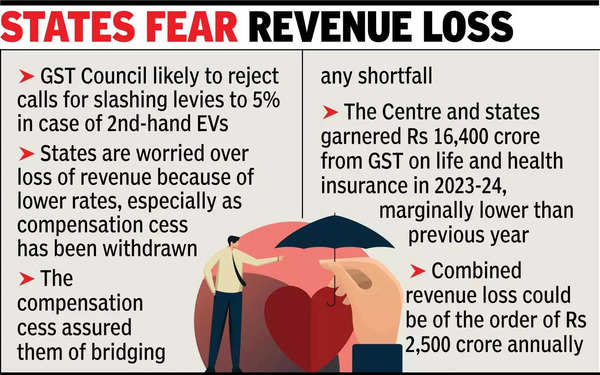
JAISALMER: With several states still not on board to waive goods and services tax (GST) on term insurance and slash the rate from 18% to 5% on health insurance, the all powerful GST Council may have to defer a call on the issue, which is of tremendous interest to the middle class.
It is, however, likely to increase the levy on second-hand vehicles from 12% to 18%, dismissing calls for slashing levies to 5% in case of second hand electric vehicles.
While there is no consensus on reworking rates, given the concerns expressed by states, such as West Bengal, Kerala and Karnataka, even insurance has failed to get the necessary support, as was widely expected. The task of reworking rates was assigned to a group of ministers (GoM) led by Bihar deputy chief minister Samrat Chaudhary.

-

It will take a massive effort on part of the Centre on Saturday to get the states to agree to the tax changes on insurance proposed by another GoM, which also has Chaudhary as the convenor.
States are worried that they will lose revenue because of the lower rates, especially as the compensation cess has been withdrawn, which assured them of covering any gaps. The Centre and states raked in Rs 16,400 crore from GST on life and health insurance in 2023-24, marginally lower than the previous year. The combined revenue loss could be of the order of Rs 2,500 crore annually.
Besides, it is unclear how the GST Council intends to enforce that the benefit of lower taxes is passed on to consumers, given that the anti-profiteering clause has now been dispensed with. Finance minister Nirmala Sitharaman had recently indicated that market forces will take care of the issue.
Even on the issue of rationalisation of rates for 148 items, which was discussed by the ministerial panel, states have their concerns. On the agenda will be issues related to taxation of food delivery services, a cut in the tax on cancer therapy and clarification on sponsorships and FSI.


Shock and awe in the world of Jatra

0
Shock and awe in the world of Jatra


In the Hindu epic Ramayana, Prince Rama of Ayodhya, his wife Sita, and his brother Lakshmana meet Viradha, a ferocious rakshasa (demon), in the dense forests of Dandakaranya. Viradha not only clashes with the brothers but also abducts Sita. This act foreshadows the final few events of the epic. In theatrical adaptations of the Ramayana, Viradha is often portrayed as pure evil.

On the chilly evening of November 26, in the remote village of Ralaba in the Ganjam district of Odisha, a farmer, Bimbadhar Gouda, played Viradha at a Jatra, a form of folk theatre that is popular across Odisha and West Bengal. Instead of bringing a prop to ‘devour’, Gouda had brought a live pig instead. “When he ripped the pig apart, there was a stunned silence in the audience,” recalled Sadasiba Jena, a villager who watched the play that day.

When footage of the incident, seen by a few as an “immersive performance”, surfaced on social media and TV news channels, drama enthusiasts and animal rights activists were enraged.

“Using any live animal or bird in a cultural performance including cinema and drama is illegal without the permission of the Animal Welfare Board of India. There are clear guidelines which prohibit animal cruelty during stage performances. In Ganjam, the theatre groups are probably not aware of the guidelines,” said Biswajit Mohanty, a wildlife expert and secretary, Wildlife Society of Orissa.


Also read | Odisha stage actor held for killing pig during performance, eating its raw meat

In the Odisha Assembly, ruling Bharatiya Janata Party (BJP) lawmakers Babu Singh and Sanatan Bijuli demanded that those responsible for the act be held accountable. The actor and the procurer of the pig now face multiple cases under sections pertaining to animal cruelty under the Bharatiya Nyaya Sanhita, 2023, and the Prevention of Cruelty to Animals Act, 1960. The case has shone a spotlight on the changing character of Jatra.

Where there are no limits

Jatra is usually performed on an open-air stage with the audience, both men and women, seated on all sides. It dates back to to the rise of Vaishnavism and the Bhakti movement during the 16th century. Back then, devotional songs and dances that were sung and performed by followers of the Bhakti movement, and plays on mythology, captivated people. Over time, social issues became central to Jatras. While Jatras include plays, music, and dance, today, stunts have taken over, in an attempt to make them more “modern” and “commercial”, said various artists and villagers.

On December 12, past midnight in Mancheswar, a village on the outskirts of the State capital Bhubaneswar, a young man lay on stage on a bed of shattered glass under the glare of multi-coloured lights. A large rock was placed on his chest. Suddenly, another actor began hammering the boulder. Despite the sharp glass shards that could have caused serious cuts and wounds, the man who was lying down remained stoic and unscathed. The audience, seated in a sprawling makeshift enclosure, watched in awe.

Jatra is usually performed on an open-air stage with the audience seated on all sides. A Jatra performance at Ralab village in Ganjam district of south Odisha.

Jatra is usually performed on an open-air stage with the audience seated on all sides. A Jatra performance at Ralab village in Ganjam district of south Odisha.
| Photo Credit:
Biswaranjan Rout

As the act unfolded, two young women, standing atop massive truck tyres lifted by a group of performers, waved the national flag. The audience rose to their feet. While the actors were to perform a play with social themes, acrobatics and stunts dominated the night and kept everyone spellbound.

“Stunts and ‘item numbers’ have grown in Jatras because the audience wants it. We have no choice but to match the expectations of people,” said Jagannath Bhol, a choreographer of the Rangamal theatre group, based in Bhubaneswar.

In both Ralaba and Mancheswar, the troupes use shock and awe as methods to reinvent themselves and remain relevant. This often happens at the expense of traditional storytelling formats.

“Over the last two decades, TV and films have transformed the entertainment landscape. Today, people can enjoy movies, shows, or dance performances in their living rooms at their convenience. In contrast, Jatra demands an audience that is willing to stay engaged throughout the night. Tsaid Sashidhar Patra, who has been a Jatra hopper for 40 years. “The younger generation, even in rural areas, is increasingly absorbed in (Instragram) Reels. So, Jatra has no option but to reinvent itself to sustain the audience’s interest.”

While Ralaba, a village of 1,400 families of mostly farmers and migrant labourers, is not economically affluent, it is culturally rich. Ralaba takes pride in its theatre group, Rama Bhakta Maruti, which boasts 70-80 active members at any given time. Since 1992, the group has been performing the Ramayana in Ralaba and neighbouring villages. Not just Ralaba; hundreds of villages across Ganjam have theatre groups that are dedicated to performing the Ramayana. Year after year, the residents of these villages watch the annual play with undiminished enthusiasm.

Politics, however, has divided these villages into two factions. In the past, theatre groups aligned with the Congress and the Janata Dal. Over time, loyalties shifted, and the groups stand mostly divided between the Biju Janata Dal and the Bharatiya Janata Party. This rivalry often transforms the traditional Ramayana play into a competitive spectacle known as Badi Ramayana, with each faction striving to draw larger crowds to assert their dominance. Badi Ramayana is staged with the rule that in passion and battle, limits don’t exist, especially in Ganjam district.

“In other parts of the world, a Ramayana play typically concludes within five to six hours. However, in our region, the play goes on for 13 to 14 hours,” says Nila Bhaula, a resident of Ralaba. “When troupes are drawn into competing in the Badi Ramayana, the epic is enacted for days. The actors and the audience remain immersed in the performance and often don’t even take a break.”

In one of the plays, the actor playing Vali, the king of Kishkinda in the Ramayana, lifted bullock cart wheels and cracked a tender coconut on his head. While the audience sat glued to the stage, a rival troupe performed similar stunts nearby. Immediately, the attention of the audience shifted.

“The two plays went on for 40 hours, with neither the actors nor the audience showing any signs of tiredness,” said Bhaula.

To transform or not to transform

The traditional staging of the Ramayana in Ganjam villages has undergone an incredible transformation in the last 15 years. Mythological storytelling has taken a back seat and there is an increased emphasis on sensual dances, acrobatics, gymnastics, and comedy.

It is not just that characters, especially demons and monkeys, often perform dramatic stunts, such as playing with cobras, lifting goats on stage, and killing chickens; the plays also give modern twists to iconic moments in the epic. Jatra performers said Sita sometimes makes her entrance in the bucket of an earthmover or Ravana’s kidnapping of Sita occasionally involves bullets fired in the air instead of a chariot. Across India, Sita is generally portrayed as the ‘ideal’ wife and a soft-spoken woman, but in Ganjam, she sometimes breaks into a frenzied freestyle dance, challenging the Sita on another stage to match her moves, much to the delight of the audience.

Santosh Khuntia, 50, who has played the role of Kaikeyi in Ralaba for over three decades, reflected on the evolution of the epic. “I have seen how the Ramayana has changed on stage. Purists might disapprove, but these reinventions are necessary to keep the people engaged,” he said.

Subrat Kumar Mishra, the manager of Rangamahal, a professional Jatra troupe based in Bhubaneswar, travels across districts with what he calls his “mini-world”. The troupe requires five trucks and two buses to transport equipment, including lights and sound systems, and a diverse team of artists from one location to another.

Seated on a cot behind the Jatra pandal in Mancheswar, Mishra discussed the stiff competition his troupe faces in generating revenue and sustaining the interest of the audience. The performance is meticulously structured to appeal to a wide range of viewers, he said. “The first two hours are dedicated to devotional songs, followed by an episode on Hanuman. Then we play Odia and Hindi film music. Men perform stunts and women wear short costumes and dance. All this caters to people of all age groups,” he said.

But not everyone supports these changes. Basant Dalai, a 60-year-old resident of Ralaba, said, “I don’t subscribe to today’s Ramayana. I stopped watching these shows long ago.”

Similarly, in Bikrampur village of Ganjam, Sakaleswar Roul, popularly known as the “Ramayana director”, has remained steadfast in his traditional approach to staging the epic. “Over the past 40 years, I have directed 27 theatre groups. I have never felt the need to use such distasteful measures to maintain interest,” he said.

Even though Ramayana performances are staged over several days, the community’s enthusiasm has never waned, added Roul. “People take turns staying near the stage, and at no point does the audience count drop to below 250, even between 3 a.m. and 6 a.m. By morning, the crowd quickly returns,” he said.

Though actors move around villages for seven months a year for rehearsals and performances, they don’t receive any remuneration. Most of them are farmers or daily wage earners who enjoy Jatra and perform to uphold the pride of the village. The income generated from Ramayana performances is given to the village fund and is used to support various cultural activities. “For us, this is a passion, not a profession,” Roul said.

From the sidelines to centre stage

While female dance troupes are roped in to perform as actors change clothes during a performance, women in villages don’t have any roles in the Ramayana plays. But this is not the case in Bhubaneswar. Rangamahal boasts a significant number of female artists and dancers who perform in front of large crowds. They are undeterred even when they hear lewd remarks.

In the past, women who did Jatra performances were often looked down upon. But times have changed, they say. A Jatra performance at Ralab village in Ganjam district of south Odisha.

In the past, women who did Jatra performances were often looked down upon. But times have changed, they say. A Jatra performance at Ralab village in Ganjam district of south Odisha.
| Photo Credit:
Biswaranjan Rout

“As women, we have to maintain our composure. Jatra audiences, who are predominantly from rural backgrounds, often attend performances in groups and don’t shy away from making vulgar remarks. While it is hurtful, we choose to take it in our stride,” said Sampoorna Swain, who has been acting in Jatra for 20 years.

In Bhubaneswar, Jatra groups and artists are professionals who demand remuneration. Jyotisikha Malla, 19, who was preparing to take the stage with her dance routine, said, “With my father working as a bus conductor, it is tough for my family to manage. I have two sisters and a younger brother to look after. I had to start earning early, and joining a Jatra troupe was the perfect opportunity.”

In the past, women who did Jatra performances were often looked down upon. But times have changed, they said. Anjana Nayak, 45, ran away from home when she was in Class 10. Since then, she has spent 30 years carving out a career in Jatra. She started with just a few hundred rupees a month. Now she earns up to ₹50,000 a month. “I am at the peak of my career,” she said, smiling.

A thriving industry

Jatra is no longer a simple gathering of artists who entertain rural audiences; it has evolved into a thriving industry. People who wish to establish a professional Jatra group need ₹8 to ₹ 10 crore. “There are about 45 major Jatra troupes travelling across Odisha for performances,” said Braja Behari Nayak, a 60-year-old character artist. “Some star performers command annual packages of up to ₹45 lakh, while a celebrated couple is said to be paid ₹60 lakh per year.”

The competition intensifies when multiple troupes perform in Bhubaneswar, elevating the quality of the acts and driving ticket prices as high as ₹1,000 per show. Securing a ticket to watch a Jatra show is a matter of luck. Bollywood celebrities such as Ameesha Patel, Rakhi Sawant, and Shakti Kapoor have also made brief appearances at these shows, boosting the industry.

“Jatra has been nothing short of a cultural revolution in Odisha,” said Naba Kishore Mania, a Jatra critic. “Some proprietors continuously innovate to keep their troupes afloat, and the earnings of certain Jatra stars rival those of top Odia film actors. It is not uncommon for Odia movie stars to step onto the Jatra stage, both to refine their acting skill and earn a lucrative paycheck.”

However, some of these radical transformations of the folk art are tarnishing Jatra’s reputation and alienating loyal Jatra enthusiasts. Unlike earlier times, some families now hesitate to attend Jatra shows together.

Bapi Panda, a leader of the Jatra Artists Association, said, “A few greedy individuals are giving us a bad name. Every art form must evolve to remain relevant, but not at the expense of its core values.”.

satyasundar.b@thehindu.co.in


Two dead as car slams into Christmas market crowd in Germany | Crime News

0
Two dead as car slams into Christmas market crowd in Germany | Crime News


The driver involved in the ramming has been taken into custody, with officials calling the incident an attack.

At least two people are dead and as many as 68 injured after a car rammed into a crowded Christmas market in the city of Magdeburg, part of the central German state of Saxony-Anhalt.

Officials on Friday night described the incident as an intentional attack and announced the driver has been taken into custody.

German Chancellor Olaf Scholz was among the many offering their condolences in the immediate aftermath.

“My thoughts are with the victims and their families,” Scholz wrote on the social media platform X.

“We stand by their side and by the side of the people of Magdeburg. My thanks go to the dedicated rescue workers in these anxious hours.”

The interior minister for Saxony-Anhalt, Tamara Zieschang, identified the suspect as a 50-year-old doctor from Saudi Arabia who arrived in Germany in 2006.

Another state official, Premier Reiner Haseloff, told a local television outlet that one of the dead included a child.

“This is a terrible event, particularly now in the days before Christmas,” Haseloff told the news outlet dpa.

Among the injured, 15 were identified as being in critical condition, according to the city government’s website. Another 37 people had injuries of medium severity and 16 were lightly injured.

Local media reports indicate the car involved was seen to be driving at high speeds, before striking the crowd at around 7pm local time (18:00 GMT).

More details to follow.


Bajaj Chetak 35 Series Electric Scooters Launched In India With Geo-Fencing Safety Feature, Starting At Rs 1.20 Lakh; Check Specs, Price | Mobility News

0
Bajaj Chetak 35 Series Electric Scooters Launched In India With Geo-Fencing Safety Feature, Starting At Rs 1.20 Lakh; Check Specs, Price | Mobility News


Bajaj Chetak 35 Series India Launch: Bajaj Auto has rolled out the latest version of its electric scooter under the Chetak 35 Series in India. The series includes three variants: the Chetak 3501, Chetak 3502 and 3503 models. However, the third variant, the Chetak 3503, will be launched later as part of the Chetak 35 Series. 

Notably, The newly-launched electric two-wheeler scooter is manufactured at Bajaj Auto’s Akurdi plant in Pune, not very far from where the iconic Chetak (old) was manufactured. The latest Chetak 35 Series is based on a new design platform and now features an extended seat length and a wider floorboard. Moreover, the changes in the scooter can also be seen in the form of crucial updates to the powertrain, feature list, and more. 

The new Chetak 35 Series still has a metal body. The company has made the wheelbase and seat longer, giving more space for your legs and knees, along with a roomy 35-litre underseat storage. The seat length has been increased by 80mm for extra comfort. 

Bajaj Chetak 35 Series Price In India And Availability

The electric two-wheeler scooter has been launched at a starting price of Rs 1.27 lakh for the 3501 variant, while the 3502 variant is priced at Rs 1.20 lakh. Notably, these prices are ex-showroom. The scooter is available for purchase on Amazon and Flipkart. Deliveries for the 3501 variant are expected to begin later this month, while the 3502 variant will be delivered starting January 2025. 

Bajaj Chetak 35 Series Specifications: 

Smart Display: The electric two-wheeler scooter comes with a 5-inch touch-enabled digital display, offering essential information about the scooter, including battery status, speed, and navigation details, ensuring a seamless and smart riding experience. 

Spacious Storage: It offers a generous 35-litre boot space. 

Battery and Performance: The two-wheeler scooters are equipped with a 3.5 kWh battery powering a 4 kW motor, delivering a range of 153 km and a top speed of 73 km/h. 

Smart Features: The scooters are loaded with a advanced technology which Includes integrated navigation, call management (accept/reject), music control, document storage, and more. 

Safety Features: It offers key features such as geo-fencing, theft alerts, accident detection, and overspeed alerts. The traditional mechanical switches have been upgraded to tactile switches, adding a modern touch.

Charging: The electric two-wheeler scooters are packed with a 950-watt onboard charger, it can recharge the scooter from 0 to 80% in just 3 hours. 


What happens if the US government shuts down?

0
What happens if the US government shuts down?


Reuters US park rangers talk at a truck Reuters

The US is edging towards another government shutdown after the lower chamber of Congress failed to pass a spending bill to keep federal agencies open.

Funding is set to lapse at midnight on Friday unless Republicans and Democrats can agree on a way forward.

Here’s a breakdown of how we got here and what this means for Americans – and for Donald Trump.

Why is this shutdown looming?

Getty Images Sign saying 'CLOSED' in front of USA flagGetty Images

Many federal government agencies rely on annual funding approved by Congress.

Every year, these agencies submit their requests, which Congress must pass, and the president must sign budget legislation for the next fiscal year.

If an agreement is not reached, then all non-essential, discretionary functions of the US government stop.

In September, both parties agreed a bill to keep government funding until 20 December.

This week, three days before lawmakers were set to head off for a holiday break, the Speaker of the House of Representatives, Republican Mike Johnson, released a bill to extend funding until March.

It was agreed with Democratic leadership but included some measures like a pay rise for lawmakers that made some Republicans unhappy.

Tech billionaire Elon Musk, an ally of Trump, posted his opposition to it and then the president-elect signalled he wanted his party to kill it, which is what happened.

A second, slimmed-down bill did make it to the floor of the House on Thursday night but failed to get enough votes to pass.

Getty Images Speaker of the House Mike Johnson  speaks to reporters at the US Capitol Getty Images

Speaker Johnson has promised to find a solution on Friday

Who is affected by a government shutdown?

If no deal is struck by midnight, then the US will have its first shutdown since early 2019.

Essential workers continue as normal, some of them without pay, while government employees deemed non-essential are put temporarily on unpaid leave.

Border protection, in-hospital medical care, law enforcement and air-traffic control will continue to operate.

But services like the food assistance programme, federally funded preschool, the issuing of student loans and food inspections, and National Parks will be curtailed or close.

While Social Security and Medicare cheques are sent out, benefit verification and card issuance stops.

There could also be travel delays if the stand-off drags on.

“An extended shutdown could mean longer wait times at airports,” said Transport Security Administration spokesman Carter Langston.

Why did Elon Musk oppose the bill?

Getty Images Tesla CEO Elon Musk, co-chair of the newly created Department of Government Efficiency (DOGE), carries his son "X" on his shoulders before a meeting with members of Congress at the US Capitol  on 5 December Getty Images

The Tesla boss has been tasked with identifying spending cuts by co-leading the proposed Department of Government Efficiency (DOGE).

It is not an official government department but he has vowed to find $2tn in savings.

On Wednesday he made dozens of posts on X, the platform he owns, to express his disgust with Mike Johnson’s bill.

Amplifying some false statements about what was in the bill, he called it criminal and outrageous.

After Musk drummed up opposition, Trump and JD Vance, the incoming vice-president, dealt the final blow to Johnson’s deal that evening.

They said in a joint statement they wanted streamlined legislation without the Democratic-backed provisions that Johnson had included.

They also called for Congress to raise or eliminate the debt ceiling, which determines how much the government can borrow to pay its bills.

What happens now?

Johnson has promised to find a solution on Friday so there will be much wrangling on Capitol Hill as the clock ticks down.

But to get the support required in the House to pass, he will need Democratic votes.

Democrats say they will only support the original bill that Trump and Musk opposed.

If no agreement is reached then the US federal agencies will shut down at midnight.

How common are shutdowns in the US?

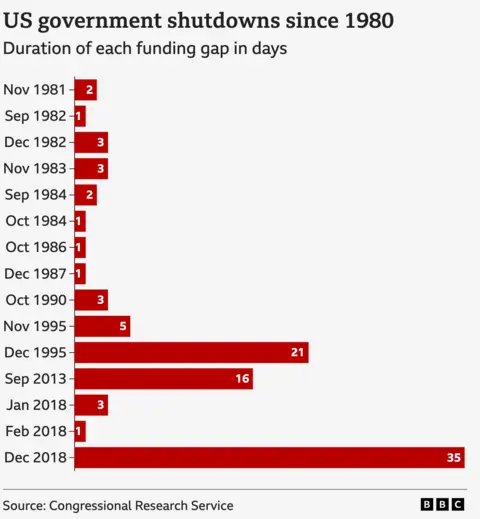
Quite common. President Ronald Reagan oversaw eight shutdowns during his tenure – though all were relatively brief.

And there were three when Donald Trump was president, including the longest in history at 36 days which ended in January 2019.

That one happened because of disagreements over funding a wall on the Mexico border.

The Congressional Budget Office (CBO) estimated that it reduced economic output by about $11bn, including $3bn that it never regained.

Graphic showing length of shutdowns since early 1980s

Shutdowns over budgets are almost unique to US politics.

Under the US system, the different branches of government have to reach an agreement on spending plans before they can become law.

In most countries, budget votes become votes of confidence in the government itself. But because the US has equal and often divided branches of government, that isn’t the case.

Why does Trump want to raise the debt ceiling?

Also known as the debt limit, this is a law that restricts the total amount of money the government can borrow to pay its bills.

This includes paying for federal employees, the military, Social Security and Medicare, as well as interest on the national debt and tax refunds.

Every so often, US Congress votes to raise or suspend the ceiling so it can borrow more.

Trump adding this condition to the deal was an unexpected demand that has made it harder for right-wing Republicans who often rail against increased government spending to back the bill.

The debt ceiling was going to have to be increased in the coming months regardless of the efficiency drive being promised.

But by demanding it happen now, some analysts believe Trump is signalling the cost of his proposed tax cuts and tougher border restrictions will test the ceiling limits. And he prefers the fight over the increase happens before he takes office.

Democrats are usually in favour of raising the debt ceiling without strings but they are in no mood to help Republicans now.

The risk to Trump is that the mini-rebellion chips away at the cloak of invincibility he has worn since the election.

And it raises questions over how smoothly his party will be able to deliver on his campaign promises that require legislation.