Bitcoin climbed to a record high, extending a rally sparked by President-elect Donald Trump’s support for digital assets and his plan to turn the US into the dominant force in the sector. The largest token rose more than 3 per cent at one point on Monday in Asia to an unprecedented $106,493, exceeding its previous peak from December 5. The advance helped to boost sentiment in the wider crypto market. Trump is moving toward creating a friendly regulatory backdrop for digital assets, undoing a crackdown imposed by President Joe Biden’s outgoing administration. The Republican has also backed the idea of a strategic national Bitcoin stockpile, though many question the feasibility of the latter idea. A lot of people are “basing their expectation on a much more favorable administration,” Aya Kantorovich, co-founder of institutional crypto platform August, said on Bloomberg Television. The optimism is reflected in demand for exchange-traded funds investing in digital assets, she added. On Friday, Nasdaq Global Indexes said Bitcoin accumulator MicroStrategy Inc. will join the Nasdaq 100 Index. The software maker’s metamorphosis into a leveraged bet on Bitcoin has transfixed Wall Street. The company has been raising capital to plow billions of dollars into the digital asset. Bitcoin through Sunday cemented a seven-week winning streak, the longest such run since 2021. But the pace of gains cooled more recently, which could be an indication that “a pullback may be coming,” IG Australia Pty Market Analyst Tony Sycamore wrote in a note. The original cryptocurrency changed hands at $106,215 as of 8:39 a.m. on Monday in Singapore. Smaller tokens such as second-ranked Ether, XRP and meme-crowd favorite Dogecoin posted increases too. US ETFs investing directly in Bitcoin have attracted $12.2 billion of net inflows since Trump’s victory in the presidential election on Nov. 5. Subscriptions for similar products for Ether have reached $2.8 billion over the same period.
An Israeli air strike has killed Palestinian journalist Ahmed Al-Louh and five Palestinian Civil Defence workers in central Gaza’s Nuseirat camp.
Al-Louh, who worked as a cameraman for Al Jazeera alongside other media outlets, was killed on Sunday in the strike on the Civil Defence post in the central Gaza camp, according to medics and local journalists.
The attack occurred as Israeli military strikes across the Gaza Strip killed at least 28 Palestinians on Sunday, medics said. Allouh is the third journalist killed in Gaza in the last 24 hours.
Al Jazeera Arabic reported that Al-louh was working while killed, wearing a press vest and helmet. He was taken to Al-Aqsa Martyrs Hospital in Gaza’s city of Deir el-Balah.
Al Jazeera Media Network condemned Al-Louh’s killing, and called on human rights and media organisations “to condemn the Israeli Occupation’s systematic killing of journalists in cold blood, the evasion of responsibilities under international humanitarian law, and to bring the perpetrators of this heinous crime to justice”.
“We urge relevant international legal institutions to take practical and urgent measures to hold the Israeli authorities and all those who are responsible accountable for their heinous crimes and to adopt mechanisms to put an end to the targeting and killing of journalists,” the network added.
Al-Louh had been covering Israel’s war on Gaza when it first began in October 2023, embedded with the Gaza Strip’s Palestinian Civil Defence teams, Al Jazeera’s Hind Khoudary said.
“It’s another heartbreaking day for Palestinians, Civil Defence teams, journalists. We [have been] wondering, how many times are we going to continue reporting on the killing[s] of our colleagues and beloved ones?” Khoudary said, reporting from Deir el-Balah.
Gaza’s media office said the head of the civil emergency service in Nuseirat, Nedal Abu Hjayyer, was also killed in Sunday’s attack.
“The civil emergency headquarters in Nuseirat camp was hit during the crews’ presence. They work around the clock to serve the people,” said Zaki Emadeldeen from the civil emergency service to reporters at the hospital.
“The civil emergency service is a humanitarian service and not political. They work in war and peace times for the service of the people,” he said, adding that the place was hit directly by an Israeli air strike.
The Israeli military said they were looking into the attack.
Several other Palestinian journalists were killed this past week, with 195 killed in Gaza since Israel’s war began, Khoudary said.
Al Jazeera’s Hani Mahmoud said earlier on Sunday that Palestinian journalist Mohammed Jabr al-Qrinawi was killed along with his wife and children in an Israeli air attack that targeted their home in Bureij refugee camp, in central Gaza, late on Saturday.
Earlier on Saturday, Al Mashhad Media said its journalist Mohammed Balousha was killed in an Israeli attack in Gaza.
Several Al Jazeera journalists have been killed since the start of Israel’s war on Gaza, including Ismail al-Ghoul, Rami al-Rifi, Samer Abudaqa and Hamza Dahdouh.
Also on Sunday, an air strike hit people protecting aid trucks west of Gaza City. Medics said several were killed or wounded but exact figures were unavailable as of yet.
Residents also said at least 11 people were killed in three separate Israeli air strikes in Gaza City. Nine were killed in the towns of Beit Lahiya, Beit Hanoon and Jabalia camp when clusters of houses were bombed or set ablaze, and two were killed by drone fire in Rafah.
Mumbai: The surge in the Indian stock market on Friday helped the Indian benchmark indices end the week on a positive note. A strong 2,000-point rebound from the lows suggests that the buy-on-dips strategy is working well in the market, experts said on Saturday.
“With inflation coming within the RBI’s tolerance level and an expectation of further ease in food prices on account of seasonal corrections in vegetable prices, it could build up the expectation for ease in monetary policy in February,” said Vinod Nair, Head of Research, Geojit Financial Services.
On the last trading session this week, Nifty witnessed a sharp recovery of more than 2 per cent from day’s low, rebounding from a significant dip earlier in the session, to close with gains of 220 points at 24,768 (+0.9 per cent).
Buying in FMCG, IT and banking stocks supported the recovery, even as broader market sentiment remained cautious.
“The intraday sell-off in Indian equities followed weakness across Asian markets, which posted steep losses amid a stronger dollar, rising US Treasury yields and continued skepticism over China’s economic revival,” said Siddhartha Khemka from Motilal Oswal Financial Services Ltd.
The lack of clarity in China’s stimulus plans weighed on metal stocks, dragging the Nifty Metal index down by 0.7 per cent. On Friday, Sensex was up 843.16 points or 1.04 per cent, at 82,133.12. During the session, BSE’s benchmark made an intra-day high of 82,213 after recovering from a low of 80,082.
Midcap and smallcap stocks underperformed compared to largecaps. Nifty midcap 100 index closed at 58,991, down 30 points or 0.05 per cent. and the Nifty smallcap 100 index closed at 19,407, down 59 points or 0.30 per cent.
According to experts, a gradual recovery in IIP and core sector data is pointing towards a better H2 earnings performance compared to subdued H1 FY25. Currently, it is believed that FII selling has subsided, at least in the short to medium term, which will add further impetus to the sentiment, they added.
The Nifty IT index reached a new high and rallied around 3 per cent during the week after US inflation data met expectations, boosting hopes for a Fed rate cut next week.
Meanwhile, gold witnessed a sharp sell-off as profit booking intensified following mixed signals from US economic data. MCX Gold tumbled from Rs 79,000 to Rs 77,450. The current weakness suggests a potential trading range of Rs 76,000– Rs 78,000 in MCX, with the short-term outlook remaining cautious amid ongoing market volatility.
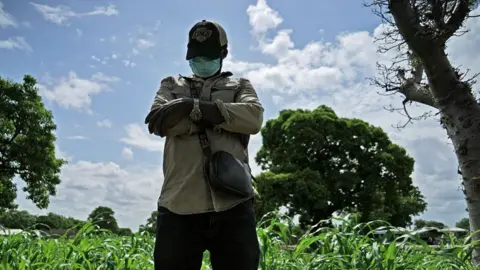
A man from Ghana has told the BBC how he was seized at gunpoint by jihadists in neighbouring Burkina Faso, before being taken to their vast desert camp where he gained a rare insight into their lives – from the children he believed were trained as suicide bombers, to the tunnels they had dug to shield themselves and their armoured tanks from air strikes.
In his first media interview since his 2019 ordeal, the man – whom we are calling James to protect his identity – said his first day at the camp was terrifying as a huge number of Islamist fighters returned from an operation, firing shots in the air.
“I thought that was the end. I was just sweating,” James said, adding that he also ended up wetting his pants when some fighters hit him with their guns – and laughed.
James, who is in his 30s and follows a traditional African religion, said the insurgents later attempted to recruit him, enticing him with the allure of power by saying he could one day become the commander of a battalion.
“The commander brought out a sack. It contained different weapons, AK-47, M16, and G3 [rifles]. So he asked me which of them I could operate, and I said I had never operated one before. He said: ‘We have bigger weapons, so if I give you a battalion to handle, no-one can harm you’,” James added.
He said he was lucky to be released about two weeks later after he begged for his freedom, claiming that he had a sick child at home and promising the camp commander that he would become his recruiting-sergeant in Ghana – a promise he says he never kept.
Ghana’s National Commission on Civic Education, a government body which is spearheading a public campaign to prevent young people from joining the jihadists, told the BBC that it was aware of James’ experience.
“I met him in an attempt to sensitise tertiary-level students,” said Mawuli Agbenu, the commission’s regional director in the capital, Accra.
“We will definitely have a way of engaging with him so that he will be an ambassador or an influencer within his community,” Mr Agbenu added.
Long a stable democracy, Ghana has so far been spared the violence that has seen the insurgency spread, causing havoc in Burkina Faso and its West African neighbours.
The insurgents who kidnapped James belonged to Jama’at Nusrat al-Islam wal-Muslimin (JNIM), or The Support Group for Islam and Muslims. An affiliate of al-Qaeda, it was officially launched in 2017 as an umbrella body for various jihadist groups in the region.
In Burkina Faso, they are strongest in the north, where they control large areas, but they have also expanded to the south, along the porous 550km-long (340 mile) border with Ghana.
More than 15,000 people from Burkina Faso have fled into northern Ghana to escape the conflict, aid agencies say.
Apart from Burkina Faso, the jihadists have also gained territory in Niger and Mali, and have carried out attacks in Ivory Coast, Benin and Togo – all former French colonies – raising fears that the insurgency was spreading south towards the coast.
Jihadists linked to both al-Qaeda and the Islamic State (IS) group operate in the region.
Thomas Naadi / BBC
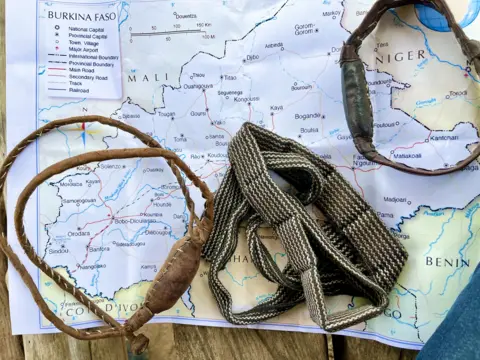
James says the jihadists gave him amulets, falsely promising that the one on the left would protect him from bullets
A Ghanaian security officer stationed along the border with Burkina Faso told the BBC that the jihadists often crossed over to regroup when under pressure from Burkina Faso’s military – and they also used the country to smuggle weapons, food and fuel.
“It’s not safe for Ghana. They hide in towns like Pusiga. Residents of border communities are worried because there’s no tight security,” he added.
In a report released in July, the Netherlands Institute of International Relations think-tank said the “absence of real attacks on Ghanaian soil seems to result from JNIM’s calculus of not disturbing supply lines and places of rest as well as not provoking a relatively strong army”.
“Examples of people who are spared by JNIM by showing their Ghanaian identity cards fits this reading,” it added.
Most Ghanaians are Christians, but the population near the border with Burkina Faso is mainly Muslim – and parts of the region have also been riven with ethnic tensions, raising fears that the jihadists could exploit them to their advantage.
The think-tank said that JNIM had attempted in a “very small number” of instances to recruit or incite Ghana’s small, largely Muslim Fulani community to carry out attacks.
JNIM claimed that they were marginalised, but its recruitment efforts had “minimal success” as the Fulani were “aware of the chaos that has enveloped the Sahel due to familial networks” and did not want it to occur in Ghana, the think-tank added.
A Fulani Muslim preacher in Burkina Faso, Amadou Koufa, is the co-founder of JNIM and is its second-in-command. He recruits most of his fighters from the Fulani community in Burkina Faso.
The military has been accused by rights groups of retaliating by stigmatising Fulanis, and carrying out indiscriminate attacks on their villages in Burkina Faso.
In 2022, a France-based NGO, Promediation, said its research showed that the jihadists had recruited between 200 and 300 young Ghanaians.
Although some were operating in insurgency-hit countries like Burkina Faso, others had been sent back to their villages in northern Ghana to preach their “radical faith”, it added.
This could eventually lead to the jihadists gaining “a sustainable foothold in remote and peripheral areas in the north”, the NGO said.
Since 2022, Ghana has been at the forefront of efforts to create a new Western-backed, 10,000-strong regional force to combat the Islamist insurgency.
Tamale – the biggest city in northern Ghana – is supposed to be the force’s headquarters.
However, the headquarters has not yet opened, and the fate of the initiative is unclear after the region split between pro-Western and pro-Russian states.
Burkina Faso – along with Mali and Niger – have pivoted towards Russia. The three countries have formed their own alliance to fight the insurgents, and have also relied on help from Russian mercenaries.
Ghana and other regional states have remained allied with the West.
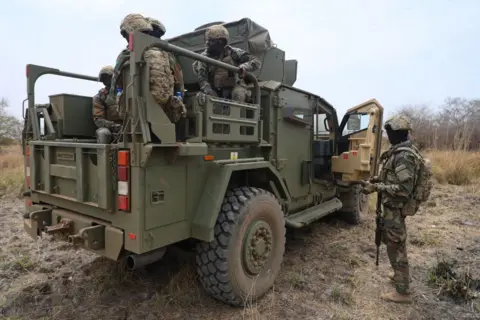
Ghana’s military has established bases in the north, but newly installed border surveillance equipment was not yet working, the security officer, who spoke on condition of anonymity, told the BBC.
However, more troops have been sent since JNIM carried out two attacks, late last month and earlier this month, on the Burkina Faso side of the border, the officer added.
Ghana’s government did not respond to a BBC request for comment.
However, its ambassador to Burkina Faso, Boniface Gambila Adagbila, told the BBC the two countries were helping each other to fight the insurgents, warning that if Burkina Faso fails “Ghana may likely to be the next place”.
Ghana’s National Democratic Congress (NDC) party – which will form the next government after winning elections on 7 December – promised in its campaign manifesto to “enhance” border security with “international partners”, as well as improve the country’s intelligence capabilities.
In August 2023, the European Union announced that as part of a 20m euro ($21.6m; £16.6m) aid package it would supply Ghana with about 100 armoured vehicles, as well as surveillance equipment such as drones.
Many civilians and refugees cross the Ghana-Burkina Faso border through footpaths and back roadsto work, trade or visit relatives despite the security risk – and James said he was one of them. He was travelling all the way to Senegal on his motorbike when he was taken captive.
AFP
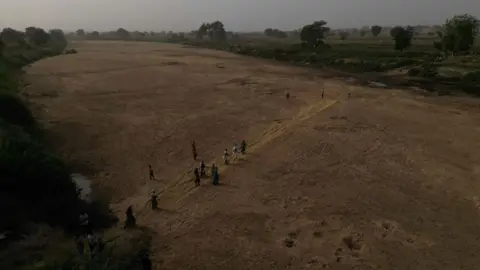
People often walk between Ghana and Burkina Faso to work on farms or to look for their stray livestock
After riding for nearly a day, he said he encountered the insurgents in north-western Burkina Faso, as he was nearing the border with Mali.
A handful of jihadists, also on motorbikes, stopped him and took him to their camp where he was interrogated until their commander was convinced that he was not a spy, James said.
He added that his blindfold – the trademark black jihadist flag – was then removed.
James said he found about 500 insurgents – mostly young men, including one who identified himself as a doctor – living in the camp.
Located in desert-like terrain, it was made up of thatch-roofed huts, with small electricity-generating solar panels, he said.
He added that the camp was divided into three sections – for commanders and their families, lower-ranking jihadists and captured villagers and soldiers.
James said he was detained in the latter section, but got “closer” to the jihadists in the second week as he increasingly acted as though he had become a sympathiser of their cause.
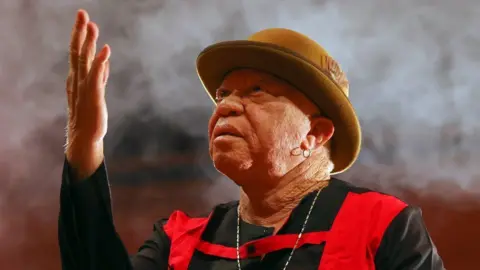
They sat around in groups of five or 10, and listened to the songs of Salif Keïta, the Malian musician known as the Golden Voice of Africa, James said.
Other jihadist groups have banned music, saying it is un-Islamic.
Getty Images
Salif Keïta mixes traditional Mandé music with jazz, blues and Western music styles
James said that while the atmosphere at the camp was generally relaxed, groups of jihadists regularly went to fight, firing celebratory shots when they returned, claiming to have achieved battlefield success.
James said he realised that this was the gunfire he had heard on the first day, and got used to it.
He added that the insurgents parked their tanks and pick-up trucks in two inter-connected tunnels to ensure they were not destroyed if there was an air strike, while only a few vehicles remained outside “on stand-by, for an emergency”.
He said the jihadists also revealed their darkest sides – telling him they captured women during raids on villages and sold them to each other.
“They trade the women they’ve captured. Others sell wives that they are fed up with. Those who resist are gang-raped into submission by two or three fighters,” James added, though he did not see them do this.
James said the women at the camp included the wives of jihadists who performed domestic chores like cooking and cleaning, while those who were captured were either sex-slaves or were forced to become fighters.
He explained that he saw fully veiled women, with AK-47 rifles hidden under their clothes, leave the camp to raid villages for livestock to feed people at the camp – or to sell at markets in nearby towns.
James said he also saw dozens of children, including those of jihadists, being trained in the use of weapons and explosives.
“You’ll see a small kid holding a gun and telling you that if he goes to meet some people, this is how he is going to kill them,” James added.
He said he twice saw four children being taken to another location, before returning to the camp with suicide vests.
They wore long, loose outfits over them, and left the camp with begging bowls, James said.
Jihadists told him that when they anticipate a tough battle in a town or military camp, they send children disguised as beggars who then blow themselves up, so the fighters can enter amid the chaos, James said.
He added that three jihadists had told him that they “sacrifice their children as suicide bombers and they get paid after every mission”, though they did not disclose the amount.
He said the jihadists tried to indoctrinate him, preaching that “anything Western is evil” and showing him propaganda videos every night, including one of the US invasion of Iraq and the killing of Palestinians in the current conflict with Israel.
According to James, as the insurgency was being waged in French-speaking countries, all the jihadists were Francophone, but one spoke English with a Ghanaian accent, and always kept his face covered so that he could not see him.
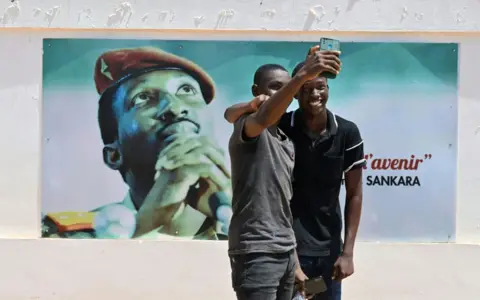
In a sign that the jihadists were also influenced by pan-Africanism, James said some of them invoked the names of revolutionaries like Burkina Faso’s Thomas Sankara and Ghana’s Kwame Nkrumah and told him that people should “rise up” against “bad leaders” and free themselves from “bondage”.
AFP
Thomas Sankara ruled Burkina Faso from 1983 until his assassination in 1987
James said the jihadists also expressed the view that if Sankara and Nkrumah had “lived long”, then “the whole of Africa would have been a better place – nobody would have travelled from Africa to the West. People would have been travelling from the West to Africa”.
James, unemployed at the time, said their rhetoric was powerful, and only “strength of heart” prevented him from joining their ranks.
On how exactly he was captured, James said that two Muslim friends were travelling with him at the time, promising to introduce him to a Muslim spiritual leader in Senegal who could pray for him and improve his fortunes.
All three of them were intercepted by the jihadists as they were coming to the end of the first leg of their trip, he said.
James added one of his friends was shot dead as he attempted to flee, while his other friend was taken with him to the camp.
James said the commander did not release his friend, making him fear that he had been forced to join the jihadists – or was dead.
“The commander told me that: ‘I will let you go if you assure me you will get me more fighters’,” James said.
He added that before driving him to a bus rank and giving him the fare for the trip back home, the insurgents gave him a contact number to keep in touch, but, James said, he never did and changed his number.
According to James, the jihadists also gave himcharms, which supposedly had supernatural powers.
Again, many other jihadists reject the use of amulets, believing them to be contrary to the teachings of Islam.
James showed the BBC the amulets, which were made of fowl feathers, animal skins and herbs, covered in leather and cloth.
They included one which the jihadists falsely told him offered protection from bullets.
James said he never got the impression that the insurgents wanted to destabilise Ghana, seeing it as the “safest place” to hide when under pressure from Burkina Faso’s military.
Their focus was on waging an insurgency in countries where France and the US “exists”, believing that these two countries exploit Africa’s resources, to the detriment of its people, James said. This is denied by both countries.
AFP
Ghana’s military has so far avoided battle with the insurgents
Ghana-based security analyst Adib Saani expressed concern about the growing insurgency in West Africa, and said he did not see a military solution to it.
“We need to go beyond the militarised posture. We must address the socio-economic and geopolitical deficits that are creating the environment for terrorism to strive,” he told the BBC.
Ghana’s National Commission for Civic Education has been carrying out a public awareness campaign dubbed “see something, say something” to encourage residents in the north to report suspicious activity.
The campaign has also been extended to Accra, to educate young people about the dangers of jihadism.
The commission’s Mr Agbanu told the BBC that the campaign was vital as Ghanaians were vulnerable to recruitment.
“There’s a high rate of corruption, unequal development across the country, and huge youth unemployment,” he said.
James, who is now a subsistence farmer, said that he was just relieved to be alive as the jihadist commander had told him that he was making an exception by releasing him because normally it was “either your dead body that will go home or nobody will ever hear of you again”.
When Trafigura Group director Mark Irwin stood up last week to give evidence in a Swiss criminal court, it represented a pivotal moment in the relationship between the world’s commodity traders and the country that many of them call home.
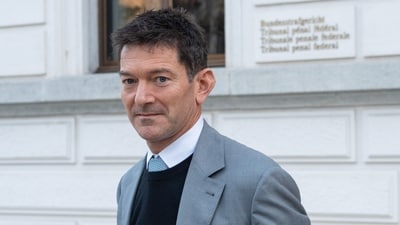
Mike Wainwright, former chief operating officer of Trafigura Group, leaves the Federal Criminal Court in Bellinzona, Switzerland(Bloomberg)
Until now, Swiss prosecutors had never put a commodity trading house on trial. In fact, they’d never tried any company for corruption at all.
Irwin, who was one of Trafigura’s earliest employees, was the company’s official representative at the federal criminal court in the picturesque alpine town of Bellinzona, where Trafigura and three individuals — including former chief operating officer Mike Wainwright — faced charges of bribery in a landmark case. All four defendants denied the charges against them.
The testimony from a procession of current and former senior figures at Trafigura meant the case has provided an unprecedented glimpse into decision making at one of the world’s biggest commodity traders, a company that handles enough oil every day to meet the combined demand of Germany, France and Spain. But it’s also served to highlight a shifting stance in Switzerland, which has long been known for its light-touch regulation.
Instead, federal prosecutors were accused by Trafigura’s lawyers of being on a “crusade,” while a lawyer for Wainwright argued his client was being unfairly made an example of to show the country was cracking down on the sector.
“Switzerland became a leading commodities hub thanks to a unique combination of tax privileges, its financial industry, weak regulation and a lax embargo policy,” said Adrià Burdy Carbo of Swiss NGO Public Eye. “In the Trafigura trial, federal prosecutors are for the first time opening up and scrutinizing a corruption machinery in a public trial, in order to establish the responsibility of individuals.”
It’s a far cry from the not-so-distant past, when commodity traders from all over the world flocked to Switzerland, lured by low taxes, political neutrality and business-friendly laws.
In the 1960s, Egyptian cotton merchants relocated to Geneva. Later, industry godfather Marc Rich chose the town of Zug for his eponymous trading house when fleeing US justice. He was followed by Russian oil and metals merchants in the 1990s.
But in recent years, mirroring a crackdown on corruption and market manipulation by commodity traders from US authorities, Swiss prosecutors have launched several cases against the industry.
Both Glencore Plc and Gunvor Group have been fined for historical corruption, though the cases were resolved without going to trial. Trafigura has said it had been willing to settle, but the Swiss prosecutors “decided to send the case to court.”
And so, over the past fortnight, a small army of lawyers descended on Bellinzona. On trial were not just Trafigura, but also Wainwright, the former COO, Thierry Plojoux, a former Trafigura employee who was an alleged middleman for bribe payments, and Paulo Gouveia Junior, an Angolan oil official who allegedly received the bribes.
At times, the court — which last saw major corporate action when Credit Suisse Group AG was convicted for laundering a cocaine dealer’s cash in 2022 — didn’t seem equipped to handle the volume of lawyers, public relations officials, observers and journalists.
On the first day of the trial, prosecutors complained that Trafigura’s vast team meant there wasn’t enough space in the courtroom. During breaks, defendants and witnesses, some of them multimillionaires, queued along with everyone else for the courthouse’s two toilets and one coffee machine.
The crackdown on corruption is happening at a time when Switzerland’s position as an epicenter for much of the world’s physical commodities trade is under increasing threat.
Singapore has wooed many of the world’s commodity traders with tax breaks — including Trafigura, which reorganized itself under a Singapore parent company in 2015, although its top executives are still based in Geneva. And Switzerland’s decision to mirror EU sanctions on some Russian commodities since 2022 has resulted in a significant shift in the companies handling those trade flows to Middle Eastern hubs like Dubai and Abu Dhabi.
Still, Switzerland doesn’t look like losing its status as a key hub for commodity trading any time soon. Swiss-based trading companies handle a third of the world’s trade in crude and oil products, according to the Swiss Commodity Trading Association SUISSENÉGOCE. In return “fiscal contributions” from trading represent 22% of Geneva’s budget, 10% in Zug and around 19% of Lugano’s income, according to the body.
The country’s famously low taxation rates mean it is still an attractive location for many trading businesses. Trafigura itself had an effective tax rate of just 2.8% on profits of $2.8 billion in its most recent financial year, it said in its annual report on Friday. Moreover, many traders receive the lion’s share of their compensation through the rise in value of their shareholdings in their companies — which, as capital gains, are not subject to Swiss tax.
Even Swiss corruption cases remain relatively easy for the traders to brush off. The country has a maximum corporate fine of 5 million francs ($5.6 million) on top of disgorgement of profits made in corrupt acts — a rounding error for companies that make billions of dollars in profits a year.
In the case that concluded this week, the charge against Trafigura is that it allegedly failed to take the necessary measures to prevent bribes being paid. Much of the trial focused on the adequacy of the company’s compliance function during the period of 2009 to 2011, when it paid around $5 million, via intermediaries, to Gouveia.
Irwin, who attended the trial as Trafigura’s representative, told the court that the company’s compliance team had been “very independent” in the period when the alleged bribes were paid.
Asked by the judges to explain the payments, he replied: “I cannot explain the payments to Mr. Gouveia.”
Prosecutors are seeking a total penalty of $157 million from Trafigura. Judges in the Bellinzona court usually take several months to deliver their verdict.
The decision, reached at a summit of West Africa’s main political and economic group this weekend in the Nigerian capital Abuja, was seen as a last-ditch effort to dissuade the three countries from leaving, a move the bloc has thus far been unable to halt. Burkina Faso, Mali, and Niger reaffirmed that their decision to leave is “irreversible”.
The three countries, located in the insurgency-torn central Sahel region, have formed their own group called the Alliance of Sahel States (AES). The new effective departure date has now been extended to July 29, although January 29 will still be the official withdrawal date. The bloc hopes to use the six-month transition period to convince the countries to return.
On Saturday, the three nations stated that their territories would remain visa-free for all ECOWAS citizens post-exit. This move has alleviated concerns that their departure could threaten free trade and movement for the 400 million people living across the region.
Among those who attended the summit was Senegal’s President Bassirou Diomaye Faye, who has served as a mediator between the 15-member bloc and the three countries set to leave.
The Senegalese president, who was appointed to lead negotiations in July, said he was “making progress” in talks with the three countries and added that there was no reason for them not to maintain relations amid ongoing security concerns in the region, where al-Qaeda and ISIL (ISIS) have gained ground.
The withdrawal of Burkina Faso, Mali and Niger from ECOWAS would mark the culmination of a tumultuous period for the Sahel, where a series of coups since 2020 has brought military authorities to power. The new governments have fostered closer ties with Russia at the expense of their former colonial ruler, France, and other one-time allies from the region and beyond.
NEW DELHI: Fundraising through qualified institutional placements (QIPs) reached an all-time high in 2024, exceeding the Rs 1 lakh crore mark for the first time. This milestone, fueled by strong stock market conditions and higher valuations, saw Indian companies raise Rs 1,21,321 crore via QIPs by November, as per data from the Prime Database. This marks an increase of over two times compared to the Rs 52,350 crore raised in the previous calendar year. Analysts highlighted that this growth highlights market resilience as a key driver, with companies expected to continue raising capital through QIPs. The data also revealed that 82 companies had accessed capital markets through QIP issues by November this year, compared to just 35 companies that raised Rs 38,220 crore during the same period last year. QIP is a fast-track method for listed companies and investment trusts to raise funds from institutional investors. It enables them to secure capital swiftly without the requirement of pre-issue filings to market regulators. Key players in this record-breaking year include the Vedanta group and food delivery giant Zomato, both raising Rs 8,500 crore each through QIPs. They were closely followed by Adani Energy Solutions and Varun Beverages, which raised Rs 8,373 crore and Rs 7,500 crore, respectively. The data also stated that JM Financial, a financial services company, emerged as the leading manager for QIP transactions, overseeing 16 issues. Chirag Negandhi, managing director at JM Financial Ltd told news agency PTI, “In 2024, promoters have taken advantage of strong market conditions, leveraging higher valuations and upward trends in the secondary market to raise funds. Our performance reflects our superior distribution capabilities and our ability to handle complex transactions and achieve results for our clients.” Pranjal Srivastava, partner-investment banking at Centrum Capital, also resonated with the same views, “CY 2024 has been a landmark year for all forms of public market fundraise, be it IPO, QIPs, or blocks. Listed companies raised record levels of funds through QIPs to meet their funding requirements”. Srivastava stated that the strong secondary markets, abundant domestic liquidity, and overall positive sentiment created an ideal environment for companies to raise funds, ensuring that all QIPs received strong subscription levels. “The record-breaking fund mobilisation by companies through QIP is the direct consequence of a booming stock market. Experience tells us that a booming secondary market leads to a booming IPO and QIP market,” V K Vijayakumar, chief investment strategist at Geojit Financial Services, said. The QIP route made a remarkable comeback in CY23, following a decline in 2022, the lowest in eight years when only Rs 11,743.29 crore was raised through 14 issues due to stock market volatility, high valuations, and other factors. The QIP surge this year reflects the strong inflow from retail and domestic investors. Given the Indian stock market’s resilience over the past four years and ongoing institutional demand for quality issues, promoters are taking advantage of the favorable market conditions, Vijayakumar said. With Torrent Power, Bharat Forge, Senco Gold, and Sammaan Capital’s QIP fundraising worth more than Rs 8,000 crore in December, analysts expect India Inc to go up further by the end of the calendar year, cementing 2024 as a milestone year for QIPs in India.
Watch: Cars smashed and walls knocked down following Mayotte cyclone
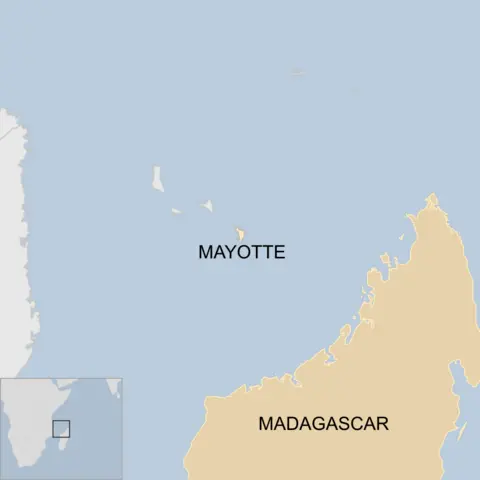
The search for survivors in Mayotte, a French island territory in the Indian Ocean, continued on Sunday after it was hit by a powerful cyclone.
Rescue workers are still attempting to reach some communities and it is feared the eventual death toll could stretch into the thousands once the damage is fully assessed.
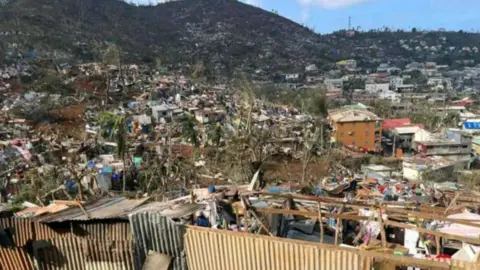
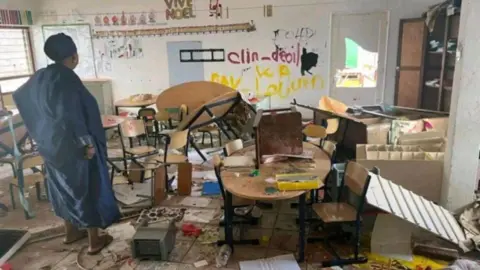
Entire settlements were flattened when Cyclone Chido brought wind speeds of more than 225km/h (140mph), with the poorest living in makeshift shelters particularly hard hit.
Some of Mayotte’s population of 320,000 have said they are struggling with severe shortages of food, water and shelter.
One resident of the capital city, Mamoudzou, waiting in line for supplies said: “We’ve had no water for three days now, so it’s starting to be a lot.
“We’re trying to get the bare minimum to live on, because we don’t know when the water will come back.”
Mohamed Ishmael, another Mamoudzou resident, told Reuters news agency the situation there was “a tragedy” and said: “You feel like you are in the aftermath of a nuclear war… I saw an entire neighbourhood disappear.”
Getty Images
Images emerging from Mayotte have revealed widespread devastation
Another said they had used a nearby school for shelter, adding: “We can still take refuge with our neighbours, and we’re still sticking together and being cautious. We need everyone to hold hands.”
Mayotte’s impoverished communities, including undocumented migrants who have travelled to the French territory in an effort to claim asylum, are thought to have been particularly hard hit due to the vulnerable nature of their housing
Its population is heavily dependent on French financial aid and has long struggled with poverty, unemployment and political instability.
About 75% of the population lives below the national poverty line and unemployment hovers at around one in three.
French President Emmanuel Macron said his thoughts are with “our compatriots in Mayotte, who have gone through the most horrific few hours and who have, for some, lost everything, lost their lives”.
While some French aid and rescue workers have reached Mayotte, efforts to get to some communities are still under way.
Getty Images
Francois-Xavier Bieuville, the island’s prefect, told local media the death toll could rise significantly once the damage is fully assessed. He warned it will “definitely be several hundred” and could reach the thousands.
French Interior Minister Bruno Retailleau, who is scheduled to visit the island, acknowledged the “exceptional severity” of the cyclone and assured that efforts to assist the population are being ramped up.
Cyclone Chido also brought strong winds and heavy rainfall to Mozambique, making landfall early Sunday about 25 miles (40.2km) south of the northern city of Pemba, according to weather services.
The cyclone caused structural damage and power outages in the northern coastal provinces of Nampula and Cabo Delgado on Saturday morning, authorities reported.
Guy Taylor, a spokesperson for aid agency Unicef in Mozambique, said “we were hit very hard in the early hours of this morning”.
“Many houses were destroyed or seriously damaged, and healthcare facilities and schools are out of action,” he added.
Mr Taylor said Unicef is concerned about “loss of access to critical services”, including medical treatment, clean water and sanitation, and also “the spread of diseases like cholera and malaria”.
The auto component aftermarket grew by 5 per cent due to an increase in used vehicle parc and formalisation of the repair and maintenance market, according to the findings of the Automotive Component Manufacturers Association of India (ACMA).
The aftermarket in the first half (H1) of the financial year (FY) 2024 stood at Rs 45,158 crore (USD 5.5 billion) which grew to Rs 47,416 crore (USD 5.7 billion) in one year, with 5 per cent of the increase.”Auto Component Industry growth over last 10 years driven by robust domestic vehicles sales, strong aftermarket and increasing exports,” the ACMA added.
The aftermarket refers to the secondary market that deals with the parts, accessories, and services related to vehicles after they have been sold by the original equipment manufacturer (OEM).
As per the industry body that represents the manufacturers in the Indian auto component industry, the auto component supply to OEMs in H1 FY 2025 stood at Rs 2.83 lakh crore, with a rise of 11.2 per cent.
The ACMA report added that the USA has emerged as the key destination for exports while China is a key source of imports for the Indian automobile players.
The share of Indian exports to the USA stands at 28 per cent, followed by Germany (8 per cent) Turkey (5 per cent) Brazil (4 per cent), and countries such as UK, Italy, Bangladesh, Thailand, Mexico, and UAE with 3 per cent of export.China accounts for 28 per cent of imports in India, followed by Germany, Japan, S Korea, USA, Thailand, Singapore, Italy, UK and Indonesia.
The exports, in the H1FY25, grew by 7 per cent while imports by 4 per cent; a trade surplus of USD 150 million. The finding stated that customers have started to move towards larger and more powerful vehicles across all segments, exhibiting a shift in preference.UVs (Utility Vehicles) in the Passenger Vehicle (PV) category grew by 13 per cent, with UV1 models (length 4000 to 4400 mm, priced under 20 Lakhs) showing a 25 per cent growth.
Sales of motorcycles with engine capacities between 350cc and 500cc increased by around 74 per cent. Overall EV sales rose by 22 per cent in H1 FY25 compared to the previous year, with electric two-wheelers (e2W) growing 26 per cent, but electric passenger vehicle (e-PV) sales declined by 19 per cent. The industry saw a 7 per cent growth in exports, contributing to a USD 150 million trade surplus.
The auto components sector continued to deliver higher value-added products. These growth percentages are based on Rupee values, and the cost of Li-ion batteries is excluded from component consumption calculations for EVs.
Move comes days after rebel groups toppled Syrian leader Bashar al-Assad, weeks before Donald Trump becomes US president again.
Israel’s government has approved a plan to increase the number of settlers in the illegally occupied Golan Heights, days after seizing more Syrian territory following the toppling of Syria’s longtime leader Bashar al-Assad.
Israeli Prime Minister Benjamin Netanyahu’s office said the government had “unanimously approved” the “demographic development” of the occupied territory, which would seek to double the Israeli population there.
The new plan is only for the portion of the Golan Heights that Israel has occupied since 1967. In 1981, Israel’s Knesset moved to impose Israeli law over the territory, in an effective annexation.
The plan does not relate to the portion of Syrian land seized by Israel in the wake of al-Assad’s toppling a week ago. The seized area, which had been demilitarised as part of an agreement reached after the 1973 war, also includes Mount Hermon overlooking the Syrian capital Damascus.
In a statement, Netanyahu praised the plan, which provides more than 40 million shekels ($11m) to increase the settler population.
There are about 31,000 Israeli settlers spread across dozens of illegal settlements in the Golan Heights already. They live alongside minority groups, including the Druze, who predominantly identify as Syrian.
“Strengthening the Golan is strengthening the State of Israel, and it is especially important at this time,” Netanyahu said. “We will continue to hold onto it, cause it to blossom, and settle in it.”
Reporting from Amman, Jordan, Al Jazeera’s Nour Odeh said the approval comes at what Israel views as an “opportune moment”.
While Israeli occupation of the Golan Heights is illegal under international law, during his first term in office, from 2017 to 2021, US President-elect Donald Trump made the United States the first country in the world to officially recognise Israeli sovereignty over the area.
Trump is set to retake office again on January 20 after winning the US presidential election in November.
“Netanyahu is using this moment to announce more settlement activity in order to entrench that occupation and make it permanent,” Odeh said. “Much like he’s doing in the occupied West Bank: land grab, settlements, permanent occupation.”
Meanwhile, Netanyahu’s office said he had discussed the situation in Syria during a phone call with Trump on Saturday. He also discussed efforts to reach a ceasefire agreement in Gaza.
Despite Israel launching hundreds of strikes on Syrian sites since opposition groups led by Hayat Tahrir al-Sham (HTS) overthrew al-Assad and moved to create a transitional government, Netanyahu said: “We have no interest in conflict with Syria.”
He said the attacks were to “thwart the potential threats from Syria and to prevent the takeover of terrorist elements near our border”.
On Sunday, Saudi Arabia was among the first to condemn Israel’s new plan to increase the number of settlers, while accusing Israeli leaders of seeking to sabotage Syria’s fledgling transition.