Tuesday, September 29, 2026
Home Blog Page 7054

Stock market today: BSE Sensex opens over 200 points down; Nifty50 below 24,500

0
Stock market today: BSE Sensex opens over 200 points down; Nifty50 below 24,500


Stock market today: BSE Sensex opens over 200 points down; Nifty50 below 24,500
The technical view suggests continued sideways movement in Nifty. (AI image)

Stock market today: Indian equity benchmark indices, BSE Sensex and Nifty50, opened in red on Friday. While BSE Sensex was below 81,100, Nifty50 was near 24,500. At 9:17 AM, BSE Sensex was trading at 81,080.00, down 210 points or 0.26%. Nifty50 was at 24,489.45, down 59 points or 0.24%.
On Thursday, domestic markets experienced downward pressure throughout the session, closing near the day’s lowest point. The broader markets ended their 14-day positive streak. Markets are expected to respond to the inflation data of 5.48% today.
“We expect markets to trade in a range with a positive bias, on the back of easing retail inflation and favourable global cues,” said Siddhartha Khemka, Head – Research, Wealth Management, Motilal Oswal.
“We anticipate the consolidation phase to conclude soon, with the Nifty likely to surpass the 24,800 resistance level. While sectoral participation remains selective, the banking and IT sectors are expected to play a pivotal role in driving the next leg of the rally,” said Ajit Mishra – SVP, Research, Religare Broking.
The technical view suggests continued sideways movement in Nifty, with support at 24,470 and resistance at 24,650-24,700. India VIX decreased by 0.58% to 13.19.
US markets declined as investors assessed economic indicators before next week’s Federal Reserve meeting. Asian markets showed weakness, with Japanese and Australian shares declining. The F&O ban list includes Granules, Manappuram, Metropolis, PVR Inox, RBL Bank, and Hindustan Copper.
FIIs became net sellers at Rs 3,560 crore while DIIs purchased shares worth Rs 2,646 crore. FII net short position increased from Rs 47,768 crore to Rs 68,081 crore.


Green fades to grim in Telangana

0
Green fades to grim in Telangana


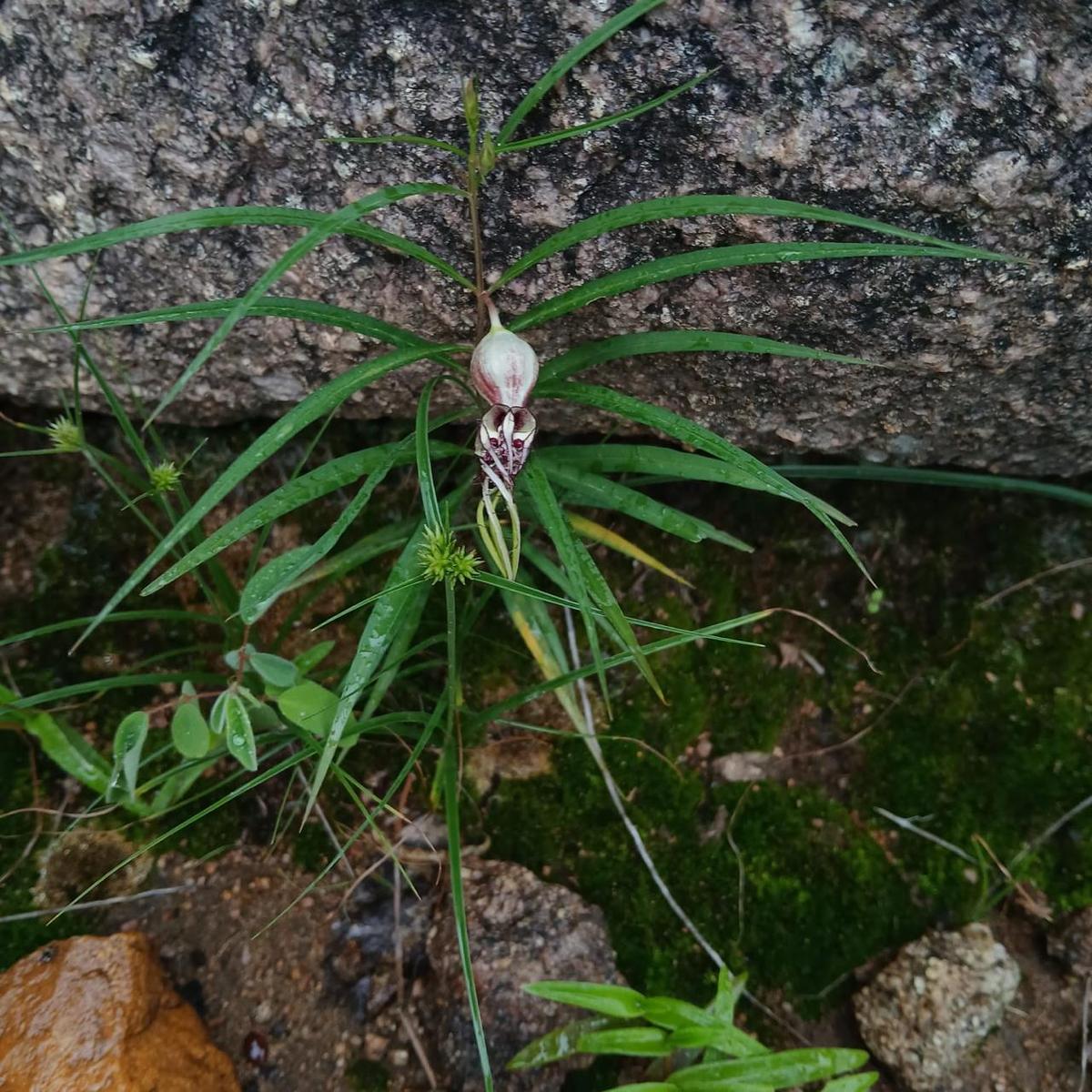
On August 7 this year, Aparna Sankaran, an M.Sc. student at the University of Hyderabad (UoH), sighted what many botanists consider lucky and rare to find — a 20-centimetre highly specialised deceptive slender herb, bearing flower right in the backyard of her School of Life Sciences during a field exercise. A cheater plant, endemic to the peninsular Indian plateau, it has a unique pollination strategy and is studied as one of evolution’s marvels.

Its floral scents mimic pheromones of potential food or sex to lure kleptoparasites like bees and flies, trapping them for up to 24 hours to collect pollen. “However, there is no pollinator’s reward, such as nectar, but a major loss of fitness for flies when they are freed, and most of them starve to death,” explains Annemarie Heiduk, pollinator biologist at University of KwaZulu-Natal, South Africa, in the internationally popular ‘In Defense of Plants’ podcast.

For Aparna and her mentor Siddharthan Surveswaran, spotting this elusive plant was a moment of sheer excitement. “Sir said it was Ceropegia spiralis; his favourite plant. He had been looking for it for years,” recollects Aparna.

The elusive Ceropegia spiralis sighted by M.Sc student Aparna Sankaran on August 7 in University of Hyderabad.

The elusive Ceropegia spiralis sighted by M.Sc student Aparna Sankaran on August 7 in University of Hyderabad.
| Photo Credit:
By Arrangement

Heiduk studied 14 species of Ceropegia. The plant is recorded as vulnerable, according to Red Data Book of Indian Plants, published by Botanical Survey of India (BSI) in 1988.

Two months later, when Aparna returned to the site, she could not find the Ceropegia — one of the hundreds of endemic herbaceous (non-woody plants), geophytes (plants with underground storage organs like bulb, tuber and rhizome) and grass species. Its home, a thriving grassland ecosystem in the south of the 1800-acre walled university campus, was gone too. Excavators had razed the area, replacing the swampy, blooming ecosystem with a barren, dry landscape. “It looked like a house that had been robbed — messy and shattered,” she recalls.

While grasslands globally face threats from agriculture, urbanisation and industrialisation, the culprit at the UoH is Miyawaki tree plantations, promoted as ‘biodiversity’ initiatives. The university permitted the Urban Forestry Wing of the Hyderabad Metropolitan Development Authority (HMDA) to plant trees in its open spaces, despite experts warning of irreversible damage to native habitats.

Heartbroken, Aparna wrote to newspaper editors on November 9 about the death of her natural lab, but did not receive any response. She even drafted a student petition but semester exams came in the way of action. But Surveswaran emerged as a vocal critic of the university administration and HMDA.

Grassland ecosystem

On October 29, he sent an e-mail titled ‘An urgent appeal to stop destruction of biodiversity on the campus’ to 16 university heads, including Vice-Chancellor B.J. Rao, Registrar Devesh Nigam and the Internal Quality Assurance Cell (IQAC).

The detailed appeal included the campus biodiversity profile, elevation map, journal articles, and photographs: “The university campus holds the last refuge of some endemic and ecologically important plants native to Telangana. Is there an alternative, something like pausing it and discussing this project, weighing the pros and cons of this insane destruction of the wetland ecosystem? This is not a lonely voice, I am sure.”

The mail was circulated to some media outlets by one of its recipients a week later, but failed to gain attention.

Newly-planted saplings in the south campus of University of Hyderabad. The area was a swampy grassland until September, when the HMDA razed it for the proposed Miyawaki forest plantation; nursery polybags line the path in the south campus of UoH as planting operations continue at a brisk pace; and plantation workers saplings take a break in the south campus.

Newly-planted saplings in the south campus of University of Hyderabad. The area was a swampy grassland until September, when the HMDA razed it for the proposed Miyawaki forest plantation; nursery polybags line the path in the south campus of UoH as planting operations continue at a brisk pace; and plantation workers saplings take a break in the south campus.
| Photo Credit:
G. RAMAKRISHNA

Tropical grasslands, or savannas, are vegetation dominated by grasses with scattered trees, unlike forests. Telangana, part of the Deccan Plateau, hosts 273 grass species, as recorded by the Botanical Survey of India between 2017 and 2022, with UoH representing the region’s rich biodiversity.

Researchers Jayashree Ratnam of the National Centre for Biological Sciences, Abi T Vanak of the Ashoka Trust for Research in Ecology & Environment, and Tarsh Thekaekara of the Dakshin Foundation, highlight the neglect of Indian savannas in conservation, overshadowed by forests due to colonial forestry’s focus on timber and a misconception that grasslands lack endemism.

But a 2021 study led by Ashish N Nerlekar of Texas A&M University, along with 11 other researchers from across the country, found “exponential rise in the endemic plant discovery”: 206 endemic plant species of which 43% were described in the last two decades, counter the assumption that Indian savannas support no endemic plants. Of them, the most (88) were found in undivided Andhra Pradesh. And in the UoH perspective, “the older the ecosystem has for plant community assembly, the more it is likely to contain endemic species”.

Researcher Vanak, along with J.W. Veldman (Texas A&M University) and Brazil-based Fernando Ao Silveira, emphasises that tree plantations harm savanna ecosystems. They argue savannas naturally have low tree density, a narrative grossly missing in policies that prioritise afforestation. Colonial-era policies valuing trees over herbs have led to the conversion of thousands of acres of Indian savannas into plantations under the guise of conservation.

The Wasteland Atlas of India, 2019, by the Department of Land Resources, states that 119 sq.km wastelands became non-wastelands and 496 sq.km non-wastelands became wastelands, an increase by 377 sq.km in Telangana. It also declares 17% of India’s geographical area as wasteland.

First coined by the British, the term ‘wastelands’ was defined in 1985 by the National Wasteland Development Board as “degraded land, which can be brought under vegetative cover, with reasonable effort, and which is currently underutilised and (that) land which is deteriorating for lack of appropriate water and soil management or on account of natural causes.”

The Surveswaran-Seshagirirao effect

Surveswaran (48), a Ph.D graduate from The University of Hong Kong and former conservation officer there, joined UoH in 2022 after a stint at Christ University, Bengaluru. With 38 publications, his work reflects a deep interest in Ceropegia species, which he has studied since 2009.

Associate Professor in the Plant Science department, he is the only botanist in the university who is focused on plants as entities rather than their molecular or cellular aspects, apart from the Horticulture department that handles and maintains plants for aesthetic purposes.

Surveswaran is seen as filling the shoes of the late K. Seshagirirao, a UoH botany doyen who cataloged its flora. Seshagirirao identified 724 flowering species on the campus by 2002, cited in his widely referenced ‘University of Hyderabad Flora’. However, his online database has expired, and only partial documentation from his M.Phil disseration work in 1986 remains in the university library.

The unofficial blog site of former Vice-Chancellor Ramakrishna Ramaswamy in 2011 describes Seshagirirao as ‘BioDiplomat-Seshagiriravu’, where he wrote about his 2003 list of 734 flowering plant species at UoH, including several threatened taxa under International Union for Conservation of Nature. “It is interesting to note that the number of recorded species from the campus is higher than the numbers recorded in entire districts in Andhra Pradesh: Ranga Reddy (694), Medak (704), Adilabad (673), and Nalgonda (506),” Seshagirirao had written.

Following Seshagirirao’s death in 2017, his herbarium specimens (plants dried, pressed and preserved for future reference) were reportedly discarded. “We didn’t find a single sheet,” says Sushant Kumar, a doctoral student. “But Surveswaran sir is rebuilding the project from scratch, in three samples of each specimen — one to preserve at UoH, the second at BSI, Telangana, and the third in an institute in another State. But much of the ecosystem was destroyed even before it could be catalogued,” adds Kumar, sharing a list of the 115 plant species identified since 2022.

Seshagirirao’s contribution went beyond identifying 734 species. The New York Botanical Garden’s Index Herbariorum, where 396 million botanical specimens are housed, lists UoH under code UH with 3,762 specimens collected by him and two others.

Ramaswamy’s blog lauding the biodiversity efforts of Sudhakar Marathe, then head of English and dean of Humanities, through his macro photography and Nature Club activities, also leads to a comment by Appa Rao Podile, professor in the Plant Science department. He mentioned a proposal was sent to the University Grants Commission XI plan committee for using scientific methods to allow the UoH to preserve, showcase and educate the public on the importance of plant biodiversity. But “unfortunately, other requirements got priority over this apparently ‘insignificant proposal’ that was developed as an outreach activity”.

In 2016, a year after Appa Rao became Vice-Chancellor, UoH collaborated with HMDA and Confederation of Real Estate Developers’ Association of India (CREDAI) to plant over one lakh saplings across 250 acres in half a day as part of the Telangana Ku Haritha Haram afforestation programme, according to the university news portal.

It was also during his tenure that UoH was accorded the ‘Institute of Eminence’ (IoE) status in 2019, promoting the tagline ‘National needs, global standards’. IoE, according to the UGC, aims to transform higher education institutions into world-class teaching and research hubs with 19 strict benchmarks, including global rankings, merit-based admissions and reputed publications.

Plantation efforts in 2016 and 2017 were not as smooth, show reports. On December 3 this year, alumnus Ravi Jillapalli marked the seventh anniversary of the ‘4th deforestation in two-year period at UoH’ with a Facebook post featuring 34 images of land cleared for plantation, resembling the current scenario.

“This is rogue activity in the name of biodiversity. What is the need for plantation, by uprooting old ones or clearing grasslands, in a naturally occurring habitat like UoH? I suspect there is huge money involved,” says Ravi, now a research associate at Northwestern University, Chicago.

A doctoral student in Animal Biology back then, Ravi is remembered as “an aggressive campaigner for campus flora and fauna, who even caught hold of poachers and objected to plantation drives.” He ran a group called ‘Wild Lens’.

The only ones

The GIS elevation map in the e-mail shows the south and southwest UoH campuses at a low of 555 metres and the east at a high of 630 metres. The open habitat features seasonal pools, aquatic flora and fauna, and a vibrant succession of plants — pink Parasopubia, blue and violet Exacum or spiky blue devils, chocolate lilies, and yellow and snowy whites — captured vividly in photos and videos.

“These tiny ones live in succession with much of their activity underground. They are resilient and clever in making the best of the conditions, which also makes their identification difficult and time-taking. Their only goal in life is to grow, flower or fruit, seed set, die, and the cycle repeats,” says Kobita Dass Kolli, an independent researcher in her fifth year of documenting floral species of Hyderabad.

Kolli is a former UoH plant science student and labmate of Seshagirirao in 1985. Her organisation ‘Nature Lovers of Hyderabad’, with team members Tejah Balanthrapu and Sadhana Ramchander, appealed to current V-C B.J. Rao to halt the plantation drive.

“The current ecosystem provides water catchment, water purification, carbon and nitrogen fixation, pollination services, aesthetic value, invaluable diversity and above all they are the living heritage of Telangana,” it reads. Their November 13 appeal remains unacknowledged.

Associate Professor Joby Joseph, from the UoH’s Centre for Neural and Cognitive Sciences, supports Surveswaran’s cause. His Nikon Zf mirrorless camera with a 600 mm lens placed horizontally on his table, like a machine gun on a tripod, and Deep Learning by Ian Goodfellow, a textbook on machine learning, tell his to-do things at 11 a.m.

“Nobody will be convinced if you say grasslands are destroyed and birds won’t come. You should say deer won’t get its food, they all will die; you should talk to a deer ecologist,” he jokes, seated in his worn chair, beard framing his grin.

On eBird, the global bird observation platform managed by Cornell Lab of Ornithology, UoH is a hotspot with 233 species recorded since September 1989. Among 91 birders, Joseph ranks first, having documented 198 species.

But now, Joseph is worried. Shrinking grasslands on campus mean losing birds like the Booted Eagle, Brown Shrike, Painted Sandgrouse, Grey Francolin, and 30 others he loves to photograph and showcase during campus bird walks.

Scrub and grassland birds as documented by Joby Joseph, professor in the Centre for Neural and Cognitive Sciences, UoH.

Every year, photos taken by students and teachers of grasses concealing spotted deer, strolling peafowl, or vibrant flora adorn UoH’s New Year calendars. Now, those once-thriving expanses, dug up like graves, resemble barren egg trays, with its erstwhile natives found in the corner as debris.

The last man standing

The university administration responded to queries about land use, sapling targets, review processes and grassland destruction, stating: “The UoH would like to clarify that no trees were uprooted. This is false information. Every year the GHMC undertakes plantation on campus after their experts clear the same. This year also GHMC has undertaken the plantation of indigenous species without destruction to the grasslands.”

However, an HMDA official clarified they are using the Miyawaki method — a dense Japanese plantation technique — to create a fast-growing green belt. With 4,000 saplings per acre (or 4,046 sq.metres), over 30,000 saplings have been planted as of December first week.

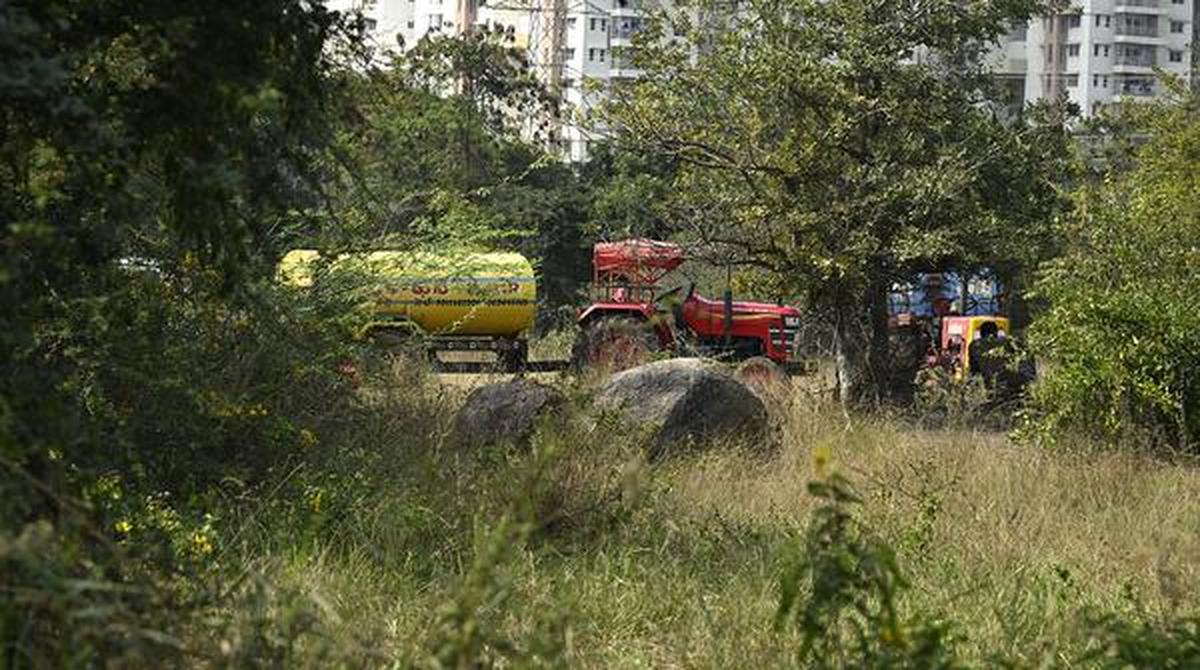
Field visits reveal plantation areas extend beyond the south campus, with trucks carrying bamboo sticks and saplings arriving even past the campus dumping yard.

Interaction with this official also indicated that the university did not conduct an internal consultation before granting permission. The development, as per the minutes, was also not mentioned in the biannual IQAC meetings, “for promoting quality in academics, research & administration” held on March 12 and November 1 this year. “We are doing this with the university’s consent; their botany head said OK. We can stop if they say no; it’s only based on their utility,” says the official, requesting anonymity, adding that there is no target number of saplings, but “open spaces” can be used.

The permission letter for the plantation, dated September 11, features two signatures, in red and green ink. The latter one approves, “Pl. put up”. The letter, opening with the subject ‘request to take up plantation drive’ has ‘request’ and ‘appreciate’ two more times, and appears more like an invitation.

Surveswaran, characteristically surrounded by posters of phylogeny, his two laptops and a steel water bottle, refuses to comment on the goings-on or his crucial mail. “Unplanned Miyawaki plantations might prove successful in a short run, but in the long run, they would wipe out the native plant biodiversity of Telangana region, and it might impact not only plants but insects, birds, reptiles and mammals,” he says, after much persuasion.

In his room, a glass window faces east, with blinds raised to let in sunlight. On the sill, a jade plant in a gold pot and two repurposed plastic bottles serve as planters. “That’s Ceropegia spiralis. I picked it in Maharashtra,” he says, adjusting his glasses.

(Student names have been changed to protect their identity)


The inherent irony of Section 69 of the Indian Judicial Code

0
The inherent irony of Section 69 of the Indian Judicial Code


On July 31, a 25-year-old woman resident of Ramgarh, Jharkhand lodged an FIR alleging A man had sexual relations with her on the pretext of marriage. The woman claimed in her FIR that the 26-year-old man, whom she knew from college, visited her home several times and expressed his desire to marry her. In one instance, he reportedly explicitly told her mother not to consider any marriage proposals for him, as he wanted to marry her himself.

The woman said in her First Information Report (FIR)She was introduced to his mother, who reportedly supported their union. She claimed that the man and his mother “went back on their commitments”. So she was filing the case under section 69 of the Indian Penal Code (BNS), the new set of criminal laws that replaced the colonial-era Indian Penal Code (IPC). While the case is still pending, the man was granted bail by a local court in October.

Section 69 of the BNS criminalizes “sexual intercourse by fraudulent means” and “a promise to marry a woman, which there is no intention of fulfiling” as grounds for the possibility of imprisonment up to 10 years and a fine. Quoted in. Although this is not considered rape, it is considered “inducement” and also applies to “false promise of employment or promotion, or marriage by concealing identity”.

There are many cases in the court that use Section 69 in their FIRs, thereby opening the doors to public and legal discussion. On December 5, the Gauhati High Court granted bail to a man arrested after a woman claimed that she and the man were in a relationship for nine years, during which period, they regularly had physical relations. . The man reportedly also promised to marry her. However, she learns that he is engaged to other women. When she asked for clarification, the man allegedly cited parental pressure to marry the woman.

“It is the settled position of law that a simple promise to marry without anything additional does not give rise to the concept of misrepresentation of fact. Therefore, in the given circumstances, the petitioner is not entitled to be kept in custody,” the high court said.

codified based on past experience

Advocate KS Nanda says, before the enactment of BNS, such cases were punishable under Section 376(2)(n) (repeated rape of the same woman) as well as Section 90 (consent given under fear or misconception). Were recorded under. Who had represented the accused person in the Jharkhand case.

Ravi Kant, lawyer and country head of the Access to Justice Project, A global network that works against child exploitationExplains the differences between the previous law under the IPC and the new provision in the BNS. “This is a new offense because they have used words like ‘fraudulent means’, ‘inducement’, ‘false promise’. This is not rape,” he clarifies.

Section 69 falls under Chapter 5 of the BNS: ‘Offences against Women and Children’, under “Sexual Offences”. Kant says that this section was needed because during the time of IPC, such cases were very much reported in the courts.

Another difference is that earlier, if a relationship lasted for several years, and the woman claimed that she was duped on the pretext of marriage, the court would usually dismiss such cases, he says. “It was argued that a long-term relationship implies mutual consent and understanding, making it difficult to prove fraud.” Now even if the relationship is consensual, it is considered a crime because it is considered a false promise or deception.

gender biased

Deepika Narayan Bhardwaj, a journalist, filmmaker and activist, calls the new law “inherently gender biased and discriminatory”, saying the law suggests women have no agency in decisions related to sexual matters. On January 10, 2024, he started an online petition on Change.org to repeal Section 69 of the BNS, which has since garnered over 60,000 signatures.

His argument in the petition is that “consensual sexual intercourse on the promise of marriage will be a crime only if the man refuses to do so and not the woman”. The petition also talks about the power equation, where “the law recognizes that a woman cannot be in the power to induce a man to have sex with her by false promise of a job or promotion”. He described the law as “extremely regressive” and also said that it “completely rejects the concept of will and consent” related to sexual matters.

Since Section 69 has been added recently, Bhardwaj uses previous data recorded under Section 376 (rape) for reference and comparison. As of 2015, the National Crime Records Bureau (NCRB) which compiles an annual collection of crimes across India in the category ‘Relationship of perpetrators to rape victims’ under the chapter ‘Crime against women’, accused and survivors in rape cases. Relationships between were broadly classified as ‘family members’, ‘neighbours’ or ‘strangers’. However, the increasing number of cases involving ‘false promise of marriage’ prompted the NCRB to refine its classification.

Since 2016, specific subcategories were introduced under ‘relationship of perpetrators to rape victims’, including ‘friends’, ‘live-in partners under the pretext of marriage’ and ‘separated spouses’. NCRB data shows that, on an average, cases in this category accounted for 39.45% of the total reported rape cases between 2016 and 2022.

NCRB data shows that the average conviction rate across all rape cases between 2016 and 2022 was 29.71%. However, the data do not include sub-categorization of conviction rates under the category ‘relation of perpetrators to rape victims’. This makes it challenging to determine specific sentencing trends for cases involving false promises of marriage or similar charges.

parliamentary report

Report no. Rajya Sabha resolution 246 on BNS, issued by the department-related Parliamentary Standing Committee on Home Affairs on November 12 last year, six months before BNS came into existence, had cautioned against reinforcing gender stereotypes.

“Determining whether a promise to marry has been made can be subjective and challenging to prove,” it said. Intentions may change over time, and it may be difficult to prove that the promise was truly made with the intent to marry.”

It also says that “criminalizing the promise of marriage” could interfere with a person’s right to privacy and autonomy. The report said that “defining a legally binding promise to marry can be vague and open to interpretation” leading to “inconsistencies in enforcement and decisions.” Also, a verbal intention to marry can be a challenge when it comes to collecting evidence.

Different court views

On November 26, the Supreme Court flagged a “worrying trend” of criminalizing long-term consensual relationships after they turn sour. Justices BV Nagarathna and N. “If physical relations at such a late stage are equated with criminality, it can have serious consequences,” a bench of Justice Kotiswar Singh said while quashing an FIR against a man accused of rape. A woman who, according to her, was in a relationship with him for more than nine years.

In another judgment, the Gujarat High Court had on September 19 this year remarked that, “In every case where a man fails to marry a woman despite a promise made to her, (he) will be held liable for the offense of rape. Cannot be held guilty.”

The high court’s decision came while quashing a rape FIR registered in February 2019 against a man who had physical relations with a woman on the promise of marriage. The cases registered before the implementation of BNS are being tried under the old IPC only. The woman alleged in her FIR complaint that she became pregnant and when she told the man about it, he went back on his promise.

During the pendency of the case, a child was born. However, when the DNA samples of the accused and the child were tested, it was proved that the accused was not his biological father. Meanwhile, the woman married another man and did not appear in the court proceedings again.

“He can be held guilty only if it is proved that the promise of marriage was not made with the intention of honoring it and that was the only reason due to which the woman agreed to have sexual relations,” the high court said. It said, ‘The cases of consensual sexual relations later being converted into allegations of rape are increasing rapidly.’

On the other hand, in a separate case, the Kerala High Court in October this year refused to quash the criminal proceedings against a priest accused of raping a woman after she promised to marry him. Rejecting Pujari’s plea, the High Court said that prima facie, allegations have been made out requiring trial of the case and in such a case, there is no reason to close the proceedings earlier.

Supporting the new law, advocate Gaurav Dudeja, partner, law firm Phoenix Legal, says, “Section 69 of the BNS fills the gaps and ambiguities in the previous law relating to sexual relations obtained under false pretenses, such as promise of marriage or other fraudulent means. Addresses. ,

“The definition of rape revolves around the ‘consent’ of the woman, and courts have consistently held that sexual intercourse based on a false promise of marriage, where there was no real intention to begin with, amounts to rape. By invoking Section 69, BNS clearly criminalizes such acts and provides clear penalties for them,” he explains.

This law is protective of women who work in a male-dominated, patriarchal society, where marriage is seen as a way for women to achieve personhood. Many women are constantly told throughout their childhood years that they belong in another home – the home of their husbands and in-laws.

Dudeja says the law broadens the legal framework by introducing the concept of sexual intercourse by fraudulent means. “Furthermore, it recognizes that coercion is not limited to physical force, but can also be psychological or emotional – an aspect that has not been explicitly addressed under earlier legislation.”

PIL in Kerala HC

In September this year, a public interest litigation (PIL) was filed before the Kerala High Court challenging the constitutional validity of Section 69 of the BNS. “This section is derogatory and misogynistic to the extent that it treats women as naïve, gullible and incapable of taking decisions related to their lives,” the plea by a lawyer practicing in Kerala courts said. The petition also argues that the section will create “serious problems for people in live-in relationships and people in relationships in the nature of marriage”.

The petition further argued that “By not including the LGBTQ community, it is a violation of the Equal Protection Clause. Moreover it punishes a very basic human sentiment, the right to have sex, which is an aspect protected under Article 21 of the Constitution. The High Court had sought a reply from the Central Government on this issue.


India’s Retail Inflation Drops To 5.48% In November From 6.21% In October | Economy News

0
India’s Retail Inflation Drops To 5.48% In November From 6.21% In October | Economy News


New Delhi: India’s retail inflation has declined to 5.48 per cent in November as compared to 6.21 per cent in October, as per the latest government data released on Thursday. This decline is primarily attributed to a drop in food prices, particularly vegetables which have helped reduce the overall inflation rate. This cooling of prices provides some relief to consumers who have been facing higher costs in recent months.

According to the Consumer Price Index (CPI) data from the National Statistics Office (NSO), inflation in the food basket dropped to 9.04 per cent in November, down from 10.87 per cent in October. However, it was slightly higher compared to 8.70 per cent in November 2023.

The NSO stated, “During the month of November 2024, a significant decline in inflation is observed in vegetables, pulses and products, sugar and confectionery, fruits, eggs, milk and products, spices, transport and communication, and personal care and effects subgroups.”

CPI-based headline inflation rose from an average of 3.6 per cent in July-August to 5.5 per cent in September, and further increased to 6.2 per cent in October 2024, marking the highest level in over a year since September 2023.

Last week, the Reserve Bank revised its inflation forecast for the current fiscal year, raising it to 4.8 per cent from the previous estimate of 4.5 per cent. It also highlighted that persistent food price pressures are expected to keep overall inflation high in the December quarter. CPI-based headline inflation rose from an average of 3.6 per cent in July-August to 5.5 per cent in September, and further climbed to 6.2 per cent in October 2024. (With PTI Inputs)


US watchdog cites FBI missteps but avoids blame in report on January 6 riot | Donald Trump News

0
US watchdog cites FBI missteps but avoids blame in report on January 6 riot | Donald Trump News


The United States Department of Justice has issued a report into the intelligence gathered in the lead-up to the 2021 attack on the US Capitol — and whether that evidence was properly handled to prevent violence.

Thursday’s 88-page report, issued by the office of Inspector General Michael Horowitz, zoomed in on the work of the Federal Bureau of Investigation (FBI), one of the US’s foremost domestic intelligence agencies.

It concluded that the FBI had behaved “effectively” ahead of the attack on January 6, 2021, which sought to disrupt the certification of the 2020 election.

“Despite playing only a supporting role in preparing for and responding to the events of January 6, the FBI recognized the potential for violence and took significant and appropriate steps to prepare for this supporting role,” the inspector general’s office explained.

But, it added, the FBI could have gone further to identify intelligence about potential threats, including by canvassing its field offices for materials, as it does before major events like the Super Bowl.

An uncertain future

The FBI, however, has long come under scrutiny for its actions in the lead-up to the January 6 attack.

And the agency’s future is now in question, as its longtime director, Christopher Wray, prepares to step down after more than seven years at the helm.

Incoming President Donald Trump has long taken an adversarial approach to the bureau, which he has described as part of a “deep state” system designed to undercut his authority.

His nominee to lead the FBI, former prosecutor Kash Patel, has floated shuttering the agency’s headquarters in Washington, DC, and significantly reducing its operations.

The report centres on the events of January 6, when Trump, the outgoing president at the time, held a rally near the White House calling on supporters to “stop the steal” of the 2020 election.

He claimed — falsely — that his defeat in the 2020 race was the result of widespread voter fraud.

In the hours afterwards, pro-Trump protesters moved from the Ellipse, a round park south of the White House, to the US Capitol, where members of Congress inside were certifying the election results.

Rioters assaulted law enforcement officers and broke into the Capitol building, some chanting slogans like “Hang Mike Pence”, Trump’s then-vice president. Congress members were evacuated, and one protester was shot and killed as she tried to enter a room through a broken window.

Other deaths have also been linked to the attack. Some protesters suffered medical emergencies during the riot, while several law enforcement officers reportedly killed themselves in the aftermath.

Criticisms and conspiracy theories

What role the FBI played in the lead-up to those events has been the subject of bipartisan scrutiny in the years since.

A June 2023 report from the Senate Homeland Security and Government Affairs Committee took the stance that the January 6 attack was “planned in plain sight”.

It blamed both the FBI and the Department of Homeland Security (DHS) for “intelligence failures” that allowed the attack to unfurl.

“The intelligence failures in the lead-up to January 6th were not failures to obtain intelligence indicating the potential for violence,” that 2023 report argued.

Rather, it accused the FBI and DHS of failing “to fully and accurately assess the severity of the threat” based on the tips they received.

The report added that both agencies had a duty to issue guidance “with sufficient urgency and alarm to enable” law enforcement “to prepare for the violence that ultimately occurred on January 6th”.

Meanwhile, far-right conspiracy theorists have claimed FBI agents helped spur the violence on January 6, to unfairly smear Trump supporters.

Thursday’s report refutes that. No undercover FBI agents were at the protest, the report says.

While there were 26 confidential informants in Washington, DC, for the events of January 6, only three were at the Capitol, according to the report. It specifies they were tasked with observing “specific domestic terrorism case subjects”, nothing more.

“None of these FBI CHSs [confidential human sources] was authorized by the FBI to enter the Capitol or a restricted area or to otherwise break the law on January 6,” the report explained.

“Nor was any CHS directed by the FBI to encourage others to commit illegal acts on January 6.”

This week’s report also emphasises that the FBI was charged with only a “supporting role” in preparing for the events of January 6.

Rather, it said, law enforcement agencies like the US Capitol Police and the Metropolitan Police Department “were generally responsible for security operations, crowd control, and visitor protection in advance of protests and other demonstrations in and around the Capitol”.


Indian students travel around the world for higher studies

0
Indian students travel around the world for higher studies


In the early 2000s, as the IT industry boomed in Bengaluru, it also set a trend for engineering students to go abroad for higher studies, primarily to the United States and Canada. Gradually, as the decades passed, the United Kingdom and Australia also emerged as top countries for higher education, as non-engineering students in streams like pure science, marketing and management also took flight.

As the years passed, students’ preferences changed – from their choice of destination to the subjects they chose. These decisions were also influenced by geopolitical tensions, visa barriers, job availability and financial constraints. Educational consultants have observed that students now prefer non-traditional destinations like Ireland, Germany, smaller European countries, UAE, Uzbekistan, Russia and even China.

According to Ministry of External Affairs data earlier this year, by 2024, about 1.33 million Indian students were expected to pursue higher studies abroad in 101 countries. This figure is a jump from 0.93 million in 2023. While Canada, US, UK and Australia had the highest number of students, followed by Germany, UAE, Russia, Kyrgyzstan, Georgia and Kazakhstan.

“There was a time when in our circle someone went abroad for higher education, it was a big deal and everyone celebrated it. But now, at least one person from every alternative household in Bengaluru goes abroad for education, and sometimes, it is to countries like the Philippines or Ireland, which were not even known for higher education a few years ago. Padmini Vilas said. Retired teacher of the city Mohd.

Why changed the option?

Many educational consultants, as well as educational finance organizations, have observed a 35-40% increase in the number of students from Bengaluru showing interest in new destinations.

Prashant A., Founder, Kuhu EduFintech. “Students are increasingly choosing new locations for various reasons, the most prominent of which is better job prospects,” Bhonsle said.

Supriya M. chose Ireland as her destination after completing her engineering in Bengaluru. “The Irish university admissions process was easy, and when I completed my master’s degree I got a job at a good tech company. I didn’t get such good placement opportunities even in Bengaluru and so I was pleasantly surprised by how smoothly things progressed here,” she said.

With the job market in traditional destinations approaching saturation levels, many students have found that even if they get a job in the US or UK, companies do not want them to move to the UAE, smaller European countries or even back to India. Transfers across countries. This is why destinations like Ireland, Germany, France and Italy, where job opportunities are more available, even in non-STEM courses, are being preferred by students and parents.

“After completing my master’s degree in Bengaluru, I went to the UK for a second master’s degree because I wanted to secure a job there. I worked there for two years after completing my studies. I had to renew my visa in 2025, and I wasn’t happy with my job, so I started looking for other options. But due to the current economic situation there, I could not get a job in my field, and ultimately I decided to come back to India and apply for jobs in other less saturated countries,” says Kaveri (name changed), a health care The worker said. , He said that based on his experience, his younger cousin is now going to study business in Hungary.

education cost

Elaborating on the financial aspect of these decisions, Prashant said, “The cost of education in these emerging locations is significantly lower than existing, popular hubs like the UK and the US. This affordability makes higher education more accessible to a wider range of students.

While a two-year post-graduation course in the US costs around ₹60 lakh to ₹70 lakh, a similar course in France costs ₹45 lakh to ₹50 lakh and in the UAE it costs ₹20 lakh to ₹25 lakh. Is. In the UK, a one-year post-graduation course will cost around ₹25 lakh to ₹30 lakh, while in Ireland it will cost ₹18 lakh to ₹23 lakh.

Geopolitical considerations also play a role, Prashant said. “Many students find the political climate in these new destinations to be more friendly and welcoming than in traditionally popular countries.”

Apart from these reasons, the marks/percentage cut-off in top universities in the US and UK is also a reason for students to choose other destinations. “The top universities out there ask for more than 75% grades in 10thth and 12th Classes, which many don’t have. Therefore, they choose programs that do not have such strict cut-offs. The flip side is that students in these countries also need to pass exams like TOEFL, which proves to be a hurdle for some,” said Farhan Hooda, overseas education consultant.

higher competition

Even though foreign education is expensive and requires a lot of hard work and a complete change in lifestyle, why do students still prefer to go abroad?

Nabiha, a student from Bengaluru, was studying medicine in Ukraine for two years before the war broke out and had to return to India. Today he is in his third year of medical studies in Uzbekistan. When asked why she decided not to continue her studies upon returning to India, her parents said, “If she had wanted to study here, I would have got a seat as a donation because of the tough competition.” Had to pay a huge amount. Instead, he got a seat at a top college in Uzbekistan, which cost much less. Also, every year after leave, he gets a chance to come back here and work in the hospital for a month, which increases his practical knowledge.”

Students who want to study medicine prefer to take admission in universities outside India as they face difficulties in securing seats here due to competition. Countries like Uzbekistan, Philippines and Mauritius are preferred destinations. While Ukraine was also one such destination, now according to education consultants most of the students coming back from there have chosen to go to Uzbekistan, Russia or Malaysia. Samarkand State Medical University in Uzbekistan reportedly admitted 900 Indians this academic year.

For students from other streams, it is about the quality of education and life in other countries. “Many people go abroad because the quality of higher education in India is not good except in the top 10 universities. But even in smaller countries like Cyprus, which is preferred by students of hotel management and other management streams, the universities provide quality education with excellent English-speaking faculty,” Farhan explained.

choice of jobs

Farhan says that job opportunities in smaller countries may not be as promising as in larger countries like France or Germany, but students do not mind.

“We have seen students taking up jobs in housekeeping, driving or even chain restaurants. While Indian parents generally dislike such jobs in India, their children take up such jobs there because they get paid in dollars and pounds and can become self-reliant. Therefore, they complete their education, get ample exposure to the international crowd, take up well-paid jobs and settle in such countries. We rarely see students who go abroad coming back to India,” he said.

Many countries also look for Indian students after seeing the impact of NRIs on traditional study destinations.

“Many, even traditionally non-English speaking countries are starting English language programs to attract Indians because they want the contribution of Indians to their economy. So, we are looking at English language programs in Germany, in Japan, in South Korea,” said Rahul Subramaniam, co-founder of Athena Education, a consultancy.

satellite complex

Satellite campuses of popular American universities are also becoming popular among Indian students. They are usually established in alliance with local universities or independently and provide the same quality education and experience to students.

“Some of these complexes are being built mainly in the Gulf countries. For example, New York University is in Abu Dhabi, and Georgetown University is in Doha. In fact, Duke has a satellite campus, Duke Kunshan, in China,” Rahul said.

Earlier this year, the University Grants Commission had given its approval to the UK’s University of Southampton to set up its satellite campus in Gurugram. Academic programs at this campus are expected to start by July 2025.

multicultural thinking

However, Rahul said that families should get over the rigid mindset, think multiculturally and be more flexible while choosing study destinations. “Part of college admissions is its status. Some people may think that these satellite complexes are not as good as the US, but I beg to differ. I would encourage families to be more flexible as these can provide wonderful possibilities for students’ professional careers,” he commented.


Star luxury property brokers charged with sex trafficking in US

0
Star luxury property brokers charged with sex trafficking in US


Two famous real estate brokers and their brother have been charged with sex trafficking in a case involving the alleged drugging, assaulting and raping of dozens of women over more than a decade.

Prosecutors say Tal and Oren Alexander, who are known for selling high-end properties in New York and Miami, along with their brother Alon, used their wealth to take advantage of women.

The brothers were arrested in Florida on Wednesday and are expected to be taken to New York to face the charges.

A lawyer representing Oren Alexander rejected the accusations. Alon Alexander’s lawyer said her client will be pleading not guilty. Tal Alexander’s representative, Joel Denaro, declined to comment.

“As of today, law enforcement has interviewed dozens of women who reported being forcibly raped or sexually assaulted by at least one of the Alexander brothers,” said Damian Williams, US Attorney for the Southern District of New York, at a press conference in Manhattan.

“This conduct, as alleged, was heinous.”

The prosecutors say the alleged crimes were committed over more than a decade.

The indictment describes a scheme that involved inviting women to parties as well as using the promise of luxury experiences and travel to lure them to locations in the US and abroad where the alleged assaults happened.

It also says they procured drugs and provided them to the women and, at times, “surreptitiously” put them in drinks.

Finally, prosecutors also say that in some instances the brothers “physically restrained and held down their victims during the rapes and sexual assaults and ignored screams and explicit requests to stop”.

Immediately after the assaults, the brothers allegedly provided some of the victims with concert tickets and other luxury items.

The three brothers are being charged with one count each of engaging in a sex trafficking conspiracy, and a second count of sex trafficking by force, fraud, or coercion.

Tal Alexander is also charged with a further count of sex trafficking by force, fraud, or coercion.

“Oren Alexander is innocent,” said his lawyer, Susan Necheles.

“The evidence will show that neither he nor his brothers ever committed a crime.”

Meanwhile, a lawyer representing the women welcomed the indictment.

“We are glad to hear that there will finally be some measure of accountability for the Alexander brothers and justice for their many victims,” said David Gottlieb in a statement posted by his law firm Wigdor LLP on X.

“We applaud all the survivors who have had the strength and courage to speak up about their unimaginable experiences after years of pain and suffering.”

Tal and Oren Alexander have worked for real estate giant Douglas Elliman, listing properties for celebrities including Liam Gallagher, Lindsay Lohan, Kim Kardashian and Kanye West.

In 2022, they started a firm called Official.


Lower tax rate for manufacturing coops, higher cash pay limit: Amit Shah in RS

0
Lower tax rate for manufacturing coops, higher cash pay limit: Amit Shah in RS


Newly set up co-operatives that undertake manufacturing activities will get benefits of a lower tax rate of 15%, as is available to new manufacturing firms, Union minister for home and cooperation Amit Shah has said in a reply in Parliament.

₹2 lakh from any person. (ANI photo)” title=”The Income Tax Act’s section 269 ST prohibits cash receipts of over ₹2 lakh from any person. (ANI photo)” /> The Income Tax Act’s section 269 ST prohibits cash receipts of over <span class=₹2 lakh from any person. (ANI photo)” title=”The Income Tax Act’s section 269 ST prohibits cash receipts of over ₹2 lakh from any person. (ANI photo)” />
The Income Tax Act’s section 269 ST prohibits cash receipts of over ₹2 lakh from any person. (ANI photo)

In a written reply to a question in the Rajya Sabha on Wednesday, Shah also stated that milk cooperatives, the backbone of India’s sprawling dairy sector, can receive cash in excess of ₹2 lakh on bank holidays towards payment of milk price.

The Income Tax Act’s section 269 ST prohibits cash receipts of over ₹2 lakh from any person, via any transaction or multiple transactions in a day for a “single event”, or business exchange. Violations of this limit leads to penalties and may trigger investigations.

Also Read: Amit Shah asks Haryana govt to ensure 100 pc implementation of new criminal laws

Milk cooperatives are now being exempted from this prohibition. “This would enable cooperative societies to make payments to their members, who are mostly from rural and farming communities, on bank holidays without fear of income tax penalty,” Shah said.

Another key exemption for cooperatives relates to loans, Shah stated.

Under section 269 SS of the Income Tax Act, 1961, any deposit or loan advance of more than ₹20,000 in cash is not allowed. Violation can invite a penalty equal to the loan or deposit amount.

Penalties for cash deposits or loan disbursal by primary agricultural cooperatives will not be levied if the “amount of such loan or deposit including their outstanding balance is less than ₹2 lakh. Earlier this limit was ₹20,000 per member”, Shah stated.

Cooperatives are grassroots business enterprises owned jointly by their members, where profits and losses are shared equally. India’s cooperative sector is over a century old and provides livelihood to millions, especially women, in sectors such as dairy, fisheries, finance, housing and agriculture.

Amul, the country’s largest dairy brand, runs on a cooperative model, as does Iffco, the largest fertiliser company. The country also has a large network of cooperative-based urban and rural banks.


India shouldn’t build another LLM: Nandan Nilekani

0
India shouldn’t build another LLM: Nandan Nilekani


India shouldn't build another LLM: Nandan Nilekani

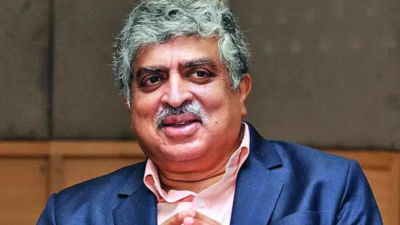
BENGALURU: Nandan Nilekani said he stands by his view that India need not spend resources building another large language model (LLM). He was responding to a question from us on the view expressed recently by Google Research India director Manish Gupta that India will benefit from building a foundation model.
“Foundation models are not the best use of your money. If India has $50 billion to spend, it should use that to build compute, infrastructure, and AI cloud. These are the raw materials and engines of this game,” he said.
Foundation models like the ones that OpenAI and Meta are building often cost billions of dollars because they are being trained on vast amounts of data using very expensive infrastructure.
Nilekani has in the past stressed that India should focus on building use cases for AI on top of the LLMs that are available globally.
Last month, Gupta had said at the Bengaluru Tech Summit that he “respectfully disagreed” with Nilekani’s advice on prioritising use case building over building foundation models around AI. “He is not preaching what he practised. He revolutionised India’s technology landscape by starting with the basics. With Aadhaar, he did not start with use cases, he started with building foundations. We too must, using our constraints as ingredients for innovation,” he said.


Venezuela releases more than 100 people imprisoned after contested election | Nicolas Maduro News

0
Venezuela releases more than 100 people imprisoned after contested election | Nicolas Maduro News


Venezuela’s government has taken steps to release some arrested in post-election crackdown but continues to pressure opposition.

The government of Venezuelan President Nicolas Maduro has released 103 people imprisoned following the country’s contested July election, which the opposition accused Maduro of stealing.

The citizen security service, headed by Minister Diosdado Cabello, announced the prisoner release in a written statement on Thursday.

It explained that Maduro had instructed the government to review “all the cases concerning acts of violence and crimes committed in the framework of the election”.

The 103 prisoners were released during a 72-hour period, from Tuesday through Thursday. The service explained that their release came in addition to “precautionary measures” granted to other detainees on November 26.

Those “precautionary measures” also allowed 225 prisoners to be released but required them to appear before a court once every 30 days, according to the attorney general’s office.

Despite such gestures, the government has refused calls from the opposition and regional leaders to release data that could validate Maduro’s victory.

In the hours after the July 28 election, the Venezuelan electoral authority declared Maduro the winner of a third term, despite pre-election polling that showed him trailing opposition leader Edmundo Gonzalez by a seemingly insurmountable margin.

But critics immediately seized upon the fact that officials in several key areas refused to release the paper voting tallies, a standard part of the election process in Venezuela.

Thousands of protesters flooded the streets in cities like the capital Caracas, and the opposition released data it said showed Gonzalez won handily.

However, both the Venezuelan electoral authority and the country’s supreme court — which critics say are stacked with loyalists — confirmed Maduro’s victory. And the government responded with a harsh crackdown on both demonstrators and opposition members.

At least 28 people were killed and nearly 200 injured as security forces clashed with protesters throughout the country. Government numbers indicate about 2,000 people were arrested.

The opposition, which faced arrests and a series of candidate disqualifications even before the voting took place, has continued to face pressure in the time since. Earlier this week, an opposition party named Vente Venezuela said that three of its regional leaders had been detained.

Gonzalez himself fled abroad to Spain in September, where he was granted asylum. “My departure from Caracas was surrounded by acts of pressure, coercion and threats,” he said at the time.

Opposition figures have also sought shelter in Argentina’s embassy in Caracas, after warrants were issued for their arrest after the election.

This week, the government of Argentina once again accused the Maduro government of harassing the opposition group sequestered inside the embassy, which includes four men and two women.

Embassies and consulates are considered “inviolable” spaces under international law, and local law enforcement is generally barred from entering without prior permission.

“The Venezuelan government has not only denied the safe passage that would allow their safe departure but has adopted totally unacceptable harassment actions,” Argentinian Foreign Minister Gerardo Werhein said in remarks to the Organization of American States (OAS) this week.

“The asylum seekers are subjected to water cuts, interruptions in electricity, restrictions on the entry of food and the constant presence of security forces in the vicinity of the diplomatic headquarters.”