Tuesday, September 29, 2026
Home Blog Page 7072

Tall dreams meet ground realities | Latest News Delhi

0
Tall dreams meet ground realities | Latest News Delhi


Rapid urbanisation, population density, and economic growth are the primary motivations for constructing tall buildings, and while several Indian cities are already on a vertical ascent, they don’t yet match other global cities.
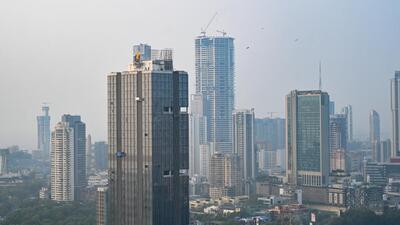
The much-awaited Mumbai projects include the super-tall 320-metre Palais Royale at Worli, which will have its first habitable floor at 82.5 metres. (Raju Shinde/HT Photo)

To qualify as tall, a building must rise at least 150 metres. India has 123 fully completed tall buildings, of which 102 are in Mumbai alone. India is 12th on a worldwide ranking collated by the Council on Tall Buildings and Urban Habitat (CTBUH), a US-based non-profit.

It is CTBUH that set the height benchmarks for tall and super-tall buildings. Super-tall buildings are those that rise 300 metres or above.

At the top of the CTBUH list is China with 3,320 tall buildings, followed by the United States which has 902 tall buildings – 318 are in New York City alone. Dubai’s Burj Khalifa is the world’s tallest building at 828 metres. In India, just one – Mumbai’s 300.6-metre Lokhandwala Minerva – falls in the super-tall category. But despite the recent proliferations of tall structures, India still ranks eighth behind countries such as Indonesia, Thailand and the Philippines in Asia even.

“Nothing says we have arrived on the global scene more than having the world’s tallest building,” writes American economist Jason Barr in his latest book “Cities in the Sky: The Quest to Build the World’s Tallest Skyscrapers”.

The iconic form of the Empire State Building (the tallest in the world between 1930 and 1971), he writes, was “a global beacon for American entrepreneurial and engineering prowess… and other cities seek to imitate its magic by erecting their version, be it the Shanghai Tower, the Burj Khalifa, or Taipei 101.”

However, as Barr told HT, these towers also have an economic rationale: “For countries, especially in Asia, it is a signal (to the world) that they are open for business and eager to receive foreign direct investment.”

Going by India’s per capita GDP, the vertical growth in its cities “is exactly where we would predict it to be.”

But India, Barr pointed out, is “yet to employ them (tall buildings) in the same manner as other Asian countries like the UAE, China, or Malaysia.”

The vertical growth in urban India was led by Mumbai, where high-rises became a necessity due to the rise in population, affluence, and geographical constraint. The city’s first skyscraper, the 80-metre Usha Kiran at Carmichael Road, was built in 1961. Over the years Usha Kiran was home to some of the country’s most affluent families including the Ambanis and the Godrejs.

However, the construction of tall buildings accelerated only in the 2000s as post-liberalisation growth became steady. A 2023 report by the Confederation of Indian Industry (CII) and CBRE, an international property consultancy, states nearly 77% of India’s tall buildings are in Mumbai and the city will continue to grow vertically.

Anarock Property Consultants projects a 34% increase in skyscrapers with over 40 floors in the larger Mumbai Metropolitan Region in the next six years.

The much-awaited Mumbai projects include the super-tall 320-metre Palais Royale at Worli, which will have its first habitable floor at 82.5 metres; the 282-metre-high residential complex Arav at Byculla, and the 270-metre Sesen at Nepean Sea Road.

According to the CTBUH dashboard, Kolkata is the second-tallest city in India with ten buildings that are 150 metres or higher. The city’s tallest structure, The 42 at 249 metres, was constructed in 2019. Gurugram and Noida share the third spot in India, followed by Hyderabad and Bengaluru. As urbanisation accelerates and land prices soar, building upwards rather than outwards becomes more economically viable and efficient, said Anarock’s Anuj Puri.

Earlier this year, the West Bengal government said it would revisit provisions of the Urban Land Ceiling Act which is still not repealed in the state despite the Centre ending it in 1999. Experts say this may open up large parcels of land in Kolkata for vertical development.

But reforms are already underway. Since 2015-16, the real estate sector in Kolkata has been incentivised, said Sidharth Pansari, president of the Confederation of Real Estate Developers’ Associations, Bengal. Developers get a 10% additional Floor Area Ratio (FAR) on pre-certified green buildings and 20% extra FAR on projects within one kilometre of any Metro corridor.

In real estate planning, the Floor Space Index (FSI) and FAR determine the size and the height of buildings according to the size of the plot. FSI is a percentage, while FAR is a ratio.

In Hyderabad, the big push came in 2006 when the then-Andhra Pradesh (now Telangana) government allowed unlimited FSI to attract real estate investments.

The CTBUH dashboard ranks Hyderabad as India’s fifth tallest city where three 228-metre-high buildings are under construction. Not too far away, Bengaluru is about to start construction on a 250m sky deck, a ₹500 crore project touted as the tallest in South Asia.

Not everyone is impressed by these tall structures though. Girish Dravid, chairman of CTBUH India, said cities like Hyderabad have no compulsion to build tall because there is enough space to expand horizontally. “However, we have to respect the vanity statements of developers as a human trait, and the same goes with the rich buyers willing to pay a premium for higher floors,” he said.

Some cities, such as Delhi and its outskirts, opted for low-rises as ample land was available in the hinterland. “Whether it’s the DLF, Cyber City, or the Golf Course, buildings are tall but not tall enough to qualify as super or mega tall. That is because the city has ample land and is expanding in the periphery,” said Joshi.

Most Indian cities have sprawled horizontally and outwards for varied reasons.

Before the advent of formal town planning regulations, four or five-storeyed buildings were constructed cheek-by-jowl, leading to very dense habitation in many inner-city areas of Mumbai, explained Vidyadhar Phatak, a veteran urban planner. Low FSI, he said, was a reaction “to control population densities in cities.” The problem, he pointed out, is that FSI is not recognised as a market intervention. “If done rightly, it can help optimal and efficient land use. Otherwise, it can increase land prices and affect the affordability of floor space.”

In recent years, cities have become more liberal with the FSI allowance. Greater Mumbai relaxed the FSI allowance for buildings along wider roads. However, compared to other major Asian cities, these allowances are still low. According to a CBRE analysis, Indian cities typically have FSI of 2 to 5, so developers must pay a hefty premium for additional FSI to build higher. In contrast, Taipei ranges from 4 to 8, while Seoul and the Greater Seoul area allow for 4 to 13. Tokyo’s FSI varies from 0.5 to 13, Hong Kong permits between 10 to 15, and Singapore has a range of 8.4 to 15.

A 2017, a Niti Aayog report highlighted an unusual trend in Indian cities, particularly Delhi-NCR where a higher FSI is permitted on the periphery rather than in the city centre. This results in a shortage of space in the central business district, which is reserved solely for commercial use. Consequently, residential units are pushed to the outskirts, significantly burdening the transportation system.

The India Infrastructure Report-2023 says that Connaught Place and the planned areas of Delhi have been regulated to “near death” with very low FSI.

Delhi’s first master plan of 1962 prompted the expansion of Connaught Place Central Business District to include adjoining arterial roads such as KG Marg, Barakhamba Road, Baba Kharak Singh Marg and Janpath. An FAR of 400 allowed buildings to rise to 20 storeys, resulting in Delhi’s first lot of high-rises.

But this vertical growth was fraught with mistakes, said AK Jain, former planning commissioner of the Delhi Development Authority.

Instead of combining plots to create shared parking spaces, basements, pedestrianised plazas, traffic circulation areas, and social amenities, each building constructed its exclusive parking in a limited space, creating a template for chaos.

As a consequence, the FAR was reduced to 250 in the mid-1970s and further decreased to 150 under the 2001 Master Plan.

However, using the FAR allowance granted to government projects, the Civic Centre at Minto Road rose to 112 metres. Redevelopment of government housing in south Delhi led to high-rise growth in East Kidwai Nagar and the World Trade Centre in Nauroji Nagar. In industrial estates, several high-end residential apartment buildings were granted a higher FAR to compensate for the shutting down of their factories.

Some of the completed buildings have gone as high as 125 metres. Among the under-construction high-rises that are tipped to cross the 150-metre mark are The Amaryllis Versace in Karol Bagh, DLF One Mid-Town in Moti Nagar, The Leela Sky Villas in Shadipur, and NBCC’s Transit Oriented Development project in Karkardooma.

Barr noted in his book that historically the tallest buildings in cities rarely exceeded five storeys because people would avoid climbing more than 50 vertical feet for living or working purposes. This meant that the top floors had the lowest property values.

However, from the 1870s onwards, Elisha Otis’s safety elevator and other innovations dramatically changed the rental dynamics for higher floors in New York City. Barr describes this “growth spurt as nothing short of revolutionary, like the introduction of the iPhone in 2007.”

Traditionally, Indians preferred low-rise buildings with courtyard living. The late Charles Correa, one of the country’s most prominent architects, argued that this model had crucial advantages.

High-rise buildings restrict activity to a handful of developers who have the money to organise finances, a small bunch of architects and engineers who could design them and even fewer companies that could construct them, he wrote in his 2010 book ‘A Place in the Shade — The New Landscape and Other Essays’.

Low-rises, on the other hand, wrote Correa, can grow according to the owner’s requirements and do not need such heavy investments and speedier to construct.

In India and much of the developing world, he added, high density does not come from high-rise buildings alone but from a high occupancy rate per room and the criminal omission of play spaces, schools, hospitals, and other social amenities. That is why, in most cities worldwide, high-rises are office buildings.

“No one lives in the Sears Tower (Now Willis Tower, Chicago). They don’t build 60-storey apartments like we do in Mumbai,” Correa said at a CBTUH conference in 2010.

In contrast, more than 90% of tall buildings in India are residential, while only 5% are for office space, said the CBRE report.

In a residential space, an investor can fetch a higher premium by positioning a skyscraper in the premium or luxury segments, as buyers are willing to pay over the market value for a “stellar view, better quality, and the status that comes with owning/renting a tower space.”

Tall buildings are capital-intensive and high-maintenance.

They must be structurally strong to endure strong winds, earthquakes, and other natural disasters.

They need passive firefighting systems and sophisticated plumbing for pressure control. Installing high-speed elevators, power generators, and water treatment plants and maintaining common facilities, lawns, parking, and lighting also push up electricity and water consumption.

Sprawling cities also have their own economic, social and environmental costs. Barr said that the skyscraper is a “geography-shrinking machine” that can be deployed when the demand for specific locations exceeds the land’s ability to accommodate it.

The vertical is also compact, allowing more people to live and work nearby, thereby reducing a city’s carbon footprint and the need to provide expansive infrastructure. That’s why, experts say, Indian cities will follow a mixed trajectory for now — expanding both vertically and outwards, subject to land prices, construction costs, and FSI regulation. But land is not infinite, and cities will hit their physical limits, having to go upwards sooner or later.

Redevelopment, for example, will require a relatively higher FSI and more storeys because taller buildings will have to accommodate existing occupants.

If city authorities are serious about going compact, the high-rise market will have to amalgamate the demand for residential and commercial space in the vicinity.

A CTBUH evaluation shows that 2023 was the 10th consecutive year that the world completed more than 100 buildings at least 200 metres tall. Indian cities also continued the vertical journey with 17 such completions. Even while opting for vertical growth, say experts, it is prudent to restrict buildings to reasonable heights.

“We must keep the urban growth functional and sustainable, go tall if there is no alternative to high-rises, not necessarily for the sake of making a statement,” said Dravid.

India’s strategy, they feel, is on the mark as many countries are rethinking this.

New York, for example, is not going to record-breaking heights due to rising construction costs, zoning regulations, and an erratic rental market. Even China — which last year completed 94 buildings that were 200 metres and higher — has set a height limit for tall buildings at 500 metres in 3 million-plus population cities to address oversupply and structural safety issues.

Ultimately, any prescription for vertical growth must factor in the ground constraints. “FSIs should not be determined by road width but land prices, which in turn, are largely determined by accessibility (read transit),” said Phatak.

In Indian cities, exponential growth in private vehicles caused by densification severely compromises mass mobility. Civic mismanagement and extreme weather events leave cities flooded and water-stressed, often in the same year. Power outages and water shortages are also not uncommon.

These issues must be resolved to ensure that urban growth—whether horizontal or vertical — does not become a liability.


Carmakers talk price hikes amid discounts

0
Carmakers talk price hikes amid discounts


Carmakers talk price hikes amid discounts

NEW DELHI: Amid slowdown in demand for new cars and steep discounts, the talk of a price hike by car companies in the new year has surprised other industry stakeholders as dealers grapple with large inventory.
Announcements regarding price hikes towards the end of the year have become almost an annual ritual as companies resort to desperate measures to clear piled-up inventory because unsold vehicles will need to be liquidated with heavy discounts if they flow into the new year. Often, the price increase “considered” by companies does not translate into a hike in Jan.
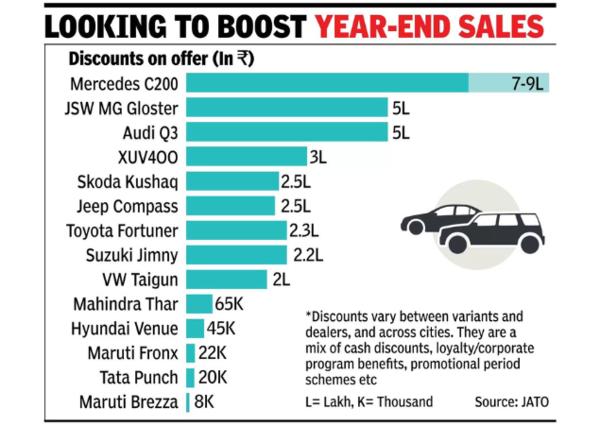
So far, the call for price hikes – of around 3% – has already come from companies ranging from Maruti Suzuki, Hyundai, Mahindra & Mahindra, JSW MG Motor, Audi, and Mercedes-Benz. Ironically, many of them are already throwing in steep discounts to lure buyers. The discounts run from a few thousand of rupees for small cars, to much higher for bigger SUVs and sedans, and lakhs for the luxury brands.

Looking to boost year-end sales

Justifying the prices hikes, M&M (like other companies) blamed inflation and increased commodity prices.
Industry officials, however, say that this smacks of a “desperate attempt to lure buyers” as carmakers try to clear pending inventory before the new year.
“This conversation is more of a marketing trick to get people to the showrooms, especially with footfalls being low post the festive period. Companies want to clear current-year inventory before the new year begins and thus talk about price hikes. The fact is that price hikes may not happen across all the models, and many a times can only be on select variants,” an industry official told TOI.
C S Vigneshwar, president of the Federation of Automobile Dealers Associations (FADA), said the practice of calling out price hikes when there is already heavy inventory at the retail level is not healthy. “Last month, there was an inventory of 75 days at the dealerships, and we are now calculating the levels for this month.”
Vigneshwar said companies should not “flood” dealerships with new stocks when the past stock is already more than required. “Stop sending us these many new vehicles, and temper down a bit.”
Ravi Bhatia, president of analytics firm JATO Dynamics, said that significant discounts on models like the Mahindra XUV4OO, JSW MG Gloster, and VW Tiguan highlight the efforts of automakers to drive year-end sales and clear inventory.
“Maruti’s consideration of a price hike in Jan may face challenges in this competitive landscape, where rivals are leveraging aggressive incentives. Balancing profitability with consumer sentiment will be critical for Maruti to sustain its leadership in this price-sensitive market,” Bhatia said.


Mcap Of Six Of Top-10 Most Valued Firms Surges Rs 2.03 Lakh Crore, TCS Biggest Winner | Economy News

0
Mcap Of Six Of Top-10 Most Valued Firms Surges Rs 2.03 Lakh Crore, TCS Biggest Winner | Economy News


Mumbai: The combined market valuation of six of the top-10 most valued firms surged Rs 2.03 lakh crore last week as the Indian stock market ended with gains.  In the trading session from December 2 to December 6, Nifty closed at 24,677 with a gain of 2.27 per cent or 546 points and Sensex closed at 81,709 with a gain of 2.39 per cent or 1,906 points. This was the third consecutive week when the stock market closed in the green.

Among the top 10, Tata Consultancy Services (TCS), HDFC Bank, ICICI Bank, Infosys, Reliance Industries, and State Bank of India (SBI) were gainers, while Bharti Airtel, Life Insurance Corporation of India (LIC), ITC, and Hindustan Unilever were laggards.

The market capitalisation of TCS surged by Rs 62,574 crore to Rs 16,08,782 crore. The market valuation of HDFC Bank jumped Rs 45,338 crore to Rs 14,19,270 crore. 

Infosys added Rs 26,885 crore taking its market cap to Rs 7,98,560 crore and the market capitalisation of Reliance Industries surged by Rs 26,185 crore to Rs 17,75,176 crore. The market capitalisation of SBI soared by Rs 22,311 crore to Rs 7,71,087 crore. ICICI Bank added Rs 19,821 crore to its market capitalisation to Rs 9,37,545 crore.

On the other hand, the market capitalisation of Bharti Airtel declined by Rs 16,720 crore to Rs 9,10,005 crore. The market valuation of ITC went lower by Rs 7,256 crore to Rs 5,89,572 crore and the market capitalisation of Hindustan Unilever declined by Rs 2,843.01 crore to Rs 5,83,673.71 crore. LIC’s market cap declined by Rs 1,265 crore to Rs 6,21,937.02 crore. On Friday, the stock market ended with a marginal loss.

Sensex and Nifty declined by 56 points and 30 points, respectively.


US caught by surprise as Syria overthrows al-Assad: Analysis | Syria’s War News

0
US caught by surprise as Syria overthrows al-Assad: Analysis | Syria’s War News


Washington, DC – A lightning-quick offensive has seen Syria’s opposition take control of major cities and large swaths of territory, toppling the government of longtime leader President Bashar al-Assad and indelibly altering the war-torn country’s future.

The events represent a remarkable reversal of fortunes in Syria and enlivened a multipronged civil war that appeared largely stagnant for years. The situation, analysts told Al Jazeera, also appears to have been largely unanticipated by the administration of United States President Joe Biden, and raises galling questions over how Washington will proceed in the weeks and months ahead.

“I think everything that’s happening caught them by surprise,” Qutaiba Idlbi, a senior fellow at the Washington, DC-based Atlantic Council, told Al Jazeera. “So many of us analysts and Syria watchers have been wondering what’s going to come next.”

“[The Biden administration] will need to recalibrate their approach to Syria,” added Idlbi, who is also a Syrian refugee. But that is all but assured to be constrained by Biden’s diminished power before he hands over the office in January to president-elect Donald Trump, he said.

“I feel that the events on the ground are moving way too quickly for them to catch up, especially in this lame-duck session.”

‘Historic opportunity’ or ‘risk and uncertainty’?

Speaking on Sunday – hours after opposition groups led by Hayat Tahrir al-Sham (HTS) entered the Syrian capital of Damascus and sent al-Assad fleeing the country – Biden gave his first response to what he described as both a moment of “historic opportunity” and “risk and uncertainty”.

Biden said the end of al-Assad’s presidency was in part due to US support for Israel’s war on Gaza and its fight against Hezbollah in Lebanon, as well as support for groups in Syria and Iraq that weakened Syria’s close ally, Iran.

He also pointed to US support for Ukraine’s war against Russia’s invasion, which siphoned resources from Moscow, a close ally of al-Assad: “The upshot of all of this, for the first time ever, neither Russia [nor] Iran or Hezbollah could defend this abhorrent regime in Syria,” Biden said.

Looking ahead, Biden said Washington would prioritise supporting Syria’s neighbours – including Jordan, Lebanon, Iraq and Israel.

He said US forces would remain in northeast Syria, where they support the Kurdish-led Syrian Defence Forces against ISIL (ISIS). About 900 US troops are currently in the northeast of the country.

Finally, Biden pledged to engage “with all Syrian groups”, while vowing to “remain vigilant”.

“Make no mistake, some of the rebel groups that took down Assad have their own grim record of terrorism,” he said.

A senior US official quoted by Reuters, however, said that HTS was “saying the right things”.

‘Six weeks left on the clock’

The first official response from the White House underlines several key questions that will determine the shape of US policy on Syria going forward.

But Biden – during his short time left in office – is unlikely to provide those answers, according to Aaron David Miller, a senior fellow at the Carnegie Endowment for International Peace and a former Middle East analyst at the State Department.

“You’re talking about an administration that has six weeks left on the clock,” he said. “And with six weeks left on the clock, I would just try to prevent and guard against potential complications or catastrophes.”

That means most major decisions will likely be made by Trump.

During his first term, Trump repeatedly sought to withdraw US troops from Syria. He appeared to re-up that effort on Saturday, writing on his Truth Social account that the US “would have nothing to do” with the country.

The Biden administration has also not articulated how it will mediate its support for the SDF’s fight against ISIL with the evolving landscape on the ground. Like other rebel groups, the SDF has seized new territory – including the eastern city of Deir Az Zor and the Abu Kamal border crossing with Iraq – in recent days.

Speaking to reporters last week, Pentagon spokesman Pat Ryder said US forces were not “participating in combined arms manoeuvre with the SDF” in their offensive.

But the fluid situation on the ground could see more opportunities for escalation between the SDF and the Turkish-backed Syrian National Army (SNA) group, according to analyst Idlbi.

“Of course, those questions are still pending,” he said.

The Biden administration is also widely expected to revisit its designation of HTS as a “terrorist organisation”, which could restrict US engagement with any fledgling transitional government.

Jabhat al-Nusra was formed in 2012 by ISIL but broke from the group a year later and pledged allegiance to al-Qaeda. It joined with other factions and broke from al-Qaeda in 2017, rebranding as HTS.

Its leader, Abu Mohammed al-Julani, whose real name is Ahmad al-Sharaa, has since portrayed himself as a supporter of pluralism and equality, but wariness remains for how the group would treat the vastly diverse communities that make up Syria’s population.

The US government continues to have a $10m bounty on his head.

‘Backburner’

Despite Biden’s celebration over al-Assad’s ousting, Idlbi said he remains wary that this was the outcome the administration wanted to see.

At the very least, he said the Biden administration had been caught flat-footed between diverging schools of thought: One that supported keeping al-Assad in power to avoid a vacuum, while coaxing him away from Iran, and another that supported wider regime change.

He pointed to a Reuters news agency report last week that said the US and United Arab Emirates had recently discussed the possibility of lifting sanctions on al-Assad if he agreed to pull away from Iran and cut off weapons routes to Hezbollah.

The principles of the Biden administration’s approach to the situation, with its deprioritisation of Syria since taking office in 2021, never fully took form, he added.

“Syria has been put on the back burner for the last four years, and the burner has been turned off,” Idlbi said.

In many ways, the muddied strategy has reflected US policy throughout the war, which saw support for some opposition groups fizzle into a diplomatic pressure campaign against al-Assad.

The administration of former US President Barack Obama had initially embraced opposition to al-Assad as similar popular uprisings stretched across the Middle East, supporting a coalition of rebel groups largely based in pockets of the country’s east and south.

That support involved a since-declassified CIA programme that saw the US, the United Kingdom and several Arab countries funnel money, weapons and training to some rebel groups. The programme has been criticised for inadvertently funnelling weapons to groups considered “terrorists” by the countries involved.

Obama also famously said that al-Assad’s use of chemical weapons against Syrians would constitute a “red line”, but he balked on direct military intervention following the government’s chemical attack on Ghouta in 2013. Four years later, Trump did strike a Syrian air base in response to the Khan Sheikhoun chemical weapons attack, the first US attack of its kind since the war began.

Speaking to Al Jazeera, Mahmood Barazi, the president of the American Coalition for Syria, a grouping of US organisations that has opposed al-Assad, said the quickly shifting situation has prompted him to rethink how to approach advocacy with the incoming Trump administration.

Given Trump’s unique mix of isolationism and hawkishness towards Tehran, Barazi had planned to focus on Iranian influence in Syria to convince officials of the need to turn the screws on al-Assad.

Now, he is trying to figure out the best way to “create a system with this administration to keep a very mindful and proactive approach towards Syria”.

“For me, this an opportunity,” he said.


What is happening in Syria and why now?

0
What is happening in Syria and why now?


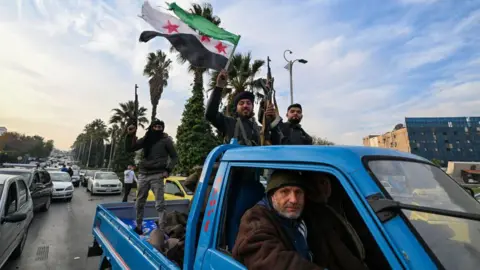
AFP Syrian rebel fighters celebrate and hold up the Free Syria flag in Damascus after President Bashar al-Assad reportedly fled abroad (8 December 2024)AFP

Syrian rebel fighters and their supporters celebrated after entering Damascus with no resistance on Sunday

The Assad family ruled Syria for more than 50 years with an iron fist. Now that has come to an end.

Bashar al-Assad became president after the death in 2000 of his father Hafez, who had ruled for almost three decades.

In 2011, he brutally crushed a peaceful, pro-democracy uprising, sparking a devastating civil war in which more than half a million people have been killed and 12 million others have been forced to flee their homes.

Twelve days ago, the Islamist militant group Hayat Tahrir al-Sham (HTS) and allied rebel factions launched a major offensive in north-western Syria.

The rebels quickly captured the country’s second-largest city, Aleppo, then swept southwards down the highway to the capital, Damascus, as the military collapsed.

Russia announced that Assad had stepped down and left Syria on Sunday, hours after the rebels entered Damascus and crowds gathered on the streets to celebrate, although his whereabouts remained unknown.

HTS leader Abu Mohammed al-Jawlani later arrived in Damascus and told Syrians: “The future is ours.”

How did the takeover unfold?

For the past four years, it had felt like the civil war was effectively over.

Assad’s government had regained control over most of Syria’s cities with the help of Russia, Iran and Iranian-backed militias like Hezbollah, and the front lines were largely frozen.

However, large parts of the country were still out of the government’s control.

The rebels’ last stronghold was in Aleppo and Idlib provinces, which border Turkey and where more than four million people were living, many of them displaced. It was dominated by HTS, but a number of allied rebel groups and jihadist groups were also based there. Turkish-backed rebel factions also controlled territory with the support of Turkish troops.

On 27 November, HTS and its allies launched their surprise offensive.

After three days, they took control of most of Aleppo – Syria’s second-largest city. They said they faced little resistance on the ground after the government rapidly withdrew its troops and security forces.

The Turkish-backed rebel factions meanwhile capitalised on the government’s retreat by launching a separate offensive on territory north of Aleppo controlled by a Kurdish-led militia alliance supported by the United States, the Syrian Democratic Forces (SDF).

Assad vowed to “crush” the rebels with the help of his allies. Russian warplanes intensified strikes on rebel-held areas and Iran-backed militias sent reinforcements to help the military near Hama – the next city south on the way to Damascus.

But Hama fell to the rebels on Thursday, after several days of fierce battles that eventually prompted the military to withdraw.

The rebels declared their next goal was to take Homs, Syria’s third-largest city, and achieved that on Saturday night after only a day of fighting. At the same time, other rebel factions based reached the suburbs of Damascus.

Early on Sunday, HTS-led rebels announced they had entered Damascus and released detainees at the country’s most notorious military prison, Saydnaya.

Less than two hours later, they declared: “The tyrant Bashar al-Assad has fled.”

Activists and army officers said the president had left Damascus on a plane to an undisclosed location.

Prime Minister, Mohammed al-Jalali, meanwhile announced in a video that he was “ready to co-operate with” any leadership that was “chosen by the Syrian people”.

Abu Mohammed al-Jawlani ordered his forces not to approach official institutions, saying they would remain under the authority of the prime minister until they were “officially” handed over.

The rebels also promised to build a “homeland for all, including all sects and social classes”.

The Syrian Observatory for Human Rights, a UK-based monitoring group, reported that at least 910 people had been killed, including 138 civilians, since the start of the rebel offensive.

What is Hayat Tahrir al-Sham?

The Islamist militant group that led the offensive against Assad was set up in 2012 under a different name, al-Nusra Front.

Al-Nusra Front, which pledged allegiance to al-Qaeda the following year, was regarded as one of the most effective and deadly groups fighting President Assad.

But it was feared for its jihadist ideology, and was seen as being at odds with the largely secular main rebel coalition – the Free Syrian Army.

In 2016, Al-Nusra broke ties with al-Qaeda and took the name Hayat Tahrir al-Sham when it merged with other factions a year later.

However, the UN, US, UK and a number of other countries continue to consider HTS as an al-Qaeda affiliate and frequently refer to it as al-Nusra Front. The US named Abu Mohammed al-Jawlani as a specially designated global terrorist and offered a $10m reward for information that led to his capture.

HTS consolidated its power in Idlib and Aleppo provinces by crushing its rivals, including al-Qaeda and Islamic State (IS) group cells. It set up the so-called Syrian Salvation Government to administer the territory according to Islamic law.

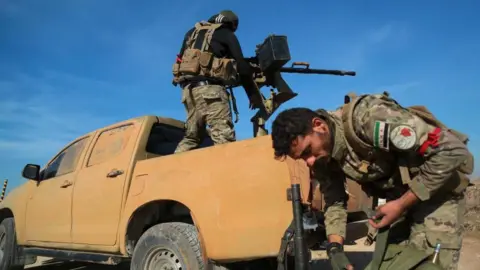
Reuters A rebel fighter stands on back of a truck holding a weapon in Menagh, north of Aleppo, Syria, December 2Reuters

HTS and its allies said they launched the offensive to “deter aggression” by the government

Why did the rebels succeed?

For several years, Idlib remained a battleground as Syrian government forces tried to regain control.

But in 2020, Turkey and Russia brokered a ceasefire to halt a push by the government to retake Idlib. The ceasefire largely held despite sporadic fighting.

HTS and its allies said on 27 November that they had launched an offensive to “deter aggression”, accusing the government and allied Iran-backed militias of escalating attacks on civilians.

But it came at a time when the government had been weakened by years of war, sanctions and corruption – with allies Russia and Iran preoccupied by other conflicts.

The Iran-backed group Hezbollah had recently suffered from Israel’s offensive in Lebanon. Israeli strikes had eliminated Iranian military commanders in Syria, and Russia was distracted by the war in Ukraine.

Without them, Assad’s forces were left exposed.

How have world and regional powers reacted?

Russia said it was “following the dramatic events in Syria with extreme concern”. The foreign ministry called on “all parties involved” in the Syrian conflict to “renounce the use of violence and resolve all governance issues through political means”. It also said that Russian military bases in Syria were “on high alert”, although there was “no serious threat to their security”.

Iran expressed a hope for “the swift end of military conflicts, the prevention of terrorist actions, and the commencement of national dialogue” with all parts of Syrian society.

Turkey said Syria was now at a stage “where the Syrian people will shape the future of their own country”. Foreign Minister Hakan Fidan said the new government “must be established in an orderly manner” and warned that “the principle of inclusiveness must never be compromised”.

Israel’s prime minister said the collapse of the Assad government was the “direct result” of his country’s action against Hezbollah and Iran. Benjamin Netanyahu also announced that he had ordered the Israeli military to temporarily “take over” Syrian army positions in the demilitarized zone in the Golan Heights, saying a 1974 ceasefire agreement between the two countries had “collapsed” because Syrian troops had abandoned their posts.

The White House said US President Joe Biden and his team were “closely monitoring the extraordinary events in Syria and staying in constant touch with regional partners”.

Iraq, where powerful Iran-backed militias sent fighters to support the Syrian military in the civil war, said it supported efforts to open a dialogue in Syria “leading to the adoption of a pluralistic constitution that preserves the human and civil rights of Syrians”.

Jordan’s King Abdullah, which backed rebel factions at the start of the war, said it respected the will and choices of the Syrian people. He stressed the importance of imposing stability and avoiding “any conflict that could lead to chaos”.

The European Union’s foreign policy chief, Kaja Kallas, called Assad’s fall “a positive and long-awaited development”, and said the bloc’s priority was to ensure security in the region.


Jeff Bezos reveals the secret to build a successful business like Amazon | World News

0
Jeff Bezos reveals the secret to build a successful business like Amazon | World News


Dec 08, 2024 12:09 PM IST

Jeff Bezos said people often overestimate risks while underestimating the potential opportunities.

Amazon founder Jeff Bezos, in an recent interview, opened up about the mindset and strategies that helped him build one of the world’s most successful companies and his continued ambitions for the future. Currently the world’s second-richest person with a net worth of $246 billion, Bezos has seen a $69.3 billion increase in his wealth in 2024 alone, according to the Bloomberg Billionaires Index.

Jeff Bezos is currently the world's second-richest person with a net worth of $246 billion.(AP)
Jeff Bezos is currently the world’s second-richest person with a net worth of $246 billion.(AP)

Bezos discussed his approach to achieving massive success, particularly in founding and scaling Amazon, as well as his space exploration venture, Blue Origin. When asked about his confidence in building large-scale companies, Bezos shared a thought-provoking perspective on risk and opportunity.

He noted that it is common for people to overestimate risks while underestimating the potential opportunities. To counteract this tendency, Bezos advised entrepreneurs to recognize that the risks they perceive might not be as significant as they seem, and the opportunities before them could be more substantial than they anticipate.

“You say it’s confidence, but maybe I’m just accepting that human bias and trying to compensate against it,” Bezos explained while speaking at the New York Times DealBook Summit last week.

He further emphasised the importance of thinking big, stating, “The second thing I would point out is that thinking small is a self-fulfilling prophecy.”

According to Jeff Bezos, if a person believes they can only achieve small things, their actions will inevitably align with that belief, preventing them from reaching their full potential.

Strategies for success

While discussing his strategies for success, Bezos also touched on broader issues facing the United States, including the regulatory environment and the national debt. He expressed optimism about the potential impact of a second term for former President Donald Trump, particularly in terms of reducing regulations. “We do have too much regulation in this country,” Bezos said, offering his willingness to assist in streamlining rules for businesses and fostering a more conducive environment for growth.

Read breaking news, latest…

See more


Indian billionaires’ wealth up 42% in last financial year, says report

0
Indian billionaires’ wealth up 42% in last financial year, says report


Indian billionaires' wealth up 42% in last financial year, says report
Representative AI image via Lexica

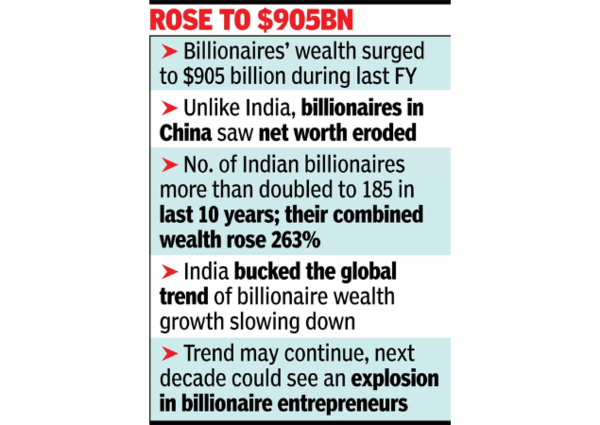
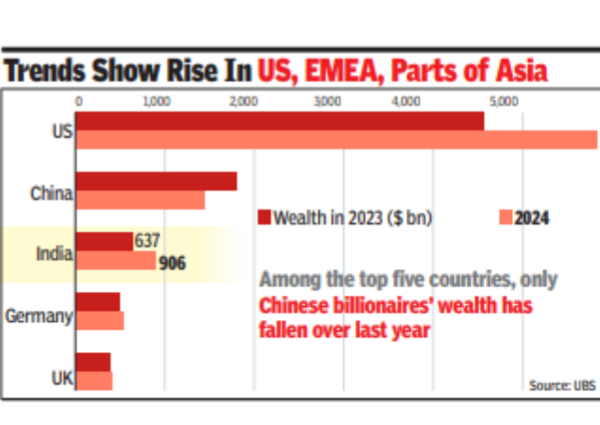
MUMBAI: The wealth of Indian billionaires surged 42% to over $905 billion during the last financial year, positioning it as the third largest base behind the US and China, a report by Swiss bank UBS said. In contrast, in China, where the Xi Jinping regime has gone after businesses, billionaires saw an erosion in their net worth.
The UBS Billionaire Ambitions Report said during the last 10 years, the number of Indian billionaires more than doubled to 185, with their combined wealth trebled (rose 263%) at the end of April 2024. Family-led businesses are playing a pivotal role in India’s economic rise. As India breaks into the top tier of global economies, it boasts one of the highest numbers of publicly listed family-owned businesses, many spanning generations, the report said. This phenomenon has contributed significantly to the surge in Indian billionaires over the past decade.
Family businesses are spread across a diverse range of sectors- from established conglomerates to new-economy ventures in pharmaceuticals, education technology, financial technology, and food delivery.

Billionaire wealth

While global billionaire wealth growth has slowed, India remains an exception. This is attributed to the continued dynamism of Indian entrepreneurs and the country’s favourable economic environment.
“It’s been a time of exceptional economic growth. During two completed terms in office, Prime Minister Narendra Modi’s National Democratic Alliance government introduced structural reforms that have helped propel the economy to the fifth biggest in the world,” the report said.
This trend is expected to continue, fuelled by rising urbanisation, digitalisation, a growing manufacturing sector, and the ongoing energy transition. India could witness an explosion in billionaire entrepreneurs over the next decade, mirroring China’s trajectory until 2020. In recent years, there has also been debate in the country over growing economic disparity between the rich and the poor.
Between 2015 and 2024, global billionaire wealth surged by 121% to $14 trillion, outpacing the 73% gain in the MSCI AC World Index. The number of billionaires grew from 1,757 to 2,682, peaking at 2,686 in 2021. However, growth has stalled since 2020, with a 1% annual increase in billionaire wealth globally, down from a 10% rate between 2015 and 2020.

Worldwide trends

Regional trends show continued expansion in the US, EMEA, and parts of Asia, particularly India, even as Chinese billionaire wealth fell 16% from its 2020 peak of $2.1 trillion.
Tech billionaires have led the wealth accumulation, tripling their holdings from $788.9 billion in 2015 to $2.4 trillion in 2024, driven by advancements in generative AI, cybersecurity, fintech, and robotics. Industrials billionaires followed, with wealth rising from $480.4 billion to $1.3 trillion due to investments in green technology and reshoring initiatives. In contrast, real estate billionaires lagged, impacted by China’s property correction, the pandemic’s effects on commercial real estate, and rising interest rates in the US and Europe.


‘New history written’ says HTS leader al-Julani in Syria victory speech | Syria’s War News

0
‘New history written’ says HTS leader al-Julani in Syria victory speech | Syria’s War News


The leader of the main Syrian opposition armed group that seized Syria’s capital, Abu Mohammed al-Julani, has said the Syrian people are the “rightful owners” of the country after the ouster of President Bashar al-Assad, and declared a “new history” has been written for the entire Middle East.

Arriving in Damascus just hours after his Hayat Tahrir al-Sham (HTS) rebel group led the capture of the city on Sunday, the leader gave a victory speech in the capital’s symbolic Umayyad Mosque.

As daylight broke, Syrians woke up to a dramatically changed country, after opposition forces swept into Damascus following a lightning offensive. They declared that they had toppled the government of “tyrant” Bashar al-Assad, who fled Syria in the early hours of Sunday and is in Russia, according to Russian media reports.

“The [al-Assad] regime has imprisoned thousands of its own civilians unjustly and without them committing any crimes,” al-Julani told a crowd gathered at the Umayyad Mosque.

“We [the Syrian people] are the rightful owners [of this country]. We have been fighting, and today we have been rewarded with this victory.”

“How many people were displaced across the world? How many people lived in tents? How many drowned in the seas?” asked al-Julani, who has begun to go by his real name, Ahmed al-Sharaa.

“A new history, my brothers, is being written in the entire region after this great victory,” he said before reminding the crowd that it would take hard work to build a new Syria that would be “a beacon for the Islamic nation”.

The leader called for prayers to give thanks for the triumph.

“God will not fail you,” al-Julani said. “This victory is for all Syrians; they were all part of this victory.”

Focus on unity

Al-Julani previously led the Syrian branch of al-Qaeda, al-Nusra Front, before distancing himself from the group.

However, HTS is still considered a “terrorist” group by the United States, the European Union and Turkiye, and has been accused by human rights groups of committing abuses in Idlib, where it has governed much of the province since 2017.

Al-Julani and HTS have sought to change that perception, focusing on a message of unity since their offensive began, and highlighted in al-Julani’s speech in the Umayyad Mosque.

Speaking from the Lebanon-Syria border, Al Jazeera’s Zein Basravi said that there were two significant elements of the HTS leader’s speech.

“He pushed this idea that there should not be vengeance … that Syria for all Syrians, should be something that people should focus on,” said Basravi.

“He also criticised the Iranian government and its involvement in Syria, making the point that this is no longer going to be a government that will be affected by Iran as an outside actor.”

Al-Julani was filmed prostrating in prayer on Sunday after he arrived in Damascus.

A statement read earlier on Sunday on Syrian state television, which rebels took over, quoted al-Julani as saying: “We continue to work with determination to achieve the goals of our revolution … We are determined to complete the path we started in 2011.”

The televised statement also quoted him saying: “We will not stop fighting until all the rights of the great Syrian people are secured. The future is ours and we are moving towards victory.”

The whirlwind opposition advance on Sunday came after 13 years of brutal war, which also put an end to more than half a century of the al-Assad family’s rule.

The Syrian war started as a largely unarmed uprising against al-Assad in March 2011, but eventually turned into an all-out war that dragged in foreign powers, killed hundreds of thousands of people and turned millions into refugees.

Russian and Iranian intervention appeared to sway the tide towards al-Assad in 2015, but the HTS-led offensive that began last month took advantage of Russia’s focus on its war on Ukraine, as well as the weakening of Iran and its Lebanese ally Hezbollah as a result of their conflict with Israel.


Copper Demand Sees 13% Yoy Growth In FY2024, Reaches 1700 Kilotonnes: ICA India | Economy News

0
Copper Demand Sees 13% Yoy Growth In FY2024, Reaches 1700 Kilotonnes: ICA India | Economy News


The copper demand in the country witnessed a 13 per cent year-on-year growth in FY2024, reaching 1700 kilotonnes(kt), said International Copper Association India (ICA India) in a release. This surge is attributed to overall economic expansion. Notably, post pandemic, the average annual copper demand increased by 21 per cent p.a. between FY2021 and FY2024.

The domestic production of copper cathodes rose by 8 per cent and net imports of various forms of copper increased by 13 per cent during the same period, ICA India said in the release. The strong demand from building construction and infrastructure sectors continue to drive copper demand in India, as per ICA India. As per the latest GDP data, these sectors registered growth of 9.1 per cent and 6.8 per cent respectively in the H1 FY2025.

Traditionally, building construction and infrastructure accounts for 43 per cent of copper demand while contributing 11 per cent to GDP. “The trends reflect robust growth in copper demand, aligning with India’s GDP growth trajectory.

The growth is fuelled by public and private sector investments, higher consumer spending, and advancements in key sectors like building construction, infrastructure, transportation, industrial and consumer goods wherein copper demand grew by double-digits,” said Mayur Karmarkar, Managing Director, International Copper Association India.

While demand has risen steadily, the growth in India’s domestic refined copper production has largely remained flat for many years due to closure of Vedanta’s Tuticorin smelter. With only Hindalco’s smelter operating, domestic cathode production fell by 7 per cent in FY2024, mainly due to major plant maintenance in first quarter of FY2024, as per the ICA India. The net cathode imports grew by 103 per cent in FY2024, as per the release.

India generated 468 kt of end-of-life and process copper and alloy scrap which was further supplemented by the net imports of an additional 192 kt of copper and alloy scrap in FY2024. The overall secondary scrap supply increased by 15 per cent.

Presently, India primarily relies on direct melting of scrap, resulting in variable copper purity due to the use of diverse scrap types. The direct remelting of copper in semis fabrication raises quality concerns, especially regarding tramp elements (elements that cannot be removed easily by direct remelting process) in electrical conductivity applications.

Karmarkar added, “The trends highlight India’s immense potential to develop a robust copper ecosystem. With Adani’s copper smelter being operational from Q3 FY2025 and the duty exemptions on copper concentrates and blisters the outlook for domestic production is promising. These advancements, coupled with sustained demand growth, position copper as a key enabler of India’s technological and economic aspirations.”

The implementation of the Quality Control Order (QCO) for copper products is expected to address the quality issues in the long run by ensuring that copper used in India adheres to strict standards. 


the musical cancelled after viral Olympian’s legal threat

0
the musical cancelled after viral Olympian’s legal threat


Harry Langer/DeFodi Images via Getty Images Australian breaker Raygun at Paris Olympics 2024Harry Langer/DeFodi Images via Getty Images

‘Raygun: The Musical’, was to be a parody about Rachael Gunn’s journey to the Olympics

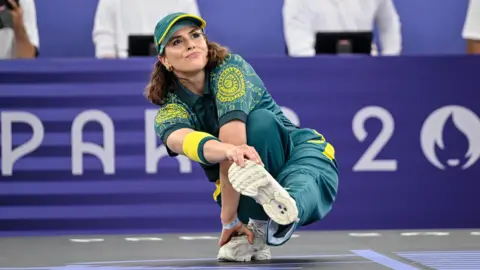
Australian breaker Rachael Gunn’s legal team has stopped a musical parody about her journey to the Paris Olympics from taking to the stage.

The show titled ‘Raygun: The Musical’ was created by Australian comedian Steph Broadbridge, who was also due to feature in the cast.

It was due to debut on Saturday at Kinselas in Darlinghurst, Sydney, but Broadbridge was forced to cancel the show after lawyers sent a cease and desist letter.

In a statement to the Guardian, Gunn’s legal and management team said it was committed to protecting her intellectual property and ensuring that her brand remained strong and respected.

Ezra Shaw/Getty Images Australian breaker Raygun kangaroo hop at Paris OlympicsEzra Shaw/Getty Images

Gunn’s lawyers said comedian Steph Broadbridge was ‘not allowed’ to do the kangaroo dance

Broadbridge said on Instagram that she planned for the show to be “back soon” and “with a whole new story arc”. Everyone who was due to attend the trial show would be offered a refund for their A$10 ticket, she added.

She said: “They [Gunn’s legal team] were worried I was damaging her brand, which I would never.”

Gunn failed to receive a single point from judges at this summer’s Olympic games and was subsequently eliminated from the round-robin stage which led to a torrent of abuse online.

Despite being defended by officials, her performance divided opinion within the breaking community, with some saying she made a mockery of the scene.

Gunn had initially planned to keep competing after the Olympics, but in November said the saga had been so “upsetting” that she changed her mind and had decided to retire.

Some of Gunn’s unconventional moves – such as the sprinkler and kangaroo-hop – went viral after her Olympics performance.

Now, Gunn’s lawyers have reportedly trademarked the poster for the musical and advised Broadbridge that she was “not allowed” to do the kangaroo dance because Gunn “owns” it.

“That one did puzzle me – I mean, that’s an Olympic-level dance,” Broadbridge said in her Instagram video. “How would I possibly be able to do that without any formal breakdancing training?”

She ended her video saying that she intends to change the name of her character to “Raygun with an I” in hopes that “fixes everyone’s concerns”.

In their statement to The Guardian, Gunn’s legal team said: “While we have immense respect for the credible work and effort that has gone into the development of the show, we must take necessary steps to safeguard Rachael’s creative rights and the integrity of her work.

“This action is not intended to diminish the contributions of others, but rather to ensure her brand is properly represented and protected in all future endeavours.”