The three officers were convicted in the death of Genivaldo de Jesus Santos, a Black man who died in police custody.
Three former members of Brazil’s Federal Highway Police have been sentenced to lengthy prison terms for the torture and death of a Black man held in the boot of their squad car.
On Saturday, Justice Rafael Soares, a judge for the 7th Federal Court in the Brazilian state of Sergipe, gave one of the officers, Paulo Rodolpho Nascimento, 28 years in prison for the crime of aggravated homicide.
Two of his colleagues, William Noia and Kleber Freitas, each received 23 years in prison for torture resulting in death.
The sentencing was the culmination of a case that began in May 2022, with the arrest of 38-year-old Genivaldo de Jesus Santos.
Protesters in Rio de Janeiro, Brazil, call for justice in the case of Genivaldo de Jesus Santos during a demonstration on May 28, 2022 [Pilar Olivares/Reuters]
The three officers pulled Santos over for riding his motorcycle without a helmet, not far from the town of Umbauba in Sergipe.
A bystander took a video of the encounter that later went viral. Santos appeared to offer no resistance as the three police officers pulled him to the ground and restrained his arms and legs.
The officers, however, had described Santos as “actively resisting”.
Local media reported that Santos suffered from schizophrenia and was heard yelling to explain that he was taking medication. But the officers lifted Santos into the boot of their sport utility vehicle (SUV).
The video captured the officers as they lowered the boot’s door and held it shut while clouds of dense, white smoke poured from the car. Santos screamed, and his legs could be seen kicking. A witness cried, ”They are going to kill him!”
Rodolpho was accused of throwing tear gas into the boot and helping to hold the door. He received the highest sentence.
Prosecutors, meanwhile, said Freitas used pepper spray five times against Santos, while Noia played a role in keeping the boot door shut while the tear gas poured out.
An autopsy later showed Santos ultimately died of asphyxiation. The three officers were dismissed from the Federal Highway Police.
During the course of their 12-day trial, the court heard from experts who described Santos’s final moments, spending more than 11 minutes restrained in an enclosed space surrounded by toxic gas.
Tear gas contains potentially lethal chemicals, particularly when deployed in large doses or over long periods of time.
All three officers were convicted. Santos’s sister, Laura de Jesus Santos, welcomed the outcome of the sentencing hearing on Saturday.
“It was a satisfactory result, although we are not happy with anyone’s misfortune. It calms us down, but it does not bring happiness,” she told the news agency G1.
An activist holds up a ‘Black Lives Matter’ sign in Brasilia, Brazil, on May 27, 2022 [Adriano Machado/Reuters]
Earlier this year, the United Nations issued a report addressing police violence in Brazil. It found that more than 6,000 people per year have been killed in interactions with Brazil’s law enforcement for the last six years. In 2023, the total was 6,393.
That is a marked increase over previous yearly totals. In 2013, for instance, 2,212 people were killed by officers.
Black people were disproportionately represented among the statistics. People of African descent represented nearly 83 percent of the cases, making them three times more likely to be killed by Brazilian police.
NEW DELHI: The Unified Payments Interface (UPI), since its launch in 2016, has vastly transformed financial access in the country, enabling 300 million individuals and 50 million merchants to perform seamless digital transactions, and till October last year, 75% of all retail digital payments in India were made through UPI, according to a research paper released on Saturday. “Within a short span, UPI led to exponential penetration of digital payments across India and is used at all levels from street vendors to large shopping malls,” says the paper, prepared by IIM and ISB professors The paper says that UPI has enabled underserved groups, including subprime and new-to-credit borrowers, to access formal credit for the first time. “In regions with high UPI adoption, loans to new-to-credit borrowers grew by 4%, and to subprime borrowers by 8%,” the paper said, adding the average size of a fintech loan was Rs 27,778 – about seven times the rural monthly expenditure. The authors said fintech lenders scaled rapidly, increasing their loan volumes 77 times, far outpacing traditional banks in catering to smaller, underserved borrowers. The rapid adoption of UPI was possible due to affordable internet across the country. “The affordability of digital technology played a critical role, enabling widespread UPI adoption in rural and urban areas alike,” according to the paper. The authors highlighted how credit growth was aided by UPI adoption. It said that a 10% increase in UPI transactions led to a 7% rise in credit availability, reflecting how digital financial histories enabled lenders to assess borrowers better. “Between 2015 and 2019, fintech loans to subprime borrowers grew to match those of banks, with fintechs thriving in high UPI-usage areas,” the paper said. It also highlighted the fact that despite the credit surge, default rates did not rise. This demonstrated that UPI-enabled digital transaction data helped lenders expand responsibly. The authors said the success of UPI has global implications and India could play a leading role in helping other countries adopt the technology.
There’s a lot to be concerned about over the past year. As far as I remember, politics was the most divisive. War and genocide is raging and women’s rights are under attack from Afghanistan to America. The rampant crime and violence against women and the grim reality that home is the most unsafe place for many of us.
The many lives of Syeda X
And then there were the books.
Provocative, lyrical, brutal, honest, thought-provoking, entertaining, satirical, heartbreaking. What were some of the best books of 2024? My four judges are prolific readers and writers. They come from journalism and publishing.
Incidentally, since none of my Fab Four have mentioned any fictional works, I’ll add a small personal contribution. Rosarita by Anita Desai (Picador, 499) There is a slim novel that lay near my bed for several days, until one morning I picked it up and read it to the end, amazed by the beauty and elegance of its writing. It stirred memory and desire, the universal story of so many women who lose themselves because of marriage and family.
Neelanjana S Roy
story of an unknown indian
The Many Lives of Syeda X: The Story of an Unknown Indian, by Neha Dixit (Juggernaut) 799)
A sensitive and comprehensive portrait of women’s work and existence in Delhi, a harsh city, emerges from the life of a Muslim woman.
Wild Women: Seekers, Heroes, and Goddesses in Sacred Indian Poetry, edited by Arundhati Subramaniam (Penguin Random House, 999)
Sacred, sensual poetry of seekers, explorers and mystics spanning centuries of Indian history.
Imprisonment: Bhima Koregaon and the Search for Democracy in India, by Alpa Shah (HarperCollins) 799)
The criminalization of dissent, unjust imprisonment and the power of the state are told through the story of the Bhima Koregaon Six.
Witness Sakshi Malik
Sakshi Malik and Jonathan Selvaraj (Juggernaut, 799)
An inspiring memoir about a champion wrestler overcoming poverty and sabotage to pursue a sport where he found meaning and purpose.
(Author of The Wildings (2012), The Hundred Names of Darkness (2013), The Girl Who Ate Books (2016) and, most recently, Black River (2022), which was named one of The New York Times’s 100 Notable Books of 2024 The year it was published in the US, Nilanjana Roy also writes a column on books for The Financial Times.)
Neha Dixit
This land we call home
This Land We Call Home: A Story of Family, Caste, Transformation, and Modern India, Nusrat F. by Jafari (Penguin Random House, 699)
Nusrat’s book deals with India and the complexity of family. She effectively addresses questions of origin and identity and how they are affected by politics in the outside world. His book is a masterpiece in telling inter-generational stories.
From the Hanging Yard: My Year with the Women of Yerwada, by Sudha Bhardwaj (Juggernaut) 799)
Sudha spoke about the 76 prisoners she met in the jail where she was kept in solitary confinement. She complicates the conversation on freedom for women both behind and outside bars. She raises questions about the existence of women in India and the structured inequality of the system in which women live. Despite his personal suffering, his empathetic writing is poignant and inspiring.
India’s Forgotten Country: A View from the Margins, by Bela Bhatia (Penguin Random House) 1,299)
Bela’s collection of writings from the most remote and marginalized corners of the country highlights the arbitrariness of violence against India’s least resourceful and poorest people. Her writing powerfully connects class, gender and geography and tells us how people are systematically invisible.
personal is political
The Personal Is Political: An Activist’s Memoir Aruna Roy (HarperCollins, 599)
Aruna’s book is a lesson in documentation that is often lacking for those who are less resourceful. The stories of his activism and the people he has worked with are a reminder of how much one can learn about the world through practice.
Semiotics of Rape: Sexual Subjectivity and Violation in Rural India Rupal Ojha (Tongue, 403 on Amazon)
Roopal’s book pushes us to look beyond terms like victim and survivor and how the language around cases of sexual violence often solidifies stereotypes and patriarchal systems. It is a much-needed reminder of how women insist on their autonomy and refuse to be defined by violence.
(Award-winning freelance journalist Neha Dixit’s debut book The Many Lives of Syeda X: The Story of an Unknown Indian (Juggernaut, 799) It has been causing a stir since its publication earlier this year.)
Ghazala Wahab
force magazine
Imprisonment: Bhima Koregaon and the Search for Democracy in India, by Alpa Shah (HarperCollins) 799)
Given the current political climate in India, this is a very brave book where the author balances things and presents both sides. Actually, Alpa Shah has written how these people were implicated, how evidence was planted and how despite there being no case, they continued to be tortured for political reasons.
Shades of Nationalism: A Memoir of Dreams, Hopes and Betrayals, by Nandita Haksar (Speaking Tiger) 599)
These memoirs are a continuation of the first part where Nandita Haksar talks about food and taste. In the second part she talks about her introduction to all aspects of nationalism. There is a certain naivety in her optimism as a teenager and her ideas about how India should move forward, but she is also very honest. As soon as he reaches adulthood, he begins to collide with reality, due to which his despair and disillusionment begins to increase. His book is as much a memoir as it is a brief history of independent India and its struggle for justice, equality and secularism.
(Co-founder of Force magazine, which looks at issues ranging from homeland security to religious extremism, Ghazala Wahab’s 2021 book, Born a Muslim: Some Truths About Islam in India, was a best-seller that won two books of the year.) His second book, The Hindi Heartland, is scheduled to be published in 2025.
Urvashi Butalia
Ashoka University
The Many Lives of Syeda X: The Story of an Unknown Indian, by Neha Dixit (Juggernaut) 799) I love it for the story it tells about a woman – she could be any poor woman – and it has a deep insight into the many exploitation, violence, oppression, but ultimately resistance.
obscenity of caste
The Obscenity of Caste: Dalits, Sexuality and Humanity in Modern India, by Shailaja Paik (Navayan, 500)
This book about the lives of tamasha dancers in Maharashtra through the lens of caste explores the complex relationship between sexually charged public performances by Dalit women, the non-recognition of their labour, labeling it as obscene and, therefore, morally reprehensible. exposes.
Seeking Begumpura: The Social Vision of Anti-Caste Intellectuals, by Gail Omvedt (Navayan, 292 on Amazon)
From Chokamela, Kabir to Phule, the visions and utopias expressed by people with marginalized identities and how they saw the ideal society.
Revolutionary Desires: Women, Communism and Feminism in India, by Ania Loomba (Routledge, 5,012 on Amazon)
Set in the 1920s, when communism was becoming a vocal entity in Indian politics, Loomba looks at the lives of communist women and how they were shaped by the cultural and political context.
Secularism as Misdirection: Critical Thoughts from the Global South by Nivedita Menon (Permanent Black, 1,095)
I’m only half way through this book which questions our received notions about secularism and how we interpret it as development and progress, which hides important issues like caste. It examines how, over the last 30 or 40 years, secularism discourse has used the women’s movement and asks whether we can rethink secularism and view it through the lens of gender and caste.
Toote Pankhon Se Parwaaz Tak, by Sumitra Mehrol (English translation published by Zubaan in 2025, Hindi paperback, 290 on Amazon)
I am in the process of translating this book from Hindi to English. Sumitra is a disabled, Dalit and woman writer who sees life through these triple oppressions. This book is a very unusual memoir, far-reaching and reflective. I found it extremely moving.
(One of India’s leading historians of the women’s movement and, in particular, Partition, Urvashi Butalia, co-founder of India’s first feminist publishing house, Kali for Women, now heads Zubaan, also a feminist imprint.) She has published several Has edited collections including Indian Women’s Short Stories, Speaking Peace: Voices of Kashmir Women, Women and Hindu Rights, and Partition: The Long Shadow of Partition (2015). From the Partition of India (also available as a paperback) won the Oral History Book Association Award.)
(What were your favorite books written by women in 2024? Write to me at: namita.bhandare@gmail.com ,
A TV journalist and cameraman have come under attack from masked men while covering pro-EU protests in Georgia.
Reporter Maka Chikhladze, from pro-opposition TV Pirveli, was violently thrown to the ground, while cameraman Giorgi Shetsiruli was kicked in the head on a side street in the capital, Tbilisi.
They were covering the 10th night of mass pro-EU protests that have taken place in several cities. The protests are in response to Georgia’s increasingly authoritarian government suspending the process towards joining the EU.
LIC Bima Sakhi Yojana Eligibility: Prime Minister Narendra Modi is set to inaugurate the Life Insurance Corporation of India’s Bima Sakhi Yojana this Monday at an event in Panipat, Haryana, according to a statement from the state-owned insurer.
Aligned with the Prime Minister’s vision of empowering women for a developed India (Viksit Bharat), the event is expected to feature Haryana Governor Bandaru Dattatreya, Finance Minister Nirmala Sitharaman, Haryana Chief Minister Nayab Singh Saini, and other ministers from both the central and state governments.
However, the LIC has not yet disclosed further details about the scheme.
LIC Bima Sakhi Yojana: Job Opportunities
Under this program, women will have the opportunity to become insurance agents (Bima Sakhi). They will receive financial support of up to Rs 7,000 per month. The objective of the Bima Sakhi Yojana is to provide rural women with job opportunities and financial assistance.
LIC Bima Sakhi Yojana: Earnings (Rs 7,000 to Rs 21,000)
In the first year, women will receive Rs 7,000 per month. In the second year, this amount will reduce to Rs 6,000 per month. By the third year, women will receive Rs 5,000 per month. Additionally, they will receive an extra incentive of Rs 2,100. Commission-based rewards will also be provided for achieving insurance targets.
LIC Bima Sakhi Yojana: Recruitment
In the first phase of this program, 35,000 women will be recruited as insurance agents. In the future, the program will be expanded to include an additional 50,000 women. Initially, the program will be launched in Haryana and gradually implemented across the country.
LIC Bima Sakhi Yojana: Eligibility And Minimum Qualification
To register for the Bima Sakhi Yojana, women must be between 18 and 50 years of age. Adding further, a minimum qualification of passing the 10th grade is mandatory. Priority will be given to women. (With ANI Inputs)
: All records related to interception, including orders and intercepted messages, must be destroyed securely and “with utmost confidentiality” by the Government Review Committee, as well as authorized entities – Union or State Home Secretaries – and law enforcement agencies. Six months into the new blockchain rules notified by the Centre, experts have raised questions on accountability and transparency.
Interception records must be destroyed half yearly: rules
The Telecommunications (Procedures and Safeguards for Lawful Interception of Messages) Rules, 2024 – which replace Rules 419 and 419A of the Telegraph Rules, 1951 – were promulgated by the Department of Telecommunications (DoT) on Friday. The draft rules were released for public consultation on 29 August.
These have been issued under the Telecommunications Act, 2023, which allows the Center to specify one or more agencies to intercept messages for five reasons – sovereignty and integrity of India, defense and security of the state, conflict with foreign states. In the interest of friendly relations with. , public order, and to prevent incitement to commit any offence.
“Although under the earlier rule, one could still hope to get some information about interception orders by filing an RTI related to the review committee, that too is now over. It would be as if the blockage never existed. Then where is the scope for monitoring and accountability?” said Namrata Maheshwari, senior policy advisor and encryption policy lead at Access Now.
Under the new rules, the findings of the review committee, which is responsible for assessing the legality of interception orders, will also be required to be destroyed. This review committee has the power to cancel non-compliant detention orders.
Interception records that law enforcement agencies are required to maintain include details of messages intercepted, the person whose messages are intercepted, the officer or agency to whom the message has been disclosed, the number of copies of the message, the number of copies Includes date and period of destruction. For which the blocking order was in force.
The composition of the review committees that confirm blocking orders at the central and state levels also remains the same. For Maheshwari, this is a problem because it means the review committee is not independent from the executive. “Independent judicial oversight or parliamentary oversight over surveillance orders, as is the case in many other areas, should be the norm,” he said.
The Department of Telecommunications and the Telecom Unit will also have to destroy the records within two months of the interception stopping, as is the case now and was reiterated in the draft rules.
According to the rules, the interception order must specify: the authorized agency that will carry out the interception; and one or more of the five reasons for which blocking may be ordered and will limit the use of blocked messages to these reasons only. Unless canceled earlier, the order will remain in force for a maximum of 60 days but can be renewed. No order can remain in force for more than 180 days.
According to the rules, if the information can be obtained through “other reasonable means”, the interception order cannot be passed.
Detention order can be issued by the Central or State Home Secretary. In “unavoidable circumstances”, a duly authorized joint secretary level officer can issue the order.
lower limit for orders
The notified rules lower the threshold for circumstances where officers other than the Central or State Home Secretary or a Joint Secretary level officer can issue interception orders. Earlier, in “cases of emergency in remote areas” or “for operational reasons” when it was not possible for Home Secretaries to issue orders, the head of the authorized law enforcement or security agency or the second senior most officer not below Was appointed. The Inspector General of Police can issue rank orders.
Now, no officer below the rank of IGP at the state level or the head or second senior-most officer of an authorized agency at the central level can issue detention orders “in remote areas or for operational reasons”. The threshold has been lowered, removing the requirement for “contingent cases”.
What constitutes an “emergency case” depends on the executive’s interpretation, said Nikhil Narendran, partner at Trilegal, adding: “Public emergency could be a standard.”
These orders must be confirmed by the Home Secretary (Union or State) within seven working days from the date of issue. If not confirmed, the interception must be stopped immediately, intercepted messages cannot be used for any purpose, including evidence in court, and copies must be destroyed within two days. .
“There is no judicial remedy for persons affected by orders not confirmed by the Home Secretary,” Maheshwari said. “So it’s possible that an interception occurs, then is stopped, and the affected individuals never know. Notice and information, as may be possible in different circumstances, and judicial remedies are vital to any monitoring framework in a democracy.
All blocking orders must be sent to the relevant review committee within seven working days of being issued or confirmed.
The notified rules do not cover the demonstration and testing of lawful interception systems and monitoring facilities that the government may require telecom entities to install, which is different from Rule 419A.
The provision for imposing penalty on service providers or suspending/revoking their license for non-maintenance of confidentiality or unauthorized interception of such orders has been removed in the notified rules. Telecommunications entities will now be responsible for the actions of both their employees and their vendors that result in any unauthorized interception.
Ambiguity on covered entities
As is the case with the original Act, it is not clear whether telecommunications services, and thus telecommunications entities, include online communication services such as WhatsApp, Signal, FaceTime and possibly also email services such as Gmail and Outlook. While the then Communications Minister Ashwini Vaishnav, after the bill was passed in Parliament in December 2023, had said that online communication services were not included within the scope of the Act, she did not make this statement on the floor of either House, and the definitions within the Act did not include such services. are sufficiently vague to permit regulation. In the case of end-to-end encrypted services like WhatsApp and Signal, the Act and the interception rules have a significant impact.
Maheshwari said, “While the Minister had publicly stated that OTT services would not fall within the scope of the Act, this statement is not legally binding, and the definition of telecom services in the Act is broad enough to facilitate a range of interpretations.” Is.”
This ambiguity has been a significant point of confusion, even as TRAI’s open house discussed how the authority (a mechanism that replaces the existing system of licensing telecom entities) should work, between Jio and Airtel. Like had repeatedly disagreed with telecom unions. Like the Broadband India Forum which represents technology companies on whether services like WhatsApp need specific authorization from the government to operate in India.
The notified rules also empower the government to exempt certain telecom entities from complying with obligations related to interception. “Its scope remains unclear. How will the government use this exemption? Will this be determined by the size of the unit? Their technical ability? This needs to be clearly defined for predictability which is expected from every policy,” Maheshwari said.
How will the interception order be given?
Once the Home Secretary (or other authorized officer) issues the interception order, it will be sent to the authorized agency (the law enforcement agency carrying out the interception). The authorized agency will send the order prescribed by the Central Government “in writing or using other secure means of communication” to the DoT or the telecom entity. Orders can be physically delivered only by officers who are not less than sub-inspectors.
The DoT or telecom unit must inform the receipt of the blocking order within 2 hours.
The rules require confidentiality, “utmost confidentiality” and “utmost care and caution” to be maintained by the law enforcement agency, DoT and the telecom entity while dealing with interception orders. Only authorized nodal officers in each of these units are allowed to handle any matter related to interception.
The authorized agency will have to appoint two nodal officers of at least the rank of Superintendent of Police to send orders to the DoT nodal officer (two such officers in each service area) or the telecom entity (such as Airtel or Jio). ,
While every telecom unit is required to inform the Central Government about the details of two senior employees in each service area of its operations who will act as nodal officers to enforce interception orders, Maheshwari says this requirement is small. This may prove very difficult for the units. ,
As per the notified rules, nodal officers in DoT and telecom units are required to submit fortnightly reports on the 1st and 16th of every month. These reports should list the blocking orders received, reference numbers, date of issue or confirmation, date and time or receipt of the orders, and date and time of implementation of the orders.
In the waning days of his presidency, Biden seeks to bolster Ukraine’s defences amid its years-long fight against Russia’s invasion.
Secretary of Defense Lloyd Austin has announced that the United States will provide nearly $1bn in additional military aid to war-torn Ukraine, as it attempts to fend off an ongoing Russian invasion.
In unveiling the aid package on Saturday, Austin offered some pointed remarks aimed at the incoming administration of US President-elect Donald Trump.
“The baton will soon be passed,” Austin said. “Others will decide the course ahead. And I hope that they will build on the strength that we have forged over the past four years.”
The package, valued at $988m, comes on the heels of a separate $725m in military assistance announced on December 2.
The latest announcement includes drones and munitions for the High Mobility Artillery Rocket Systems (HIMARs) that the US has previously provided.
In total, the US has given $62bn in military aid to Ukraine since Russia launched its full-scale invasion of the country in February 2022.
But the latest rush of funds and supplies to Ukraine arrives in the waning days of President Joe Biden’s administration. His term is set to end on January 20, when Trump takes office.
Under Trump, it is unclear whether the US will continue its support for Ukraine. Trump has threatened to pull funding from Ukraine’s fight and other military alliances, including NATO.
Speaking at a meeting of national security officials at the Ronald Reagan Presidential Library in California, Austin briefly addressed the uncertainty ahead.
“This administration has made its choice. So has a bipartisan coalition in Congress. The next administration must make its own choice,” Austin said.
He added that Reagan, a Republican icon, “would have stood on the side of Ukraine, American security and human freedom”.
The Biden administration has largely been using “presidential drawdown authority” to withdraw excess defence materials from US stockpiles and transfer them to Ukraine, without congressional approval.
Approximately $6bn remains in the president’s hands under his drawdown authority.
But Saturday’s $988m package comes instead from the $2.21bn remaining in the Ukraine Security Assistance Initiative (USAI), which allows for the purchase of weapons and military supplies.
The USAI is designed to supply Ukraine with longer-term weapons systems to bolster its military capabilities.
Trump, meanwhile, participated in a brief, closed-door meeting with his Ukrainian counterpart, Volodymyr Zelenskyy, on Saturday.
Both were in Paris, France, to celebrate the reopening of the Notre Dame cathedral.
When Trump campaigned for re-election earlier this year in Savannah, Georgia, Trump criticised Zelenskyy as the “greatest salesman on Earth” for extracting military aid from the US.
“Every time Zelenskyy comes to the United States, he walks away with $100bn,” Trump said, citing a made-up statistic.
He blamed Biden and Vice President Kamala Harris, his rival in the presidential race, for enmeshing the US in Ukrainian affairs.
“I will settle the war in Ukraine and end the chaos in the Middle East,” he added. “Biden and Kamala got us into this war in Ukraine, and now they can’t get us out.”
He added, “We’re stuck in that war unless I’m president.”
Trump has made clear he plans to pursue an “America First” policy during his second term.
The passive-investing juggernaut is picking up speed — and it’s stirring up fresh angst about the dangers posed by the index-tracking boom across Wall Street.
With almost a month still to go in 2024, index funds have raked in some $500 billion in fresh cash.(Reuters)
With almost a month still to go in 2024, index funds have raked in some $500 billion in fresh cash, while their active counterparts are set for outflows. In recent weeks, that growing dominance prompted outcry from active manager behemoths Apollo Global Management and Citadel, who have blamed the surge in index-following cash for derailing the crucial role of stock pickers as drivers of market efficiency, among other charges.
But two of Wall Street’s largest banks have mounted a fresh defense of the allocation frenzy, which has seen US-listed passive ETFs grab a record $105 billion in the last month alone.
Contrary to popular claims that the price-agnostic money is fueling market distortions by blithely lavishing capital just to the largest companies, a Goldman Sachs Group Inc. study showed the role of fundamentals, like the stability of corporate earnings, remains an all-powerful driver for stock valuations. Meanwhile, passive players hold a far weaker sway, if any.
Similarly at Citigroup Inc., a team led by Scott Chronert found that active managers themselves exert a far bigger influence than their passive rivals on a stock’s performance relative to its industry. It’s a rebuttal to critics like AllianceBernstein’s Inigo Fraser Jenkins, who have alleged that index players are distorting asset prices to a unique degree.
The controversy continues to rage as ETFs, which are dominated by passive products, increase their stranglehold over cost-conscious investors. Passive products now account for 62% of US equity fund assets, up from 35% about a decade ago per Bloomberg Intelligence. In turn, suspicions are only growing that something is off in the underbelly of markets as benchmark-hugging managers become the go-to buyer across the largest indexes.
“The market is not broken, but arguably less efficient,” said Matthew Fine, a value-focused fund manager at Third Avenue Management.
Among passive equity vehicles, ETFs lured $500 billion in the first 11 months of 2024, while mutual funds added $38 billion through October, according to Bloomberg-compiled data. Active counterparts, by contrast, have been hit by total outflows of more than $150 billion.
The passive era is coinciding with an increasingly top-heavy equity market, where the seven largest companies, mostly technology related, keep getting bigger. To some market watchers, it’s proof that the index-fund proliferation is changing the fundamentals of investing, leaving no natural buyer to lift up the equity laggards and close a valuation gap between cheap and expensive stocks that is now among the widest in history. A gauge tracking tech-heavy growth stocks, for instance, has crushed a value benchmark in all but two years since 2012.
In a report by Apollo last month, Felix von Moltke and Torsten Slok pointed to the concentration of so-called “Magnificent Seven” as one unwelcome outcome from the passive fervor, among other alleged aftershocks like higher volatility and lower liquidity.
Goldman, for one, is pushing back. Strategists led by David Kostin found that the Mag Seven overall have lower passive ownership than other S&P 500 members. In other words, indexing money has played a smaller role than expected in the cohort’s dominance. Further, the team showed that fundamental factors, such as earnings-growth expectations and asset turnover, help explain half of the variation in valuations today, while passive ownership has no discernible impact.
At Citi, Chronert and his colleagues compared stock returns against industry peers, and concluded that the differences are more sensitive to active buying than passive. Put another way, despite an expansion in market share, indexing funds remain “tailwinds for, not determinants of” share performance, the strategists wrote.
Discretionary buyers are certainly capable of creating market dislocations in the short term. Super Micro Computer Inc.’s entry into the S&P 500 and Nasdaq 100 this year followed a stock surge that was fueled by AI-enamored day traders and institutional investors — who later saw the shares plunge amid allegations of accounting and governance issues.
Given the stock’s addition into major benchmarks, passive demand may have added fuel to the runup. Still in reality, the line between active and passive is thin because behind each index-tracking strategy, there is a human in every step, writing the investment rules and executing the trades. Super Micro was added to the S&P 500 following a decision by the panel which oversees the benchmark.
The shrinking pool of active mangers continues to fuel fears about market health over the long haul. Those investors play a prime role in ensuring an optimal allocation of capital in the economy by identifying market mispricing, according to Stephen Berger, Citadel’s global head of government and regulatory policy. That role is under-valued by regulators, which “could present a material financial stability risk,” he said on a panel at a recent conference.
It’s a sentiment that finds sympathy with Third Avenue’s Fine, a 25-year market veteran whose $730 million value fund has beaten 98% of its peers in the past five years.
“The whole premise of investing passively is that ‘I’m going to let all those smart people compete against each other, trade against each other. They’re going to create price efficiency, and I’m just going piggyback off of that in economic terms,’” Fine said. “Some portion of the capital must stay with active management.”
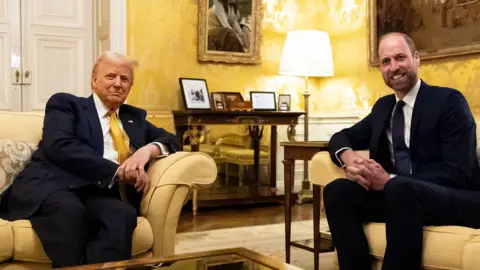
Prince William and Donald Trump had a meeting after the Notre Dame reopening
The Prince of Wales met US President-elect Donald Trump while visiting France for the ceremonial reopening of Notre-Dame cathedral.
Prince William joined other world leaders in Paris to mark the restoration of the world-famous landmark, which was devastated by a fire five years ago.
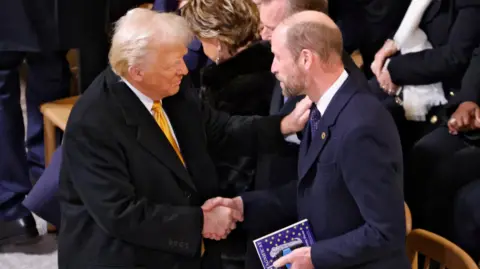
After shaking hands at the ceremony, the pair also met afterwards, with the president-elect describing the prince as a “good man” doing a “fantastic job”.
During the event, French President Emmanuel Macron delivered a speech in which he said of the restoration: “We must treasure this lesson of fragility, humility and will”.
Other leaders and dignitaries at the event included Ukrainian President Volodymyr Zelensky and outgoing US First Lady Dr Jill Biden, who was representing President Joe Biden.
Prince William was expected to discuss the importance of the US-UK “special relationship” with both Trump and the first lady during their respective meetings.
Greeting the prince at the ceremony, Trump gave William a pat on the shoulder before the two shook hands and spoke for a few seconds.
He last met Trump in 2019 when the then-president made a state visit to the UK.
William and Trump met at the residence of the British ambassador in Paris.
The prince was standing in the foyer when Trump arrived. The pair shook hands and greeted one another again, before Trump gestured to the Prince of Wales and said: “Good man, this one”.
Prince William asked the president-elect if he had warmed up, and Trump replied that he had and that “it was a beautiful ceremony”. The meeting lasted for about 40 minutes.
The prince had also been due to meetTrump and Dr Biden earlier in the day but Kensington Palace said he had been delayed by weather on his journey from the UK to France.
Reuters
Reuters
Prince William’s journey to the ceremony was delayed by stormy weather
At the ceremony, The Archbishop of Paris Laurent Ulrich led more than 1,500 guests through the reopening service.
A choir sang out as Macron took his seat next to Trump. A message from the Pope was read aloud before the French president delivered his address.
Parts of the event had to be reconfigured due to the stormy weather – with a concert that was due to take place on the esplanade actually being staged on Friday.
The prince’s last official trip to Paris was in 2017, when he visited with the Princess of Wales for a two-day trip in the aftermath of the Brexit result.
He joined other world leaders in Normandy earlier this year for the 80th anniversary commemorations of the Second World War D-Day landings.
The medieval cathedral has been closed since a major fire tore through it in 2019, destroying its wooden interiors before toppling its spire.
Getty Images
Some 600 firefighters battled the blaze for 15 hours. The main structure of the 850-year-old building was saved, including its two bell towers.
Macron set a five-year goal for the reconstruction of the Catholic church shortly after the fire.
An estimated 2,000 masons, carpenters, restorers, roofers, foundry-workers, art experts, sculptors and engineers worked on the project, which reportedly cost €700m (£582m).
Tickets for the first week of Masses in the cathedral sold out in 25 minutes, the cathedral’s rector said.
Royal charm offensive to help build bridges
Analysis by Sean Coughlan, royal correspondent
Prince William has been scrambled, like in his old air ambulance days, to rush to this meeting in Paris with President-elect Donald Trump.
Although what’s in need of rescue on this occasion is the well-being of the special relationship between the US and the UK.
It’s an important connection for both sides – and for wider military links such as Nato – but there’s not a lot of obvious empathy between Starmer’s Labour government and the incoming Republicans.
So the royals, who are funded by taxpayers, are being deployed to smooth the path, with Prince William taking on the statesman role, meeting Trump before attending the reopening of the Notre Dame cathedral.
Trump is a royal fan, so that might make for a more positive connection. Prince William last met Trump in 2019, during the then-president’s visit to the UK, where Trump spoke very enthusiastically about his meeting with the late Queen Elizabeth II.
But there’s a massive contrast in their styles. Prince William’s flagship project is his Earthshot environmental awards, while Trump has dismissed efforts to boost green energy as a “scam”.
This week Prince William went to serve dinner at the Passage homelessness charity and on Friday night he was helping with a “kindness tree” outside Westminster Abbey.
A kindness tree and campaigning on housing and climate-change aren’t exactly the ‘Make America Great Again’ style.
But the aim of this hurriedly-arranged meeting will be for a royal charm offensive to help build bridges at an uncertain time for western alliances.
As South Korea descends into political chaos, its equity market risks falling further behind major tech rival Taiwan, which is basking in the glory of the global artificial intelligence boom. A near 30% surge in Taiwan’s stock benchmark this year, set to be the best since 2009, has already helped spur a historic divergence between Asia’s two tech-dominated markets. The island’s market capitalization now exceeds South Korea’s by about $950 billion as the world’s AI frontrunners from Nvidia Corp. and Microsoft Corp. to OpenAI all increasingly turn to Taiwanese firms for supply. Looking ahead to next year, while both export-oriented economies face the risk of higher tariffs by incoming US President Donald Trump, many investors see Taiwan as less vulnerable given the reliance of American firms on its technology as well as its relatively better economic prospects. Such optimism, and a recent pickup in inflows into local stocks, also augur well for the Taiwanese dollar, which has fared better than the Korean won in 2024. “The structural theme of AI is likely to only get extended further, and this means we could see another year of Taiwan outperformance,” said Charu Chanana, chief investment strategist at Saxo Markets in Singapore. “The Korea discount may linger for longer given the recent political debacle, and the corporate governance reforms will have to be prioritized to get any closer to erasing this discount.” South Korean President Yoon Suk Yeol is fighting for his political life after his attempt to break an impasse in parliament by briefly imposing martial law backfired. The turmoil has cast a pall over the nation’s outlook and it also may impact the Corporate Value-Up program much touted by Yoon as a way to boost shareholder returns and eradicate the so-called Korea Discount, a term referring to the long depressed valuations of the country’s equities. Down more than 8% this year, the Kospi is one of the world’s worst-performing major equity indexes. Its underperformance versus Taiwan’s Taiex has deepened further this month. TSMC rules Taiwan’s equity-market outperformance has a lot to do with this year’s 80% surge in the shares of Taiwan Semiconductor Manufacturing Co., the world’s top advanced chipmaker that accounts for 37% of the benchmark’s weighting. The company is the major supplier of Nvidia and Apple Inc.’s most advanced chips. In contrast, shares of Samsung Electronics Co. — South Korea’s most-valued company — have been the biggest drag on its local market. Samsung’s stock has slumped 31% in Seoul this year on concerns that the firm is missing out on the AI boom due to slow progress on technological breakthroughs and lingering management woes. Overall, Taiwan’s exposure to AI goes far beyond TSMC: over 40 AI-related firms constitute about 73% of MSCI Taiwan’s index weighting, according to Goldman Sachs Group analysts. At 33%, Korea is a distant second in Asia and features SK Hynix Inc. and Samsung Electronics only. Analysts’ average earnings per share estimate for MSCI Taiwan has risen more than 33% this year to a record high, while that for MSCI Korea has declined 5% since a peak in August, Bloomberg compiled data shows. “If you think of Nvidia’s AI server market and so on, Taiwan is heavily involved in that value chain,” said Yan Taw Boon, portfolio manager at Neuberger Berman. “Conversely, Korea has not performed as strongly as they have very little involvement in this new booming environment.” Trump tariffs While the higher tariffs threatened by Trump are a universal challenge, there are reasons some investors believe that Taiwan’s treatment may be more nuanced and less punishing. “One will recall that many Taiwanese exports were exempt from tariffs last time around as they were key components of US tech supply chains,” JPMorgan Chase & Co. analysts including Rajiv Batra wrote in a note. “This time is likely to be the same with TSMC seen as a major part of the Global AI trade.” The Wall Street bank sees Taiwan relatively better positioned than Korea in a trade war with the US. Another buffer for Taiwanese equities is the growing presence of local investors, especially when the global investment climate turns more capricious. “Taiwan retail investors’ home bias and the still interesting AI ramp-up theme should continue to drive participation in the stock market,” said Vivian Pai, fund manager at Fidelity International. Their increased awareness of long-term investing can help form strong consistent inflows into local stocks, she added. The Taiwan dollar has weakened about 5% against the US currency this year while the Korean won has fallen around 9%. “Both Taiwan and Korea are exposed to tariffs but Taiwan’s underlying economic fundamentals are more solid,” said Eddie Cheung, a strategist at Credit Agricole CIB. “This should persist in 2025.”