WhatsApp is said to be developing a new feature for its Android app that lets users share music on status updates, as per the claims by a feature tracker. This functionality is speculated to allow users to search, select and search for the music, courtesy of Meta Platforms’ recent agreement with the Universal Music Group. They can tap on a new button that appears on the status update page to use this feature.
Sharing Music on WhatsApp Status Update
According to the WhatsApp feature tracker WABetaInfo, the messaging client is developing this feature for release on a future version of the app. It was spotted on the WhatsApp beta for Android version 2.24.22.11. Following its rollout, users may be able to pick the songs as per their preference and post them as a status update on WhatsApp.
Option to Add Music on WhatsApp Status Update Photo Credit: WABetaInfo
As per the screenshot (above), the feature is presented in the form of a music note as the first option on the status update page. Upon tapping it, a new user interface (UI) will appear where users can search for songs or specific artists. Once selected, the music is speculated to be automatically integrated into the status update. Users can then add photos or videos to personalise the status update even further. This feature is speculated to function similarly to the version present on other Meta Platforms apps such as Instagram and Facebook which allow adding music on status updates.
WABetaInfo claims that the new ability to share music on status updates on WhatsApp for Android is still in development and is not available to beta testers registered via the Google Play Beta program. A similar functionality is also claimed to be in development for WhatsApp for iOS.
However, it is crucial to note that while the instant messaging platform might be working on several new features for various platforms, not all of them make it to the public release.
Samsung has finally introduced its next-generation ultra-modern notebooks for the Indian market with the launch of its Galaxy Book4 series. Samsung has introduced three new models for the 2024 lineup – the Galaxy Book4 Pro, the Galaxy Book4 Pro 360, and the Galaxy Book4 360. The Book4 Series succeeds the previous Samsung Galaxy Book3 lineup of laptops, serving as the company’s premium offering within this segment. Much like the Galaxy Book3 range, these new laptops perfectly portray finesse and luxury.
Each laptop has cutting-edge hardware and features, making it the top choice in the premium laptop segment. With its lightweight form factor, immersive displays, and best-in-class hardware, the Galaxy Book4 series is here to slay the laptop segment. To discover the unique qualities of these newest laptops, be sure to read this article.
Galaxy Book4 Pro and Galaxy Book4 Pro 360
The latest 2024 Galaxy Book4 Pro series from Samsung will blow away your mind! The newest laptops are not just your regular ultrabooks but a pinnacle of notebooks. The Galaxy Book4 Pro series offers the ultimate screen experience with its 16-inch 3K Dynamic AMOLED 2X display. The screen provides unparalleled colours and saturations alongside a super-smooth 120Hz refresh rate for a best-in-class experience.
The ultra-smooth and super-responsive touchscreen makes the Galaxy Book4 Pro 360 and Galaxy Book4 Pro even more special. Moreover, with Galaxy Book4 Pro 360, you also get S Pen support, meaning you can glide between your projects, draw your favourite inspirations with great detail, or write a diary to let out your innermost thoughts. Moreover, the Vision Booster lets you view the best-quality display even in bright sunlight while enhancing colour reproduction.
The Samsung Galaxy4 Pro series also packs a punch when it comes to performance. The latest lineup of laptops are loaded with the latest Intel Core Ultra processors, delivering up to 7 per cent more performance than the 13th Raptor Lake Intel chipsets. The new line of Ultra processors also houses advanced NPUs onboard that deliver the next level of intelligent AI performance for different tasks. The laptops are also Intel Evo certified, meaning they will glide smoothly at all the heavy tasks you throw at them.
The Galaxy Book4 Pro and Galaxy Book4 Pro 360 are among the lightest ultrabooks available in the market, making an ideal choice for those always on the go. The latest laptops brings exceptional battery backup. Moreover, if you are low on battery, you can quickly charge up to 35 per cent in just 30 minutes.
The Galaxy Book4 360 is one of the sleekest and most lightweight laptops available on the market, with just 13.7mm thickness and 1.46 kg weight. The laptop is available in Grey colour option, which redefines premium look and feel.
The latest 2-in-1 laptop offers a super sharp 15.6-inch Super AMOLED display that delivers vivid colours and ultra-fast response time to get the best visual experience in this segment. Moreover, you get muti-touch gesture support with the response touchscreen. With S Pen support, you can now flip the screen, take notes, and draw your masterworks with great precision.
The Galaxy Book4 360 is a powerhouse that provides state-of-the-art performance with the latest generation of EVO-certified Intel Core processors. This, coupled with powerful Intel graphics, will never cause you to notice any lag or drop in performance while using this beastly machine. You may wonder if all these power-packed performances will quickly eat away the battery. However, it is quite the opposite. With the all-new Galaxy Book4 360, the battery can last throughout the day. Moreover, a mere 30-minute charge can deliver up to 39 per cent of battery.
Experience the Samsung Galaxy Ecosystem with Galaxy Book4 Pro Series and Galaxy Book4 360
The Galaxy Book4 series is so special and unique that you can get the maximum with your other Galaxy devices. With the Galaxy ecosystem, you can easily connect your smartphone and use it as a webcam to get the highest quality of video and the perfect angle during virtual meetings and more.
Talking about AI features, you can access an AI-powered Photo Remaster tool that lets you upscale your old and low-quality images to high-quality ones with simple taps. Moreover, the Samsung Studio makes editing videos on your laptop and Galaxy mobile more accessible. It brings out the masterpiece you always envisioned.
Apart from this, Buds Auto Switch to switch from one device to another; Multi-control to manage projects across devices; switch to dual-monitor experience with Galaxy Book4 and Galaxy Tab; quick share to transfer files at blazing high speeds; and more. These are some of the long list of features the all-new Galaxy Book4 Pro, Galaxy Book4 Pro 360, and Galaxy Book4 360 offer, making it your most reliable companion.
Disclaimer: T&C’s applied.
Affiliate links may be automatically generated – see our ethics statement for details.
An asteroid measuring roughly one metre in diameter impacted Earth’s atmosphere on October 22, 2024, only hours after its initial detection. Discovered by the Asteroid Terrestrial-impact Last Alert System (ATLAS) in Hawaii, the object — named 2024 UQ — approached the planet undetected by global impact monitoring systems before disintegrating over the Pacific Ocean off California’s coast. The European Space Agency’s (ESA) Near-Earth Object Coordination Centre later confirmed the event in its November newsletter, reporting that tracking data for the asteroid did not reach monitoring systems until after the impact had already taken place.
Limited Tracking Data Due to Detection Timing
According to ESA’s November newsletter, 2024 UQ had been picked up by ATLAS’ sky-monitoring telescopes. However, the asteroid was only identified as a moving object minutes before it entered Earth’s atmosphere due to its location between two adjacent sky fields in the survey system. This detection delay meant that essential tracking data was delayed and unavailable for impact monitoring centres, which track potential near-Earth object (NEO) threats. Confirmation of the asteroid’s impact was made possible by data from the National Oceanic and Atmospheric Administration’s (NOAA) GOES weather satellites and NASA’s Catalina Sky Survey, which recorded flashes that confirmed the entry of 2024 UQ.
Third Imminent Impact Event in 2024
This incident marked the third imminent impactor event in 2024. In January, a similar object designated as 2024 BX1 burned up over Berlin, while another asteroid, 2024 RW1, exploded above the Philippines in September, with footage of the fireball captured by local observers. These instances underscore the rarity yet growing frequency of small asteroids entering Earth’s atmosphere undetected.
Global Efforts to Monitor Near-Earth Objects
Planetary defence remains a priority as space agencies worldwide develop systems to track potentially hazardous objects. In addition to projects like ATLAS and the Catalina Sky Survey, NASA’s upcoming NEO Surveyor mission aims to use infrared technology to enhance detection capabilities. ESA’s NEO Coordination Centre continues its work on tracking near-Earth objects, while deflection experiments, including NASA’s DART mission in 2022, are also underway to test potential asteroid redirection strategies.
Microsoft is bringing a new strike-based enforcement program to Xbox, aimed at curbing toxic behaviour among its players. The company outlined its new measures in a blog post, with a systemic diagram that clears up any confusion regarding how punishments will be handed out based on infractions. Based on the severity of the offence, be it using slurs, hateful conduct, or even sending death threats, affected players can now report toxic behaviour, triggering a response from the moderation team, who will investigate the issue. The new system will see players receiving strikes, going all the way up to eight, after which they will be barred from using Xbox multiplayer services like messages and voice chat.
With the previous ban system, it was quite confusing for players as to why some bans were resolved within a day, while others took weeks or even months to settle down. For now, it’s a bit unclear how Xbox determines the severity of a strike, but starting now, every player in its gaming ecosystem will start with a clean slate, devoid of strikes. The punishments based on strikes scale in increasing order, with longer penalties issued to those who failed to maintain good behaviour despite being suspended once. As mentioned before, Xbox has released a diagram that best explains this, with things like the use of profanity or cheating in-game amounting to one strike each. Both the first and second strikes will ban you from using Xbox online services for a day, while the third strike suspends you for three days. When it eventually adds up to eight days, players will be banned for an entire year.
Here’s how strikes will eventually stack up against your Xbox account Photo Credit: Xbox
All strikes stay on your profile record for six months, so if you don’t want strikes to stack up over time, it’s best to calm down on the toxicity. Also, upon being banned, affected users will be able to see their enforcement history, which details the strike count, reasoning, active suspension’s start and end date, and a link to Xbox’s community standards. Any completed and expired suspensions will also show, though I’m assuming the latter is merely for your record once you’ve built a clean slate. That said, Xbox assures that players will always have the ability to submit an appeal for any enforcements that have been issued against them. And if the punishment is reversed, the strike goes away as well.
Xbox has assured that all reports are carefully evaluated and that no automated enforcement will be enacted based on a simple report. “In 2022, fewer than 1 percent of all players received a temporary suspension, and only one-third of those received a second. Our data shows us that players typically stop inappropriate behaviour after one enforcement, quickly learning what is and is not acceptable based on the Xbox Community Standards and how to better engage on our platform,” Dave McCarthy, CVP, Xbox Player Services said in the blog post.
“The strike system is designed to further empower players to engage positively and appropriately on Xbox and with the community.”
Affiliate links may be automatically generated – see our ethics statement for details.
OnePlus has announced Diwali offers across its product categories as the festive season approaches. From smartphones, tablets, smartwatches, and earbuds, the discount sale has something in store for everyone. The sale is currently live and will last till November 5. The OnePlus Nord 4, OnePlus Nord CE 4, and OnePlus 12R are listed with discounted prices. Besides a general price cut, OnePlus devices can be purchased with no-cost EMI options and bank discounts.
OnePlus Diwali Sale in India
OnePlus’s ‘MakeitSpecial’ Diwali sale is currently live in India. As part of the sale buyers can purchase OnePlus products with discounted rates from the OnePlus India website, OnePlus Experience Stores, and Amazon. Shoppers can also avail of these discounts while purchasing devices from offline stores including Reliance Digital, Bajaj Electronics, Croma, Vijay Sales, Poorvika, Sangeetha Mobiles, Pai Electronics, Big C Mobiles, and Lot Mobiles among others. The festival sale will end on November 5.
The OnePlus Nord 4 can be grabbed for Rs. 25,999 (including a bank discount of Rs. 2,000) instead of the original launch price of Rs. 29,999. No-cost EMI options are available for up to nine months with select bank cards. Similarly, the Snapdragon 7 Gen 3 SoC-powered OnePlus Nord CE 4 is available for Rs. 20,999 (including a Rs. 1,500 bank discount), down from the launch price of Rs. 24,999. Buyers can opt for a three-month-cost EMI option.
In the ongoing sale, the base variant of the OnePlus 12R can be purchased for Rs. 32,999 after applying Rs. 4,000 flat off and Rs. 3,000 instant bank discount. It was launched with a price tag of Rs. 39,999 for the base 8GB RAM +128GB storage configuration.
The OnePlus Pad Go is available for Rs. 14,999, instead of the launch price of Rs. 19,999. Similarly, the OnePlus Nord Buds 3 and Nord Buds 3 Pro are retailing for Rs. 2,099 and Rs. 2,499, respectively. The OnePlus Watch 2R is listed with a price tag of Rs. 12,999, instead of Rs. 17,999.
OnePlus 12, OnePlus Pad, and OnePlus Watch 2 are also getting discounts during the sale and are available for purchase at a starting price of Rs. 54,999, Rs. 33,999, and Rs. 16,999, respectively.
Affiliate links may be automatically generated – see our ethics statement for details.
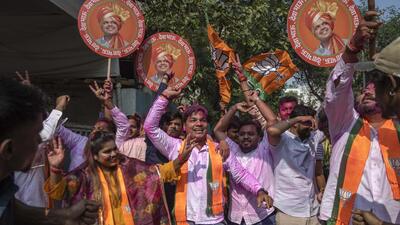
The Bharatiya Janata Party-led Mahayuti won 235 seats out of 288 assembly constituencies in Maharashtra, with the BJP winning 132 out of 149 seats, with a strike rate of 88.5%; Its allies Shiv Sena and Nationalist Congress Party contested 81 and 59 seats respectively and won 57 and 41 seats.
BJP workers celebrated the party’s victory in Mumbai on Saturday. (HT photo)
If the results were surprising – in terms of magnitude, if not direction – then attribute it to the summer Lok Sabha elections, when Mahayuti could win only 17 of the state’s 48 seats, with the opposition, Maga Vikas Aghadi, winning. 30.
If the results were surprising, attribute it to the fact that Mahayuti was outgoing, facing allegations of poor governance and mismanagement.
And if the results were surprising, base it on the fact that Mahayuti came to power after the BJP caused a split in the Shiv Sena, and it consolidated power by causing another split in the Nationalist Congress Party, and many experts believe The point was that the eccentric coalition-building had disappointed some voters.
But Mahayuti surprised everyone.
Because it campaigned much better than the MVA, not only in terms of issues but also in terms of managing alliance dynamics.
Party leaders attributed the victory to Mahayuti’s welfare schemes, especially the Ladki Bahin scheme, which was launched in August, and which gives Rs 1,500 to eligible female beneficiaries. They attribute this victory to the BJP’s move to double down on its Hindutva agenda, consolidating Hindu votes across different classes and communities. They attribute this to an efficient and area-specific campaign, which addressed hot-button local issues. And they attribute this to the role played by the BJP’s ideological parent Rashtriya Swayamsevak Sangh, which was conspicuous by its absence during the Lok Sabha campaign.
Preparation
Within days of the June 4 Lok Sabha election results being announced, preparations for the Maharashtra battle began in full swing, leaving the BJP nervous. Within days, the party met state-level leaders to understand what went wrong, according to a senior party functionary on condition of anonymity. Within a fortnight, on 17 June, the party announced state in-charges to oversee the election campaign. The party chose Union ministers Bhupendra Yadav and Ashwini Vaishnav as state in-charge.
“The main reasons for the poor performance were apathetic and demotivated cadre, internal fissures and the challenges of leading the coalition; Another important reason was the separation between the Sangh (RSS) and the party,’ the functionary said.
Union Home Minister and BJP’s chief election strategist Amit Shah met state leaders in several closed-door meetings and in a meeting on July 21, he is believed to have stressed that the fight will be between alliances.
“There was a whisper campaign that forging an alliance with Ajit Dada (Ajit Pawar’s NCP) would harm the party, and there was a group that felt Uddhav Thackeray (of Shiv Sena-UBT) would go away with the sympathy vote. BJP was seen as the driving force behind the split in the party. Then Shah said in a brief message that the story would be decided by the BJP and it would be Mahayuti versus MVA,” said the official quoted above.
To ensure this message, Shah and party chief JP Nadda met workers from every sector.
“Shah addressed more than 10,000 workers directly,” the official said.
To counter voter apathy and apathy among workers, the party reset its booth management program, focusing on smaller communities. “Across the state, we held meetings with voters from smaller caste groups (from SC and OBC categories), in which 200 to 250 people were in attendance. There was a new approach for both SC and OBC voters,” said a second functionary on condition of anonymity.
The party also identified those booths where it had lost by small margins and set a target of increasing its vote share there to 15%.
And in each case, the party chose the issues it believed would have the greatest impact on the grassroots.
“We studied caste, party affiliation and issues in each constituency to design a campaign that would resonate most,” said the second official.
role of rss
After differences between the party and the Sangh were resolved, the BJP decided to run its election campaign on the twin poles of development (which includes welfare) and ideology. While on one hand it showcased huge infrastructure projects like Atal Setu and policies for empowerment of women and farmers, on the other hand it echoes the ‘Ek Hai To Surakshit Hai’ (We are safe as one) theme raised by the Prime Minister. Walk with. Minister Narendra Modi at a rally in the state.
Political observers said the emphasis on Hindutva was to counter calls for a caste census by the opposition, especially the Congress; Both the BJP and the RSS stressed that it was a call for unity of the larger Hindu community in the interest of peace and national security.
A senior RSS functionary, speaking on condition of anonymity, said, “Why call it polarisation…this is the unification of Hindus who were divided on the basis of caste.” He said RSS volunteers were active on the ground, were creating “awareness” of the issues, motivating voters to cast their ballots and countering the opposition’s “false narrative”.
“The volunteers conducted public awareness (door-to-door visits) and addressed small meetings to create awareness about issues important for India’s development and security…” the official said.
The Union’s vast network of foot soldiers was used to promote the party’s campaign to highlight the “failures and misdeeds” of the opposition such as the Emergency; Genocide against Sikhs in 1984 and demand for restoration of Article 370 in Jammu and Kashmir.
“Despite predictions of a major defeat in Haryana, (BJP’s) victory is an encouragement to the workers who were motivated to give their best,” the RSS functionary said.
The union’s renewed efforts also ensured that voters came to vote that day. “About 4-5% of BJP’s committed voters did not show up in the Lok Sabha elections…this time we have left no stone unturned to ensure that the problem does not happen again,” another BJP functionary said.
Maharashtra recorded a voter turnout of 66.05%, which was 4.5 percentage points higher than the Lok Sabha elections, and 4.5 percentage points higher than the 2019 assembly elections. Interestingly, the turnout percentage of female voters was 65.22% – a sign, analysts say, that the girl sissy scheme was working.
target the opposition
And when Mahayuti went public with its “good governance record”, it launched a simultaneous campaign to “defame” the opposition.
Thus, the BJP accused Uddhav of moving away from Hindutva, which his father Bala Saheb had championed, and it portrayed Sharad Pawar’s party as a dynastic entity.
“The same day the Congress released its manifesto, the BJP ran advertisements in Himachal Pradesh, Karnataka and Telangana highlighting the failures and unfulfilled promises of the Congress,” a third party leader said on condition of anonymity.
“Thackeray’s alliance with the Congress, his decision to become CM, his appeasement of Muslims, all this was against Balasaheb’s views…it became a rallying issue against him during the campaigns,” said a third leader. To answer the question who would be the face of the grand alliance, the party put forward three faces, Eknath Shinde, Ajit Pawar and Devendra Fadnavis, as the three pillars of the alliance and sidelined the thorny issue of the chief ministerial candidate.
Party officials aware of the details said the party was unable to achieve this in Jharkhand because it failed to woo tribal communities in the absence of a strong local leader. The BJP on Saturday accepted defeat from the Jharkhand Mukti Morcha (JMM)-led alliance and won 21 of the 68 seats it contested.
According to senior party leaders, although the party’s election story was more inclined towards ideological issues which had resonance across the state, the party failed to project a local face to take on JMM’s Hemant Soren.
“The central leadership identified two strong leaders to oversee the elections, who have a record of winning elections, Union Minister Shivraj Singh Chouhan and Assam Chief Minister Himanta Biswa Sarma, but it failed to project a strong local leader, Who can compete with Soren,” said. A party official.
With the share of tribal voters in Jharkhand’s population being 26.21%, BJP took all steps to win 28 ST-reserved seats, but could win only 1 of the 25 seats it contested. In 2019, the BJP, which contested 79 seats, won two of these 28, while its total was 25 with a vote share of 33.37%.
The party’s attempt to woo the tribal vote bank by including Champai Soren in the party also yielded no results. “There was a section of leaders in the state who suggested Soren to form his own party, which would have helped in denting JMM’s vote share,” the leader said.
social media
Even the coalition’s social media strategy was designed to ensure that coalition partners appeared in sync with each other. Around 30 broad issues including infrastructure, women, farmers, employment and internal security were identified for the social media campaign. Of these, eight were region-specific. Apart from the party’s own social media handles, third party handles on platforms like YouTube were given details of the issues that needed to be raised.
Like Haryana, the party also avoided making the election a battle of personalities, avoided excessive reliance on the PM and focused on leveraging boots on the ground to retain power.
“Ultimately the BJP was able to balance the politics of indirect benefits (development and infrastructure) and direct benefits (doles and concessions) and tap into the goodwill of women, who is a game changer,” said another functionary.
Beirut strike ‘so powerful it was felt across the city’
A massive Israeli air strike on central Beirut has killed at least 20 people, Lebanese officials say, in the latest attack on the capital amid an escalation of Israel’s campaign against Hezbollah.
The strike happened without warning at about 04:00 (02:00 GMT) on Saturday, and was an attempt to assassinate a senior Hezbollah official, Israeli media reported.
The attack was heard and felt across the city, and destroyed at least one eight-storey residential building in the densely populated Basta district.
Lebanon’s National News Agency said a so-called bunker buster bomb was used, a type of weapon previously used by Israel to kill senior Hezbollah figures, including former leader Hassan Nasrallah.
The death toll rose from 15 to 20 on Saturday as emergency workers used heavy machinery to remove the rubble and retrieve bodies.
The Lebanese health ministry said more than 60 peoplehad been wounded, and that the number of victims was expected to rise as DNA tests would be carried out on body parts that had been recovered.
“It was a very horrible explosion. All the windows and glasses were over me, my wife and my children. My home now is a battlefield,” said 55-year-old Ali Nassar, who lived in a nearby building.
“Even if one person is hiding here…Should you destroy buildings where people are sleeping inside? Is it necessary to kill all the people for one person? Or we’re not humans? That’s what I’m asking.”
According to the Israeli public broadcaster Kan, the attack was an attempt to kill Mohammed Haydar, a top Hezbollah official. Hezbollah MP Amin Sherri said none of the group’s leaders were in the building hit, and Haydar’s fate remained unclear.
The Israel Defense Forces (IDF) has not commented.
Also on Saturday, the IDF carried out further air strikes on the Dahieh, the area in southern Beirut where Hezbollah is based, saying they were buildings linked to the group.
Israeli attacks have also hit the south, where an Israeli ground invasion is advancing, and the east, where air strikes in the city of Baalbek killed at least 15 people, including four children, the Lebanese health ministry said.
Getty Images
Lebanese officials say a ‘bunker buster’ bomb was used in the strike
In the past two weeks, Israel has intensified its campaign against Hezbollah, the Iran-backed militia and political movement, amid international efforts for a ceasefire, in what appears to be a strategy to pressure the group to accept a deal.
The escalation comes as renewed negotiations to end more than one year of conflict showed initial signs of progress. This week, Amos Hochstein, who has led the Biden administration’s diplomatic efforts, held talks in Lebanon and Israel to try to advance a US-drafted deal.
Since the conflict intensified in late September, Lebanese authorities have said any deal should be limited to the terms of United Nations Security Council Resolution 1701, which ended the 2006 war between Hezbollah and Israel.
The resolution includes the withdrawal of Hezbollah’s fighters and weapons in areas between the Blue Line – the unofficial frontier between Lebanon and Israel – and the Litani river, about 30km (20 miles) from the boundary with Israel.
Israel says that was never fully respected, while Lebanon says Israeli violations included military flights over Lebanese territory.
Getty Images
The strike happened in the early hours of Saturday with no warning
The proposal, according to a Western diplomat who spoke on condition of anonymity, includes a 60-day ceasefire which would see the withdrawal of Israeli forces from southern Lebanon and the removal of Hezbollah’s presence from the area. The Lebanese military would then boost its presence there, with thousands of extra troops.
But disagreements over some elements remained, the diplomat added, including about the timeline for an Israeli pull-out and the formation of an international mechanism to monitor the agreement.
Both Hezbollah and Iran have indicated being interested in a deal, according to a senior Lebanese source. After the initial shock, the group has reorganised itself, and continues to carry out daily attacks on Israel, though not with the same intensity, and confront invading Israeli soldiers.
On Wednesday, Hezbollah’s Secretary General Naim Qassem said the group had received the US proposal, clarified its reservations, and that it was allowing the talks to go ahead to see if they produced any results. The conditions for a deal, he said, were a complete cessation of hostilities and the preservation of Lebanon’s sovereignty, warning that Hezbollah was ready for a long fight.
Israel’s stated goal in its war against Hezbollah is to allow the return of about 60,000 residents who have been displaced from communities in northern Israel because of the group’s attacks.
In Lebanon, more than 3,670 people have been killed and at least 15,400 injured since October 2023, according to Lebanese authorities, with more than one million forced from their homes.
Additional reporting by Dearbail Jordan and Jaroslav Lukiv in London
The MSI Claw has been launched and is now available to buy in the US and a few other select markets. The handheld gaming PC was first unveiled at CES 2024 in January as a new entrant into the handheld gaming space. The MSI Claw will compete with the Steam Deck, Asus ROG Ally, Lenovo Legion Go and other handhelds in a burgeoning product category. The base variant of the handheld, A1M-052US, comes with the Intel Core Ultra 5-135H processor and runs on Windows 11 Home. There are two higher-end variants, as well, powered by Core Ultra 7 processor, which will be available to buy on March 12.
MSI Claw price, availability
The base variant MSI Claw A1M-052US with Core Ultra 5 chip and 512GB SSD storage is priced at $699 (roughly Rs. 57,793) in the US. Meanwhile, the A1M-051US and the A1M-050US variants with Core Ultra 7 chipset and 512GB and 1TB SSD storage, are priced at $749 (roughly Rs. 61,933) and $799 (roughly Rs. 66,067), respectively. The base model is currently up for sale in a single Black colourway on the MSI store in the US and select retailers in other markets.
MSI Claw specifications
The MSI claw handheld sports a 7-inch full-HD (1,920×1080 pixels) IPS touchscreen display with 500nits of peak brightness and 120Hz refresh rate. It is powered by the Intel Core Ultra 7-155H processor, running Windows 11 Home out-of-the-box.
MSI’s handheld comes with 16GB of LPDDR5 RAM and up to 1TB NVMe PCIe Gen4 SSD storage, which can be expanded via a MicroSD card slot. The MSI Claw comes with Intel Arc graphics. Connectivity options on the handheld include Wi-Fi 7, Bluetooth 5.4, a Thunderbolt 4 enabled USB Type-C port, and a 3.5mm headphone/mic combo jack.
It also comes with dual speakers, RGB ABXY buttons and thumb sticks, a D-pad, triggers, bumpers, HD haptics and a fingerprint scanner. The handheld boasts a Cooler Boost HyperFlow technology for heat management during gaming. It packs a 6-cell, 53WHr battery with 65W USB PD 3.0 charging support. The MSI Claw measures 294 x 117 x 21.2mm in size and weighs 675g.
Affiliate links may be automatically generated – see our ethics statement for details.
The discovery of amber in Antarctica has been reported for the first time, as detailed in a recent study published in Antarctic Science. Dr. Johann Klages from the University of Bremen, alongside a team of researchers, uncovered this specimen in sediment cores from the Pine Island trough in West Antarctica. This ancient amber, originating from approximately 83 to 92 million years ago during the mid-Cretaceous period, offers valuable insights into prehistoric environmental conditions near the South Pole.
Unveiling the First Antarctic Amber
The study was published in Antarctic Science journal and reveals that the amber, known as Pine Island amber, was retrieved using the MARUM-MeBo70 drill rig during a 2017 expedition on the RV Polarstern vessel. This mid-Cretaceous resin is considered a significant breakthrough as it suggests that a swampy temperate rainforest, dominated by coniferous trees, thrived in the region during a much warmer period in Earth’s history. According to Dr. Henny Gerschel from the Saxon State Office for the Environment, Agriculture and Geology, the amber likely contains tiny fragments of tree bark, preserved through micro-inclusions. Its solid, translucent quality indicates that it was buried close to the surface, protecting it from thermal degradation.
Insights into Prehistoric Forest Ecosystems
The presence of pathological resin flow within the amber offers clues into the defence mechanisms used by ancient trees against environmental stressors like parasites or wildfires. “This discovery hints at a much richer forest ecosystem near the South Pole during the mid-Cretaceous,” Dr. Klages explained, noting the resin’s defensive chemical and physical properties that protected it from insect attacks and infections.
Reconstructing Ancient Antarctic Environments
The amber’s discovery marks a key step in reconstructing ancient polar climates, supporting the idea that temperate forests once spanned across all continents. Researchers aim to explore further by analysing whether signs of past life are preserved in the amber. This study, beyond unearthing Antarctic amber, opens new opportunities to deepen understanding of Earth’s climatic past and the adaptability of prehistoric ecosystems.
Starfield has finally gone gold ahead of its release next month, indicating that main development on the game has ended and that it’s ready to hit store shelves soon. As such, developer Bethesda has confirmed preload details for its expansive space-set RPG, with Xbox Series S/X receiving early treatment on August 17. Meanwhile, PC players on Steam can begin pre-installing the game in anticipation, starting August 30. Additionally, the game will be available to play for free to those who’re subscribed to Xbox Game Pass, though access for them will begin on launch day i.e., September 6.
Leading up to the release, lead game designer Emil Pagliarulo and lead quest designer Will Shen also held a Q&A session on Starfield’s Discord server (via ResetEra), revealing some interesting details such as the inclusion of a jail system. Just like The Elder Scrolls V: Skyrim, performing sketchy acts such as smuggling contraband can get you in trouble with law enforcement of the galaxy. Upon being caught, you’ll be presented with two main options to deal with the situation: you can either pay the required fine when apprehended or get thrown into jail. And of course, there is the third alternative, which is to blast your way through them and go on the run. Those looking for smooth sailing, however, can invest in spaceship parts and modules that help conceal those illegal items, as you get past security.
The items themselves have a set price in Starfield’s universe but can be sold for a profit if you have the right skills unlocked. That money can then be spent on property located in major cities or you can complete specific quests that grant homes as a reward. An interview from last year revealed that Bethesda is heavily leaning on character customisation in this game — to the extent that picking up the ‘Kid Stuff’ trait makes it so your in-game parents resemble your appearance. The developers weren’t entirely clear in what capacity parents would be involved in Starfield, but noted that the feature is quite similar to Fallout 3 and Fallout 4. Another feature derived from Fallout is the Persuasion system, which can be used to avoid confrontations by smooth talking your way through, albeit Bethesda confirmed that a full pacifist playthrough isn’t ‘totally feasible.’
Just like previous Bethesda RPGs, Starfield presents companions who would tag along for the ride — in this case, over 20, all of whom are named and have unique backstories. The Q&A also confirmed that while real-world religions are present within the game’s universe, the focus is mostly on the three fictional ones. We’ve got the Sanctum Universum, which preaches that God is somewhere out there in the wider universe; a group of atheists who called themselves The Enlightened; and The Great Serpent, who is worshipped by mysterious citizens.
Starfield is out September 6 on PC and Xbox Series S/X. Preloading on Xbox begins on August 17, while PC (Steam) players can start on August 30.
Affiliate links may be automatically generated – see our ethics statement for details.