

Friday, September 25, 2026
Home Blog Page 7450

Top pro-democracy leaders jailed for subversion

0


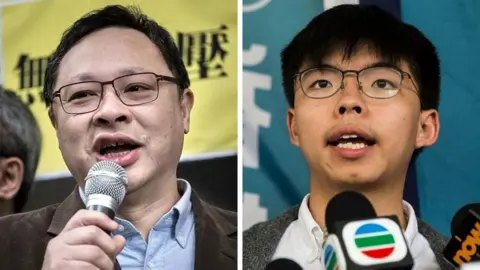
Getty Images Pro-democracy leaders Benny Tai (left) and Joshua Wong (right) were among those sentenced for subversion on TuesdayGetty Images

Benny Tai (left) was jailed for 10 years and Joshua Wong (right) for four

A Hong Kong court has sentenced dozens of pro-democracy leaders to years in jail for subversion, following a controversial national security trial.

Benny Tai, 60, and Joshua Wong, 28, were among the so-called Hong Kong 47 group of activists and lawmakers who were involved in a plan to pick opposition candidates for local elections.

Tai received 10 years while Wong received more than four years. A total of 45 people were jailed for conspiring to commit subversion. Two of the defendants were acquitted in May.

This was the biggest trial under the national security law (NSL) which China imposed on the city shortly after explosive pro-democracy protests in 2019.

Beijing and Hong Kong’s government deny this, arguing instead that the NSL is necessary to maintain stability. They also say these sentences serve as a warning for those trying to undermine China’s national security.

“No one can engage in illegal activities in the name of democracy and attempt to escape justice,” China’s foreign ministry said on Tuesday. It also said that it was “firmly opposed” to Western countries “undermining the rule of law in Hong Kong”.

‘Their families are devastated’

The city’s pro-democracy campaigners reacted to the sentences with disappointment and sadness.

“We are very distressed and their families are devastated,” Emily Lau, former chair of the Democratic Party of Hong Kong, told the BBC’s Today programme.

She added that she and many others were not able to enter the courtroom because it was full. Tuesday’s hearing attracted huge interest from Hongkongers, dozens of whom queued up outside days before to secure a spot in the public gallery.

Many of the 45 people on trial were icons of Hong Kong’s protest movement. Tai, a law professor, shot to fame as a key leader back in 2014, Wong was still a teenager when he took to activism, and Gwyneth Ho, a young former journalist, was admitted to hospital after a mob attack during the 2019 protests.

Veteran former lawmakers such as Claudia Mo and Leung Kwok-hung, also known as Long Hair, spent much of their careers fighting for a freer Hong Kong, and first-time activists such as Owen Chou and Tiffany Yuen stormed the legislative council in what was a defining moment for the protests.

All of them were in court in a rare public appearance as many have been in jail since their arrest in early 2021 because pre-trial detention is common under the NSL.
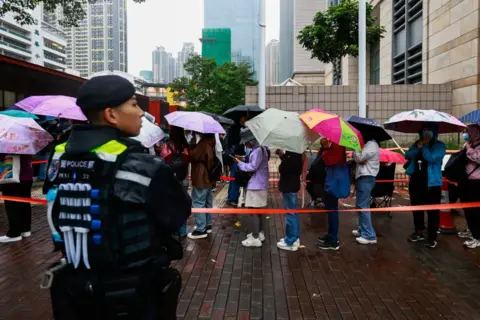
Getty Images Heavy police presence is seen as huge crowds queue up for public gallery seats, ahead of a sentencing hearing for 45 pro-democracy activists, outside a court in Hong Kong, China, on November 19, 2024. Getty Images

A heavy police presence was seen as huge crowds queued up for public gallery seats

Standing in line on Tuesday was Lee Yue-shun, one of the two defendants acquitted. He told reporters he wanted to urge Hongkongers to “raise questions” about the case, as “everyone has a chance to be affected” by its outcome.

There were several activists waiting to enter court. Bobo Lam, who was once arrested under the NSL, said he was showing up to support friends who are now in jail and “let them know, that there are still many HongKongers who haven’t forgotten them”. Others seemed heartened by how many people had showed up, suggesting they “remember what happened”.

An elderly woman, Regina Fung, chanted “everybody hang in there, stand for Hong Kong” before the hearing. “It’s very sad, even the weather in Hong Kong is miserable today,” she said.

Inside the courtroom, family members and friends waved from the public gallery to the defendants, who appeared calm as they sat in the dock. Some in the gallery had tears in their eyes as the sentences, ranging from four to 10 years, were read out.

Tai, a former law professor who came up with the plan for the unofficial primary, received the longest sentence with judges saying he had “advocated for a revolution”.

Wong had his sentence reduced by a third after he pleaded guilty. But unlike some other defendants, he was not given further reductions as judges “did not consider him to be a person of good character”. At the time of the arrests, Wong was already in jail for participating in protests.

In court, Wong shouted “I love Hong Kong” before he left the dock.

As Leung’s wife, activist Chan Po-ying, walked out of the court at the end of the hearing, she was heard chanting a protest against his jail term.

The ‘illegal’ primary

The UK government said those sentenced had been “exercising their right to freedom of speech, of assembly and of political participation”.

“Today’s sentencing is a clear demonstration of the Hong Kong authorities’ use of the NSL to criminalise political dissent,” a UK government statement said.

The US has described the trial as “politically motivated”. Australia said it had “strong objections” to the use of the NSL and it was “gravely concerned” by the sentencing of one of its citizens, Gordon Ng.

The ruling comes a day after UK Prime Minister Sir Keir Starmer met with China’s Xi Jinping at the G20 summit – a meeting which saw him raise the case of Jimmy Lai, the billionaire pro-democracy activist on trial for treason.

Asked directly about Tuesday’s ruling, he defended pursuing closer ties with Beijing, saying that while it was “important” to be “open… and talk about our disagreements”, it was also in the “national interest” to have a” serious and pragmatic relationship” with China.

“I certainly hope the British government, the prime minister, will stand up for the rights that they promised the Hong Kong people. All these promises, these rights and rule of law are evaporating,” Ms Lau told the BBC. She asked why organising an election should warrant jail time.

After the 2019 protests dwindled with the Covid pandemic, the defendants organised an unofficial primary for the Legislative Council election as a way to continue the pro-democracy movement.

Their aim was to increase the opposition’s chances of blocking the pro-Beijing government’s bills. More than half a million Hongkongers turned out to vote in the primary held in July 2020.
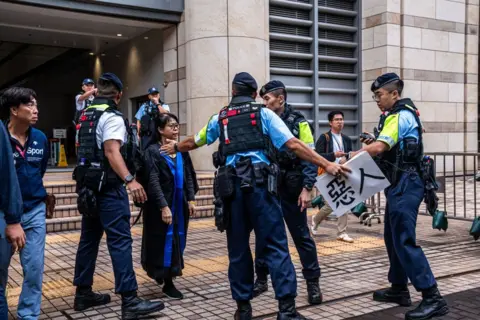
Getty Images Police officers remove a protest banner from Elsa Wu, the foster mother of one of the defendants Hendrick Lui, as she leaves the West Kowloon Court following a sentencing hearing for 45 pro-democracy activists in Hong Kong, China, on Tuesday, Nov. 19, 2024.Getty Images

Police officers confiscated a protest banner from a relative of one of the defendants as she left the court

Organisers argued at the time that their actions were allowed under Hong Kong’s Basic Law – a mini-constitution that allows certain freedoms.

But it alarmed Beijing and Hong Kong officials, who warned that the move could breach the NSL, which came into effect days before the primary. They accused the activists of attempting to “overthrow” the government, and arrested them in early 2021.

The trial judges agreed with the prosecution’s argument that the plan would have created a constitutional crisis.

‘National security is the priority’

“Central authorities are using the trial to re-educate the Hong Kong people,” said John P Burns, emeritus professor at the University of Hong Kong. The lesson being “national security is the country’s top priority; don’t challenge us on national security’”.

“The case is significant because it provides clues to the health of Hong Kong’s legal system,” he told the BBC. “How can it be illegal to follow processes laid down in the Basic Law?”

A Human Rights Watch spokesperson said that China and Hong Kong “have now significantly raised the costs for promoting democracy in Hong Kong”.

Stephan Ortmann, assistant professor of politics at the Hong Kong Metropolitan University, agreed. Tuesday’s sentencing “set a precedent for the severity of punishments for political dissent under the NSL”, adding that “self-censorship has become the norm”.

But this isn’t a win for Beijing, said Sunny Cheung, an activist who ran in the 2020 primary but has since fled to the US. “They might be happy in a way because the entire opposition is being wiped out… but they don’t have the trust of the people.”

Others, like Ms Lau, said the city had already lost more than a generation of pro-democracy campaigners.

There has been “no permission for marches and demonstrations in the past few years – it’s very, very quiet, very peaceful,” she said.

“But that’s not Hong Kong. If you have been to Hong Kong, you know it is a city of protest. Very colourful, very vibrant, but not any more.”


Out of Gaza

0


We photographed badly wounded Gazans who made it out for treatment. Many can think of little but the dead they left behind. “We wanted to go with them, too,” one child told us.


More than 200 children killed in Lebanon amid Israeli bombardment: UN | Israel attacks Lebanon News

0


Three children have been killed daily in Lebanon over the past two months, UNICEF reports, as it urges action to stop the violence.

More than 200 children have been killed in Lebanon since Israel launched a military campaign focused on its northern neighbour two months ago, the United Nations agency for children (UNICEF) has said.

An average of three children have been killed every day in Lebanon, UNICEF told reporters on Tuesday, as Israel has intensified its bombing campaign across the country. It warned that as in Gaza, despite the horrific toll on Lebanon’s children “those with influence” were failing to mount a meaningful response.

“Despite more than 200 children killed in Lebanon in less than two months, a disconcerting pattern has emerged: their deaths are met with inertia from those able to stop this violence,” UNICEF’s spokesperson James Elder told reporters.

“For the children of Lebanon, it has become a silent normalisation of horror,” he added.

Elder listed at least six attacks across Lebanon where children were killed, most of the time along with their families, over just the past 10 days.

The UN official noted “chilling similarities” between what is happening to children in Lebanon with those in Gaza, which has been pounded by Israeli air raids for more than a year.

At least 17,400 children have been killed in Gaza, according to the Palestinian Ministry of Health.

“In Lebanon, much the same as has become the case in Gaza, the intolerable is quietly transforming into the acceptable. And the appalling is slipping into the realm of the expected,” the UNICEF official said.

As in the besieged Strip, hundreds of thousands of children in Lebanon are now homeless; schools remain closed due to widespread attacks; signs of emotional turmoil are evident and no meaningful response has been put in place, Elder said.

According to the Lebanese Ministry of Public Health, 231 children are among 3,452 people killed since the start of the war. Of the 14,664 people wounded, 1,330 of them are children.

Israel had been swapping low-level strikes across its northern border with the armed group Hezbollah, which began firing rockets into Israel in October last year as a show of support for fellow Iran-linked group Hamas.

Hamas’s attack on Israel, which killed about 1,139 people and saw about 250 captives seized, was followed by Israel’s onslaught on Gaza, which has now killed nearly 44,000 Gazan Palestinians.

However, Israel renewed the intensity of its offensive in Lebanon in late September, after widening its war goals to include the destruction of Hezbollah infrastructure and the return of 60,000 Israelis to their homes in the north.

Israeli authorities say its aim is to dismantle Hezbollah, yet the army’s shelling has killed thousands of civilians and at least 200 healthcare workers. Hezbollah has also continued to fire rockets striking deeper into Israeli territory, including Tel Aviv.


Furious row at UN as Russia blocks peace move

0


In a move strongly condemned by the UK and US, Russia has vetoed a draft UK-backed UN Security Council resolution calling for a ceasefire in Sudan.

British Foreign Secretary David Lammy called the veto a “disgrace”. But Russia accused the UK of meddling in Sudanese affairs without involving Sudan itself.

Sudan’s 19-month civil war is believed to have led to the deaths of tens of thousands of people. More than 11 million have been forced from their homes.

Aid workers say the conflict has created the world’s worst humanitarian crisis, with many thousands at risk of famine.

Sudanese activists have been highly critical of the UN for being slow to respond to the conflict.

It began in April last year after the army and a powerful paramilitary group, the Rapid Support Forces (RSF), began a vicious struggle for power.

The military is in control of the government.

Monday’s draft resolution, proposed by the UK and Sierra Leone, called on both sides to immediately halt hostilities and start talks aimed at agreeing a national ceasefire.

It also called on the army and RSF to respect previous agreements to protect civilians, but specifically mentioned RSF attacks in the western region of Darfur and elsewhere in the country.

Sudan’s representative at the UN said that clauses that it wanted in the text were not included.

Aside from Russia, all the other 14 Security Council member states voted in favour of the draft, but the veto meant the resolution did not pass.

“This Russian veto is a disgrace and it shows to the world yet again Russia’s true colours,” Lammy told the meeting in New York.

“I ask the Russian representative in all conscience sitting there on his phone. How many more Sudanese have to be killed? How many more women have to be raped? How many more children have to go without food before Russia will act?”

US ambassador to the UN Linda Thomas-Greenfield was equally outspoken, accusing Russia of obstructing moves “to address the catastrophic situation in Sudan, and playing both sides – both sides of the conflict to advance its own political objectives, at the expense of Sudanese lives”.

Russia was once seen as backing the RSF in the conflict, but appears to have switched sides.

Russia’s representative at the UN, Dmitry Polyanskiy, said that Sudanese sovereignty was being ignored, adding that the UK-backed resolution was “an attempt to give themselves an opportunity to meddle” in what was happening in Sudan.

“Shame on you, the UK!”, he posted on X later. “For trying to push through a resolution that pours gasoline into [the] Sudan crisis leaving muddy waters for Western countries, that they love so much in former colonies, to push for their agenda.”

Sudan analyst Alex de Waal described this as an “absolutely extraordinary argument to make in the face of the humanitarian catastrophe – the total state collapse of Sudan and the fact that the government is only able to govern a very small corner of the country”.

In an interview with the BBC World Service’s Newsday programme he added that it was a “very bad day for Africa” as previously the continent’s diplomats through the Africa Union (AU) had managed to bridge the divides in the Security Council between Russia, the US and China when it came to Sudan.

Speaking after the Security Council’s discussions had finished, Sudan’s ambassador to the UN, Al-Harith Idriss al-Harith Mohamed, said that certain “prerequisites” were not in the draft.

He said that Sudan had wanted a clause condemning the United Arab Emirate’s backing of the RSF, something which the UAE has consistently denied.

He also wanted the RSF to be classified as “terrorists… because it wages a war of extermination against civilians”.

Both the army and the RSF have been accused of human rights violations that could amount to war crimes.

Additional reporting by the BBC’s Nada Tawfik in New York


Are ATACMS missiles ‘too late’ for Ukrainian strikes on Russia? | Russia-Ukraine war News

0


Kyiv, Ukraine – Washington’s decision to let Kyiv use high-precision Army Tactical Missile Systems (ATACMSs) to strike targets in Russia came “too late”, says Vitaly, a wounded Ukrainian serviceman who needs crutches to get around central Kyiv.

He thinks that outgoing United States President Joe Biden “should have let us use them without any limits two years ago”.

“We were chasing the Russians out of [the eastern region of] Kharkiv, and could have brought the war to them, to their territory,” the fair-haired 29-year-old told Al Jazeera, withholding his last name in accordance with wartime regulations.

Since then, Moscow has mobilised hundreds of thousands of men, boosted arms production, secured the supply of weaponry from Iran and North Korea, and bypassed Western sanctions to import dual-purpose items such as chips used in drones.

“It’s too late, because now, Russians are emboldened. Their economy works for the war, their people are zombified into enlisting and get loads of money for it, and we are losing a little every day,” Vitaly said.

Washington provided the first ATACMS long-range ballistic missiles to Ukraine last year but did not let Kyiv use them for strikes deep inside Russia.

Biden’s decision was reported by several Western media outlets on Sunday. The White House and the Pentagon have refused to confirm it.

Ukrainian President Volodymyr Zelenskyy said in a video address that “strikes are not made with words”.

“Such things are not announced. The missiles will speak for themselves,” he said.

The Kremlin has predictably lashed out at Washington and Kyiv.

President Vladimir Putin on Tuesday signed a revised nuclear doctrine, which Russian officials have previously said is a measure “connected with the escalation course of our Western adversaries”.

While the revision had been in the works, the timing of Putin’s signing is seen as a warning after the US allowed the Ukrainian attacks.

The doctrine states that assaults on Russia by countries supported by a nuclear power are to be seen as a joint attack on it.

The White House’s decision on the missile strikes “is a qualitatively new circle of tension and qualitatively new situation from the viewpoint” of the US involvement in this conflict, Kremlin spokesman Dmitri Peskov told reporters on Monday.

Hungary and Slovakia, whose governments tilt towards the Kremlin, also lambasted the move.

‘ATACMS can’t change anything principally’

Some Ukrainian analysts say Biden’s decision may have followed his preoccupation with his political legacy.

“This is a final entry for memoirs and an attempt to say ‘I did all I could’ before leaving,” Kyiv-based analyst Aleksey Kushch told Al Jazeera.

“Plus, there is a factor of strategic uncertainty for Russia, but it won’t work any more,” he said.

Biden rushed the supply of US military aid before leaving office in January, while President-elect Donald Trump and his fledgling team are largely sceptical about further support to Ukraine.

They advocate for a prompt peace deal with Moscow that will entail the loss of occupied Ukrainian areas in the east and the south, and, possibly, recognition of them as part of Russia.

ATACMSs are surface-to-surface ballistic missiles with a range of 300km (186 miles). They fly high up into the atmosphere to gain speed before hitting their targets and are therefore hard to intercept by air defence systems.

They can carry cluster warheads that consist of hundreds of small bombs that explode over a large area, or a single warhead that can destroy large, fortified structures.

But they are far from being a game-changing “wonder weapon”, analysts warn.

“ATACMS, just like any other type of missiles, can’t change anything principally, and the damage they cause is always limited, especially when there’s too few of them,” Nikolay Mitrokhin, a researcher with Germany’s Bremen University, told Al Jazeera.

Russia has long anticipated Washington’s permission and already removed large groups of servicemen, arms depots and heavy bombers from the areas that can be hit by ATACMS, he said.

The missiles, however, can strike bridges, fuel depots or airstrips in western Russia so that there is a “pretty picture” for Western television viewers, said Mitrokhin.

However, Kyiv’s biggest problem is not the missiles or the arrival of some 12,000 North Korean soldiers in the western Russian region of Kursk, where they help Moscow push out Ukrainian forces, he said.

The problem is the configuration of the front line that gets longer while the number of Ukrainian soldiers defending them is decreasing dramatically, he said.

“That’s why Russia is winning, first of all, with the main index – the number of soldiers on the battlefield,” Mitrokhin said.

Ukraine also has a “strange” organisation of defence lines, and faces “huge” problems in decision-making amid conflicts between top brass, front-line officers and servicemen in the trenches, he said.

Kyiv centred its defence lines on the cities and industrial towns in the rust belt region of Donbas, while Russian forces use this “tactical failure to simply walk across the fields around them”, Mitrokhin said.

But Ukraine can use whatever arms it can get.

“The situation on the front lines is difficult, but we need to follow the ‘better-late-than-never’ rule” when it comes to ATACMS, according to Lieutenant General Ihor Romanenko, former deputy head of Ukraine’s general staff of armed forces.

Russian weaponry has already “surpassed” Ukraine’s, he said.

For example, it equipped gliding heavy bombs with engines and propellers.

Bombers drop them far from the front line and the reach of Ukrainian air defence systems, letting them fly for more than 100km (62 miles).

“We need parity at the very least,” Romanenko told Al Jazeera.

Ukraine’s military woes

Meanwhile, Ukraine has still not managed to start producing basic arms and ammunition, such as powder and artillery shells.

The shortage or absence of Ukrainian-made weaponry is exacerbated by the post-Cold War decrease of arms manufacturing in the West.

While the West pledged to provide a million shells to Kyiv within two years, Russian military plants churn them out nonstop, and North Korea supplied five million Soviet-era shells, Romanenko said.

However, volunteer groups that mushroomed throughout Ukraine compensate for the lack of conventional weaponry with the production of hundreds of thousands of drones and other devices.

But Ukraine’s largest problem is a lack of trained servicemen who can replace the exhausted and dispirited veterans.

Kyiv faces a dire shortage of servicemen despite a ruthless and highly unpopular mobilisation campaign.

It urgently needs to spur up mobilisation and training of servicemen, Romanenko said.

“Otherwise, the situation will deteriorate quite seriously,” he concluded.


Georgian police clear protesters challenging ‘stolen’ election

0


Police in Georgia have clashed with demonstrators in the centre of the capital Tbilisi protesting against last month’s disputed election which they say was stolen by the government.

The protesters had set up tents and barriers at a major junction near Tbilisi State University and security and riot police detained a number of people as they moved in to clear the area.

Georgia’s pro-Western opposition accuses the ruling Georgian Dream (GD) party of using voter intimidation and fraud to win last month’s parliamentary elections.

Georgian Dream denies rigging the vote. The result has been rubber-stamped by the central election commission even though it was not corroborated by Western polling groups.

The European Union and US have backed opposition calls for an investigation into the 26 October election which was seen in Georgia as a choice between a future within the European Union or a return to Russia’s orbit.

After years of increasingly authoritarian rule under Georgian Dream, it was widely considered the most crucial vote since Georgians backed independence from the Soviet Union in 1991.

Tens of thousands of Georgians had already taken to the streets to protest against the disputed result, but the election commission’s decision on Saturday to confirm the ruling party’s victory prompted further demonstrations in the centre of the capital.

The commission said GD had won 53.9% of the vote and 89 seats in the 150-seat parliament. But Edison Research, one of two respected US firms who carried out exit polls for opposition TV channels, said the commission’s figure could not be explained “by normal variation”.

After opposition protesters, many of them students, set up tents and barriers near Tbilisi State University, police moved in early on Tuesday to disperse them by force.

A cameraman working for an opposition TV channel was among those arrested and several people were reportedly hurt.

One of the opposition leaders, Helene Khoshtaria, told the BBC that the protests would continue because they were fighting for the votes of the people and struggling for Georgia’s European future.

The EU has said it will send a mission to Georgia to discuss “the irregularities” of the vote, warning that the government in Tbilisi will not be able to move towards membership of the European Union “without strong changes”.


Trump bucks Washington “establishment” with Defence Secretary pick

0


Niall Stanage talks about why Donald Trump’s nominee for the position of defence secretary is raising concern.


Russia-Ukraine war: List of key events, day 998 | Russia-Ukraine war News

0


As the war enters its 998th day, these are the main developments.

Here is the situation on Tuesday, November 19:

Fighting

  • A Russian missile attack on a residential neighbourhood has killed 10 people and wounded 44 in Ukraine’s Black Sea port of Odesa. Four children were among the wounded while three people are in serious condition, according to local officials.
  • Russia’s Ministry of Defence said its forces took control of the village of Novooleksiivka in eastern Ukraine’s Donetsk region.
  • Ukrainian President Volodymyr Zelenskyy visited the eastern front-line towns of Pokrovsk and Kupiansk as Kyiv marks 1,000 days since the start of Russia’s full-scale invasion.
  • The world’s chemical weapons watchdog said it found traces of tear gas in samples taken last month on the front line with Russia in Ukraine’s Dnipropetrovsk region. The team was not mandated to assign blame, but Ukraine and the US have claimed Russia has illegally deployed tear gas to clear trenches.
  • Ukrainians in Odesa had been without power for 24 hours as of Monday morning and further cuts were expected across the country after a Russian missile strike damaged energy infrastructure.

Long-range missiles

  • The United States said Russia is escalating its war in Ukraine by deploying North Korean troops after the Kremlin warned Washington it was adding “fuel to the fire” by allowing Kyiv’s forces to strike far into Russia with US-made weapons.
  • Russia’s Ministry of Foreign Affairs reiterated that Ukraine’s use of long-range missiles to attack Russian territory would mark a radical escalation of the conflict, triggering “an adequate and tangible” response.
  • Changes to Russia’s nuclear doctrine have been drawn up and just need to be formalised, according to Dmitry Peskov, the Kremlin’s press secretary.
  • French President Emmanuel Macron said US President Joe Biden’s administration made a “good decision” to allow Ukraine to use US-made weapons to strike inside Russia.
  • Minister of Foreign Affairs Jean-Noel Barrot also signalled that allowing Kyiv to strike military targets inside Russia remained an option for France, which has provided long-range missiles to Ukraine.
  • Polish President Andrzej Duda said the decision to allow Ukraine to use US-made weapons to strike deep into Russia may be a decisive moment in the war.
  • A German government spokesperson said Berlin is sticking with its decision not to provide long-range missiles to Ukraine despite Washington’s move.
  • Slovakian Prime Minister Robert Fico said he strongly opposes the US’s decision, calling it an “unprecedented escalation of tensions” aimed at thwarting peace negotiations.
  • Hungarian Foreign Minister Peter Szijjarto also labelled the move “astonishingly dangerous”.
  • EU foreign policy chief Josep Borrell said he hopes the bloc can agree to allow Ukraine to use arms to strike inside Russia. He also expressed concerns about reports of Iran, North Korea and China producing and supplying weapons systems to Russia for its war in Ukraine.

International diplomacy

  • Leaders from the Group of 20 major economies, meeting in Brazil this week, issued a joint statement highlighting the suffering caused by conflicts in Gaza and Ukraine, reaching a narrow consensus on Russia’s escalating war focused on “human suffering” and its economic fallout.
  • German Chancellor Olaf Scholz said he will discuss the delivery of dual-use goods with Chinese President Xi Jinping at the G20, following a report that a Chinese factory is producing military drones for Russia. Scholz added he will also tell Xi it is unacceptable that North Korean soldiers are being deployed to fight Ukraine.
  • Speaking at the G20 Summit, South Korean President Yoon Suk-yeol urged North Korea and Russia to end what he said is their illegal military cooperation.
  • Speaking on the sidelines of the G20 summit, British Prime Minister Keir Starmer has said support for Ukraine is “number one” on his agenda.
  • US Ambassador to the UN Linda Thomas-Greenfield said the US will announce additional security assistance for Ukraine in coming days.
  • Estonian Foreign Minister Margus Tsahkna said Scholz’s call with Russian President Vladimir Putin was a “strategic mistake” that weakened European unity in the face of Moscow’s war against Ukraine.
A digital advertising van, commissioned by Ukrainian campaigners, passes by the Elizabeth Tower, also known as Big Ben, with a message to urge Britain to stand firm against Russia's attack on Ukraine, in London, Britain, November 18, 2024. Chris Ratcliffe/Handout via REUTERS THIS IMAGE HAS BEEN SUPPLIED BY A THIRD PARTY
A digital advertising van, commissioned by Ukrainian campaigners, passes by Big Ben with a message to urge Britain to stand firm against Russia’s attack on Ukraine, in London, UK, November 18, 2024 [Chris Ratcliffe/Handout via Reuters]

Sanctions

  • The EU widened sanctions against Iran over Tehran’s support of Russia in its war against Ukraine, the European Commission said, targeting Islamic Republic of Iran Shipping Lines and its director Mohammad Reza Khiabani, among others.
  • The United Kingdom imposed sanctions against Iran’s national airline and shipping carrier in response to Iran’s alleged transfer of ballistic missiles to Russia for use on the battlefield against Ukraine.


Car driven into crowd outside primary school in China

0


A car has been driven into a crowd of people outside a primary school in China’s Hunan province, according to state media.

There are no details of casualties yet but state media said “several students and adults were injured and fell to the ground”.

Several people have been sent to hospital.

The driver of the vehicle – identified as a white SUV – was reportedly caught by parents and school security officers and handed over to police.

Video from the scene posted on a private WeChat account showed some children lying on the ground, while panicked students carrying school bags flee the scene.

The school has been identified as the Yong’an Primary School in Dingcheng District in China’s southern Hunan province.

This is the third such seemingly random attack on crowds in China in a week.

At least 35 people were killed in a car attack in southern China on 12 November, and eight people were killed in a stabbing at a school in eastern China over the weekend.

On social media, there have been discussions about the social phenomenon of “taking revenge on society“, where individuals act on personal grievances by attacking strangers.


Israeli strikes hit ‘component’ of Iran’s nuclear programme: Netanyahu | Israel attacks Lebanon News

0


Israeli Prime Minister Benjamin Netanyahu says his country’s air attack on Iran last month hit “a component” of Tehran’s nuclear programme and degraded its defence and missile production capabilities.

“There is a specific component in their nuclear programme that was hit in this attack,” Netanyahu said in a speech in Israel’s parliament, the Knesset, on Monday without providing details on the element hit.

“The programme itself and its ability to operate here have not yet been thwarted,” he added.

On October 26, Israeli fighter jets launched three waves of strikes targeting Iranian military assets, weeks after Iran had fired about 200 ballistic missiles at Israel, saying its attack was in response to Israel’s killings of Hezbollah leader Hassan Nasrallah in the southern suburbs of Beirut and Hamas leader Ismail Haniyeh in Tehran.

At the time of Israel’s attack, Supreme Leader Ali Khamenei said the strikes “should not be exaggerated nor downplayed”. United States President Joe Biden said before the strikes took place that he would not support an attack on Iranian nuclear sites, which would open up the possibility of an even further escalation in the region.

In addition to the claim of an attack on Iran’s nuclear programme, Netanyahu also said in Monday’s speech – which was interrupted by family members of Israeli captives held in Gaza – that three Russian-supplied S-300 surface-to-air missile defence batteries stationed near Tehran had been hit.

Netanyahu said Russia had supplied four of the defence batteries to Iran and the other one had been destroyed during an exchange of direct attacks between Iran and Israel in April.

Iran has not commented on the Israeli claims.

Last week, Iranian President Masoud Pezeshkian told the head of the International Atomic Energy Agency (IAEA), Rafael Grossi, that his government was prepared to address concerns about its nuclear programme before US President-elect Donald Trump’s inauguration in January.

Grossi said achieving “results” in nuclear talks with Iran was vital to avoid a new conflict in the region already inflamed by Israel’s wars on Gaza and Lebanon, stressing that Iranian nuclear installations “should not be attacked”.

Stepping up sanctions

Netanyahu gave his speech as the European Union and the United Kingdom on Monday expanded their sanctions against Iran over its alleged support for Russia’s war on Ukraine.

In a move decried by Tehran, the EU said it will prohibit the export, transfer, supply or sale from the EU to Iran of components used to make missiles and drones.

It also banned any transactions with ports “owned, operated or controlled” by sanctioned individuals and entities or otherwise used to supply Russia with drones, missiles, related technology and components.

“This measure includes the access to facilities of the ports and locks, such as Amirabad and Anzali, and the provision of any services to vessels,” the EU said in a statement, referring to two Iranian ports on the Caspian Sea.

As the bloc’s foreign ministers met in Brussels, it also adopted restrictive measures against Iran’s state-run shipping company IRISL, its director Mohammad Reza Khiabani and three Russian shipping firms accused of ferrying weapons across the Caspian Sea.

Brussels had already imposed sanctions on prominent Iranian officials and entities, including airlines, accused of aiding Russia’s war effort.

Acting in parallel, Britain also announced new sanctions against Iran, freezing the assets of IRISL as well as national airline Iran Air for allegedly transporting ballistic missiles and military supplies to Russia for use in Ukraine.

The British Foreign, Commonwealth and Development Office also said the Russian cargo ship Port Olya-3, sanctioned for carrying missiles from Iran to Russia, would not be allowed to enter any UK port.

“Iran’s attempts to undermine global security are dangerous and unacceptable,” Foreign Secretary David Lammy said in a statement in advance of announcing the sanctions at the United Nations Security Council. “Alongside our international partners, we were clear that any transfer of ballistic missiles from Iran to Russia would face a significant response.”

The decision follows a previous round of sanctions against Iran and Russia that the UK announced in September alongside Germany and France.

Before the new sanctions announcement, Iranian Foreign Minister Abbas Araghchi said on Sunday that the EU was using a “nonexistent missile pretext” to target its shipping lines.

“There is no legal, logical or moral basis for such behaviour. If anything, it will only compel what it ostensibly seeks to prevent,” Araghchi wrote on X.

Iran’s economy has been struggling under the weight of US sanctions imposed after Washington’s unilateral withdrawal from a landmark nuclear agreement between Iran and world powers in 2018.

On Monday, Iran’s Ministry of Foreign Affairs spokesman Esmaeil Baghaei said Tehran would respond in due course.