Friday, September 25, 2026
Home Blog Page 7451

Biden issues more Israeli settler sanctions ahead of Trump term | Gaza News

0


US President Joe Biden’s administration has issued a new round of sanctions against groups and individuals involved in illegal Israeli settlements in the occupied West Bank, as the United States continues to provide unwavering support for Israel’s Gaza war.

The US sanctions announced on Monday targeted the settlement development organisation Amana, as well as its subsidiary Binyanei Bar Amana Ltd.

Amana is a “key part of the Israeli extremist settlement movement” and supports settlements and farms in the occupied West Bank “from which in turn settlers commit violence”, the US Treasury Department said.

At the same time, the US State Department also sanctioned three individuals and a third organisation for their “roles in violence targeting civilians or in the destruction or dispossession of property” in the West Bank.

They included Shabtai Koshlevsky, the vice president and co-founder of Hashomer Yosh, an Israeli group already under US sanctions, and Zohar Sabah, who the State Department said has “engaged in threats and acts of violence against Palestinians, including in their homes”.

Sabah was also involved in an attack on Palestinian students and teachers at the Arab al-Kaabneh Primary School near Jericho in September, the department said.

State Department spokesman Matthew Miller said Biden and US Secretary of State Antony Blinken “have repeatedly stressed with their Israeli counterparts that Israel must do more to stop violence against civilians in the West Bank and hold accountable those responsible for it”.

“But, as we have also made clear, in the absence of such actions by the government of Israel, we will continue to take our own steps to hold those responsible for violent extremism accountable,” Miller told reporters on Monday afternoon.

He added that the Biden administration has sanctioned 33 individuals and entities over the last 10 months.

The sanctions come amid a spike in Israeli settler violence in the occupied West Bank in the shadow of Israel’s war on Gaza, which has killed more than 43,900 Palestinians in the bombarded coastal enclave since October 2023.

While rights groups had called on Biden to sanction Israeli settlement groups over the attacks on Palestinians in the West Bank, many also have stressed that the curbs do not go far enough because the settlements are backed by the Israeli government itself.

Last week, dozens of US lawmakers urged the Biden administration to sanction members of the Israeli government, including far-right Finance Minister Bezalel Smotrich and National Security Minister Itamar Ben-Gvir, for their roles in the violence.

“With radical officials in the Netanyahu government continuing to enable settler violence and enact annexationist policies, it is clear that further sanctions are urgently needed,” they wrote in a letter to Biden.

“The key individuals and entities that are destabilizing the West Bank – thereby also threatening the security of Israel and the broader region, and US national security as well – should be directly held accountable.”

The US provides Israel with at least $3.8bn in military aid annually, and the Biden administration has authorised $14bn in further assistance to its ally since the Israeli military began its war on the Gaza Strip.

Monday’s sanctions, which freeze the targeted groups’ and individuals’ assets in the US and block US citizens from conducting business with them, come in the final weeks of Biden’s time in the White House.

US President-elect Donald Trump — who will take office in January — has already signalled that he is likely to take a more permissive approach towards Israeli settlements, leading some observers to believe he could lift the Biden-era sanctions.

During Trump’s first term as US president in 2017-2021, his administration went back on the long-held US position that Israeli settlements in the West Bank were illegal. Biden later undid the reversal.

The Republican president-elect also recently selected former Arkansas Governor Mike Huckabee — a Christian evangelical who once said there is “no such thing as a West Bank” — as the US ambassador to Israel.

“It’s Judea and Samaria,” Huckabee said in 2017, referring to the biblical name of the territory regularly used by far-right Israeli officials and settlers.

“There’s no such thing as a settlement. They’re communities, they’re neighbourhoods, they’re cities. There’s no such thing as an occupation,” he said.

Meanwhile, Israeli Prime Minister Benjamin Netanyahu has tapped American-Israeli Yechiel Leiter – another staunch supporter of the settlements – to be Israel’s ambassador to the US when Trump takes office.

Israeli daily Haaretz reported that Leiter was a former member of the hardline ultranationalist Jewish Defense League, which has been linked to violent attacks on US soil and is designated as a hate group by the Southern Poverty Law Center.

Leiter’s appointment is “an indication of where Netanyahu’s going” with Trump set to enter the White House, Michael Omer-Man, director of Israel-Palestine research at the think tank Democracy for the Arab World Now, told Al Jazeera last week.

“We’re going to see a lot more of these signals,” he added. “The intention is to simply go way further than they did in the first Trump term.”


Biden’s move on missiles for Ukraine angers Trump allies

0


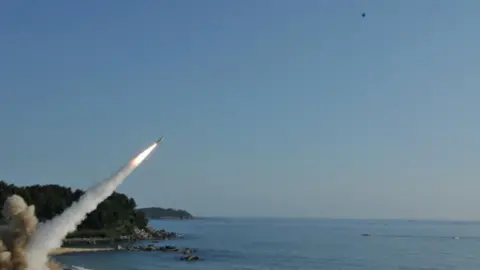
Reuters United States and South Korean troops utilizing the Army Tactical Missile System (ATACMS) and South Korea's Hyunmoo Missile II, fire missiles into the waters of the East Sea, off South Korea, 5 July 2017.Reuters

President Joe Biden’s apparent green light for Ukraine to strike Russia with US-made long-range missiles has caused consternation among some of Donald Trump’s allies.

Trump himself has not commented, but he won the election after promising to end the war – and several people close to him have condemned the move as dangerous escalation.

Biden has committed tens of billions of dollars to Kyiv’s war effort, and at the weekend he reportedly ditched a long-standing red line on Ukraine’s use of American weaponry to launch attacks deep into Russia.

Donald Trump Jr tweeted that the president was trying to “get World War Three going” before his father took office.

Biden’s decision has not been formally confirmed and it may never be.

When asked about how typical it would be for a presidential administration to take such a significant policy decision in its final months, State Department spokesman Matthew Miller said that Biden was “elected to a four year-term, not a term of three years and 10 months.”

“We will use every day of our term to pursue policy interests that we believe are in the interests of the American people,” he said. “If the incoming administration wants to take a different view, that is, of course, their right to do so.”

“There’s one president at a time,” he added. “When the next president takes office, he can make his own decisions.”

Ukraine’s President Volodymyr Zelensky said no such announcement was forthcoming – “missiles will speak for themselves”.

Trump’s camp is not pleased

Trump swept to victory on 5 November and is due to be back in the White House for a second term from 20 January next year.

Trump has campaigned on a promise to end the US involvement in wars and instead use taxpayers’ money to improve Americans’ lives.

He has said he will bring the Russia-Ukraine war to an end within 24 hours, without saying how.

One thing is certain, though: Trump has always seen himself as a dealmaker and will not want Biden to take any such credit.

His son, Donald Trump Jr, was among the first Republicans to respond.

“The military industrial complex seems to want to make sure they get World War Three going before my father has a chance to create peace and save lives,” he said.

Another vocal Trump supporter, Congresswoman Marjorie Taylor Greene, condemned Biden, too.

“The American people gave a mandate on Nov 5th against these exact America last decisions and do NOT want to fund or fight foreign wars. We want to fix our own problems,” she wrote on X.

Not all of Trump’s allies, including some who advised him on national security affairs during his first term, shared this view – though they were critical of the Biden administration’s approach.

James Gilmore, who served as Trump’s ambassador to the Organization for Security and Cooperation in Europe, told the BBC that the main issue with Biden’s decision to provide Ukraine this new capability is that it came so late in the war.

“My criticism of Biden is the same as every other conservative and supporter of Trump – which is that the Biden administration slow walked this,” he said.

Gilmore said he did not know what the president-elect would choose to do regarding Ukraine once he entered office. “I don’t believe that he’s a man that usually walks away,” he said.

Getty Images  U.S. President-elect Donald Trump speaks at a House Republicans Conference meeting at the Hyatt Regency on Capitol Hill on November 13, 2024 in Washington, DCGetty Images

Trump has made it clear he wants to curtail American support for wars overseas

Polls suggest a large number of Republicans want US support for Ukraine to stop – 62% told a poll by Pew Research the US had no responsibility to support the country against Russia.

Senator JD Vance, who will be Trump’s vice-president, has regularly objected to providing arms to Ukraine. He argued that the US lacks the manufacturing capacity to continue providing weapons like the missile systems that Kyiv will use to strike within Russia.

Gilmore, however, said the US was able to backfill and upgrade its weapon systems through this process, but he said the US’s European allies would need to take on a bigger role.

“President Trump is exactly right about this – the alliance is stronger when Western European countries step up to the plate,” he said. “The United States cannot continue to act alone. The taxpayer won’t permit it, the next administration won’t permit it, and I wouldn’t, either.”

Putin is also silent

Since launching the full-scale invasion of Ukraine in February 2022, Russia’s president has been railing against the US-led Nato alliance – and described every pledge of military support by the Western allies for Ukraine as a direct involvement and warned of retribution.

His spokesman said on Monday that the US was “adding fuel to the fire”.

At times, Putin has mooted the possibility of using nuclear weapons, too.

Few believe this may come to pass as, under the mutual-destruction doctrine established during the Cold War when nuclear arsenals were built up, Putin knows their use would bring untold suffering to all, including Russians.

But the Russian leader will be fully aware of the magnitude of the threat of Western-supplied long-range missiles.

The Institute for the Study of War, a think tank, has published a map of 225 Russian military installations within range of ATACMS.

Former US envoy to Ukraine, Kurt Volker, said Biden’s decision would enable Ukraine “to go after airfields, the ammunition depots and the fuels supplies, logistics that Russia has, which right now are in a sanctuary zone in Russia”.

Biden’s decision will cause Russia to be more cautious, Volker told the BBC.

Dismissing Putin’s threats, he said the Russian leader “should have anticipated that there would be efforts by Ukraine to fire back”.

Ukraine has had ATACMS as well as UK and French Storm Shadow missiles of similar range for some time, though the numbers are not known. But it has not been allowed to use them inside Russia.

France and the UK are expected to follow the US lead and issue the same authorisation to Ukraine. So far, they have not commented.

White House officials are emphasising to US media that Biden’s change of heart is in response to Russia’s deployment of North Korean troops – a signal to Pyongyang not to send any more.

Gilmore, Trump’s OSCE ambassador, told the BBC that he believes it is “Putin who has escalated the war” by deploying North Korean soldiers, and the US cannot “just stand aside and let this dictator go ahead and conquer Ukraine”.

“I don’t like it and I take it all very seriously, but the decision is not ours. The decision is being forced upon us by Putin – by the dictator,” he said.

The move also follows a barrage of Russian attacks on Ukraine in recent days.

One strike on Odesa on Monday killed 10 people, including seven policemen, and injured 47 others.


Ecuador declares 60-day state of emergency to help battle wildfires | Climate News

0


State of emergency to allow government to send more money, people to help bring blazes under control, minister says.

Ecuador has declared a 60-day state of emergency as the South American country has been hit by a severe drought and record wildfires that have razed large swaths of territory over the past weeks.

The Ecuadorian Secretariat for Risk Management (SNGR), the country’s emergency management agency, said in a statement on Monday that the state of emergency was declared “due to forest fires, water deficit and drought”.

It will allow the government to mobilise funds and send more people to help fight the blazes, Environment Minister Ines Manzano said.

Approved by the Ministry of Environment, Water and Ecological Transition, it will allow the freeing of funds to tackle the multifaceted crisis, the SNGR also said.

Authorities are battling 17 active wildfires, which have primarily affected the Azuay and Loja provinces in southern Ecuador. Another five fires have recently been brought under control, the secretariat said.

The blazes in the two provinces have affected about 10,200 hectares (25,204 acres) of forest and land.

Smoke in Quito, Ecuador
Smoke rises as a wildfire burns in Quito, Ecuador, on September 25, 2024 [Karen Toro/Reuters]

In September, a severe wildfire threatened the country’s capital, Quito, blanketing it in smoke and ash. More than 2,000 firefighters, rescue workers and members of the military were called in to evacuate residents and fight the blaze.

Ecuador is experiencing its worst drought in 60 years, which has affected water levels in hydroelectric dams – a source of more than 70 percent of the country’s power.

Since October, the government has had to impose daily power cuts of up to 14 hours a day as it urged its 17 million people to save energy.

According to the Global Wildfire Information System (GWIS), which monitors wildfires around the world, Ecuador’s wildfire danger forecast is expected to increase from high to extreme in the affected provinces.

Record-setting blazes have broken out in other countries across South America as well, including Brazil, Colombia, Venezuela, Bolivia and Peru, as the region has been hit by severe drought.

The US space agency NASA reported that plumes of smoke could be seen from space over several parts of the region from July to October as a result of the fires while rivers in the Amazon basin fell to record low levels last month.

The drought, which has steadily gotten worse since the latter half of 2023, has been linked to the El Nino weather phenomenon and to climate change.


Maori protest as hikoi reaches Wellington

0


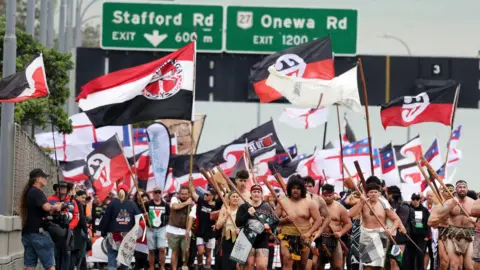
Getty Images Hikoi members walk across the Auckland Harbour Bridge on day three of a nine-day journey to Wellington on November 13, 2024 in Auckland, New Zealand. Getty Images

The 1,000km (621-mile) march began nine days ago in the far north of the country

Thousands of people are gathering to take the final steps in a march on New Zealand’s parliament to demonstrate against a controversial bill seeking to overhaul the country’s founding document between British colonisers and Māori people.

Hotels are sold out in the capital Wellington – up to 30,000 people are expected to attend Tuesday’s rally outside parliament.

The demonstration marks the end of a nine-day hīkoi, or peaceful protest, that’s been making its way through the country.

The hīkoi has brought together Māori activists and their supporters who oppose the bill introduced by a junior member of the governing coalition.

Watch: Moment MP leads haka to disrupt New Zealand parliament

New Zealand is often considered a world leader when it comes to supporting indigenous rights – but under the centre-right government of Christopher Luxon, many fear those rights are now at risk.

“They are trying to take our rights away,” says Stan Lingman, who has both Māori and Swedish ancestry and is planning on attending the rally. “[The hikoi is] for all New Zealanders – white, yellow, pink, blue. We will fight against this bill.”

Stan’s wife Pamela says she’s marching for her “mokos”, which means grandchildren in the Māori language.

The 1840 Treaty of Waitangi is seen as fundamental to the country’s race relations.

But under the Luxon government, there’s a concern that the rights won by the Māori community are being eroded. The bill that has been introduced by the Act political party argues that New Zealand should legally define the principles of the Treaty of Waitangi.

The party’s leader, David Seymour, says that over time the treaty’s core values have led to racial divisions, not unity.

“My Treaty Principles Bill says that I, like everybody else, whether their ancestors came here a thousand years ago, like some of mine did, or just got off the plane at Auckland International Airport this morning to begin their journey as New Zealanders, have the same basic rights and dignity,” says Seymour, who has Māori ancestry.

“Your starting point is to take a human being and ask, what’s your ancestry? What kind of human are you? That used to be called prejudice. It used to be called bigotry. It used to be called profiling and discrimination. Now you’re trying to make a virtue of it. I think that’s a big mistake.”

He’s been blamed for wasting time and creating political rifts by bringing a bill that isn’t even expected to pass. Prime Minister Luxon has called the bill “divisive” – despite being part of the same coalition.

Despite the differences, plenty of supporters feel the march has gone too far.

“They [Māori] seem to want more and more and more,” says Barbara Lecomte, who lives in the coastal suburbs north of Wellington. “There’s a whole cosmopolitan mix of different nationalities now. We are all New Zealanders. I think we should work together and have equal rights.”

Equality, though, is still a way off, says Debbie Ngarewa-Packer, co-leader of Te Pāti Māori (Maori Party).

“We can’t live equally if we have one people who are the indigenous people living ‘less than’,” she argues. What the coalition government is doing is “an absolute attempt to divide an otherwise progressive country and it’s really embarrassing”.

Rose Raharuhi Spicer

“This isn’t just any normal hīkoi – this is the hīkoi of everybody,” says Rose Raharuhi Spicer

Such is the strength of feeling that New Zealand’s parliament was brought to a temporary halt last week by MPs performing a haka, or traditional dance, in opposition to the bill. The video went viral.

“To see it in parliament, in the highest house in Aotearoa, there’s been a real state of surprise and I think disappointment and sadness that in 2024 when we see politics and the Trump extremes, this is what the Māori are having to endure,” says Debbie Ngarewa-Packer. “It’s humiliating for the government because we are normally seen as punching above our weight in all of the great things in life.”

For those watching New Zealand and wanting to witness more hakas, this rally won’t disappoint. Organisers on Monday taught participants the words and moves of the rally’s haka, the subject of which is Te Tiriti o Waitangi (the Waitangi Treaty). Those in the audience enthusiastically repeated the lyrics written on a large white sheet, trying to soak in as many words as possible ahead of the rally.

“This isn’t just any normal hīkoi – this is the hīkoi of everybody,” says grandmother Rose Raharuhi Spicer, explaining that they’ve called on non-Māori, Pacific Islanders and the wider population in New Zealand to support them.

This is the fourth hīkoi Rose has been on. She comes from New Zealand’s northernmost settlement, Te Hāpua, right above Auckland. It’s the same village that the most famous hīkoi started from, back in 1975, protesting over land rights.

This time, she’s brought her children and grandchildren.

“This is our grandchildren’s legacy,” she says. “It’s not just one person or one party – and to alter [it] is wrong.”

On the grass nearby, Leah Land, a 26-year-old from Whangārei, is putting the final touches to a sign for the rally which reads ‘Honour It, Don’t Edit It’.

“I am here because I believe as a Pākehā [non-Māori], without those sacred documents I don’t have a right to live and be on this land, so that’s the foundation of me being able to be here in this beautiful country,” she said, adding that the proposed bill was terrifying.

“The saddest thing is that I will be fine because I am white – but my very best friends are Māori and I want Aotearoa New Zealand to be a safe space for them to exist.”


Tottenham’s Bentancur banned for seven games over racist remark about Son | Football News

0


Uruguayan midfielder found guilty of ‘aggravated breach’ in comments about his South Korean club captain Son Heung-min.

Tottenham Hotspur’s Rodrigo Bentancur has been banned for seven matches after the Uruguayan made a racist remark about South Korean people when talking about teammate Son Heung-min during a television appearance, the English Football Association (FA) has said.

In a statement on Monday, the FA said the midfielder “acted in an improper manner and/or used abusive and/or insulting words and/or brought the game into disrepute”.

“It was further alleged that this constitutes an ‘aggravated breach’… as it included a reference – whether express or implied – to nationality and/or race and/or ethnic origin,” the statement added.

In June, on Uruguayan television programme Por La Camiseta, host Rafa Cotelo asked Bentancur for a Spurs player’s shirt, to which he replied, “Sonny’s?”, adding: “It could be Sonny’s cousin too as they all look the same.”

Bentancur apologised later on Instagram, saying it was a “very bad joke” and he would “never disrespect you or hurt you”.

Son accepted the excuses, saying his teammate had made a mistake and “would not mean to ever intentionally say something offensive”.

“We are brothers and nothing has changed at all,” Son said in June. “We’re past this, we’re united, and we will be back together in preseason to fight for our club as one.”

An independent commission also imposed a fine of 100,000 pounds ($126,000) on the player. The sanction can be appealed.

The suspension only covers domestic matches, meaning the 27-year-old Bentancur will be available to play for his London club in the Europa League. Spurs take on Roma in the league phase of the tournament on November 28.

The FA also ordered Bentancur to attend a “face-to-face education program”, details of which will be provided later. The course should be completed by March 11 next year.

“If the player fails to complete the program satisfactorily in that period, he will be immediately suspended from all domestic club football until such time as the mandatory program is completed,” the FA said.

Tottenham and Bentancur did not immediately react to the punishment.


Hundreds of Honduran villages cut off by rain

0


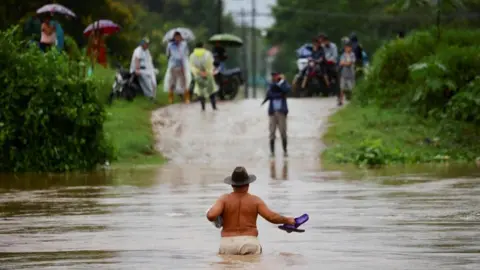
Reuters A shirtless man wearing a brown hat and holding his flip flops in one hand wades across waist-deep water while people watch from the other side of an inundated road in El Progreso, Honduras.Reuters

Many roads and bridges became impassable after days of rain

Torrential rain caused by Tropical Storm Sara has cut off more than 1,700 communities in Honduras.

The slow-moving storm caused widespread flooding across the Central American nation.

So far, Honduran officials have confirmed only one death but said that more than 110,000 people had been affected by the storm.

Forecasters say Sara is likely to further weaken on Monday as it moves over the southern Mexican state of Quintana Roo.

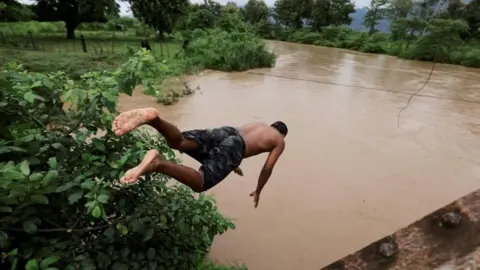
Reuters A man can be seen diving head first into the brown waters of a river that has burst its banks in El Progreso, HondurasReuters

Many rivers burst their banks and could only be crossed by swimming

Sara formed in the Caribbean Sea on Thursday.

The tropical storm was extremely slow moving, dumping huge amounts of rain on northern Honduras for four days running before moving north to Belize and Mexico.

Some areas saw 500mm (19.7 inches) of rain fall causing rivers to swell.

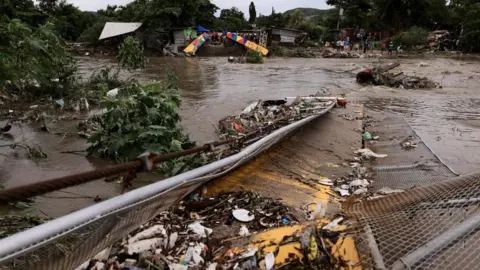
Nine bridges were destroyed by fast flowing waters and another 19 damaged, Honduran emergency services said.

Reuters Twisted metal and debris can be seen partially submerged in the flooded waters of the Bermejo river. On the other side of the river's bank, people are standing and watching. Reuters

Strong currents in the Bermejo river washed away a bridge in San Pedro Sula

Several highways also became impassable following landslides.

Honduran President Xiomara Castro had warned citizens living near rivers as early as Thursday to take shelter elsewhere and thousands heeded her call.

Reuters Rescue workers wearing red inflatable jackets carry a woman aloft into a waiting boat. Rain is falling and the road is flooded with water reaching the rescuers' thighs. Reuters

Rescue workers have been moving house to house to help stranded people

More than 2,500 homes were damaged and more than 200 destroyed, officials said.

Sara is the 18th named storm of the Atlantic hurricane season and the third this month.

Less than two weeks ago, Hurricane Rafael caused a nationwide blackout when it hit Cuba.

Meteorologists say the storms have been fuelled by high sea surface temperatures.

While hurricanes and tropical storms occur naturally, human-caused climate change is supercharging them and exacerbating the risk of major damage,” Kevin Trenberth, a distinguished scholar at the National Center for Atmospheric Research in Boulder, Colorado, has warned.


Access to climate education is a matter of justice | Climate Crisis

0


In his poem The Right to Dream (1995), Uruguayan writer Eduardo Galeano imagines “how the world will be in 2025”. He dreams of a better future where there is respect for nature, equality and peace.

Unfortunately, 2025 is coming up and we are nowhere near fulfilling Galeano’s dream. In fact, we increasingly find ourselves in a situation where the survival of human civilisation is at stake. This year alone, millions of people worldwide experienced extreme climate events, groundbreaking temperatures, genocide, and deadly exposure to toxic chemicals and pollution leading to mass death, injury, displacement, poverty, and trauma.

While the near future seems bleak, our education systems are nowhere near providing children with the right tools and knowledge to help them understand it.

Schools continue to be battlegrounds for the building of societies, and education can either be utilised to uphold the status quo or to create a just and sustainable future. Across the world, far-right and authoritarian regimes have consistently attacked access to public education, books, race and gender history, and more.

Even in places where this is not happening, education systems are simply inadequate to prepare new generations for living in an era of climate change and taking action on it.

In a world where climate disasters are disrupting access to education, where eco-anxiety is prevalent among youth, and where pollution affects the health of millions of children, we must ensure that young people are equipped to tackle the climate crisis.

The Global Education Monitoring Report at UNESCO and the MECCE Project’s recent global mapping showed that the world scored only 50 percent on a test on how extensively education systems cover climate change in their curricula and syllabi. It also showed that most of the content related to climate change is still only taught in science classes and is not covered across other subject areas.

Attending public schools in Texas, I saw this playing out in practice. I saw how climate change was briefly mentioned and only framed as a future issue that will affect polar bears. The solutions that were brought up didn’t go beyond recycling and reducing one’s carbon footprint.

It wasn’t until I interned for the Young Scholars for Justice (YSJ) programme, launched by the women-led People Organized in Defense of Earth and Her Resources (PODER), that the pieces began to fall into place. The YSJ curriculum centres on environmental justice organising, the history of movements led by people of colour, local Indigenous cultures, and a critical analysis of sociopolitical structures.

Through various lessons, art and poetry workshops, guest speakers, and organising initiatives, I was able to put words to describe the what, why, and how of the inequalities I had experienced and observed around me.

It was also the first time I realised that traditional knowledge is a critical part of climate solutions. The cosmological stories of plants, tree spirits, bodhisattva etc passed down to me from my Hakka and Indigenous Taiwanese ancestors were full of wisdom. The cultural knowledge I had grown up with was valuable outside my home.

In the following years, I became involved with numerous campaigns, from fighting against the petrochemical industry and for access to clean and affordable water, to advocating for a fossil fuel phaseout and cumulative impact policies.

The climate justice education I received from PODER, from my mum’s stories, my community, my radical professors, and from organising allowed me to turn despair into action. I see education as a practice of freedom, as an opportunity to reclaim culture, rewrite history, and reimagine our world.

I believe it is imperative for all school students to have access to comprehensive climate education, one that centres on traditional ecologies, justice, critical consciousness, social-emotional learning, STEAM (science, technology, engineering, art and mathematics) and action. This is what led me to co-create environmental justice curricula and programming alongside other people of colour.

Even in the face of book bans, attacks on diverse histories and climate science, we have to keep working to ensure communities have access to critical education. This is especially important now, as a new administration which espouses climate denialism will soon take power in the United States.

We must go beyond simple awareness of the climate crisis to understanding its sociopolitical root causes and solutions. This is why I am supporting the call to action being signed by young people and supported by UNESCO for climate education to adapt so that we can all become empowered changemakers.

We owe it to the next generation to provide them with the tools and knowledge needed to tackle the climate crisis and systemic oppression. Only then can we imagine and build a different world – and I sincerely hope that our future generations will continue to dream. Who knows, perhaps in 2055 Galeano’s dream will come true.

The views expressed in this article are the author’s own and do not necessarily reflect Al Jazeera’s editorial stance.


Fury in Russia at missile move but Putin so far silent

0


President Biden’s decision to allow Ukraine to strike inside Russia with long-range missiles supplied by the US has sparked a furious response in Russia.

“Departing US president Joe Biden… has taken one of the most provocative, uncalculated decisions of his administration, which risks catastrophic consequences,” declared the website of the Russian government newspaper Rossiyskaya Gazeta on Monday morning.

Russian MP Leonid Slutsky, head of the pro-Kremlin Liberal-Democratic Party, predicted that the decision would “inevitably lead to a serious escalation, threatening serious consequences”.

Russian senator Vladimir Dzhabarov called it “an unprecedented step towards World War Three”.

Anger, yes. But no real surprise.

Komsomolskaya Pravda, the pro-Kremlin tabloid, called it “a predictable escalation”.

What really counts, though, is what Vladimir Putin calls it and how the Kremlin leader responds.

He said nothing on Sunday night.

But Russia’s president has said plenty before.

In recent months, the Kremlin has made its message to the West crystal clear: do not do this, do not remove restrictions on the use of your long-range weapons, do not allow Kyiv to strike deep into Russian territory with these missiles.

In September President Putin warned that if this were allowed to happen, Moscow would view it as the “direct participation” of Nato countries in the Ukraine war.

“This would mean that Nato countries… are fighting with Russia,” he continued.

The following month, the Kremlin leader announced imminent changes to the Russian nuclear doctrine, the document setting out the preconditions under which Moscow might decide to use a nuclear weapon.

This was widely interpreted as another less-than-subtle hint to America and Europe not to allow Ukraine to strike Russian territory with long-range missiles.

Guessing Vladimir Putin’s next moves is never easy.

But he has dropped hints.

Back in June, at a meeting with the heads of international news agencies, Putin was asked: how would Russia react if Ukraine was given the opportunity to hit targets on Russian territory with weapons supplied by Europe?

“First, we will, of course, improve our air defence systems. We will be destroying their missiles,” President Putin replied.

“Second, we believe that if someone is thinking it is possible to supply such weapons to a war zone to strike our territory and create problems for us, why can’t we supply our weapons of the same class to those regions around the world where they will target sensitive facilities of the countries that are doing this to Russia?”

In other words, arming Western adversaries to strike Western targets abroad is something Moscow has been considering.

In my recent interview with Alexander Lukashenko, the leader of Belarus, Putin’s close ally seemed to confirm the Kremlin has been thinking along these lines.

Mr Lukashenko told me he had discussed the subject at a recent meeting with Western officials.

“I warned them. ‘Guys, be careful with those long-range missiles,'” Mr Lukashenko told me.

“The Houthi [rebels] might come to Putin and ask for coastal weapons systems that can carry out terrifying strikes on ships.

“And if he gets his revenge on you for supplying long-rage weapons to [President] Zelensky by supplying the Houthis with the Bastion missile system? What happens if an aircraft carrier is hit? A British or American one. What then?”

But some of the media reaction in Russia appeared designed to play things down.

“The Russian armed forces had already [previously] intercepted ATACMS missiles during attacks on the Crimean shore,” a military expert told the Izvestia newspaper, which went on to suggest that President-elect Trump might “revise” the decision.

This is, to put it mildly, an unusual situation.

In two months’ time, President Biden will be out of office and Donald Trump will be in the White House.

The Kremlin knows that President-elect Trump has been far more sceptical than President Biden about military assistance for Ukraine.

Will that be a factor in Vladimir Putin’s calculations as he formulates Russia’s response?


‘I will not be silent’: Australia censures senator for King Charles protest | Indigenous Rights News

0


Indigenous Senator Lidia Thorpe says she has no regrets as Senate expresses disapproval of protest against the monarch.

Australia’s Senate has voted to censure Indigenous lawmaker Lidia Thorpe after she heckled Britain’s King Charles III during his visit to parliament last month.

The vote, led by Australia’s governing Labor Party, was passed with 46 votes in favour and six against.

Thorpe, a Gunnai, Gunditjmara and Djab-Wurrung woman who represents the state of Victoria, released a statement before the vote, saying she would not be silenced by the measure.

The Senate does not have the power to appoint or remove senators, and censure motions, though politically symbolic, do not carry legal weight.

“I will not be silent. The truth is, this colony is built on stolen land, stolen wealth and stolen lives,” Thorpe said in the statement.

“The British Crown committed heinous crimes against the First Peoples of this country. These crimes include war crimes, crimes against humanity and failure to prevent genocide. The Crown must be held accountable for these crimes,” she added.

Although Australia has had de facto independence from the United Kingdom since 1901, it remains a realm of the Commonwealth, meaning that King Charles is Australia’s head of state.

Charles was attending a ceremonial welcome and parliamentary reception at Australia’s Parliament House in Canberra on October 21 when proceedings were briefly interrupted by Thorpe’s protest.

“You committed genocide against our people. Give us our land back! Give us what you stole from us!” Thorpe yelled out as she entered the room where the king was being officially welcomed.

“Our bones, our skulls, our babies, our people. You destroyed our land!”

“This is not your land!” she continued as security guards led her away.

Recordings of the protest were viewed and shared around the world, with the rare direct protest against the British monarch sparking consternation from some and celebration from others.

After the censure was passed by the Senate on Monday morning, Thorpe ripped the piece of paper it was printed on into two pieces, Australia’s public broadcaster reported.

The gesture appeared to be a nod to New Zealand’s Te Pati Maori legislator Hana-Rawhiti Maipi-Clarke, who last week ripped up a copy of a bill revising a treaty that granted land rights to Maori tribes, before beginning a traditional haka dance in protest.


Russian ballet star Vladimir Shklyarov dies at 39

0


The ballet world is mourning the death of Vladimir Shklyarov, one of its leading male dancers.

Shklyarov, a principal with the prestigious Mariinsky Theatre, was an “extraordinary artist” who inspired fans worldwide, one tribute said.

His death, announced by the St Petersburg company on Saturday, is being investigated by federal authorities, according to Russian media reports.

Mariinsky representatives told media he had fallen from the fifth floor of a St Petersburg building while on painkillers.

“This is a huge loss not only for the theatre’s staff but for all of contemporary ballet,” the company said in a statement on Saturday.

“Our condolences to the artist’s family, loved ones, friends and all the numerous admirers of his work and talent.”

Shklyarov was married to fellow company dancer Maria Shklyarov, with whom he had two children.

Born in Leningrad, he studied at the famed Vaganova Academy of Russian Ballet, graduating in 2003.

He joined the Mariinsky Theatre the same year, becoming a principal in 2011.

Over 20 years with the company, he danced leads across several productions, including Giselle, Sleeping Beauty, Don Quixote, Swan Lake and Romeo and Juliet.

He performed at prestigious venues around the world, including the Royal Opera House in London and Metropolitan Opera in New York.

In 2014 and 2015, he featured as a guest artist at the American Ballet Theatre. The company issued a statement on Sunday mourning his “tragic loss.”

“We mourn the tragic loss of Vladimir Shklyarov, an extraordinary artist whose grace and passion inspired audiences worldwide.

“Your light will continue to shine through the beauty you brought to this world,” the company wrote on Instagram.

Shklyarov received several accolades during his lifetime, including the Léonide Massine International Prize in 2008. He was also appointed an Honoured Artist of Russia in 2020.

“He forever inscribed his name in the history of world ballet,” the Mariinsky Theatre said.