Friday, September 25, 2026
Home Blog Page 7456

Volunteers enter South Africa shaft to aid miners

0


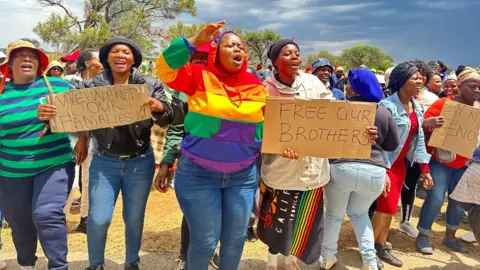
BBC A group of female protesters, with one dressed in a rainbow hoodie, are shouting. They are holding placards saying - "free our brothers" and "we want our families"BBC

Dozens of volunteers have entered an abandoned gold mine in South Africa to help what could be thousands of illegal miners who have been underground for a month

Because the miners entered the shaft in Stilfontein deliberately, desperate to retrieve gold or mineral residues, the authorities have taken a hard line, blocking food and water supplies.

Earlier in the week, one government minister said: “We are going to smoke them out.”

The miners have refused to co-operate with the authorities as some are undocumented migrants and fear being deported or arrested.

Some are said to have been eating vinegar and toothpaste while underground.

It is feared that their health could be deteriorating, and they may be too weak and frail to leave the mine themselves.

The volunteers, who are organised into three groups of 50, say it takes about an hour to get one person out.

Lebogang Maiyane has been volunteering since the beginning of the week.

“The government doesn’t care about the impact on the right to life of the illegal miners who remain beneath the surface – this is tantamount to murder” he said.

Illegal miners are called “zama zama” (“take a chance” in Zulu) and operate in abandoned mines in the mineral-rich country. Illegal mining costs the South African government hundreds of millions of dollars in lost sales each year.

Many South African mines have closed down in recent years and workers have been sacked.

To survive, the miners and undocumented migrants go beneath the surface to escape poverty and dig up gold to sell it on the black market.

Some spend months underground – there is even a small economy of people selling food, cigarettes and cooked meals to the miners.

Local residents have pleaded with the authorities to assist the miners, but they have refused.

“We are going to smoke them out. They will come out. We are not sending help to criminals. Criminals are not to be helped – they are to be persecuted [sic],” said Minister in the Presidency Khumbudzo Ntshavheni on Wednesday.

Relatives of the miners have been protesting near the mine site, holding placards with the words: “Smoke ANC out” and “Down with Minister in Presidency”.
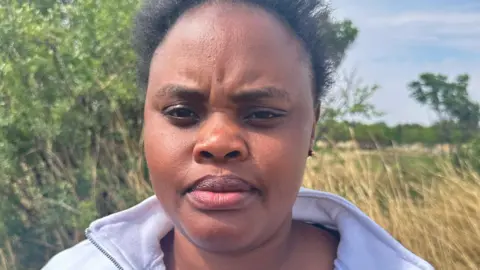
A close-up image of a young woman wearing a grey hoodie.

Thandeka Tom says her brother is one of the thousands of miners underground

Police Minister Senzo Mchunu visited the site on Friday, but as he tried to speak to community members waiting to hear news of their loved ones in the shaft, he was chased away.

Thandeka Tom, whose brother is in the mine, criticised the police for not sending help.

“They’re speaking from a point of privilege, there’s a problem of unemployment in the country and people are breaking the law as they try to put food on the table” she told the BBC.

Police are hesitant to go into the mine as some of those underground may be armed.

Some are part of criminal syndicates or “recruited” to be in one, Busi Thabane, from Benchmarks Foundation, a charity which monitors corporations in South Africa, told the BBC’s Newsday programme.

Without any access to supplies, conditions underground are said to be dire.

“It is no longer about illegal miners – this is a humanitarian crisis,” said Ms Thabane.

On Thursday, community leader Thembile Botman told the BBC that volunteers had used ropes and seat belts to pull a body out of the mine.

“The stench of decomposing bodies has left the volunteers traumatised,” he said.

It’s not clear how the person died.

Although the authorities have been blocking food and water, they have temporarily allowed local residents to send some supplies down by rope.

Mr Botman said they had been communicating with the miners by notes written on pieces of paper.
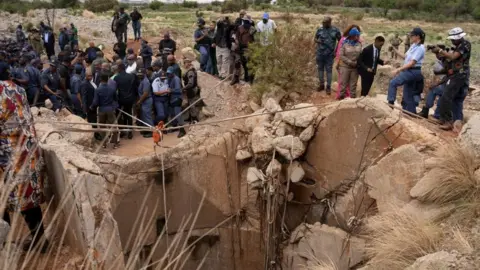
Reuters A crowd stand near the entrance to a mineshaft. Ropes and a pulley can be seen at the top.Reuters

Police have blocked off entrances and exits in an effort to compel the miners to come out.

This is part of the Vala Umgodi, or “Close the Hole”, operation to curb illegal mining.

Five miners were pulled out on Wednesday by rope, but they were frail and weak. Paramedics attended to them, and then they were taken into police custody.

In the last week, 1,000 miners have emerged and been arrested.

Police and the army are still at the scene waiting to detain those who are not in need of medical care after resurfacing.

“It’s not as easy as the police make it seem – some of them are fearing for their lives,” said Ms Thabane.

Many miners spend months underground in unsafe conditions to provide for their families.

“For many of them it’s the only way they know how to put food on the table,” said Ms Thabane.
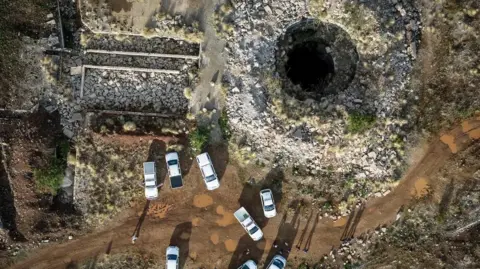
AP An aerial view of the mineshaft with some vehicles parked nearbyAP

Some of those in the abandoned mine have been there for at least a month

Local residents have also attempted to convince the miners to come out of the mineshaft.

“Those people must come out because we have brothers there, we have sons there, the fathers of our kids are there, our children are struggling,” local resident Emily Photsoa told AFP.

The South African Human Rights Commission says it will investigate the police for depriving the miners of food and water.

It said there is concern that the government’s operation could have an impact on the right to life.

Minister Ntshavheni’s remarks have provoked mixed reaction from South Africans, with some praising the government’s unyielding approach.

“I love this. Finally, our government is not tiptoeing on these serious matters. Decisiveness will help this country,” one person wrote on X.

While others felt the stance was inhumane.

“In my view, this kind of talk from the Minister in the Presidency is disgraceful and dangerous hate speech,” one user said.

Another wrote: “They are criminals but they have rights too.”

Illegal mining is a lucrative business across many of South Africa’s mining towns.

Since December last year, nearly 400 high-calibre firearms, thousands of bullets, uncut diamonds and money have been confiscated from illegal miners.

This is part of an intensive police and military operation to stop the practice that has severe environmental implications.

More BBC stories from South Africa:

Getty Images/BBC A woman looking at her mobile phone and the graphic BBC News AfricaGetty Images/BBC


New storm bears down on the Philippines after Typhoon Usagi wrecked havoc | Weather News

0


Another dangerous storm is barrelling towards the Philippines, threatening an area where dozens of people were killed by flash floods and landslides just weeks ago, the weather service said.

Typhoon Usagi blew out of the archipelago nation on Friday as rescuers worked to reach residents stranded on rooftops in northern Luzon island, where herds of livestock were devastated.

Thousands of people were displaced by Usagi, the fifth major storm to hit the country in less than a month.

It weakened as it headed towards Taiwan, after blowing away houses in its path.

The recent wave of disasters has killed at least 159 people and prompted the United Nations to request $32.9m in aid for the worst-affected regions.

On Thursday, flash floods caused by Usagi struck 10 largely evacuated villages around the town of Gonzaga in Cagayan province, local rescue official Edward Gaspar told the AFP news agency.

“We rescued a number of people who had refused to move to the shelters and got trapped on their rooftops,” Gaspar said.

Trees uprooted by flooding damaged a major bridge in Gonzaga, isolating nearby Santa Ana, a coastal town of about 36,000 people, Cagayan officials said.

“Most evacuees have returned home, but we held back some of them. We have to check first if their houses are still safe for habitation,” Bonifacio Espiritu, operations chief of the civil defence office in Cagayan, told AFP.

By early Friday, Usagi was over the Luzon Strait with a reduced strength of 120km/h (75mph) as it headed towards southern Taiwan, where authorities downgraded it to a tropical storm.

But the streak of violent weather was forecast to continue in the central Philippines, where Tropical Storm Man-yi is set to reach coastal waters by Sunday.

The weather service said it could potentially strike at or near the heavily populated capital, Manila.

According to a UN assessment, the past month’s storms damaged or destroyed 207,000 houses, with 700,000 people forced to seek temporary shelter.

Many families were without essentials such as sleeping mats, hygiene kits and cooking supplies, and had limited access to safe drinking water.

Thousands of hectares of farmland were destroyed and persistent flooding was likely to delay replanting efforts and worsen food supply problems, the report added.

About 20 big storms and typhoons hit the Southeast Asian nation or its surrounding waters each year, killing dozens of people and keeping millions in enduring poverty, but it is unusual for multiple such weather events to take place in a small window.


Ten dead in fire at Spanish care home

0


At least 10 people have been killed and others hurt in a fire that broke out at a care home near Zaragoza in north-eastern Spain, emergency services say.

The fire broke out in the town of Villafranca de Ebro early on Friday morning and local officials said 82 people were living in the home at the time.

The centre opened 16 years ago as a retirement home, according to local reports, but has since specialised in care for residents with dementia and mental health problems.

Emergency services were alerted at about 05:00 (04:00 GMT) on Friday and firefighters were able to put out the fire.

The ages of those who died are not yet known.

Two other people were taken to hospital, including one person whose condition was described as critical, the mayor of Villafranca de Ebro told Spanish radio.

Volga Ramírez told Cadena Ser that the tragedy may have been caused by a mattress on fire in one of the rooms.

Witnesses said there was little fire damage to the single-storey building and smoke inhalation is being blamed for the large number of fatalities.

“My husband went in to get people out. You couldn’t even breathe because of the smoke,” the mayor told reporters.

The Spanish government’s delegate in Aragón region, Fernando Beltrán, paid his condolences to the victims and said they would continue to monitor the progress of those in hospital and the investigation into the cause of the fire.

Prime Minister Pedro Sánchez also expressed his dismay and shock at the disaster.

Nine years ago a fatal fire left nine people dead at another retirement home in the Zaragoza area.


Trump led the charge to ban TikTok. Now he says he’ll save it | Technology

0


As United States President-elect Donald Trump prepares to return to the White House, TikTok could be in line for a reprieve from the very leader who led the charge to ban the embattled video-sharing platform.

Under a law signed by US President Joe Biden in April, ByteDance, the Chinese owner of the wildly popular app, was given nine months to divest its stake in the company or face a ban on national security grounds.

The deadline for the sale – January 19 – is the day before Trump’s inauguration.

On the campaign trail, Trump, who signed an executive order seeking to ban the app during his first term, pledged to “save TikTok” but neither he nor his transition team have disclosed further details about what this might mean for ByteDance.

The president-elect potentially has several options, although he would not be able to overturn the law enforcing the ban on his own, according to legal experts.

Originally passed in the US House of Representatives as the Protecting Americans from Foreign Adversary Controlled Applications Act, a shorter version of the ban was tacked onto a Senate bill approving foreign aid to Israel, Ukraine and Taiwan.

Shortly after it was signed into law, ByteDance initiated a lawsuit arguing that the ban violates the freedom of speech of 170 million American users of the app.

“For the first time in history, Congress has enacted a law that subjects a single, named speech platform to a permanent, nationwide ban, and bars every American from participating in a unique online community with more than 1 billion people worldwide,” the company said in the lawsuit.

ByteDance did not respond to Al Jazeera’s request for comment.

The lawsuit is expected to take years to conclude and is further complicated by the fact that a ban would involve the participation of Google and Apple, which offer TikTok in their app stores, and Oracle, which hosts the app in the US.

Anupam Chander, an expert on global tech regulations at Georgetown Law in Washington, DC, said that Trump could ask the US Congress to empower him to negotiate a different arrangement with ByteDance and TikTok that takes security concerns into account.

“I think many politicians would prefer that TikTok not go dark in the US in January. After all, some 170 million Americans continue to use the app, even after the government told them it’s a national security threat,” Chander told Al Jazeera.

“And yes, even if TikTok stops working for a while because TikTok’s owners won’t sell at a fire sale price, Trump could convince Congress to change the law to bring it back.”

David Greene, the civil liberties director of the US-based Electronic Frontier Foundation (EFF), said Trump could also instruct the US Justice Department to drop or modify its defence in the lawsuit with ByteDance or instruct the US Department of Commerce not to enforce the law.

The incoming president could also choose to do nothing and let the ban stand, Greene said.

“There’s a fair chance he still doesn’t stick to his offhand comment that ‘I’m going to reverse the TikTok ban’ because he tends to change his mind about these things or he gets talked into changing his mind,” Greene told Al Jazeera.

“You may recall he was the one who issued the initial TikTok ban. He did it by executive order [in 2020], which was overturned by the courts, but he was very much of the belief that TikTok posed a national security threat,” he added.

The EFF was one of dozens of civil liberties and freedom of speech organisations that opposed a ban on TikTok, arguing that it posed no greater threat than other social media platforms.

Critics of the TikTok ban also say that rather than targeting a single social media company, the US needs laws protecting data privacy similar to those passed by the European Union.

Much of the concern around TikTok has focused on its Chinese ownership and fears that Beijing could use the app to harvest data on millions of Americans or find a secret back door into their devices.

Proponents of a ban also argue that Beijing could use the platform to carry out influence campaigns aimed at subverting US democracy.

US-based apps, however, are also capable of harvesting massive amounts of user data, which they can in turn sell to data brokers and then on to intelligence agencies and other buyers.

ByteDance attempted to mollify US lawmakers with its $1.5bn “Project Texas” initiative, which created a dedicated US subsidiary to manage American data on US soil with the assistance of US tech company Oracle.

Despite the concession, many US officials remain suspicious of the app and its Chinese ownership amid a growing bipartisan consensus that Beijing poses a threat.

TikTok has already been banned or otherwise restricted in numerous countries, including Afghanistan, India, Nepal, Somalia, Australia, Canada and the United Kingdom.

Restrictions also exist in the US for government employees and at agencies in individual US states.

Despite the threat of a US ban, the sale of TikTok had seemed unlikely to many observers from the start because it would mean giving away access to the app’s secret – and some argue, addicting – algorithm.

It is also unclear whether Beijing would allow such a sale to go ahead.


Sri Lankan president’s coalition heads for landslide election win

0


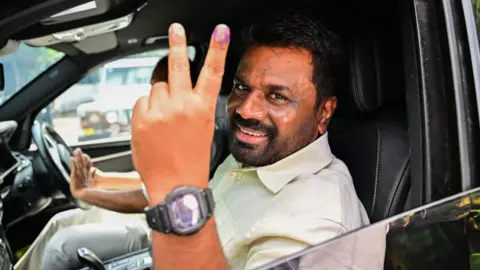
Getty Images Sri Lankan President Anura Kumara Dissanayake shows his inked finger as he leaves a polling station after casting his ballot to vote in Sri Lanka's parliamentary election in Colombo on November 14, 2024.Getty Images

A parliamentary majority will be a boost for Dissanayake, who was elected on a promise to combat corruption and restore stability

The alliance of Sri Lanka’s new leader is headed for victory in the country’s snap parliamentary elections, according to partial official results.

President Anura Kumara Dissanayake’s National People’s Power (NPP) coalition has so far won 97 seats and more than 60% of the vote. It needs 113 seats in the 225-member house to secure a majority.

Dissanayake, who was elected in September, needs a clear majority to deliver his promise to combat corruption and restore stability after the island’s worst-ever economic crisis.

The high cost of living was one of the key issues for many voters.

Analysts expect the NPP to do well in the elections but what remains to be determined is the margin of victory, and whether it gets the two-thirds majority it wants to be able to pass its ambitious reforms.

In the outgoing assembly, Dissanayake’s Janatha Vimukthi Peramuna (JVP) party, which now leads the NPP, had just three seats. More results are expected later on Friday.

“We believe that this is a crucial election that will mark a turning point in Sri Lanka,” the 55-year-old Dissanayake told reporters on Thursday after voting in the capital Colombo.

Nearly two-thirds of former MPs chose not to run for re-election, including prominent members of the former ruling Rajapaksa dynasty.

Sajith Premadasa, the man Dissanayake defeated in the presidential elections, led the opposition alliance.

Dissanayake called for snap elections shortly after he became president to seek a fresh mandate to pursue his policies. There was “no point continuing with a parliament that is not in line with what the people want”, he had said.

Out of 225 seats in the parliament, 196 MPs will be directly elected. The rest will be nominated by parties based on the percentage of votes they get in what is known as proportional representation.

High inflation, food and fuel shortages precipitated a political crisis in 2022 which led to the ousting of President Gotabaya Rajapaksa. His successor Ranil Wickremesinghe managed to negotiate a bailout package worth $3bn with the International Monetary Fund – but many Sri Lankans continue to feel economic hardship.

“We are still stuck with the problems we faced before. We still don’t have financial help even to fulfil our daily needs,” 26-year-old garment factory worker Manjula Devi, who works in the Katunayake Free Trade Zone near Colombo, told the BBC.

The number of people living below the poverty line in Sri Lanka has risen to 25.9% in the past four years. The World Bank expects the economy to grow by only 2.2% in 2024.

Disenchantment with established political players greatly helped the left-leaning Dissanayake during September’s election. His party has traditionally backed strong state intervention and lower taxes, and campaigned for leftist economic policies.

Dissanayake made history as Sri Lanka’s first president to be elected with less than 50% of the vote. Many observers think his alliance will do better this time.

How his alliance fares will be partly due to a fragmented opposition – with many leaders and parties breaking away into either smaller groups, or contesting as independent candidates.

Observers say the JVP-led alliance ran a more vibrant campaign than the opposition, which is likely to have a significant impact on the outcome of the election.

What is clear is that whoever comes into power will be under massive pressure to perform and live up to their campaign promises.

Sri Lanka’s economic situation remains precarious – and the main focus is still on providing essential goods and services. How the country progresses from this point will be a real challenge for the new government.

Additional reporting by Kelly Ng


Russia-Ukraine war: List of key events, day 994

0


As the war enters its 994th day, these are the main developments.


Bitcoin hacker sentenced to five years in prison

0


A hacker has been sentenced to five years in a US prison for laundering the proceeds of one of the biggest ever cryptocurrency thefts.

Ilya Lichtenstein pleaded guilty last year to hacking into the Bitfinex cryptocurrency exchange in 2016 and stealing almost 120,000 bitcoin.

He laundered the stolen cryptocurrency with the help of his wife Heather Morgan, who used the alias Razzlekhan to promote her hip hop music.

At the time of the theft, the bitcoin was worth around $70m (£55.3m), but had risen in value to more than $4.5bn by the time of they were arrested.

The $3.6bn worth of assets recovered in the case was the biggest financial seizure in the DOJ’s history, deputy attorney General Lisa Monaco said at the time.

“It’s important to send a message that you can’t commit these crimes with impunity, that there are consequences to them,” district judge Colleen Kollar-Kotelly said.

Lichtenstein, who has been in prison since his arrest in February 2022, expressed remorse for his actions.

He also said that he hopes to apply his skills to fight cybercrime after serving his sentence.

Morgan also pleaded guilty last year to one count of conspiracy to commit money laundering. She is due to be sentenced on 18 November.

According court documents, Lichtenstein used advanced hacking tools and techniques to hack into Bitfinex.

Following the hack, he enlisted Morgan’s help to launder the stolen funds.

They “employed numerous sophisticated laundering techniques”, the US Department of Justice (DoJ) said in a statement.

The methods included using fictitious identities, switching the funds into different cryptocurrencies and buying gold coins.

Lichtenstein, who was born in Russia but grew up in the US, would then meet couriers while on family trips and move the laundered money back home, prosecutors said.

Morgan’s Razzlekhan persona went viral on social media when the case emerged.

Even as the couple attempted to cover up the hack, she published dozens of expletive-filled music videos and rap songs filmed in locations around New York.

In her lyrics she called herself a “bad-ass money maker” and “the crocodile of Wall Street”.

In articles published in Forbes magazine, Morgan also claimed to be a successful technology businesswoman, calling herself an “economist, serial entrepreneur, software investor and rapper”.


Indonesia’s shrinking middle class casts shadow on economic rise | Business and Economy

0


Medan, Indonesia – Halimah Nasution used to feel as if she had it all.

For years, she and her husband Agus Saputra made a good living renting out supplies for weddings, graduations and birthdays.

Even after splitting their earnings among several of their siblings, the couple in Indonesia’s North Sumatra province took in about 30 million rupiahs ($1,917) each month.

Spending about one-quarter of their takings each month, the couple belonged to the upper reaches of Indonesia’s middle class, officially defined as those with monthly outgoings of between two million rupiahs ($127) and 9.9 million rupiahs ($638).

Then the COVID-19 pandemic hit.

Communal events and social gatherings were banned across Indonesia.

For a couple who had made celebrations their business, the lockdowns dealt a devastating blow.

“We lost everything,” Nasution told Al Jazeera.

Several years later, the couple are yet to claw their way back.

They are among the millions of Indonesians who have slipped out of the Southeast Asian country’s shrinking middle class.

The number of Indonesians classified as middle class fell from 57.3 million in 2019 to 47.8 million this year, according to data from the Central Bureau of Statistics.

Those classified as belonging to the “aspiring middle class” increased from 128.85 million to 137.5 million over the period, according to the statistics agency.

Together, the two segments make up about two-thirds of Indonesia’s 277 million people.

indoneisa
People gather at a park with a view of buildings in the Sudirman Central Business District in Jakarta on July 31, 2024 [Ajeng Dinar Ulfiana/Reuters]

Economists have attributed the decline to a range of causes, including the aftershocks of COVID-19 and gaps in the country’s social safety net.

Ega Kurnia Yazid, a policy specialist with the government-run National Team for the Acceleration of Poverty Reduction, said “several interconnected factors” had contributed to the trend.

“Firstly, [Indonesia’s middle class] primarily contributes to tax revenue but receives limited social assistance, most of which is disbursed through formal employment mechanisms such as job security and national health insurance,” Yazid told Al Jazeera.

“Meanwhile, other forms of assistance, such as cash transfers and energy subsidies, often suffer from inclusion errors and are not effectively channelled to this group.”

Nasution and her husband experienced this lack of support firsthand when their business collapsed.

“We did not get any help from the central government when we were no longer able to work during the pandemic and we only received a small amount from our local village office to help us buy groceries, but it was only 300,000 rupiahs a month [$19],” she said.

Indonesia’s economy has been growing steadily since the end of the pandemic, with annual gross domestic product (GDP) growth of about 5 percent.

But like many of its developing peers, Southeast Asia’s largest economy relies heavily on trade, leaving it exposed to slowing global growth.

“Major trading partners like the US, China, and Japan are experiencing contractions, as indicated by the Purchasing Managers’ Index (PMI), leading to reduced international demand for Indonesian commodities,” Yazid said.

“This adds further strain on the middle class.”

Adinova Fauri, an economic researcher at the Centre for Strategic and International Studies (CSIS), said Indonesia’s strained middle class “reflects deeper structural issues, particularly the impact of deindustrialisation in Indonesia.”

“Manufacturing, which used to absorb a large share of the labour force, is no longer able to do so. A significant portion of the workforce has shifted to the services sector, much of which is informal and offers lower wages and minimal social security,” Fauri told Al Jazeera.

To rectify the situation, labour conditions and productivity need to be improved, he said.

“We can no longer compete with countries like Vietnam or Bangladesh solely on low wages. Instead, we need to strengthen labour conditions and regulations to access new markets, such as the US, which prioritise better labour standards,” Fauri said.

“Productivity is also a critical issue, not only in terms of skills but also in relation to workers’ health. We should also learn from other countries by investing in research and development and fostering innovation to boost productivity.”

Prabowo
Indonesian President Prabowo Subianto attends a meeting with Chinese President Xi Jinping at the Great Hall of the People in Beijing on November 9, 2024 [Florence Lo/Pool via AFP]

The inauguration of President Prabowo Subianto last month as Indonesia’s eighth leader, replacing Joko Widodo, popularly known as Jokowi, has raised hopes for the economy in some quarters.

During his election campaign, Prabowo pledged to achieve GDP growth of 8 percent and eliminate poverty and stunting in children by rolling out a free school lunch programme.

Meanwhile, Nasution and her family are still picking up the pieces of their shattered life.

After buying many big-ticket items such as furniture and stages on credit, she and her husband quickly found themselves in a financial hole once business dried up.

“We sold our car, sold our land and mortgaged our house,” Nasution said. “It died. Our business just died completely.”

Nasution’s husband took up the first job he could find, a role harvesting the fruit of oil palms for about 2.8 million rupiahs ($179) a month.

Nasution took up a cleaning job, working 8am to 1pm six days a week for a monthly salary of about 1 million rupiahs ($63).

These days, the couple spend a little less than the two-million-rupiah ($127) threshold that marks entry to the middle-class bracket.

“Our life is so different now, and we are still not stable like we were before. We need capital to start the business again, but we can’t save any money to do so,” Nasution said. “We would need to buy all the equipment for the parties that we owned before or rent it.”

“We only have enough money to just barely live, but life is full of ups and downs, and hopefully things will turn around,” she added.

“I just leave it up to God at this point.”


UN climate talks ‘no longer fit for purpose’ say experts

0


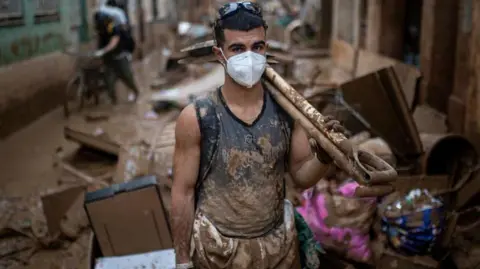
getty Man cleaning up after flood, wearing face maskgetty

Recent deadly floods in Valencia, Spain, were made worse by climate change, scientists say

The United Nations’ COP climate talks are “no longer fit for purpose” and need an urgent overhaul, key experts including a former UN secretary general and former UN climate chief have said.

In a letter to the UN, senior figures say countries should not host the talks if they don’t support the phase out of fossil energy.

This week the Azerbaijani president told world leaders gathered in his country for COP29 that natural gas was a “gift from God” and he shouldn’t be blamed for bringing it to market.

That came days after the BBC reported that a senior Azerbaijani official appeared to have used his role at COP to arrange a meeting to discuss potential fossil fuel deals.

The UN’s climate talks have made significant progress in recent years, despite the fact that unanimous agreement is needed among almost 200 countries to take action.

The Paris climate agreement, signed in 2015, outlines a long-term plan to rein in rising temperatures, as countries strive to keep that rise under 1.5C this century.

They have also agreed to transition away from fossil fuels in energy systems, and to treble renewable power by 2030.

But while the authors of this letter recognise these achievements, they feel that the slow-moving COP process is “no longer fit for purpose” in dealing with a fast-moving climate crisis.

“Its current structure simply cannot deliver the change at exponential speed and scale, which is essential to ensure a safe climate landing for humanity,” said its signatories. They include former UN Secretary General Ban-Ki Moon, former UN climate chief Christiana Figueres and former president of Ireland Mary Robinson.

This year will likely be the warmest on record, with emissions of planet warming gases still rising, while the impacts of warming often outpace the ability of countries to cope.

“Planet Earth is in critical condition,” said leading climate scientist Johan Rockström, another signatory.

“There is still a window of opportunity for a safe landing for humanity, but this requires a global climate policy process that can deliver change at exponential speed and scale,” Prof Rockström said.

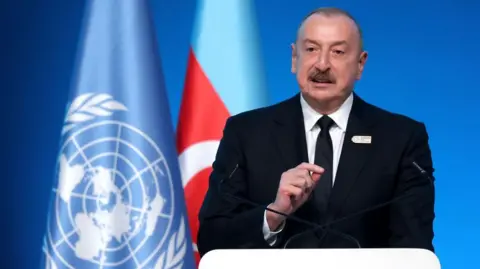
Getty Images The president of Axerbaijan speaking to COP29 delegatesGetty Images

The President of Azerbaijan, Ilham Aliyev addressing COP29 delegates

The letter has been prompted by growing concerns about some of the countries chosen to host COP talks and their ability to deliver a significant advance in the fight against rising temperatures.

Just before the latest conference started, a secret recording showed the chief executive of Azerbaijan’s COP29 team, Elnur Soltanov, discussing “investment opportunities” in the state oil and gas company with a man posing as a potential investor.

At the start of COP29, the country’s authoritarian leader, Ilham Aliyev, defended Azerbaijan’s current exports of gas and plans to expand production by a third in the next decade.

“It’s a gift of God,” he told an audience in Baku.

“Every natural resource whether it’s oil, gas, wind, sun, gold, silver, copper, all that are natural resources,” he said.

“And countries should not be blamed for having them and should not be blamed for bringing these resources to the market because the market needs them, the people need them.”

The use of oil and gas are major causes of global warming, as they release planet-warming gases like carbon dioxide when they are burned.

President Aliyev also hit out at France for carrying out colonialist “crimes” and “human rights violations” in overseas territories.

Such strongly expressed views are extremely rare from the leader of a COP host, where the aim is to build consensus on how to tackle rising temperatures.

The authors of the letter are also concerned by the selection process for hosting COPs. Azerbaijan followed on from another major oil producer, the United Arab Emirates, which held the conference in Dubai last year.

“At the last COP, fossil fuel lobbyists outnumbered representatives of scientific institutions, Indigenous communities and vulnerable nations,” said former UN climate chief Christiana Figueres.

“We cannot hope to achieve a just transition without significant reforms to the COP process that ensure fair representation of those most affected.”

The authors say that host countries “must demonstrate their high level of ambition to uphold the goals of the Paris agreement.”

They also want smaller, more frequent COPs with clear accountability for the promises that countries make.


Trump’s transition team aims to kill Biden EV tax credit in US: Report | Automotive Industry News

0


US President-elect Donald Trump’s transition team is planning to kill a $7,500 consumer tax credit for electric-vehicle purchases as part of broader tax-reform legislation, Reuters news agency has reported, citing two sources with direct knowledge of the matter.

Ending the tax credit could have grave implications for an already stalling electric vehicle (EV) transition in the United States. And yet representatives of Tesla – by far the nation’s largest EV seller – have told a Trump transition committee that they support ending the subsidy, said the two sources, who spoke on condition of anonymity.

Tesla CEO Elon Musk, one of Trump’s biggest backers and the world’s richest person, said earlier this year that killing the subsidy might slightly hurt Tesla sales, but would devastate its US EV competitors, which include legacy automakers such as General Motors.

Shares of Tesla fell 5.5 percent to $311.77 in afternoon trading on Thursday.

Repealing the subsidy, which has been a signature measure of President Joe Biden’s Inflation Reduction Act (IRA), is being discussed in meetings by an energy-policy transition team led by billionaire oilman Harold Hamm, founder of Continental Resources, and North Dakota Governor Doug Burgum, the two sources said.

The group has had several meetings since Trump’s November 5 election victory, including some at his Mar-a-Lago estate in Florida, where Musk has also spent considerable time since the election.

Representatives of Tesla, GM, Ford, Stellantis and the Trump transition team did not immediately respond to requests for comment.

The Alliance for Automotive Innovation, a trade group representing nearly all major automakers besides Tesla, also did not immediately respond. The alliance last month in an October 15 letter urged the US Congress to retain EV tax credits, calling them “critical to cementing the US as a global leader in the future of automotive technology and manufacturing.”

Trump repeatedly pledged to end Biden’s “EV mandate” on the campaign trail, without spelling out specific targeted policies.

The energy-focused transition team has determined that some of the clean-energy policies in Biden’s IRA will be tough to roll back given that the programmes have already started allocating money, including to Republican-dominated states where the programmes are popular, the sources said.

Trump’s energy transition team views the consumer EV credit as an easy target, believing that eliminating it would get broad consensus in a Republican-controlled Congress as part of a larger tax-reform bill.

Trump needs the cost savings from killing the credit to help pay for the extension of his trillions of dollars in tax cuts that are set to expire early in his term, the two sources said. Congressional Republicans are set to take up the broader tax measure as one of their first actions.

Members of the energy transition team expect the Republican-controlled Congress will deploy a legislative measure known as reconciliation to avoid relying on Democratic votes. Biden used the same tactic to get the IRA bill passed.

Killing EV tax credits is strongly supported by Hamm, a longtime Trump supporter, along with most of the broader oil-and-gas industry.

The president-elect promised before the election to boost US oil production even as it has hit record highs and to roll back Biden’s costly clean energy initiatives, which, in addition to the EV credit, include subsidies for wind and solar power and the mass production of hydrogen.

Hurt rising competition

Tesla has over the years been the biggest beneficiary of EV tax credits like the one in Biden’s IRA legislation, along with similar credits that preceded it. And yet it now may stand to gain from killing the subsidy because that could hurt rising EV competitors more than Tesla.

Musk himself pointed out as much in a July earnings call when asked about the possibility of losing the subsidy, along with battery-production tax credits, under a Trump administration.

Tesla had a market share of just under half of all electric vehicles sold in the third quarter of this year, according to data from Cox Automotive. Other automakers with notable US EV sales such as GM, Ford and Hyundai individually trail far behind. But Tesla’s US EV rivals collectively have in recent years steadily eroded its market share, which exceeded 80 percent in the first quarter of 2020.