Friday, September 25, 2026
Home Blog Page 7455

Trump cabinet picks battle misconduct claims and controversy

0


A look at Trump’s cabinet and key roles… in 74 seconds

US President-elect Donald Trump’s campaign is circling the wagons round several of his cabinet nominees as they come under heavy scrutiny, including claims of misconduct.

His defence secretary pick Pete Hegseth denies a sexual assault allegation and potential attorney general Matt Gaetz is at the centre of an ethics investigation.

Trump’s health secretary nominee, Robert F Kennedy Jr, is facing severe criticism for his vaccine scepticism.

Trump will need the US Senate to confirm these nominees when he takes office in January, and though the chamber will be controlled by his fellow Republicans, his cabinet contenders will face an intense grilling during bipartisan hearings.

On Friday, police said that Hegseth, the Pentagon nominee, had been investigated for an alleged sexual assault in California in 2017.

Hegseth, a Fox News host and veteran of the wars in Afghanistan and Iraq, was never arrested and denies wrongdoing.

Trump spokesman Steven Cheung said: “Mr Hegseth has vigorously denied any and all accusations, and no charges were filed.”

Meanwhile, the BBC’s US partner CBS reported that Hegseth had once been flagged as a potential “insider threat” by fellow military personnel who thought he had a white-supremacist tattoo.

Hegseth has denied any connection to extremist groups.

A former member of the Minnesota National Guard, he has a tattoo on his bicep reading “Deus Vult”, a latin phrase meaning “God wills it”, a rallying cry for Christian crusaders in the Middle Ages.

Retired Master Sgt DeRicko Gaither told CBS: “I looked it up and that tattoo had ties to extremist groups.” He said he had flagged the body ink to leadership.

US Vice-President-elect JD Vance rushed to Hegseth’s defence, saying the latin phrase is a nothing more than a Christian motto. He accused the Associated Press, which first reported the story on the tattoo, of “disgusting anti-Christian bigotry”.

Hegseth was stopped from serving as an officer in Washington DC during President Joe Biden’s inauguration in 2021. In a book published earlier this year he said he was turned down for the duty because of his tattoos.

Meanwhile, Trump’s pick for attorney general, Matt Gaetz, is battling allegations of misconduct while he was a congressman.

He resigned from his Florida seat in the US House of Representatives on Thursday within hours of Trump nominating him to lead the US Department of Justice.

His exit halted the release of a congressional report into allegations of sexual misconduct, illicit drug use and misuse of campaign funds.

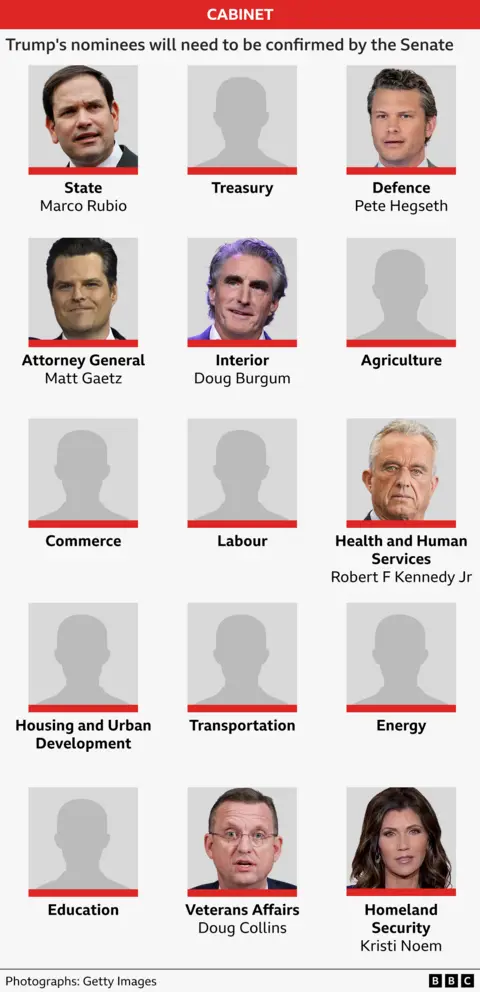
A graphic showing who Donald Trump has picked for the top roles in his new Cabinet: Marco Rubio as Secretary of State; Pete Hegseth as defence secretary; Matt Gaetz as Attorney General; Doug Burgum as Interior secretary; Robert F Kennedy Jr as Health and Human Services secretary; Doug Collins as Veterans Affairs secretary; and Kristi Noem as homeland security secretary.

House Speaker Mike Johnson, a Republican, asked on Friday that the report remain under wraps as Gaetz is no longer a member of the body – even amid bipartisan requests that it be shared as part of his vetting for the role of top prosecutor in the US.

Hours later, an attorney for two women who provided testimony to the House Ethics Committee about Gaetz urged lawmakers to release the panel’s report.

The lawyer, Joe Leppard, told CBS that one of his clients had witnessed Gaetz having sex with an underage girl in Florida in 2017. Mr Leppard urged lawmakers to release the House Ethics Committee report.

However, the justice department last year investigated the allegations and declined to press charges against Gaetz.

He has previously denied claims he had sex with a 17-year-old while he was an adult at a party in Orlando.

Banner titled 'More on TRUMP TRANSITION' with pic of Trump pointing outwards on background of red stripes and white stars

The 42-year-old Florida lawmaker wrote on Friday on X that “lies were weaponised to try to destroy me”.

Robert F Kennedy Jr, Trump’s nominee to serve as the head of the US Department of Health and Human Services, is meanwhile facing backlash over his vaccine scepticism.

Shares in vaccine makers and healthcare firms around the world slid sharply on Friday, as investors reacted to the nomination of a campaigner who has vowed to crack down on “Big Pharma”.

The head of the American Public Health Association, which has a 25,000-strong membership of health professionals, told the BBC that Kennedy’s criticism of immunisations had “already caused great damage in health in the country”.

George C Benjamin added that Kennedy was “just absolutely the wrong guy for it”.

Trump himself has so far not directly addressed the criticism of his picks.

The president-elect is still hiring for his incoming administration, with posts such as FBI director and treasury secretary yet to be named.

Trump names vaccine sceptic RFK Jr for health secretary


‘Dastardly deeds’: Family of Malcolm X sues US agencies over assassination | Civil Rights News

0


Three daughters of Malcolm X, a Black empowerment and civil rights icon in the United States, have accused the Central Intelligence Agency (CIA), the Federal Bureau of Investigation (FBI) and the New York Police Department (NYPD) of being in part responsible for their father’s 1965 assassination.

On Friday, the family filed a $100m wrongful-death lawsuit against the three agencies.

The legal action is the latest turn in the decades-long fallout from Malcolm X’s killing, which has prompted many questions but few answers.

He was shot dead in February 1965, when gunmen opened fire on the 39-year-old shortly after he began speaking at an event in the Harlem neighbourhood of New York.

Friday’s lawsuit charges that a “corrupt, unlawful, and unconstitutional” relationship between law enforcement and the “ruthless killers” allowed for the assassination.

The ties between the government agencies and the killers “went unchecked for many years and was actively concealed, condoned, protected, and facilitated by government agents”, the lawsuit alleges.

The suit further claims that the government agencies took several missteps that allowed for the killing to unfold.

The NYPD, coordinating with federal law enforcement, had arrested Malcolm X’s security detail just days before the assassination. The police force also intentionally removed officers from inside the ballroom, according to the suit.

Plus, the court filing says, the federal agencies had undercover personnel in the ballroom at the time of the attack, but the officers failed to intervene.

Malcolm X
Civil rights attorney Ben Crump announced the lawsuit in February of last year [File: Ted Shaffrey/AP Photo]

Speaking at a news conference on Friday, civil rights attorney Ben Crump summed up the family’s claim.

“We believe that they all conspired to assassinate Malcolm X, one of the greatest thought leaders of the 20th century,” Crump said.

He added he hoped law enforcement officials would read the lawsuit “and learn all the dastardly deeds that were done by their predecessors and try to right these historic wrongs”.

The CIA and FBI have not commented on the lawsuit. The NYPD, meanwhile, has previously said it does not comment on pending litigation.

Decades of speculation

Malcolm X was born Malcolm Little in Omaha, Nebraska. He initially gained prominence as the national spokesperson of the Nation of Islam, changing his name to el-Hajj Malik el-Shabazz later in life.

His Black revolutionary messaging drew attention from federal intelligence agencies, and he was closely monitored throughout his career as an activist and public figure.

Eventually, he broke from the Nation of Islam and became more closely aligned with the more mainstream civil rights movement. After his assassination, three men were arrested and found guilty of his murder.

In 2020, then-Manhattan District Attorney Cy Vance announced a review of the initial investigation into Malcolm’s X killing, which had long attracted the interest of historians and amateur sleuths.

Two years later, two of the three men convicted – Muhammad Aziz and Khalil Islam – were acquitted after the probe found that prosecutors, the FBI and the NYPD had withheld evidence that may have cleared them of culpability.

The conviction of a third man, Mujahid Abdul Halim, was not overturned.

Prosecutors had maintained that the trio – all members of the Nation of Islam – had killed Malcolm X in retribution for his acrimonious split from the group a year earlier.

The review did not identify the actual killer or uncover a wider collusion between the attackers and the government.

However, it drew attention to the fact that law enforcement was aware that the Nation of Islam was targeting Malcolm X after they firebombed his home a week before his killing.

It also revealed, as stated in Friday’s lawsuit, that authorities did not disclose the presence of undercover agents at the time of the attack.

In addition, NYPD files showed a New York Daily News reporter received an apparent tip about the killing shortly before it occurred.

Malcolm X
Martin Luther King Jr and Malcolm X are seen together in 1964 [Marion S Trikosko/Library of Congress via Reuters]

The lawsuit filed on Friday argued that Malcolm X’s family suffered the “pain of the unknown” in the decades after his killing.

“They did not know who murdered Malcolm X, why he was murdered, the level of NYPD, FBI and CIA orchestration, the identity of the governmental agents who conspired to ensure his demise, or who fraudulently covered-up their role,” the lawsuit said.

“The damage caused to the Shabazz family is unimaginable, immense, and irreparable.”


Inside the Lebanese border town that has not been evacuated

0


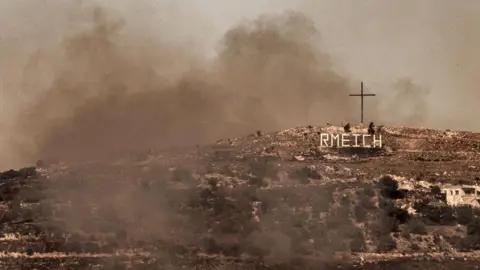
AFP Smoke rises following Israeli bombardment of hills near Rmeish, in southern Lebanon (22 October 2024)AFP

Since the start of the Israel-Hezbollah war, hundreds of thousands of Lebanese have fled their homes because of the fighting. But the residents of one town right in the combat zone have decided to stay.

Rmeish, just 2km (1.2 miles) from the border, is home to 7,000 Maronite Christians – and surrounded by firing on all sides.

“There’s lots of damage. Maybe 90% of houses have damage of some kind, glass smashed and cracks in the walls. I don’t know what’s going to happen when winter comes,” says Jiries al-Alam, a farmer who also works as an undertaker with the town’s church.

“We are determined to stay but hardly anyone sleeps at night because of the air strikes. Thankfully, there’s been no deaths among the residents so far, but 200 of my cattle died from the military flares,” he adds.

George al-Ameel General view of Rmeish, southern LebanonGeorge al-Ameel

Rmeish is the only Lebanese border town that has not been directly ordered to evacuate by the Israeli military

A day after Hamas launched its unprecedented attack on southern Israel from Gaza on 7 October 2023, its Lebanese ally Hezbollah began launching rockets into northern Israel, which in turn, started to strike Lebanon.

The residents of Rmeish began seeing rockets flying in both directions above them.

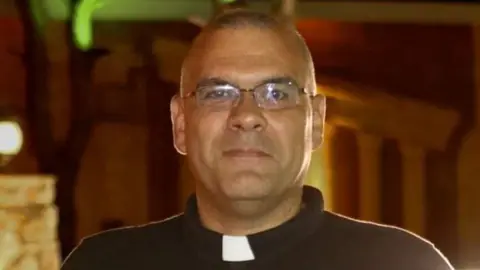
“Lots of families raised white flags on their homes and cars to say that they are peaceful and have no link to what is happening,” says Father George al-Ameel, 44, a priest and teacher in the town.

“We want to stay in our homes and don’t want any war in our town.”

George al-Ameel Father George al-Ameel, a priest and teacher in RmeishGeorge al-Ameel

Father George al-Ameel says the town is peaceful and that residents want to stay

After Israel began its ground invasion of Lebanon on 1 October this year, the war drew closer to Rmeish, with heavy fighting taking place in two villages both less than 1.6km away.

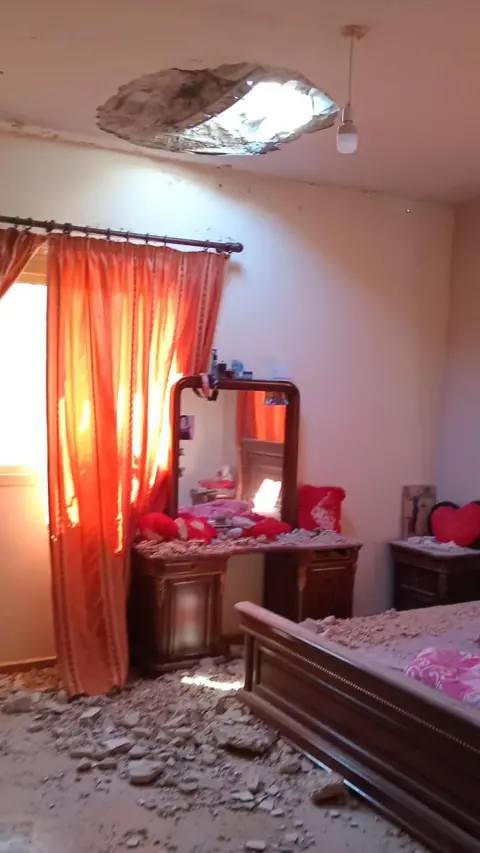
“We were staying in our house for months, then the air strikes started getting very close and suddenly our house was hit, we were forced to leave in the middle of the night,” says Rasha Makhbour, 38.

“People’s work has stopped and no-one goes out, our children’s school is shut, everything has changed.”

Rasha’s family of six moved to another house in the centre of town after theirs became uninhabitable.

“We believe the rockets that hit our home came from the south, not from our country,” she says.

The Israel Defense Forces told the BBC that there were “no known IDF strikes” on Rmeish during the dates Rasha Makhbour’s house was damaged, claiming it was a “failed launch by Hezbollah”.

Rasha Makhbour Rubble lies on bedroom furniture beneath a hole in a ceiling at Rasha Makhbour's home, in Rmeish, southern LebanonRasha Makhbour

The roof of Rasha Makhbour’s home was hit and damaged

Israel has issued a general evacuation order for the south of Lebanon since its ground invasion began. The UN says over 640,000 people have been displaced from there as they flee the fighting.

The Israeli government says that its military goals in southern Lebanon are to push back Hezbollah and return 60,000 Israelis displaced from its northern border towns to their homes.

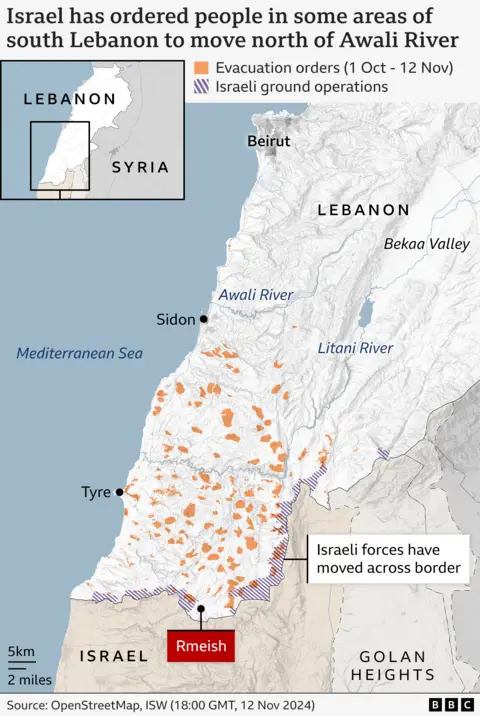
Map showing the areas in Lebanon where Israel has ground operations and also the areas targeted by Israeli evacuation orders. The city of Rmeish, in South Lebanon, is close to a ground operation area, but out of the evacuation orders zone.

On the border with Israel, Rmeish is the only Lebanese town that has not been directly ordered to leave.

While neither side has directly threatened the residents of Rmeish during the conflict, they have had their loyalty to Lebanon questioned.

“There’s been voices under the table spreading rumours that our presence here is evidence of our collaboration with Israel, the enemy. We completely reject this,” says Father al-Ameel.

It is a message reiterated by Rmeish’s mayor, Milad al-Alam.

“We’ve had no guarantees of safety from any side,” he says. “Our town is peaceful, and our only cause is to stay for our identity and our country.”

Jiries al-Alam Jiries al-Alam, a farmer and Rmeish's undertakerJiries al-Alam

Jiries al-Alam says essential supplies are running out in Rmeish

Until the start of Israel’s ground invasion, a Lebanese army unit had stayed in Rmeish and helped organise movement in and out of the town. But as Israeli forces moved to cross the border, the Lebanese army – which is not directly involved in the war – decided to pull out of Rmeish, much to the distress of locals.

The Lebanese army said it rejected the description that they have ‘withdrawn’ from border locations, referring the BBC to a statement that the army is “repositioning” a number of military units in the south.

Then at the end of October, the main route out of Rmeish itself was hit – leaving residents feeling further isolated and vulnerable. Since then, just one aid convoy has reached the town with the coordination of UN peacekeeping forces, the Unifil mission said.

“We have needs for fuel, foods and medicines, there was a delivery coming from Tyre that had to turn around,” says Father al-Ameel. “If someone is hurt, there’s no hospital for serious medical care.”

Mayor Al-Alam tells us he is optimistic that the route out of town will be regularly usable again soon, so they can fill up their fuel reserves, even if the route through an active warzone is dangerous.

Others in the town remain anxious.

“The situation is really bad. There are no goods, no food or fuel coming through. We’re starting to see items going missing from the shelves,” says Jiries al-Alam, the town undertaker.

“But we’ll find a way through. Now is the olive season and in the worst case we can just eat olives. We want to stay in our homes and so we will die in our homes if we have to.”

Additional reporting by Joanna Majzoub and Aakriti Thapar


Protesters storm parliament in Abkhazia | Protests

0


Protesters in the breakaway Georgia region of Abkhazia stormed the parliament building and demanded the resignation of its leader over a proposal to allow Russians to buy property in the Black Sea territory. Opponents say the measure would drive up prices and boost Russian dominance of the region.


Elon Musk met Iran’s UN ambassador in New York

0


Elon Musk met Iran’s ambassador to the UN a day before he was made joint head of Donald Trump’s new cost cutting department, the BBC’s US partner CBS has confirmed.

The meeting took place at ambassador Amir Saeid Iravani ‘s residence in New York, with the aim of discussing how to ease tensions between the two nations, according to the New York Times which first reported the story.

It is not clear if President-elect Trump or his national security team were aware of the meeting.

Several of the recent appointees to Trump’s national security team, including Mike Waltz and Marco Rubio are known Iran hawks, believing the US should take a tough stance against Iran.

The US does not have diplomatic relations with Tehran but a private meeting with Musk provided a workaround, allowing Iran to avoid a meeting with an American official, according to the New York Times.

The newspaper also said that Musk requested the meeting with the ambassador, and that it was described by Iranian officials as “positive” and “good news”.

Trump spokesperson Steven Cheung said “We do not comment on reports of private meetings that did or did not occur.”

The Iranian mission to the UN and the White House declined a request for comment from CBS News.

During his first term as president, Trump withdrew the US from the Iran nuclear deal, brokered in 2015 during Barack Obama’s presidency, and reinstated harsh economic sanctions which largely prohibit US companies from doing business in Iran.

Trump also ordered the air strike which killed Iranian military commander Qasem Soleimani in 2020.

The president-elect is also a strong supporter of Israel, which has been at war with the Iranian-backed groups Hamas and Hezbollah since Hamas’s 7 October attack on Israel last year.

Musk was recently appointed joint head of Donald Trump’s new cost cutting department, which will advise on government cost cutting but will not be an official arm of the government.

The tech billionaire and Tesla boss also joined Trump in a phone call with Ukrainian President Volodymyr Zelensky, and has played a key role in providing communications to Ukraine’s military via his Starlink satellite internet system.


Israel ramps up attacks on Lebanon as officials study US ceasefire plan | Israel attacks Lebanon News

0


The Israeli military has carried out air raids in the suburbs of Beirut for the fourth consecutive day as Lebanese officials studied a US plan for a ceasefire.

Israeli air strikes flattened five buildings in the Lebanese capital’s southern suburbs on Friday. One of them was located near one of Beirut’s busiest traffic junctions, Tayouneh.

The Israeli military said its fighter jets attacked munitions warehouses, a headquarters and other infrastructure used by the Lebanese group Hezbollah.

Reporting from Beirut, Al Jazeera’s Zeina Khodr said the Israeli military had issued two forced evacuation orders before the attacks.

“[Residents] are forced to leave their homes only to watch the strikes come in and wonder whether or not they have a home to return to. There are no casualties because many people left the area and because of these evacuation orders,” she said.

“Human rights groups have criticised these forced evacuation orders, saying most of the time they don’t give people enough time to leave,” Khodr added.

Meanwhile, Iran-aligned Hezbollah said it fired rockets at a group of Israeli soldiers in Misgav Am and the Yiftah barracks in northern Israel.

The Lebanese armed group said in a statement on Telegram it also attacked another group of Israeli soldiers with rockets on the eastern outskirts of the Lebanese town of Markaba.

Hezbollah also said it attacked Israeli soldiers in northern Israel’s Sasa and Dishon.

Israel’s military escalated its attacks on Lebanon in late September after almost a year of cross-border hostilities with the Lebanese armed group Hezbollah in parallel with the Gaza war. It says it aims to secure the return home of tens of thousands of Israelis, forced to evacuate from northern Israel under Hezbollah fire.

Israel’s attacks on Lebanon have forced more than one million Lebanese to flee their homes, igniting a humanitarian crisis.

It has dealt Hezbollah serious blows, killing its leader Hassan Nasrallah and other commanders. Hezbollah has kept up rocket attacks into Israel and its fighters have been battling Israeli troops in the south.

Ceasefire talks

Diplomacy attempting to reach a ceasefire has shown tentative signs of progress this week.

The Reuters news agency reported on Thursday that the US ambassador to Lebanon had presented a draft ceasefire proposal to Lebanon’s parliament speaker Nabih Berri, citing two senior political sources. Berri is endorsed by Hezbollah to negotiate and met the senior Iranian official Ali Larijani on Friday. The AFP news agency reported that senior Lebanese officials are reviewing the US proposal.

A senior Iranian official said on Friday that Iran would back any decision made by Lebanon in truce talks, signalling Tehran wants to see an end to the conflict.

Asked at a news conference whether he had come to Beirut to undermine the US truce plan, Larijani said, “We are not looking to sabotage anything. We are after a solution to the problems.”

“We support in all circumstances the Lebanese government. Those who are disrupting are Netanyahu and his people,” Larijani added, referring to Israeli Prime Minister Benjamin Netanyahu.

World powers have said a Lebanon ceasefire must be based on UN Security Council Resolution 1701, which ended a previous 2006 war between Hezbollah and Israel. Its terms require Hezbollah to move weapons and fighters north of the Litani River, which runs some 20km (30 miles) north of the border.

Israel has demanded the freedom to attack, should Hezbollah violate any agreement – a demand that Lebanon has rejected.

In a meeting with Larijani, Lebanon’s caretaker Prime Minister Najib Mikati urged support for Lebanon’s position on implementing 1701 and called this a priority, along with halting the “Israeli aggression”, a statement from his office said.

Larijani stressed “that Iran supports any decision taken by the government, especially resolution 1701”, the statement said.

Meanwhile, on Thursday, Eli Cohen, Israel’s energy minister and a member of its security cabinet, told Reuters that prospects for a ceasefire were the most promising since the conflict began.

At least 3,386 people have been killed and 14,417 wounded in Israeli attacks on Lebanon since October 2023.


North Korean troops in Ukraine ‘grave escalation’, Scholz tells Putin

0


German Chancellor Olaf Scholz told Russian President Vladimir Putin on Friday that Russia’s deployment of North Korean troops against Ukraine was a “grave escalation” of the conflict, according to government sources.

In the first phone call between the leaders in nearly two years, Scholz called on Putin to end the war and pull Russian troops out of Ukraine.

The Kremlin described the conversation as “a detailed and frank exchange of opinions on the situation in Ukraine”, adding “the very fact of dialogue is positive”.

Ukrainian President Volodymyr Zelensky said the call was a “Pandora’s box” and argued it weakens Putin’s isolation.

According to government sources, the chancellor condemned Russia’s attack on Ukraine and called on Moscow to negotiate with Kyiv to come to a “fair and lasting peace”.

He also stressed “Germany’s unwavering determination to support Ukraine in its defensive struggle against Russian aggression for as long as necessary”.

Scholz condemned in particular the Russian air strikes on civilian infrastructure.

The phone conversation lasted about an hour and both leaders agreed to stay in contact. Russian media is reporting that according to the Kremlin, the call was initiated by Germany.

The German government will be keen to avoid any accusations that Berlin is trying to strike a deal with Moscow over Ukraine’s head, particularly given painful 20th century memories in eastern Europe of Nazi Germany and the Soviet Union carving up the region between them.

In a written statement, the chancellor’s office highlighted that Scholz also talked to Zelensky before the call to Putin. Scholz also planned to talk to Zelensky again once the call was over to give details about the conversation with the Russian president.

In a statement from the Kremlin to Russian media, Putin reportedly told Scholz that Russian-German relations had suffered “an unprecedented degradation across the board as a result of the German authorities “unfriendly course”.

According to the Kremlin, Putin told Scholz that any potential peace agreement must “be based on the new territorial realities” — in other words the Ukrainian territory that Russia has occupied since 2022.

Putin also said a peace deal could only happen by removing “the root causes of the conflict”. The Kremlin justifies its invasion of Ukraine with the accusation of Nato “expansion” into eastern Europe.

In the call, Putin reportedly said “the current crisis was a direct result of Nato’s years-long aggressive policy aimed at creating in Ukrainian territory an anti-Russian bridgehead”.

In an interview on German television last Sunday, Scholz said he was planning to talk to Putin to push for peace talks. He said he was not acting on his own, but rather in consultation with others.

There is speculation that Scholz is planning to also talk to the Chinese president Xi Jinping, a lukewarm supporter of Russia, about the war in Ukraine at the G20 next week in Rio de Janeiro.

The last time Scholz talked to Putin on the phone was on 2 December 2022. They last met in person a week before the full invasion of Ukraine.

At the time, Scholz returned to Berlin with promises from Putin that Russia did not intend to invade Ukraine. The attack a week later was the final break in trust between Germany and Russia.

For decades, Berlin had tried to ensure peace with Moscow by binding the two countries together with trade and energy links. That aspiration shattered overnight when Russia launched its full invasion of Ukraine.

Today, Germany is the largest donor of military and financial aid to Ukraine after the US, and mainstream politicians from across the political spectrum, as well as most voters, favour supporting Ukraine.

But with elections in Germany now due in February, pressure is growing for serious peace negotiations to end the war in Ukraine.

The far-right AfD and the new far-left populist BSW, which together could win between a quarter and third of votes in the election, accuse the government of not doing enough to bring about a peace deal.

Scholz’s governing coalition collapsed last week and he now runs a minority government until the elections. Both he and his party are doing badly in the polls.

Germany has been hit hard by the war in Ukraine, both politically and economically.

So any sign that Scholz is helping to end the conflict could turn around his fortunes at the ballot box.


What a second Trump presidency means for the Middle East and Ukraine | TV Shows

0


Marc Lamont Hill discusses the impact of a second Trump presidency on US foreign policy and global crises.

As the US braces for a transition of power between President Joe Biden and President-elect Donald Trump, both US geopolitical allies and adversaries wonder what direction American foreign policy will take under Trump.

With tensions in the Middle East at a boiling point and Israel continuing its genocidal campaign in Gaza, what effect will a Trump administration have on the region? And how will Trump’s handling of the war in Ukraine affect Europe and global stability?

This week in UpFront, Marc Lamont Hill talks with former US State Department official Annelle Sheline, professor of international affairs at Harvard Kennedy School Stephen Walt, and political analyst Omar Baddar about the future of American foreign policy under a second Donald Trump term.


Netanyahu aide investigated by police over 7 October timeline

0


The Chief of Staff to Israeli Prime Minister Benjamin Netanyahu is being investigated by police over allegations of altering documents relating to the 7 October Hamas attack to portray his boss in a more favourable light.

Tzachi Braverman, one of Netanyahu’s closest advisors, was questioned by the Israeli police Lahav 433 major crimes unit for over five hours on Thursday, according to reports in Israeli media.

Detectives have confirmed an investigation is under way.

The accusation is focused around two telephone calls that Netanyahu received as the Hamas cross border raid was unfolding on 7 October 2023.

Braverman is suspected of having altered the documented time when Netanyahu first received an update on the attack via a telephone call from his military secretary at the time, Major General Avi Gil.

The chief of staff is accused of changing the time from 06:40 to 06:29.

He denies having altered the transcript of the call other than to change the time.

“I know that the first call was received at 06:29, that’s why I insisted on changing it,” he is reported to have told detectives during the interrogation.

While Gil had phoned Netanyahu at 06:29, as the Hamas attack began, Netanyahu did not give any instructions, telling him instead to phone again in 10 minutes, at 06:40, according to a report in the Haaretz newspaper,

It was only during the second phone call for which Braverman allegedly altered the time stamp to appear as though it was the first, that Netanyahu ordered Gil to hold a situational assessment on the developing Hamas invasion, Haaretz reported.

The allegation is that Braverman altered the time, in order to give the impression that the prime minister had acted more urgently and more decisively.

The chief of staff denies that.

The 7 October attack was the biggest military and intelligence failure in Israel’s history.

Several senior military officials have already resigned over it.

Netanyahu has consistently denied any personal failure.

His critics though, believe it is the prime minister who was ultimately responsible for the failure to prevent the deadliest attack on the country since the foundation of the State of Israel in 1948.

Various investigations are under way into the military and intelligence failures and Netanyahu has rejected claims he is stalling on demands for a full-scale inquiry.

This potential scandal is in its infancy, but it could go on to seriously undermine the Prime Minister’s position.

And it comes at a time when Netanyahu is mid-way through a trial facing corruption charges. He is due to testify in that trial next month, having failed to have the case thrown own, believing it is a political witch-hunt.


Croatian PM sacks health minister accused of corruption | Politics News

0


Prosecutors accuse suspects of ‘accepting and giving bribes, abuse of position and authority and money laundering’.

Croatia’s prime minister has fired Health Minister Vili Beros following his arrest on suspicion of corruption as part of a European Union investigation.

“This morning, former Minister Vili Beros and two other individuals were arrested as part of an operation conducted” by anticorruption officials, Prime Minister Andrej Plenkovic told a news conference on Friday.

“As prime minister, I am personally appalled by the idea that anyone in the healthcare system would use their position either for personal enrichment or to favour someone else within the healthcare system,” Plenkovic said.

The European Public Prosecutor’s Office (EPPO) in the capital, Zagreb, said it had launched an investigation into eight people, including Beros and the directors of two hospitals.

The EU’s independent public prosecution office accused the suspects, and two companies, of “accepting and giving bribes, abuse of position and authority and money laundering”, it said in a statement.

“Mr Beros completely denies any criminal responsibility,” his lawyer Laura Vakovic told journalists.

Plenkovic, who was re-elected in April, said, “We as a government have not and will not protect anyone from criminal prosecution if they are suspected of committing criminal acts, regardless of who that may be or which duty they have.”

Between June 2022 and November 2024, five of the suspects tried to “secure undue financial gains” in a scheme involving the sale of medical robotic devices for several hospitals in Croatia, prosecutors said.

The suspects also offered bribes to manipulate the public procurement process, according to the EPPO.

This was attempted on at least four occasions but did not work in the case of an EU-funded project in the coastal town of Split, where their bribe was refused, the prosecutors said.

In the other three instances in various hospitals in Zagreb, “there are allegations that the minister of health, in exchange for a bribe received, issued approvals for the purchase of operating microscopes at unreasonably inflated prices, and provided funds for public procurement.”

The price was “unjustifiably increased by [$654,000] to the detriment of the Croatian national budget,” the prosecutors added.

Croatia’s Office for the Suppression of Corruption and Organised Crime (USKOK) confirmed the arrests without identifying the suspects.

Beros was appointed to the post after his predecessor, Milan Kujundzic, was sacked in January 2020 over his links to a case involving undeclared assets.

Since taking power in 2016, several ministers from the prime minister’s conservative Croatian Democratic Union (HDZ) party have stepped down amid corruption allegations.

Croatia has had severe problems with systemic and political corruption. It is generally ranked by international anticorruption groups as one of the most corrupt states among the 27 EU member countries.