


Voters are waiting in long lines at polling locations across the US, with both Democrats and Republicans hoping high turnout will give their candidates an edge.
Published On 5 Nov 2024

Voters are waiting in long lines at polling locations across the US, with both Democrats and Republicans hoping high turnout will give their candidates an edge.
Published On 5 Nov 2024

 Getty Images
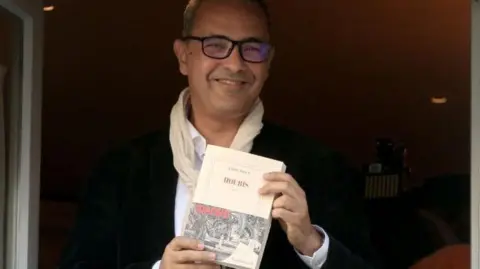
For the first time, an Algerian author has won France’s top literary award, the Goncourt, with a searing account of his country’s 1990s civil war.
Kamel Daoud’s novel Houris tells of Algeria’s blood-soaked “dark decade”, in which up to 200,000 people are estimated to have been killed in massacres blamed on Islamists or the army.
The heroine Fajr (Dawn in Arabic) has survived having her throat cut by Islamist fighters – she has a smile-like scar on her neck and needs a speaking tube to communicate – and tells her story to the baby girl she carries inside her.
Written in French, the book “gives voice to the suffering of a dark period in Algeria, particularly the suffering of women,” the Goncourt committee said.
“It shows how literature… can trace another path for memory, next to the historical account.”
The irony is that few in Algeria are likely to read it. The book has no Algerian publisher; the French publisher Gallimard has been excluded from the Algiers Book Fair, and news of Daoud’s Goncourt success has – a day on – still not been reported in the Algerian media.
Worse, Daoud – who now lives in Paris – could even face criminal charges for speaking of the civil war.
A 2005 “reconciliation” law makes it a crime punishable by jail to “instrumentalise the wounds of the national tragedy”.
According to Daoud, the effect is to make the civil war – which traumatised the entire country – a non-subject.
“My 14 year-old daughter did not believe me when I told her about what had happened, because the war is not taught in schools,” Daoud told Le Monde newspaper.
“I cut out some of the worst scenes I wrote. Not because they were untrue, but because people would not believe me.”
Daoud, 54, had first-hand experience of the massacres because he was a journalist at the time working for the Quotidien d’Oran newspaper. In interviews he has described the ghastly routine of counting corpses, then seeing his count altered – up or down – by the authorities, depending on the message they wanted to be given.
“You develop a routine,” he said. “Come back, write your piece, then get drunk.”
 Getty Images
He worked as a columnist for many years, but gradually fell foul of the Algerian government because of his refusal to toe the line.
He is strongly critical of what he sees as the official “instrumentalisation” of the 1954-1962 war of independence against France; and of what he sees as the continuing subjugation of women in Algerian society.
“In a way the Islamists lost the civil war militarily, but they won politically,” he said.
“What I hope is that my book will make people think about the price of freedom, especially for women. And in Algeria, that it will encourage people to confront all of our history, not fetishise one part over the rest.”
Daoud has written two previous novels, one of which – the much-praised Meursault Investigation – was a rewriting of Albert Camus’s The Stranger and was shortlisted for the Goncourt in 2015.
In 2020 the author moved to Paris, “exiled by the force of things”, and took French nationality. “All Algerians are Franco-Algerians,” he has said. “Either out of hate or out of love.”
In Algeria he is a divisive figure. His enemies regard him as a traitor who sold his soul to France, while others recognise him as a literary genius of whom the country should be proud.
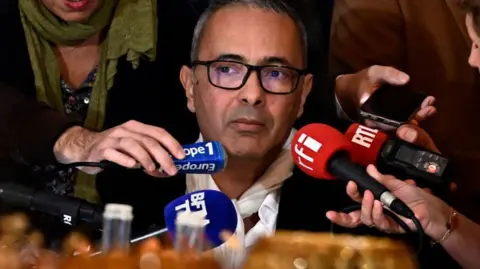
In his post-award press conference, Daoud himself said that it was only by coming to France that he was able to write Houris.
“France gave me the freedom to write. It is a land of refuge for writers,” he said. “To write you need three things. A table, a chair and a country. I have all three.”

Package includes 838 million euros in cash handouts to small businesses and freelance workers affected by the disaster.
Spain has announced a 10.6 billion euro ($11.5bn) aid package to help those affected by flash floods that killed at least 217 people and destroyed businesses and homes last week.
The package includes 838 million euros in cash handouts to small businesses and freelance workers affected by the disaster, Prime Minister Pedro Sanchez said on Tuesday.
He said the package also includes 5 billion euros ($5.5bn) of state-guaranteed loans, while the national government will finance 100 percent of the cleanup costs by local councils and half the repair to infrastructure.
He added that Spain has also requested aid from the European Union solidarity fund.
”There are still missing persons to be located, homes and businesses destroyed, buried under the mud and many people suffering severe shortages,” Sanchez said in a news conference in Madrid.
“We have to keep working.”
At least 217 people died in Valencia, Castile La Mancha and Andalusia, but only 111 have been identified so far.
Reporting from Chiva, a town in Valencia, Al Jazeera’s Sonia Gallego said as rescue efforts continue “hundreds” of people are still missing with authorities warning that the death toll could increase.
The regional judicial authorities in Valencia said on Tuesday that at least 89 people were missing.
The number only includes reports from families who have provided data and biological samples for the identification of their relatives, the Superior Court of Justice of the Region of Valencia said in a statement.
Last week, heavy rainfall was caused by a weather system where cold and warm air meet and produce intense rain clouds, which are believed to be growing more frequently due to climate change.
The floods were the deadliest in modern Spanish history and the most catastrophic flood-related event in Europe since 1967.
In the face of criticism and anger at the slow response to the disaster, Sanchez said the government had deployed nearly 15,000 police and military to help clear flood-affected areas, along with hundreds of forestry officials, forensic scientists, customs agents and heavy machinery to clear roads and rubble.

Anger reached boiling point on Sunday when crowds in Paiporta, a suburb in Valencia which experienced heavy flooding, threw mud at King Felipe VI, Queen Letizia, and Sanchez as they chanted, “Murderers, Murderers!”.
Matilde Gregori, 57, from Sedavi, a town in Valencia affected by the flooding, also criticised the government’s response.
“Only the people are helping … And the politicians, where are they? Why didn’t they raise the alarm? Murderers!” Gregori told the news agency AFP.
“They don’t know how to take care of their people, let them go home … We know how to do better,” she said, whose shop was affected by the floods.

Israel’s Prime Minister Benjamin Netanyahu has fired defence minister Yoav Gallant, saying there is a “crisis of trust” between them.
Netanyahu said in a statement his trust in Gallant had “eroded” in recent months and Foreign Minister Israel Katz would replace Gallant.
Gallant posted on social media that the “security of the state of Israel was and will always remain the mission of my life”.
The sacking has already prompted protests on the streets of Tel Aviv and political opposition leaders have called for wider public demonstrations.
Netanyahu and Gallant have long had a divisive working relationship. Prior to the start of the war in Gaza in October 2023, Netanyahu in March that year had fired Gallant over political differences before reinstating him following major public outcry.
Since Israel began its military offensive against Hamas in Gaza, Gallant has been a key senior figure of the campaign.
But on Tuesday Netanyahu said in a statement: “In the midst of a war, more than ever, full trust is required between the prime minister and the minister of defence.
“Unfortunately, although in the first months of the campaign there was such trust and there was very fruitful work, during the last months this trust cracked between me and the minister of defence.”
Netanyahu said that “significant gaps were discovered between me and Gallant in the management of the campaign”.
“These gaps were accompanied by statements and actions that contradict the decisions of the government and the decisions of the cabinet,” he added.
Following his firing, Gallant only posted a short message on X, stating that the security of Israel “was and will always remain the mission of my life”.
Katz will succeed Gallant as defence minister, while Gideon Sa’ar – who previously held no cabinet portfolio- becomes the new foreign minister, Netanyahu said.
Gallant’s removal will come into effect in 48 hours. The appointment of the new ministers requires the approval of the government and then the Knesset.
Netanyahu first fired Gallant in March 2023 following their disagreement over controversial plans to overhaul the justice system.
But he was forced to retract the sacking following massive public protests in several cities in Israel – an event that became known as “Gallant Night.”
In May this year, Gallant voiced open frustration at the government’s failure to address the question of a post-war plan for Gaza. Gallant wanted Netanyahu to declare publicly that Israel has no plans to take over civilian and military rule in Gaza.
It was a rare public sign of divisions within Israel’s war cabinet over the direction of the military campaign.
“Since October, I have been raising this issue consistently in the cabinet,” Gallant said, “and have received no response”.
Netanyahu responded by saying that he was “not ready to exchange Hamastan for Fatahstan,” in reference to rival Palestinian groups Hamas and Fatah.
Responding to Gallant’s removal on Tuesday night, members of Israel’s political opposition parties called for protests from the public.
A group representing the families of people taken hostage by Hamas in its 7 October attack also condemned Netanyhu’s dismissal of Gallant, calling it a continuation of efforts to “torpedo” a release deal.
They called on the incoming minister Katz to “express an explicit commitment to the end of the war and to carry out a comprehensive deal for the immediate return of all the abductees”.

In a race against time, United States presidential candidates Donald Trump and Kamala Harris have traversed the nation’s swing states in a bid to woo undecided voters and bag crucial Electoral College votes that could decide the winner of the 2024 US election.
Even if both White House hopefuls secure their traditional blue (Democratic) and red (Republican) states, the Electoral College votes from those are unlikely to be enough for either candidate to reach the magic number of 270 needed to cross the threshold to victory.
This year, the seven closely watched swing states are Arizona, Georgia, Michigan, Pennsylvania, Wisconsin, Nevada and North Carolina.
Here’s a brief look at some of the key issues shaping the swing states and both candidates’ stance on them:

Since 1952, Arizona has voted Republican in all but one election (1996) before Joe Biden flipped it in 2020 for the Democrats.
This time, polls show Trump leading marginally.
Arizona is a border state, and many polls have shown immigration and border control as key issues for many of its residents. In a May poll by CBS News, for instance, 52 percent of the respondents said recently arrived immigrants from Mexico had worsened living conditions for them.
Here is how both candidates plan to tackle immigration and border security:
Vice President Harris believes the US immigration system is “broken” and in need of “comprehensive reform”. While she has pledged support for a border security bill that would increase detection technology to intercept drugs and has promised to add 1,500 border security agents, Harris has also promised an “earned pathway to citizenship” and an increase in the number of employment-based and family visas.
Overall, Trump blames immigrants for rising housing, education and healthcare costs.
Trump’s plans include deporting millions of undocumented migrants by force, sealing the border to stop the “migrant invasion” by using the military on the US-Mexico border, and constructing detention facilities.
The former president wants to reinstate the “Remain in Mexico” policy, which requires asylum seekers to stay in Mexico until their immigration cases have been resolved. Trump also wants to end birthright citizenship for children born to undocumented parents.
The Republican candidate wants to impose ideological screening of immigrants but has proposed automatic green cards for foreign graduates of US universities.
Traditionally a Republican stronghold, this southern state went Democratic in 2020 – but only just. The votes in Georgia were counted three times, including once by hand, but that did not stop Trump from controversially attempting to overturn the results.
This time, perceptions about the state of the economy could determine how Georgia votes. A September poll by Redfield & Wilton Strategies, in partnership with the UK newspaper, The Telegraph, found that 41 percent of Georgia’s voters viewed the economy as the single biggest issue for them.
How do both candidates propose to ease the burden of inflation – which is not yet down to pre-COVID-19 levels?
Harris has promised to cut taxes for “more than 100 million working and middle-class Americans” by restoring Child Tax Credits and Earned Income Tax Credits. She has also pledged to increase Long-Term Capital Gains Tax from 20 percent to 28 percent, and the corporate tax rate from 21 percent to 28 percent to pay for this.
In order to help lower the cost of living, the vice president has proposed a federal ban on price gouging on food and groceries.
Trump has pledged to “end inflation” and significantly increase the Child Tax Credit while cutting government spending and bringing down the corporate tax rate to 15 percent.
The state of Michigan was a key stop in Vice President Harris’s last stretch of campaigning and here is why: Harris wanted to make a last-ditch effort to win over the continent’s largest Arab-American community that has been angered by the Biden-Harris administration’s unequivocal support for Israel in its war on Gaza.
While pre-poll numbers show Harris with a slender lead in the state, Trump will hope that his “Muslim supporters” will help him win in Michigan.
More than 100,000 uncommitted voters in the state have declared that they will not endorse Harris or Trump and some may opt for the Green Party candidate, Jill Stein, who has pledged to press for a ceasefire and halt weapons sales to Israel.
While Harris has promised to work towards ending the war in Gaza, “allow Palestinians to realise their right to dignity, security, freedom and self-determination”, she has also backed Israel’s “right to defend itself” and has rejected an arms embargo on the US ally in the Middle East.
Trump has not revealed specific details about what he would do on the issue of Gaza. However, during a meeting with Prime Minister Benjamin Netanyahu in July, Trump urged the Israeli leader to “get his victory” over Hamas. He said the killings in Gaza had to stop but that Netanyahu “knows what he’s doing”.
That rhetoric is in line with Trump’s actions during his first run as president. His government recognised the disputed city of Jerusalem as Israel’s capital, prompting anger among Palestinians. He negotiated “normalisation” deals between Israel and several Arab nations under the Abraham Accords and he pulled out of the Iran nuclear deal, which Israel also opposed.
However, he has also argued that he will push for peace – and get it.
President Joe Biden’s home state of Pennsylvania offers 19 Electoral College votes, the most among battleground states – and could prove to be the state that determines who wins the election.
In recent days, Harris has gained ground there, according to Democratic strategist Anish Mohanty. “Things have changed in this election over the last few days and the vice president has pulled off her campaign effectively,” Mohanty told Al Jazeera shortly after polls opened on the East Coast. Mohanty alluded to racist remarks against Puerto Rico by a comedian at a Trump rally recently as a turning point for the campaign: Pennsylvania is home to more than 480,000 Puerto Ricans.
But in addition to concerns over political divisiveness, immigration, the state of the economy and abortion, Pennsylvanians are concerned about an issue specific to their state: Fracking.
Fracking is a form of oil and gas production that environmentalists say is bad for the environment but which is the source of a huge number of jobs around the state. The practice causes earth tremors and has a high environmental cost since the procedure consumes large amounts of water, in addition to releasing methane, a greenhouse gas.
An October poll found that the state’s residents are divided on fracking: 58 percent backed it, while 42 percent opposed it.
Harris famously opposed fracking when she ran for president four years ago but in late July, her campaign officials confirmed that she will not seek to ban fracking if elected.
Harris wrapped up her campaign with a final, glitzy event in Philadelphia, where iconic talk show host Oprah Winfrey introduced her.
The vice president called on “everyone” in Pennsylvania to vote.
“You are going to make the difference in this election,” she told her supporters.
Meanwhile, Trump supports fracking and has said he will once again withdraw from the 2015 Paris Agreement to reduce greenhouse gas emissions and will also remove environmental regulations, such as restrictions on fossil fuel production, deemed “burdensome”. He had withdrawn from the Paris pact during his first term – President Joe Biden had recommitted the US to the agreement when he came to power.
Up until 2016, Wisconsin had been a reliably blue state for decades, but Trump was able to spring a surprise, beating Hillary Clinton by wooing mostly white, working-class voters who were unhappy about wages, poverty and rising healthcare costs.
Four years later, Biden was able to bring the state back into the Democratic Party’s fold.
This time, multiple opinion polls have suggested that healthcare is the most pressing issue for voters, in a state that has been badly affected by the country’s opioid crisis.
Harris has said she will lower the cost of pharmaceutical drugs, strengthen the Affordable Care Act, and lower healthcare premiums. If elected, she will also work with states to cancel medical debt for more people, she has promised.
On the other hand, Trump says he is “looking at alternatives” to the Affordable Care Act, which he calls too expensive.
While Nevada has the fewest Electoral College votes – six – among the swing states, they could still be crucial in such a close race.
Nevada suffers from the highest unemployment rate among all US states – only Washington, DC has a higher joblessness rate – as well as high costs of living.
Harris has promised to review which federal jobs require a college degree if elected president.
“We need to get in front of this idea that only high-skilled jobs require college degrees,” Harris said at a rally in October, promising she would tackle this on “day one” of her presidency.
At his October rally in Nevada, Trump promised to tackle inflation, but in a more recent rally this month, did not address the issue of unemployment.
Al Jazeera’s John Holman, who attended Trump’s November rally in Nevada, noted that while Trump concentrated on migration, the primary concern for voters in Nevada is the economy.
“This is the state with the highest unemployment in the US. It’s been hit hard with inflation. Gas prices, in particular, are high, and it’s a state that has never completely recovered from the pandemic,” Holman said.
North Carolina is the only one of this year’s swing states to have been won by Trump in 2020 and although Harris does not necessarily need to win North Carolina, any scenario in which she does will make her path to 270 a lot easier.
Trump can also get to 270 without North Carolina but doing so will be very difficult.
Abortion is a key issue in the state, according to polls. The state reduced the legal limit for abortions from 20 weeks of pregnancy to just 12 weeks in 2023 after the US Supreme Court overturned the landmark 1973 Roe v Wade court ruling granting the right to abortion.
The ruling left the issue largely unresolved and turned the current election into a referendum on fundamental rights for women.
Democrats are hoping that the issue of abortion will motivate white women, who have historically favoured Republicans and 60 percent of whom voted for Trump in 2020, to now vote for Harris instead.
The vice president, hoping to become the first female president in the country’s history, has said she will prevent a national abortion ban from becoming law and will sign any bill passed by Congress that restores the legality of abortion nationwide.
Meanwhile, Trump has said abortion laws are for individual states to decide and said he will not sign a national abortion ban. However, he has not signalled that he would oppose states – like North Carolina – adopting restrictive measures against reproductive rights.

 Ondrej Huserka / Facebook
A leading Slovak mountain climber has died while descending a 7,234m (23,730ft) peak in Nepal, after completing the rare feat of scaling the mountain’s perilous eastern face.
Ondrej Huserka fell into a crevasse on Thursday, after he and his climbing partner ascended the Langtang Lirung mountain in the Himalayas – the 99th-highest peak in the world.
The 34-year-old mountaineer had previously climbed in the Alps, Patagonia and the Pamir Mountains.
His Czech climbing partner Marek Holecek said the pair were returning to base after becoming the first mountaineers to ascend Langtang Lirung via a “terrifying” eastern route.
While rappelling a mountain wall, Mr Huserka’s rope snapped and he fell into an ice crevasse, his partner said in an emotional Facebook update posted after he returned alone.
He then “hit an angled surface after an 8m drop, then continued down a labyrinth into the depths of the glacier”.
In the Facebook post, Mr Holecek recalled hearing his partner’s cries for help and desperately trying to save him.
“I rappelled down to him and stayed with him for four hours until his light faded,” Mr Holecek said.
After freeing him from the ice, Mr Holecek realised his partner was paralysed.
“His star was fading as he lay in my arms,” he said.
The Slovak climbers’ association, SHS James, said adverse weather in Nepal had prevented rescue action.
“Following a phone call with Marek Holecek and his status published yesterday, and given the weather conditions under Langtang Lirung, the family and friends will have to cope with the fact that Ondrej is not with us any more,” it said in a social media post.
 Judith Swift
The Langtang Lirung mountain sits alongside other peaks in the Nepalese Himalayas and is a popular trekking destination.
Judith Swift, a climber who visited Langtang in the spring of this this year, said it was described to her by a local Nepalese Sherpa as “the killer mountain”.
“Not many people have summited it and many, including now sadly Ondrej Huserka, have died climbing it,” she told the BBC.
Mr Huserka joined the Slovak national alpinism team in 2011 and won the SHS James best ascent of the year award six times, according to his personal website.
His decade-long mountaineering career took him around the world.
He completed the first ascent of the “Summer Bouquet” on Alexander Block Peak in Kyrgyzstan, and repeated a “legendary route” on the Cerro Torre’s south-east ridge in South America, his website says.
Paying tribute to the late climber, SHS James said Mr Huserka was a “top alpinist” and “world-class”.
The Slovak Spectator said he was “one of the best Slovak mountaineers”.

In an advertisement for the Democrats in the United States in October, an image of left-wing environmentalist politician Jill Stein morphs into the face of Republican candidate and former President Donald Trump within the blink of an eye.
“A vote for Stein is really a vote for Trump,” a cautionary voiceover in the advertisement, titled “Crucial”, says. The video segues into Trump at a Pennsylvania rally this year, saying: “Jill Stein? I like her very much. You know why? She takes 100 percent from them.”
On October 28, the Democratic National Committee announced that it would spend about $500,000 in a last-minute effort to persuade voters in swing states against voting for third-party candidates such as Stein, the Green Party’s nominee for the presidential election, and the unaffiliated candidate, Cornel West.
Both Trump and the Democrats have implied that Stein could dent the vote for Democratic candidate and Vice President Kamala Harris, paving the way for a Trump win.
But what do the polls say? How much impact could Stein, a third-party candidate, have on the outcome?
Stein, 74, is the US Green Party nominee for the presidential election. She announced her candidacy via a video message on X on November 9, 2023. She previously ran for the 2012 and 2016 elections.
Born in Chicago and raised in Illinois, Stein graduated from Harvard College in 1973 and from Harvard Medical School in 1979. Her campaign website describes her as a practising physician.
The Green Party is a left-wing federation of Green state parties in the US, advocating for environmentalism and social justice.
Her positions on some of the key issues in this election are:
Stein has called for an immediate ceasefire in Gaza, an end to the blockade of the Palestinian enclave, the provision of humanitarian aid and the release of Palestinian prisoners in Israeli jails alongside Israeli captives being held in Gaza. According to her campaign website, she wants to “stop US support and arms sales to human rights abusers”. She wants to “end the longstanding US practice of vetoing UN Security Council resolutions to hold Israel accountable to international law”. She also says she wants to disband NATO and “replace it with a modern, inclusive security framework that respects the security interests of all nations and people”.
The Green Party wants to “stop fuelling” the Russia-Ukraine war and work on negotiating a peaceful end to it.
Stein’s party wants to advance the Green New Deal proposal to transition to clean energy and achieve zero emissions. The party says it takes an “eco-socialist approach” towards the environment, centring and compensating Black people, Indigenous people and the poor. Stein wants to declare a climate emergency and ensure the release of $650bn annually to boost renewable energy and clean transport.
A Stein administration would seek to create an economy that “works for working people, not just the wealthy and powerful”. Stein wants to introduce an economic bill of rights, abolishing private schools and guaranteeing free childcare and a lifelong free public education for all from preschool to graduate school. Additionally, she wants to cancel student debt for 43 million people in the US. She also wants to reduce taxes on incomes below the real median income of $75,000 per household, and increase taxes on “the ultra-wealthy and giant corporations”.
Overall, Stein was polling at about 1 percent nationally, according to The New York Times polling released in the first week of October.
However, discontent is brewing among many Arab-American and Muslim voters towards both the leading candidates – Harris and Trump – because of their unwavering support for Israel in its war in Gaza.
The Council on American-Islamic Relations (CAIR), a US-based Muslim civil rights and advocacy organisation, revealed on Friday that 42.3 percent of Muslim voters prefer Stein compared with 41 percent of Muslim voters who prefer Harris.
The poll of 1,449 verified Muslim American voters was conducted between October 1 and 31. It showed just 9.8 percent of Muslim voters were in support of Trump.
On February 27 this year, CAIR estimated that there were about 2.5 million registered Muslim American voters. That is approximately 1.6 percent of some 160 million registered voters in the US.
Between October 30 and 31, Brazil-based analytics and data intelligence website AtlasIntel polled samples of voters in the seven swing states.
As the margins between Harris and Trump are so slim, some experts believe that votes for Stein could indeed swing the election.
“The vote right now is so close that a small amount of tipping in one direction or another could swing it,” Bernard Tamas, professor of political science at Valdosta State University, told The Guardian newspaper.
The Guardian also quoted Nura Sediqe, an assistant professor in American politics at Michigan State University, who said: “Muslims are split. They’re not all voting third party, but let’s imagine a third are: then you’ve got up to 50,000 votes that had traditionally gone to the Democrats moving away. So if the margin is as slim as it was last time, it may affect the Democratic party.”
On Friday, the European Green family, including Green parties all over Europe, released a joint statement calling on Stein to withdraw from the race and endorse Harris. “We are clear that Kamala Harris is the only candidate who can block Donald Trump and his anti-democratic, authoritarian policies from the White House,” the statement read.
However, Kyle Kopko, an adjunct professor of political science at Elizabethtown College in Pennsylvania told Al Jazeera that while Stein can, in theory, swing the election, in practise it depends on how close the election results are.
It will have to be an “extraordinarily close election” for her to swing the vote, Kopko said.
Stein contested the 2016 election and won 132,000 votes across battleground states Wisconsin, Michigan and Pennsylvania. Together, the three states are worth 44 Electoral votes.
In these three states, Democrat Hilary Clinton lost by a combined 77,000 votes. Despite winning the popular vote, therefore, Clinton lost the Electoral College vote to Trump, who won 304 votes compared with Clinton’s 227.
The Republican leader beat Clinton in Michigan with a 0.3 percentage point margin of victory, in Pennsylvania with a 0.7 point margin of victory and in Wisconsin with a 0.7 point margin. These narrow victories earned him 44 Electoral votes combined from the three states.
In November 2016, an analysis cited by Vox suggested that if every Stein voter had voted for Clinton instead, she could have won Wisconsin, Michigan and Pennsylvania, and therefore, the election.
Kopko said this might be misleading, however. If Stein had not been on the ballot, it is unlikely that every Stein voter would have voted for Clinton. “Some voters would be disillusioned and not vote at all, or find another third party candidate to vote for,” he said.
In the 2000 US presidential election, Green Party candidates Ralph Nader and Winona LaDuke contested the election on the party’s ticket and ended up winning 2.7 percent of the popular vote. Nader made inroads in swing states Florida and New Hampshire, and it is believed that this allowed the states to switch from the Democrats to the Republicans.
This fed speculation that the Green Party ticket ate away the vote share for Democrat Al Gore to bolster a Republican George Bush win. The Green Party denied this.
Gore won more than half a million votes and conceded only after a monthlong legal battle.
The two-party political system has made it difficult for third parties to make a dent in election results.
Only four third-party candidates have been able to win Electoral College votes since 1920. They are – Robert La Follette, who won 13 Electoral votes in 1924; Strom Thurmond, who won 39 in 1948; George Wallace, who won 45 in 1968; and John Hospers, who won one Electoral vote cast by a faithless elector in 1972.

In many countries it’s a teenage right of passage: a first kiss.
But a new survey of Japanese high school students has revealed that four out of five 15-18-year-old boys have yet to reach the milestone.
And things aren’t looking much different for the girls, with just over one in four female high schoolers having had their first kiss.
These are the lowest figures recorded since Japan first began asking teenagers about their sexual habits back in 1974 – and are likely to be a worry in a country with one of the world’s lowest birth rates.
The study by the Japan Association for Sex Education (Jase) quizzed 12,562 students across junior high schools, high schools and university – asking them about everything from kisses to sexual intercourse.
The survey takes place every six years, and has been recording a fall in first kisses since 2005 – when the figure was closer to one in two.
But this year’s report found kissing was not the only area which had seen a fall in numbers. Perhaps unsurprisingly, it also revealed a drop in the numbers of Japanese youth having sexual intercourse.
According to the study, the ratio of high school boys who say they have had sexual intercourse fell 3.5 points from 2017 to 12%. For high school girls, it declined 5.3 points to 14.8%.
Experts have pointed to the impact of the Covid pandemic as one possible reason for the drop.
School closures and restrictions on physical contact during the Covid pandemic had likely impacted many of these students, as it happened “at a sensitive time when [they were] beginning to become interested in sexuality”, according to Yusuke Hayashi, a sociology professor at Musashi University quoted in the Mainichi newspaper.
However, the survey did find one area of increase: the number of teenagers admitting to masturbation across all demographics was at record high levels.
The results come after a separate survey earlier this year found that nearly half of marriages in Japan are sexless.
The results of the surveys come as Japan struggles to arrest its falling birth rate, and provide further cause for concern. In 2023, the then-prime minister warned that the country’s low birth rate was pushing it to the brink of being able to function.
Some researchers have suggested the population – currently at 125 million people – could fall to less than 53 million by the end of the century. A range of other contributing factors have been marked out as possible contributing factors – including rising living costs, more women in education and work, as well as greater access to contraception, leading to women choosing to have fewer children
Japan already has the world’s oldest population, measured by the UN as the proportion of people aged 65 or older.
In late 2023, Japan said that for the first time one in 10 people in the country are aged 80 or older.
In March, diaper-maker Oji Holdings announced it would stop making baby nappies to focus on making adult diapers.

A group of medical staff and journalists at a hospital in Gaza are seen singing a song of resilience called ‘We will live here’, as Israel continues its genocide against Palestinians in the territory.
Published On 5 Nov 2024

 Getty Images
A series of parcel fires targeting courier companies in Poland, Germany and the UK were dry runs aimed at sabotaging flights to the US and Canada, Polish prosecutors say.
Katarzyna Calow-Jaszewska revealed late last month that four people had been arrested and authorities across Europe were investigating the incidents.
On three days in July, a fire broke out in a container due to be loaded on to a DHL cargo plane in the German city of Leipzig.
A fire broke out at a transport company near Warsaw, and there was a similar fire at Minworth near Birmingham, UK, involving a package described as an incendiary device.
UK officials have given few details about the Minworth fire.
However, Ken McCallum, head of the UK’s domestic intelligence agency MI5, said last month that Russian secret agents had carried out “arson, sabotage and more dangerous actions conducted with increasing recklessness” after the UK had helped Ukraine in Russia’s war.
The head of Germany’s domestic intelligence agency (BfV) has said it was only by a stroke of fortune that the Leipzig device had not ignited in mid-air.
Ms Calow-Jaszewska said in a statement that a group of foreign intelligence saboteurs had been involved in sending parcels containing hidden explosives and dangerous materials via courier companies. The parcels then spontaneously burst into flames or blew up.
Western officials are now thought to have linked the arson attacks to a campaign orchestrated by Russia’s GRU foreign military intelligence service. They believe the fires originated in electric massage machines containing a “magnesium-based” substance.
Magnesium-based fires are hard to put out, especially on board a plane. The incident at Jablonow near Warsaw took two hours to extinguish, according to Polish reports.
“The group’s goal was also to test the transfer channel for such parcels, which were ultimately to be sent to the United States of America and Canada,” the prosecutor said.
Russia denies being behind acts of sabotage.
But it is suspected to have been behind attacks on warehouses and railway networks in EU member states this year, including in Sweden and in the Czech Republic.
German BfV’s head Thomas Haldenwang has described the device that caught fire at DHL’s logistics hub at Leipzig-Halle airport as suspected Russian sabotage.
The package is thought to have arrived from Lithuania and its onward flight was delayed.
The device that caught fire in Minworth is also understood to have come from Lithuania, where the head of the parliament’s national security and defence committee, Arvydas Pocius, said it was part of an ongoing campaign of hybrid attacks aimed at “causing chaos, panic and mistrust”.
DHL has increased security since the recent freight fires. “DHL Express has taken measures in all European countries to protect its network, its employees and facilities, as well as its customers’ shipments,” a spokeswoman said a few weeks ago.
Poland’s government has already responded to Russian sabotage, with Foreign Minister Radoslaw Sikorski announcing the closure of a Russian consulate in Poznan and threatening to expel the Russian ambassador if it fails to bring an end to its attacks.
Russia’s foreign ministry condemned the move as “a hostile step that will be met with a painful response”.

