Friday, September 25, 2026
Home Blog Page 7462

America braced as two stark visions collide on election day

0


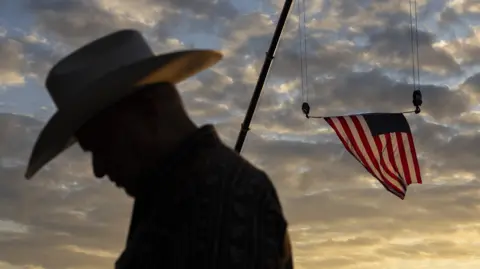
Getty Images Image shows a silhouette of a man walking past an American flagGetty Images

America is choosing its path forward, and the stakes could not be higher.

Both candidates have presented stark visions for the future if they lose this election. Donald Trump says the country will “go to hell” and become “communist immediately” if he loses, while Kamala Harris describes her opponent as a “fascist” who wants “unchecked power”.

Voters in the key battleground states have been bombarded by campaign ads, much of it designed to induce fear. Given this climate, it is no wonder surveyed Americans are reporting high levels of anxiety.

“I do believe they’re making us live in fear just to get our vote,” Heather Soucek told me in Wisconsin as election day loomed. She lives in a swing county in a swing state, and plans to back Trump because, in her words, Harris’s economic plans are “scary”.

But just along the street, I also met Tracy Andropolis, a registered independent who said she would vote for Harris. “It’s one of the most important elections in my lifetime. There’s a lot on the line,” she said, adding that she was concerned Trump would refuse to give up power if he won.

Both expressed genuine fears for the future if their candidate lost, reflecting the existential mood of many voters on the eve of the election.

Ms Andropolis also told me she did not believe the neck-and-neck polls. Not because she has any real evidence, but because she cannot envisage millions of people planning to vote for Trump. And she is by no means alone in her struggles to accept the closeness of this race.

One of the things I’ve learned travelling around this country and talking to voters is that America doesn’t just seem remarkably divided, it feels as though two separate nations are awkwardly cohabiting on the same land mass.
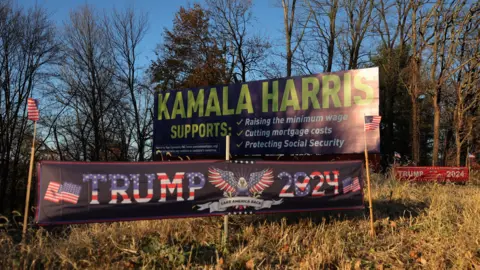
Getty Images Campaign signs for Republican presidential nominee, former U.S. President Donald Trump and Democratic presidential nominee, U.S. Vice President Kamala HarrisGetty Images

Democrats mainly live in the cities and suburbs, with Republicans mostly living in rural areas. Americans are increasingly moving to places where their neighbours share their political outlook. And it’s not hard to identify these areas at the moment, given the yard signs and placards that so often mark out Trump and Harris territory.

But it is not possible to live in these separate political worlds forever. These two sides are about to collide with the harsh reality of an election.

However disputed, however contested, there has to be a winner.

And when some here learn the eventual result and realise that tens of millions of their fellow Americans feel very differently to them, it will be a shock.

US voters: My biggest fear if the other side wins

Both Trump and Harris have charted their own historic and tumultuous paths to polling day.

I was among the press pack gathered outside a Manhattan court to witness Trump’s arraignment in his criminal hush-money trial in April. He was found guilty weeks later, becoming the first former or sitting president to be convicted of a crime. Many asked at the time: could a convicted felon really reclaim the White House?

But his legal troubles and his claim that he was being deliberately targeted by the Biden administration only fuelled his campaign and fired up his supporters. “They’re not after me, they’re after you,” he would so often say.

“They’re weaponising the criminal justice system against their political enemies, and it’s not right,” one of his supporters told me outside the courthouse. “I will fight for this man until the day I die,” another said.

A familiar pattern emerged: with each indictment, his poll ratings climbed and financial donations poured in.

Just think back to the moment last year when his mugshot was taken as part of the election interference case in Georgia. It quickly became an iconic image that now adorns many of the T-shirts I see at Trump rallies.
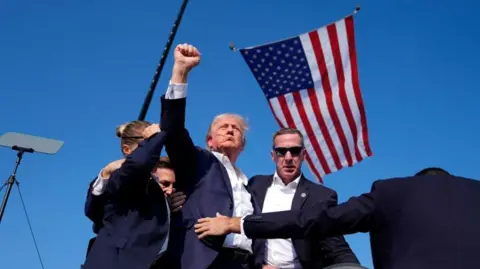
Evan Vucci/AP Donald Trump raises his fist as he is surrounded by US Secret Service agents after the shootingEvan Vucci/AP

Trump shortly after a gunman shot at him in Butler, Pennsylvania.

And it is impossible to recount the former president’s wild ride to polling day without the moment that produced another iconic image and almost ended the contest altogether.

When Trump was shot by a would-be assassin in Butler, Pennsylvania, in July, it shook this race and this nation profoundly. As he was helped to his feet by Secret Service agents, blood pouring from his ear, he raised his fist in the air and urged his supporters to fight.

When he appeared just 48 hours later at his party’s convention in Milwaukee with gauze over his ear, some in the crowd were weeping. I could see tears rolling down the face of one delegate standing near to me. It was Tina Ioane, who’d travelled from American Samoa.

“He is the anointed,” she told me. “He was called to lead our nation.”

At that stage in the summer, electorally, Trump looked unassailable.

On the other side, Democrats were becoming increasingly depressed about their own prospects. Deeply anxious that their candidate, Joe Biden, was too old to win re-election.

I was in the press room watching his shambolic debate against Trump in late June. There was stunned silence as we watched Biden’s 50-year career in politics essentially come to an end in front of our eyes.

But even then, many who publicly suggested he should step aside were dismissed. The Biden campaign even hit out at the “bedwetting brigade” who were calling for him to go.

It would, of course, be a matter of time.

Just days after that jubilant Republican convention in July, when Trump looked like he could not lose, Biden announced he was giving up his re-election bid. The mood among Democratic supporters soon swung from anxious pessimism to excited anticipation.

Any reservations they had about whether Kamala Harris was their best candidate were erased at a joyful convention in Chicago a few weeks later. People who had been resigned to defeat were now swept away on a tide of enthusiasm.

This election represented a chance to “move past the bitterness, cynicism and divisive battles of the past”, she said to loud cheers.

But this burst of excitement did not last. After an initial bump in the polls, Harris struggled to maintain the momentum. It appears she quickly won back traditional Democrats who were not backing Biden but found it harder to win over crucial undecided voters.
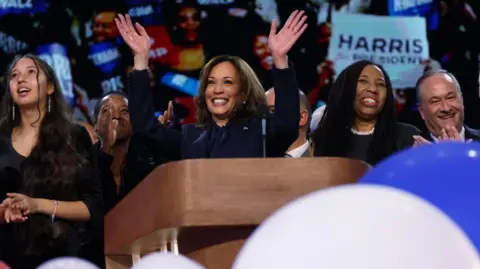
Reuters Democratic presidential nominee and U.S. Vice President Kamala Harris waves from the stage on Day 4 of the Democratic National ConventionReuters

Kamala Harris gave the Democratic party a new sense of enthusiasm.

Harris, however, has repeatedly pushed that more optimistic message. She has also made reproductive rights a cornerstone of her campaign, and is hoping the issue will motivate women to turn out in high numbers.

But the challenge, as in all presidential elections, is to convince the undecided.

I met Zoie Cheneau at a hair salon she owns in Atlanta, Georgia, less than two weeks out from the election. She said she had never been so unmotivated to vote.

“It’s the lesser of two evils for me right now,” she said, explaining that she would ultimately cast her ballot for Harris but felt Trump may prove better for small businesses.

“I will be excited that a black woman would be the president of the United States,” she said. “And she will win, I know she will win.”

Two tribes face crunch moment

While some voters are anxious and believe this race to be close, Ms Cheneau’s certainty about the eventual result is something supporters on both sides repeatedly express.

Many Harris supporters simply cannot understand why she is not further ahead of a convicted criminal who has been publicly attacked and derided by those who served in his last administration.

Trump supporters are equally aghast that anyone could vote for a candidate who has flip-flopped on policy and has been in the White House at a time when illegal border crossings reached record levels.

These two tribes exist in what appear to be parallel political ecosystems, across a deep partisan divide where opposing views are dismissed and the candidates inspire a devoted loyalty that goes beyond normal party affiliation.

Voters have been given apocalpyptic warnings about what might happen if the other side wins. They’ve been told this election is about far more than who sits in the Oval Office for the next four years. Many believe it is an existential event that could have disastrous consequences.

There is no doubt the tone of this campaign has raised the stakes, ratcheting up anxiety and tension, meaning the aftermath of this election could be explosive. We are expecting legal challenges and street protests would be a surprise to no one.

This is a nation split between opposing visions of what’s at stake. But it is in the polling stations that Red and Blue America will meet and be counted.

Whatever the result, roughly one half of the country is about to discover that the other half has a completely different sense of what America requires.

For the losers, this will be a stinging realisation.

Election banner


Boeing workers vote to end seven-week strike | Labour Rights

0


BREAKING,

International Association of Machinists votes to approve latest contract offer after rejecting two previous proposals.

Boeing workers in the United States have voted to accept the aircraft manufacturer’s latest contract offer, ending a seven-week strike that crippled production of the 737 Max and 777.

The International Association of Machinists and Aerospace Workers (IAM) said on Monday that its members voted by 59 percent to approve the deal, which includes a 38 percent pay rise over four years as well as a one-off $12,000 bonus and changes to workers’ retirement plans.

The vote, which comes after union members rejected Boeing’s two previous offers, means that some 33,000 employees in the Seattle area will begin returning to work as early as Wednesday.

The strike has compounded a difficult year for Boeing, which has suffered heavy financial losses and faced intense scrutiny since an incident in January during which one of its aircraft lost a door panel midflight.


Elon Musk can keep giving $1m to voters, judge rules

0


Elon Musk’s political group can keep awarding $1m (£722,000) to voters in swing states, a judge has ruled.

The giveaway by Mr Musk’s America PAC is set to end on Tuesday, and the final recipient has already been determined, a lawyer for the billionaire said in a court hearing on Monday.

In a surprising turn, the lawyer revealed that people receiving the money have not been chosen randomly in a lottery-style contest, as many believed, but were selected by the group.

Philadelphia District Attorney Lawrence Krasner had sued to stop what he called an “an illegal lottery” after Musk announced he would give the money to one voter in a swing state each day until Election Day.

Pennsylvania Judge Angelo Foglietta did not immediately give a reason for the ruling, made a few hours after the hearing, according to the Associated Press.

“The $1 million recipients are not chosen by chance,” the lawyer, Chris Gober, said during the hearing, according to the Associated Press. “We know exactly who will be announced as the $1 million recipient today and tomorrow.”

Mr Gober told the court that America PAC has already determined the final recipient will be a voter from Michigan, US media reported.

On Monday, America PAC announced a man named Joshua in Arizona had been awarded the day’s sum.

In a post on X, formerly Twitter, which Mr Musk owns, the group added: “Every day until Election Day, a person who signs will be selected to earn $1m as a spokesperson for America PAC.”

But when the world’s richest man unveiled the giveaway last month, many believed it was a random drawing for registered voters who signed a petition supporting the First and Second Amendments of the US Constitution.

“We are going to be awarding $1m randomly to people who have signed the petition, every day, from now until the election,” Musk told a campaign event.

A few days later, the US justice department warned that the group could be breaking election laws, which forbid paying people to register to vote. Krasner’s office sued to stop it.

Mr Musk has been aggressively campaigning for Republican White House candidate Donald Trump in swing states across the country, and his committee has been pushing hard in Pennsylvania, where polls suggest Trump is in a tie with his Democratic rival, Vice-President Kamala Harris.

A lawyer in Krasner’s office told Reuters that Mr Gober’s comments in court were “a complete admission of liability”.

During the hearing, prosecutors played a video where Mr Musk, who is also the chief executive of SpaceX, said that “all we ask” is that the winners serve as spokespeople for the group, Reuters reported.

But Chris Young, the director of America PAC, said in court that the recipients are screened and must have values aligned with the group, US media reported.

Those who receive the money sign non-disclosure agreements that block them from publicly discussing the terms of their contracts, according to Reuters.

Mr Musk did not attend Monday’s hearing.

Also on Monday, Joe Rogan released an episode of his podcast featuring a nearly three-hour interview with Mr Musk.

In a post promoting the podcast on X, he said he would be endorsing former President Donald Trump.

“He [Musk] makes what I think is the most compelling case for Trump you’ll hear, and I agree with him every step of the way,” Rogan wrote.


Kamala Harris makes final push for votes in battleground Pennsylvania | US Election 2024 News

0


Democratic presidential candidate Kamala Harris spent the last day of the United States election campaign in Pennsylvania, the state that could make or break her historic bid for the White House.

Her message to supporters was blunt: Every vote is crucial in the state that holds 19 Electoral College votes, the most of all the seven swing states that will likely determine the outcome.

“We need everyone in Pennsylvania to vote,” she said to an exuberant afternoon crowd in Allentown. “You are going to make the difference in this election.”

The polls have Harris essentially tied in Pennsylvania with her Republican rival, former President Donald Trump, who held one of his final rallies in Reading, Pennsylvania, only a few kilometres away from Harris.

Over the last few days, Harris has sought to further differentiate her campaign from Trump’s by not mentioning his name, and emphasising optimism and community.

“Momentum is on our side, momentum is on our side, can you feel it? We have momentum, right?” she said to cheers.

“Because our campaign has tapped into the ambitions and aspirations and the dreams of the American people, we are optimistic and excited about what we will do together.”

Harris, 60, could make US history as the first woman, the first Black woman and first person of South Asian descent to reach the Oval Office. Four years ago, she broke the same barriers in national office by becoming President Joe Biden’s second-in-command.

Harris’s last day was all about encouraging supporters to vote and think about the future.

“It’s time for a new generation of leadership in America, and I am ready to offer that leadership as the next president of the United States of America,” she said.

‘No joke’

Harris’s Allentown rally was introduced by Grammy award-winning musician Fat Joe, who was raised by parents of Puerto Rican and Cuban descent. He wasted no time in taking aim at the racist remarks that featured at the recent Republican rally in New York’s Madison Square Garden.

“That was no joke ladies and gentlemen. That was no joke, filled with so much hate,” he said.

Comedian Tony Hinchcliffe, who was part of Trump’s warm-up act at the New York rally,  created a firestorm of protests when he called Puerto Rico a “floating island of garbage”.

Southeast Pennsylvania is home to thousands of Latinos, including a sizeable Puerto Rican population. Harris and her allies have repeatedly hit at Trump for those comments.

Fat Joe reminded the Allentown rally that people can make their feelings clear when they vote.

“My Latinos, where is your pride?” He asked.

“If I am speaking to undecided Puerto Ricans, especially in Pennsylvania, what more do they gotta do to show you who they are? If I tell you that Kamala Harris is with us, she’s with us.”

On Monday, Harris told supporters: “I stand here proud of my longstanding commitment to Puerto Rico and her people and I will be a president for all Americans.”

Harris also swung by Scranton – the birthplace of Biden.

“Are you ready to do this?” she yelled to supporters there, with a large handmade “VOTE FOR FREEDOM” sign behind her and a similar “VOTE” banner to her side.

‘We are not going back’

Throughout the whirlwind last day, Harris repeated one of the slogans of her campaign – “We Are Not Going Back”. It is designed, in part, to contrast her with Republicans who supported the US Supreme Court decision that overturned a national right to an abortion.

She repeated her promise to protect women’s reproductive rights.

“We are not going back because ours is the fight for the future, for freedom, like the fundamental freedom for a woman to make decisions over her own body and not have the government tell her what to do,” Harris said.

Harris will wrap up her Pennsylvania tour with a stop in Pittsburgh, and conclude her final day of campaigning with a late-night Philadelphia rally, which will include Lady Gaga and Oprah Winfrey.


Why dyeing clothes has a big environmental impact

0


Getty Images Workers at a dyeing factory in Bangladesh stand knee-deep in blue dye.Getty Images

Some textile dyeing is still done by hand

In a small corner of rural Taiwan, set amongst other dye houses and small factories, the start-up Alchemie Technology is in the final phase of rolling out a project it claims will upend the global apparel industry and slash its carbon footprint.

The UK-based start-up has targeted one of the dirtiest parts of the apparel industry – dyeing fabric – with the world’s first digital dyeing process.

“Traditionally in dyeing fabric, you’re steeping the fabric in water at 135 degrees celsius for up to four hours or so – gallons and tons of water. For example, to dye one ton of polyester, you’re generating 30 tons of toxic wastewater,” Alchemie founder Dr Alan Hudd tells me.

“That is the same process that was developed 175 years ago in the northwest of England, in the Lancashire cotton mills and the Yorkshire cotton mills, and we exported it,” he points out, first to the US and then onto the factories in Asia.

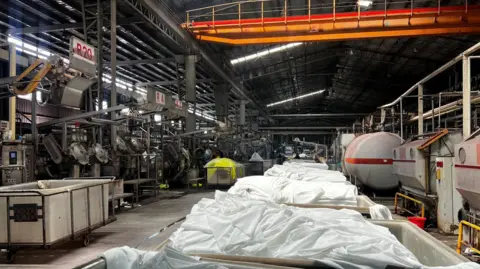
Crates of white textiles sit in a large dyeing factory

Dye houses use a lot of heat and water

The apparel industry uses an estimated five trillion litres of water each year to simply dye fabric, according to the World Resources Institute, a US-based non-profit research centre.

The industry is, in turn, responsible for 20% of the world’s industrial water pollution, while also using up vital resources like groundwater in some countries. It also releases a massive carbon footprint from start to finish – or around 10% of annual global emissions, according to the United Nations Environment Programme.

Alchemie says its technology can help solve that problem.

Called Endeavour, its machine can compress fabric dyeing, drying, and fixing into a dramatically shorter and water-saving process.

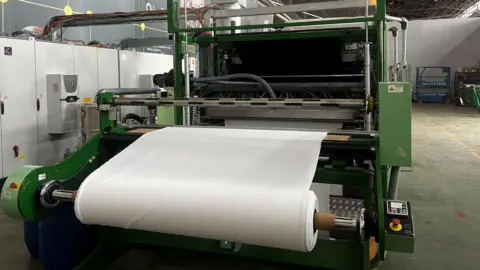
Endeavour uses the same principle as inkjet printing to rapidly and precisely fire dye onto and through the fabric, according to the company. The machine’s 2,800 dispensers fire roughly 1.2 billion droplets per linear meter of fabric.

“What we’re effectively doing is registering and placing a drop, a very small drop precisely and accurately onto the fabric. And we can switch these drops on and off, just like a light switch,” says Dr Hudd.

Alchemie claims big savings through the process: reducing water consumption by 95%, energy consumption up to 85%, and working three to five times faster than traditional processes.

Developed initially in Cambridge, the company is now in Taiwan to see how Endeavour works in a real-world environment.

“The UK, they’re really strong in R&D projects, they’re really strong in inventing new things, but certainly if you want to move to commercialisation you need to go to the real factories,” says Ryan Chen, the new chief of operations at Alchemie, who has a background in textile manufacturing in Taiwan.

A roll of white cloth sits on Alchemie's new dyeing machine

Alchemie has developed a machine uses a printing process to fix colours

Alchemie is not the only company attempting a nearly waterless dye process.

There’s the China-based textile company NTX, which has developed a heatless dye process that can cut down water use by 90% and dye by 40%, according to their website, and the Swedish start-up Imogo, which also uses a “digital spray application” with similar environmental benefits.

NTX and Imogo did not reply to the BBC’s interview request.

Kirsi Niinimäki, a professor in design who researches the future of textiles at Finland’s Aalto University, says the solutions offered by these companies look “quite promising” – although she adds that she would like to see more specific information about issues like the fixing process and long-term studies on fabric durability.

But even though it’s early days, Ms Niinimäki says companies like Alchemie could bring real changes to the industry.

“All these kinds of new technologies, I think that they are improvements. If you’re able to use less water, for example, that of course means less energy, and perhaps even less chemicals – so that of course is a huge improvement.”

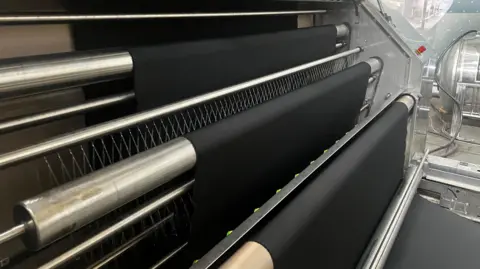
Black textiles on the Alchemie dyeing machine

Alchemie is in the process of scaling up its operations

Back in Taiwan, there are still some kinks to be ironed out – like how to run the Endeavour machine in a hotter and more humid climate than the UK.

Alchemie service manager, Matthew Avis, who helped rebuild Endeavour in its new factory location, discovered that the machine needs to operate in an air-conditioned environment – an important lesson given how much apparel manufacturing happens in southern Asia.

The company also has some big goals for 2025. After its test run with polyester in Taiwan, Alchemie is heading next to South Asia and Portugal to test their machines and also try it out on cotton.

They will also have to figure out how to scale up Endeavour.

Big fashion companies like Inditex, the owner of Zara, work with thousands of factories. Its suppliers would need hundreds of Endeavours working together to meet its demand for fabric dyeing.

And that’s just one company – there will be many, many more in need.

More Technology of Business


Canada’s largest port could see lockout of more than 700 workers | Al Jazeera News

0


The dispute between port foremen and their employers could disrupt crucial international shipments.

Employers at Canada’s largest port have said they would lock out their workers after a negotiating deadline with the union had passed, potentially disrupting key shipments of the country’s coal, potash and beef.

The BC Maritime Employers Association said it would lock out more than 700 foremen at the Port of Vancouver at 4.30pm local time (00:30 GMT) on Monday because negotiations with their union, the International Longshore and Warehouse Union Local 514, had broken down.

The threatened lockout in Vancouver, on Canada’s west coast, comes at the same time as an ongoing strike at the Port of Montreal, the largest port in eastern Canada.

The employers association, which includes private-sector waterfront employers, said the lockout in Vancouver was preventative because the union had issued a strike notice for Monday. It said this was to “facilitate a safe and orderly wind down of operations” in anticipation of a strike.

But the union’s president, Frank Morena, said in a statement that workers had started their shifts and the union had only planned “limited job action” such as refusing overtime. The workers are also refusing to participate with “technological change implementation” connected to automation, according to the Canadian Press news agency.

The two sides have been in lengthy negotiations over a new labour deal with the help of a federal mediator. The issues include pay, working conditions and increased automation with each side accusing the other of bargaining in bad faith.

Crucial exports affected

The lockout will not affect bulk grain shipments, but it could halt coal, potash, forestry products and products shipped in containers such as pulse crops and meats.

The work stoppage would also affect the Port of Prince Rupert on the northern coast of British Columbia.

Reuters said a 13-day strike last year disrupted more than 6 billion Canadian dollars ($4.32bn) in trade at the ports of Vancouver and Prince Rupert.

It has alarmed regions and industries in landlocked parts of Canada.

The government of Saskatchewan, which exports grains, petroleum products and fertilisers, has asked the federal government to intervene and resolve the dispute. In the past, the government has resisted calls to interfere in collective bargaining.


When will we know who won?

0


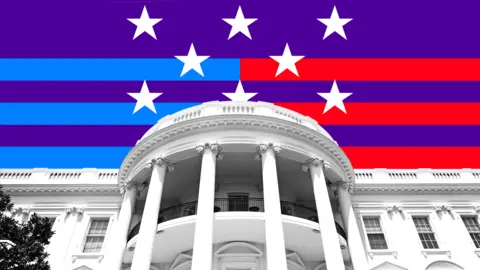
BBC A graphic that shows the White House against a red, white and blue stars-and-stripes backdropBBC

American voters go to the polls on 5 November to choose their next president.

US election results have sometimes been declared within hours of the polls closing, but this year’s close contest could mean a longer wait.

When is the 2024 presidential election result expected?

In some presidential races the victor has been named late on election night, or early the next morning. This time, the tight race in many states could mean media outlets wait longer before projecting who has won.

Democrat Kamala Harris, the current vice-president, and Republican Donald Trump, the former president, have been running neck-and-neck for weeks.

Narrow victories could also mean recounts. In key swing state Pennsylvania, for example, a state-wide recount would be required if there’s a half-percentage-point difference between the votes cast for the winner and loser. In 2020, the margin was just over 1.1 percentage points.

BBC’s Sumi Somaskanda explains when a new president will be announced

Legal challenges are also possible. More than 100 pre-election lawsuits have already been filed, including challenges to voter eligibility and voter roll management, by Republicans.

Other scenarios that could cause delays include any election-related disorder, particularly at polling locations.

On the other hand, vote-counting has been sped up in some areas including the crucial state of Michigan, and far fewer votes will be cast by mail than in the last election, which was during the Covid pandemic.

When have previous presidential election results been announced?

The 2020 election took place on Tuesday 3 November. However, US TV networks did not declare Joe Biden the winner until late morning on Saturday 7 November, after the result in Pennsylvania became clearer.

In other recent elections, voters have had a much shorter wait.

In 2016, when Trump won the presidency, he was declared the winner shortly before 03:00 EST (08:00 GMT) the day after the election.

In 2012, when Barack Obama secured a second term, his victory was projected before midnight on polling day itself.

However, the 2000 election between George W Bush and Al Gore was a notable exception.

The vote was held on 7 November, but the two campaigns went to war over a tight contest in Florida and the race was not decided until 12 December. The US Supreme Court voted to end the state’s recount process, which kept Bush in place as winner and handed him the White House.

What are the key states to watch in 2024?

Across the country, the first polls will close at 18:00 EST (23:00 GMT) on Tuesday evening and the last polls will close at 01:00 EST (06:00 GMT) early on Wednesday.

But this race is expected to come down to results from seven swing states which experts believe could plausibly be won by Harris or Trump. These are Arizona, Georgia, Michigan, Nevada, North Carolina, Pennsylvania and Wisconsin.

19:00 EST (00:00 GMT) – Polls close in Georgia and five other states, and partially in two more states. This is also when US TV networks are likely to begin making their first calls of the night, in less competitive states like Kentucky.

19:30 EST (00:30 GMT) – Polls close across three states, including North Carolina. With early results from North Carolina and Georgia, a picture may start to form of which candidate is performing better, but it will still be far too early to identify any trend forming nationally.

20:00 EST (01:00 GMT) – Polls close in Pennsylvania, 15 other states and the District of Columbia, as well as partially in Michigan and four other states. Georgia’s top election official estimates that about 75% of votes will be counted by then.

21:00 EST (02:00 GMT) – Voting ends in Arizona, Wisconsin and 12 other states. All remaining polls close in Michigan. Michigan allows officials to begin counting votes one week before election day, but they are not allowed to reveal the results until these polls shut. In contrast, Pennsylvania and Wisconsin do not allow vote counting to begin until the start of in-person voting, leading to an expected delay in results from those states.

22:00 EST (03:00 GMT) – Polls close across Nevada and two other states, and partially in two others.

BBC’s Sumi Somaskanda explains when a new president will be announced

A BBC banner graphic reads: "More on US election 2024"
A BBC divider

How does the vote-counting work?

Typically, the votes cast on election day are tallied first, followed by early and mail ballots, those that have been challenged, and then overseas and military ballots.

Local election officials – sometimes appointed, sometimes elected – verify, process and count individual votes, in a process known as canvassing.

Verifying ballots includes comparing the number cast with the number of active voters; removing, unfolding and examining every single ballot for tears, stains or other damage; and documenting and investigating any inconsistencies.

Counting ballots involves feeding each one into electronic scanners that tabulate their results. Some circumstances require manual counts or double-checked tallies.

Every state and locality has rigorous rules about who can participate in the canvass, the order in which votes are processed and which parts are open to the public, including how partisan observers can monitor and intervene in vote-counting.

What happens if the presidential election results are challenged?

Once every valid vote has been included in the final results, a process known as the electoral college comes into play.

In each state a varying number of electoral college votes can be won, and it is securing these – and not just the backing of voters themselves – that ultimately wins the presidency.

Generally, states award all of their electoral college votes to whoever wins the popular vote and this is confirmed after meetings on 17 December.

The new US Congress then meets on 6 January to count the electoral college votes and confirm the new president.

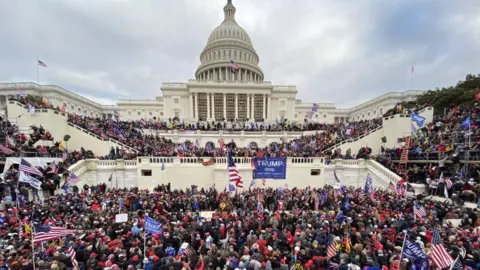
After the 2020 election, Trump refused to concede and rallied supporters to march on the US Capitol as Congress was meeting to certify Biden’s victory.

Getty Images Trump supporters gathered outside the US Capitol building on 6 January 2021Getty Images

He urged his vice-president, Mike Pence, to reject the results – but Pence refused.

Even after the riot was cleared and members of Congress regrouped, 147 Republicans voted unsuccessfully to overturn Trump’s loss.

Electoral reforms since then have made it harder for lawmakers to object to certified results sent to them from individual states. They have also clarified that the vice-president has no power to unilaterally reject electoral votes.

Nevertheless, election watchers expect that efforts to delay certification of the 2024 vote could take place at the local and state level.

Trump, his running mate JD Vance and top Republican leaders on Capitol Hill have refused on several occasions to state unequivocally that they will accept the results if he loses.

When is the presidential inauguration?

The president-elect will begin their term in office after being inaugurated on Monday, 20 January 2025, in the grounds of the US Capitol complex.

It will be the 60th presidential inauguration in US history.

The event will see the new president sworn in on a pledge to uphold the Constitution and then deliver their inaugural address.


Nigeria president orders release of minors charged over protests | Protests News

0


At least 30 minors were charged with treason and inciting a military coup after they took part in August protests against the rising cost of living.

Nigeria’s president has directed that all minors detained during protests against the rising cost of living in August be freed and treason charges against them dropped, Information Minister Mohammed Idris has said.

“The president has directed that these children, these minors, be released immediately,” Idris said on Monday.

At least 76 people, including 30 minors, were charged with treason and inciting a military coup after they took part in deadly August protests against economic hardship.

The minors’ arraignment sparked public outrage and criticism of the government after they were paraded in court last Friday.

Frustration over the cost-of-living crisis has led to several protests in recent months that demand better opportunities and jobs for young people.

In August, protesters rallied in Abuja, the commercial capital Lagos and several other cities to show discontent with economic reforms that have led to rampant inflation and the worst cost-of-living crisis in a generation in Nigeria.

Rights group Amnesty International said at least 22 people died during the demonstrations in clashes with security forces.

President Bola Tinubu has since vowed to pursue the changes, which he says are needed to keep the economy afloat.

In addition to the severe financial crisis, Nigerians are living with widespread insecurity that has damaged the farming sector, with armed gangs kidnapping residents and schoolchildren for ransom in the north.


Mozambique presidential runner-up escapes alleged assassination attempt

0


Mozambique opposition leader Venâncio Mondlane, the runner-up in last month’s disputed presidential election, says he has escaped an assassination attempt in South Africa, where he sought refuge after challenging the results.

In a video posted to Facebook, Mondlane said he was in “mortal danger” after assassins had gone to his home to try to kill him.

Mondlane said he had to jump through the back door and run through a hair salon, while carrying his bags, accompanied by his wife and daughter.

He did not provide any evidence to back up his claim and the Mozambican authorities have not commented.

Mondlane went into hiding about two weeks ago, after his aide and lawyer were killed as they were preparing to challenge the results.

Daniel Chapo, the candidate of the ruling party Frelimo, was officially declared the winner with over 71% of the vote, as opposed to Mondlane’s 20%.

Mondlane didn’t specify exactly where the alleged assassination attempt had taken place.

In the video, he said he had been staying in the affluent Sandton neighbourhood in Johannesburg.

“I was with my wife and my daughter, running from one place to another,” he said.

South Africa’s foreign ministry told the AFP news agency they didn’t even know Mondlane was in the country and that the matter should have been reported to the police.

The BBC reached out to South African police, but they didn’t respond.

Mondlane went into hiding before the results were announced, claiming his home had been surrounded by members of the security forces.

He has called on Mozambicans to hold nationwide demonstrations against the election results, which are being challenged in court by the Podemos party which backed Mondlane.

The protests have led to violent clashes with the police and several people have been killed, with dozens injured.

The internet and social media have also been restricted.

A general strike called by Mondlane has continued, despite the prime minister’s call for people to return to work.

Three children were reportedly shot dead by police in different parts of the capital Maputo on Monday, while eight people were reportedly killed in the northern province of Nampula over the weekend.

Two different Frelimo offices were reportedly attacked in Nampula, prompting the police to respond with tear gas, rubber bullets, and live ammunition, killing one person.

The demonstrators then set fire to the house allegedly belonging to a police officer accused of killing a protester.

Mondlane has been rallying people to come together for a “final march” in Maputo, on Thursday.

It is due to be the end of a seven-day protest he called last week.


“Survival becomes so difficult” in Gaza without UNRWA

0


Tamer Qarmout explains why Israel's decision to unilaterally ban UNRWA will cost Palestinians lives.