Quincy Jones’s life in music: From Thriller to Austin Powers
Quincy Jones, the celebrated US musician and producer who worked with Michael Jackson, Frank Sinatra, Ray Charles and many others, has died at the age of 91.
Jones’ publicist, Arnold Robinson, said he “passed away peacefully” on Sunday night at his home in Bel Air.
“Tonight, with full but broken hearts, we must share the news of our father and brother Quincy Jones’ passing. And although this is an incredible loss for our family, we celebrate the great life that he lived and know there will never be another like him,” the family said in a statement.
Jones was best known as the producer of Michael Jackson’s Thriller album.
Over a career spanning more than 75 years, he won 28 Grammy Awards and was named as one of the most influential jazz musicians of the 20th century by Time magazine.
He worked closely with Sinatra and reworked the crooner’s classic Fly Me To The Moon, taking it from a waltz to a swing.
For the film The Wiz, Jones found himself working alongside a 19-year-old Michael Jackson. He went on to produce Jackson’s album Off the Wall and the pop star’s follow-ups Thriller – which sold 34 million copies int he US alone – and Bad.
In 1985, Jones gathered 46 of America’s most popular singers of the time, including Jackson, Bruce Springsteen, Tina Turner and Cyndi Lauper, to record We Are the World.
Jones co-wrote the song to raise money for those suffering from a devastating famine in Ethiopia. The record was the US equivalent to Band Aid’s Do They Know It’s Christmas.
The hit reached number one in the UK and the US and was performed at Live Aid.
Getty Images
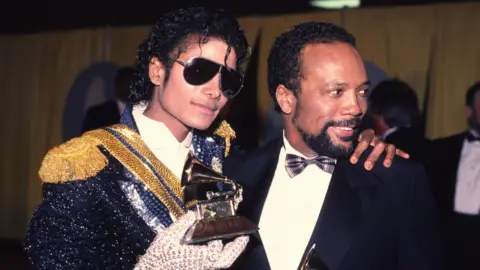
Jones produced three of Michael Jackson’s albums
Jones also composed the soundtrack to more than 50 films and TV programmes including the 1969 British film, The Italian Job.
Michael Caine, who starred in The Italian Job, paid tribute to Jones on X, calling him “a titan in the musical world”.
“He was a wonderful and unique human being, lucky to have known him.”
Sir Elton John also praised Jones and said “nobody had a career as incredible” as him, writing: “He played with the best and he produced the best. What a guy. Loved him.”
Quincy Jones on gangsters, David Bowie and Picasso
On the big screen, Jones produced the film The Color Purple, which introduced the public to two then unknown performers – Oprah Winfrey and Whoopi Goldberg.
Posting a tribute on Instagram, Goldberg said he was “one of a kind”.
On the small screen, he was one of the producers behind the hit TV show The Fresh Prince of Bel Air.
But it was music where Jones excelled – as well as winning multiple Grammys, including a legend award in 1992, he was also recognised by the Emmys, Tonys and Oscars.
Jones was married three times and had seven children, including music producer Quincy Jones III and actress Rashida Jones, known for the US version of The Office.
Getty Images
Jones made his debut as a film producer with 1985’s The Color Purple which received 11 Oscar nominations, including one for Jones’ score
Jones’ family said the music producer was “truly one of a kind” and “through his music and his boundless love, Quincy Jones’ heart will beat for eternity”.
One of the first to pay tribute was playwright Jeremy O’Harris, who wrote on X that Jones’ “contributions to American culture were limitless”, noting he was the first black person nominated for an Oscar for best score among his other achievements.
Rapper LL Cool J, who briefly dated Jones’ daughter Kidada Jones, said on Instagram that Jones was “a father and example at a time when I truly needed a father”.
He added: “Mentor. Role model. King. You gave me opportunities and shared wisdom. Music would not be music without you.”
Ice T also paid tribute and wrote: “Genius is a description loosely used but Rarely deserved. Point blank, Quincy was the MAN. I won my 1st Grammy with Quincy and I live with his Wisdom daily.”
Montreux Jazz Festival CEO Mathieu Jaton, who worked alongside Quincy for many years, said the spirit of Jones “will forever resonate” with the festival’s history.
He added that Jones, as a co-producer in the 1990s, “helped elevate the festival to new heights”.
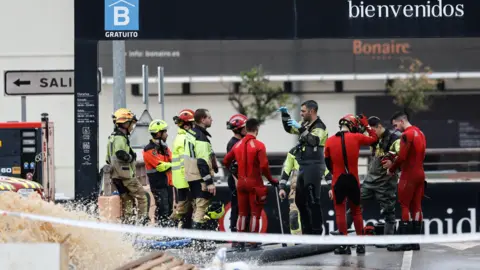
Divers have concentrated their search for missing bodies in garages and a multi-storey car park in the town of Aldaia
Spanish rescuers are focusing their search for missing people on underground garages and a multi-storey car park following last week’s devastating floods in Valencia.
The death toll after a year’s worth of rain fell in parts of the region last week now stands at 217.
A car park in the nearby town of Aldaia capable of holding thousands of vehicles, has become central to the search, but rescue teams have reportedly not yet found any bodies.
It comes as Spain’s State Meteorological Agency (AEMET) placed part of the north-eastern Catalonia region on red alert for torrential rain, with its capital Barcelona experiencing flooding on Monday morning.
The car park at the Bonaire shopping centre in Aldaia was inundated during flash floods last week.
According to Spanish news agency Europa Press, police have confirmed that search teams did not locate any victims in the first 50 vehicles inspected at the site.
EPA-EFE/REX/Shuttershock
Divers are searching a car park in Aldaia which was inundated by the flash floods
The storm caught many victims in their vehicles on roads and in underground spaces such as car parks, tunnels and garages where rescue operations are particularly difficult.
Objects were also thrown at Prime Minister Pedro Sánchez, who was quickly evacuated.
The Civil Guard has opened an investigation into the chaotic scenes, Interior Minister Fernando Grande-Marlaska told public broadcaster TVE.
He blamed “marginal groups” for instigating the violence where mud spattered the monarchs’ face and clothes.
Video shows angry crowd throwing objects at Spanish king on Sunday
Local authorities in Valencia have extended travel restrictions for another two days to facilitate the work of the emergency services, cancelled school classes and urged people to work from home.
In Catalonia, train services have been suspended due to adverse weather conditions, while footage shared online appears to show vehicles submerged in floodwater on roads.
The move comes following the adoption of two controversial bills banning the UN agency from operating in Israel.
Israel has officially notified the United Nations of its decision to cut ties with its agency for Palestinian refugees (UNRWA) as another UN agency warns of an impending famine in genocide-ravaged Gaza.
In a statement on Monday, the Israeli Ministry of Foreign Affairs said it cancelled a cooperation agreement from 1967 which provided the legal basis of the country’s relations with UNRWA.
“UNRWA – the organisation whose employees participated in the October 7 massacre and many of whose employees are Hamas operatives – is part of the problem in the Gaza Strip and not part of the solution,” Foreign Minister Israel Katz was quoted as saying.
The Israeli parliament last week adopted two controversial bills banning UNRWA from operating on Israeli territory, closing its premises in the occupied West Bank, including East Jerusalem, and Gaza.
Israel alleges fighters of Palestinian group Hamas have infiltrated UNRWA. The UN agency denies the allegations and says it takes measures to ensure its neutrality.
UNRWA on Monday said Israel’s ban on its operations would lead to the “collapse” of humanitarian work in the war-torn Gaza Strip.
“If this law is implemented, it would be likely to cause the collapse of the international humanitarian operation in the Gaza Strip – an operation of which UNRWA is the backbone,” Jonathan Fowler, UNRWA spokesman, told the AFP news agency.
The UN agency provides education, healthcare and other basic services to Palestinian refugees from the 1948 war surrounding Israel’s creation and their descendants, who now number nearly six million. Refugee families make up the majority of Gaza’s 2.3 million population.
Aid groups have warned that Israel’s ban on UNRWA could create further obstacles to addressing a severe humanitarian crisis in Gaza. Israel has said other UN agencies and aid groups can fill the gap, but those organisations insist UNRWA is essential.
Israel’s notification to the UN came as the World Food Programme (WFP) on Monday warned that the humanitarian situation in Gaza “could soon escalate into famine” as Israeli forces continue to severely restrict the entry of food and other supplies into the enclave.
On Saturday, a WFP official said the agency cannot serve as a replacement for UNRWA in Gaza. “We cannot replace the important functions of the UNRWA in Gaza, such as the administration of emergency shelters, schools and health centres,” Martin Frick, head of the WFP Berlin office, told German media group RND.
In January, Israel claimed that more than a dozen UNRWA members took part in a Hamas-led attack on Israel last year, in which Palestinian fighters killed more than 1,100 people, mostly civilians, and took about 250 captives.
After the assault, the Israeli army waged a ferocious military campaign in Gaza, killing more than 43,000 people so far, displacing almost its entire 2.3 million population, and reducing large swaths of the Palestinian enclave into rubble.
The UN launched an investigation into Israel’s allegations which resulted in the termination of contracts of nine staff members against which “the evidence – if authenticated and corroborated – could indicate that the UNRWA staff members may have been involved” in the attack.
In July, Israel claimed that another 100 UNRWA employees were members of Hamas and other Palestinian groups. The agency asked Israel to provide more information to take action. UNRWA on Monday told Al Jazeera it had not received any response.
Meanwhile, UN officials say Israeli forces have killed more than 130 of their workers in a year in Gaza – the largest such toll in any conflict since the global body was founded.
Footage shows houses burned and damaged by the rain of rocks
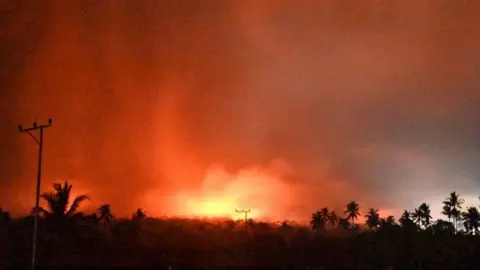
At least 10 people have been killed after a volcano erupted in eastern Indonesia in the early hours of Monday, officials have said.
Mount Lewotobi Laki-laki, located on Flores Island in East Nusa Tenggara province, erupted at 23:57 local time, according to the Indonesian Center for Volcanology and Geological Disaster Mitigation (PVMG).
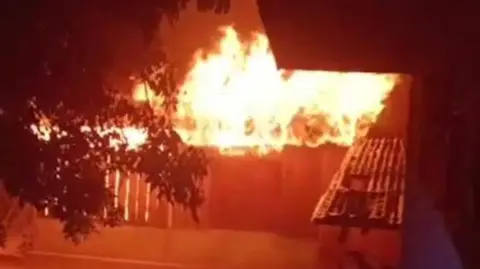
Hadi Wijaya, a PVMG spokesperson, said fiery lava and rocks had hit the villages about 4km (two miles) from the crater, burning and damaging residents’ houses.
According to local officials, the eruption has affected seven villages.
PVMG said fires had “occurred in residential areas due to the ejection of incandescent material” from the volcano.
It has raised the status of the volcano to the highest alert level, warning that a 7km (four-mile) radius from the crater must be cleared.
“We have started evacuating residents since this morning to other villages located around 20km (13 miles) from the crater,” local official Heronimus Lamawuran told Reuters.
HANDOUT
Flames were seen in a nearby settlement in footage shared with the BBC
Video footage shared with BBC News by eyewitnesses shows people covered in volcanic ash, rock showers and homes ablaze, as well as the scorched aftermath of the disruption.
HANDOUT
Some residents were covered with ash in footage seen by the BBC
A spokesperson from Indonesia’s disaster agency warned of potential flash floods and cold lava flows in the coming days.
They added that the local government had declared a state of emergency for the next 58 days, meaning the central government could help provide aid to 10,000 affected residents.
Mount Lewotobi Laki-laki – one of a pair of prominent volcanic peaks at the eastern end of the island of Flores – has been erupting on and off since last December, and there was already an official warning to stay more than 3km away from it.
Hundreds of people have left their homes and have been sheltering in schools, while cashew nut farmers have complained that their crops have been ruined by the huge quantities of ash which have fallen on the surrounding area.
Indonesia sits on the Pacific “Ring of Fire”, an area of high seismic activity atop multiple tectonic plates, and has about 130 active volcanoes.
Many communities live dangerously close to the volcanoes in order to cultivate the fertile soil they provide.
In this episode of Centre Stage, our guest is John Mearsheimer, a political scientist and influential scholar in international relations who’s best known for his theory of offensive realism.
Mearsheimer talks to Al Jazeera’s Rawaa Auge about the wars in Gaza, Ukraine and Lebanon and how global and regional powers support and arm the belligerent parties. Mearsheimer also weighs in on the 2024 US presidential election, and the minefield that is US foreign policy.
This episode is produced in partnership with the Islam and Muslims Initiative, an international platform that connects Muslims and non-Muslims in the realms of religion, politics, business, media, academia and civil society.
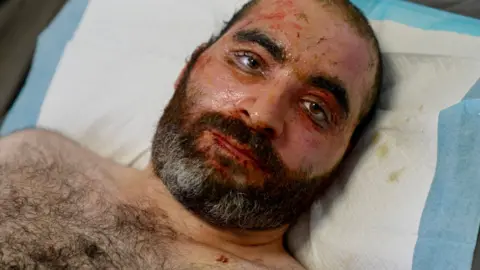
Mohammed, 29, was badly burned in an Israeli attack on his village in southern Lebanon
When the air strike hit, Mohammed was handing out hot food to elderly neighbours – something he and his friends had been doing since Israel’s latest invasion of Lebanon on 1 October.
The civil engineer, 29, was standing about 5m (16ft) away from the explosion, which destroyed a house in his village in southern Lebanon.
Layers of skin were scorched from his forehead and his cheeks, leaving his face raw and pink. His hands were charred. His abdomen has third-degree burns. Two weeks on he radiates pain, and trauma, but wants to tell his story.
“It was all black, smoke everywhere,” he says in a low voice. “It took about a minute. Then I started to recognise what is around me. I noticed my two friends were still alive but bleeding a lot. It took about five minutes for the people to get us out.”
Mohammed recounts the horrors from his bed in the Nabih Berri government hospital, which is perched on a hilltop in Nabatieh. It is one of the biggest cities in the south, and just 11km (seven miles) from the border with Israel, as the crow flies. Before the war it was home to about 80,000 people.
Mohammed says there was no warning before the strike – “not at all, not to us, not to our neighbours, not to the person inside the house that was hit.”
That person was a policeman, he says, who was killed in the attack.
“We are not military,” he says, “we are not terrorists. Why are we being hit? The areas that are being hit are all civilian areas.”
Mohammed will return home to his village, Arab Salim, when he is discharged, though it remains under fire. “I don’t have anywhere else to go,” he says. “If I could [leave] I would. There’s no place.”
Goktay Koraltan
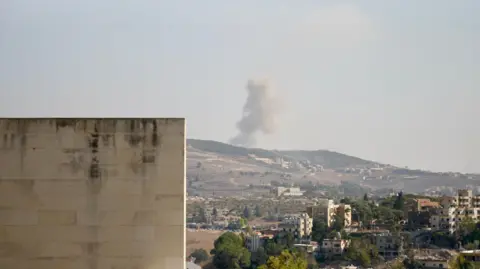
Another air strike hits Mohammed’s village, while he lies in hospital in Nabatieh
As we tour the hospital, another air strike sends staff rushing to a balcony, to check what has been hit this time. The hospital offers a panoramic view of grey smoke billowing from high ground about 4km away.
Shortly afterwards, a few floors down in the emergency room, the wail of a siren warns of casualties arriving – from that air strike. It had hit Mohammed’s village, Arab Salim.
A woman is rushed in on a stretcher, with blood streaming down her face. She is followed by her husband, who hits a wall in frustration before slumping over in shock. Doctors disappear behind closed doors to examine her.
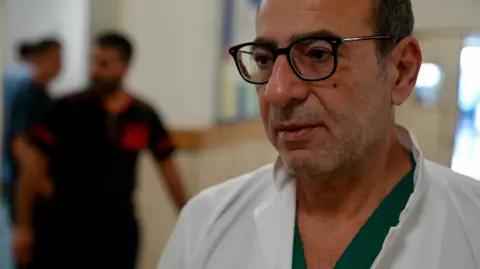
Within minutes the hospital director, Dr Hassan Wazni, tells staff she has a ruptured artery and must be moved to a specialised vascular centre in a hospital further north.
“She needs it immediately,” he says, as cries of pain come from the examining room. “Talk to Saida [a nearby town]. If it’s OK, let’s take her immediately, because she can’t wait.”
Goktay Koraltan
Dr Wazni has to find fuel to keep the hospital generators running
The hospital receives 20-30 casualties from Israeli air strikes a day. Most are civilians, but no-one is turned away. “We take all patients, and all injured, and all martyrs who come,” he says. “We don’t discriminate between them.”
Dr Wazni has not left the hospital since the war began. Behind his desk in his office, he opens a packet of cigarillos. “I think it’s OK to break some rules in a war,” he says with an apologetic smile.
He is struggling to pay wages and come up with 1,200 litres of fuel per day to run the generators that power the hospital. “We get nothing from the government,” he says. “It doesn’t have it.”
His fuel is espresso, which he offers us repeatedly.
With 170 beds, Nabih Berri is the main public hospital in the city, but now has only a skeleton staff, and 25 patients. The sick and the wounded brought here are transferred quickly to hospitals in safer areas further North. Staff say there have been “many strikes “close to Nabih Berri. During our visit there’s broken glass inside the foyer.
Nabatieh has been under fire for more than a month.
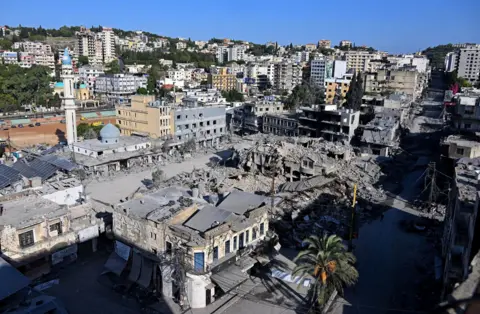
The municipality building was blown up two weeks ago, killing the mayor, Ahmad Kahil, and 16 others. At the time he was having a meeting to co-ordinate aid distribution. When we pass by the ruins, bundles of flat bread remain visible on the floor of a wrecked ambulance.
Reuters
The air strike on 16 October destroyed Nabatieh’s market, as well as municipal buildings
The massive strike brought down several neighbouring buildings – a city block is missing from the landscape.
Also missing is an Ottoman era market – the heart of Nabatieh – which was destroyed on the same day. Centuries of history were crushed into rubble, heritage turned to dust.
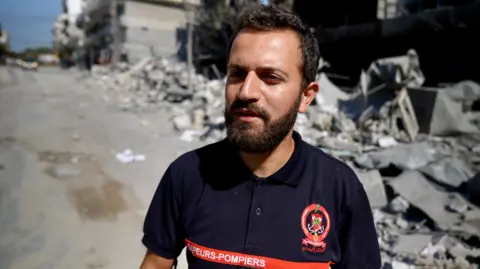
The old market, or souk, was treasured by Hussein Jaber, 30, who is part of the government’s emergency services. He and his men, some of them volunteers, take us there for a brief visit. They drive at speed – the only way to travel in Nabatieh.
“We were born and raised here,” Hussein says, gesturing around at slabs of concrete and twisted metal. “We have been here since we were children. The souk means a great deal to us. It is really sad to see it like this. It holds memories of the past and the beautiful days we spent with the people of this city.”
Like Dr Wazni, Hussein and his colleagues have remained with the people, despite the risks. More than 110 paramedics and first responders have been killed in Israeli attacks in Lebanon in the past year, according to Lebanese government figures – most of them in the past month. Some attacks involve “apparent war crimes”, according to the international campaign group, Human Rights Watch.
Goktay Koraltan
Civil defence worker Hussein Jaber says an Israeli drone hovers over Nabatieh almost constantly
Hussein lost a colleague and a friend this month, in an air strike 50m from their civil defence station, where they sleep with mattresses up against the windows. The dead man, Naji Fahes, was 50 years old and had two children.
“He was enthusiastic and strong and loved to help others,” Hussein tells me. “Even though he was older than us, he was the one rushing to go on missions, to be with the people and to rescue them.”
He died, as he lived.
When the air strike happened, Naji Fahes was standing outside the station, ready to go on a mission.
As Hussein speaks, we have company. An Israeli drone circles in the skies overhead, then gets lower and louder. The insistent buzzing of the drone competes with his voice. “We hear it 90% of the time,” he says. “We think it’s directly above us now. Most probably it’s watching us.”
As for Hezbollah, its presence in the city is out of sight.
The Israel Defence forces (IDF) told us it is “operating solely against the Hezbollah terrorist organisation, not against the Lebanese population.”
Israel says its fight is “against the Hezbollah terrorist organisation, embedded within civilian population and infrastructure”.
A spokesman said it “takes many measures to mitigate civilian harm including advance warnings”, though there was no warning for the air strike that wounded Mohammed, or the attack that killed the mayor.
In five and a half hours in this once bustling city we saw two people out in the open, on foot. Both rushed away, unwilling to speak. During our visit a drone was broadcasting messages from the Israeli army – instructing people to leave immediately.
It’s estimated that only a few hundred remain here unwilling or unable to move elsewhere. They are mainly the old and the poor, and they will live or die with their city.
And Hussein and his team will be here, to come to their aid. “We are like a safety net for the people,” he says. “We will stay, and we will carry on. We will be next to the civilians. Nothing will stop us.”
Additional reporting by Wietske Burema and Angie Mrad
Taichung, Taiwan – When Li Wei took over the running of his father’s glass-making business in northern China’s Cangzhou in 2020, he immediately set about optimising the firm’s operations.
Li moved Hebei Yiyue Glass Products’ sole factory from its city location to a site outside Cangzhou, providing better access to important road networks and more space to expand the facility.
At the same time, Li changed the primary focus of the company from selling glass components to customers in China to exporting finished glass products to customers abroad.
Today, he oversees a successful export business that sells cups, pots and jars throughout the world and employs twice as many workers as when he took over.
Much of Li’s success is owed to the demand for his products in the United States, which in recent years has been the destination for as much as 80 percent of his company’s exports.
But now, Li and his colleagues are concerned that their success could all come crashing down if former US President Donald Trump is re-elected to the White House on November 5.
Trump, who is running neck and neck with Vice President Kamala Harris in a race that is too close to call, has floated plans for tariffs of 60 percent or more on all goods heading to the US from China.
Economists have dubbed Trump’s plans “Tariff War 2.0”, after the Republican imposed tariffs as high as 25 percent on a range of Chinese goods during his first term in office, prompting Beijing to announce its own tariffs in turn.
“Such a large increase in tariffs by the United States will definitely have a great impact on me and my business,” Li told Al Jazeera.
“It will result in our products not being competitive, and at the very least our sales in the US will drop sharply.”
Former US President Donald Trump gestures after speaking at a campaign rally in Green Bay, Wisconsin on October 30 [Julia Demaree Nikhinson/AP]
Since Trump’s announcement, Li has been working 12-hour days to identify other export destinations that could offset a downturn in his US business.
So far, he has not been able to find a substitute for the world’s largest market.
“I’m very busy trying to find solutions, but some days the situation feels terrible,” he said. “Often, I don’t like to think about it.”
Gary Ng, a senior economist with investment bank Natixis in Hong Kong, said that Chinese exporters have serious cause for concern if Trump re-enters the White House and follows through on his plans.
“With tariff rates at 60 percent, many Chinese manufacturers would no longer be competitive or able to turn a profit from their exports to the US market,” Ng told Al Jazeera.
“For the Chinese companies that are particularly exposed to the US market, this would be problematic, and they could face a lot of pressure.”
Among exporters already feeling the pressure is Sotech, a producer of advanced electronic components based in Shanghai, according to company sales manager Dong Sion.
“I was shocked,” Dong told Al Jazeera, referring to the moment she first heard about Trump’s proposals.
More than 90 percent of Sotech’s products, which include smart glasses, are exported overseas, with about 30 percent of those exports going to the US.
“If 60 percent tariffs are imposed then it could disrupt our US business or even end it completely,” Dong said.
“And we would be forced to cut staff.”
For some Chinese companies, additional tariffs could prove to be the fatal blow at a time of already challenging conditions in the world’s second-largest economy, said Allan Von Mehren, chief analyst and China economist at Danske Bank.
“It would have big repercussions in China,” Von Mehren told Al Jazeera.
The US is by far the top destination for China’s exports, taking in more than $400bn worth of its goods each year.
With so much trade at risk, UBS has estimated that imposing a 60 percent tariff, on top of existing tariffs, would lower China’s gross domestic product (GDP) growth by 2.5 percentage points over the next 12 months.
Such a hit would come at an inopportune time for the world’s second-largest economy.
An ailing property sector, low consumer confidence and household spending well below the global average are all weighing on growth, while the country’s traditional investment-fuelled, export-led development model is struggling to pick up the slack.
Facing such headwinds, Chinese authorities are widely seen as unlikely to hit the government’s growth target of about 5 percent – a challenge that will only get harder if Chinese exporters lose US market access due to new tariffs.
Lily Wang, a recent university graduate who works at Li Wei’s glass-making company outside Cangzhou, said she is afraid that new tariffs combined with the poor state of the Chinese economy will lead to a surge in unemployed workers and worsening working conditions for those who are employed.
“Chinese employers are cutting a lot of things already, and if trade with the US declines, I’m worried that it will get even worse,” Wang told Al Jazeera.
The actual damage to the Chinese economy from the tariffs is likely to depend on companies’ ability to adapt, Ng said.
“Some companies might try to diversify their export structure or move their production to other countries and then export to the US from there,” he said.
Some Chinese firms have already taken such measures.
At Hebei Cangzhou New Century International Trade, a construction materials company in Hebei province that sends about 40 percent of its exports to the US, the management is considering teaming up with manufacturers in Indonesia.
“A 60 percent tariff rate cannot be covered by our export profits,” Vice President Lucy Zhang told Al Jazeera.
“So, we are looking into ways to indirectly export to the US instead.”
At the same time, the Chinese government has been working on nurturing new markets for Chinese exporters.
In September, Beijing hosted 50 African nations for the Forum on China-Africa Cooperation, which aimed to boost African imports of Chinese products, particularly solar panels and electric vehicles.
China is Africa’s biggest trading partner, as well as the leading trade partner of most South American nations.
“Beijing has known for a while now that relations with the US were not going to significantly improve any time soon and has tried to gain better access for its companies in countries where the bilateral relations are friendlier,” Von Mehren said.
Despite China expanding trade with friendlier nations, it is unclear whether a replacement exists for the vast volumes of Chinese goods going to the US.
In some cases, US restrictions on Chinese imports have been quickly emulated in other jurisdictions.
In May, US President Joe Biden’s administration announced that tariffs on Chinese electric vehicles would be raised to 100 percent, effectively shutting the door to the US market.
The European Union announced tariffs as high as 38.1 percent on Chinese EVs the following month.
Since then, Turkey and Canada have followed suit with similar measures.
“As some countries take actions against Chinese exports, a concern can quickly set in among other countries that a Chinese surplus will be dumped on their markets causing them to take action as well,” Von Mehren said.
US President Joe Biden arrives to speak at a General Motors assembly plant in Detroit, Michigan on November 17, 2021 [Evan Vucci/AP]
Trump has also suggested he would impose steep tariffs on Mexico, where Chinese EV companies are considering building new production facilities to circumvent tariffs.
“All I’m doing is saying ‘I’ll put 200 or 500, I don’t care.’ I’ll put a number where they can’t sell one car,” Trump said earlier this month during an interview with Fox News.
China has responded to the various trade measures in kind, launching anti-dumping investigations into European pork and Canadian canola, for example, and imposing export controls on rare elements used in the production of semiconductors.
While directed at China, Trump’s tariff hikes would also likely be keenly felt in the US.
In an analysis published in September, the Peterson Institute for International Economics estimated that the measures would cause a 0.4 percent rise in inflation in 2025 and 0.23 percent loss in GDP by 2027.
The rise in inflation and GDP losses would double if Beijing retaliates, the think tank said.
Liu Pengyu, a spokesperson for the Chinese embassy in Washington, DC, said there would be no winners from a new trade war.
“Artificial restrictions or protectionism will only disrupt normal trade flows and the stability of the production and supply chain which serves the interests of no one,” Liu told Al Jazeera.
Back in Hebei, Li Wei struggles to see an upside for consumers or workers in Trump’s plans.
“But I don’t know – those in power do what they want,” he said.
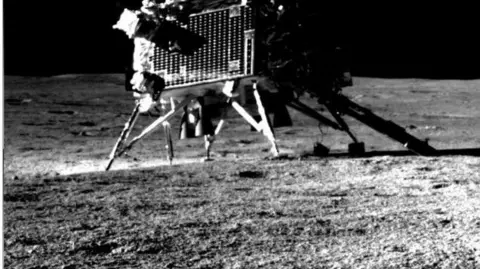
Last year, India became the first country in the world to land near the previously-unexplored lunar south pole
India recently announced a host of ambitious space projects and approved 227bn rupees ($2.7bn; £2.1bn) for them.
The plans include the next phase of India’s historic mission to the Moon, sending an orbiter to Venus, building of the first phase of the country’s maiden space station and development of a new reusable heavy-lifting rocket to launch satellites.
It’s the single largest allocation of funds ever for space projects in India, but considering the scale and complexity of the projects, they are far from lavish and have once again brought into focus the cost-effectiveness of India’s space programme.
Experts around the world have marvelled at how little Indian Space Research Organisation’s (Isro) Moon, Mars and solar missions have cost. India spent $74m on the Mars orbiter Mangalyaan and $75m on last year’s historic Chandrayaan-3 – less than the $100m spent on the sci-fi thriller Gravity.
Nasa’s Maven orbiter had cost $582m and Russia’s Luna-25, which crashed on to the Moon’s surface two days before Chandrayaan-3’s landing, had cost 12.6bn roubles ($133m).
Despite the low cost, scientists say India is punching much above its weight by aiming to do valuable work.
Chandrayaan-1 was the first to confirm the presence of water in lunar soil and Mangalyaan carried a payload to study methane in the atmosphere of Mars. Images and data sent by Chandrayaan-3 are being looked at with great interest by space enthusiasts around the world.
So how does India keep the costs so low?
Screenshot from Doordarshan
India aims to send a female humanoid to space soon ahead of its ambitious Gaganyaan mission
Retired civil servant Sisir Kumar Das, who looked after Isro’s finances for more than two decades, says the frugality can be traced back to the 1960s, when scientists first pitched a space programme to the government.
India had gained independence from British colonial rule only in 1947 and the country was struggling to feed its population and build enough schools and hospitals.
“Isro’s founder and scientist Vikram Sarabhai had to convince the government that a space programme was not just a sophisticated luxury that had no place in a poor country like India. He explained that satellites could help India serve its citizens better,” Mr Das told the BBC.
But India’s space programme has always had to work with a tight budget in a country with conflicting needs and demands. Photographs from the 1960s and 70s show scientists carrying rockets and satellites on cycles or even a bullock cart.
Decades later and after several successful interplanetary missions, Isro’s budget remains modest. This year, India’s budgetary allocation for its space programme is 130bn rupees ($1.55bn) – Nasa’s budget for the year is $25bn.
Mr Das says one of the main reasons why Isro’s missions are so cheap is the fact that all its technology is home-grown and machines are manufactured in India.
In 1974, after Delhi conducted its first nuclear test and the West imposed an embargo, banning transfer of technology to India, the restrictions were “turned into a blessing in disguise” for the space programme, he adds.
“Our scientists used it as an incentive to develop their own technology. All the equipment they needed was manufactured indigenously – and the salaries and cost of labour were decidedly less here than in the US or Europe.”
Isro
India’s solar orbiter Aditya-L1 has cost only $46m
Science writer Pallava Bagla says that unlike Isro, Nasa outsources satellite manufacturing to private companies and also takes out insurance for its missions, which add to their costs.
“Also, unlike Nasa, India doesn’t do engineering models which are used for testing a project before the actual launch. We do only a single model and it’s meant to fly. It’s risky, there are chances of crash, but that’s the risk we take. And we are able to take it because it’s a government programme.”
Mylswamy Annadurai, chief of India’s first and second Moon missions and Mars mission, told the BBC that Isro employs far fewer people and pays lower salaries, which makes Indian projects competitive.
He says he “led small dedicated teams of less than 10 and people often worked extended hours without any overtime payments” because they were so passionate about what they did.
The tight budget for the projects, he said, sometimes sent them back to the drawing board, allowed them to think out of the box and led to new innovations.
“For Chandrayaan-1, the allocated budget was $89m and that was okay for the original configuration. But subsequently, it was decided that the spacecraft would carry a Moon impact probe which meant an additional 35kg.”
Scientists had two choices – use a heavier rocket to carry the mission, but that would cost more, or remove some of the hardware to lighten the load.
Getty Images
The space programme is a matter of huge pride for Indians
“We chose the second option. We reduced the number of thrusters from 16 to eight and pressure tanks and batteries were reduced from two to one.”
Reducing the number of batteries, Mr Annadurai says, meant the launch had to take place before the end of 2008.
“That would give the spacecraft two years while it went around the Moon without encountering a long solar eclipse, which would impact its ability to recharge. So we had to maintain a strict work schedule to meet the launch deadline.”
Mangalyaan cost so little, Mr Annadurai says, “because we used most of the hardware we had already designed for Chandrayaan-2 after the second Moon mission got delayed”.
Mr Bagla says India’s space programme coming at such low cost is “an amazing feat”. But as India scales up, the cost could rise.
At the moment, he says, India uses small rocket launchers because they don’t have anything stronger. But that means India’s spacecraft take much longer to reach their destination.
So, when Chandrayaan-3 was launched, it orbited the Earth several times before it was sling-shot into the lunar orbit, where it went around the Moon a few times before landing. On the other hand, Russia’s Luna-25 escaped the Earth’s gravity quickly riding a powerful Soyuz rocket.
“We used Mother Earth’s gravity to nudge us to the Moon. It took us weeks and a lot of resourceful planning. Isro has mastered this and done it successfully so many times.”
But, Mr Bagla says, India has announced plans to send a manned mission to the Moon by 2040and it would need a more powerful rocket to fly the astronauts there quicker.
The government recently said work on this new rocket had already been approved and it would be ready by 2032. This Next Generation Launch Vehicle (NGLV) will be able to carry more weight but also cost more.
Also, Mr Bagla says, India is in the process of opening up the space sector to private players and it’s unlikely that costs will remain so low once that happens.
Dearborn, Michigan – For more than a year, Layla Elabed says she and other Arab Americans have been at a “collective funeral”.
“We’re grieving. We’re frustrated. We’re angry. We’re heartbroken. We feel betrayed,” Elabed said, finally taking a breath as she reflected on Israel’s raging wars on Gaza and Lebanon.
And now, with bombs still raining down, she added that Arab American voters were being asked to hit pause their sorrow and cast a ballot on Tuesday for presidential candidates who do not have a plan “to stop the killing”.
It is a sentiment that reverberates across the large Arab American community in the battleground state of Michigan, where Elabed has been a leader in the Uncommitted Movement, which has aimed to pressure United States President Joe Biden and his vice president and Democratic contender, Kamala Harris, to end their unwavering support for Israel.
Harris has promised to continue arming Israel while her Republican rival, Donald Trump, has a staunchly pro-Israel record despite his claims of wanting to bring “peace” to the region.
Draped in a scarf featuring Palestinian embroidery, known as “tatreez”, Elabed told Al Jazeera that she was leaving the top of the ticket blank.
“I’m skipping it because neither Vice President Harris nor Donald Trump has adopted a policy that clearly says the bombs are going to stop,” said the Detroit area resident, who is a mother of three and the 12th of 14 children of Palestinian immigrants.
Other Arab Americans, however, are making different choices.
Some are backing Harris, arguing that despite her pledge to sustain the flow of US weapons to Israel, the Democrat remains a better choice than Trump on domestic and foreign policy.
Others see Trump’s unpredictability and self-proclaimed status as an antiwar candidate as an opportunity to break away from the Democratic Party and penalise Harris.
Elabed belongs to the third camp: those who argue that neither candidate deserves the community’s votes.
But even within that approach, there are divisions. Some are calling for skipping the presidential race altogether, while others are campaigning for Green Party candidate Jill Stein.
‘We need to respect ourselves’
Overall, however, there seems to be little enthusiasm across the board, underscoring the dilemma Arab Americans face as they struggle to agree on a strategy that could help influence the election and end the US-backed Israeli wars, which have so far killed more than 43,000 people in Gaza and nearly 3,000 in Lebanon.
Alissa Hakim, a Lebanese American university graduate, said she has “no hope whatsoever” about the vote.
Hakim in 2020 cast her first-ever vote in a presidential election, voting for Biden who she believed would be better than Trump. But after four years and a war that many experts have described as a genocide, the 22-year-old said she firmly rejected the “lesser of two evils” argument.
“There’s been such a low bar for our presidential candidates that you want us to vote for you just because you’re not the other person,” said Hakim, sitting in a Yemeni coffee shop with a laptop featuring stickers of the map of historic Palestine.
“It’s made me realise, we need to respect ourselves more than to just sell our vote to whoever says the nicer words,” she told Al Jazeera.
Alissa Hakim, 22, sits at a coffee shop in Dearborn, Michigan, October 31, 2023 [Ali Harb/Al Jazeera]
While Hakim remains undecided, she said her vote would certainly not go for either Trump or Harris.
In Dearborn, a city of 110,000 people known as the Capital of Arab America, both major campaigns are trying to reach out in various ways but their efforts do not appear to be producing a decisive outcome.
With Election Day approaching, Al Jazeera surveyed dozens of residential neighbourhoods in the heavily Arab east side of the city. Signs for school board candidates and Lebanese and Palestinian flags far outnumbered signs for the two major presidential hopefuls.
Biden won more than 80 percent of the votes in predominantly Arab precincts in Dearborn in 2020, according to the city’s election data, helping him win Michigan.
This time, however, Harris is facing an uphill battle in the local community. Even Arab Americans who backed the Democrat in interviews with Al Jazeera have voiced frustration with her positions and acknowledged her campaign’s shortcomings.
Last week, former President Bill Clinton said at a Harris rally in Michigan that Israel “forces” Hamas to kill civilians. He also suggested that Zionism predated Islam in comments that stirred outrage among Arab and Muslim groups.
Harris has also refused to meet advocates from the Uncommitted Movement after her campaign rejected the group’s demand to allow a speech by a Palestinian representative at the Democratic National Convention in Chicago in August.
At a campaign stop in Michigan on Sunday, Harris was asked if she had a closing case to make to Arab Americans. She said she hoped “to earn” the votes of the community and repeated her position about the “need to end the war” on Gaza and secure the release of dozens of people held captive in the besieged territory.
‘Tough pill to swallow’
Ali Dagher, a local Democratic activist who signed a letter by prominent Arab Americans endorsing Harris, said the community was in “shock” and “deep depression” over the carnage in Gaza and Lebanon.
Dagher told Al Jazeera that endorsing Harris was done in partnership with other groups, including civil rights advocates and labour organisations that see Trump as a threat.
“Another presidency under Donald Trump would be a greater danger, not just on international policy… but also on a domestic level – about human rights, about civil rights, about the environment,” Dagher said.
Harris’s campaign office in Dearborn, Michigan, features signs that include, ‘Arab Americans for Harris’ [Ali Harb/Al Jazeera]
He acknowledged that voting for Harris was a “very tough pill to swallow”, but said the decision was made on the premise that Arab American Democrats would work with their allies to push her to shift US policy on Israel and Palestine.
Some Arab Americans, however, advocate for a divorce from the Democrats altogether, arguing that working within the party’s system has proven futile.
“You do not do the same thing over and over and expect different results,” Hamtramck Mayor Amer Ghalib said at an Al Jazeera town hall in Dearborn earlier this week.
Ghalib, one of the local Arab American officials to have endorsed Trump, said he had opened the channels of communications before the war broke out in an attempt to end the disconnect with the Republican Party after years of political engagement with the Democrats only.
Arab Americans were not always considered a Democrat-leaning constituency. Many Arab voters in the Detroit area backed Republican President George W Bush in 2000. But the 2003 US-led war on Iraq and the so-called “war on terror” shifted the community’s support to the Democratic Party – and not just on the presidential level.
Numerous Arab American politicians in southeast Michigan have been elected to public office as Democrats, including Congresswoman Rashida Tlaib as well as several county commissioners and state lawmakers.
But those same Democratic officials, including Tlaib and Dearborn Mayor Abdullah Hammoud, who have both served in Michigan’s House of Representatives, have refused to publicly back Harris over the war – signalling yet another shift.
Campaigns target Arab voters
Harris has welcomed the endorsement of Republican former Vice President Dick Cheney – an architect of the post-9/11 era that drove Arab Americans to the Democrats – and campaigned with his daughter, Liz Cheney.
That embrace did not sit well with many in the area, and Republicans are trying to capitalise on that discontent.
“Kamala is campaigning with Muslim-hating warmonger Liz Cheney, who wants to invade practically every Muslim country on the planet,” Trump said at a rally in Michigan in October. “And let me tell you, the Muslims of our country, they see it and they know it.”
A Republican-linked campaign has been aggressively targeting Arab Americans in Michigan with advertisements and text messages highlighting Harris’s ties to the Cheneys as well as her pro-Israel record.
“I’m a volunteer helping elect pro-Israel candidates. Our records show you support VP Harris. Thats [sic] great,” a text message sent to Dearborn residents on Sunday read.
“We need her to continue Biden’s policy of sending aid to Israel so they can continue to [stand] up to terrorism in the Middle East. Do you agree?”
Conversely, Emgage PAC – a Muslim political group backing Harris – has sent mailers to voters in the Detroit area underscoring Trump’s pro-Israel policies and his close relationship with Israeli Prime Minister Benjamin Netanyahu.
A Republican-linked advertisement campaign targeting Arab voters has been underscoring Harris’s pro-Israel record [Ali Harb/Al Jazeera]
‘What’s happening is trauma’
Still, faced with “impossible choices”, many voters say they are not convinced by either effort.
As Trump met a group of Arab Americans in Dearborn on Friday, Leila Alamri, a local health professional, brought a Palestinian flag to the gathering outside the Trump event.
She said her message was about Palestinians, not the US election, adding that she would not vote for either of the two major candidates.
“We’re here just to represent the people of Palestine. We’re not here in support of one candidate or the other,” Alamri told Al Jazeera.
Wissam Charafeddine, a local activist backing the Green Party’s Stein, said the community felt humiliated by people in power and faced a “catastrophe” of retreating from the political system.
“What’s happening is trauma,” he told Al Jazeera.
“Every single person living in this area is affected directly somehow from this war – either by a family member or a friend being killed or by a house or property being destroyed. That’s other than the shared trauma of watching a genocide of children and women that’s being committed in front of their eyes on a daily basis.”





 Getty Images
 Getty Images

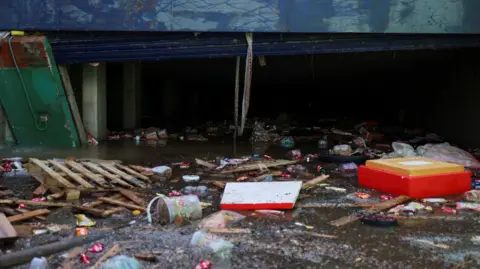







![Hebei Yiyue Glass Products’ factory in Cangzhou, Hebei, China [Courtesy of Hebei Yiyue Glass Products]](https://www.aljazeera.com/wp-content/uploads/2024/10/IMG-20241030-WA0002-1730357055.jpg?w=770&resize=770%2C513)