


As anger flared in the stricken town of Paiporta, the Queen of Spain, with mud smeared on her face, was seen crying.
Queen Letizia in tears on visit to flood-hit Valencia

Trump slams media in Pennsylvania as Harris stumps in Michigan | US Election 2024 News

Republican presidential candidate Donald Trump has given a profane and conspiracy-laden speech two days before the presidential election, as his Democratic rival Kamala Harris spoke at a historically Black church in the battleground state of Michigan.
Opinion polls show the pair locked in a tight race, with Vice President Harris, 60, bolstered by strong support among women voters while former President Trump, 78, gains ground with Hispanic voters, especially men.
In remarks on Sunday that bore no resemblance to his standard speech in the campaign’s closing stretch, Trump spoke about reporters being shot and suggested he “shouldn’t have left” the White House after his 2020 loss to President Joe Biden.
The former president also resurrected old grievances about being prosecuted after trying to overturn his defeat four years ago.
Trump intensified his verbal attacks against a “grossly incompetent” national leadership and the American media, steering his Pennsylvania rally at one point onto the topic of violence against members of the press.
In a meandering 90-minute rally speech two days before Tuesday’s US presidential election, Trump noted gaps in the glass panes around him.
The former president has survived two attempted assassinations this year, including being grazed in the ear by a gunman’s bullet during a July rally in Butler, Pennsylvania.
Surveying the gaps, Trump said: “To get me, somebody would have to shoot through the fake news and I don’t mind that so much.”
Unrestrained rhetoric
His rhetoric has become increasingly unrestrained in the campaign‘s final weeks.
Arizona’s top prosecutor on Friday opened an investigation after Trump suggested prominent Republican critic and former congresswoman Liz Cheney should face gunfire in combat.
He said Cheney would not be willing to support foreign wars if she had “nine barrels shooting at her”.
Trump campaign spokesperson Steven Cheung issued a statement after the media remarks on Sunday, saying Trump was looking out for the media’s safety.
“The president’s statement about protective glass placement has nothing to do with the media being harmed or anything else. It was about threats against him that were spurred on by dangerous rhetoric from Democrats,” the statement said.
Trump spent a considerable amount of his speech attacking the news media at the rally, at one point gesturing to TV cameras and saying, “ABC, it’s ABC, fake news, CBS, ABC, NBC. These are, these are, in my opinion, in my opinion, these are seriously corrupt people.”
Harris in Michigan
Democratic presidential candidate Kamala Harris, meanwhile, told a Michigan church congregation on Sunday that God offers America a “divine plan strong enough to heal division”.
The two candidates offered starkly different tones with the campaign almost at an end, as Harris said voters can reject “chaos, fear and hate”.
She concentrated on Michigan, beginning the day with a few hundred parishioners at Detroit’s Greater Emmanuel Institutional Church of God in Christ. It marked the fourth consecutive Sunday that Harris, who is Baptist, has spoken to a Black congregation, reflecting how critical Black voters are across multiple battleground states.
“I see faith in action in remarkable ways,” she said in remarks that quoted the Old Testament prophet Jeremiah. “I see a nation determined to turn the page on hate and division and chart a new way forward. As I travel, I see Americans from so-called red states and so-called blue states who are ready to bend the arc of history toward justice.”
She never mentioned Trump, though she’s certain to return to her more conventional partisan speech in stops later Sunday. But Harris did tell her friendly audience that “there are those who seek to deepen division, sow hate, spread fear and cause chaos.”
The election and “this moment in our nation,” she continued, “has to be about so much more than partisan politics. It must be about the good work we can do together.”
After her Detroit appearance, Harris was due to head to East Lansing, Michigan, a college town in an industrial state that is viewed as a must-win for the Democrat.
Trump was due to speak in Kinston, North Carolina, before ending his day with an evening rally in Macon, Georgia.
Of the seven US states seen as competitive, Georgia and North Carolina are the second-biggest prizes up for grabs on Tuesday, with each holding 16 of the 270 votes a candidate needs to win in the state-by-state Electoral College to secure the presidency. Pennsylvania is first with 19 electors.
Russia-friendly candidate ahead amid claims of Kremlin meddling


 EPA-EFE/REX/Shutterstock
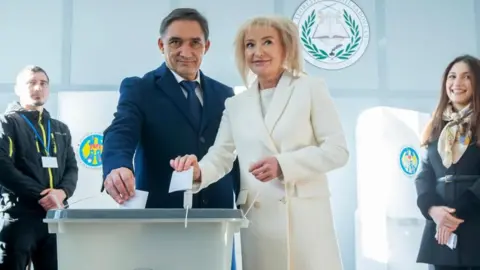
The man challenging Moldova’s pro-EU leader Maia Sandu for the presidency has taken a narrow lead, according to preliminary results, in a pivotal presidential election run-off seen as a choice between Europe and Russia.
Alexandr Stoianoglo, who was backed by the pro-Russian Party of Socialists, had promised a closer relationship with Moscow, after Sandu spearheaded Moldova into talks on EU membership.
The Central Election Commission said with more than 90% of the vote counted, Stoianoglo was on 50.5% of the vote and Sandu 49.5%.
During the vote, the president’s national security adviser said there had been “massive interference” from Russia in Moldova’s electoral process that had “high potential to distort the outcome”.
Russia had already denied meddling in the vote, which came a week after another key Eastern European election in Georgia, whose president said it had been a “Russian special operation”.
Alexandr Stoianoglo, who was fired as prosecutor general by Sandu, has denied being pro-Kremlin.
Voting ended in Moldova at 21:00 (19:00 GMT), with a 54% turnout higher than four years ago, and especially high among expat voters at polling stations abroad.
The result is likely to become even tighter as results from polling stations in the EU and the US become clear. The final result will be declared on Monday.
As polls closed, both Maia Sandu and her rival thanked voters, with Stoianoglu speaking in Russian as well as Romanian. Although Romanian is Moldova’s main language, Russian is widely spoken because of its Soviet past.
Casting his ballot, he promised to be an “apolitical president” for everyone, telling reporters he had voted for “a Moldova that should develop in harmony with both the West and the East”.
Stoianoglu polled particularly well in rural areas and the south, while Sandu was ahead in the cities and abroad, Moldovan media reported.
 Diego Herrera Carcedo/Anadolu
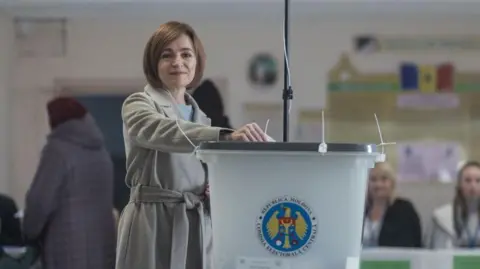
Sandu appealed after casting her ballot for Moldovans to preserve their independence, warning of “thieves” who sought to buy their vote and their country.
Presidential national security adviser Stanislav Secrieru said Russia had organised buses and large charter flights to bring voters to polling stations.
Bomb scares had briefly disrupted voting in Moldova, at UK polling stations in Liverpool and Northampton and at Frankfurt and Kaiserslautern in Germany, he added.
 EPA-EFE/REX/Shutterstock
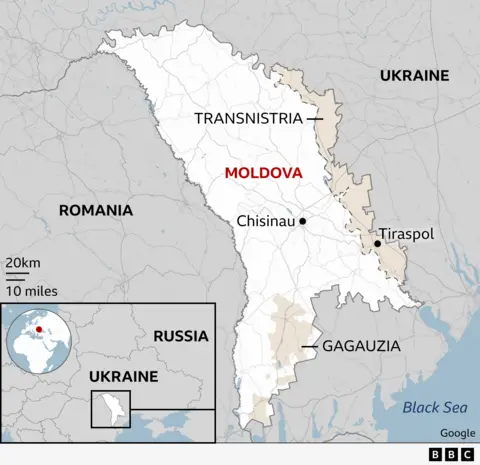
A Soviet republic for 51 years, Moldova is flanked by Ukraine and Romania and one of Europe’s poorest countries. It has a population of 2.5 million and an expat population of 1.2 million.
Moldova’s authorities have long warned that a fugitive oligarch called Ilan Shor has spent $39m (£30m) trying to buy the election for Moscow with handouts to 138,000 Moldovans.
Shor, who is based in Moscow, denies wrongdoing but did promise cash payments to anyone prepared to back his call for a “firm No” to the EU.
Commentators and politicians had warned that a Stoianoglu victory could radically change the political landscape in the Danube and Black Sea region, not because he was some kind of “Trojan horse”, but rather because Russia has thrown its weight behind him.
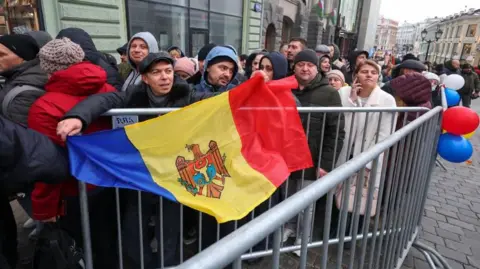
There were queues at polling stations in Moscow, Italy and among voters from a mainly Russian-speaking breakaway region of Transnistria, who had to cross the River Dniester into Moldovan-controlled territory to vote. Transnistria is home to a Russian military base and a huge arms depot.
Moldova’s election commission said it was aware of reports of organised and illegal transports of voters by air and land in Russia, Belarus, Azerbaijan and Turkey, and appealed to the public to report further violations.
Although Sandu had easily won the first round of the vote, several candidates swung behind Stoianoglo, although the third-placed candidate refused to back either of the two.
The first round coincided with a nail-biting referendum on backing a change to the constitution embracing the commitment to join the EU.
In the end the vote passed by a tiny margin in favour, and Maia Sandu said there had been clear evidence of attempts to buy 300,000 votes.
At least three killed as Israel bombards southern and eastern Lebanon | Israel attacks Lebanon News

At least three people have been killed in an Israeli air attack in southern Lebanon, and other strikes were reported in the country’s east as Israeli Prime Minister Benjamin Netanyahu visited the border region.
“The Israeli enemy’s raid on Haret Saida resulted in an initial death toll of three people killed and nine others injured,” Lebanon’s health ministry said on Sunday, referring to a densely populated area near the city of Sidon in southern Lebanon.
Footage, verified by Al Jazeera, showed the aftermath of the attack on a multi-story building in Haret Saida, showing a fire on the top floor and extensive destruction across all floors.
News agencies also reported an additional Israeli strike on the town of Ghaziyeh, south of Sidon. According to the AFP news agency, the strike hit a residential building, and a child was rescued from the rubble.
“Sidon has been struck multiple times – twice in the last few days, an indication of an escalation further north than the main theatre of operations for the Israelis further south,” said Al Jazeera’s Charles Stratford, reporting from Beirut.
Lebanon’s state-run National News Agency reported other Israeli strikes near a hospital in Tebnin, a town in the Bint Jbeil district of southern Lebanon. The mayor of Tebnin said the hospital sustained significant damage. None of these strikes were preceded by evacuation warnings.
Earlier on Sunday, Israel’s military said it would be targeting Hezbollah-linked facilities in Lebanon’s Baalbek area, which includes east Lebanon’s largest city and UNESCO-designated Roman ruins. At least three strikes have been reported in the area.
According to Lebanon’s Ministry of Public Health, at least 2,986 people have been killed in Israeli attacks on Lebanon since October 2023, including 18 dead and 83 injured in the past 24 hours.
‘With or without an agreement’
During a visit to the border with Lebanon on Sunday, Israeli Prime Minister Benjamin Netanyahu vowed to push the Lebanese armed group Hezbollah back beyond the Litani River, approximately 30km (18 miles) inside Lebanon from Israel’s border.
“With or without an agreement, the key to returning our (evacuated) residents in the north safely to their homes is to keep back Hezbollah beyond the Litani, to strike its every attempt to re-arm, and to respond forcefully against all action against us,” Netanyahu said.
In Israel, the military said it intercepted several projectiles fired from Lebanon into Israeli territory, while some fell into unpopulated areas. On Thursday, rocket fire from Lebanon killed seven people in the town of Metula in northern Israel, in the deadliest day on the Israeli side of the border since the war between Israel and Iran-backed Hezbollah escalated on September 23 – when Israel ramped up its attacks after a year of tit-for-tat exchanges of fire. One week later, it sent ground troops into southern Lebanon.
Israel’s military says 38 soldiers have been killed in the Lebanon campaign since it began ground operations.
Iran-aligned groups in Yemen, Iraq, and Syria have also joined the fighting, while Iran and Israel have directly attacked each other, escalating fears of an even broader conflict.
Separately on Sunday, the Israeli military reported conducting a ground raid into Syria, capturing a Syrian citizen allegedly involved in Iranian networks. This marks the first time in the current conflict that Israel has announced sending troops into Syria, whose government has not yet commented on the report.
The military did not disclose the specific location or timing of the raid but identified the suspect as Ali Suleiman Al-Eatzi, a Syrian citizen living in the Tsida area in southern Syria.
Israel’s assault on northern Gaza continued on Sunday, with at least 35 people killed across the Strip since dawn.
Voter fraud claims flood social media before US election

 Getty Images
Rumours, misleading allegations and outright lies about voting and fraud are flooding online spaces in unprecedented numbers in advance of the US election.
Hundreds of incidents involving purported voting irregularities are being collected and spread by individuals, as well as both independent and Republican-affiliated groups. A small number of posts are also coming from Democrats.
The US government has also alleged that foreign actors, including Russia, are spreading fake videos to undermine confidence in the electoral process.
The whirlwind of misinformation spreading online poses a challenge to election officials who are having to debunk rumours and reassure voters, while preparing to administer election day on Tuesday.
Many posts alleging election irregularities support the Trump campaign’s false claim that the former president won the 2020 election and suggestions that he will potentially be cheated out of victory again on 5 November.
When asked whether he will accept the 2024 election result, Donald Trump said during the presidential debate in September that he would if it was a “fair and legal and good election”.
A majority of Americans – 70% – expect him to reject the result if he loses, according to a CNN/SSRS poll released Monday.
Just this week, Trump himself claimed widespread fraud in a key swing state.
“Pennsylvania is cheating, and getting caught, at large scale levels rarely seen before,” Trump posted on his Truth Social network. “REPORT CHEATING TO AUTHORITIES. Law Enforcement must act, NOW!”
The allegation followed officials in three Pennsylvania counties saying they were working with local law enforcement to investigate some voter registration applications for potential fraud.
While Trump and allies seized on the announcements, the state’s top election official, Republican Al Schmidt, has urged caution and warned voters to be aware of “half-truths” and disinformation circulating on social media.
“This is a sign that the built-in safeguards in our voter registration process are working,” he said.
Flood of misleading content
The BBC has seen hundreds of allegations of election fraud online, on social networks and on message boards and in chat groups. Some of these posts have been viewed millions of times each.
The posts have implied it’s easy for non-citizens to vote, made false claims about voting machines and sowed distrust in the ballot-counting process.
One video claimed to show recently-arrived Haitians voting in Georgia.
The BBC has found clear indications, including false addresses and stock photos, which indicate the video is a fake. On Friday US security officials said it was made by “Russian influence actors”.
Another person on X claiming they were Canadian posted a picture of a ballot and said: “Figured I would drive across the border and vote.”
It, too, is a fake, and part of an effort co-ordinated on the fringe message board 4chan. The ballot shown is from Florida, a state that requires identification to vote in person and is about a 20-hour drive from the Canadian border.
Meanwhile in Northhampton County, Pennsylvania, a video was posted on X showing a man dropping off a container of ballots at a courthouse, alleging suspicious activity. It turned out he was a postal worker delivering mail-in ballots, but the video was seen more than five million times.
Echoes of 2020
Experts worry the burst of misinformation just before election day could undermine people’s trust in the results – or lead to threats and violence in the lead-up to the election and beyond.
It’s happened before.
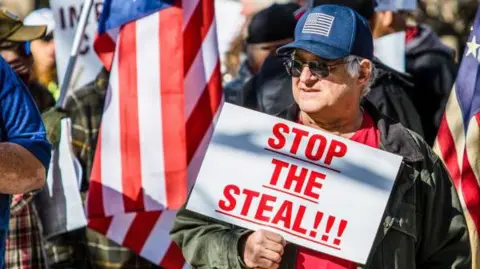
In the hours and days that followed the 2020 presidential election, while votes were still being counted, then-President Trump turned to social media to allege fraud and falsely claim that he was the real winner of the election. “Stop the steal” became a slogan of his supporters’ movement to overturn the results.
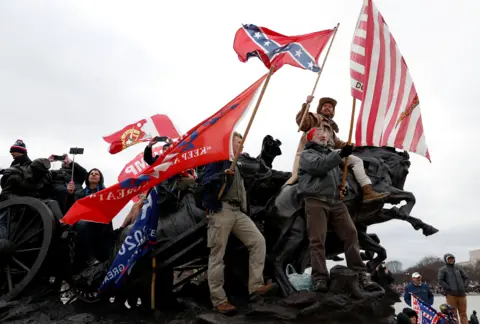
On social media, chatrooms and during street protests, conspiracy theorists alleged widespread voter fraud, culminating with a riot at the US Capitol on 6 January 2021.
Meanwhile, in battleground states like Georgia, election officials – civil servants whose job it is to oversee the election – faced death threats.
While false claims about voting ramped up after the 2020 vote, groups that monitor this kind of activity say this year it has started well before election day.
Wendy Via, founder of the Global Project Against Hate and Extremism (GPAHE), said some far-right and right-wing activists “are preparing themselves for the election to be stolen in a way they weren’t in 2020”.
“We cannot overstate the role of conspiracy theories in all of this,” she said.
These doubts have already reached Trump supporters on the ground. At a rally this week in Wisconsin, another key swing state, a number of people said they believed only illegal activity would prevent the Republican nominee from winning.
“I feel very confident about Trump, as long as there’s no cheating,” said Brad Miller of Green Bay, who mentioned that he’d already heard rumours about fraud. “Our only hope is that it’s not big enough to change the result.”
After the 2020 election, dozens of court cases alleging election fraud were lodged by Trump’s team across multiple states, but none succeeded.
Isolated fraud incidents blown out of proportion
Experts say that isolated incidents of ballot fraud and administrative errors always happen in US presidential elections, which run across all 50 states and in 2020 involved more than 150 million voters.
But real incidents are now being catalogued and shared online to an unprecedented degree and being used, alongside fake posts, as evidence of widespread cheating.
In southern California, dozens of ballots were found in a storm drain. Despite the unknown circumstances around the event, online partisans immediately suspected deliberate fraud.
“They WILL cheat,” says one of the thousands of comments posted.
As cases have cropped up in recent days – including those in Pennsylvania and a Chinese student being charged with illegally voting in Michigan – authorities have repeatedly pointed to their investigations as examples of the robustness of election safeguards.
But those who believe conspiracy theories about widespread fraud see these incidents as evidence of a co-ordinated plan by Democrats to “rig” the election.
“Look at this new cheat voter fraud,” read one typical comment responding to the news from Pennsylvania. “Dems already doing their best to steal another election.”
The overall effect can have a disastrous impact on trust in democracy, experts say.
“These incidents are catnip for those who seek to undermine confidence in the election result,” said Luis Lozada, chief executive of Democracy Works, a not-for-profit group that distributes information about voting.

Groups behind the deluge
The mass of election fraud claims spreading on social media have been aided by a network of groups that crowdsource allegations.
Groups like Texas-based True The Vote, founded in 2009, have long been on the forefront of questioning election security.
On an app developed by True the Vote called VoteAlert, supporters post examples of alleged election irregularities.
They have collected a wide range of claims, from minor security oversights to allegations of deliberate vote tampering. The organisation also has people monitoring live-streamed cameras that have been pointed on ballot drop boxes in a number of states. Many local officials have repeatedly outlined the steps they have taken to make the boxes secure.
“Our hope is we see exactly nothing at these drop boxes,” said True the Vote founder Catherine Engelbrecht during one of her recent regular online meetings for supporters.
But she also hinted that Democratic-aligned groups were aiming to commit election fraud on a vast scale.
“If they want to try to pull the kinds of things that we saw being pulled in 2020, they’re highly unlikely to get away with it because we have, literally, eyes everywhere,” she added.
The BBC contacted True the Vote for comment.
A number of other groups are asking supporters to report alleged irregularities.
Elon Musk’s America political action committee has started a community – akin to a message board – on X, filled with rumours and allegations about voting. With 50,000 members, several posts go up every minute, almost around the clock.
Other efforts include the Election Integrity Network, a group founded by a former Trump lawyer who is challenging voter registrations and recruiting poll watchers – partisan observers who attend polling places.
The volume of messages on these platforms – along with the vagueness of some of the claims, with often anonymous sources – makes it nearly impossible to verify each allegation.
The groups, and the Trump campaign, say that these efforts are solely meant to ensure the integrity of the vote. The BBC contacted the Trump campaign for comment.
 EPA
EPABad information will continue to spread
The effect of this is unpredictable.
The Department of Homeland Security, in a memo reported on by US outlets including the BBC’s partner CBS, said on Monday that election conspiracy theories could spark action by domestic extremists.
And observers expect the wave of misinformation to continue well beyond election day. Polls suggest the election will be among the closest in modern US history. It may take days to count all the votes and determine the winner.
Luis Lozada of Democracy Works says the election is being conducted in an “ecosystem of distrust”.
But despite the doubts being sown, he says, “accurate information is getting out there”.
“Election officials work very hard to ensure that elections are run properly, as they were in 2020,” Mr Lozada said. “That’s not going to stop folks from taking anecdotes, and trying to punch holes.”
With reporting by BBC Verify
South Africa’s Sipho ‘Hotstix’ Mabuse on art’s role in resistance | Music

Decades after the fall of apartheid, the echoes of South Africa’s cultural resistance still ring out, inspiring new generations. During the struggle, artists like Sipho Mabuse used their craft as both a weapon and a lifeline, giving voice to a vision of freedom and dignity.
In this edition of Talk to Al Jazeera, we delve into the power of the arts in resistance, asking what role they played in South Africa’s journey to freedom and drawing comparisons to today’s struggle for Palestinian self-determination.
What Kamala Harris’s years as a prosecutor tell us about her

 Getty Images
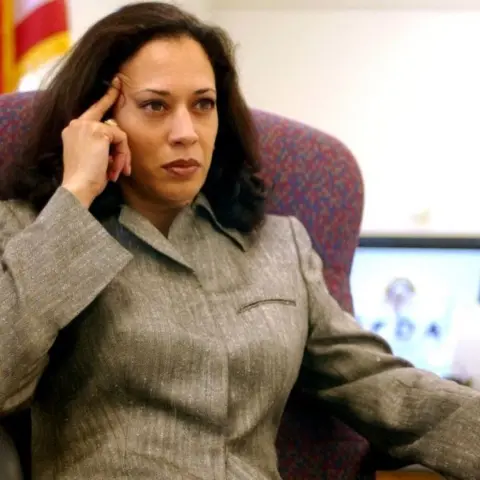
Just over three months ago, Vice-President Kamala Harris walked up to a microphone to make a speech that would define both her past and her future.
A day before, President Joe Biden had dropped out of the election race and endorsed her to succeed him as Democratic candidate. With only a short period of campaigning ahead of her, Harris had no time to waste.
There is a saying in politics: define yourself or be defined by your opponent. And in that moment, when Harris made her first pitch to the American people, she defined herself not just in terms of her record in the White House or as a US senator, but the years she spent as a California prosecutor.
“I took on perpetrators of all kinds – predators who abused women, fraudsters who ripped off consumers, cheaters who broke the rules for their own gain. So, hear me when I say: I know Donald Trump’s type,” she said of her Republican challenger.
The line has been repeated often at her campaign rallies and stump speeches, as the 60-year-old has sought to frame this election as a contest between a hard-bitten prosecutor and a convicted felon, constantly reminding voters of Trump’s legal troubles.
But a look back at Harris’s time in and out of California’s courtrooms reveals her enduring struggle to define herself, what her opponents say is a history of pivoting on issues depending on the political weather, as well as her uncanny ability to seize the moment when others have counted her out.
Street murders and rough San Francisco politics
Harris’s time in law enforcement began just out of law school in Alameda County, California – which includes the cities of Berkeley and her hometown of Oakland.
During the 1990s, in the midst of the government’s “war on drugs”, Oakland struggled with violent crime.
For a junior prosecutor, the job was daunting. But the severity of the cases you had to deal with meant it was considered a top job for a young and ambitious attorney, said Teresa Drenick, who worked with Harris at the time.
“It was like a potboiler of an atmosphere. The amount of grief and agony you ingested every day was hard to process. For us, it was intense. The stakes being high, the crimes being so serious,” she told the BBC.
“It was near the height of the crack-cocaine epidemic. There were gang murders, street corner murders taking place. There was a lot going on in Oakland that enabled you as a prosecutor to handle some of the most serious cases that a prosecutor is ever going to handle.”
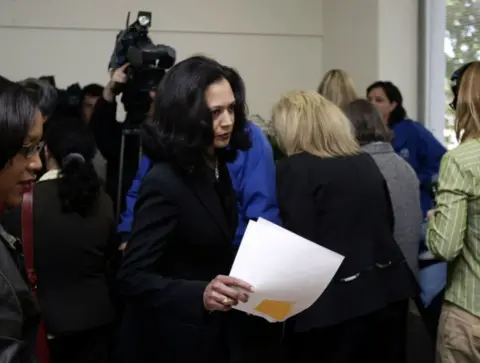
Ms Drenick and Harris were on the same trial team together. She admired Harris’s confidence in front of a jury, and her respect for her colleague only grew when Harris was transferred to a different team in the same courthouse focused on child sexual assault.
“She was very, very caring of victims of child abuse. She was able to speak to them in a way that allowed them to open up to her,” she said.
 Getty Images
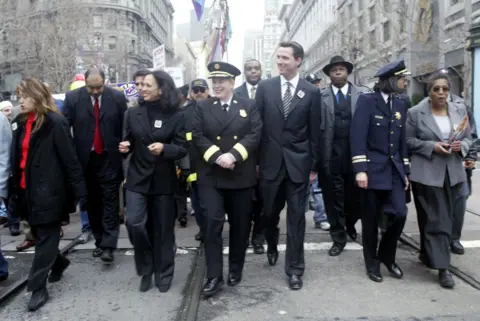
It was at this time that Harris dated Willie Brown, a local political kingmaker and speaker of the California State Assembly who helped launch the careers of some of the state’s other most prominent political leaders, including Gavin Newsom, the current governor, and San Francisco Mayor London Breed.
Brown appointed her to two state boards and introduced her to some of San Francisco’s highest-profile Democratic donors. The short-lived romance ended by the time Brown was elected as the city’s mayor in 1995. Three years later, Harris took a job at the San Francisco district attorney’s office.
During her relationship with Brown, who was 30 years her senior, Harris had begun mingling with some of the city’s political heavyweights.
San Francisco’s political machine, which Harris has described as “a bare-knuckled sport”, has launched the careers of some of the nation’s biggest political stalwarts including former House Speaker Nancy Pelosi and the late Senator Dianne Feinstein.
Harris forged relationships with both of them, rising alongside contemporaries like Newsom, as she found her feet in the political world.
Her swift rise through San Francisco’s rough-and-tumble politics were defined by days in courtrooms representing victims and nights at glitzy political galas.
This was also around the time that Harris met one of her closest friends – and most significant donors – Laurene Powell Jobs, the widow of Apple co-founder Steve Jobs.
Jobs donated $500 to Harris’s 2003 campaign for San Francisco district attorney, which she won, toppling the man who had hired her. Twenty years later, the billionaire philanthropist donated nearly $1m to the Biden-Harris re-election campaign, according to Fortune Magazine. It’s not known how much she has directly contributed to Harris’s bid for the presidency, but the amount is considered substantial.
‘No exception to principle’
On the day before Easter in 2004, just four months into Kamala Harris’s tenure as the district attorney of San Francisco, a gang member brandishing an AK-47 rifle fatally shot a 29-year old police officer named Isaac Espinoza.
The slaying stunned the city, with many politicians and prominent members of the police calling for the death penalty.
But Harris, who had made opposition to capital punishment a key part of her political campaign to become the city’s top prosecutor, instead decided to pursue a life sentence without parole. She made her decision public just 48 hours after the murder, without informing the widow first.
“She did not call me,” Espinoza told CNN in 2019. “I don’t understand why she went on camera to say that without talking to the family. It’s like, you can’t even wait till he’s buried?”
The backlash was swift. Speaking at the officer’s funeral, Senator Feinstein demanded his killer “pay the ultimate price”. While walking out of the church service, she told reporters that had she known Harris was against the death penalty, she probably wouldn’t have endorsed her.
“[T]here can be no exception to principle,” Harris later wrote in an opinion piece in the San Francisco Chronicle, defending her decision.
Long-time civil rights attorney John Burris, who supported Harris’s decision at the time, said he thought it was “politically was not wise for her, but it was a philosophical position she took”.
“She was pretty bold in her position and she did take a lot of heat for it,” he told the BBC. “That was a pretty progressive stand.”
The incident could have been the end of her political ambitions, but Harris, who had grown up with a single mother in the working-class city of Oakland, carried on.
“Is she a political animal? Absolutely not. Is she naturally skilled? Yes,” said Brian Brokaw, who managed Harris’s two successful campaigns for California attorney general in 2010 and 2014. “For her, politics is the means to the end. She is focused on the end result and the impact she can have on people’s lives less than the process.”
 Getty Images
Harris seemed to absorb some lessons from her first major decision as San Francisco district attorney. Four years later, she again declined to pursue the death penalty after a dramatic killing, but this time, she better understood how her decision would reverberate.
Tony Bologna had been driving in San Francisco with his three sons when their vehicle was barraged by gunfire. Bologna and two of his sons were killed; his third son was critically injured.
Shortly after the killing, police arrested Edwin Ramon Umaña, an undocumented member of the MS-13 gang who had evidently mistaken the 49-year old Bologna for a sworn enemy.
This time, Harris opted to deliver the difficult news about her prosecutorial decision to Bologna’s widow Danielle herself, recalls Matt Davis, who was representing Danielle Bologna in a civil suit against the city at the time.
“It was no surprise that Danielle had a very strong, negative reaction to the news,” Mr Davis told the BBC in a recent interview. “She made it clear that she was upset, and Kamala listened to her and expressed her sympathies but stayed pretty firm.”
The meeting left an indelible impression on Davis. He had befriended Harris in law school in San Francisco, and when she had first revealed her plans to run for D.A., he remembers thinking she didn’t have a chance.
But he says that painful conversation made him realise he had underestimated her.
“That was not an easy thing to do,” Mr Davis said.
Progressive prosecutor?
Over the span of her law enforcement career, Harris’s allies sought to paint her as a “progressive prosecutor” committed to criminal justice reform but also tough on crime.
It was a fine line to walk in a liberal city in the country’s largest left-leaning state, and one that critics on both sides of the political aisle say she did not stick to.
As district attorney, she adopted a so-called “smart-on-crime” philosophy, which included initiatives to keep non-violent offenders out of prison by steering them into job training programs and ensuring young offenders remained in school.
Niki Solis, an attorney in the San Francisco public defender’s office who worked opposite Harris in the early 2000s, said she had been receptive to her concerns about how young victims of sex trafficking were being charged with prostitution, as opposed to being treated as victims.
“I realised that she understood issues that a lot of her predecessors and a lot of [district attorneys] up and down the state failed to understand or even acknowledge,” said Ms Solis.
Trump and his allies on the right have sought to play up this time in her career, depicting her as part of a “San Francisco liberal elite”. But on the left of politics, she has been accused of not being reform-minded enough, with some on social media nicknaming her “Kamala the cop”.
But by the time Harris was elected as California’s attorney general, in 2010, her progressive tendencies appeared to have given way to political pragmatism.
“She was seeking more of a national profile. She wanted to make a mark. There was definitely an expectation of an interesting future to come,” said Gil Duran, who worked for Harris in the attorney general’s office for a few months.
“The attorney general – usually a sleepy backwater of an office – was now home to a rising star.”
On the national stage, Harris began to make her mark. In 2012, in the aftermath of the global financial crisis, Harris threatened to walk away from negotiations on a financial settlement between state attorneys general and five US banks. California was set to receive around $4 billion in the initial deal, and Harris eventually secured $18 billion for the state.
The Harris campaign has highlighted this case on the campaign trail as more proof she’s willing to stand up to powerful interests.
But more recent reporting shows that only $4.5 billion of the settlement ended up going towards California homeowners who had been ripped off by lenders.
In moves that angered some liberals, she implemented a school truancy program state-wide, which some county prosecutors used to arrest parents. And she defied a Supreme Court order to reduce overcrowding in the state’s prisons.
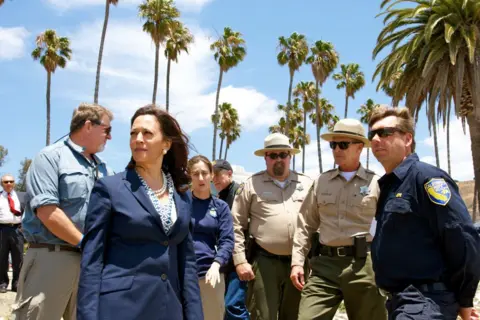
She also reversed her previous position on the death penalty in 2014 when, as attorney general, she appealed a lower court’s ruling that found it was unconstitutional. Now, the prosecutor who once refused to sentence violent murderers to death on the basis that “there is no exception to principle” was defending the state’s right to do just that.
Hadar Aviram, a criminal justice and civil rights professor who petitioned Harris to leave the decision in place, was one of many critics of her stance.
“You are not under any obligation to defend things that are morally unjust,” she told CNN in 2019 of the episode. “If you truly believe that they’re morally unjust and you have an opportunity to take a stand, I think it’s an imperative to do so.”
 Getty Images
Former San Francisco city attorney Louise Renne, who worked with Harris when she first left Oakland, said the torrent of criticism she faced over her support for the death penalty was unfair.
“The thing is when you’re state attorney general, you have to defend the law. That’s your obligation,” she told the BBC. “ I don’t regard that as a weakness or a valid criticism at all.”
But Harris was selective about which laws she enforced. In 2004, when Gavin Newsom, then San Francisco’s mayor, decided to allow same-sex weddings, in violation of state law, Harris helped officiate a few of the ceremonies, calling it “one of the most joyful” moments of her career.
Her long record as a prosecutor would prove tricky when, after being elected to the US Senate in 2016, Harris decided to run for the Democratic presidential nomination.
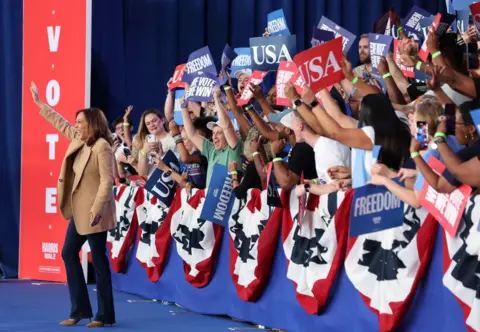
She chose to kick off her 2020 presidential run just blocks away from the Alameda County Courthouse, the same place where she first uttered the words, “for the people” – which would become part of her campaign slogan.
But in the midst of her campaign, George Floyd, an unarmed black man, was murdered by a police officer during an arrest, igniting a nationwide racial reckoning and demand for criminal justice reform. Her past defence of the death penalty, and resistance to prison reform, earned her criticism from her party’s left-flank.
She dropped out of the presidential race before the primary contests to choose a Democratic contender had even begun.
 Getty Images
Reinvented again
Now, as Harris campaigns for president against Donald Trump, she is again calling attention to her prosecutorial bona-fides, but reframed in a new political atmosphere.
While many cities, including San Francisco, experimented with progressive police reform after Floyd’s murder, a spike in crime and homelessness during the pandemic has triggered a public backlash against so-called “soft on crime” policies. Republicans have also heavily focused on political messaging around crime and public safety in recent years.
Harris’s past as a prosecutor is no longer such a liability, and in a race against the first former president to be convicted of felony crimes, the narrative aligns with the political moment.
Notably, at the Democratic National Convention this summer, abolishing the death penalty was dropped from the party platform.
And while in 2020, Harris was trying to win over left-leaning Democrats, she is now explicitly making a pitch for moderate Republicans who may be fed up with Trump. To do that, she has shifted a number of her positions – from border security to single-payer health care – to the centre.
This has led to accusations from her opponents that she is a flip-flopper.
She’s “a chameleon”, Trump’s running mate and Ohio Senator JD Vance told CNN in August. “She pretends to be one thing in front of one audience and she pretends to be something different in front of another audience.”
But Mr Duran, Harris’s former colleague in the attorney general’s office, sees it less as a matter of political scrupulousness and more simply a sign of her political pragmatism.
“I think she does have conviction but it’s really hard to run a campaign on your convictions alone, for the most part,” he said. “The Kamala Harris we’re seeing now is very much poll and focus-group driven.”
What Harris really stands for has been a question that has dogged her throughout her career – and continues to follow her on her bid for the Oval Office. But to Mr Brokaw, her former campaign manager, she has always operated on her own terms.
“She has carved her own path and left a whole bunch of people behind who counted her out and underestimated her,” he said.

How one survivor of Canada’s residential schools reclaimed her identity | Indigenous Rights

‘It’s like home’
Martha was able to heal some of that trauma by reconnecting with her father before he died in 2005.
“He sobered up in the later years,” she says. “He was getting sickly, but I would ask him things, [about our culture]. And he would bring me to round dances, he would bring me to a healing sweat lodge.”
At each ceremony, she would observe her father – the way he carried himself, how he interacted with the elders, the precise way he performed their cultural rituals. When he spoke of their Cree traditions, she would lean in close, soaking up every word.
“This was what I was missing,” she says.
“I really felt that he was trying to look out for me now that I was older and understood about pain and hurt and all that stuff. I think that’s why he was bringing me to these ceremonies. I lost my culture and my identity. And he was trying to bring it back.”
Martha was just getting to know him, she says, when, aged 72, he died in his sleep at home.
Now, Martha passes on the culture and traditions to her 14 grandchildren.
But to be able to fully do that, she has had to forgive those who abused her.
“I had to pray for [the people who hurt me] because I want to have a good life. I want to be at peace. I had to learn how to forgive.”
In 2008, Canadian Prime Minister Stephen Harper apologised to the residential school survivors. In the same year, the Truth and Reconciliation Commission was established. Over six years, it travelled across Canada, gathering testimonies from survivors. The Catholic Church delivered a historic apology in 2022.
Martha is now retired. She fills her time hosting healing workshops in Saddle Lake and other Indigenous communities and volunteering at a church in Edmonton, where she feeds the homeless and provides outreach to people in need.
Martha runs her fingers over a large bundle of dried sage leaves.
“Healing is a lifelong journey,” she says.
“It took a long time [to get where I am],” she reflects. “I’m going to keep learning, keep going back to my culture. I just love it when somebody is talking to me in Cree. It’s like home.”
This summer Martha participated in a sun dance ceremony, a sacred ritual practised by several Indigenous Nations. The sun dance is a time of spiritual renewal and personal sacrifice. Participants seek visions, offer prayers and make sacrifices to the Creator. Martha fasted for four days and danced in the sacred circle praying for healing for her community.
It was pouring with rain as she danced, but she says the skies opened to a stunning vision of her father.
“When I was dancing, I saw my dad. He was looking down. I thought, ‘Oh, I’m doing this for my dad.’ And the message for me was, ‘Your dad is happy, you’re doing it for him, you’re doing it for everybody’.”
“I don’t want to be stuck over there [in the past],” she says. “I was already there long enough.”
If you, a child or a young adult you know require support, help is available. Please visit Child Helplines International to find sources of help. In Canada, Kids Help Phone is available on 1-800-668-6868. In the United Kingdom, call Childline on 0800 1111 and in the United States, text or call the Childhelp hotline number 800-422-4453.
Lightning kills 14 at Palabek refugee camp

A lighting strike at a refugee camp in Uganda had killed 14 people, police say.
They say the victims were attending a church service on Saturday evening when the lightning struck. Another 34 people were injured.
An official told local radio that all those who died were children.
The incident occurred at Palabek Refugee Settlement in the north-west of the country. The area has recently seen heavy rains with thunder and lightning.
US Women’s March 2024: Huge rally in DC to back Harris, abortion rights | US Election 2024 News

Thousands of women have rallied in Washington, DC, in support of Democratic presidential candidate Kamala Harris and reproductive rights.
The vice president has made abortion rights a central plank of her White House bid against Republican Donald Trump, who appeared to have publicly backed the 2022 Supreme Court ruling that took away the constitutional right to an abortion.
“Voting for the candidate that’s going to support our rights as women is the most important thing to me,” said Leah Brooker, 19, who travelled from North Carolina to join the event on Saturday, three days before Election Day.
The student said she had already cast her ballot in early voting, calling it “very empowering that my first vote was for a woman”.
She held a sign reading: “If boys will be boys, then women will be presidents.”
Other signs had slogans like “Voting prevents unwanted presidencies” and “A woman’s place is in the Oval Office.”
Organisers estimated turnout was about 15,000 people. Other US cities also organised sister marches.
With the dome of the US Capitol as the backdrop, speakers at Freedom Plaza whipped up support for 60-year-old Harris.
“We’re not going back!” the crowd chanted, repeating one of Harris’s campaign slogans.
Retiree Marlene Wagner, 70, came from Nebraska, saying she was joining “for my grandkids and my children because I fear for their future”.
In her Midwestern state, abortion is banned after the 12th week of pregnancy.
The restriction came after US Supreme Court justices appointed by Trump tipped the panel in 2022 into ending the national right to abortion granted 50 years ago through the Roe v Wade verdict.
Abortion access is on the ballot in 10 states, in referendums that are taking place alongside the presidential vote.
In Nebraska, a proposal seeks to add abortion restrictions to the state constitution, while another seeks to extend the period in which the procedure is allowed.
For Wagner, who also participated in the first Women’s March in 2017 after Trump’s election, the choice was stark.
The abortion restrictions have “already had repercussions, because women haven’t been able to get the care they need”.
