



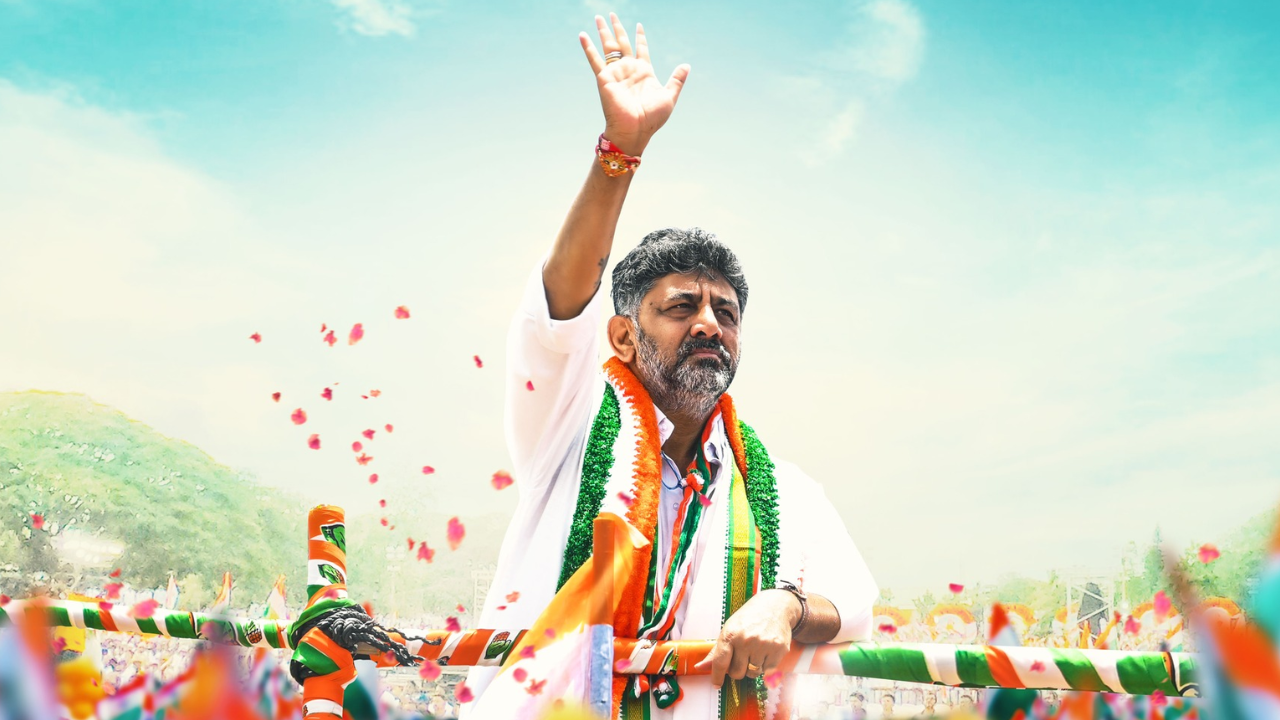
New Delhi: Karnataka Congress Leader DK Shivakumar Long known for his firefighting skills. Whenever things went bad, Congress turned to him. But now, as he prepares to assume the top post in Karnataka, the test will be not only of his fire-fighting skills (in his own backyard) but also of his governance skills.shivkumarAlso known as DKS, will be sworn in as the Chief Minister of Karnataka on June 3, completing a political journey that has defined the revival of the Congress party in the state. For nearly a decade, he has been the party’s troubleshooter, strategist, fund raiser, negotiator and organizational anchor. He helped keep Congress MLAs united in moments of crisis, revived the party after electoral setbacks and played a central role in its decisive victory in Karnataka in 2023.His transition from deputy chief minister to chief minister comes after months of speculation, bargaining and careful choreography by the Congress high command. Siddaramaiah’s resignation on May 28 under the party’s power-sharing arrangement finally opened the door for Shivakumar. Yet the swearing-in ceremony may be the easiest part of the new assignment for DKS.
Complex factional tensions within the Congress, caste expectations, fiscal pressures from the state and the relentless demands of governing India’s most economically important southern state await him.Here are the top challenges for DK Shivakumar as he prepares to take over the top post in Karnataka:
Siddaramaiah’s shadow
The first challenge before Shivakumar is also the most immediate: Former CM Siddaramaiah.The outgoing Chief Minister may have vacated the office, but he remains the most influential mass leader in the Karnataka Congress. Over the past three years, he has strengthened a powerful network of MLAs and social groups, especially through the Ahinda alliance of backward classes, minorities and Dalits in the state.In theory, the chief ministerial change is systematic but in practicality, political changes are still visible.Many of the MLAs whose political rise was due to Siddaramaiah remain influential within the party. Many ministers are expected to seek continuity across departments and policy priorities. There is already pressure from Siddaramaiah’s camp regarding representation in the new cabinet, which also includes demands related to his son Yatindra Siddaramaiah.
The challenge for Shivakumar is not just to accommodate the supporters of the outgoing CM. He will have to establish dominance among the Siddaramaiah camp MLAs and, at the same time, assert independence without provoking factional war.For Shivakumar, the task is particularly delicate as the Congress government cannot afford visible instability and infighting. BJP and Janata Dal (Secular) will keep a close watch on any sign of rift between the two camps.BJP has already opened a front against the change. BJP national spokesperson Shehzad Poonawalla said the leadership change reflects Congress’s admission that Siddaramaiah’s rule has failed on many fronts.“After two and a half to three years of ‘Game of Thrones’, ‘Battle of the Chair’ and ‘Who will be the Chief Minister’, Karnataka Congress has elected a new CLP leader in the form of DK Shivakumar and replaced Siddaramaiah. It means they are admitting that the Siddaramaiah regime has been a complete failure on all fronts – economy, law and order and infrastructure,” Poonawalla said.“Therefore, they had to change them. Otherwise, 2028 (assembly elections) will go,” he said.Former Karnataka CM and BJP MP Basavaraj Bommai also said that Siddaramaiah’s decision to remain active in state politics would act as a “hanging sword” on Shivakumar, while he also said that whenever elections are held in the state, the BJP will return to power on its own.For Shivakumar, the success of his first six months may depend on whether he is able to keep Siddaramaiah loyalists on his side.
cabinet puzzle
If there is one political test every CM has to face soon after assuming office, it is cabinet formation.Shivakumar’s version of that test may be particularly difficult.Each allocation is likely to send a political message.Who gets the houses, who controls the finances, who oversees Bengaluru development? A single boycott can lead to months of resentment.Meanwhile, Siddaramaiah himself is in talks with the high command to get a cabinet ministerial berth for his son and loyalists after his resignation.It will be interesting to see how much space Shivakumar leaves to accommodate the former CM’s loyalists.
Karnataka’s new boss
Shivakumar’s challenge is further heightened by another looming decision: the selection of the new Karnataka Pradesh Congress Committee president.As state party chief, Shivakumar built one of the most effective political organizations in the state. His departure from that role creates a void. Whoever succeeds him will inherit a powerful political machine.This selection will shape not only the future of the party but also Shivakumar’s own authority. A loyal organizational ally can strengthen their position. On the other hand, an ambitious successor could eventually emerge as an alternative power centre.
caste equation
Shivakumar’s rise to this position is significant as he is the most prominent Vokkaliga leader in the Congress. The community remains one of the most influential political groups in the state, especially in southern Karnataka.Yet Congress’s 2023 victory was not built solely on Vokkaliga support. It all depended on the Ahinda alliance carefully crafted by Siddaramaiah. That alliance now faces a moment of uncertainty.Many Dalit, backward class and minority leaders will be closely watching to determine whether the leadership change changes the government’s priorities. Shivakumar may need to reassure them that power has changed but political representation has not.At the same time, influential leaders from other communities are likely to push for greater prominence in the new system.According to reports, the demand is already being made for several Deputy CMs representing different social groups. Senior Dalit leaders, Lingayat leaders and regional power brokers all have claims that cannot be easily dismissed.
Ticking bomb of caste census
Shivakumar is also inheriting another politically sensitive issue from Siddaramaiah: the caste census. Before leaving office, Siddaramaiah accepted the findings of the socio-economic and educational survey and supported its implementation, positioning it as a tool for greater social justice and representation.However, the decision drew sharp reaction from influential Vokkaliga and Lingayat leaders, who questioned the methodology of the survey and the population figures given to their communities. Several organizations called for a fresh survey or a review of the findings.As Vokkaliga leader, Shivakumar faces a delicate balancing act. Reversing or weakening Siddaramaiah’s position may dismay the non-aligned groups that form the Congress’ core social coalition, but moving forward aggressively with the census recommendations risks alienating sections of key communities whose support is crucial to both the Congress and Shivakumar’s own political base.
Welfare versus development dilemma
The Congress government came to power on the strength of its guarantee schemes.Free electricity, free bus travel for women, cash assistance programs and other welfare initiatives helped build a powerful electoral coalition. While these schemes are popular among the beneficiaries, they are also expensive.Shivakumar inherits a government that must deliver on welfare commitments as well as invest in infrastructure, urban development and economic growth.This stress can affect his tenure to a great extent.Guarantees have become politically non-negotiable, withdrawing them would risk alienating key supporters. Yet continuing these indefinitely without expanding revenues creates fiscal constraints.Therefore, the challenge is not whether to continue the schemes or not, but how to sustain them.Can Karnataka maintain its welfare architecture while maintaining its reputation as one of India’s most investment-friendly states?This question is likely to become more acute as the next elections in the state approach.
countdown to 2028
Perhaps the biggest challenge facing Shivkumar is time. Shivkumar is holding the post of CM in the second half of his tenure.Meanwhile, the clock is already ticking towards the next assembly elections in 2028. This leaves him about two years to establish an independent record, deliver visible results and convince voters that Congress deserves another term.Anti-incumbency is already a factor.And for Shivakumar, this creates a unique political dilemma.Even if the government performs well, most of the credit can be given to Siddaramaiah as many key policies originated under his leadership.If the government struggles, the blame will probably fall on the new CM as he was in charge during the last phase before the elections.In this sense, Shivakumar has inherited both the benefits and burdens of power.For decades, Shivakumar had built his reputation as a political operator with extraordinary skill. He became indispensable to the Congress leadership. Also fondly called ‘Kanakpura Bande’ – the granite rock of Kanakapura (his constituency) – the 64-year-old leader has steadily established himself as the key Vokkaliga strongman of the Congress party. However, the troubleshooter now faces a different challenge.The qualities that make him a successful political manager may or may not result in successful governance. It will be known in the coming months whether Shivkumar will be able to make this change or not.And the results could decide not only the future of his government but also the future of the Congress in one of its most important states.After the oath taking ceremony on Wednesday, Congress’ crisis manager will be in charge of Karnataka and soon after this his real test will begin.


