



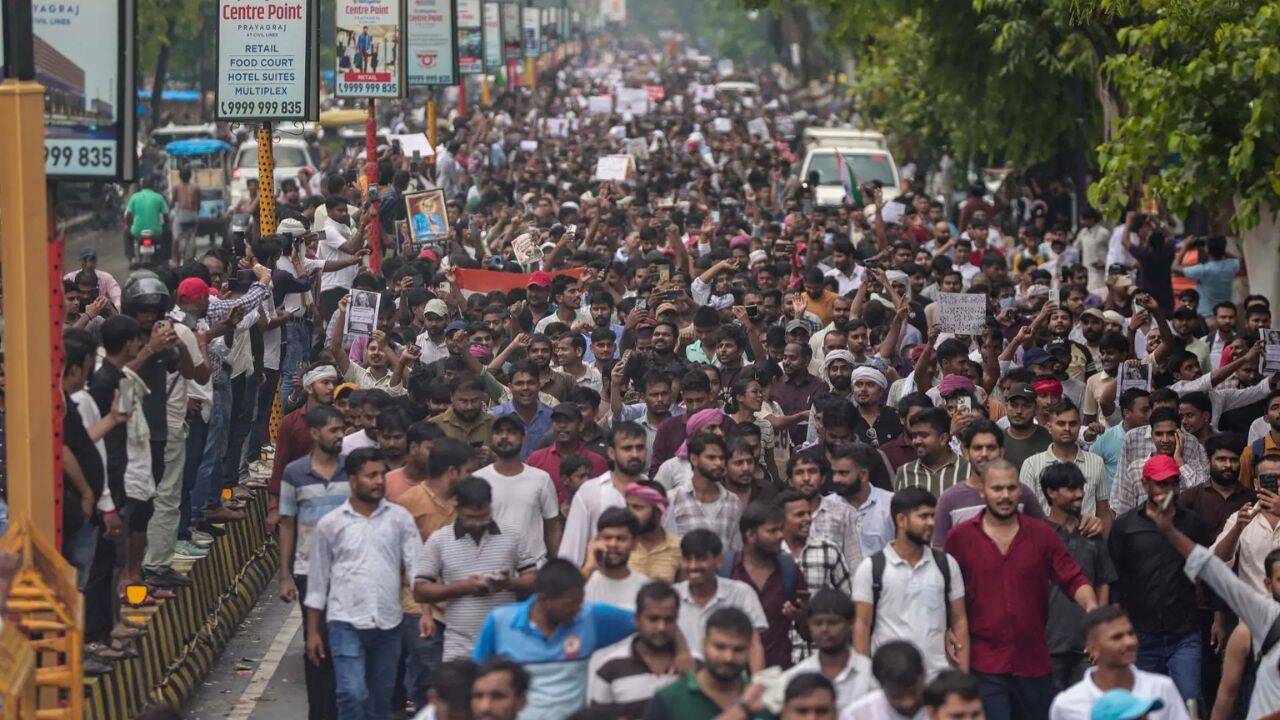
Bengaluru: In May 2026, the Chief Justice of India made a derogatory, insulting comment about unemployed young Indians being like cockroaches. Ten weeks later, a Union minister had resigned, thousands of protesters marched on Parliament, and a satirical party named after an insult was the biggest story in the country – not necessarily in that order!No one involved in that first comment could have predicted where it would end. The difference between how small these things start and how big they grow is the story of Indian student politics.In fact, this is the pattern that connects almost every major student movement since independence, given in the timeline accompanying this piece. The state government collapsed in Ahmedabad due to increase in hostel mess-fees. A poetry reading on the university lawn became a national debate about treason.A self-immolation outside a college in Delhi has reshaped a decade of caste politics. Indian students have time and again turned small, local sparks into fires. Not because the sparks were extraordinary in themselves, but because they landed on a reservoir of frustration, economic crisis, discrimination, corruption, feeling unheard, already ripe for the taking. Few groups have intervened in Indian public life so frequently, so unexpectedly, or with so little warning.
Why students and why so often?
India has one of the world’s youngest populations, and its colleges concentrate large numbers of young people in one place, with time and energy that older, overburdened protesters often can’t spare – but that doesn’t mean students are less at risk.The point is that their very future is at stake: the job market they are about to enter, the country they are about to inherit, the fairness of the exams or quotas or citizenship rules that will decide their next decade.
Campuses also come with built-in organizing infrastructure: hostels, unions, canteens, and, increasingly, group chats that can turn a local complaint into a national one in a matter of hours. Students also possess a kind of moral capital unlike any other in Indian public culture: the idea, inherited from the independence movement itself, that protesting youth are a sign of healthy conscience rather than a threat to the system.But structure alone does not explain the patterns. India has witnessed at least 13 significant movements since 1947 that have influenced Indian politics in different ways – from the Bengal food riots of 1959 to the Cockroach Movement. Look closely at five of them over seven decades, and a consistent anatomy emerges: the way these movements start, grow, inflame the situation, and either win, lose, or transform into something else.
5 Movements That Define Pattern
Gujarat, 1974, a government was toppled: In December 1973, students of Ahmedabad Engineering College demanded a 20% increase in hostel mess fees. The strike, sparked by rising food prices and allegations of corruption against the state Chief Minister, took the form of the Navnirman Andolan within a few weeks. Curfew imposed in 44 towns; Army was deployed.Facing continued pressure, Chief Minister Chimanbhai Patel resigned in February 1974, and when the assembly was not dissolved on its own, fresh elections were called due to veteran leader Morarji Desai’s hunger strike and continued student pressure. It is the only example in the history of independent India of an elected government being toppled by a sustained public movement – and by many accounts, it directly inspired Jayaprakash Narayan (JP)’s much larger Bihar movement a few weeks later, which changed the political climate that led to both the 1975 Emergency and the Congress’s historic 1977 defeat.Assam, 1979-85, became a war of attrition for 6 years: After apparent non-citizens appeared in the voter list, the All Assam Students Union launched a movement demanding detection and deportation of illegal immigrants. What followed is one of the longest-running student-led movements in Indian history: blockades, election boycotts, and a period of horrific ethnic violence, including the 1983 Nellie massacre, which is estimated to have resulted in a total of more than 850 deaths.This ended with the Assam Accord of 1985, which set an end date for citizenship claims and promised cultural protection measures that are only partially fulfilled even today. AASU leaders transformed the movement into a political party, the Assam Gana Parishad, and subsequently won the state elections.
Delhi and Bihar, 1990, turned a policy battle into public self-immolation: When the government moved to implement Mandal Commission’s 27% OBC quota in central jobs, upper caste students across North India started protesting. On September 19, 1990, Rajeev Goswami, a 19-year-old Delhi University student, set himself on fire outside his college; He survived severe burns but never fully recovered. His act sparked a wave of copycat self-immolation attempts across the country. The quota was implemented anyway, and VP Singh’s government fell within a few months for reasons beyond Mandal alone – proof that a movement can dominate the national imagination for years without overturning the policy that instigated it.Delhi, 2019-20 showed how quickly state forces can turn local protests into national protests: The student-led protests against the Citizenship Amendment Act spread from Jamia Millia Islamia to campuses across the country, but the defining moment came on the night of December 15, 2019, when Delhi Police entered the campus, including Jamia’s library, and used batons and tear gas on the students inside. That one raid, captured on phone camera, played a more significant role in nationalizing the anti-CAA movement than months of organizing. The law remained on the statute books and was later notified, even as the protests fundamentally reshaped the national debate.Delhi, 2026, moved faster than any of the above: A dismissive comment about unemployed youth being like “cockroaches” was turned into satire by a strategist who founded the Cockroach Janata Party – a parody of the ruling party’s name with an AI-generated mascot. Inspired by anger over leaked entrance exams and nearly 40% graduate unemployment, it grew from an online joke to hundreds of thousands of members in a matter of weeks. On July 20, 2026, about 20,000 protesters tried to march on the Parliament; The police used tear gas and batons, injuring about 180 people.Instead of retreating, the movement camped at Jantar Mantar and spread to a dozen cities. On 25 July, Education Minister Dharmendra Pradhan resigned – the main demands were met in about ten weeks, a fraction of the time it took earlier movements to win anything.
8 and those who shaped the pattern
The five above are the most obvious cases, but the other eight matter equally.Bengal, 1959, gave independent India the first major student movementThere had already been other student protests in places like Travancore and Hyderabad – when a famine-level food crisis and police firing at a mass rally drew students into the streets along with workers and farmers – establishing, for the first time, that such politics were legitimate in the new republic.Madras, 1965, is the clearest victory in this entire list: Student-led protests against the imposition of Hindi as the sole official language ultimately led the government to guarantee that English would continue indefinitely, and permanently reshaped Tamil Nadu politics around the DMK.Telangana, 1969-70Decades before statehood in 2014, students were mobilized about regional neglect and job inequities – a reminder that some of these movements take generations to pay off, if they ever do.Bihar, 1974-75is where JP’s “Total Revolution” transformed the student movement into a national coalition against corruption and unemployment; When Indira Gandhi responded by declaring Emergency in 1975, students – opposition parties, socialists, RSS cadres, trade unions also working from the underground – were among the groups that kept organized dissent alive underground until elections were held in 1977.Delhi and Mumbai, 2006Medical and engineering students protested against the expansion of OBC quota in central higher-education institutions. The courts upheld most of the provisions of the policy in 2008, making it a direct sequel to the 1990 argument, fought with less violence but the same underlying tensions.Delhi, 2012was not organized by any student union – it was a largely leaderless, student-heavy public outburst after the gang rape and murder of a young physiotherapy student (the Nirbhaya case), and here was one of the rare cases that led to rapid legislative change: the 2013 criminal law was reformed to toughen the punishment for rape.Pune, 2015Small in scale but long in duration: FTII students went on strike for 139 days over the appointment of a president, whom they saw as a political choice, keeping alive a broader argument about political interference in public institutions, even if the appointment itself was valid.Hyderabad and Delhi, 2016Two separate shocks in one year: The suicide of Dalit scholar Rohith Vemula following his suspension amid political pressure has reignited a national level discussion on caste discrimination on campus. A few weeks later, the arrest of JNU Students Union president Kanhaiya Kumar on sedition charges following an event on campus turned “anti-national” speech into one of the most defining and most polarizing arguments of the decade.
Anatomy: what do these activities share
Four patterns are repeated in all thirteen movements above, not just the five examined in depth.Small trigger, big fuse: As argued in the opening of this piece, the size of the spark has never predicted the size of the fire. This goes to show how much pre-existing frustration was already sitting there, waiting for something to flare up.
The state response usually determines the trajectory: In case after case, the decisive escalation was not the original complaint but the visible use of force against students: police firing in Calcutta in 1959 and Madurai in 1965, the raid on Jamia Library in 2019, the use of tear gas at Jantar Mantar in 2026. Violence against students, especially once caught on camera, has repeatedly turned local protests into national protests and the state’s own response into the story.Self-sacrifice is a typical Indian performance: Self-immolation recurs throughout history, most notably in the 1990s, as a form of protest with few real parallels in student movements in other democracies – an indication of both the intensity of the emotions involved and a media culture in which the extreme act of one person can change public opinion faster than a rally of thousands of people.Success is rare, and usually narrow: Of the above 13 movements, only Navnirman explicitly overthrew a government. A handful won specific, definitive concessions – language guarantees in 1965, rape-law reforms in 2013, the premier’s resignation in 2026. Mandal, the JNU sedition case and several other cases, including the anti-CAA protests, ended without overturning the underlying policy at all, even though they reshaped the public debate for years.
Share your thoughts in the comments
be respectful · TOI Community Guidelines
The honest lesson of seventy years of student politics is that these movements are far better at forcing a national conversation or costing an official his job than at overturning the government’s core commitments. What has changed is speed, not size. In 1974 and 1990, it took months or years for a local complaint to be taken to a national level by hostel meetings and cyclostyled pamphlets.In 2026, it took ten weeks for it to be carried by a meme and a mascot. The grammar is the same either way: a complaint, a trigger, a confrontation with the state, and an outcome evaluated based on whether it led to a resignation, a repealed law, or just a memory.


