



One of the enduring memories of the Mamata Banerjee era in West Bengal will be the elaborate Durga Puja carnival, where handpicked baro pujos (marquee pujas) would parade along Red Road with tableaux before the CM and other dignitaries in an almost Republic Day-esque procession. It would often end with Mamata Banerjee doing an impromptu jig with the crème de la crème of the Bengali film industry.The carnival has been scrapped. Instead, a pre-Puja event will be held at the iconic Eden Gardens on Mahalaya, October 10, which Prime Minister Narendra Modi is expected to attend. These and many other changes are expected as West Bengal counts down to the homecoming of the Goddess.This year marks a significant break in Bengal’s politics. The BJP government took office on May 9, making this its first Durga Puja in power in the state. And some changes are already in motion. Beyond the cosmetic, is Bengal’s intrinsic style of celebrating Durga Puja going to change?The number of pujas continues to grow. As of September 24, 2,318 Durga Pujas had already registered on Kolkata’s Sahaj single-window permission portal, including 270 new applicants, with more applications still expected. In 2025, the final tally of 2,936 applications was the highest ever. Across Bengal, the state power department expects the number of community pujas to cross 65,000 this year, an estimate based partly on demand for temporary electricity connections.
Durga Puja Carnival-has been scrapped
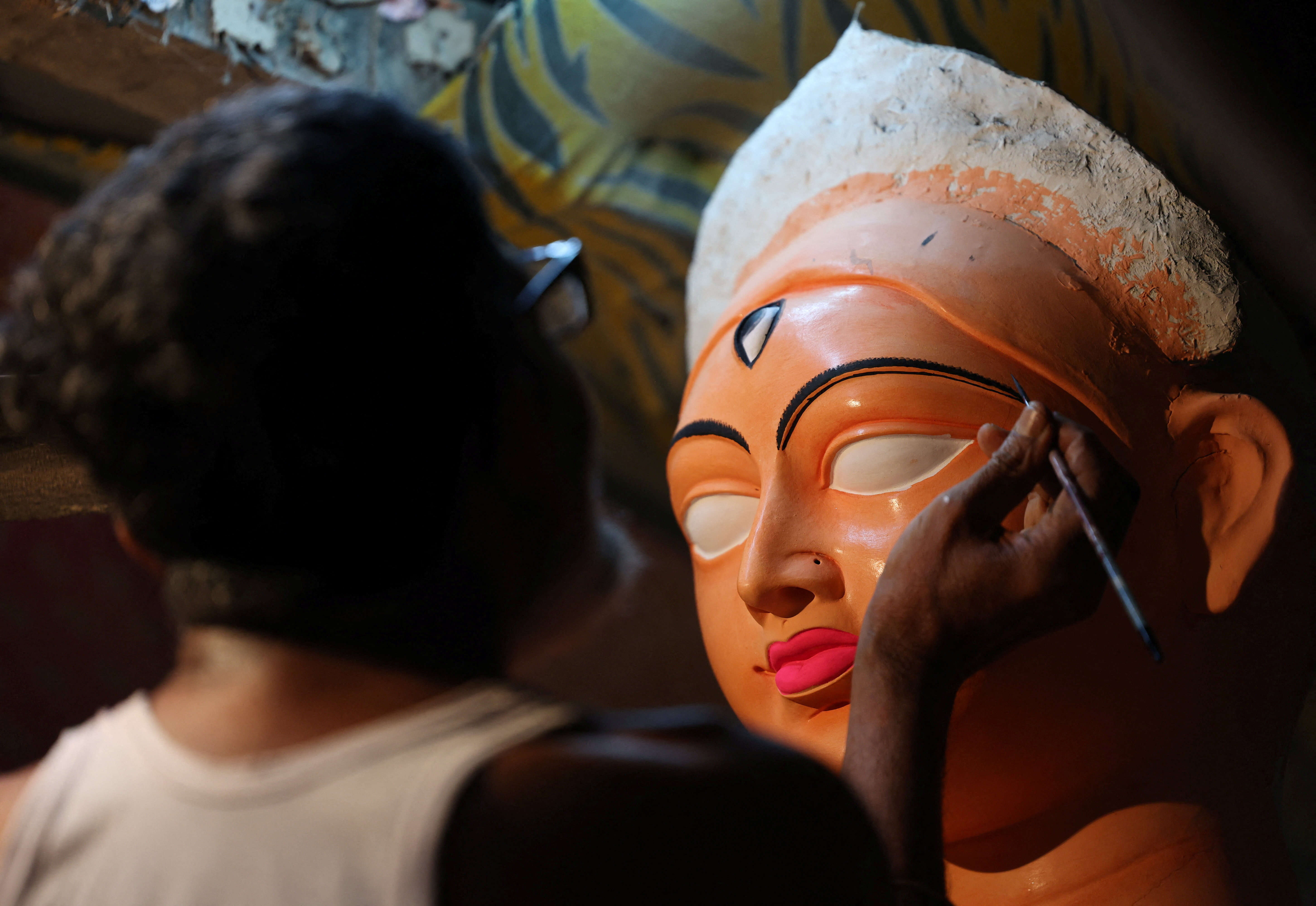
The barowari, or community-puja, tradition in Bengal is generally traced to late-18th-century Guptipara, although historians differ over the precise year and even whether the earliest community celebration there was Durga Puja or Jagaddhatri Puja. The word barowari is generally traced to baro yaar, or “twelve friends”. From the patronage of zamindars to that of influential political leaders, Durga Puja’s format has constantly changed, though it remains the cornerstone of Bengal’s annual cultural calendar.From ek-chalar thakur, where the divine family is presented within a single frame, to multi-part installations; from sabeki pratima, or traditional-style idols, to theme pujas; from sholar saaj to idols made from unconventional materials, creative people have continually found new ways to express their love and reverence for Goddess Durga.In the run-up to Mahalaya, Kumartuli, north Kolkata’s famous idol-making quarter, draws growing crowds of photographers, selfie-seekers and curious visitors into its narrow lanes. The adjoining Kumartuli Ghat is now adding another attraction. A Rs 10-crore redevelopment of a 300-metre stretch of the Hooghly riverfront, with viewing areas, walkways and improved public facilities, is expected to add to the draw.
Change in Durga Puja patronage
The most visible change this year is in the patronage of Durga Pujas. For years, the names of influential Trinamool leaders were virtually interchangeable with those of Kolkata’s marquee pujas. There was Sujit Bose’s Sreebhumi, Arup Biswas’s Suruchi, Firhad Hakim’s Chetla Agrani and Partha Chatterjee’s Naktala Udayan Sangha, among others.Along with these, many up-and-coming political leaders ensured that relatively unknown Durga pandals shot to fame with innovative themes. Often, hosting a large-scale Durga Puja became a proxy for growing political clout.That competition for spectacle and social ownership, however, long predates contemporary party politics. Kaliprasanna Sinha’s 19th-century Hutom Pyanchar Naksha used Durga Puja to lampoon Calcutta’s babu culture, its display, extravagance and social pretensions.At Sreebhumi Sporting Club, the extravaganza that became synonymous with former Trinamool minister Sujit Bose is being prepared by a new committee. BJP leader Kanak Debnath has become president, with the organisers promising to retain the puja’s grandeur while ending prolonged road blockades.
Sreebhumi Puja in 2025
At Suruchi Sangha, for years associated with Arup Biswas and his brother Swarup, BJP MLA Sourav Sikdar is now secretary. Suruchi’s new committee has replaced the Biswas brothers, although the transition was accompanied by protests from residents. At Tala Prattoy, which has been delivering extremely eye-catching themes over the last few years, much of the previous organising set-up has changed, with Sushanta Shibani Pal handling this year’s theme.The organisational change is extending beyond individual clubs. A new statewide coordination platform, Paschim Banga Durga Puja Samannay Samiti, or West Bengal Durga Puja Coordination Committee, is taking shape, with Kartik Maharaj as chairman and BJP MLA Rudranil Ghosh as chief adviser. It could emerge as an alternative pole to the established Forum for Durgotsab, which represents hundreds of committees.The churn has reached venues old and new. Known for its elaborate Christmas and New Year celebrations, Park Street will host a Durga Puja at Allen Park for the first time this year. Without missing a beat, Kolkata Sanatani Sangha, fronted by BJP leader Shankudeb Panda, will be organising it.At Mohammad Ali Park, competing committees put up banners under different names after BJP councillor Meena Devi Purohit proposed renaming the historic venue Mahabali Park. The iconic Bagbazar Puja, meanwhile, landed in trouble over a deadlocked committee election before the courts sorted it out.The financial machinery behind Durga Puja is also being recalibrated. The Mamata Banerjee government introduced annual assistance to puja committees at Rs 10,000 in 2018 and increased it over the years to Rs 1.1 lakh in 2025. The new BJP government has announced Rs 1 lakh for 2026, while chief minister Suvendu Adhikari has appealed to big-budget organisers to leave the assistance for smaller celebrations that need it.During TMC rule, BJP leader Sajal Ghosh’s Santosh Mitra Square was something of a ‘rebel’ puja, refusing to take grants. With power having changed hands and TMC virtually disintegrating, there are no such rebel pujas this time, at least publicly.Several prominent committees have agreed to forgo the grant, in line with the government’s appeal. The BJP government has also asked electricity suppliers to provide free power to organisers; under the previous government, the waiver in 2025 was 80%.In Birbhum, BJP district president Uday Shankar Banerjee told puja committees that clubs taking the 2026 government grant must display the chief minister’s photograph or face action, a claim promptly shot down by minister Dilip Ghosh.
Navratri tradition in Durga Puja?
It is perhaps on food that the focus will be most intense.In late August, Swami Nirgunananda, a member of the VHP’s central advisory council, suggested that non-vegetarian food should be kept away from the immediate puja space, while acknowledging that Bengal’s Durga Puja has never been exclusively vegetarian. VHP leaders subsequently clarified that there was no official or binding directive banning non-vegetarian food during Durga Puja.Days later, religious preacher Dhirendra Krishna Shastri, popularly known as Bageshwar Baba, went considerably further. He criticised the consumption of non-vegetarian food during Durga Puja, describing those who did so as pakhandis, or hypocrites.The remarks provoked criticism, including from within the BJP. State party president Samik Bhattacharya defended Bengal’s food traditions, while Adhikari subsequently visited Kalighat temple and consumed traditional prasad that included fried fish, fish head and basanti pulao. At Suruchi Sangha, where BJP MLA Sourav Sikdar is now secretary, organisers have said mutton and hilsa will continue to be served at the Maha Navami feast. Many housing societies where community Durga Pujas take place have also affirmed that their Puja feasts aren’t going to change and will remain largely non-vegetarian, barring Maha Ashtami.In large parts of north India, abstaining from meat during Navratri is commonplace. Critics of the BJP have expressed concern that such a food culture could gradually be pushed on Bengal. There is no evidence of any government plan to impose such a restriction. But the effect could be subtler than a formal ban.Some organisers are already drawing a firmer boundary around the immediate sacred space. Thakurpukur SB Park and Chaltabagan have announced restrictions on visitors entering while eating, while the new Allen Park puja will have no food stalls inside the park, TOI has reported previously.There is a perception that, at many pandals, egg-roll stalls and other non-vegetarian food outlets will be stationed farther away from the main arena where the Goddess will be placed.
To theme or not to?
Theme pujas have not been barred, but organisers have been asked to ensure that idols and themes do not hurt religious sentiments or undermine what the new government describes as Sanatani traditions. That has prompted some artists and organisers to tread more cautiously.However, social and experimental subjects continue this year too, including themes around care workers, gender identity and ecology. What is changing is the political vocabulary surrounding them. At the same time, several high-profile pujas this year are invoking patriotism, nationalism and Hindu cultural identity.There is no official census separating theme pujas from traditional ones.Santosh Mitra Square, whose committee is headed by BJP MLA Sajal Ghosh, has chosen Vande Mataram. New Town Sanatani Durga Puja, whose leadership includes chief ministerial adviser Subrata Gupta and Kartik Maharaj, is exploring what its organisers describe as the relationship between ancient Indian traditions and modern science.
Santosh Mitra Square in 2025 showing Operation Sindoor
The use of Goddess Durga as a political or nationalist metaphor is hardly new. In Bankimchandra Chattopadhyay’s Amar Durgotsav (My Durga Puja), included in Kamalakanter Daptar, an opium-addled Kamalakanta looks at the Durga image on Saptami and eventually sees in her Bengal itself (Banga Janani, Mother Bengal), invoking the Goddess as an image of collective strength and awakening.Nazrul would later take the idea in another direction. In his Durga and Agomoni compositions, the rebel poet repeatedly invoked the Goddess as Shakti, or living power, rather than merely an image of clay. His 1922 poem Anandamoyeer Agamane used Durga’s arrival as an anti-colonial metaphor so explicitly that the British prosecuted him for sedition.The VHP’s Nirgunananda, though, has argued for a more explicitly religious ownership of the festival. At an August meeting with Puja organisers, he rejected the formulation that “religion belongs to individuals, but festivals belong to everyone”, arguing instead that festivals primarily belong to followers of the faith, while people of other religions were welcome to visit.That marks a clear difference in outlook, which may well become one of the faultlines around Bengal’s Durga Puja celebrations.
‘Sharadotsav’ coinage contested
Pandal-hopping has also traditionally been an easy way to get a crash course in political history.The Left Front’s stalls, where the para-r communist kaku would be stationed selling books on Markshiyo Darshan, or Marxist philosophy, were hard to miss. Seeing them, the TMC also started its Jago Bangla stalls, though Didi, a skilled politician, never quite got the stamp of approval from Bengalis for her literary exploits.This year, though, the Left may face problems putting up some of those stalls.The name Sharadotsav, synonymous with Durga Puja, is facing questions. Chief minister Suvendu Adhikari has asked committees not to accommodate CPI(M) bookstalls that describe the festival as “Sharadotsav” instead of “Durga Puja”, arguing that the terminology dilutes its religious identity.Interestingly, Rabindranath Tagore wrote Sharadotsav, a play celebrating the autumn season, way back in 1908, a point also raised by Left leaders in response to the controversy. A puja committee at Kamardanga in Tangra has gone further, announcing that it will not allow stalls run by CPI(M), DYFI, SUCI or other Left-wing organisations at its celebration. The committee has appealed to other organisers to follow suit, while CPI(M) has criticised the move.
How the calendar is changing
The Red Road immersion carnival, first held under Mamata Banerjee’s government in 2016, has been discontinued. In its place comes a grand Mahalaya celebration at Eden Gardens on October 10, 2026, one week before Maha Shashthi on October 17. The programme is expected to feature traditional performers, thousands of dhakis, fireworks and a drone show. Prime Minister Narendra Modi is expected to attend and virtually inaugurate prominent Kolkata pujas from the programme. The Eden Gardens presentation aims to recreate important events and rituals associated with Durga Puja.Mahalaya holds a very special significance. Beyond tarpan, the ritual offering to one’s ancestors, Birendra Krishna Bhadra’s recitation in the Mahishasuramardini radio programme, which became associated with Mahalaya from the 1930s, has itself become a ritual. Hosting such a gala event on that day gives the new government a prominent ceremonial role at the opening of Bengal’s Puja season.
Tarpan in Mahalaya
There are changes for ordinary pandal-hoppers too. The new government has said Puja pandals will not be allowed to be inaugurated before Mahalaya. Maha Ashtami will be a dry day, with liquor sales prohibited. DJs have been banned during Puja celebrations and immersion processions, while organisers have been instructed to avoid prolonged road blockades and complete immersions within the prescribed period.Even the appearance of Kolkata Police’s crowd-management volunteers is set to change, with police floating a tender for orange T-shirts and caps to replace the familiar white-and-blue attire.There is not much clarity yet about how active the TMC will be during Durga Puja. But one thing Kolkata will surely be revisiting through reels is Mamata Banerjee’s one-liners and gestures, from her suggestion that kash, the tall white kans grass associated with the Bengali autumn, could be used as stuffing for pillows to her symbolic chokhu daan.
File Image of Mamata Banerjee doing chokhu daan
What no government can legislate
So will Bengal’s intrinsic style of celebrating Puja change? The answer may lie in how varied that style has always been.There has never been one compulsory Bengali Puja menu, or even one compulsory visual grammar. Mahendranath Datta, the younger brother of Swami Vivekananda, recorded striking differences between Durga images in Shakta and Vaishnava households. In Shakta homes, he wrote, Durga’s lion had the conventional lion’s face; in Gosain or Vaishnava homes, the lion had a horse-like face, apparently marking a distinction between the two traditions. On food too, practices differed. At Brahmin homes, guests could be served rice, five vegetable dishes, curd and payesh; in Shakta Brahmin households, he noted, fish was also permitted, while Kayastha homes served luchi.The traditions that have survived in Bengal’s old family pujas are equally difficult to squeeze into a single dietary rule. The Sabarna Roy Chowdhury family continues to offer katla as Nabami bhog.
Share your thoughts in the comments
Be respectful · TOI community guidelines
At Chorbagan Chatterjee Bari, fish is offered during the Puja days. At the Janbazar home of Rani Rashmoni’s descendants, on the other hand, the Goddess receives vegetarian bhog even as non-vegetarian food is served to guests, reported TOI previously.There is no quick primer on how to be Sanatani across Bengal’s myriad Durga Puja traditions. The pandals may change hands, and the colour of uniforms may change. But beneath the contest for ownership lies a diversity of practice too old and too deep-rooted.Perhaps the more things change, the more they stay the same.


