



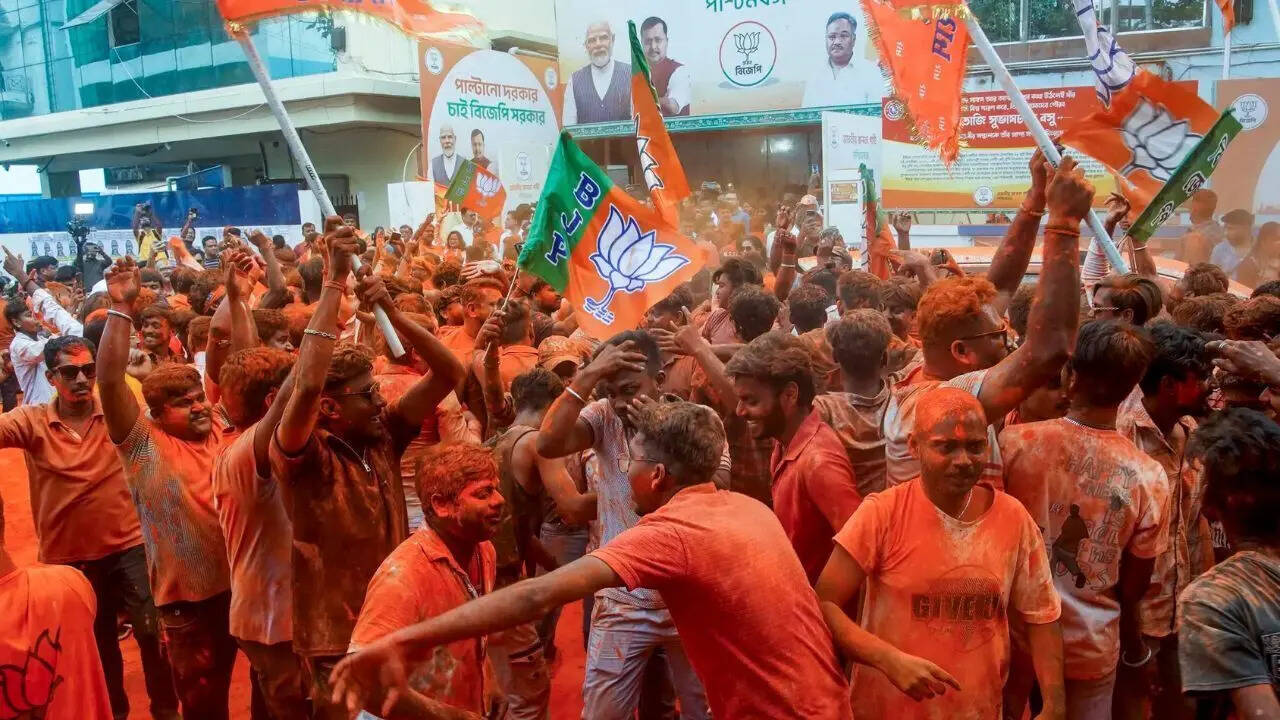
New Delhi: On May 4, Bengal felt the pulse of its politics and what seemed inevitable – poriborton.The decision of the 2026 Bengal Assembly was not just decisive – it was transformative. The once weak BJP transformed into an unstoppable force, crossing the 200 mark and capturing 207 seats with 45.84% vote share.Trinamool Congress (TMC), which once dominated the state with 225 seats, was reduced to double digits and its vote share dropped to 40.8 percent. The scale of this reversal tells a deeper story than numbers alone. This was not a narrow swing or a fractured mandate, as the decision resonated loudly across Bengal, echoing the deep-rooted anti-incumbency wave against the Mamata regime.The signal was unmistakable when more than 92.5 percent of Bengal’s voters came to vote, a level of participation never seen since independence. Such increases in turnout rarely occur without a powerful undercurrent of emotion and feeling.Nine out of 10 voters contesting against the 15-year-old incumbent could not be read as normal without serious misjudgment, especially when the government faced allegations of corruption, unemployment and, above all, the breakdown of law and order.The message was consistent with structural changes across regions, communities and classes from North Bengal to the industrial areas of Howrah and the urban agglomerations around Kolkata. Bengal and its bhadralok voted not just for Axis, but for one Shompurno Poriborton!
saffron wave in west bengal
a full reset
This outcome seemed inevitable for reasons that go far below the final figures, where layers of discontent, recalibration and political strategy are hidden that have been unfolding over the years.At the core of the decision was a powerful and deeply embedded anti-establishment sentiment. Fifteen years of TMC rule under the leadership of Mamata Banerjee has created fatigue in rural and urban Bengal. What started as a movement against the stagnation of the Left Front in 2011 had taken full form by 2026. Mamata Banerjee once represented disruption and hope. Over time, his rule became associated with a different terminology. Terms such as “cut money”, “syndicate control” and “bargaining” became shorthand for everyday governance failures.
There was a very tense atmosphere in and around the residence of West Bengal Chief Minister Mamata Banerjee in Kolkata on Monday, the day of counting of votes for the West Bengal Assembly elections. (ANI)
This was not just opposition rhetoric, it was a lived experience. Local syndicates were believed to control economic activities, from construction projects to small home repairs. For many citizens, governance appears to be outsourced to local intermediaries, considered stooges of Trinamool, rather than being directed by the state. The gap between Mamata’s image as a grassroots leader and the functioning of her party machinery continued to widen. That separation proved politically fatal.
deep stains of corruption
Corruption scandals played an important role in strengthening this sentiment as Bengal had already seen controversies ranging from Saradha to Narada, but the teacher recruitment scam struck a different chord. With the Supreme Court canceling over 25,000 teaching and non-teaching appointments, corruption turned from an abstract allegation into a personal crisis for thousands of families. In a state where government jobs hold immense social importance, this scam is a symbol of the breakdown of trust.
Vote share in West Bengal elections
Widespread concerns arose about corruption as well as law and order. The rape and murder of a trainee doctor at RG Kar Medical College in 2024 became a turning point in the public psyche. The outrage that followed was not limited to Kolkata, as it echoed every Indian and made its way to social media feeds, especially among women voters, who had long been the backbone of Trinamool’s electoral strength. The perception that the government’s response lacked urgency or empathy deepened the damage. For a leadership that built its legitimacy on emotional connections, this rupture was profound.
women safety
Women voters turned out in large numbers, even more than men. However, the turnout did not translate into votes for TMC. Welfare schemes like Lakshmi Bhandar and Kanyashree had once enjoyed unwavering support from Mamata, but by 2026, that support had become conditional. Women voters began to weigh financial support as well as security, employment, and long-term prospects. The BJP recognized this change early and responded with a well-thought-out strategy.
plans and promises
It promised more cash transfers, effectively doubling existing benefits, as well as bringing to the fore issues of safety and dignity. The result was not a complete realignment but a significant erosion of Trinamool’s gains.
‘Chakri’ crisis
Economic concerns formed another pillar of the BJP’s phenomenal performance in the non-Hindi speaking state. The long story of de-industrialization in Bengal had reached a climax in the public imagination. Migration became a powerful symbol of failure. Families spoke openly about children leaving the state for work and moving to other areas, including BJP-ruled areas. It wasn’t just that Chakras (Jobs). It was about dignity and aspiration. The promise of industrial revival and job creation gave the BJP a credible economic plank, even if it remained aspirational.
How did the regions vote?
The impact of this narrative was especially visible in industrial areas like Barrackpore and Howrah. These areas, once dominated by labor politics, had experienced decades of decline. Factories closed, jobs disappeared, and political networks shifted toward control of local economies rather than production. Voters in these areas responded to the BJP’s promise of disruption. The party’s success here was not just electoral. It symbolized a broader shift from nostalgia to impatience.
Counter-unification of Hindus
Identity politics played a huge role in paving the way for the entry of Hindutva politics in Bengal. The consolidation of Hindu votes cutting across caste and linguistic lines provided the BJP with a stable electoral base. Allegations of appeasement by the ruling party, whether purely grassroots or politically exaggerated, created fertile ground for this solidarity. The BJP’s message was clear and consistent as it positioned itself as a party that would restore balance, enforce the rule of law and address concerns about illegal immigration and demographic change.
saffron shift
However, the party did not rely solely on polarization but complemented this narrative with a conscious effort to localize its appeal. The external tag that caused it was systematically destroyed in 2021 with campaigns invoking Bengali culture, from contexts mother black Use of local idioms and symbols. Leaders clung to everyday cultural markers to signal familiarity rather than distance, whether through fish, jhalmudi or festivals. This recalibration helped the BJP establish itself in the socio-cultural landscape of Bengal.
tireless campaign
Prime Minister Narendra Modi And Union Home Minister Amit Shah, who stayed in the state for 15 days, maintained a constant presence on the ground, adding another layer to the tireless campaign by the local BJP cadre, which looked weak in large parts of Bengal, especially rural Bengal.
110 days of campaign
His message evolved from broad ideological appeals to highly local issues. The call for Poriborton became both a slogan and a sentiment that resonated among voters already eager for change.
special intensive review
The role of institutional factors cannot be ignored as the revision of electoral rolls under the SIR process has become a contentious issue. While Trinamool framed it as a targeted boycott of its voter base, the BJP argued that it was a necessary reform in the enlarged lists. No matter where the truth lay, the result was clear. The issue did not translate into political gains for the ruling party. Instead, improved voting conditions and the presence of central forces boosted voter confidence who might otherwise have hesitated.
Strike rate in 2026 Bengal elections
The BJP’s targeted outreach among its voter base further strengthened its position as the Matua community, an important electoral block, remains largely aligned with the party despite concerns over citizenship and voter list amendments. This continuity ensured that the key constituencies of North 24 Parganas and Nadia remained in the BJP fold.Urban and suburban voters also emerged as decisive factors. The decline of Trinamool’s dominance in the Kolkata belt and surrounding districts was the turning point. These areas had historically provided the margin needed for victory. Their inclination towards BJP reflects a convergence of factors. Economic discontent, concerns about governance, and a desire for change combine to bring about decisive change.
perception war
What tilted this election decisively towards the BJP was Mamata Banerjee’s failure to decide her story. Instead, the Chief Minister played on his opponent’s ground and reacted to his attacks. In the age of social media, such perceptual damage may prove irreparable.The most notable aspect of the election was the BJP’s ability to craft a multilayered narrative that addressed different constituencies simultaneously.
Prime Minister Narendra Modi arrived at the BJP headquarters in New Delhi on Monday to celebrate the victory with BJP supporters after the party’s massive victory in the West Bengal, Assam and Puducherry Assembly elections 2026. BJP national president Nitin Nabin was also present.
For welfare beneficiaries, it offered higher financial assistance. For the unemployed, it promised jobs and industrial revival. For women, it highlighted safety and respect. For Hindu voters, it emphasized identity and security. This comprehensive approach created an alliance that was difficult for TMC to counter.In contrast, the ruling party struggled to adapt. Its welfare model, once innovative, had become predictable. Its narrative of Bengali identity, which had effectively countered the BJP in earlier elections, has lost some of its resonance in the face of economic and governance concerns. Reform efforts, such as stipends for priests or increased support for cultural programs, appeared reactive rather than strategic.Gratitude-based politics gave rise to transactional expectations as beneficiaries of welfare schemes began to see themselves as consumers of political offerings rather than loyal supporters, and that shift made them more open to alternatives that promised better returns.Migration, industrial decline, corruption, security concerns, and identity politics all combined to create a political environment in which change became not only desirable but inevitable. BJP did not create this situation. It identified and exploited them more effectively than its competitor.Even events during the campaign indicated the direction of the decision. Local conflicts, changing voting patterns, and the changing tone of public discussion suggested the ground was changing. By the time the votes were cast, momentum had moved decisively in one direction.The phrase “carved in stone” may sound fatalistic, but in the context of Bengal’s 2026 decision, it reflects a reality that has unfolded over the years. The BJP’s victory was not just the result of a successful campaign, but of accumulated grievances, politically prudent adaptation and changing consciousness among the voters.By the time the votes were cast, there was no doubt about the result. As the results showed, the signs were visible in anger, in silence, and in unprecedented turnout. Bengal did not wake up on the day of counting to choose change, it had chosen this option long ago. The results merely confirmed what was already “set in stone”, May the 4th be Poriborton!


