



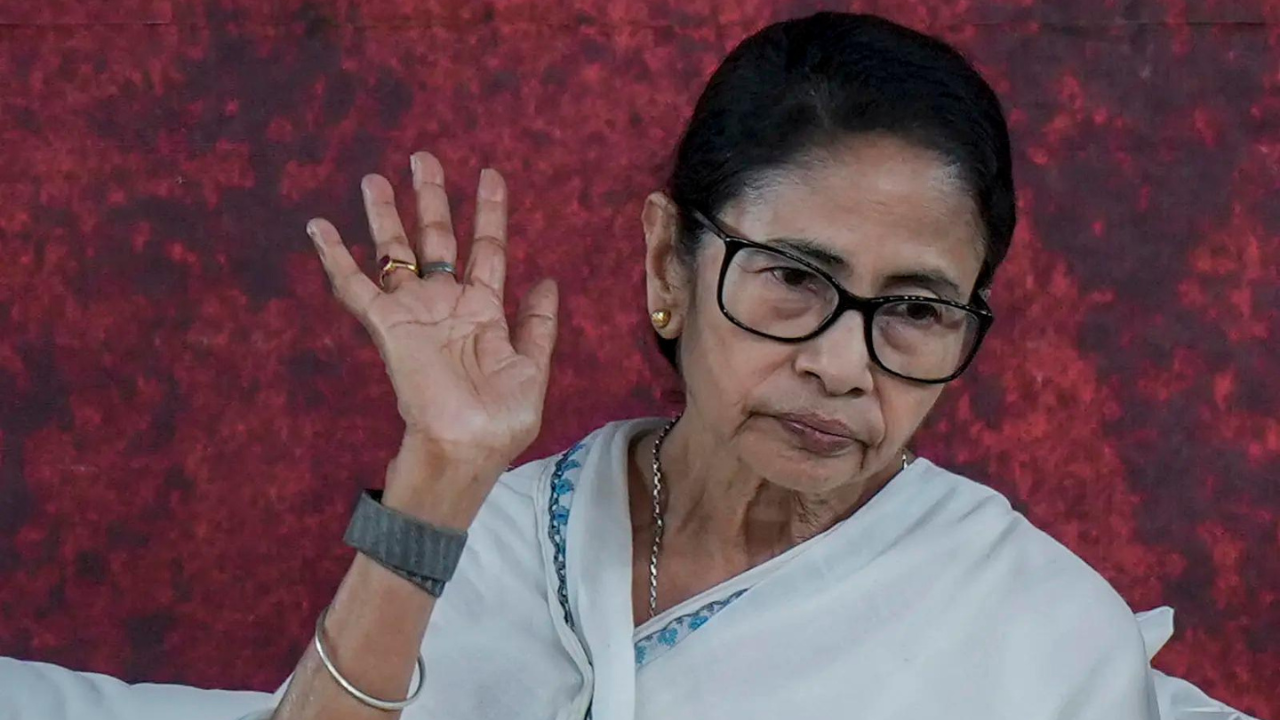
New Delhi: Trinamool Congress It is looking at what could be the biggest breakdown in its 28-year history. Just weeks after suffering a crushing defeat in West Bengal, Mamata BanerjeeThe party now finds itself grappling with an all-out internal rebellion that threatens not only its influence in the state, but also the loss of power. NDA Easy proceedings in Parliament.The situation inside is evolving TMC This goes beyond the usual post-election allegations and counter-allegations. This has evolved into an open challenge to Mamata’s authority by a large section of leaders, who till recently were the backbone of the party’s parliamentary line-up.The immediate question before the political establishment is no longer whether the Trinamool Congress can survive the insurgency. The bigger question is whether the turmoil in Didi’s camp can give Prime Minister Narendra Modi’s NDA a big parliamentary gain and bring the ruling alliance closer to the politically crucial two-thirds majority mark in the Lok Sabha.For BJPThe stakes are huge.A strong NDA government will make it easier to deal with contentious legislative battles and push through reforms that remain politically difficult despite the alliance’s comfortable majority.Measures often associated with such ambitions include One Nation, One Election and a possible delimitation bill, which are expected to dominate the political debate in the monsoon session starting on July 21.The opposition put up a confident display with its ability to coordinate during the budget session, where the Indian faction managed to put pressure on the ruling party, and stop the Center from moving forward on the delimitation bill.A weak opposition and a strong NDA will change that equation significantly.
from bengal to delhi
The roots of the rebellion lie in the dramatic decision given by Bengal voters in May.For the first time in years, the aura of invincibility surrounding Mamata Banerjee took a major hit. Trinamool Congress, which had dominated Bengal politics for one and a half decade, saw a decline in its numbers.Yet the real blow came from elsewhere.As the counting progressed, the focus shifted to Mamata Banerjee’s political stronghold and Bhabanipur, the constituency most closely associated with her coming to power. However, by the evening it became clear that his former lieutenant turned arch rival Suvendu Adhikari had once again defeated him.Unlike last time in Nandigram, this time the defeat took place in Bhabanipur only.The party was shocked by this defeat. TMC’s tally dropped from 215 seats to just 80 in 2021, leaving the leadership struggling to deal with one of the most serious electoral setbacks in its history.Even before the dust settled, another crisis arose.
first signs of rebellion
The first signs of rebellion emerged when Ritabrata Banerjee openly claimed the post of leader of the opposition in the Bengal Assembly.The move triggered immediate disciplinary action.Abhishek Banerjee wasted no time in branding him a “traitor” and expelled him from the party. But this decision failed to stop the disagreement.Instead, the rebellion expanded.Ritabrata managed to unite around 50 MLAs, posing the first major challenge to Didi’s influence and power within the party after her election defeat.What initially appeared to be a state-level power struggle soon began to spread beyond Bengal.Anti-Didi sentiment gradually spread from Kolkata to Delhi.Soon, the focus shifted to TMC MPs.
MPs break ranks
The most dramatic development came when rebel leader Kakoli Ghosh Dastidar indicated that a large section of TMC MPs were ready to part ways with the leadership.The former women’s wing chief, who had recently resigned from her organizational post, emerged as the face of the parliamentary rebellion.According to the rebel camp, at least 20 of TMC’s 28 Lok Sabha MPs are supporting the move.If the claim holds true, the rebels would easily cross the two-thirds threshold required under anti-defection provisions.That number is politically important.Under anti-defection rules, a faction needs the support of at least two-thirds of the legislative party to be protected from disqualification.In case of TMC, 19 MPs will be enough.The rebels say they do not plan to formally join the BJP.Ghosh Dastidar said, “We will not join BJP. We will support NDA.”The announcement immediately turned the Bengal-centric political crisis into a national story.A letter reportedly signed by the rebel MPs was handed to the Speaker’s office, although no formal acknowledgment has yet been made public.Then the rebellion went into the open.
Benefit to NDA?
Soon after the letter came out, many rebel MPs gathered at the residence of Union Minister Bhupendra Yadav in Delhi.Bengal Chief Minister Suvendu Adhikari also met members of the rebel camp.These meetings took place on the same day when Mamata was urging the opposition parties to remain united against the BJP in the India Block meeting.Sources said he accused the BJP of actively trying to divide his party.The figures are worth a closer look for the NDA.The alliance currently enjoys a comfortable majority in the Lok Sabha, but falls short of the politically crucial two-thirds mark.The support of a large TMC breakaway faction could take the alliance beyond the 300-seat limit and provide additional comfort during the crucial legislative battle.The growth will also come on top of recent gains elsewhere.Just a few weeks ago, another opposition alliance, the Aam Aadmi Party, saw internal turmoil, which ultimately benefited the BJP in Parliament.However, the TMC rebellion will be on a completely different scale.
Didi camp hit back
The Mamata camp has rejected the claims of the rebels and accused them of serving the interests of the BJP.Party MP and Didi loyalist Kalyan Banerjee emerged as one of the strongest voices defending the leadership.Addressing a press conference on Tuesday, he accused the dissidents of betraying Mamata Banerjee and questioned whether they had enough numbers to survive the anti-defection probe.Calling him a “desperate” and a “traitor”, he alleged that the BJP was trying to weaken the TMC from within.In a sharp attack on BJP, Kalyan Banerjee declared, “You (BJP) have CM, ED, CBI and other powers, but I have ‘Maa, Mati, Manush’, my party, my party workers and the people of West Bengal.”The press conference revealed growing uneasiness within the party.For a leadership already reeling from electoral defeat, the prospect of a parliamentary split represents an even greater threat.
Kirti Azad’s challenge
Standing alongside Kalyan Banerjee was fellow MP and party colleague Kirti Azad, who gave an equally sharp message to the rebels.Questioning his political morality, he said, “Through Maa, Mati, Manush’s party, Trinamool Congress, with Didi’s blessings and Abhishek’s support and guidance, all our 29 MPs were elected. I want to ask these ‘traitors’… If you were facing problems and grievances, why did you express them only after the elections? You should have raised those concerns before the elections. Many allegations were made after the voting. Shubhendu Shekhar made allegations and then resigned. Whether those allegations were true or false is a different matter. But at least he demonstrated a sense of political morality. He resigned from the party to which he belonged, gave up the membership of Rajya Sabha under the symbol of that party and stepped down from the post.”Azad then directly challenged the “traitors”.If you also have political morality then resign and contest elections on BJP ticket. If you have even an ounce of self-respect, morality and propriety, stand up and openly declare that you are no longer with the Trinamool Congress.”He further warned that the party will continue to support its cadre in the constituencies represented by the rebel MPs.“And if Trinamool workers are attacked in your constituency, under the leadership of Kalyan (Banerjee) da, we will go there and stand with them, because we do not betray our own people.”Azad also argued that the party’s defeat was the result of a larger anti-TMC alliance.“And at a time when we were forced to lose, let me make it clear… we did not lose in Bengal on our own. We lost because of the collective effort of everyone coming together against us.”
rebellious disobedient
However, the rebel camp has shown no signs of backing down.Responding to the attacks of the leadership, Kakoli Ghosh Dastidar said in an insulting tone.“My head will be cut but it will not bow down… I have endured a lot… I did not come here after Mamata Banerjee became the Chief Minister in 2011; I have been fighting here for 40 years. And as I said, the words of such people have absolutely no impact on me.”He also attempted to present the rebellion as a movement motivated by broader national concerns.“We will know later what happens. For now, is it not enough that we want to work for Bengal, for the country and to keep India safe? This is an important issue. The issue of the nation is paramount for us.”
What next?
It remains to be seen whether the rebels can ultimately overcome legal hurdles and maintain their numbers.What is already clear is that the TMC is facing its most serious internal challenge since its formation in 1998.For Mamata, the fight is to retain control over the party she built from scratch and brought to power.For the rebels, this is a fight over the future direction of the organization.However, for the BJP and the NDA, the rebellion provides an opportunity for something else entirely.An opportunity to further weaken one of the country’s most influential opposition parties and move closer to parliamentary power, which could smooth the way for some of its biggest legislative ambitions.Bengal’s decision may have removed Mamata from power. The subsequent rebellion could reshape the numbers game in New Delhi.


