Thursday, October 1, 2026
Home Blog Page 1054

BCCI unveils India’s 2026-27 home fixtures: 22 matches across 17 cities | Cricket News

0
BCCI unveils India’s 2026-27 home fixtures: 22 matches across 17 cities | Cricket News


BCCI unveils India’s 2026-27 home fixtures: 22 matches across 17 cities
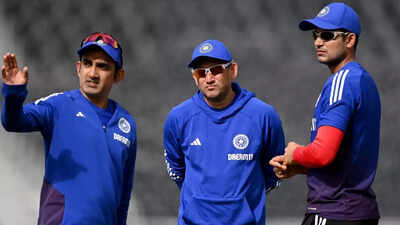
Gautam Gambhir, Ajit Agarkar and Shubman Gill (Getty Images)

NEW DELHI: The Board of Control for Cricket in India (BCCI) on Thursday announced the complete schedule for Team India’s international home season for 2026-27, unveiling a packed calendar featuring 22 matches across 17 cities.The upcoming season promises a wide-ranging contest with four visiting teams — West Indies, Sri Lanka, Zimbabwe and Australia — across formats, giving fans a chance to witness top-tier international cricket across the country.Go Beyond The Boundary with our YouTube channel. SUBSCRIBE NOW!West Indies tour kicks off action-packed seasonThe home season begins with the West Indies tour starting September 27, 2026. The series includes three ODIs followed by five T20Is. The ODI matches will be held in Trivandrum, Guwahati and New Chandigarh, before the T20I leg moves to Lucknow, Ranchi, Indore, Hyderabad and Bengaluru.

Watch

IPL 2026: Ishan Kishan steals the show at captains meet

Sri Lanka series in DecemberIndia will then host Sri Lanka in December 2026 for a white-ball series comprising three ODIs and three T20Is. Delhi, Bengaluru and Ahmedabad will stage the ODIs, while Rajkot, Cuttack and Pune will host the T20Is, ensuring a wide geographical spread for fans.Zimbabwe ODIs in new yearAt the start of 2027, Zimbabwe will tour India for a three-match ODI series in January. The matches are scheduled to take place in Kolkata, Hyderabad and Mumbai, marking the first leg of the new year’s international action.

Poll

What’s your favorite format of cricket to watch?

Border-Gavaskar Trophy headline attractionThe season will culminate with the marquee Border-Gavaskar Trophy, featuring a five-match Test series against Australia. The series begins on January 21, 2027, in Nagpur, before moving to Chennai, Guwahati, Ranchi and Ahmedabad.With a mix of white-ball and red-ball cricket, marquee rivalries and matches spread across 17 venues, the BCCI’s announcement sets the stage for a blockbuster home season.

Complete India’s 2026-27 home fixtures

WEST INDIES TOUR OF INDIA
Day & Date Time Match Venue
Sun 27-Sep-26 2:00 PM 1st ODI Trivandrum
Wed 30-Sep-26 2:00 PM 2nd ODI Guwahati
Sat 03-Oct-26 2:00 PM 3rd ODI New Chandigarh
Tue 06-Oct-26 7:00 PM 1st T20I Lucknow
Fri 09-Oct-26 7:00 PM 2nd T20I Ranchi
Sun 11-Oct-26 7:00 PM 3rd T20I Indore
Wed 14-Oct-26 7:00 PM 4th T20I Hyderabad
Sat 17-Oct-26 7:00 PM 5th T20I Bengaluru
SRI LANKA TOUR OF INDIA
Day & Date Time Match Venue
Sun 13-Dec-26 2:00 PM 1st ODI Delhi
Wed 16-Dec-26 2:00 PM 2nd ODI Bengaluru
Sat 19-Dec-26 2:00 PM 3rd ODI Ahmedabad
Tue 22-Dec-26 7:00 PM 1st T20I Rajkot
Thu 24-Dec-26 7:00 PM 2nd T20I Cuttack
Sun 27-Dec-26 7:00 PM 3rd T20I Pune
ZIMBABWE TOUR OF INDIA
Day & Date Time Match Venue
Sun 03-Jan-27 2:00 PM 1st ODI Kolkata
Wed 06-Jan-27 2:00 PM 2nd ODI Hyderabad
Sat 09-Jan-27 2:00 PM 3rd ODI Mumbai
AUSTRALIA TOUR OF INDIA
Day & Date (From) Time Match Venue
Thu 21-Jan-27 9:30 AM 1st Test Nagpur
Fri 29-Jan-27 9:30 AM 2nd Test Chennai
Thu 11-Feb-27 9:00 AM 3rd Test Guwahati
Fri 19-Feb-27 9:30 AM 4th Test Ranchi
Sat 27-Feb-27 9:30 AM 5th Test Ahmedabad


Ranveer-Deepika celebrate ‘Dhurandhar 2’ success

0
Ranveer-Deepika celebrate ‘Dhurandhar 2’ success


Ranveer Singh and Deepika Padukone celebrate ‘Dhurandhar: The Revenge’ Rs 1000 crore box office success with dosa shop date - PIC

Bollywood power couple Ranveer Singh and Deepika Padukone made a rare public appearance in the city on Thursday as the actor’s film, ‘Dhurandhar: The Revenge’, hit a major box office milestone by crossing the Rs 1000 crore mark globally.

Deepika Paduone and Ranveer Siingh spotted on dosa date

Maintaining a rather low profile, rocking a simple pair of jeans and a black tee, the couple twinned on their quiet day out about town. As per paparazzi footage, Ranveer and Deepika were seen enjoying a low-key date at a local restaurant, indulging on dosas.

Ranveer Singh and Deepika Padukone joined by father Jagjit Singh Bhavnani

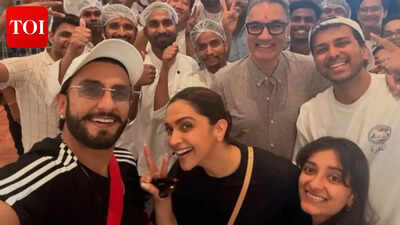
After their meal with Ranveer’s father Jagjit Singh Bhavnani, Deepika and Ranveer appeared rather cheerful as they obliged the hotel’s staff with a selfie. Photos doing the rounds online, see the couple all smiled as they strapped an arm around the restaurant’s team and posed for the click. The photo saw the entire restaurant’s staff, squeezing in enthusiastically for group pictures. After their visit to the eatery, the two were seen making a dash for their car before zooming off.

‘Dhurandhar: The Revenge’ box office success

‘Dhurandhar: The Revenge’ on the other hand, has been shattering box office records. The film entred the Rs 1000 crore club on Day 7, making it one of the fastest films in Indian box office history to hit this milestone in record time. Meanwhile, it is also in a league of its own, with reports indicating that the film will beat the ‘Dhurandhar’ lifetime collection in just a matter of days. The film is now gearing up for another record-breaking weekend ahead. ‘Dhurandhar 2’ has amassed a total worldwide haul of Rs 1,067.24 crore with an all-India gross estimated to be around Rs 805.32 crore and an overseas total of Rs 261.92 crore.


Mbappe nets for 10-man France in win against Brazil in World Cup warm-up | World Cup 2026 News

0
Mbappe nets for 10-man France in win against Brazil in World Cup warm-up | World Cup 2026 News


France beat Brazil 2-1 in a friendly in the United States, in what was a potential dress rehearsal for World Cup 2026 final.

France forward Kylian Mbappe showed no ill effects of his left knee injury when he broke free for a goal to give France an early lead on its way to a 2-1 victory over Brazil in a World Cup tuneup between two of the world’s top teams.

With a crowd of 66,215 heavily favouring Brazil, Mbappe and Hugo Ekitike gave France a 2-0 lead on Thursday on the same pitch where they will play their final group stage game of this summer’s World Cup, against Norway and Erling Haaland. Bremer cut the deficit to 2-1 in the 78th minute.

Recommended Stories

list of 4 itemsend of list

The friendly went off without any evident hiccups despite the simmering feud between the town of Foxborough and World Cup organisers over almost $8m in security costs. The sides reached an agreement two weeks ago in which the organising committee promised to make the payment in advance, and the town approved the necessary entertainment licence.

That was expected to be the last remaining obstacle to the world’s biggest sporting event arriving in this 20,000-person suburb tucked between Boston and Providence, Rhode Island, that swells to three times its size for New England Patriots games. To accommodate FIFA requirements, a grass field has replaced the artificial turf that had been used for the NFL’s Patriots and the New England Revolution of Major League Soccer.

The crowd was the second-largest to watch a football match at Gillette Stadium, behind only a 2007 friendly between Brazil and Mexico. It was speckled with fans in Brazilian yellow kits, with just a few French flags waving to celebrate Mbappe’s goal. (The media dining room was more neutral, with madeleines, macarons and eclairs alongside Brazilian brigadeiro, pudim and mousse de maracuja.)

Also in the house were Coach Joe Mazzulla and players from the NBA’s Boston Celtics, with forward Jayson Tatum taking part in the pregame coin toss alongside Massachusetts Governor Maura Healey.

A former Paris Saint-Germain and current Real Madrid star, Mbappe sprained his left knee in December but played through January before missing almost a month. He was used as a substitute in Real Madrid’s last two matches but started on Thursday.

Mbappe said on Monday that his injury was “truly behind me”. (Reports that said the team examined the wrong knee were false, Mbappe said at a news conference in Foxborough on Wednesday.)

And he showed it in the 32nd minute when Ousmane Dembele delivered a through ball that left no one between Mbappe and the goalkeeper. The 2018 World Cup champion and 2022 Golden Boot winner tapped it ahead once before chipping it over the keeper to make it 1-0.

France took a 2-0 lead in the 65th minute when Ekitike, Liverpool’s top scorer this season, converted on a pass from Michael Olise in the penalty area. Mbappe left for a substitute immediately afterwards.

After France’s Dayot Upamecano was sent off in the 55th minute for taking down a player with a clear path to the goal, a card that was upgraded from yellow to red on video review, Brazil cut the deficit to 2-1 when Bremer redirected a cross from Luiz Henrique past France keeper Mike Maignan.

The game also featured a mid-half “cooling break” that enabled players to rest and hydrate – even though the temperature in early spring New England was in the mid-60s (15 degrees Celsius).

After a heatwave during last year’s Club World Cup, FIFA announced that all games in the 2026 World Cup would include the break, regardless of the temperature on the pitch.

Should France and Brazil both win their groups at the World Cup, then the first time they can meet at the tournament will be in the final itself.


Dhurandhar 2: Action director reacts to criticism over brutal action

0
Dhurandhar 2: Action director reacts to criticism over brutal action


Dhurandhar 2: Action director reacts to criticism over brutal action

Action director Aejaz Gulab recently opened up about the action sequences in Dhurandhar: The Revenge amid the backlash and criticism over gory scenes. He shared that the scenes were grounded in emotion and realism. Gulab also revealed that director Aditya Dhar gave him complete creative freedom to work on the film`s intense action scenes. 

Aejaz Gulab on directing action in Dhurandhar 2

Gulab, who has an elaborate filmography spanning over 500 projects, including Shootout at Lokhandwala, Ek Villain, and series like The Family Man and Rana Naidu, saus Dhurandhar has finally brought him long-overdue recognition. Gulab also called Dhurandhar a “career-defining milestone.” While speaking to PTI, Gulab shared, “People used to praise action in South films. It feels good that action in Hindi films is finally being appreciated.”

The action director added that nearly 135 days were spent filming action sequences in the film, after around 70 days of rigorous preparation. Unlike many Bollywood productions wherein the action is often curbed by time and budgets, Gulab revealed that Aditya Dhar allowed him the space to plan extensively.

“The action is part fiction, part reality. Aditya sir gave me a free hand to do whatever I wanted,” Gulab said, adding he crafted every sequence keeping the story, characters, and their emotional intensity in mind before being refined with the director’s inputs. For the film, the action director led a large team comprising seven assistants, 12 stuntwomen, and close to 300 stunt performers.

In order to achieve a global scale, he even collaborated with international stunt directors, Yannick Ben and Sea-Young Oh, both of whom are known for their work across Hollywood and major Indian films.

Aejaz Gulab reacts to criticism

In the interview, Gulab further addressed criticism over the film’s brutality, saying that the tone was dictated by the narrative. “The script demanded that we design action sequences in a brutal way. The film is about the underworld and gangsters, and these people are known for their ruthless acts. It’s not mindless action; the action is backed by emotion,” he said

He further pointed out that certain scenes were drawn from real-life incidents and hence designed to maintain authenticity. “If we did it differently, it would look fake because the audience has seen the news footage,” he noted.

Despite its scale, the action director said the team exercised moderation. “We could have done much more terrifying things, but we did only 60 per cent of it, keeping the censor board and public sensitivity in mind,” he said.


Haryana’s cotton fields are held together by a thread

0
Haryana’s cotton fields are held together by a thread


Satyawan is a cotton farmer in Kirtan village of Hisar district. | Photo Courtesy: Shashi Shekhar Kashyap

In Haryana’s dusty heartland of Hisar, about 180 kilometers west of Delhi, Satyavan, a seasoned farmer in his 50s, recalls the declining fortunes of cotton farming. A tall figure with a stern demeanor and gray close-cropped hair, he sits among fellow farmers in Kirtan village, his sharp features reflected with concern.

For 25 years, Satyavan has plowed the land and grown cotton as a kharif crop, but profits have been disappointing for the past decade. Last year, he sowed 5 acres of land, but suffered a loss of ₹15,000. They say the culprit is the persistent pink bollworm, which has ravaged their crops since 2014. “When you take into account the costs of seed, fertilizer, diesel and harvesting, the losses are obvious.”

Sitting next to him, Dayanand Dhaka, 53, his light brown stubble shining in the sunlight, describes cotton cultivation as a Sisyphean task. “Three to four quintals per acre, that’s all I got last year,” he says, a sense of defeat evident in his voice. “The cost has outweighed my meager returns. It has caused me a loss of ₹40,000.”

Three to four quintals per acre, that’s all I got last year. The costs outweigh my meager returns. In this I got ₹ 40,000 in red color Dayanand Dhaka, farmer, Kirtan village, Hisar, Haryana. Photo Courtesy: Shashi Shekhar Kashyap

It’s a story that has been repeating itself over the last 5-6 years: the relentless onslaught of pink bollworm, the government’s elusive Minimum Support Price (MSP), and the crushing reality of survival. “Government agencies said my cotton was not at the right price, so I sold it to private buyers at ₹6,200 per quintal, which is ₹1,600 less than the MSP,” Dhaka said with resignation in his tone. Dhaka says that he used to get his crop insured every year, but he never received the insurance money.

The 2025 report of the Ministry of Agriculture and Farmers Welfare recorded that the total area under cotton cultivation in Haryana has declined from 0.72 million hectares in 2019-20 to 0.40 million hectares in 2024-25, reducing the state’s share in the total area under the crop at the national level from 5.36% to 3.47%.

The Department of Agricultural Economics, Chaudhary Charan Singh Haryana Agricultural University (CCSHAU), in its latest report has estimated that cotton farmers suffered a loss of ₹15,143 per acre in the last Kharif season. Cotton is best spread in the western and south-western districts of Haryana including Sirsa, Fatehabad, Jhajjar, Charkhi Dadri, Bhiwani and Jind.

What the study found

Titled ‘Economics of Important Kharif Crops in Haryana-2025’, the 34-page report calculates the cost of cultivation and production and net returns in 18 out of 23 districts of Haryana for seven crops: paddy, cotton, millet, moong, cluster bean (locally known as guar), maize and sorghum.

According to the report, the average variable cost of growing cotton per acre for the state was ₹22,821 and the total cost including transportation, land rental value and management charges was ₹40,024. The gross return per acre was ₹24,882, including income from by-products. The average production was four quintals per acre.

Hisar, Fatehabad and Charkhi Dadri recorded net losses of ₹17,515, ₹17,315 and ₹15,276 per acre, which are higher than the state average. The loss of ₹9,548 per acre in Rewari was less than the state average.

For the study, each district was classified into different cropping zones based on the existing cropping pattern. About 40 farmers were randomly selected from four villages representing different cropping areas and information was collected. While the report cautions that the sample size for data collection was not large, it says the results are broadly indicative for the various issues involved in the decision-making process for cultivation of various kharif crops in Haryana.

Vinay Mehla, Assistant Scientist, Department of Agricultural Economics, CCSHAU, sheds light on the cotton crisis. He says historically, cotton has faced threats from pests such as the spotted bollworm, American bollworm and pink bollworm. The introduction of genetically modified Bt cotton seeds containing Bacillus thuringiensis genes in the early 2000s initially reduced the threat of pink bollworm. However, by the early 2010s the pest developed significant resistance, causing catastrophic yield losses. “Before pink bollworm, yields were up to 10-12 quintals per acre; now, they are less than half of that. Last year’s floods have worsened the situation,” says Mehla.

Vinay Mehla, Assistant Scientist, Chaudhary Charan Singh Haryana Agricultural University (CCSHAU), Hisar, is working in Kirtan village of Hisar district, Haryana. | Photo Courtesy: Shashi Shekhar Kashyap

He advocates comprehensive reforms, emphasizing local diversity development and dedicated funding. He has urged an emergency government meeting to deal with the crisis and warned that cotton cultivation, which is already in decline, could be a thing of the past within a few years if controls are not imposed.

Last year, the yield was an average of four quintals per acre, fetching ₹5,000-₹6,000 per quintal, leading to losses to farmers. As cotton cultivation continues to decline, farmers, industry, and the economy face serious consequences, including increased imports and revenue loss. “Those who are still growing cotton are mostly hanging on by a thread to its by-products,” says Mehla.

finished gold

Haryana’s cotton, which once thrived in the region’s dry climate and sandy loam soils, is now struggling. Dwindling yields have left farmers like Dayanand and Satyavan with very few options. Alternative kharif crops like guar and moong are susceptible to the fungus. The highly saline groundwater in the area is not suitable for paddy, and the low returns of millet make this labor-intensive crop economically unviable.

Satyavan’s experiment with KR-64 cotton, an indigenous, hybrid variety, flopped last year, yielding only two quintals per acre. Farmers are torn between poor yields and unviable options, leaving their economic stability hanging in the balance. Shifting to new crops depends on various factors, including climatic conditions, availability of labour, market demand and, above all, the right price.

“Farmers in the cotton belt of Hisar are struggling, they depend on wheat and mustard for their livelihood,” says farmer Sandeep, who owns 6 acres of land. “Farming is becoming a loss-making business,” he says. Even with MSP, rising input costs leave farmers with little profit. Sandeep says, “In 2005, 10 grams of gold was bought for one quintal of food grains; Now this is a part of it.”

Sandeep is a cotton farmer in Kirtan village in Hisar district of Haryana. | Photo Courtesy: Shashi Shekhar Kashyap

Diesel prices also tell a similar story. It costs one quintal of grain to buy one barrel of diesel. Now, farmers require three quintals for one barrel. “The government needs to address this price-input cost imbalance. Farmers are now turning to paddy despite water problems, or exploring alternatives like poultry farming, or even selling land,” says journalist-farmer Ramandeep.

switch to rice

Sirsa, Haryana’s top cotton-producing district, has seen a gradual decline in the area under cotton cultivation over five years, registering a decline of 34.62% since 2020, according to district agriculture department data. Farmers are also abandoning cotton as the yield per hectare has gone down. From 714 kg per hectare in 2019, the average yield of cotton in Sirsa is expected to fall to 264 kg per hectare in 2022; It increased to 583 kg per hectare in 2023, which decreased to 534 kg per hectare the following year.

Despite Sirsa’s dry climate being more suitable for the crop historically and agro-climatically, farmers are turning to rice, a water-intensive crop. District agriculture department data shows that the area under rice (paddy) cultivation has increased from 1,00,300 hectares in 2020 to 1,55,650 hectares in 2024, a jump of 55.18%.

Deputy Director of Agriculture, Sirsa, Sukhdev Singh Kamboj, says cotton is a crop prone to pests like pink bollworm, whitefly and is also affected by sudden changes in weather conditions, forcing farmers to move towards alternative crops, despite various government schemes to encourage water-efficient crops.

Under the ‘Mera Pani-Meri Virasat (My Water, My Heritage)’ scheme, the Haryana government provides an incentive of Rs 8,000 per acre to farmers growing water-based crops like maize, pulses and cotton instead of paddy to conserve the falling groundwater level. Apart from causing economic hardship to farmers, the decline in cotton production has also dealt a blow to the Haryana government’s efforts to arrest the rapidly depleting groundwater level in the state.

Kamboj says, “The Haryana government also offers an incentive of Rs 3,000 per acre to farmers growing indigenous cotton because it requires much less water and is resilient to climate challenges. But it has not found many buyers because the local varieties are priced lower than Bt cotton and there is inconsistent demand in the market, although the average yield per hectare remains flat.” Desi varieties are comparatively more labor-intensive than high-density hybrids that can be picked mechanically.

Reading:How did cotton colonize the world?

However, many farmers believe that local varieties are not easily available, making it difficult for them to avail the benefits of the government scheme. The government also offers incentives of ₹2,000 per acre (maximum ₹4,000 per farmer) to cotton growers under its Integrated Nutrient Management (INM) and Integrated Pest Management (IPM) programmes, but all these efforts have so far failed to attract farmers back to cotton, says Kamboj.

farm labor struggle

The decline in cotton production has also affected agricultural labourers. Playing cards under a tree in Jhajjar’s Kherka Gujjar village, surrounded by his friends, Ishwar, from the Scheduled Caste community who is often involved in farm labor work, says the shift to paddy cultivation instead of cotton by local landowners in the region has taken a toll “really badly” on farm laborers like him.

“Cotton picking requires more hands than paddy harvesting. Moreover, landlords prefer migrant laborers from Bihar and Uttar Pradesh for paddy sowing and harvesting because of their expertise and low wages. Local people are given preference for cotton picking,” says the 48-year-old man. He adds that he, like many others from the village, now goes to the city to work as a construction worker.

Beermati, another farm labourer, says she used to earn ₹10,000-15,000 every year during the kharif harvesting season from cotton harvesting. “The decline in cotton production over the years has reduced the demand for seasonal labour, particularly for women, who drive much of the cotton-picking process,” she says. This could ultimately drive workers to urban areas, putting pressure on city infrastructure.

Jhajjar, traditionally a sugarcane region, saw a sudden increase in cotton cultivation after the advent of Bt cotton due to higher production and market price. “Cotton cultivation in Jhajjar was at its peak in 2021, where cotton was cultivated in 32,437 acres.

Jagjit Sangwan, Sub-Divisional Officer (Agriculture), Jhajjar, says, “The government scheme to encourage water-efficient crops also contributed to increasing farmers’ inclination towards this crop.” But the pink bollworm and poor prices affected the farmers.

“My grandfather had bought 2.5 acres of agricultural land with the earnings from just four acres of cotton farming,” says Mehla. “But today, farmers are incurring losses in cotton farming.” He said that soon there will be no cotton fields left in Haryana.

The area under cotton cultivation across India has also declined by 14.84% between 2019-20 and 2024-25, with production falling from 36.07 million bales (170 kg each bale) to 29.72 million bales.

ashok.kumar@thehindu.co.in

Edited by Sunalini Mathew


Israel Adesanya vs Joe Pyfer: Underdog eyes upset as UFC Fight Night looms

0
Israel Adesanya vs Joe Pyfer: Underdog eyes upset as UFC Fight Night looms


Whenever you’re going to step into the octagon against a fighter known to be one of the greatest of all time, there are bound to be nerves. Joe Pyfer heads into UFC Fight Night on Saturday, March 28, with the job of welcoming back former UFC Middleweight king Israel Adesanya.

UFC: FULL COVERAGE

The Last Stylebender is coming into the bout, not in the best of form. Since getting his revenge on Alex Pereira and winning the middleweight strap for the second time, Adesanya has gone on a three-fight losing streak. This included a decision loss to Sean Strickland, a submission defeat to Dricus du Plessis and then getting knocked out by Nassourdine Imavov. He went on a 14-month hiatus after this, the longest of his career.

Despite this, Adesanya is considered the favourite heading into the fight. After all, he is someone who enjoyed one of the quickest runs to the top of the division. Pyfer is well aware of the noise around the former UFC middleweight champion, but the plans, according to the former Dana White’s Contender Series grad remains simple: He is treating it like any other fight.

“Just gotta change the tactics a little bit. The game plan is different, per fight. But I am preparing for 5 rounds and just really studying Adesanya and what he likes to do and what his cells are. So yeah, just like any other fight,” said Pyfer to India Today.

Pyfer is on a three-fight winning streak and is 6-1 in his UFC career. Many feel that he is on the rise while Adesanya, despite being 36, is heading in the opposite direction. But the American doesn’t seem to believe it is true. When it came to the pressure element, he said that he is facing none of it while it will all be on Adesanya to perform and come out on top. In fact, he is happy with the underdog tag against Adesanya.

“He’s still one of the best in the world. He’s definitely the GOAT of the middleweights, and he’s not old. It’s not like he looked terrible in his last three fights. It’s not like he looked slow. He got caught, that’s fine. That is what it is, but I still think he’s one of the best and I think he’s motivated and he’s here to fight. So I don’t feel any pressure. All the pressure’s on him to see if he’s still gonna be the same. I’m the guy who, on paper shouldn’t be able to compete with him,” said Pyfer.

LEANING INTO FAITH

One of the striking features about Pyfer over the years has been how he has gotten rid of his angry persona to a calmer one. Openly admitting a new connection with faith and Jesus Christ, he is aiming to use that as a way to tackle all the media attention this fight will have.

“There’s definitely noise. I could definitely let this moment get to me and be bigger than what it is. But I don’t really feel like it’s that big. I know the magnitude of the fight is very big, but I don’t feel that because of all the things that have happened in my life, I’ve done a lot of interviews about it.”

“I’m just leaning on my faith and my prayer and just trusting that whatever is supposed to happen will happen and kind of letting go of what I can’t control.”

Pyfer is currently 14th in the middleweight rankings and a win against Adesanya would surely get him within the top 10. But his approach is to just fight and forget about the numbers next to him. His mantra is simple. Fight whoever is put in front of him. When it comes to Adesanya, show no fear.

“It doesn’t matter what numbers are next to my name. I’ll fight whoever they put in front of me, and I’ll try to destroy whoever they put in front of me. So right now it’s Israel, and although I respect him, I do not fear him, and I will walk in there and implement my game plan and be vicious,” said Pyfer.

And this faith and simplicity he carries now remains when it comes to his goals in the sport. For him, it is just to compete and see if he can really excel with the best in the business.

“My goal is just to see how far I can take this. That was always my goal when I got into MMA. It was to see was if I was true to myself, with what I believe, I could compete with the best, beat the best, and I could fight at the highest level.”

“I think I’ve shown I can fight at the highest level. This is the absolute highest level, so, we’ll see if it’s even competitive, right? I think it’s a win-win no matter what happens for me in the Adesanya fight. Obviously, I’m campaigning for a win, and, god willing, I will get it,” said Pyfer.

Watch UFC Fight Night – Adesanya vs Pyfer on 29th March, 2026 from 5:30 AM IST live on Sony Sports Ten 2 SD & HD, Sony Sports Ten 3 SD & HD (Hindi), Sony Sports Ten 4 SD (Tamil & Telugu).

– Ends

Published On:

Mar 27, 2026 04:00 IST


E-comm hiring up 35% in 2 yrs; AI, ops lead: Report

0
E-comm hiring up 35% in 2 yrs; AI, ops lead: Report


E-comm hiring up 35% in 2 yrs; AI, ops lead: Report

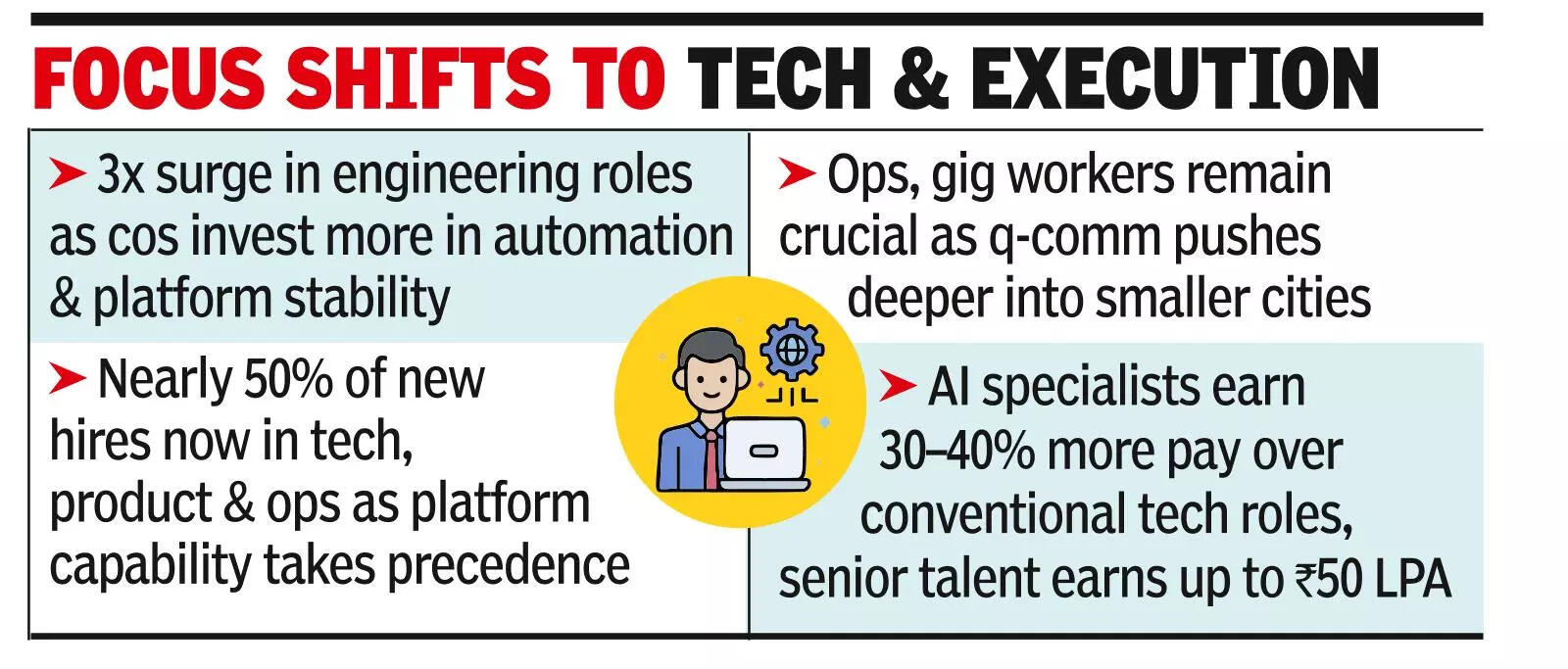
BENGALURU: India’s e-commerce and quick commerce sector is hiring again, but the playbook has changed. Talent demand rose 35% between 2023 and 2025 to nearly 98,750 roles, even as companies shifted from expansion-led hiring to building technology capability and execution strength, according to a CIEL HR report.The sharpest shift is in technology hiring. Demand for engineering roles has expanded more than threefold over the past two years, with companies prioritising solution architects, and AI and machine learning specialists. These roles are linked to investments in recommendation engines, chatbots, warehouse automation, and payments systems , the report said. Nearly half of incremental hiring is now concentrated in technology, product and operations, signalling a structural move away from customer acquisition-led hiring towards platform capability and fulfilment-led workforce design. Operational hiring remains critical as quick commerce expands into smaller cities. Demand in supply chain and fulfilment roles has risen 25%, with warehouse managers, fulfilment planners, city operations leads and inventory controllers forming the backbone of expansion. These roles are especially concentrated in tier-2 and tier-3 markets.

.

“India’s digital commerce sector is entering a new workforce phase where engineering depth, operational agility and execution precision are becoming the strongest indicators of business competitiveness,” said Aditya Narayan Mishra, managing director and CEO, CIEL HR. “Organisations are designing talent models that combine specialised technology capability with highly responsive frontline execution.“At the frontline, gig work continues to anchor the sector. India’s gig workforce has crossed 12 million, with more than half engaged in delivery, dark-store fulfilment and hyperlocal logistics. The shift is also reflected in pay. AI and machine learning specialists are earning 30%-40% more than conventional tech roles.


Dhurandhar 2's Danish Pandor recalls heartbreaking theatre turnout on day 1 due to ‘negative publicity’

0
Dhurandhar 2's Danish Pandor recalls heartbreaking theatre turnout on day 1 due to ‘negative publicity’


Filmmaker Aditya Dhar’s Dhurandhar: The Revenge has remained a major talking point ever since its release on March 19. Within just a week, the film shattered box office records and continues to enjoy a dream run in theatres. However, a day before its release, the film suffered a setback when its paid reviews were reportedly cancelled due to “technical issues”. In a recent conversation with ABP Live, actor Danish Pandor recalled a “heartbreaking” moment when he saw only 40–50 people in the theatre on the film’s opening day amid what he described as “negative publicity”.

Danish Pandor talks about being heartbroken after paid reviews of Dhurandhar The Revenge got cancelled.

Danish Pandor on negative publicity around Dhurandhar The Revenge

Danish spoke about how the cancellation of the paid reviews affected him and said, “It’s all about the audience. I remember the film released on Friday after the screening got cancelled on Thursday. I was completely heartbroken. I couldn’t understand what was happening. I kept thinking, ‘It is such a great film, why is this happening?’ And on top of that, there was too much negative publicity around it.”

He added, “When the film finally released on Friday, I went for the 2:30 pm show. There were barely 40–50 people in the theatre. I kept wondering — we have made such a beautiful film, and there are no viewers. From 8 pm onwards, reviews started pouring in. Suddenly people began watching it and talking about it on social media. It picked up so well that there was no looking back. The reality is, no matter how much negativity surrounds a film, when audiences decide to show their love, nobody can stop them.”

In the film, Danish essays the role of Uzair Baloch, the cousin of Akshaye Khanna’s character, Rehman Dakait.

Despite the setbacks, the film still took a bumper opening at the box office. On its opening day, Dhurandhar: The Revenge collected ₹145 crore, including paid reviews, recording the biggest opening for a Bollywood film so far. It then went on to register two consecutive ₹100 crore days and ended its first week with a domestic collection of ₹643 crore and a worldwide total of over ₹1000 crore.

The success of Dhurandhar: The Revenge has set a new benchmark in the industry, making it one of the fastest films to enter the ₹1000 crore club. The film continues to perform strongly and is expected to surpass the lifetime collection of its first part, which earned ₹1300 crore worldwide.

About Dhurandhar: The Revenge

Helmed by Aditya Dhar, the film tells the origin story of Ranveer Singh’s character, Hamza Ali Mazari aka Jaskirat Singh Rangi, and takes forward his journey of rising to become the kingpin of Lyari while carrying out his mission to dismantle the terror network in Pakistan. The film also stars Arjun Rampal, Rakesh Bedi, Sara Arjun, Sanjay Dutt and R Madhavan in key roles.

The film has also received praise from several celebrities, including SS Rajamouli, Ram Gopal Varma, Mahesh Babu, Allu Arjun and Alia Bhatt.


With 200 in sight, Bhuvi continues to make an impact

0
With 200 in sight, Bhuvi continues to make an impact


LUCKNOW Bhuvneshwar Kumar has been one of the most dependable fast bowlers in IPL history, and his record since his 2011 debut reflects both skill and longevity. With 198 wickets in the league, he stands among the most successful pacers the tournament has produced, built on swing, control, and calm execution under pressure.

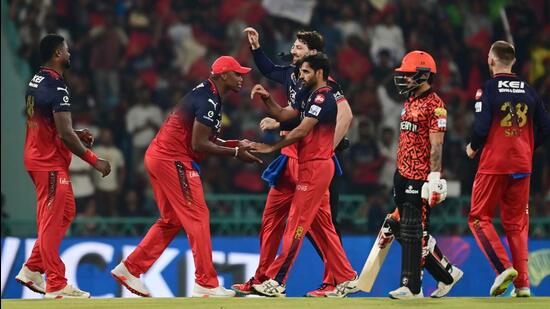
Bhuvneshwar Kumar with Royal Challengers Bengaluru teammates. (HT)

Kumar, who shot into the limelight after getting Sachin Tendulkar out on a duck in the Ranji Trophy final at Hyderabad in 2008-09, entered the IPL as a young seamer with a simple but deadly craft: moving the new ball both ways and staying disciplined at the death.

Across his long stint, especially with Sunrisers Hyderabad, he became the kind of bowler captains trusted in the first over, middle overs, and final spell alike. His value was not only in taking wickets but also in building pressure through dot balls, which made him central to Hyderabad’s bowling plans for years.

Meerut’s Kumar needs just two more wickets to reach the unique milestone of 200 wickets in the cash-rich league when his side and defending champions Royal Challengers Bangalore begin their campaign on March 28 against Sunrisers Hyderabad on their home turf..

Kumar’s early IPL years were about promise, but he quickly turned that promise into production. What separated him from many other Indian pacers was his ability to adapt to different phases of the innings without losing control. He was never reliant on raw pace; instead, he used seam position, wrist control, and subtle changes of length to force mistakes. That skill set made him effective against both right-handers and left-handers, in powerplays as well as at the end.

Kumar’s best seasons show why he is a complete T20 bowler. He picked up wickets regularly, kept his economy in a respectable range, and often handled tough overs when the match was on the line. In a format where bowlers are usually punished, his consistency stood out because he rarely drifted into chaos. Even when batting line-ups became more aggressive and flatter pitches made life harder for bowlers, he stayed relevant by relying on discipline rather than gimmicks.

One of the biggest markers of his IPL career has been longevity. Staying effective from 2011 through the modern era of power-hitting is no small achievement, and Kumar managed it through fitness, skill adjustment, and game awareness. He evolved from a new-ball specialist into a bowler who could also be trusted to close innings with yorkers and cutters and that evolution is a key reason his wicket tally kept climbing year after year.

Kumar’s mantra for success is simple: “The way I have approached myself in the last few years, personally, I will say that I never make any goals… I just keep going match by match…Whatever comes my way, I will accept it,” he was quoted as saying after RCB won their maiden title last season.

In fact, Kumar’s contribution to Sunrisers Hyderabad has been especially important. He became the face of their bowling attack for a long stretch, setting the tone for the team’s identity: disciplined, tactical, and difficult to score against. For many seasons, his presence alone gave SRH a sense of control in matches that might otherwise have slipped away. He was also a leading Indian pacer in the league, showing that Indian fast bowlers could dominate a format once seen as more favorable to express pace and big hitters.

If IPL history is measured not just by totals but by impact, Kumar’s case is strong. He has been a wicket-taker, a pressure-builder, and a bowler who made his craft last across more than a decade. The 198 wickets tell one part of the story, but the fuller picture is of a pacer who stayed effective in changing conditions and remained one of the league’s most reliable bowling assets.

“Consistency has been his success in the game. I never saw him missing even a single training session in the early days of our cricket in Meerut,” said former Team India pacer Praveen Kumar, who also hails from Meerut.

Both Bhuvneshwar and Praveen learnt the basics of swing bowling while training at the Victoria Park Ground in Meerut. “Winning two Purple Caps in IPL history isn’t easy and his consistency is amazing. It’s a learning for the younger generation in the game,” said Praveen Kumar on Thursday.

“He (BK) has maintained his consistency in the shortest format of the game and I feel he has many years left to play,” said Praveen Kumar, adding, “I pray for his success in the new season too and I always treat him like my younger brother.”


Gurmeet Choudhary: Ram Navami is a reminder of faith, positivity, and staying grounded in life

0
Gurmeet Choudhary: Ram Navami is a reminder of faith, positivity, and staying grounded in life


There are roles that shape an actor’s career, and then there are those that quietly seep into one’s life, and for actor Gurmeet Choudhary, portraying the role of Lord Rama in 2009 television show Ramayan was not just a defining moment on screen, but a turning point that continues to influence how he lives, thinks, and celebrates faith, especially on Ram Navami.

Gurmeet Choudhary
Gurmeet Choudhary

Years after stepping into the role, Gurmeet finds that the festival, which is being celebrated today, has taken on a far more introspective meaning for him. “Ram Navami is a very special day for me. It reminds me of faith, positivity, and staying grounded in life,” he says, framing the occasion not just as a celebration, but as a reminder of values he actively tries to uphold. His observance of the day remains rooted in simplicity, as he tells us, “There are no elaborate festivities, just a quiet morning of prayers at home, spent in the company of my family. It’s always a peaceful day with family (wife Debina Bonnerjee, and twins Lianna and Divisha).”

The festival, he adds, also carries a collective significance, bringing people together in ways that go beyond faith. “It connects people through faith and positivity. It brings families and communities closer,” he states, adding that the shift in his relationship with the festival is unmistakable, as playing Lord Rama changed not just his understanding of the character, but also his own approach to life. “After playing Ram, the feeling has become deeper. I celebrate it with more understanding and gratitude now,” he reflects. The role, over time, has blurred the lines between performance and personal belief, he adds. “It feels more personal and also comes with a sense of responsibility to live by those values,” shares Gurmeet, acknowledging the quiet pressure that comes with embodying a figure so deeply respected.

That awareness, however, began right from the moment he was cast back in 2009. “I felt blessed and nervous at the same time. It was a huge responsibility, that demanded not just preparation, but discipline and emotional control.” The 42-year-old adds, “Maintaining calmness and dignity in every scene was challenging. Ram is very composed, so I had to control my emotions a lot,” he says. That process, he admits, didn’t end when the shoot wrapped, it stayed with him, shaping the way he responds to situations in his everyday life.

The impact is perhaps most visible in how audiences continue to engage with him, as for many, he is still seen through the lens of Lord Rama. Recalling a memory, Gurmeet shares, “One memory I cherish is when people would touch my feet, seeing me as Ram. It was very humbling.” Off screen, too, the influence of the character is evident in quieter, more personal ways. “It made me more patient and understanding. I try to handle situations with more calmness now. Patience and righteousness are the qualities that I resonate with him.”

For Gurmeet, the true essence of Ram Navami lies beyond rituals, as he shares: “It is an opportunity for self-reflection, it’s about being a better human, not just rituals. It’s about values and inner peace.” He adds, “ “In today’s fast life, Lord Ram’s values like honesty and respect are more important than ever.”

Ask him if he would like to play the modern-day Ram, the actor mentions how he sees no disconnect. “A modern Ram would still stand for truth, respect, and responsibility in today’s world. Ram Navami is no longer just a festival I observe; it is a quiet checkpoint, a moment to realign with the values that a role once introduced me to,” he wraps.