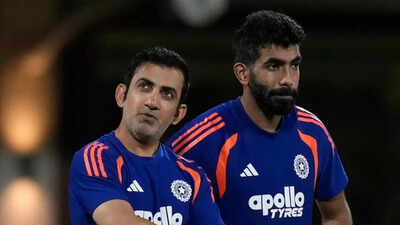
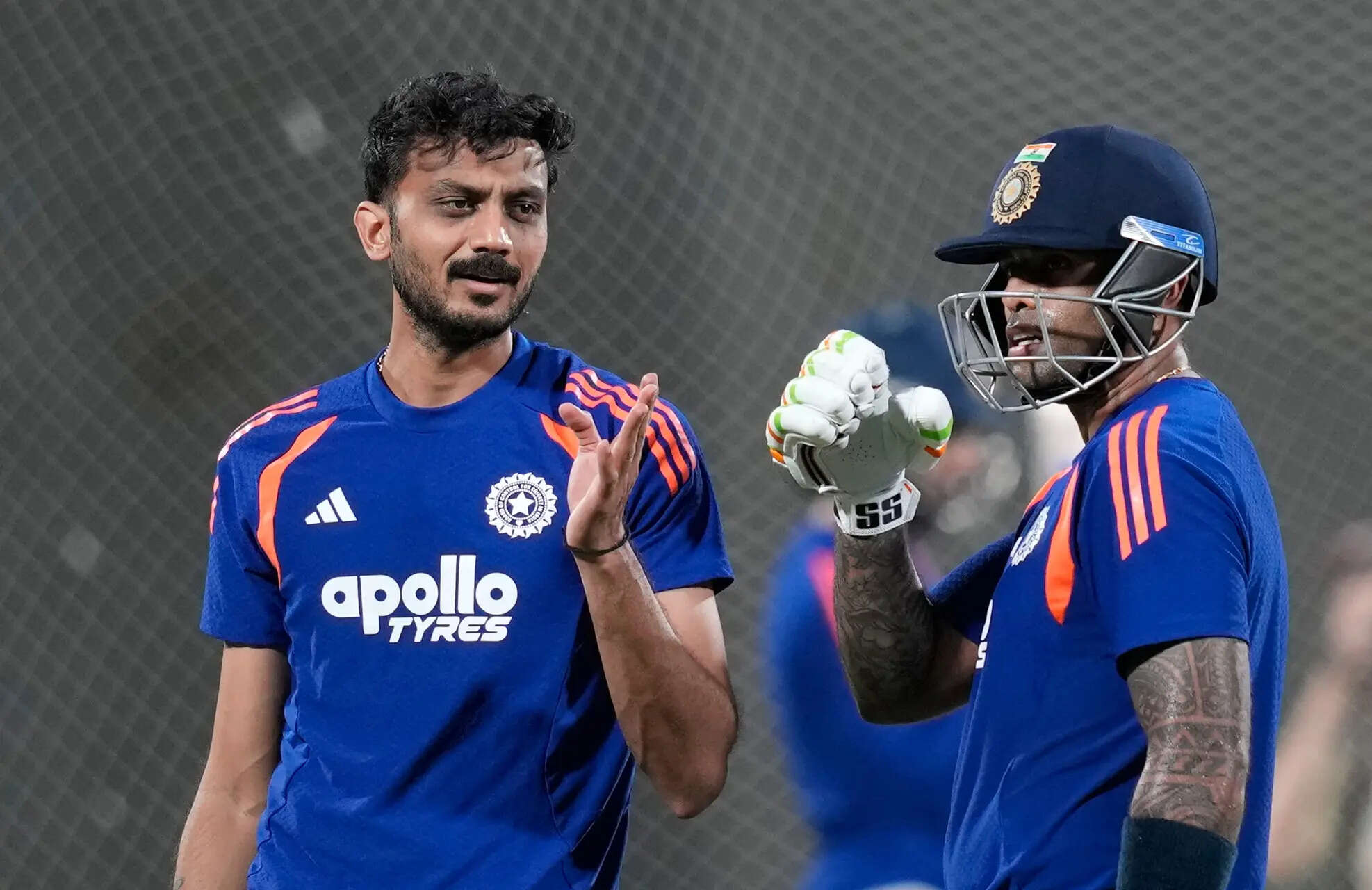
India’s coach Gautam Gambhir, left, Jasprit Bumrah during a practice session ahead of the ICC Men’s T20 World Cup 2026 cricket match between India and Zimbabwe, at M. A. Chidambaram Stadium in Chennai.
Zimbabwe all-rounder Ryan Burl said his team is aware of the task ahead against India but believes the pressure of a must-win T20 World Cup match could affect the hosts when the two sides meet on Thursday.The Group 1 Super Eights clash at the MA Chidambaram Stadium is crucial for both teams after India lost to South Africa and Zimbabwe went down to the West Indies.“Yeah, it is a must-win match for us, but it’s also a must-win game for India. There’s obviously a lot at stake here, being a World Cup game and if we are to progress to the semifinals, we both want to look at winning tomorrow’s game,” Burl said at the pre-match press conference.“Obviously, we don’t get to play India a lot, so it’s something that we really have been looking forward to. Playing India in India is a challenge in itself. They obviously got a home ground advantage, but the added pressure of both teams needing to win tomorrow’s game.“Pressure does funny things to teams. And obviously it being a World Cup, there’s that added pressure as well. We hope to execute our process tomorrow,” he added.Burl said Zimbabwe’s bowling options could help them counter India’s batting.“We’re doing a lot of our homework. Obviously, India’s got that firepower where they obviously go really hard in the power play and if they don’t lose wickets, they’ve got guys that can go hard throughout. We’ve obviously got a lot of options (in bowling) and that’s probably one of the advantages of the Zimbabwe lineup.”“We’ve got left-arm seamer, right-arm seamer, we’ve got a couple of leg-spinners, we’ve got an off spinner, we’ve got a left arm offie. So, we do have quite a lot of depth and I think it will probably just come down to what are the match-ups depending on the batters that are out there and, obviously, the combinations that we do look to go for,” he added.The all-rounder said the team has moved on from the loss to the West Indies.“To be honest, I think we can only take positives from that defeat. It sounds weird, but we hadn’t really had a bad game until then. So there is massive learning in that.“And in saying that, India obviously also had their bad game against South Africa. So we’re both looking to bounce back, and no better place than to do that tomorrow,” he said.Burl also confirmed that captain Sikandar Raza is fit despite taking a blow in the previous match against West Indies.“Sikandar Raza is 100% playing. Good luck telling him that he’s not going to play against India. Yeah, he’s going to be playing,” he added.
Television actress Dipika Kakar is steadily recovering after undergoing a procedure to remove a small cyst, and her husband Shoaib Ibrahim has shared a reassuring update with fans. The actor informed well wishers that the surgery went smoothly and that Dipika is doing fine.
Shoaib Ibrahim updates fans
Taking to Instagram Stories, Shoaib thanked everyone for their constant prayers and support. He wrote, “Allah ke karam se aur aap sabki duaaon se Dippi’s procedure is done. All went well. She is also doing fine, bass thode pain me hai, but nothing to worry about. Thank you all once again for all your prayers.” His message immediately brought relief to fans who had been concerned about Dipika’s health.
All about the surgery
According to Shoaib, Dipika had been experiencing mild stomach pain for a couple of days, which became more intense one night. Concerned, the couple decided to consult a doctor. After medical tests and a CT scan, they discovered a 1.3 cm cyst that needed to be removed. In a recent vlog, Shoaib explained, “Dipika had mild pain in her stomach for two days, which aggravated more on Friday night. So we visited the doctor and did a CT scan. That’s when we learned about this cyst.”
Doctors advised a minor procedure to remove the cyst, and Dipika was admitted to the hospital for the treatment. Shoaib assured everyone that the procedure was successful and that apart from some post surgery discomfort, there is nothing serious to worry about. He reiterated that she is under observation and recovering well.
This health update comes after Dipika’s difficult battle with stage 2 liver cancer last year. She had undergone a long surgery to remove a malignant tumour and had been bravely sharing her recovery journey with her followers. The recent cyst scare naturally caused anxiety, but the positive outcome of the procedure has brought much needed relief.
Fans continue to flood social media with prayers and warm wishes for her speedy recovery. For now, Shoaib’s update makes it clear that Dipika is stable, healing, and surrounded by love and support as she regains her strength.
Team India is set to take on Zimbabwe in the Super 8 match of the T20 World Cup 2026. The match will be played on February 26 at the MA Chidambaram Stadium in Chennai.
Ahead of the match, Team India will need to secure a win by a huge margin of runs to improve their net run rate in the ongoing marquee event. But former Team India cricketer Irfan Pathan feels that the “Men in Blue” should prioritise winning the clash.
“I really hope that approach of playing for net run-rate does not come into play at the start of the game. The priority should be winning the game first. So, perform well and try to win. Only then should you think about the run-rate,” he said.
“If you start thinking about chasing the net run-rate of, say, the West Indies, that is almost impossible. That would mean beating teams like Zimbabwe and the West Indies by a margin of 100 runs, which is not easy in T20 cricket. So, I sincerely hope that when the Indian team plays these next two matches, the main focus is simply on winning first,” added Pathan.
He also feels that Team India skipper Suryakumar Yadav should come to bat at number three and also explained the reason behind it.
“I think Surya can bat at number three. If you look at it from the team`s point of view, I completely understand the conservative approach from Surya, especially because Abhishek has been getting out early. In the last game, Ishan Kishan got out in the first over. You do not want to expose Suryakumar Yadav at number three when he is so effective in the middle overs, striking at 160. If something goes wrong with the new ball, just one good delivery can get him out. So, I understand the thinking. However, they still need to consider batting Suryakumar Yadav at number three to break the monotony of having three left-handers at the top,” said the 41-year-old former cricketer.
T20 World Cup 2026, Super 8: India vs Zimbabwe- Full squads
A 7,400 sq ft apartment at DLF The Camellias in Gurugram has been purchased by Berkshire Hathaway’s Ajit Jain. The vice-chairman overseeing insurance operations at Berkshire Hathaway, Ajit Jain, is regarded as one of Warren Buffett’s most trusted associates. The apartment has been bought for around Rs 85 crore, according to sources quoted in an ET report.Jain, who has spent most of his time living abroad, recently visited Delhi to complete the deal, the sources said. One person aware of the development said non-resident Indians account for more than 25% of DLF’s ultra-luxury housing portfolio, and Jain is among the most prominent buyers in this segment. The individual added that premium amenities offered at such developments are a major attraction for those who plan to spend only part of the year in India. Jain is widely considered one of the most influential Indian-origin business leaders in the United States.Property consultants noted that since the Covid period, ultra-high-net-worth individuals have increasingly favoured secure, gated condominium projects over independent bungalows, as such residences provide access to a wide range of on-site facilities.ET recently reported that an industrialist purchased four apartments at DLF’s new ultra-luxury project, The Dahlias, for close to Rs 380 crore, making it one of the country’s most expensive apartment transactions.In 2025, Gurugram saw the costliest property deal in the National Capital Region, overtaking Lutyens’ Delhi for the first time. Prices per square foot in the city have surpassed those in Mumbai and reached levels comparable with London and Dubai. Earlier, British entrepreneur Sukhpal Singh Ahluwalia had acquired an 11,416 sq ft apartment in the same project for Rs 100 crore.Info-x Software Technology, through its director Rishi Parti, had also purchased a 16,000 sq ft penthouse for Rs 190 crore.In October 2023, ET reported the first Rs 100-crore transaction at the same residential complex on Gurugram’s Golf Course Road.
In an exclusive chat, actor Ali Hassan, who plays the prime antagonist in Border 2, opened up about sharing screen space with Sunny Deol and why the experience meant so much to him.
Calling the film “all about Sunny Deol,” Ali said, “Of course it was an ensemble cast and I won’t deny they were amazing too. But if it wasn’t for Sunny Deol, Border wouldn’t have been a franchise.” He added, “I was very fortunate that I got to be a part of this amazing project, Border 2.”
Ali Hassan on working with Sunny Deol
While he did not share scenes with Varun Dhawan or Ahaan Shetty, Ali cherished the opportunity to work closely with Deol. “I got to work with Sunny Sir. What an amazing person he is. The energy he carries at the age he is… I used to keep looking at him. I used to forget what I had to do in the scene and just admire him while we performed together,” he admitted.
Having grown up watching the veteran star, Ali described the moment as surreal. “I’ve grown up watching him and his films. To just be in the same frame as him wasn’t easy. And then again, to be cast opposite him as an antagonist, which makes me the main antagonist of Border 2, was like a dream come true. I don’t think many people can say that, although I’ve done two movies before.”
The role, he shared, was physically demanding. “The role was very hectic. But it was great. Let me tell you, all the action that you see in the film, everything, I did not use a stunt double. It was done all by me. And the experience has been beyond words for me.”
Ali Hassan shares a heartfelt anecdote
Ali also spoke about his initial doubts. “I’m open about the fact that I have only been in television. I’ve not even approached much on the movie side. So when they thought of me, I was thrilled and excited. But frankly speaking, I was very sceptical.” He recalled being told, “Ali, you’re the central antagonist.” Laughing, he said, “I said, okay, I’ll take your word for it.”
When Border 2 released, the response overwhelmed him. “The kind of reaction I got from people, the kind of love messages I got… I was like, ‘Whoa. This is something else. This is unreal.’ I was shivering for two days.”
Reflecting on destiny, he shared a throwback memory. “Twelve years back, Sunny paaji had come on CID for promotion, and guess who was the villain in that particular episode? It was me.” Smiling at the full circle moment, he said, “It was not the first time that I met him. I worked with him then also. And ten years later I am working with him in the biggest war franchise ever.”
Recalling Deol’s reaction, Ali revealed, “When I showed it to him, he was like, ‘How many years have passed? Twelve years have passed. When are you coming back?’ He was a gem of a person back then and now too.”
Kangana Ranaut has once again grabbed attention on social media, this time for a reflective note urging people to be mindful of the company they keep. Known for her unfiltered opinions, Kangana shared a candid message advising followers to distance themselves from what she termed as “zombies”, individuals she described as lacking ambition and emotional intelligence.
Kangana Ranaut reflects on the importance of surrounding oneself with ambitious individuals and distancing from those she calls ‘zombies’
Kangana Ranaut advises her followers to stay away from negativity
Kangana recently shared her views on her Instagram stories when she wrote, “I don’t usually give gyan, but just in case you need to read this…1. No matter how smart or successful you are, if you need an upgrade in life, look for those who are smarter than you and sincerely admire them, if possible, seek their company.” She suggested that growth often comes from surrounding oneself with people who inspire and challenge one’s thinking.
Continuing her message, Kangana cautioned followers against those who might hinder personal growth. “2. every one looks normal from the outside but lots of zombies are roaming around without any ambitions or emotional intelligence, stay away from those who make you feel apologetic for being successful/gorgeous/kind. There is no shame in not having any friends. Don’t expect extraordinary behaviour from ordinary people.”
She concluded on an introspective note, encouraging self-acceptance and inner kindness. “3. Lastly, own your story, don’t see yourself through others’ eyes, look at yourself like you are your own child and now say honestly what you really desire for yourself. Be kind to yourself there is a reason for your existence, you are meaningful. Hare Krishna.”
Kangana’s latest film projects
On the film front, Kangana was last seen in Emergency, a biopic of former Prime Minister Indira Gandhi, which received mixed reviews and a tepid box-office response. She has resumed work on a new project titled Bharat Bhhagya Viddhaata, announced in 2024 and described as a tribute to unsung real‑life heroes, with shooting underway in early January 2026. Additionally, she is set to star in an untitled psychological thriller opposite R Madhavan, marking a reunion of the two actors after a decade, with filming already underway.
After fleeing the inferno of war in el-Fasher in North Darfur State and travelling more than 1,600km (9,995 miles) to safety, Sanaa Ahmed thought the worst was behind her. But in the Al-Sarraf camp in eastern Sudan, she has faced suffering of a different kind.
“We fled here with nothing,” Sanaa told Al Jazeera Mubasher. “Now Ramadan has come, and we don’t even have a pot to cook in or a cup to drink from. If you have a bucket or a jug, that’s it.”
Sanaa is one of thousands of displaced people who have sought refuge in Al-Gedaref state, far from the front lines of the war in the west. But safety has come at a steep price. The camp, intended as a sanctuary, has become a site of deprivation.
“The water is available, but there is no food,” she said. “They give us a meal, but it’s not a real meal, and it’s not enough.”
A Ramadan of hunger
For Muslims, Ramadan is traditionally a month of community, prayer and shared meals. For the displaced women of Al-Sarraf, it has become a daily struggle to find enough scraps to feed their children at sunset.
Majd Abdullah, another survivor from el-Fasher, described the stark contrast between her past life and her current reality.
“Back home, Ramadan was perfect. You would prepare everything a month or two in advance,” she recalled. “But here, we fasted the first day, not knowing what we would break our fast with. We ended up eating with neighbours because we had nothing.”
A recent United Nations report said the paramilitary Rapid Support Forces’ (RSF) atrocities in el-Fasher bore all the hallmarks of genocide.
The aid that does arrive is often woefully inadequate. Majd described receiving a single bowl of porridge to feed a family of seven or 10 people.
“No organisation has entered with a food basket or cash assistance,” she said. “We can’t feed our children unless we go into the city to wash clothes or iron – menial jobs just to survive.”
‘The children ask for biscuits’
The lack of food is compounded by a total absence of basic household necessities. Sumaya Saleh, who fled from Kutum in North Darfur, listed the items they are desperate for: cooking pots, charcoal and sugar.
“The children are missing so much,” Sumaya said. “They ask for a biscuit, and you don’t have the money to buy it for them.”
The camp’s elderly residents are also suffering. Sumaya noted that many suffer from diabetes and high blood pressure but cannot access medication or proper care at the local health centres.
Mawaheb Ibrahim, a diabetic who lost her mother, sister and uncle to shelling in el-Fasher, is now caring for orphans in the camp with no resources.
“I am a diabetic, and I had retinal surgery,” Mawaheb said. “My blood sugar has risen to 477… I went into a state of acetone [ketoacidosis], and it affected my ear. I’m just taking painkillers to sleep. I have no access to a doctor.”
Disease and neglect
Beyond the hunger, the sanitary conditions in the camp are deteriorating. Sanaa Ahmed described the health situation as “medium” but worsening, citing cases of diarrhoea and eye infections.
“There are huge amounts of flies,” she said. “The bathrooms are hot and not clean enough. We need spraying campaigns and cleaning tools.”
While some hygiene kits and soap have been distributed, the primary need – food – remains unmet. One unnamed displaced woman described the communal kitchen as insufficient for the number of people it serves.
“It doesn’t satisfy a man, a woman, or a child,” she said. “The topic of food baskets is completely finished here; they don’t bring them.”
For these women, the “safety” of Al-Gedaref has become a slow-motion crisis of neglect. They have survived the war, but they are now fighting to survive where they are not under fire.
“We need help,” Mawaheb pleaded. “I need something to keep us going, for the children I am raising and for myself.”
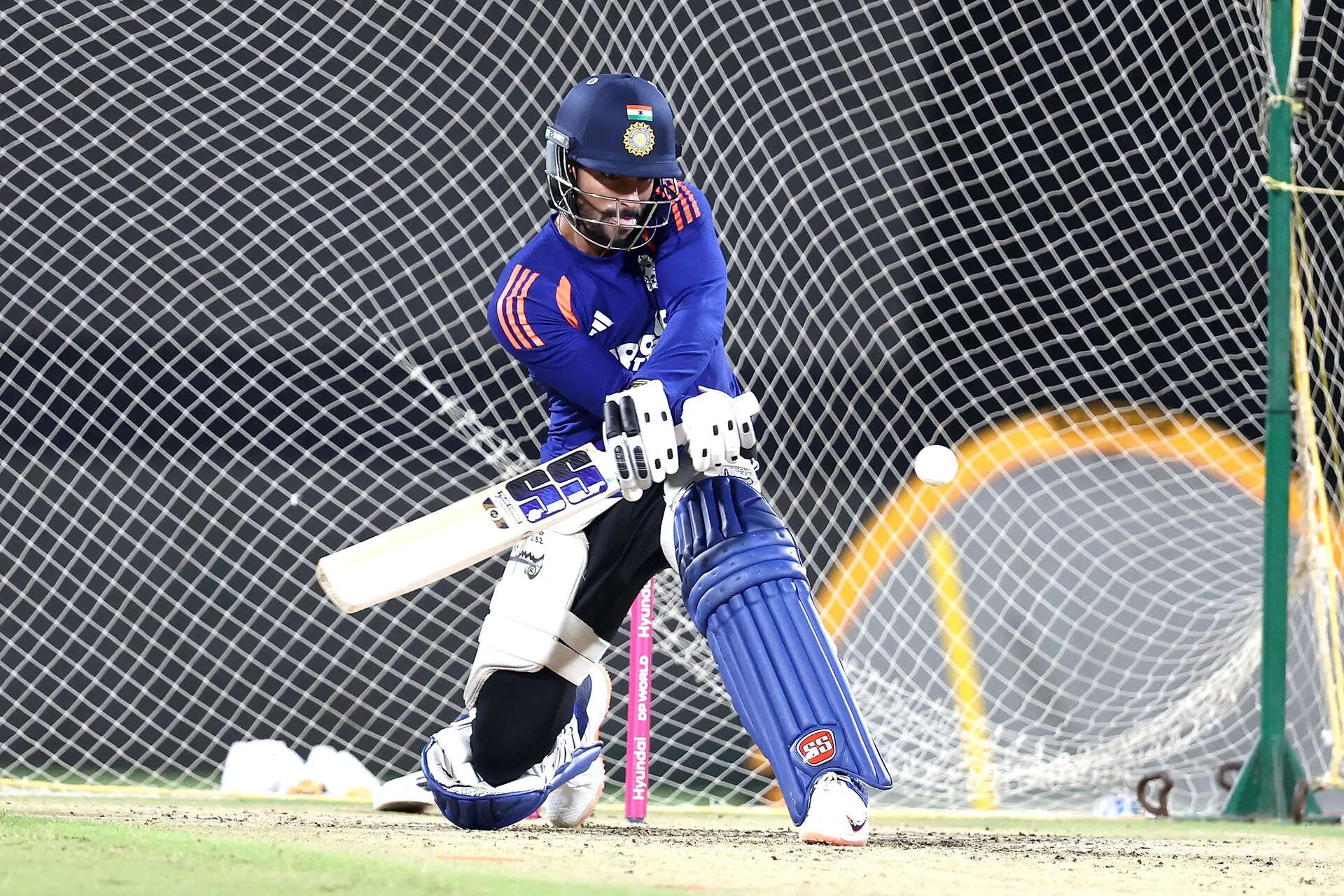
Sanju Samson during an India net session at MA Chidambaram Stadium in Chennai. (Getty Images)
TimesofIndia.com in Chennai: The stakes are high. The remaining Super Eight matches are must-win games, contingent on South Africa’s results going in their favour. The situation wasn’t this desperate but the “worst game in the last two years” has now put the Indian cricket team in a tight spot ahead of clash against Zimbabwe in Chennai. The last five matches showed the defending champions were tactically predictable due to an overdose of left-handers. Ever since the debacle in Ahmedabad on Sunday, calls to add a right-hander have only grown louder. Not that Sanju Samson is the answer to all problems but he gives you a tactical edge and could well force the oppositions to move away from the predictable off-spinner plan.The wicketkeeper-batter had a long hit in the nets on Tuesday and strong Playing XI hint emerged when he donned the big gloves for the drills towards the fag end of the session. He faced a mix of pace and spin during the marathon hit and grew more confident as he played against Varun Chakravarthy, Axar Patel, Kuldeep Yadav and Washington Sundar. India assistant coach Ryan ten Doeschate said after the South Africa game that Samson would be a talking point in the next few days and batting coach Sitanshu Kotak confirmed that the discussions have revolved around the right-hander. Kotak, however, kept the Playing XI cards close to his chest.
T20 World Cup: Sitanshu Kotak press conference before India vs Zimbabwe
“There can be changes, yes. It goes without saying that we discussed, because there are two lefty openers, number three is also left-handed and opposition is bowling off-spin. I personally don’t think that there is any problem there also. But because we lost wicket in first over, obviously any team would think. So we are thinking and we will see how it goes because we never decide the team too early and obviously it is not fair to start telling your plannings also in so advance. But yes, definitely there will be thoughts,” said Kotak on eve of the match.If Sanju returns to the India XI, it will balance the left-right issue, but the entry points for the middle order, especially the firing lower-order, led by Shivam Dube, could become interesting for the remaining two games. Dropping Tilak Varma for Samson and moving Ishan Kishan to No. 3 could have been another option but Kotak’s backing for the left-hander didn’t point in that direction. This is despite a sorry showing this tournament – 107 runs in five innings at a strike-rate of 118.88. Kotak supported Tilak and watched over him during the side’s optional practice session in the afternoon.
Tilak Varma during an India net session at MA Chidambaram Stadium. (Getty Images)
“Tilak has no such issues. In the Pakistan game, our target was good. I said earlier that 175 on that wicket was good enough. And we followed the planning. Because the same thing – and there the ball was actually spinning. And after that start, any team wouldn’t want is 3-4 wickets to go at once. So Tilak… it is a matter of two boundaries. Sometimes a batsman doesn’t get those balls. If he is at 34-35 in 30 – 32 balls or at 26 in 28 balls – if he gets one or two boundaries and a six, he will be at 38.“So I don’t think it is a question of run a ball. Neither he has any such instruction, neither he himself is thinking like that. Sometimes depending on wickets and depending on situation, I think there was more about partnerships in that game in Colombo and I think we achieved that. Yes, if Hardik had clicked more, who got out on the first ball, then we were hoping for 190 and we knew that was above par score and everyone knows that. So, there is no such tension of Tilak or Abhishek or even of losing one match.”The other talking point would be Rinku Singh and his place in the playing XI. The left-hander has had mediocre returns in the tournament and missed both team training sessions due to a personal emergency. Although he is set to rejoin the side on Wednesday evening, holding on to the spot looks highly unlikely at this stage. This could leave management with another change. If Samson walks in with Tilak holding his spot, the two players on their way out could well be Rinku Singh and Washington Sundar, making room for all-rounder and vice-captain Axar Patel.
Axar Patel (L) is slated to come into the India XI vs Zimbabwe in Chennai. (PTI)
It will be interesting to see what kind of batting order they opt for but adding a right-hander in the mix gives them a tactical edge — something that has indeed been a talking point recently.“The discussions, to be very honest, if I tell you, it is more about tactical. A lot of tactical discussion goes on, the guys are bowling here, this is how we are approaching, this is how you are approaching, what other options you have for any batsman. Not just for Tilak, for Abhishek also, if you would have seen yesterday, it was the same thing we talked. So those things are more about planning, what a batsman can prepare and how much he actually wants to do that because end of the day it is batsman’s thing to decide what he likes, what he wants to do. But to give different ideas is obviously our job,” explained Kotak.Apart from lacking the fire and confidence of the preceding bilaterals, India have been tactically questionable. Thursday presents an opportunity not only to address that but also to find the XI which can help them cover all bases, and stay ahead of the opposition.
Prime Minister Narendra Modi’s two-day visit to Israel comes at a time when the Middle East is a tinderbox – from the crippling Gaza war to rising US-Iran tensions and unprecedented missile exchanges that have redrawn the security map of the region. Yet, as executive editor of Hindustan Times Shishir Gupta Highlighted in wide-ranging conversation with senior anchor Ayesha VermaNew Delhi is choosing to walk into the eye of the storm, not away from it.
PM Narendra Modi, who reached Israel, was welcomed on the red carpet along with his Israeli counterpart Benjamin Netanyahu. (X/Narendra Modi)
Modi is ahead in one area
The United States has begun a massive military buildup in the Middle East, with advanced aircraft and carrier groups moving to launch positions, while Israel is on high alert amid fears that any US attack on Iran would trigger retaliatory strikes on Israeli territory. This build-up included America’s largest and most advanced aircraft carrier, the USS Gerald R. Ford is involved.
In parallel, Washington and Tehran are engaged in fractious diplomacy in Geneva, with negotiations hanging over a US deadline set by Trump, Iran’s nuclear and missile programs and a domestic crackdown on protesters.
Gupta says that in the context of this fever, Modi’s decision to visit Israel on the surface “appears risky”, but he argues that the symbolism cuts the other way. Rather than “sit quietly” and issue political statements in Delhi, the Prime Minister is choosing to enter “the heat of the current environment”, signaling that India wants to be present as a serious stakeholder and advocate for de-escalation.
Gupta points out that Modi has built strong personal equations across the region – with Iran, Saudi Arabia, the United Arab Emirates, Israel and other Gulf capitals – and has visited almost all the major countries of West Asia. They suggest that this allows Modi to present himself as a leader who is not choosing sides in a sectarian or factional competition, but rather as someone who is willing to talk to all actors while India firmly defines its interests.
India-Israel defense partnership deepening
Behind the optics, the visit is expected to push India-Israel relations into a new gear, especially in joint development of defence, technology and cutting-edge capabilities. Gupta reminds us that Israel has been a “very close and trusted ally” for decades, even when past Indian governments were reluctant to openly engage with Tel Aviv.
During the 1999 Kargil War, Israel quietly supplied targeted weapons, laser-guided munitions, unmanned aerial vehicles and other force multipliers, significantly enhancing the Indian Air Force’s ability to strike Pakistani targets. More recently, during “Operation Sindoor”, Indian forces used a package of Israeli origin systems – including munitions such as the PALM-200/400 and Harpy/Harop long-range Rampage missiles with munitions and BrahMos strikes – to eliminate terror infrastructure in places like Bahawalpur and Muridke, the strongholds of Jaish-e-Mohammed and Lashkar-e-Taiba in Pakistan.
India also turns to Israel for high-end anti-tank weapons, including those deployed during the Ladakh standoff with China in 2020, and for long-range stand-off missiles to neutralize air-defense systems, which Pakistan has augmented with Chinese radar support. Emerging systems such as Israeli missiles and Iron Beam laser weapons are seen as “top of the line” in Delhi and Gupta says the visit is likely to unlock supplies of weapons that were not even cleared in the past.
“The defense partnership has become much deeper,” he stressed, describing the shift between Modi and Israeli Prime Minister Benjamin Netanyahu from a simple buyer-seller relationship to a deeper, multi-layered relationship underpinned by trust at the top level.
Mission Sudarshan Chakra: Saving India from Missiles
The most strategic piece of this puzzle is India’s emerging cooperation with Israel on anti-missile defence, which Gupta directly links to Modi’s “Mission Sudarshan Chakra”, which he announced in his Independence Day speech. He says the turning point was again Operation Sindoor, when Pakistan reportedly fired about a thousand missiles, including ballistic missiles, at India – causing minimal damage but highlighting the scale of potential saturation attacks for which India should be prepared.
India’s main concern now is Pakistan, which Gupta apparently calls a “dishonest power”, in contrast to China, where he at least sees the possibility of mature dialogue between the “two big powers”. Pakistan has used Chinese systems to strengthen its air defense and is working on long-range missiles like Ababeel, a 2,000-km range system with multiple independently targetable re-entry vehicles (MIRVs) that can release multiple warheads on different trajectories.
Once such “bombs” are separated, interception becomes extremely difficult, which is why India needs the ability to shoot down enemy missiles in their boost stage or before they fragment into pieces in the terminal stage. Here, Israel’s experience is important: during Iran’s massive attack last year, Israeli systems reportedly neutralized 498 out of 500 incoming missiles using a layered shield of Iron Dome, David’s Sling and Arrow-3.
Mission Sudarshan Chakra, as Gupta explains, is essentially about building India’s own layered missile defense grid:
Launch detection through radar, aircraft and satellites.
Neutralizing threats at multiple ranges – approximately 100 km, 250 km and 400 km – using different interceptor families.
Combining this with long-range stand-off weapons that can hit enemy launchers and missile infrastructure at the source.
In a world where stand-off missiles, loitering weapons, kamikaze and swarm drones are becoming standard tools of warfare – and where both China and Pakistan have such capabilities – Gupta calls the Sudarshan Chakra “key to Indian security at present”. The India-Israel plan is to jointly develop critical elements of this architecture in India, to ensure self-reliance and rapidly scale up to worst-case scenarios.
India’s role amid US-Iran tension
Zooming out, Verma pressed Gupta on how India fits into the US-Iran confrontation that overshadows Modi’s visit to Israel. On one side is a show of American strength and a president under domestic pressure to demonstrate results on Iran following judicial setbacks on his economic agenda; On the other hand, there is an Iranian leadership that sees itself as the vanguard of Shia power and is unwilling to back down.
The talks in Geneva are trying to bridge fundamental gaps: The US wants Iran to curb its enrichment and ballistic missile programs and rein in its violent crackdown on protesters, while Tehran refuses to accept such constraints. “It doesn’t look good,” Gupta warned, suggesting that action could be taken within hours or days after Washington’s 10-day deadline expires, depending on how each side reads the situation.
In this difficult scenario, India holds a rare position: it can talk to all the major players. New Delhi maintains channels with Iraq, Saudi Arabia, the United Arab Emirates, Jordan, Bahrain, Kuwait and Iran – and separately enjoys a close, terrorism-focused partnership with Israel. India has also kept doors open with the Taliban and acted as an envoy and calming influence over the years from the Ukraine war to the Gaza conflict, while making its own red lines clear (such as calling a terrorist attack on October 7, 2023).
Gupta describes this as “pure strategic autonomy” – India talks to everyone without being owned by anyone, and uses its “good offices” to keep diplomacy and dialogue alive, even when rivals cannot talk to each other directly.
From Palestine and the “Vote Bank” to the Economic Corridor
The conversations also reveal how India’s Israel policy has evolved. India recognized Israel in the 1950s and later Palestine, but avoided direct warmth with Tel Aviv for decades, largely due to domestic political sensitivities and a desire to protect a particular “vote bank”. Relations became more open after 1992, but even then public rhetoric remained low.
Gupta argues that since 2014, Modi has flipped that script by including “everyone” – from Israel and the UAE to Jordan and the wider Gulf – while maintaining support for Palestinian statehood. He cites the almost casual “tea diplomacy” with UAE President Mohammed bin Zayed, who can fly in for a few hours of high-level discussions, as an indicator of the comfort level, and points to intensive anti-radicalism dialogues with Jordan and the UAE as evidence of a new depth.
At the economic level, Verma and Gupta discuss Netanyahu’s idea of a “hexagonal alliance” involving India, Israel, Greece, Cyprus and Middle Eastern partners – which Gupta describes less as a hard security block and more as an economic and connectivity approach built around the India-Middle East Economic Corridor.
In its envisioned form, Indian cargo will move from Indian ports to Fujairah in the UAE, then through Saudi Arabia to Jordan, to Haifa in Israel, and from there to Mediterranean ports such as Cyprus, Greece, Naples and Marseille – with the possibility of Beirut if conditions permit. Gupta calls Hamas’s October 7 attack an event that “brutally broke” this corridor as close to reality as it was, but emphasizes that the underlying logic of integrating these economies remains compelling.
He stressed that the priority for India is not to sign formal alliances drawn up by others, but to deepen economic cooperation with Gulf partners, Israel, Greece and Cyprus, while maintaining regional balance. Modi’s visit to Israel, then, is less an isolated bilateral stop and more a node in a broader strategy: strengthening India’s own security, expanding high-technology and economic ties, and establishing New Delhi as a stable, autonomous power in the Middle East.