Actress Raveena Ravi has bravely spoken out against three years of relentless online harassment by two brothers. She revealed they used fake accounts to send threatening, abusive, and pornographic messages, causing her significant mental distress. Despite police action, the abuse continues, prompting Raveena to urge public vigilance and strict action against such offenders for women’s safety.
Dubbing artist and actress Raveena Ravi has made serious allegations of constant online trolling. The actress revealed that the last three years, it was basically one man and his twin brother trolling with her, her family, and friends. Raveena Ravi claimed that they are trolling her with many fake accounts and even making threatening, abusive, and pornographic comments and messages.Raveena Ravi was mentally traumatized and feared everyone. She said, “Three years of bullying, I can’t keep quiet anymore; I’ll prioritize myself and my family.”.
What did Raveena Ravi say?
In her post on Instagram, Raveena Ravi expressed the grave influence of this issue on her life. She expressed that police complaints have been made, and notices issued, but the behaviour of the guilty is not changing. The defamation continues through new profiles on various social media websites, intimidation and harassment has occurred. Raveena said that she felt pity for her family and friends, who she claimed “have gone through this.” According to Raveana, these people, since she is a public personality, had to endure fear and pressure.
Raveena Ravi warns the public and calls for Police action
Raveena Ravi also commented on the fact that this is not the only incidence of molestation that has occurred in the industry by these individuals. She expressed that the public should be taking this into consideration and pointed out three things to be done: First report and block the mentioned profiles on social media, be careful not to receive a message from them, and do not reply to their comment or message.On the safety for women in Chennai city, Raveena Ravi said, “strict action should be taken against such miscreants”.
Inside Kollywood’s 2025 Crisis and Uncertain Future
The most common business structure in America is also the riskiest. According to the IRS, sole proprietorships account for about 73 percent of all American businesses. Most of them were never formally “started” – if you earn income from freelance work, consulting, or selling goods without creating a separate entity, you are a sole proprietor by default. No paperwork required. No filing fee. And there are no legal barriers between your business loan and your personal bank account.
LLC vs. Sole Proprietorship: What Tax Savings, Liability Protection, and Hidden Costs Really Look Like
The option most small business owners ultimately consider is a limited liability company. An LLC creates a legal wall between you and your business. It costs some to set up – filing fees range from $35 to $500 depending on the state – and requires a modest amount of ongoing maintenance. Whether that tradeoff is worth it depends on your income, your industry, and how much personal risk you’re willing to take. LLCBDWhich tracks LLC formation requirements, costs, and compliance rules in all 50 US states, publishing a more comprehensive breakdown of how much it actually costs to form and maintain each structure. The comparison below is based on that data, along with IRS guidance and state-level filings.
What a Sole Proprietorship Really Is (and What It Isn’t)
A sole proprietorship is not something you create. This exists when you begin earning business income without creating a separate legal entity. A graphic designer is a sole proprietor billing clients through PayPal. This Etsy seller is a sole proprietor shipping handmade jewelry. An advisor invoicing through his personal bank account is a sole proprietor. The IRS does not require registration. You report the business income on Schedule C of your individual Form 1040, pay self-employment tax (15.3 percent on net earnings up to a Social Security wage base of $176,100 in 2025), and that’s it.
Simplicity is real. The risk is also real. Sole proprietorship offers zero liability protection. If a customer sues your business, they are suing you personally. If the business takes on debt and can’t repay, creditors can go after your house, car, savings – anything in your name. There is no legal difference between you and the business. This is fine for a low-risk side project. This is a serious problem for anyone earning a meaningful income or working in a field where lawsuits occur.
What changes LLC
An LLC is a separate legal entity. You create it by filing articles of organization with your state’s Secretary of State and paying a one-time filing fee. Once activated, the LLC owns the business. You own the LLC. That separation is the whole point.
If the business is sued, the LLC’s assets are at risk – not yours personally. If the business owes money, creditors generally can’t go after your personal accounts, your home, or your retirement savings. This protection is not complete; Courts may “pierce the veil” if you mix personal and business funds or treat the LLC as a shell. But properly maintained, an LLC provides a layer of protection that a sole proprietorship cannot provide.
For Indian professionals and NRIs who freelance for US clients or run export-oriented businesses, the difference matters in practical terms. US customers are increasingly requiring vendors to hold business insurance before signing a contract or acting as a formal entity. An LLC indicates legality. A sole proprietorship, appropriately or not, prompts a “side hustle.”
The tax gap is smaller than you think (with one big exception)
Here’s what surprises most people: By default, single-member LLCs are taxed the same as sole proprietorships. The IRS treats it as a “disregarded entity.” You report the income on Schedule C, you pay self-employment tax on the net profit, and your effective tax burden is the same. Forming an LLC doesn’t save you a penny or a dollar in taxes.
The exception is S corporation elections. An LLC can file IRS Form 2553 to be taxed as an S Corp. Under this election, you pay yourself a “fair salary” and take the remaining profits as distributions. Salary is subject to self-employment tax. There is no delivery. In a business making $120,000 in net profits, paying yourself a salary of $70,000 and taking $50,000 as distributions saves about $7,650 per year in self-employment taxes. Over five years, that’s $38,250.
The catch: The S Corp election adds real complexity. You’ll need to run payroll, file quarterly payroll tax returns, and prepare a separate corporate tax return (Form 1120-S). Accountant fees typically increase by $1,000 to $3,000 per year. The choice only makes financial sense if net profits consistently exceed about $50,000 to $60,000 annually – below that threshold, payroll costs outweigh the tax savings.
Both structures also qualify for the qualified business income (QBI) deduction under Section 199A: a 20 percent deduction on qualified business income, subject to income limits ($197,300 for single filers, $394,600 for married filing jointly in 2025). This deduction applies equally to sole proprietors and LLC owners. This is not a reason to choose one structure over the other.
What does each structure actually cost?
It costs nothing to start a sole proprietorship and it costs nothing to maintain it at the state level. You may need a local business license depending on your city or county, but there are no state filing fees, no annual reports, and no registered agent required.
Forming an LLC costs $35 to $500 depending on the state. Kentucky is the cheapest at $40 ( ₹3,400). Massachusetts is the most expensive, with $500 ( ₹42,000). Most states fall between $50 and $150. After formation, most states require annual or biennial reports ranging from $0 (New Mexico, Arizona, Ohio) to $500 (Massachusetts) or the infamous $800 California franchise tax. If you don’t live in the state where the LLC is formed, add $100 to $300 annually for a registered agent.
For a practical five-year comparison: A sole proprietorship in any state costs $0 in state fees. The total cost of a New Mexico LLC over five years is $50. The cost of a California LLC is approximately $4,070. The cost of an LLC is completely dependent on the state, which is why the state you choose matters as much as the structure.
When sole proprietorship is the right decision
Not every business needs an LLC. If you’re testing a side project, earning a modest income from a low-risk activity, and have few personal assets to protect, a sole proprietorship is fine. The overhead is zero, tax filing is simple, and you can convert to an LLC later without losing anything.
Sole proprietorship also makes sense for very early-stage enterprises where the founder is not sure the business will survive. Paying $200 in filing fees and setting up a registered agent for a project that may not last three months is a waste of money. Start slow, validate the idea, and formalize the structure once revenue is consistent.
When should you form an LLC instead?
The trigger points are clear. If your business makes more than $30,000 to $40,000 per year, the liability protection alone justifies the cost. If you’re in a profession where clients could sue – consulting, design, development, coaching, anything involving deliverables – then an LLC is a basic precaution. If you have personal assets worth protecting – home, savings, investments – operating without liability protection is gambling.
For Indian freelancers and IT professionals who bill US clients, an LLC also offers a practical benefit: You can open a US business bank account, accept ACH payments and invoice through a formal entity. This eliminates the wire transfer friction that many cross-border freelancers deal with. Fintech banks like Mercury and Relay serve non-resident LLC owners, making the process accessible without an in-person US trip.
If net profits consistently exceed $50,000 to $60,000, also consider the S Corp election. Self-employment tax savings can be substantial, and the additional accounting costs are a fraction of your savings. A Comparison of LLC Formation Services And state-specific requirements can help you evaluate costs before filing.
mistakes that cost the most
The most expensive mistake is not choosing the wrong structure. This is creating an LLC and then treating it like a sole proprietorship. If you run personal expenses through the business account, omit the operating agreement, or never file your annual report, you are inviting the court to ignore the LLC’s liability protections entirely. The legal term is “piercing the corporate veil” and it happens more often than founders might expect.
The second most expensive mistake is to build into a “cheap” position when you are actually operating in an expensive position. A Wyoming LLC sounds attractive until you realize that California, where you actually have clients and an office, still requires you to register as a foreign LLC and pay its $800 franchise tax. You have now added a state, not avoided one.
For non-resident founders, the most common mistake is ignoring US tax compliance. A foreign-owned single-member LLC must file Form 5472 annually, reporting transactions between the LLC and its foreign owner. The penalty for failure to file is $25,000 per year. Indian founders should additionally comply with RBI’s foreign direct investment reporting under FEMA, and understand how the India-US DTAA applies to their specific income streams before the first invoice is sent.
bottom line
Sole proprietorships are free, simple, and great for low-stakes enterprises. An LLC costs money, requires paperwork, and protects you if something goes wrong. Once you’re honest about the risks the choice doesn’t have to be complicated. If a lawsuit or bad debt could materially damage your personal finances, the $50 to $200 it takes to form an LLC in most states isn’t an expense — it’s insurance.
A growing number of Indian entrepreneurs building US-facing businesses – SaaS founders, IT consultants, e-commerce operators – are choosing LLCs in a big way, and with good reason. This structure provides the liability protection, tax flexibility and reliability that US customers and payment processors expect. For everyone else, the question is simple: What will you lose if something goes wrong, and aren’t the costs of an LLC worth figuring out?
Note to readers: This article is part of HT’s paid Consumer Connect initiative and has been independently created by the brand. HT does not take any editorial responsibility for the content, including its accuracy, completeness, or any errors or omissions. Readers are advised to independently verify all information.
NEW DELHI: India fast bowler Harshit Rana’s participation in the ICC Men’s T20 World Cup 2026 is in doubt after he suffered an injury during the warm-up match against South Africa in Navi Mumbai on Wednesday.Rana picked up the injury while bowling in India’s warm-up game. He aborted his run-up twice in an over before clutching his knee and walking off the field. He bowled only one over and conceded 16 runs.
Why this T20 World Cup could well see a 300 plus total | Will India create history?
India captain Suryakumar Yadav said on Friday that while Rana has not been ruled out yet but admitted the situation does not look encouraging.“Harshit Rana has not been ruled out yet, the physios are assessing him but he does not look good,” Suryakumar said.Suryakumar said the team management is prepared to look at alternatives if Rana is unavailable.“We will see which fast bowlers have done well in last 1-2 years or bowlers who can bat. But if you are expecting a No 9 to hit out, what are the top eight doing? We will try to pick the best one,” the India T20 captain said if a replacement is required.He added that the squad was selected keeping combinations in mind and that the team has enough options to adjust if needed.“You make a squad thinking combinations, if he (Rana) is unavailable, then we have enough players to make new combination. If we miss him, we will definitely miss him. We will look at fast bowlers who can bat also, but no hard and fast rule. We have options,” Suryakumar said.India are already managing other fitness concerns in the squad. All-rounder Washington Sundar, who missed the recent T20 series against New Zealand due to a side strain, remains part of the World Cup squad and is expected to return in time for the tournament.Tilak Varma, who was earlier ruled out due to injury, has made his return and featured in two warm-up matches ahead of the World Cup.India will begin their T20 World Cup 2026 campaign on February 7 at the Wankhede Stadium in Mumbai against USA.
Mumbai: Veteran music composer Anu Malik was honoured with the title of ‘Patriotic Melody Maestro of the Year’ at the fourth edition of the Zee Real Heroes Awards 2026 for his contribution to patriotic music and Indian cinema.
The Zee Real Heroes Awards celebrate individuals for their remarkable achievements across innovation, business, healthcare, entertainment, and the arts.
During the interaction with host Manoj Muntashir, Anu Malik opened up about what continues to motivate him to work actively at the age of 65. He shared that his inspiration comes from his late father, renowned composer Sardar Malik.
Add Zee News as a Preferred Source
“I saw my father not getting enough work despite being so talented and knowledgeable. I wanted to become something not just for myself, but also for him,” Malik said.
Addressing his passion for music, he added, “Aapne suna hoga Anu Malik kaam maangne se darta nahi hai. Main kaam isliye maangta hoon taaki mujhe lagta hai jo andar bhara hua hai, woh log dekhein.”
He further recalled a lesson his father taught him: “Beech bo ke rakho, pata nahi kab barsaat aa jaaye.”
Anu Malik on Border 2 and its immortal songs
Speaking about the iconic songs from JP Dutta’s film Border, Malik credited both the filmmaker and lyricist Javed Akhtar for shaping the soundtrack that remains timeless even after 27 years.
“When asked why the songs of Border still feel relevant today and needed no changes, I credit JP Dutta and Javed Akhtar,” he said.
Malik revealed that he had initially composed a love song for the film, but JP Dutta rejected it the next day.
“He explained to me through pictures what our Army, Navy and Air Force go through something that cannot be expressed in words. He told me he did not want a love song or an item number. He wanted songs that would live forever for the nation,” Malik shared.
Reflecting on the patriotic spirit of the film, Anu Malik said,“Isse behtar desh na tha, na hai, na hoga.”
About Zee Real Heroes Awards
The Zee Real Heroes Awards bring together thought leaders, achievers, policymakers and members of the media fraternity. Through its Samvaad segment, the event encourages dialogue on leadership in times of transformation, innovation, and the role of authentic storytelling in shaping a progressive India.
Over the years, Zee Real Heroes has honoured prominent personalities including Ajay Devgn, Anupam Kher, Kartik Aaryan, Pankaj Tripathi, and trailblazers like Paralympian Navdeep Singh, along with several changemakers from across the country.
The initiative reflects Zee Media’s commitment to nation-building journalism by celebrating real stories of perseverance and achievement that continue to inspire the nation.
This week’s column makes an argument that can best be understood in three parts.
India’s universities are more inclusive – but are still failing to deliver excellence and opportunity (Representational photo)
glacial pace towards equality
This author was a student at Jawaharlal Nehru University when in 2006, in what is now known as Mandal 2.0, Arjun Singh, the then education (or human resource development) minister in the United Progressive Alliance (UPA) government, announced the extension of reservation for Other Backward Classes (OBCs) in all centrally funded higher educational institutions. Till now these benefits were available only in government jobs.
Now, there are adequate legal/constitutional provisions to debate the issue of reservation for OBCs. The fact that it is being linked with a “creamy layer” segment and now likely to be sub-stratified to differentiate between ‘more OBCs’ from ‘lesser OBCs’ – it is believed that bodies like the Justice Rohini Commission have recommended this – is a clear indication that this is far from a black and white question.
But none of this should fool you into believing that reservation in India is a purely legal or academic debate. This was seen by the students of my generation and those who were in higher education institutions at the time of Mandal 1.0 under the VP Singh government in the 1990s and saw it for the first time on our campuses. Opposition to reservation in universities was blatantly reactionary in practice, even reaching the extent of violence. It was BR Ambedkar’s political popularity among Dalits that led to the signing of the Poona Pact, which paved the way for reservations for Dalits and tribals before independence. It is the sheer democratic weight of the OBCs that has ensured that the executive and legislature threw their weight behind it despite judicial reservations after independence.
After Mandal 2.0 there has been a change in the character of elite universities and other such educational institutions. They have a lot more OBC students now. Many, if not most, of them are much less privileged than the group of students who studied at these places before the policy came into existence. One can clearly argue that our publicly funded higher education institutions are now more socially representative than before 2006. This is us, as a society, slowly but steadily, reducing a portion of the historical burden of social inequality. This should be celebrated. It should not surprise anyone that with the increasing numbers, Indian higher educational institutions have also seen an increase in subaltern or Bahujan political activism or advocacy.
However, equality in representation alone is not a guarantee of the equality of opportunity that education is expected to produce. The wave of affirmative action that followed Mandal 2.0 faced two major adversities.
The first was a lack of sensitivity about educational methods not (even if unintentionally) being changed sufficiently to meet the needs of a large group who did not bring with them the large “merit” talent of privileged students. Someone sitting in a postgraduate political economy lecture at JNU and being asked to read a text by Maurice Dobb will act very differently, depending on whether they have studied at an elite college in Delhi University or at a university in a third-tier city in Bihar or Andhra Pradesh and have never taught in English, let alone been exposed to such demanding texts. Mandal 2.0 shifted the balance of the student body towards the latter.
Second, there was the sheer inability to cope with the teaching workload in terms of volume. Mandal 2.0 also saw a 54% seat increase and a significant decline in the workload per teacher in most centrally funded universities. This has severely hampered teachers’ ability to connect personally with students. One of my teachers who taught me in my undergraduate economics course, and is largely responsible for my widespread interest in the subject, which required him to devote personal time to me, told me about this a few years ago. “When you were a student, the class was small enough that I could give individual attention to interested students. Now, if I even tried to do that, I would go crazy because the class size has now increased more than three-four times.”
These two factors, combined, have blinded the system at large to the needs of those who deserve it most. Now, bring up the systemic bias and caste-based retaliation that is rampant in our educational institutions; And things can get significantly worse at higher academic levels, as a supervisor enjoys hierarchical powers compared to the student. In all this you have an objective basis for universities becoming ticking time bombs of latent discrimination waiting to explode. Given the hierarchy, this often ends up destroying the student rather than the system. Those stories about student suicides in institutions of higher education represent this at its most horrifying.
When seen in this larger context, it would be difficult for any rational mind to disagree with the larger intent of the widely debated UGC recommendations, which were recently put on hold by the Supreme Court. Whether these recommendations see the light of day with the same legislative/executive support as was seen in the case of reservations or whether they are allowed to be weakened or even derailed under judicial cover remains to be seen. In a way, it will also test the strength of larger subaltern politics in India whether its effectiveness is limited to just winning representation or equality after representation.
Lack of any framework for quality
However, the debate does not end here. India’s ability, or lack thereof, to exploit its demographic dividend will not be determined by the outcome of this vitally important fight (even if) for equality of representation and opportunity in education. Here’s why.
Last week, the Financial Times published a long story on China’s Genius program, which has served as a key driver of its advance into the cutting-edge field of artificial intelligence. To cut a long story short, the Chinese state identifies exceptionally talented students at an early stage, tests them through internationally recognized competitions like Science Olympiad, selects the best among them and then ensures that they get admission in the best institutions for higher education. One of the biggest incentives for a student to pursue this field is that they have to waive China’s Gaokao, a notoriously difficult university entrance exam. These talents are expected to have completed college level courses in their high school. This program has now formed a tight neck loop with China’s broader economic power.
“I have seen firsthand how China has gone from having zero AI talent 20 years ago to mass-producing them,” he (Dai Wenyuan, a Chinese tech billionaire who was also a Genius Class graduate) said. “Some of our most cutting-edge work is now done by fresh graduates. The real talents changing the world may soon be among them”, he is quoted as saying in the FT story.
China’s rapid progress in producing such talents has its roots in the Maoist era’s insistence on furthering the productive forces in the country. It started with the promotion of school education on a large scale.
India, too, took the right steps in its formative years, building institutions like the IITs and even punching well above its weight in things like space technology. But it would not be an exaggeration to say that the Indian state never really achieved the Chinese zeal for identifying, shaping and grooming talents for its national economic progress like its Chinese counterpart.
The three major factors that can be listed for this failure are, a completely indifferent approach towards the quality of primary education even though some progress has been made on the quantity front, much of the educational employment being seen as a political patronage distribution exercise (even if sometimes driven correctly by notions of equity) and, on a larger scale, a complete lack of interest by domestic capital in creating a pool of super-talented students. Although there are critical voices that lament the lack of such things, it has never really even made an honest attempt to change things. There is no indication that things will change in the near future.
Dialectics with Vanishing Synthesis:
This is the classic problem of asymmetry of incentives.
Socially discriminated against, who have recently been allowed substantial entry into elite educational institutions, are still concerned about equality. It is difficult to find fault in their concerns.
The cronies of the current regime are busy clearing out the mostly imaginary left-liberal ghosts in higher educational institutions. This purification is often culminating in the institutionalization of right-wing zeal to project political hegemony. Remember the intermittent reports of absolutely ridiculous conferences and research events linking things like cancer research to cow urine?
Capital, big and small, has realized that it is not worth trying to compete with anything like its Chinese counterpart and is adjusting to a situation where returns are not necessarily tied to excellence and instead have to operate in captive markets, arbitrage or, even better, political patronage. Indian capital is happy to be at base camp at the summit rather than trying to climb the summit.
As is clear, the first two aspects mentioned above are the main contradictions in India’s educational debates: caste and communalism. The third is the central contradiction facing India’s larger economic fortunes.
Political correctness has so far prevented the first and second strands from actually interacting with the third. Unless this wall of China is broken, India will continue to lag behind China despite lakhs of rebellions and retaliatory actions.
Maybe, this problem lies in our historical development. Unlike China, we did not abolish feudal privileges. The post-colonial Indian state may have achieved peace by avoiding violent revolution, but the incentives created in society as a result of the conflict between capital and democracy put it in danger of losing in an international war for dominance. The greatest indictment of all the good that democracy has done to us is that no one with a strong stake in democratic competition is interested in winning this war.
(Roshan Kishore, HT’s data and political economy editor, writes a weekly column on the state of the country’s economy and its political fallout, and vice versa)
Aditya Dhar’s directorial Dhurandhar 2 is one of the most anticipated films of the year. The sequel to the Ranveer Singh-starrer, which proved to be a box office monster, is currently in the making. Now, it has been reported that actress Yami Gautam will be making a cameo appearance in the film.
Yami Gautam cameo in Dhurandhar 2
Yami has been closely associated with the project, as several members of her family—including her husband Aditya Dhar, her brother, and her brother-in-law—are part of the film’s team. The actress has also reportedly visited the sets during the shoot.
According to a report by NDTV, Yami plays a crucial role in Dhurandhar 2 and shot for four days for her cameo. She is said to portray a character that significantly drives the narrative forward.
The sequel, titled Dhurandhar: The Revenge, will bring back the core ensemble cast, including Ranveer Singh, Arjun Rampal, Sanjay Dutt, Sara Arjun, Danish Pandor, and Rakesh Bedi. Akshaye Khanna’s character, Rahman Baloch, who dies in the first instalment, is also expected to appear in flashback sequences in the upcoming film.
Dhurandhar 2 lands in trouble
Meanwhile, Dhurandhar: The Revenger recently ran into trouble after leaked images from its sets went viral on social media. The pictures showed Sanjay Dutt and Arjun Rampal shooting in South Mumbai’s Ballard Estate, which had been transformed into Karachi’s Lyari locality for a key portion of the film.
However, the shoot was halted two days ago following police intervention. According to a report by Mumbai Mirror, the Mumbai Police took action after the film’s crew allegedly operated a drone in the area without proper authorisation. A First Information Report (FIR) was filed against the film’s location manager, Rinku Rajpal Valmiki, under Section 223 of the Bharatiya Nyaya Sanhita (BNS) for knowingly disobeying lawful orders.
As per the report, on February 1, Sanjay Dutt arrived on set to film a crucial sequence. The actor, who plays SP Choudhary in the film, was seen dressed in a Pathani suit and holding a gun, with a drone meant to capture his dramatic walk. Police officials reportedly arrived on set soon after and ordered the shoot to be halted, citing unauthorised drone usage in a high-security area.
Sri Ma Vidyalaya (Thane) secured a hard-fought six-wicket win over St Joseph’s Convent High School (Bandra) to book their spot in the semi-finals of the girls U-16 Mumbai School Sports Association Manormaben Apte cricket tournament at Jolly Gymkhana (Vidyavihar) on Thursday.
After electing to bat first, St Joseph’s found runs difficult to come by against a disciplined Sri Ma bowling unit and finished on 51-4 in their quota of 10 overs. Tanvita Yuvraja top scored with 25 off 21 balls. Kavya Bhagwat (1-22) and Vallari Deshmukh (1-24) were the pick of the bowlers for the Thane outfit.
In reply, Sri Ma chased down the target for the loss of four wickets in 7.1 overs thanks to Deshmukh (22 off 34). IlIyana Lopez (2-22) and Rutuja Wande (2-28) were the standout bowlers for St Joseph’s.
Gold and silver prices continued to face heavy pressure on the MCX on Friday, with both metals opening sharply lower as weak global cues and a stronger US dollar dampened sentiment. The decline marked the second straight session of losses, undoing most of the gains made during a short-lived rebound earlier in the week amid a broader sell-off in global technology stocks.Silver futures for March 5 delivery on the MCX saw the sharpest fall, sliding 6% or Rs 14,628 to Rs 2,29,187 per kg. Gold futures for April 2 delivery also slipped, falling Rs 2,675 or 2% to trade at Rs 1,49,396 per 10 grams.Internationally, gold prices showed mixed movement. Spot gold edged up 0.4% to $4,790.80 per ounce as of 0224 GMT, though it was still down 1.4% on a weekly basis. US gold futures for April delivery declined 1.7% to $4,806.50 per ounce. Silver prices remained largely flat at $71.32 an ounce after suffering a steep 19.1% fall in the previous session. Earlier on Friday, silver had dropped as much as 10%, slipping below the $65 level to hit its lowest point in over one-and-a-half months.
Gold, Silver Under Pressure After Peaks: Should You Invest And Hold Precious Metals Or Sell Off?
Adding to the volatility, the MCX implemented further margin hikes on precious metal contracts. After raising margins on silver futures by 4.5% and on gold futures by 1% with effect from February 5, the exchange imposed an additional margin of 2.5% on silver futures and 2% on gold futures from Friday. This has taken the total additional margin requirement to 7% for silver futures and 3% for gold futures from February 6 onwards.Higher margin requirements increase the amount of capital traders need to maintain, often leading to a cutback in speculative and leveraged positions. In volatile markets, this can prompt profit booking or forced unwinding of positions, particularly in silver contracts, thereby exerting further pressure on prices or increasing intraday swings.Manoj Kumar Jain of Prithvi Finmart told ET that market participants are closely monitoring developments around the US–Iran nuclear deal talks, which could influence the direction of precious metals. He said gold and silver are currently witnessing very high price volatility. According to him, silver may find support near $65 per troy ounce, while gold could hold support around $4,440 per troy ounce on a weekly closing basis.Jain also said volatility is likely to persist during the session due to fluctuations in the dollar index, the partial shutdown in the US, and ongoing geopolitical tensions. He pegged gold’s support levels for the day at $4,770–$4,640 per troy ounce, with resistance at $4,955–$5,050, as cited by ET. For silver, support is seen between $71.20 and $64.00, while resistance lies in the $84.40–$88.80 range.On the MCX, Jain said gold has support at 150,500–147,700 and resistance at 154,200–155,800, while silver is supported at 225,000–212,000 with resistance at 254,000–264,000. He advised investors to stay away from precious metals markets until stability returns.(Disclaimer: Recommendations and views on the stock market, other asset classes or personal finance management tips given by experts are their own. These opinions do not represent the views of The Times of India)
A Bad Bunny lookalike contest has taken place in San Francisco, with fans turning out to cheer on his doppelgangers ahead of his Super Bowl halftime show this weekend.
The singer, who won a Grammy for album of the year, will be the first artist ever to perform the half time show entirely in Spanish.
Men with tight curly hair and women in wigs and fake facial hair were among those attempting to channel some of the 31-year-old’s signature looks.
File photo of India cricketer Shivam Dube. (PTI Photo)
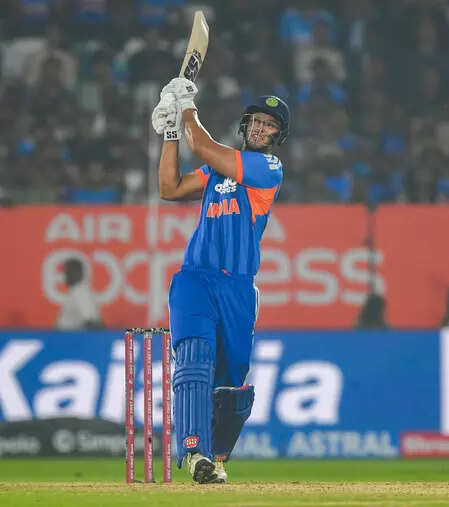
New Delhi: When the 2024 T20 World Cup squad was selected, Shivam Dube’s inclusion ahead of Rinku Singh raised eyebrows. Rohit Sharma, then the captain, had slammed the Impact Player rule in the IPL claiming it was detrimental to the growth of all-rounders. And here, Dube was picked ahead of Rinku for his ability to bowl. When it came to it, Dube did not bowl in India’s World Cup title run, but his contributions in the middle proved pivotal. The all-rounder scored 31 not out against the USA, 34 against Bangladesh, 28 against Australia and a vital 27 in the final against South Africa.The previous management used Dube as a backup for Hardik Pandya but under Gautam Gambhir, he has blossomed and created an identity of his own. In the past two years, he has grown leaps and bounds, and is in the team for a specific role — dismantle spinners in the middle overs. He is not only navigating the side through tricky phases with his six-hitting but also chipping in with the ball.
T20 World Cup | ‘Our flight is booked and we are going’ – Suryakumar Yadav on Pakistan’s boycott
Aditya Tare, his former Mumbai captain, compares him to a gladiator with a bat in his hands and someone who has a monster mentality.“Right from the start, one thing that really stood out was his willingness to win the game with both bat and ball. He wants to be in action. He has bowled in every phase in domestic cricket. He never hides away from challenges and cherishes pressure situations,” Tare tells TimesofIndia.com.The CSK hand
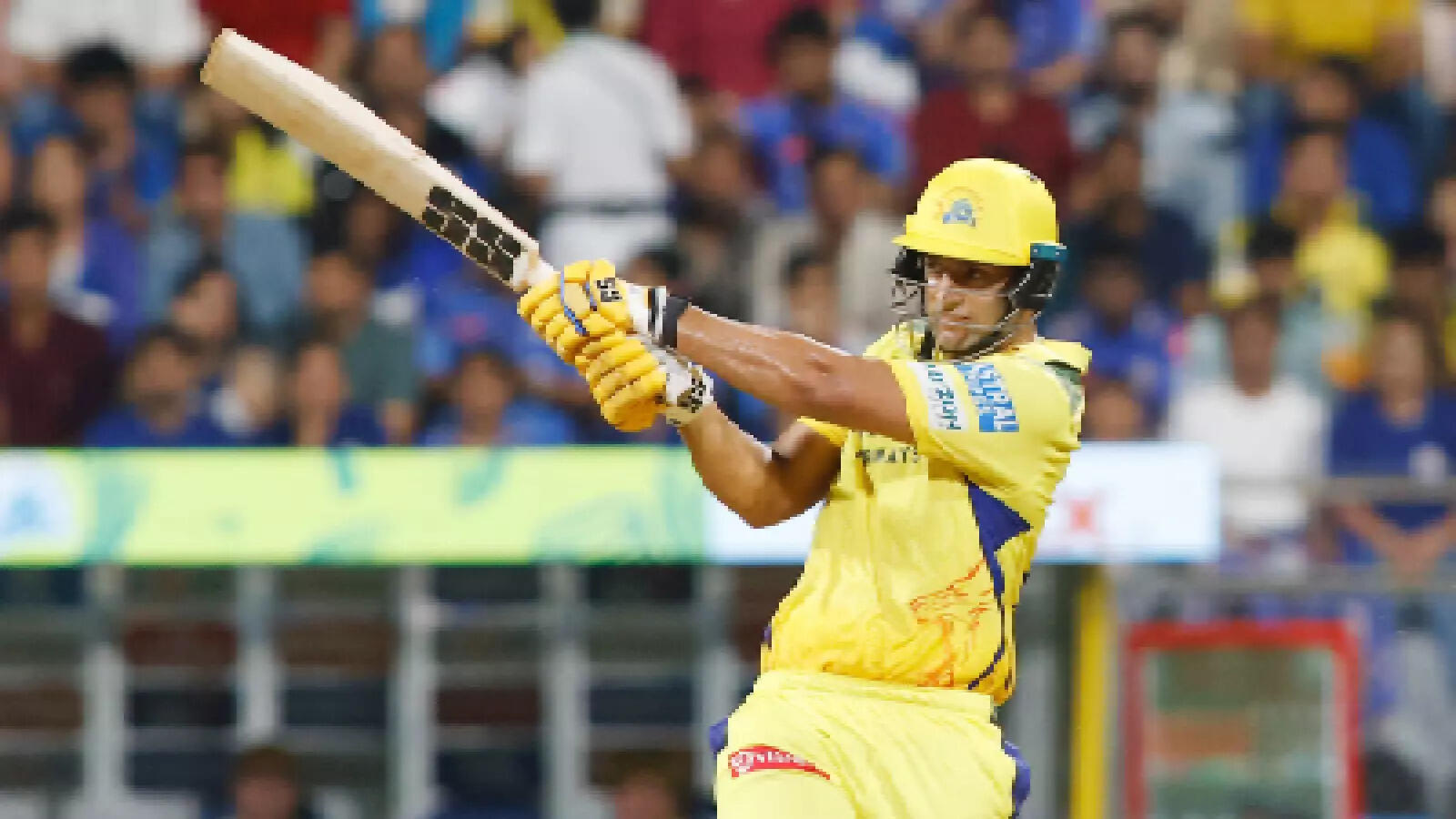
File photo of Shivam Dube, who plays for Chennai Super Kings in the IPL. (Photo- X/IPL)
Since joining the Chennai Super Kings in 2022, Dube has been a revelation. Neither Royal Challengers Bengaluru in 2019 nor Rajasthan Royals in 2020 and 2021 offered Shivam as long a run in the playing eleven as he has received with the five-time IPL champions.“Belief” is the word Tare used when asked about the secret sauce behind the successful resuscitation of Shivam’s short-format career.“The credit must go to CSK. They gave him a specific plan and belief, which helped him fight his way back into the Indian team. His determination is unmatched,” says Tare.Across four IPL seasons, Dube’s strike rates read 156.21, 158.33, 162.29 and 132.22. He struggled in IPL 2025, and his team suffered the most, finishing at the bottom of the points table.
Dhoni and Fleming gave him a lot of backing and clarity in his role. They made it very clear how they wanted him to play
Rajesh Dube, Shivam’s father
Rajesh Dube, Shivam’s father and a wrestler in his youth, hails CSK’s former captain MS Dhoni and coach Stephen Fleming.“Dhoni and Fleming gave him a lot of backing and clarity in his role. They made it very clear how they wanted him to play,” says Dube Sr.Dube Sr. further shared that since roping in Shivam, CSK had hinted that he was going to be the guy for them. “The faith shown in him has done wonders to his confidence, which we can see in his performances.”The chink in the armour
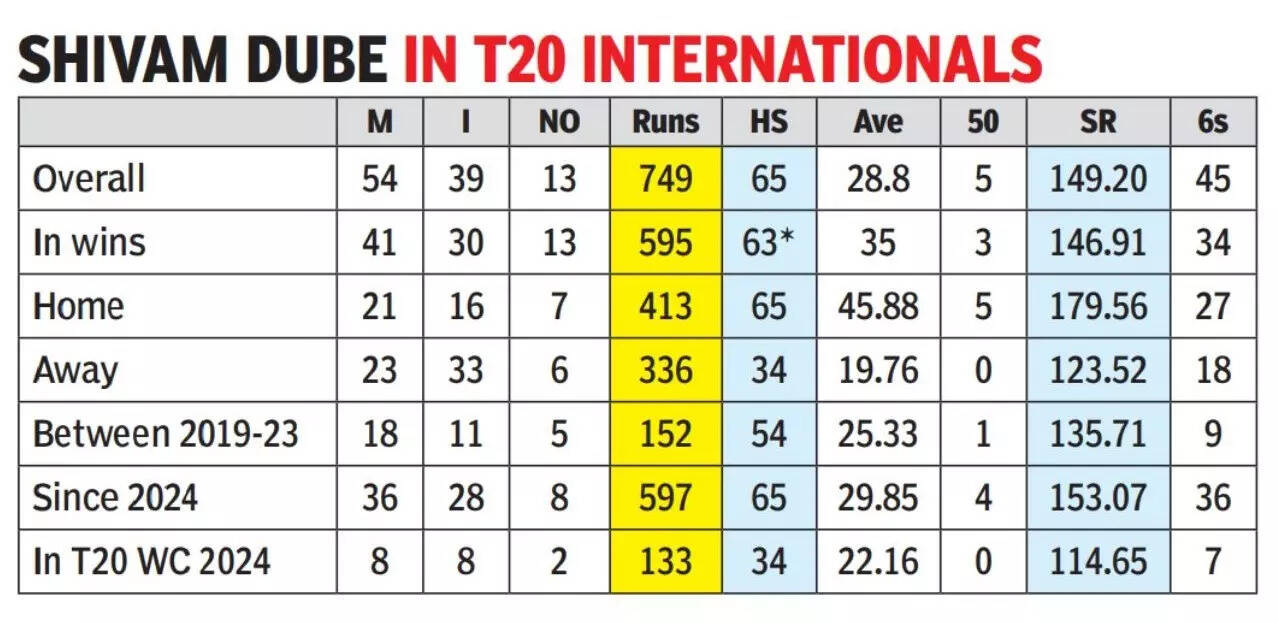
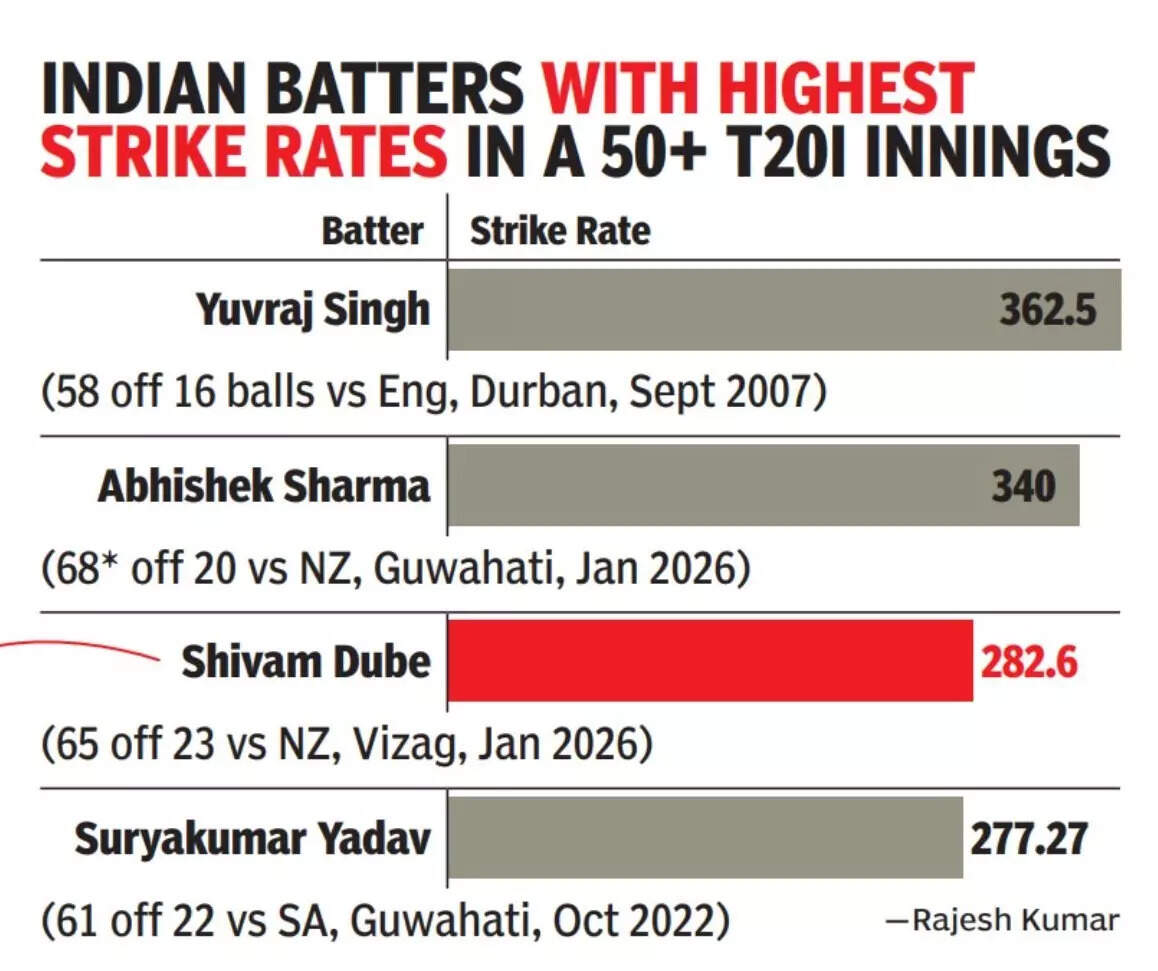
Shivam Dube’s record going into the 2026 T20 World Cup.
Despite his six-hitting prowess, the vulnerability against short-pitched bowling was exposed in the opening game of IPL 2023 against the Gujarat Titans where Alzarri Joseph and Mohammed Shami tested him with a barrage of bouncers.“Yes, he has an issue with fast bowlers, but when it comes to spinners, he’s a very clean hitter and he’s a tall guy. He has a different reach compared to some other batters, so spinners have to adjust their length according to him,” MS Dhoni had said back then.But Shivam, whose high backlift sparked comparisons with Yuvraj Singh, took it as a challenge and reached out to Pravin Amre, the man who first spotted him as a teenager during an Air India trial. Amre, who has also worked with Shreyas Iyer — another batter who initially struggled against short-pitched deliveries — explained the changes.
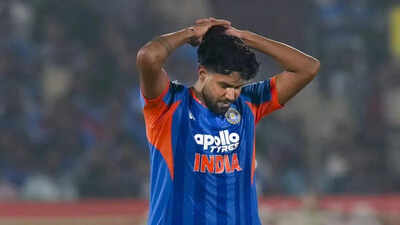
Shivam Dube during a T20I against New Zealand. (IANS)
“He used to be more side-on and struggled with balls into the ribs. We worked on that. He now has a more open stance, which has also opened up his front toe, and now you can see the monstrous sixes he hits against pacers as well,” laughs Amre.“Power was never an issue with Shivam. It was a few technical things.”Amre recalls young Dube and what impressed him when he first saw the teenager. “I was with Air India and we spotted him very early. We saw the talent, which is why we picked him and offered him a contract,” he says.“I was with Delhi Daredevils back then and brought him for the trials. He was not selected, but it gave him confidence,” adds Amre.Method behind the madness
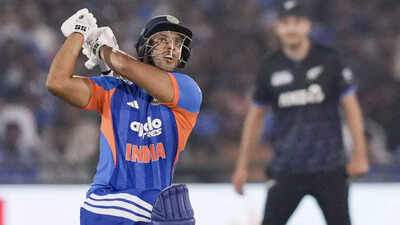
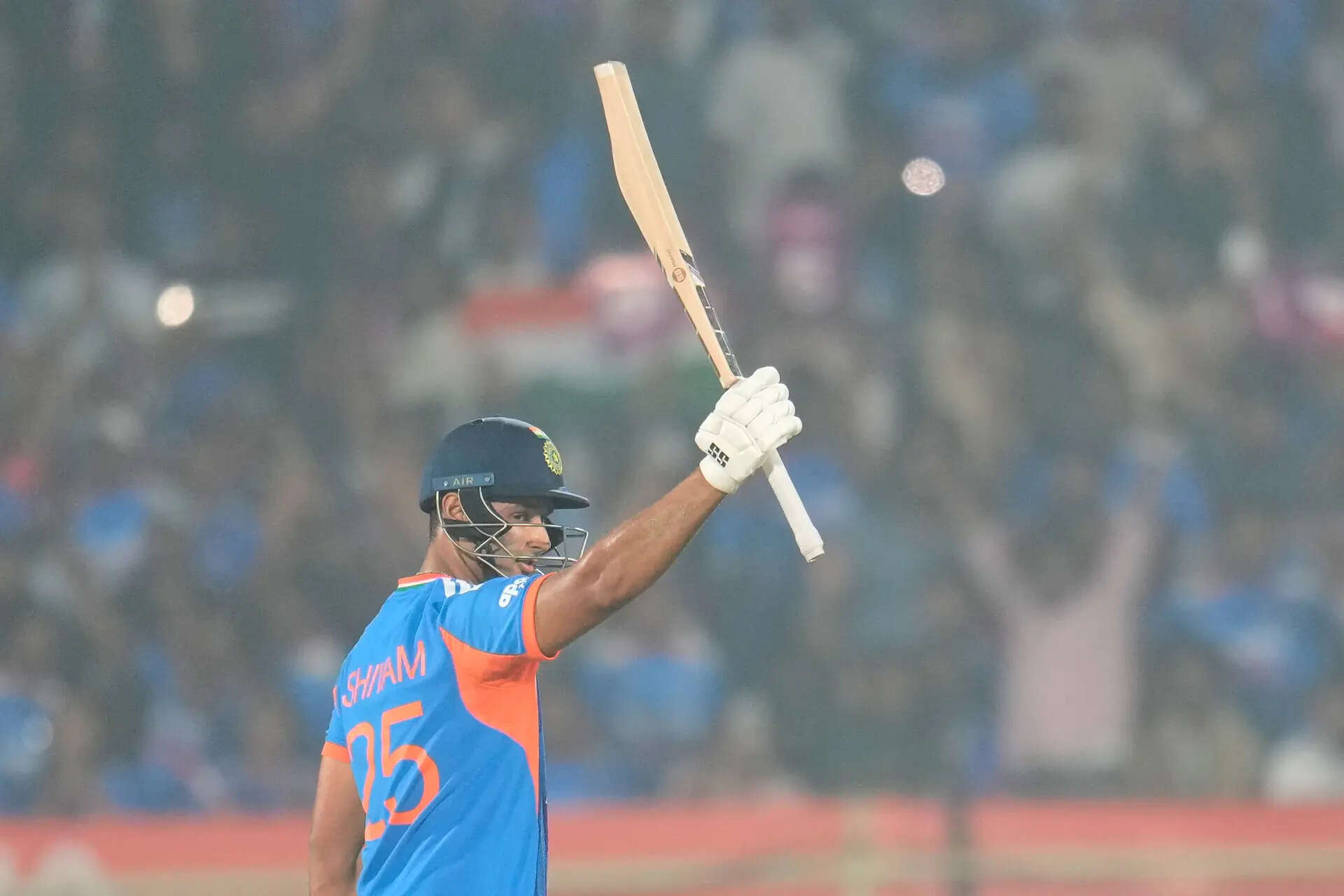
India’s Shivam Dube celebrates after scoring fifty runs during the fourth T20 cricket match against New Zealand in Visakhapatnam. (AP)
In his T20I career, Dube has smoked 46 sixes, and for CSK in the last four seasons, he has smashed 100.“I had seen him hit backfoot punches effortlessly through cover and point against seamers. That was enough for me to realise he is a top batter. His height, reach and power make him special. Spinners ko daalne nahi deta bowling,” recollects Tare.“He has a stable base and plays in the V. You will see most of the sixes he hits are down the ground,” he says.If one goes through Shivam’s numbers or binges his batting highlights from the past two years, the reason for his rise stands out. CSK is the reason the world knows him as a prolific six-hitter, followed by the role clarity first provided by his IPL franchise and then by the Indian team management.For Dube, however, improvement has come because of regular opportunities in top-flight cricket.
Shivam Dube in numbers.
“It’s just the hard work I’m doing. I’m getting better with my mindset because I’m playing those matches and batting in those situations. So, I know what’s going to happen and what a bowler is likely to try against me,” Dube said at a post-match press conference in Visakhapatnam.While dismantling spinners remains his primary role in the middle overs, Dube believes his growing comfort against fast bowlers has added another dimension, enabling him to apply sustained pressure on the opposition.“I worked really hard, but I got the opportunity to bowl, bat and do everything in the match. Experience has come to me and it is going in the right direction. Players upgrade themselves all the time.“All players, spinners, fast bowlers and teams upgrade themselves. I can’t be the same as I was. I try to be a little better and a little smarter in the next game. I have learned what my strengths are and where I can target them.”
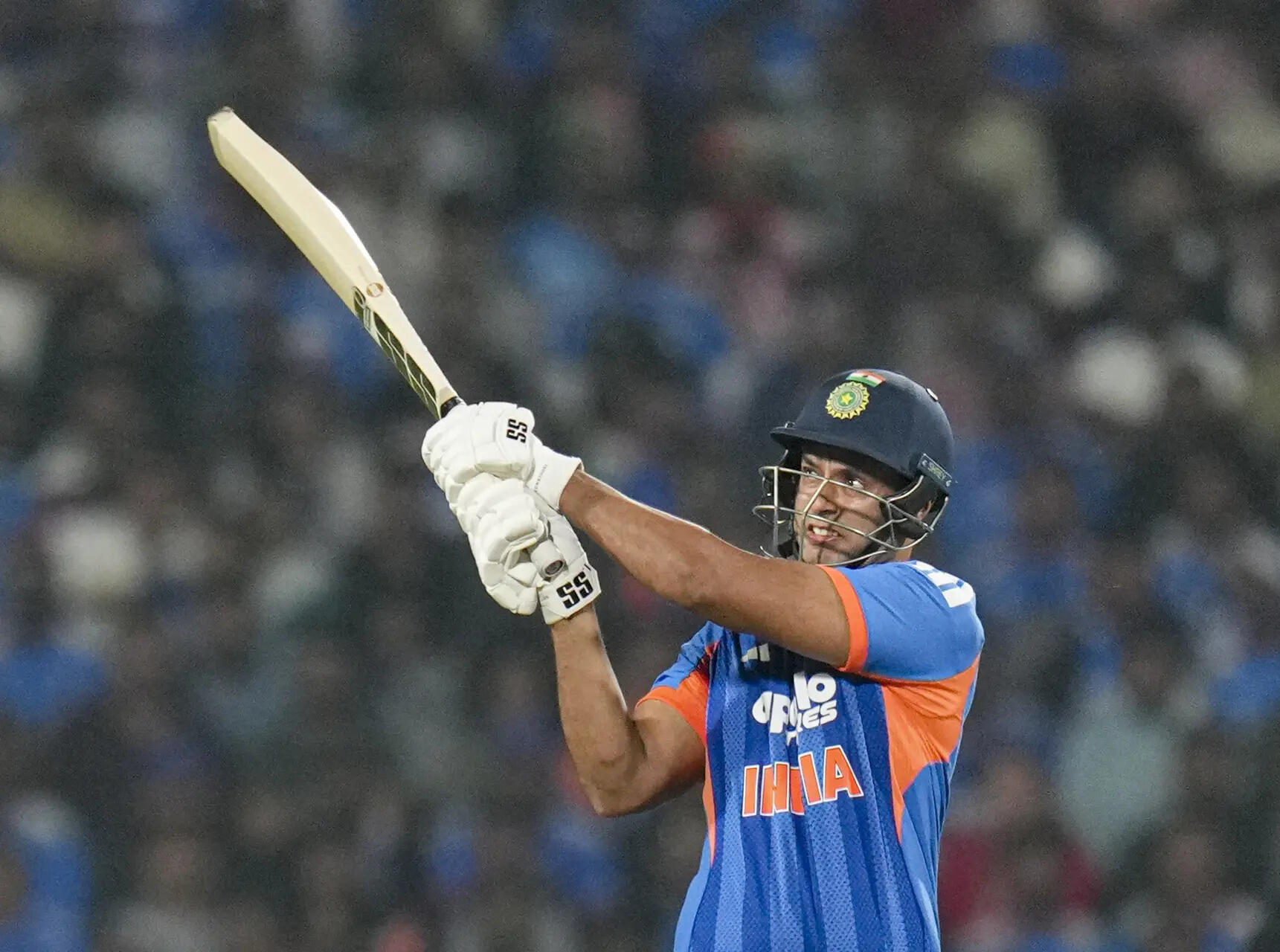
Shivam Dube plays a shot during the first T20I cricket match between India and New Zealand at Vidarbha Cricket Association Stadium in Nagpur. (PTI)
Dube believes his improved comfort against fast bowlers helps him put more pressure on the opposition.“It’s really important. It’s about the matchup. They want me to hit spinners. That is my role to keep the strike rate high in the middle overs. That is what I always try. It’s not just about spinners but fast bowlers as well.“I know that hitting spinners is my strength. I can put pressure on the opposition at that time, so my mindset is very clear,” he said.Dube will be at home in Indian and Sri Lankan conditions. He has worked on his shortcomings, but it is his strengths that he has taken to the next level. The broad-shouldered bludgeoner of the cricket ball has been given a free hand to take on spinners, and the value he offers in terms of strike rate and tactical advantage gives India a decisive edge.