Sunday, September 27, 2026
Home Blog Page 370

Wembanyama returns, Spurs rout Wolves for 3-2 lead in NBA Playoff series | Basketball

0
Wembanyama returns, Spurs rout Wolves for 3-2 lead in NBA Playoff series | Basketball


Victor Wembanyama scored 27 points and grabbed 17 ‌rebounds to lead hosts San Antonio Spurs past the Minnesota Timberwolves 126-97 and take a 3-2 lead in their Western Conference semifinal series.

Wembanyama returned to action on Tuesday after being ejected in the second quarter of an eventual 114-109 loss to the host Timberwolves in Game 4 on Sunday, when he elbowed the face of an opponent, resulting in an automatic ejection.

“Very, very much,” Wembanyama said when asked how anxious he was to return to the court for Game 5. “I mean, I was fresh, feeling good. But honestly, it’s hard to tell if it’s just, it’s just, it was just getting fired up. Obviously, I’m going to ⁠be excited with butterflies, you know. So excitement is not something abnormal.”

The Spurs led by as many as 18 points in the second quarter before going cold and settling for a 12-point advantage at halftime. After Minnesota rallied to tie the game at 61-all four minutes into the third quarter, San Antonio ran off 30 of the final 42 points of the period to carry a 91-73 lead into the final 12 minutes.

“We went away from what was working, and then, you know, defence just cratered,” Timberwolves coach Chris Finch said. “In the last six minutes of the third quarter, ‌lot of it was just ball contain stuff. And, you know, offensively found stuff that was working, then we just started breaking off plays, you know. And that’s my job. I gotta get us back on track. That’s on me.”

The Spurs stoked the margin to 20 early in the fourth. Minnesota answered with an 8-0 surge to pull within 93-81 with 9:34 remaining but never got closer than 11 points for the rest of the game.

Keldon Johnson added 21 points off the bench for San Antonio, with De’Aaron Fox scoring 18, Stephon Castle hitting for 17 and Devin Vassell and Dylan Harper tallying 12 points each. Harper also grabbed 10 rebounds.

“We played with the appropriate fear, discipline, execution, physicality, poise,” Spurs coach Mitch Johnson said. “And I thought we had it from an array of people tonight, and it was really good to see. We needed everybody, because at different moments of the ⁠game, different guys stepped up.”

Anthony Edwards led the Timberwolves with 20 points. Jaden McDaniels and Julius Randle had 17 points apiece, Ayo Dosunmu ⁠racked up 16 and Naz Reid finished with 12.

Wembanyama was on fire in the game’s early moments, scoring 16 of the Spurs’ first 24 points as San Antonio built a 24-9 lead at the 6:17 mark of the first period. The Timberwolves weathered the storm, with Reid’s driving layup with 23 seconds remaining trimming the deficit to 34-30 after 12 minutes of play.

“We knew it was going to be physical, so just making that ⁠a point of emphasis and trying to keep them off the offensive glass,” Castle said. “I thought we started the game off well, and that’s where our runs came from. But obviously, they’re a good team, you know, they’re going to go on their own run.”

The Spurs ripped ⁠off the first nine points of the second quarter, capped by a three-point play by Castle, to stoke their advantage ⁠to 43-30.

SAN ANTONIO, TX -MAY 12: De'Aaron Fox drives past Julius Randle #30 of the Minnesota Timberwolves in the first half of Game Five of the Western Conference Semifinals NBA Playoffs at Frost Bank Center on May 12, 2026 in San Antonio, Texas. NOTE TO USER: User expressly acknowledges and agrees that, by downloading and or using this photograph, User is consenting to terms and conditions of the Getty Images License Agreement. Ronald Cortes/Getty Images/AFP (Photo by Ronald Cortes / GETTY IMAGES NORTH AMERICA / Getty Images via AFP)
San Antonio Spurs’ De’Aaron Fox drives past Julius Randle of the Minnesota Timberwolves in the first half [Ronald Cortes/Getty Images via AFP]

San Antonio built their margin to 58-40 after a Wembanyama alley-oop dunk with 3:24 left in the period but then missed its final eight shots of the quarter, allowing Minnesota to pull to within 59-47 at the break.

Wembanyama had a double-double in the first half alone, scoring 21 points and collecting 11 boards. Fox contributed 12 points for San Antonio before halftime.

“I think one thing, the one word I’d like to use, just ‘mature,’” Mitch Johnson said of ‌Wembanyama. “There’s a lot that’s happened in the last 48 hours, in the last game, and I think how that young man came out tonight and played in a variety of ways, in a variety of situations, not just in terms of his production, was extremely mature and then defensively, start to finish.”

Dosunmu’s nine points paced the Timberwolves’ offence in the first half ‌while Reid ‌and Edwards added eight points each.

Minnesota continued its charge at the start of the third quarter, tying the game at 61-61 at the 7:51 mark when Dosunmu’s layup culminated a 14-2 run.

“I don’t see nobody in our locker room that [is] worried at the end of the day,” Edwards said. “Man, it’s another basketball game. So you come out, put your boots on and get ready to go to work.”

Game 6 ⁠in the best-of-seven series is Friday ⁠in Minneapolis, while Game 7 – if necessary – would be back in the Alamo City on Sunday.


Foreign outflow worries ‘overstated’: S&P confident about India amid Middle East crisis; says economy ‘fundamentally strong’

0
Foreign outflow worries ‘overstated’: S&P confident about India amid Middle East crisis; says economy ‘fundamentally strong’


Foreign outflow worries ‘overstated’: S&P confident about India amid Middle East crisis; says economy ‘fundamentally strong’
According to S&P Global, fears regarding net foreign investment outflows have been “somewhat overstated”. (AI image)

India is handling global financial headwinds more effectively than the headline figures indicate, and concerns surrounding foreign capital outflows may be exaggerated, according to S&P Global Ratings.The observations come at a time when the Iran conflict has triggered an oil price shock, while persistent selling in domestic equities has pushed the rupee to fresh record lows.India’s current account deficit has narrowed over the past few years, although fluctuations in global crude prices now pose a risk to that improvement. Continued foreign fund withdrawals have further weighed on domestic markets, with both the rupee and Indian equities underperforming several regional peers. Latest data showed India received net foreign direct investment inflows worth $4.6 billion in February after recording outflows for six straight months.Also Read | PM Modi wants Indians to cut gold buying: How much forex can be saved?The agency said the country has adequate financial buffers to manage a wider current account deficit that could emerge because of rising crude oil prices. YeeFarn Phua, Director for Sovereign and International Public Finance Ratings for Asia at S&P Global Ratings, made the remarks during an interview on Friday, according to a Bloomberg report.The assessment also strengthens confidence in India’s macroeconomic fundamentals after S&P upgraded the country’s sovereign rating to BBB from BBB- in August and maintained a stable outlook.Phua said fears regarding net foreign investment outflows have been “somewhat overstated,” noting that a large part of these outflows reflects profit repatriation rather than weakening investor confidence. She added that gross inflows into the country continue to remain healthy. “The broader picture is that the Indian economy remains fundamentally strong and continues to offer substantial investment opportunities,” she said.To reduce the economic impact of the Iran war, India is examining a series of emergency measures aimed at strengthening foreign exchange reserves. These include the possibility of raising fuel prices and restricting non-essential imports such as gold and electronic products. The government has already raised the customs duty on gold and silver from 6% to 15%. The move is aimed at preserving forex for essential items such as crude oil and to ensure food security.Also Read | Gold gets costlier: Why govt raised import duty and what changes for buyers


What you need to know about Karnataka’s Rohith Vemula Bill

0
What you need to know about Karnataka’s Rohith Vemula Bill


Karnataka Rohit Vemula (Prevention of Discrimination, Exclusion or Injustice) (Right to Education and Dignity) Bill, 2026get Cabinet approval in April After months of discussion and debate.

The amended Bill aims to prevent exclusion and injustice while protecting the right to education and dignity of students, teaching faculty and non-teaching staff belonging to Scheduled Castes and Scheduled Tribes (SC/ST). It guarantees equal access to education in all higher educational institutions across Karnataka, including public, private, charitable institutions and deemed universities.

Brief history of the bill

am following Rohit Vemula’s deathA 26-year-old Dalit PhD scholar at the University of Hyderabad, in 2016, political and civil society pressure is building for a dedicated anti-caste discrimination law in higher education.

The Karnataka government started drafting the bill almost a year ago in April 2025, after Rahul Gandhi wrote to the state urging it to introduce the Rohith Vemula Act.

The idea was to create a framework encompassing preventive and remedial measures to address the issues of students and teachers from marginalized communities who continue to face caste discrimination on campuses.

The draft bill went through several iterations. During the Karnataka Budget 2026–27, Chief Minister Siddaramaiah formally announced the government’s intention to introduce the Rohith Vemula Bill. This bill got approval from the state cabinet in April.

What is defined in the Bill?

The Bill defines both caste-based harassment and discrimination, including direct and indirect discrimination.

Caste-based harassment is defined as any hostile, derogatory or offensive behaviour, whether verbal, non-verbal, oral, written, recorded, visual or digital, that humiliates or threatens the dignity of SC/ST persons on the basis of caste.

Discrimination is any intentional or unintentional act or omission that adversely impacts people from SC/ST communities, including failure to treat them equally as others, preferential treatment towards castes considered ‘higher’ in the caste hierarchy, and other similar caste-based practices.

Who is the victim? Do the provisions apply only inside classrooms?

The aggrieved person may be a student or faculty member or employee of the SC/ST community in any higher educational institution who has allegedly faced discrimination and/or caste-based harassment.

The Bill covers not only the places of work and residence within educational institutions, but also all online and offline spaces where students, faculty and staff socialize with each other. These include hostels, health centres, sports grounds, staff quarters, parks, roads, canteens and transport facilities.

What are some important provisions of the bill?

The Bill states that institutions of higher education shall be open to all persons regardless of their sex, gender, race, caste, religion, sexuality or disability, and clearly states that no person belonging to SC/ST communities should be subjected to discrimination or caste-based harassment.

It says, “It shall not be lawful for any institution of higher education to impose on any person any test of religious belief or profession in order to entitle him to be admitted thereto as a teacher or student or to hold any office thereunder or to graduate therefrom or to enjoy or exercise any privilege prescribed.”

The Bill recognizes the right of individuals from SC/ST communities to organize collectively, form unions, promote anti-caste discussions through reading clubs, refuse to participate in programs and activities that reinforce caste prejudice, and not be subjected to punishment or negative assessment for asserting their views against caste. It also supports the right of community members to maintain privacy regarding their caste identity.

What can be called caste-based oppression?

One of the most detailed sections of the bill is the list of prohibited acts. It identifies 30 prohibited discriminatory acts on the basis of race.

These include admissions and hiring practices, such as asking questions that probe social background or family occupation in a discriminatory or disrespectful manner; Denial of admission despite meeting admission criteria; Accepting or rejecting applications on the basis of caste; And violation of reservation policies.

It also includes discrimination within educational spaces, including segregation within classrooms or educational settings; exclusion from class, laboratory, or extracurricular activities; unequal access to faculty contacts; Discriminatory assessment in examinations; And forcing students to do activities they would not normally do. The Bill also bans curriculum content that glorifies certain castes or denigrates SC/ST communities.

Institutional and administrative barriers are also addressed, such as ensuring access to opportunities that favor non-SC/ST individuals; Arbitrarily forcing students to enroll in particular courses; changing norms to their detriment; excluding them from committees or decision-making bodies; and failed to provide basic student facilities.

Financial exploitation is another category, which includes demands for payments beyond declared admission policies, forced financial contributions, withholding of documents for money and arbitrary delays in scholarship distribution.

The bill prohibits coercive practices such as forcing people to participate in religious or cultural events against a student’s beliefs, taking on uncompensated labor beyond specified duties, and steering individuals into inappropriate occupations or career paths based on race.

It addresses stigma and restriction of rights, including disclosing admission status through reservation categories, labeling students as “reserved category” or “quota students”, attributing academic poor performance to caste, barring participation in democratic or secular associations, restricting reporting of unfair practices, and limiting access to internships or work opportunities of their choice.

Not taking action on a discrimination complaint within the time prescribed under the Act and creating an intimidating or hostile environment for the aggrieved person after filing the complaint would also amount to caste-based harassment.

What is the prevention mechanism?

According to the Bill, every higher educational institution will have to constitute an Equity Committee, in which at least 80% of the members will be from the SC/ST community. The committee should consist of a Presiding Officer who is from the SC/ST community, and above the rank of Assistant Professor in the institution, two staff/faculty members, one administrative staff, one member of the NGO committed to the cause and two students from the SC/ST community, one of whom should be a woman.

The aggrieved person can submit a complaint to the presiding committee within three months from the date of the incident. If the complainant does not agree to conciliation, the Committee will have to initiate an investigation into the complaint.

If Prima facie If any case of atrocities comes to light, a complaint has to be lodged with the law enforcement agencies within seven days. The committee may recommend suspension of the accused pending investigation.

What are the remedies for the victim and punishment for the perpetrators?

Measures include Administrative intervention that will eliminate the adverse impact, reasonable adjustments, monetary compensation, counseling assistance and any other measures deemed necessary.

Students found to have engaged in discrimination or caste-based violations may face penalties, including exclusion from hostels, campus, examinations and other activities; withholding results; suspension; Or expulsion.

Faculty or staff found responsible may face adverse comments in performance evaluations, be deprived of supervisory duties, be denied employment or contract renewal, be withheld from promotion or salary increases, demotion, pay or salary reductions, suspension, or dismissal.

The severity of the penalty will be determined by factors, including the nature and severity of the harassment; the age or condition of the offender; the frequency and prevalence of the conduct; any resulting physical or mental harm; The suffering caused to the victim; and the extent of its impact on their work or academic performance.

For higher educational institutions found violating the provisions, the Bill proposes a maximum fine of Rs 10 lakh or denial of financial aid.

What you need to know about Karnataka’s Rohith Vemula Bill

The Karnataka Rohith Vemula (Prevention of Discrimination, Exclusion or Injustice) (Right to Education and Dignity) Bill, 2026 received cabinet approval in April after months of deliberations and debate. The amended Bill aims to prevent exclusion and injustice while protecting the right to education and dignity of students, teaching faculty and non-teaching staff belonging to Scheduled Castes and Scheduled Tribes (SC/ST). It guarantees equal access to education in all higher educational institutions across Karnataka, including public, private, charitable institutions and deemed universities. | Video Credit: The Hindu



Gold rate today: Prices surge after Centre raises customs duty on precious metals; check latest prices in your city

0
Gold rate today: Prices surge after Centre raises customs duty on precious metals; check latest prices in your city


Today Gold Rate: Gold prices surged sharply on Wednesday after the central government increased customs duties on precious metal imports, just days after Prime Minister Narendra Modi urged people to not buy gold. The price of 24-carat gold rose by ₹9,338 to ₹16,285.8 per gram, while 22-carat gold climbed ₹8,553.61 to ₹14,917.793 per gram. Despite the sharp jump, 24-carat gold prices are still down 1.07 per cent over the past week and 0.75 per cent over the last month.

In Delhi, gold was priced at  ₹1,62,858 per 10 grams on Wednesday, up from  ₹1,53,520 on May 12 and  ₹1,51,871 on May 7. (File Image/REUTERS)
In Delhi, gold was priced at ₹1,62,858 per 10 grams on Wednesday, up from ₹1,53,520 on May 12 and ₹1,51,871 on May 7. (File Image/REUTERS)

Silver prices also saw a strong rise, increasing by ₹18,532 to ₹2,97,386 per kg.

In Delhi, gold was priced at ₹1,62,858 per 10 grams on Wednesday, up from ₹1,53,520 on May 12 and ₹1,51,871 on May 7. Silver prices in the national capital stood at ₹2,97,386 per kg, compared to ₹2,78,854 yesterday and ₹2,57,150 a week ago.

In Chennai, the rate of gold touched ₹1,64,357.02 per 10 grams, up from ₹1,54,901.68 on Tuesday and ₹1,53,237.84 last week.

Silver prices in the city rose to ₹3,00,062.47 per kg, compared to ₹2,81,363.69 a day earlier and ₹2,59,464.35 on May 7.

Mumbai recorded gold prices at ₹1,62,909.75 per 10 grams, higher than ₹1,53,673.52 on May 12 and ₹1,52,022.87 a week ago.

Silver rates in the financial capital climbed to ₹2,97,563.27 per kg from ₹2,79,132.85 yesterday and ₹2,57,407.15 last week.

In Kolkata, gold prices stood at ₹1,64,189.09 per 10 grams on Wednesday, compared to ₹1,54,748.16 a day earlier and ₹1,53,085.97 on May 7.

Silver prices in the city rose to ₹2,99,765.09 per kg from ₹2,81,084.83 yesterday and ₹2,59,207.2 a week earlier.

The gold August 2026 MCX futures were trading at ₹166620.0 per 10 gm, up by ₹6.01 at the time of publishing.

The silver July 2026 MCX futures were trading at ₹297000.0 per kg, up by ₹6.43 at the time of publishing.

Gold and silver prices are affected by a range of factors, among them the input from major jewelers. Elements such as the global demand for gold, currency variations, interest rates, and government policies all play a role in the prices. Apart from this, international factors such as the state of the global economy and the strength of the US dollar against other currencies also exert an influence on gold rates in the Indian market.


Towards AI-ready data for India

0
Towards AI-ready data for India


India’s digital transformation has made government data more accessible than ever. The next frontier is to make this data work seamlessly with the AI ​​systems that citizens and businesses increasingly rely on for information and guidance.

Aye

Often, critical information related to policy making to ease the lives of citizens exists in government databases, regulatory portals, certification systems and official statistical repositories, which are accurate, structured and authoritative, yet largely inaccessible to analytical and modern AI tools. While AI systems can generate fluent answers from scraped Internet content, they remain isolated from government databases by their design.

As a result, when citizens, policy-makers, or entrepreneurs seek guidance on questions related to regulatory and planning requirements, such as government certification or eligibility for government schemes, using AI tools, AI produces informed guesses rather than definitive answers, not because the knowledge is absent, but because it cannot access the systems where that knowledge actually resides.

As citizens and enterprises alike increasingly turn to AI to unearth such information, and its use is expected to increase as awareness of AI’s capabilities increases, the need for AI-ready data is more urgent than ever.

India generates huge amounts of data in agriculture, commerce, health, education and other civil services.

The e-statistics portal of the National Statistical Office alone contains 135 million records of various socio-economic indicators such as GDP, industrial production, consumer prices and labor force surveys. Through its Digital India initiative, the government has already taken important steps in digitizing public services and improving access to schemes and regulatory information through UMANG, MyScheme and several other portals, generating information on a large scale.

Although these efforts have made information more accessible to citizens and businesses, data remains dispersed across multiple platforms and departments. The next step is to extend this remarkable digital transformation to AI systems by making our information portals interoperable with them, enabling a simple natural-language query to get accurate, authoritative answers directly from these government sources and providing accurate guidance to citizens and businesses in real-time.

Data exists in a number of distinct systems and portals, each designed to serve specific purposes and audiences. A wealth of resources spanning departments, documents and datasets, each providing unique insights, although often in different formats and contexts, is available; There is a need to make them AI-ready. Linking these resources effectively can empower citizens and businesses with a more holistic and actionable view of the information available. AI has already proven it can operate at this scale, processing huge datasets, converting unstructured documents into usable formats, and answering complex questions in natural language.

The opportunity lies in applying this technology to government data. By bridging the gap between AI tools and the rich information already available, we can unlock economic value for millions of users, including enterprises.

Reducing information friction benefits citizens and businesses alike, but can be especially transformative for small businesses and the marginalized, for whom access to timely intelligence and regulatory guidance can open up opportunities that were previously difficult to access. One of the best use cases could be in the MSME sector.

When these enterprises can efficiently access market information, compliance requirements and plan eligibility, they compete more effectively in global markets, optimize their operations and grow faster. Manufacturing competitiveness strengthens, employment expands in cities and towns, and supply chains become more flexible. The multiplier effect of improved information access on this huge enterprise base translates into significant economic acceleration. With such enablement, the MSME sector can truly act as a champion as envisaged in this year’s Budget.

All this is possible only when we have AI-ready data. A weak data foundation cannot be compensated for by AI. NSO India, being the nodal agency for official statistics for the Government of India, has taken several steps for data harmony such as national meta data structure, statistical quality assurance framework, compilation of unique identifiers, and codes and taxonomies to be used while creating planned data layers for interoperability.

The data accessibility requirement is met through a digital bouquet for data dissemination consisting of a website, eSankhyiki portal, mobile app, microdata portal and metadata portal. These applications provide government data in an interoperable manner using APIs for consumption by both humans and machines. Based on these parameters, NSO India has AI-ready data for use.

On February 6, 2026, the National Statistical Office, India took a significant step forward by launching a Model Context Protocol server, which maintains an open technology layer on the eSankhyiki repository. This infrastructure allows AI systems to connect directly to datasets on eSankhyiki and query them programmatically. Now anyone can ask an AI assistant about pricing trends, employment patterns or industrial production and get answers synthesized from official data in real time.

Market analysis shows that previously sought-after specialized expertise is becoming accessible through natural language queries. Immediate use cases started coming from users, from dashboard creation to deep-dive data analysis. This represents a fundamental shift in how government data serves the economy.

In an AI-driven world, more than just publishing and organizing data is required. It must be reliable, interoperable, relevant and machine-usable. Users need to know where the data comes from and whether they can trust it. Privacy protection needs to be built into the architecture, not added as an afterthought. The governance framework needs to clearly define lawful use. Quality assurance needs to be maintained continuously, flagging anomalies before they are propagated through the AI ​​system.

These elements determine whether AI produces reliable outputs and builds public trust. These safeguards are included by design in the NSO implementation. MCP provides access to verified official data through server controlled protocols while keeping the data close to its official source. When datasets are standardized, agreed upon, and made searchable through common APIs, they become an AI-ready foundation on which any model or application can safely build.

The initial deployment includes seven datasets: Periodic Labor Force Survey, Consumer Price Index, Annual Survey of Industries, Index of Industrial Production, National Accounts Statistics, Wholesale Price Index and Environmental Statistics, with more to come in the future. Each may be interrogated individually or in combination.

Consider what this makes possible. An MSME exploring new markets can analyze employment trends and industrial potential in the target sectors through an interaction with the AI ​​assistant. A researcher studying regional economic patterns can combine industrial production data with labor force surveys without manually reconciling different formats and time periods. Infrastructure development occurs through progressive integration. As more authoritative data sources join the network, queries can integrate them with other datasets. Each new connection expands and multiplies the analytical possibilities across all existing sources, enabling deeper insights and more comprehensive decision making.

MOSPI’s data reconciliation and dataset linking initiatives are laying the foundation for a data ready future. Government datasets can become accessible foundations upon which any developer, researcher, or enterprise can build. Small businesses gain access to market information that was previously only available to large corporations. Policy makers receive real-time feedback. Researchers connect datasets that were previously incompatible.

As datasets connect across the network, each connection multiplies the analytical possibilities across all existing sources. Economic benefits will increase as the number of adoptions increases. When data becomes a horizontal capability that spans all sectors, innovations stop being trapped in silos.

This approach recognizes a fundamental principle: those who generate the data should benefit from it. India’s competitive advantage in the AI ​​era will come from responsibly mobilizing diverse, relevant, high-quality data.

The question is no longer whether data can create economic value. The question is whether we design systems where that value is shared widely to empower both prosperity and the public good. AI-ready data infrastructure, built with a foundation of trust and security measures, transforms scattered information into accessible intelligence.

Thus India builds the data foundation that powers AI for economic growth at population scale en route to a developing India.

(Views expressed are personal)

This article is written by Saurabh Garg. Secretary, Ministry of Statistics and Program Implementation and Shalini Kapoor, Chief Strategist, Data and AI, Onestep Foundation.


Fighting in Sudan’s Blue Nile State displaces thousands | Sudan war

0
Fighting in Sudan’s Blue Nile State displaces thousands | Sudan war


NewsFeed

Al Jazeera’s Hiba Morgan reports from Al Karama camp in Al-Damazin, Blue Nile State, southeastern Sudan. Fighting between the Sudanese army and the paramilitary Rapid Support Forces has displaced thousands in Blue Nile State, with more than 28,000 people forced from their homes between April and January alone.


Asian stocks today: Markets mixed as AI rally loses steam, oil prices and inflation worries weigh on sentiment

0
Asian stocks today: Markets mixed as AI rally loses steam, oil prices and inflation worries weigh on sentiment


Asian stocks today: Markets mixed as AI rally loses steam, oil prices and inflation worries weigh on sentiment

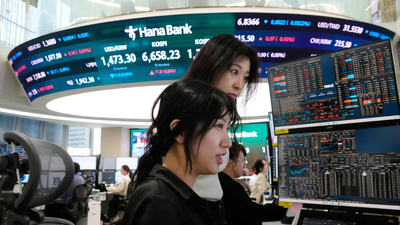
Asian markets traded mixed on Wednesday as fading momentum in artificial intelligence-linked stocks, elevated oil prices and concerns over persistent inflation kept investors cautious.Japan’s Nikkei 225 edged up less than 0.1% to 62,774.94, while South Korea’s Kospi gained 0.9% to 7,708.05 after recovering some recent losses.Australia’s S&P/ASX 200 slipped 0.3% to 8,645.80.Hong Kong’s Hang Seng Index fell 0.4% to 26,246.29, while China’s Shanghai Composite was little changed, down less than 0.1% at 4,213.86.As per Reuters, MSCI’s broadest index of Asia-Pacific shares outside Japan fell 0.6% for a second straight session, as markets reacted to stalled US-Iran talks and hotter-than-expected US inflation data.

AI stocks under pressure

South Korean markets remained volatile after a recent AI-driven rally pushed stocks to record highs. Korean shares had earlier dropped as much as 3.2% before recovering.Shares of Samsung Electronics plunged 5.7% after the company failed to reach a wage agreement with its labour union, raising the possibility of a strike involving more than 50,000 workers that could affect chip production.On Wall Street, major US indices ended lower overnight, with technology stocks leading declines.The S&P 500 slipped 0.2% from its record high, while the Nasdaq Composite fell 0.7%, AP reported. Intel dropped 6.8% after a strong rally earlier this year, while Micron Technology lost 3.6%.“Corporate earnings and AI momentum are acting as the market’s primary shock absorbers, but the road is getting significantly rougher,” Tim Waterer, chief market analyst at KCM Trade, told AP.“With oil prices becoming entrenched at elevated levels and a diplomatic breakthrough between the US and Iran remaining elusive, the easy bullish narrative is becoming much harder to maintain.”

Oil prices remain elevated amid Iran tensions

Oil prices eased slightly on Wednesday but remained near multi-month highs due to ongoing tensions in the Middle East and continued disruptions around the Strait of Hormuz.Benchmark US crude fell 58 cents to $101.60 a barrel, while Brent crude slipped 66 cents to $107.11.Oil has largely remained above $100 per barrel since US and Israeli strikes on Iran earlier this year and Tehran’s effective closure of the Strait of Hormuz disrupted global supply flows.The fragile ceasefire between the US and Iran has also failed to reassure investors, with US President Donald Trump saying on Tuesday that he does not believe China’s help is necessary to end the conflict ahead of his meeting with Chinese President Xi Jinping later this week.“We’ve seen this movie before, and we know it doesn’t end with a breakthrough agreement that resets the US-China relationship,” Phillip Wool of Rayliant Investment Research told Reuters.

Inflation fears dampen rate cut hopes

Investors also reacted to stronger-than-expected US inflation data, which reinforced expectations that the Federal Reserve may keep interest rates elevated for longer.“A hotter-than-expected inflation report and persistent geopolitical tensions reminded investors that sticky prices and elevated energy costs are not going away anytime soon,” IG analyst Tony Sycamore told Reuters.Markets have largely ruled out any Federal Reserve rate cuts this year, while expectations for a rate hike by December have risen sharply, according to CME FedWatch data.US Treasury yields remained elevated, with the benchmark 10-year Treasury yield holding near 4.47%, its highest level since July.In currency markets, the US dollar strengthened slightly against the Japanese yen to 157.77, while gold edged 0.1% higher and bitcoin slipped marginally.


Jason Collins, NBA's first openly gay player, dies aged 47

0
Jason Collins, NBA's first openly gay player, dies aged 47


Collins shared late last year that he had been diagnosed with an aggressive form of brain cancer.


OnePlus Nord CE6, Nord CE6 Lite and the maturing affordability

0
OnePlus Nord CE6, Nord CE6 Lite and the maturing affordability


There’s a clear trajectory. The first Nord ‘CE’ phone by OnePlus arrived back in 2021, and the price tag at the time was around ₹22,999. The first Nord ‘CE Lite’ phone came a year later, at around ₹19,999. Fast forward to now, and two things stand out. First, the launch windows of the OnePlus Nord CE6 and the OnePlus Nord CE6 Lite are at their narrowest point rather than months apart, which simplifies choice for consumers. Secondly, both phones have grown up to different degrees in price, which is where the challenge is to deliver a more capable spec sheet and a notch better experience. To the second point, OnePlus has managed a fine enough distinction between both propositions, and that’s also the reason for pricing differences.

The OnePlus Nord CE6 Lite (left) and the Nord CE6 have largely avoided price overlaps. (Official images)

Here’s how the pricing stacks up. The Nord CE6, with a choice of two specs and three colour options, stacks up at ₹29,999 (8GB+128GB) and ₹32,999 (8GB+256GB). The Nord CE6 Lite finds its anchors at ₹20,999 (6GB+128GB), ₹22,999 (8GB+128GB) and ₹25,999 (8GB+256GB). The risk of overlap as I’d pointed out earlier, has been largely avoided. Specifically for the Nord CE6 Lite, OnePlus had for all its previous iterations, managed to stick to the same entry price point, but psychologically, that’s changed now. It now sits just above ₹20,000 and will be perceived slightly differently.

It is this value difference that defines the choice of the Qualcomm Snapdragon 7s Gen 4 in the Nord CE6 and the MediaTek Dimensity 7400 for the Nord CE6 Lite. These aren’t direct competitors, with the Snapdragon having a distinct performance as well as gaming experience advantage, and higher memory bandwidth which should be handy when multi-tasking. The Dimensity 7400 will deliver a notch better efficiency and therefore a longer gap between charges, and fairly stable performance for the typical audience that’d buy a mid-range Android phone.

If you must pick wisely depending on the specific usage patterns, as you should, both Nord CE6 and Nord CE6 Lite do very well in terms of consistency and intuitiveness. I was particularly impressed by the thermals on the Nord CE6 Lite, since it is easier to strain a slightly less capable chip. There will be an occasional momentary hesitation, specifically when half a dozen apps are open at the same time, but OxygenOS is more than optimised to keep things smooth and clutter free for this hardware combination to work. The Nord CE6 Lite plays in a more price sensitive segment, and therefore difficult to make an outright suggestion. But, do try to get the 8GB memory variant for better performance headroom.

In contrast, the Nord CE6’s Snapdragon 7s Gen 4 is expectedly a smidgen more responsive even under app load (I say a smidgen, because real world usage averages out). Also, decidedly snappier when opening or switching apps when there isn’t extra load on the resources in the background. Since the amount of memory is same in both options for the Nord CE6, there is a clear recommendation to get the higher storage variant if the budget allows.

From the front, both the OnePlus Nord CE6 and the Nord CE6 Lite may look similar particularly with the flat slab sides, unless you’d notice the slight display size differences (unlikely though, for the human eye). OnePlus has differentiated significantly at the back, with the Nord CE6 getting a square camera island, while the Nord CE6 makes do with a vertical layout. Blue stands out as the colour I’d recommend for the Nord CE6 amongst Lunar Pearl and Black. The Nord Nord CE6 feels decidedly premium to hold, and rather well balanced too.

Both phones have parity as far as the 50-megapixel main wide camera paired with an auxiliary lens is concerned. Safe to say that till some future updates refine this, the photography performance of the Nord CE6 and the Nord CE6 Lite is at best acceptable. Photos are fine in terms of capturing the moment and a sense of the place, but dynamic range, crispness and colour richness all need some work. Complex lighting often makes this camera stumble in terms of exposure or noise. Overloading AI image tweaking features cannot compensate for baseline performance that still needs to be achieved.

Battery life is where there are no complaints. The Nord CE6 has a large 8,000mAh battery, which if the largest in this price band if I’m not mistaken. You’re looking at a fully charged Nord CE6 at 8am, still holding close to 50% charge at 8pm when used as heavily as a primary phone would be including some camera usage for the sake of this review. That’s a good 7.5 hours of screen usage time. The Nord CE6 Lite gets a 7000mAh battery, which in the drain from 100% to 50% returns a bit more than 6.5 hours of screen usage. Used right, these may be able to get through two days of usage without ease.


Argentines protest against Milei’s defunding of public universities | Education

0
Argentines protest against Milei’s defunding of public universities | Education


NewsFeed

Large crowds marched across Argentina’s major cities to demand that President Javier Milei comply with a university funding law, and reverse sweeping budget cuts to the country’s tuition-free public university system.