Al Jazeera’s Rosalind Jordan and Almigdad Alruhaid report on the latest developments after US President Donald Trump rejected Iran’s response to the US peace proposal, as negotiations increasingly focus on sanctions, ceasefire guarantees, and control of the Strait of Hormuz.
British pop star Dua Lipa has filed a lawsuit against Samsung Electronics seeking at least $15 million in damages, accusing the South Korean tech giant of using her image without permission to market its television sets. The lawsuit alleges that Samsung featured a copyrighted image of the pop star on the front of cardboard boxes containing televisions for retail sale, enabling the company to benefit from what seemed like her endorsement of the product. The image alleged to have been used on the TV boxes is titled “Dua Lipa – Backstage at Austin City Limits, 2024,” and Lipa is the owner of all rights, title and interest in the image, the lawsuit said. The suit was filed on Friday in the California federal court.
Dua Lipa says Samsung used her image to sell TVs without consent (File photo/REUTERS)
A spokesperson for Samsung Electronics declined to comment, saying it was unable to comment on pending litigation, while Dua Lipa‘s lawyers did not immediately respond to a request for comment on the case. Besides copyright and trademark infringement, Dua Lipa has accused Samsung Electronics of breaching publicity rights.
Lipa’s lawyers have attached screenshots of social media postings and comments in the filing claiming that the pop star’s image on the front of the boxes pushed potential customers to purchase the product. One of these screenshots shows a fan commenting that they would get the TV “just because Dua is on it.” The “Levitating” singer became aware of Samsung’s alleged infringement in June last year and demanded that Samsung stop using her image, but the electronics manufacturer repeatedly refused to do so, her lawyers said.
Samsung’s alleged unauthorised use of Dua Lipa’s image has “caused and continues to cause dilution” of the pop star’s “brand identity and commercial goodwill by falsely conveying to the consuming public that she approves of and endorses” the products in question, they added.
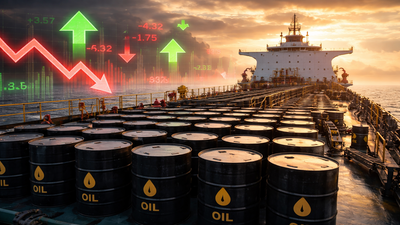
Oil prices surged sharply on Monday after tensions in the Middle East intensified and the strategically crucial Strait of Hormuz continues to stay shut, with disruptions now having crossed 70 days. Meanwhile, the Middle East conflict has continued to intensify as US President Donald Trump rejected Tehran’s response to Washington’s peace proposal and Iran issued fresh threats of violence in the Strait of Hormuz, reigniting fears over global energy supply routes.Brent crude, the international benchmark for oil, climbed 2.69% to $104.01 a barrel for July delivery. US benchmark West Texas Intermediate (WTI) rose 2.54% to $97.84 a barrel.The rally came as hopes of an imminent end to the 10-week-long US-Iran conflict faded. Trump on Sunday described Iran’s response to a US-backed peace proposal as “unacceptable”, effectively dampening expectations of breakthrough talks that could have restored stability to oil flows through the strategic Strait of Hormuz.
Watch
$6 Gas Nightmare Forces Trump Into Shock Action, Pause On Federal Tax Soon? Full Details
Attention has now shifted to Trump’s upcoming visit to Beijing on Wednesday, where he is scheduled to meet Chinese President Xi Jinping. US officials said discussions are expected to focus on trade ties between the two nations and the Iran situation.“Market attention now shifts squarely to President Trump’s visit to China this week,” IG market analyst Tony Sycamore said in a note. “There is hope he can persuade Beijing to leverage its influence over Iran to push for a comprehensive ceasefire and a resolution to the ongoing disruption in the Strait of Hormuz.”Adding to supply concerns, Saudi Aramco chief executive Amin Nasser warned on Sunday that the global market has already lost around one billion barrels of oil over the past two months. He cautioned that even if supply normalises, energy markets would take time to stabilise.Meanwhile, shipping data from Kpler indicated that at least two crude-laden tankers crossed the Strait of Hormuz last week with their tracking systems switched off, a growing tactic aimed at avoiding potential Iranian attacks and keeping Middle East oil exports moving despite heightened risks.Oil prices have continued to be volatile since the US and Israel launched joint strikes on Iran. After the attack, Tehran retaliated by tightening its noose on the strategically crucial Strait of Hormuz, world’s oil pipeline that carries 20% of global energy supplies.
The repeated mention of WFH, reducing imports, avoiding sleep, cutting fuel usage and “living responsibly during difficult times” shows that the government is preparing citizens.
The sectors that are likely to have the biggest impact of the economic shock are the same sectors that PM Modi has repeatedly mentioned in his speech. (AI-generated image)
Prime Minister Narendra ModiHis speech in Telangana on Sunday seemed less like a routine conservation appeal and more like a sign of economic caution from the government at a time of growing stress on global energy markets and India’s foreign exchange reserves.
In the backdrop of prolonged conflict in West Asia and disruption around the Strait of Hormuz, PM Modi urges Indians to revive Work-from-home practices in the COVID-eraPostpone non-essential foreign travel, Reduce use of petrol and dieselAvoid buying gold for a year, cut down on edible oil consumption and reduce dependence on imported chemical fertilizers.
“Today, the need of the hour is that we resume those practices,” the Prime Minister said, referring to WFH, online meetings and video conferences. He also said, “Gold purchasing is another area where foreign exchange is used extensively,” and appealed to citizens to avoid buying gold for weddings for a year.
The comments came as crude oil prices reportedly rose from around $70 a barrel to around $126 amid fears of prolonged supply disruptions, according to the Times of India. India imports about 90 percent of its crude oil needs, making the economy particularly vulnerable to oil shocks and dollar outflows.
The sectors that are likely to have the biggest impact of the economic shock are the same sectors that PM Modi has repeatedly mentioned in his speech.
1. Aviation, tourism and outbound travel
PM Modi’s call to suspend “unnecessary foreign travel” and resume work from home directly points to pressure building in aviation and travel.
Airlines are the first casualties of any oil shock as aviation turbine fuel (ATF) accounts for about 35–45 percent of operating costs. Indian airlines also pay aircraft lease rentals, maintenance contracts and insurance in dollars. According to Reuters report, this means that a weak rupee and expensive crude oil combine to create severe cost pressures.
The government’s messaging shows it expects further increases in ATF prices, higher ticket fares, lower discretionary travel demand and a decline in corporate travel.
The Prime Minister’s emphasis on online meetings, video conferences, working from home and reducing travel effectively signals that demand destruction could form part of India’s economic adjustment strategy, The Times of India reports.
India’s outbound tourism sector has gained momentum after the pandemic. But foreign travel is foreign exchange-intensive as Indians spend heavily on hotels, shopping, airline tickets, education and luxury consumption abroad. If the government informally discourages foreign travel, the impact could spill over to airlines, travel portals, luxury tourism, foreign exchange companies, airport retail, visa services and premium hospitality. This signal becomes stronger because PM Modi has directly linked foreign travel with conservation of foreign exchange.
2. Oil Marketing, Transportation and Logistics
This is the central tension point behind PM Modi’s entire speech.
India consumes about 5.5 million barrels of oil per day and imports most of it. Every sustained rise in crude oil prices increases the import bill rapidly and puts pressure on foreign exchange reserves.
PM Modi repeatedly stressed: “We should use imported petroleum products only as per requirement.”
He also urged metro use, carpooling, EV adoption and rail freight movement. They are not random lifestyle suggestions. They are targeted efforts to reduce oil demand in transportation, India’s largest fuel-consuming sector.
According to India Today, oil companies are incurring losses of around Rs 30,000 crore every month. The under-recovery of petrol is around Rs 24 per litre, while the under-recovery of diesel is around Rs 30 per litre. This means oil marketing companies may soon be forced to raise prices, suffer losses or seek government support. Each of these options harms development.
Higher diesel prices also affect trucking, delivery companies, e-commerce logistics, bus operators, cab services, shipping and FMCG distribution. Transport inflation then spreads to food prices, retail inflation, manufacturing costs and household budgets.
This explains why PM Modi saw fuel conservation as a “national interest” rather than just individual savings.
3. Fertilizer, Agriculture and Rural Economy
One of the strongest warnings in the Prime Minister’s speech concerned fertilizersAs he said: “We must halve the consumption of chemical fertilizers.”
This is politically significant as fertilizer is one of India’s most sensitive subsidy sectors.
India imports large quantities of urea, DAP, potash and fertilizer raw materials. Fertilizer production is closely linked to natural gas prices, global energy markets, and shipping costs. As energy prices rise, fertilizer subsidies increase.
PM Modi clearly linked fertilizer imports to forex tensions, saying: “Another sector that consumes forex is our agriculture.”
If fertilizer prices rise or subsidies become unsustainable, farming costs increase, agricultural margins decline, food inflation increases and rural demand weakens. Farmers also face high diesel costs, expensive transportation and rising input prices for irrigation. This may affect tractor demand, agri-equipment sales, rural FMCG and two-wheeler markets.
The PM’s emphasis on natural farming is also an economic hedge. Reducing imported fertilizer dependence reduces foreign exchange outflow, reduces the subsidy burden and protects agriculture from global commodity volatility. This is why the government is increasingly framing natural farming as both an environmental and economic policy.
4. Gold, luxury consumption and imported consumer goods
Perhaps the most special part of PM Modi’s speech was his appeal to Indians. don’t want to buy gold For weddings for one year. In India, this is an extraordinary request as purchasing gold is culturally ingrained.
India is one of the world’s largest gold importers. Gold imports cost billions of dollars, increase the current account deficit and put pressure on foreign exchange reserves. Unlike industrial imports, gold does not directly boost productive capacity.
If households cut discretionary imports, jewelery retail, luxury fashion, imported electronics, premium appliances, high-end cars and luxury malls could come under pressure. Many consumer electronics sectors are highly import dependent due to semiconductors, batteries, display panels and components sourced from abroad.
Reuters says the weak rupee makes their land costs rise sharply.
The government is concerned that higher oil imports, rising gold imports and slowing exports could widen India’s trade deficit. That is why PM Modi also emphasized on “Make in India” products during the same speech.
5. Manufacturing, MSME and Industrial Production
The broader manufacturing economy may face prolonged stress as almost every industrial sector depends on imported energy.
Higher oil and gas prices affect electricity, freight, chemicals, plastics, packaging, metals and industrial transportation.
MSMEs are particularly vulnerable. Small manufacturers typically operate on low margins, limited pricing power, and expensive working capital. Therefore rising fuel costs, logistics costs, imported raw material prices and interest rates can rapidly reduce profitability.
The Strait of Hormuz crisis is also disrupting shipping routes and freight costs globally. This poses a risk to pharmaceuticals, chemicals, auto components, engineering goods and textiles.
Even if shipping costs rise, crude oil-related inputs increase, and supply chains remain unstable, exporters may not fully benefit from the weak rupee.
The Prime Minister’s appeal to businesses to move goods by rail rather than by road was another signal that the government expects transportation fuel costs to remain high for longer.
coordinated push
Overall, PM Modi’s comments resemble a pre-emptive economic mobilization message.
India has so far shielded consumers from the full impact of the oil shock through tax cuts and price controls, but the speech strongly suggests that the government expects continued pressure on crude prices, a strain on foreign exchange reserves, imported inflation and potentially higher fuel prices soon.
Repeated mentions of working from home, reducing imports, avoiding sleep, cutting fuel use, natural farming and “living responsibly during difficult times” show that the government is preparing citizens for potentially longer-term external economic shocks rather than short-term disruption.
Handpicked stories, in your inbox
A newsletter featuring the best of our journalism
newsexplainer From airlines to gold: PM Modi’s speech has put 5 sectors on alert
Disclaimer: Comments represent the views of users, not of News18. Please keep discussions respectful and constructive. Abusive, defamatory, or illegal comments will be removed. News18 may disable any comments at its discretion. By posting you agree with us terms of use And Privacy Policy.
A documentary exposing Israel’s attacks on Gaza’s hospitals and the killing of 1,700 Palestinian medics won Best Current Affairs at the BAFTAs. During the acceptance speech, filmmakers criticised the BBC for initially funding the film but dropping it, accusing the broadcaster of censorship.
The fall may not have been deep, but the landing has been hard.
A second trophy-less season for Real Madrid, the most successful La Liga and Champions League club, was confirmed in the worst way possible: a defeat at Barcelona, who, with their win, defended the Spanish title.
Recommended Stories
list of 4 itemsend of list
Los Blancos kept the title race alive by their fingernails as they crawled their way to Catalonia, knowing that doing so could result in the cruellest of heartbreaks for their fans. And so it came to pass.
Down by two at half-time at Camp Nou – and it could have been a lot more – hanging in there to limit the damage and humiliation was key, but the 2-0 defeat will have cut deeply for a club that has lifted 36 league and 15 Champions League titles.
The defeat means Real will finish second this season, not an unusual circumstance in what has regularly been a two-horse race in La Liga. The manner, however, of their failure this season – including their quarterfinal exit from Europe’s top table – has left far more questions than answers in the Spanish capital after another season of discontent.
How do Real solve a problem like Mbappe?
The signing of Kylian Mbappe from Paris Saint-Germain two seasons ago was seen as a return to the days of collecting the world’s finest talents and collectively calling them “galacticos”.
Real had just completed the league and European double under the illustrious Carlo Ancelotti, the most successful manager in European history and no stranger to managing the top names, having led a list of galacticos in his previous spell as Los Blancos manager.
Last season did not go to plan, though.
Mbappe’s arrival broke up the 4-3-3 formation that had served Real so well for so long, with English midfielder Jude Bellingham playing a key, advanced role, while Vinicius Junior thrived in front of and around him.
Both were forced to shift position to accommodate Mbappe, who prefers to drop deep from his central position to link up play or run with the ball.
It trod on the toes of the two key performers. Even Ancelotti was not immune to the famed Real chop as rumours circulated all season that his failure to gel the team would bring to an end the Italian’s Spanish love affair.
Heralded as the answer to Madrid’s problems after sweeping through German football with Bayer Leverkusen, Alonso is also hailed as a midfield maestro as a player for both Madrid and the Spanish national team.
Rumours were rife from the off that the players did not buy into Alonso’s system, and friction was often apparent with Mbappe, despite the forward’s refound scoring ability. His 24 goals have him two clear at the top of this season’s Spanish scoring chart.
Alonso’s time was clearly up long before the end came, just after the clock ticked in the new calendar year. Alvaro Arbeloa was given the task of guiding the seemingly rudderless ship to the end of the season as interim head coach.
Mbappe’s troubles were only just beginning, though. By the end of the season, a “Mbappe out” petition raised more than 33 million signatures, and the Frenchman was the latest focal point of the Madridistas’ displeasure.
Reconnecting Mbappe with the fans and connecting him with his teammates’ style of play will be the number one focus for the new season.
Geling three of the world’s leading talents, Kylian Mbappe, Vinicius Junior and Jude Bellingham, has proved to be a tough task for successive Real Madrid managers [Marcelo Del Pozo/Reuters]
Can Real resolve Vinicius Jr’s fallout with fans?
Prior to the campaign waged against Mbappe, Vinicius fell foul of the home support, with boos for the forward ringing around a series of performances either side of the Champions League exit at the hands of Bayern Munich.
The Brazilian went on a 19-game run without a goal for club and country between October 10 and January 11.
Ironically, he broke his unwanted streak in the 3-2 Spanish Super Cup final defeat by Barcelona, Alonso’s last game in charge.
The ruptures were apparent, however, and rumours abounded that the 25-year-old’s stay at the only club he has ever known could be coming to an end.
Manchester United were the first to be linked with a move for the versatile forward, but all of Europe’s elite will be on red alert should there be any indication that Real may consider Vinicius as the way to reshape the team around their most bankable asset on and off the field: Mbappe.
Will Valverde and Tchouameni survive dressing-room bust-up?
As the day of destiny at Barcelona approached, the last thing Real needed were more unwanted headlines, let alone from two of the brighter spots in an otherwise dark campaign.
Uruguay’s Federico Valverde and France’s Aurelien Tchouameni were involved in a training-ground bust-up on Thursday, which left the former needing a trip to hospital for a head injury, ruling the midfielder out of the coming weeks.
Real swiftly fined both players on Friday, but Tchouameni was still named in the starting lineup at Barcelona.
Should Real decide that one or both were required to leave to avoid a potential toxic fallout in the dressing room, then, much like in the case of Vinicius, the phone lines of Europe’s top clubs will be working overtime to seal one or the other.
Real Madrid coach Jose Mourinho, right, is greeted by Pepe, second right, and Cristiano Ronaldo, third right, in 2012, as they celebrate their 32nd La Liga title [Paul Hanna/Reuters]
Is Jose Mourinho’s return the answer for Real?
Cometh the hour, cometh the man?
Given the extent of the discontent across the club, the job of replacing Alonso on a full-time basis will require something not far short of a miracle.
Mourinho was not a popular choice in his time in the Real dugout, given his pragmatic tactics, seen as defensive by some, which were out of keeping with Real’s free-flowing philosophy.
Given the chasm between Los Blancos and Barca – not to mention the German and French top teams and the financial power of the English Premier League – Real fans may find themselves being a little more forgiving of Mourinho’s style.
The return of Ancelotti – a man born out of an Italian Serie A that only knew a defence-first mindset – proved successful and popular, and Real are known for their desire for managers with lengthy and proven track records.
Mourinho, who says there has been no contact to date with Real, would ruffle feathers, as his stint at Manchester United proved. But he regarded his second-placed finish behind cross-city rivals City with the Old Trafford club as one of his greatest achievements.
Lifting Real one place from their successive runner-up spots in La Liga may not be beyond the 63-year-old, who won La Liga, the Copa Del Rey and the Spanish Super Cup with Real in his 2010-2013 stint. The spell also resulted in three Champions League semifinal appearances.
The Portuguese also provided an early-season wake-up call for Real in this campaign, when his Benfica side claimed a 4-2 league-phase win that pushed Los Blancos into the Champions League playoffs, which they did eventually progress from with a win against Benfica in a rerun over two legs.
Who else could be the next Real manager?
The rally-rousing Jurgen Klopp would certainly help with the reconnection Real so desperately need with their fans. He is renowned in his title-winning spells, both domestic and European, with Borussia Dortmund and Liverpool, for uniting the players and fans in a shared, focused mindset. It could be the antidote for the current malaise, a cathartic approach that contrasts with the momentum building behind Mourinho’s latest comeback.
Another widely respected German is Julian Nagelsmann, who is currently in charge of his country’s national side, but may call time on the role after the 2026 World Cup.
At 38 years old, it may be seen as a risk – not dissimilar to the 44-year-old Alonso – but a three-year stay with Bayern Munich, prior to taking on the German job in 2023, may count in his favour.
It is thought that Didier Deschamps may also be coming to the end of his time in charge of the France team, and his former French international teammate Zinedine Zidane is also linked with a second spell at Real. Despite his 57 years, Deschamps has limited experience as a club manager, a contrast with another of the perceived frontrunners, Massimiliano Allegri, who led Juventus to five consecutive league titles in his native Italy.
The task of leading one of the most successful clubs in football is becoming unenviable. But the rebuild begins now, and the rise will start out of the ashes of the crash and burn that culminated in Sunday’s defeat, deep in enemy territory, at Camp Nou.
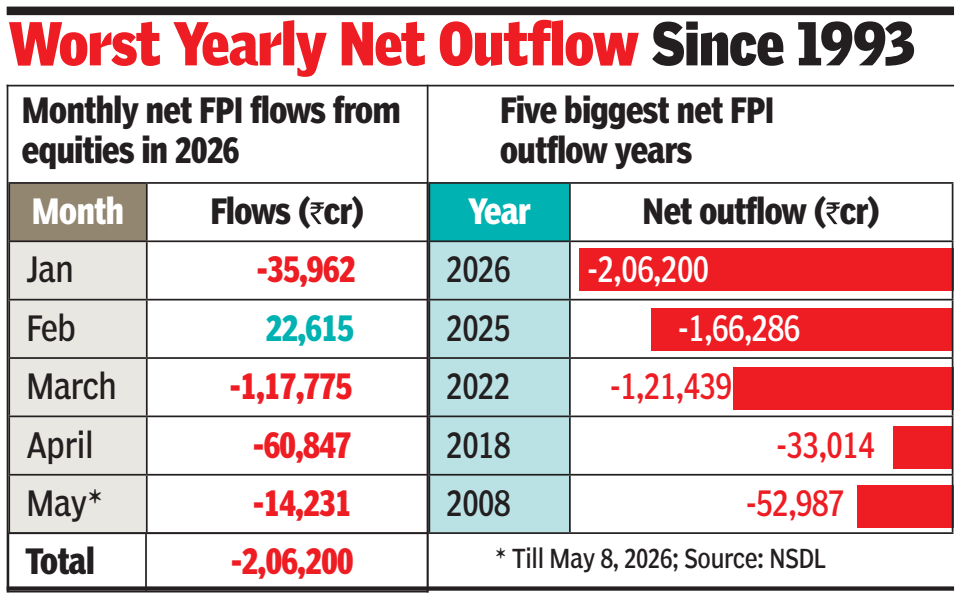
MUMBAI: Net outflow by foreign portfolio investors (FPIs) from the stock market for the current year crossed the Rs 2-lakh-crore mark for the first time ever. This also showed up in aggregate foreign holding in Indian stocks falling to a 14-year low at 14.7%, a level much below the comparative data for domestic institutions, which is at 18.9%, a report by JM Financial showed.So far in a little over four months till May 8, FPIs have net taken out nearly Rs 2.1 lakh crore from India, making it the worst yearly number since 1993, the year these fund managers were allowed to invest in domestic stocks, data from Sebi and NSDL showed. More than half of this was in March alone, soon after the war in West Asia started and the rupee crashed to below the 95/$ level, then the lowest level ever against the greenback. In April, the selling slowed to Rs 60,847 crore. In whole of 2025, the total outflow from stocks was Rs 1.7 lakh crore.
A report by Goldman Sachs said that although the intensity of FPI selling has slowed, it’ll be some time before foreign funds start buying again into Indian stocks.“The bulk of foreign selling is likely over, after record outflows over the recent months,” the report said. “Various approaches using flows, positioning and ownership trends suggest foreign flows are now close to downside scenarios.” Analysts at the US-based global financial major estimated that the downside risk of incremental foreign selling could be limited at about $4-5 billion, translating to nearly Rs 50,000 crore at the upper end of the band.On the other hand, the report noted that while the bulk of foreign selling is likely over, “foreign re-buying may still be impeded in the near term, for a few reasons.”For one, empirical evidence suggests foreign funds won’t immediately return to buy in India when oil prices fall. “Foreign capital did not return to Indian equities in the early-April oil correction, despite the significant sell-off during the preceding oil rally in March. “Past evidence shows that foreign flows tend to be modestly positively correlated with falling oil prices in the short-term.”Secondly, earnings revisions have become an increasingly important variable guiding foreign flows in Indian equities. While much of foreign selling may have already occurred in anticipation of the forthcoming downgrade cycle, low visibility around a recovery will likely limit foreign re-buying in the near-term, it said.And lastly, “compared to north Asian markets, India offers a less attractive risk-reward as it trades at significantly higher growth-adjusted valuations, on top of the ongoing investor concerns over the potential adverse impact of AI,” the report said.