Mumbai: What’s a usual Mumbai Indians’ bowling highlights reel like? It features plenty of Jasprit Bumrah splattering the zing bails with his pin point yorkers. When he’s not cleaning up batters, he’s still confounding them with his perfectly disguised slower balls.
Mumbai Indians’ Jasprit Bumrah bowls a delivery during the Indian Premier League cricket match between against Punjab Kings. (AP)
This season, however, has been far from business as usual for MI. Bumrah simply can’t get himself in the highlights package. When he’s there, it’s for the wrong reasons: at the receiving end of young Vaibhav Sooryavanshi’s pickup six, or being pulled to the stands by Shreyas Iyer.
In the 114 balls he’s bowled this season, Bumrah doesn’t even have a strike rate. That’s because he simply hasn’t bowled anyone over. As rare as a chilly Mumbai winter, Bumrah has yet to pick up a wicket in the five matches so far.
A lot of this may be down to the great fast bowler being short of gas, all of which he spent in helping India defend the T20 World Cup title, days ahead of IPL 2026.
MI head coach Mahela Jayawardene thought as much when quizzed about Bumrah’s performance. “I think initially because he had a slight niggle which he came with from the World Cup. We wanted to build him up over the last few games,” he said after the Punjab Kings match.
The MI coach, though, wasn’t unduly concerned. “His speeds have gone up, we’ve looked at all that. So he’s very comfortable,” he said. “I think once he starts taking wickets, (they) might not be able to stop him. So we just need to back that.”
Even in the middle of this dry spell, Bumrah has been MI’s most economical bowler (ER 8.63). That may be well above his career economy rate (7.29), but what makes matters worse is the lack of support for the premier bowler. Every other pacer in the MI ranks has been conceding over 10 runs per over. They have been especially poor in the Powerplay.
A case in point was the MI-PBKS clash on Thursday where Arshdeep Singh made the batters sway to his swing even as MI’s swing specialist Deepak Chahar found none. Even Hardik Pandya with the ball looks like a pale shadow of his World Cup self. Bumrah’s regular new-ball partner Trent Boult has performed so far below his usual standards that he became the first casualty when the overseas quota needed tweaking.
MI’s bowling shortcomings have added to Bumrah’s burden. Usually, when all seems lost in a match situation, MI’s unorthodox bowling hand finds a way. At his best, Bumrah would have broken open the match for MI in the 6th over after Allah Gazanfar had delivered two early blows. Or made his presence felt in the 13th over, when he was brought back to bounce out Shreyas Iyer and brought the hosts back into the match. The reverse happened. Iyer smashed him out of sight over deep mid-wicket as if he were facing any other bowler.
What a less-than-best Bumrah required from his fellow bowlers was for them to raise the bar, allowing him to build his workload into the tournament. Not to be thrust with match-turning challenges. Lest, his workload thresholds are crossed.
Only the MI think tank would know if there are any red flags with his fitness. If this is only a form and rhythm issue, Bumrah is too good a bowler not to be able to sort things out. Just the way his fellow India pacer Ashdeep Singh was able to in opposing colours at the Wankhede.
Train when no one’s watching, they say. That’s what Arshdeep did in a pre-match training session, this week, at a net on the sidelines with a few cones and two stumps. A little bubble he created and operated in to regain his bowling rhythm, swing, precision yorkers too.
“It goes back to one of the training sessions with Ricky (Ponting) where I told him the ball wasn’t coming out of the hand the way I would like. He told me how I was expecting too much out of myself and not keeping it simple. You are coming off a World Cup high and it wasn’t easy to maintain that high all the time. It was about having fun,” Arshdeep said at the presentation on Thursday. “I had a nice spot bowling session before the match. That’s when I felt the ball coming out well.”
Arshdeep was the pick of the bowlers with figures of 3/22. In contrast, Bumrah finished with 0/41. Rest is not an option for marquee players in the unrelenting IPL months where action never stops. Somewhere in this constant travel-play-travel routine, Bumrah will have to find the energy for a spot bowling session like Arshdeep. If that sparks a Eureka moment, it could well bring the pace ace and with him, MI, back to life.
It’s barely been five months since he became a dad, and now, he’s becoming Dada. Playing ex-cricketer Sourav Ganguly in his biopic, we mean! November 2025 saw Rajkummar Rao stepping into a new role: a dad to daughter Parvati.
Rajkummar Rao
Chatting with Sonal Kalra, Chief Managing Editor, Entertainment and Lifestyle on The Right Angle show, he said life ever since has been ‘so beautiful’, “Whenever somebody talks to me about Parvati, there’s this big smile that is there on my face. One of my co-actors asked me once “What’s your daughter’s name?” I said, “Parvati.” He was like “Have you noticed how our faces change when we talk about our kids?” I was like, “I didn’t notice!” Everything has changed.”
Even his motivation to pick up particular films now is influenced by how his daughter would view them once she grows up, “Whatever time I can, I just give her, I want to do that. I took a five month break after she was born. Then I got back to shoot for Dada. It was surreal to leave her alone after five months and go to shoot. It was tough. I want to be with her 24/7. I just want to see her growing up into this beautiful girl one day.”
As for changes within himself, he feels more vulnerable, “And even softer in life. I have decided now I am going to do way less work than what I was doing earlier. I’m going to try and do only two films a year. Now I am being very careful about the kind of films I do. I just want to really push myself and make Parvathy, along with my mother and Patralekhaa, proud.”
NEW DELHI: Two-time Paralympic medallist Sumit Antil has levelled serious allegations of mental harassment and abusive behaviour against javelin coach Naval Singh, with Olympic champion Neeraj Chopra extending his support to the complaint filed with the Sports Authority of India (SAI).According to a report by The Bridge, multiple elite Indian javelin throwers submitted a written complaint to SAI on April 10, accusing the coach of repeated verbal abuse, mental harassment, and inappropriate conduct. The complaint was also raised with officials from the Paralympic Committee of India (PCI).Go Beyond The Boundary with our YouTube channel. SUBSCRIBE NOW!Antil, who initiated the complaint, described a pattern of behaviour that he claims crossed professional boundaries.“I have always been a clean athlete, and I don’t want to be part of any controversy. I tried to explain to him multiple times, but this is not the first time. It has gone beyond my patience level,” Antil said, as quoted in the report.He further alleged that the coach would send abusive audio messages. “He gets drunk and sends random recordings abusing us and dragging our families into it. He tends to behave this way when competitions approach,” Antil added.The report also claimed that emails submitted to SAI included audio recordings in which Singh is allegedly heard verbally abusing Antil, Chopra, Navdeep Singh and even Pakistan’s Olympic medallist Arshad Nadeem.
Neeraj Chopra backs athletes, seeks action
Backing his fellow athletes, Chopra strongly condemned the alleged conduct and called for strict action.“I stand in full agreement with my fellow athletes and strongly demand strict action in this matter,” Chopra wrote in his email to authorities.“I write this as an athlete who has had the honour of representing India at both national and international levels. Sport must uphold dignity, discipline, and respect. The statements made by coach Naval Singh are not just inappropriate; they are disgraceful,” he added.Antil revealed that he had earlier approached SAI officials, including Deputy Director Arunlal and TOPS CEO Nash Johal, and even participated in discussions aimed at resolving the issue. However, he rejected attempts at compromise, citing repeated incidents.“The language used has been extremely degrading, not only towards athletes but also towards our families,” Antil said, adding that despite multiple complaints, no action has yet been taken against the coach.
Virat Kohli has once again caught attention for his ‘like’ on an Instagram post. Last time, his reaction to a post made by Avneet Kaur had also raised similar social media chatter. On Friday, he liked a picture of German vlogger Liz Laz. This observation by eagle-eyed fans on the platform went viral on the internet in no time. Now, actor Ameesha Patel has reacted to it.
Ameesha Patel has commented on the chatter around Virat Kohli ‘liking’ a pic of a German model.
What did Virat Kohli ‘like’?
Virat liked a photograph of German model Liz Laz, originally posted by photographer Advait, back in January. The post was shared with the caption, “Some golden hour shots.”
How Ameesha reacted
Ameesha was spotted by the paparazzi in Mumbai, where she was asked to comment on this issue. Initially unaware, the actor wondered what was the issue when told about the ‘like’ scenario. She said, “Like karna kuch paap hai kya? Unki life, unka Instagram, unki marzi. Logon ko bas troll karna hi aata hai. Aur koi kaam dhanda hi nahi hai. Acchi baat hai kisi ke acche kaam ko like karna. Troll karna paap hai, kisi ko like karna nahi (Is liking something a sin? It’s his life, his Instagram, his choice. People only know how to troll; they have nothing better to do. It’s a good thing to appreciate someone’s good work by liking it. Trolling is the real wrongdoing, not liking someone),” she said.
Kohli’s clarification on ‘liking’ Avneet Kaur post
Last year, Kohli’s like on Avneet’s picture went viral on social media. As rumours swirled, many questioned the nature of the gesture, given Kohli’s high-profile public image and personal life. To put an end to the chatter, he later took to Instagram Stories, clarifying that the “like” was a technical glitch.
The cricketer wrote on his Instagram Stories, “I’d like to clarify that while clearing my feed, it appears the algorithm may have mistakenly registered an interaction. There was absolutely no intent behind it. I request that no unnecessary assumptions be made. Thank you for your understanding.”
For Avneet, the accidental “like” turned into a golden opportunity. She gained over 1 million new followers and reportedly signed 12 new brand deals, which increased her brand value by 30%.
Virat has not commented on this matter. Notably, the cricketer has since unliked the post on Instagram.
Crude oil prices plunged more than 10% on Friday after US President Donald Trump and Iran announced that the Strait of Hormuz is fully open again for oil tankers carrying crude from the Persian Gulf to customers worldwide, easing fears of supply disruptions.The sharp drop in oil prices lifted global markets, with US stocks rallying strongly. The S&P 500 rose 1% as it moved toward a third straight week of gains, while the Dow Jones Industrial Average jumped 722 points, or 1.5%, and the Nasdaq composite added 1.1% in morning trading.The price decline came immediately after Iran’s foreign minister, Abbas Araghchi, said on X that the passage for all commercial vessels through the strait “is declared completely open” and would remain so for the duration of the current ceasefire period in Lebanon. US crude fell 10.2% to $81.88 per barrel, while Brent crude dropped 10.3% to $89.09. Despite the fall, prices remain above their pre-war levels, indicating lingering caution in markets.Optimism has been building on Wall Street in recent weeks, with stocks rising 12% since late March on hopes that the United States and Iran can avoid a worst-case economic outcome despite ongoing conflict. The reopening of the Strait of Hormuz is seen as the clearest sign yet of easing tensions, although the situation remains uncertain. President Donald Trump said in a speech late Thursday that the war “should be ending pretty soon.”Shortly after Iran’s announcement, Trump said on his social media platform that the US Navy’s blockade of Iran remains “in full force” until both sides reach an agreement. He added that negotiations “should go very quickly in that most of the points are already negotiated,” emphasizing the statement in all capital letters.Companies with high fuel costs led the market gains as oil prices fell. United Airlines rose 9.8%, while Norwegian Cruise Line and Royal Caribbean Group both climbed 9.3%.A solid start to the earnings season also supported investor sentiment. State Street gained 2.9%, and Fifth Third Bancorp rose 1.4% after reporting stronger-than-expected quarterly results.Not all companies benefited from the rally. Netflix fell 9.2% despite posting higher profits, as it did not increase its full-year revenue forecast. The company also said cofounder and chairman Reed Hastings will step down from its board in June when his term expires.European markets also moved higher following the development, with France’s CAC 40 rising 2% and Germany’s DAX gaining 2.2%.Asian markets, which had closed before the announcement, ended lower. Japan’s Nikkei 225 fell 1.8%, and Hong Kong’s Hang Seng dropped 0.9%.In the bond market, Treasury yields declined as lower oil prices reduced pressure on inflation. The yield on the 10-year Treasury fell to 4.24% from 4.32% late Thursday.
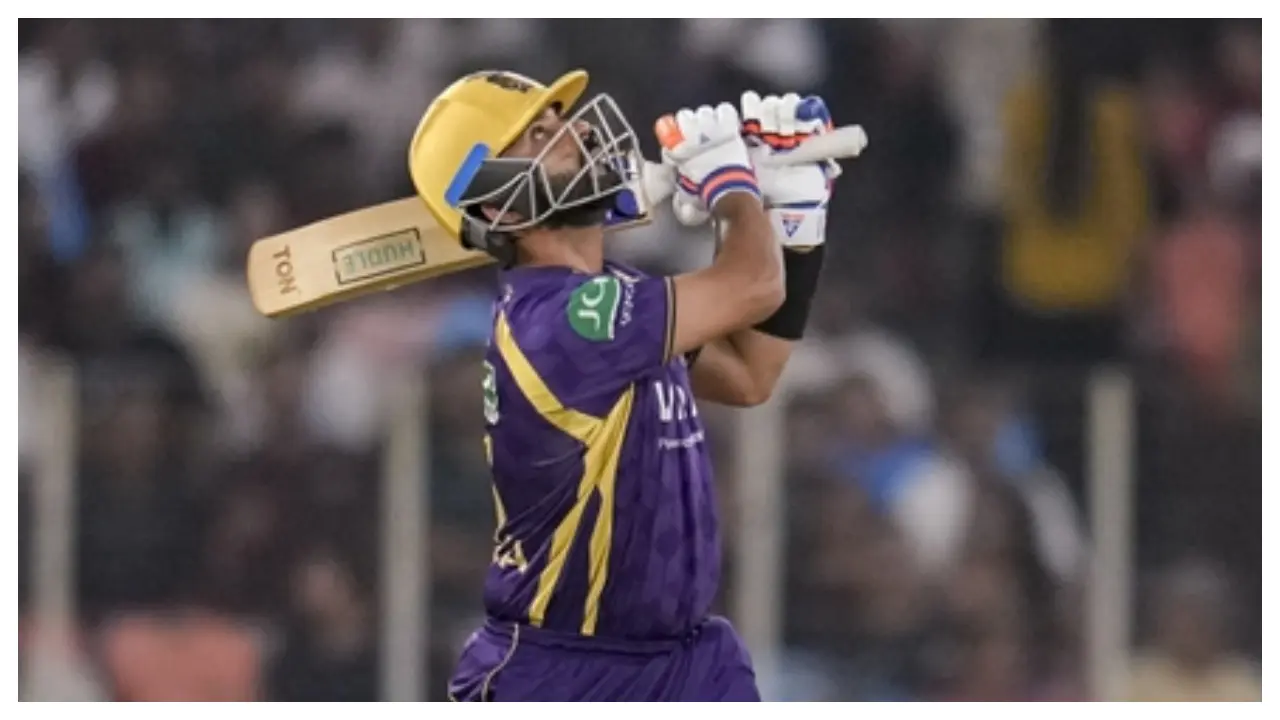
The Kolkata Knight Riders were struggling at 80/3 at the halfway stage of the innings against the Gujarat Titans. KKR lost their skipper, Ajinkya Rahane, for a first-ball duck as they found it hard to get going early on in the innings.
Rahane departed for zero, and his dismissal was followed by Angkrish Raghuvanshi, who was dismissed for 8 runs in 4 balls. Tim Seifert soon joined the list as he departed for 19 runs in 14 balls.
For GT, Mohammed Siraj and Kagiso Rabada were the star bowlers. Siraj picked a wicket while Rabada took 2 wickets to give GT a dream start.
Earlier, Ajinkya Rahane won the toss and decided to bat first against the Gujarat Titans at the Narendra Modi Stadium in Ahmedabad. KKR are still winless this season and are stuck at the bottom of the table. Meanwhile, GT will move into the top 4 of the table with a win.
After winning the toss, KKR skipper Ajinkya Rahane decided to bat first. The Indian batter suggested that his team is just trying to find a way to win games, and batting first will give them the option to bat more freely.
“We`ll look to bat first. We just want our batters to play freely, with freedom. The kind of tournament we’ve had so far, we’ve tried everything, chasing targets, batting first as well. I thought giving that freedom to the batters and then defending the total would be a good approach. That (batting first is a good option) is what I got to know. But again, sometimes you don’t have to depend too much on data and stats. It’s all about what you feel as a team and what you strongly want to do. We just want to focus on our strengths, play good cricket. T20 is all about momentum, winning small moments. Today, we just want to play fearless cricket and stay in the moment. Just one change. Tim Seifert comes in place of Finn Allen.” Ajinkya Rahane said.
Confirmed playing XI for both teams:
Gujarat Titans (Playing XI): Shubman Gill(c), Sai Sudharsan, Jos Buttler(w), Washington Sundar, Glenn Phillips, Rahul Tewatia, Rashid Khan, Ashok Sharma, Kagiso Rabada, Mohammed Siraj, Prasidh Krishna
Actor Neha Dhupia has come out in support of Patralekhaa after the latter faced body shaming on social media following a recent public appearance. Patralekhaa and Rajkummar Rao recently became parents to a baby girl. When the actress was recently spotted at the screening of the film ‘Toaster’ which she has produced, Patralekhaa was trolled and also faced insensitive comments. While the ‘Citylights’ actress hit back at the body-shaming, now Neha Dhupia also has come in her support. Neha spoke about the constant and unfair scrutiny women—especially new mothers—face over their appearance. Taking to Instagram Stories, Neha reshared Patralekhaa’s post and wrote, “Commenting on someone’s body has to stop. Especially a new mom who’s grown a whole human being inside her and is nurturing life with everything she has. Before judging us fix your own thinking… Sending love Patra.”Earlier in the day, Patralekhaa had also addressed the trolling, pointing out that she is not only adjusting to motherhood but is also juggling work commitments, including two film projects.Calling out the lack of empathy, she wrote, “Pap pages! What’s happened to me!? is that I have just given birth! Yes, I have gained the weight, which seems like an unnatural phenomenon to you all. I have not sat and eaten a mountain, I just delivered a baby and produced two films simultaneously which are not easy jobs”.She further emphasised that physical changes after pregnancy are completely natural and appealed for kindness. “If I could I would not be this way. But that’s how my body has reacted to pregnancy. For God’s sake please learn to be a little kind,” added Patralekhaa.Patralekhaa and Rajkummar Rao stepped into parenthood on November 15 last year, welcoming their daughter on the occasion of their fourth wedding anniversary.
Television actor Urvashi Dholakia recently voiced her frustration over ongoing late-night construction at a property in Mumbai’s Juhu area owned by Asit Modi, calling the experience a “midnight horror” for residents.
Urvashi Dholakia talks about the construction disturbance
Taking to social media, Urvashi described the constant noise and disruption caused by construction activities during odd hours, raising concerns about the lack of adherence to civic rules. She expressed how the situation has been distressing not just for her, but for others living in the vicinity as well. Highlighting the seriousness of the issue, she revealed that the construction work continued well into the early hours of the morning, disturbing the peace of the neighborhood.
Sharing her ordeal, the actor recounted how she even reached out to authorities for help. According to her, she dialled the police emergency helpline around 4:23 AM in an attempt to put an end to the disturbance. However, she indicated that the response was either delayed or ineffective, adding to her frustration over the situation. The incident has sparked conversations about the enforcement of rules regarding construction timings in residential areas.
Calling out the issue publicly, Urvashi said the experience felt like a “midnight horror,” underlining how unbearable the noise had become during late hours. Her remarks have drawn attention to the broader issue of unchecked construction activities in Mumbai, especially in upscale residential areas like Juhu, where such disturbances are expected to be strictly regulated.
Known for her outspoken nature, Urvashi did not hold back in criticizing the apparent disregard for residents’ comfort. She emphasized that basic civic sense and compliance with rules should be a priority, particularly in densely populated cities where people rely on limited quiet hours for rest.
All about the incident
The incident has since triggered discussions online, with many supporting her stance and sharing similar experiences of late-night construction noise. It also raises questions about accountability and whether existing regulations are being properly enforced.
As the debate continues, Urvashi’s remarks have once again spotlighted the everyday challenges faced by residents dealing with urban disturbances, urging authorities to take stricter action against violations and ensure that such inconveniences are addressed promptly.
The water is running out. And yet we don’t seem very worried.
Perhaps one reason is that there seems to be so much of it.
To put that in perspective, less than 3% of the water on Earth is freshwater.
Earth’s natural desalination programme, the rains, turns some of the vast ocean stores into potable supply, but we force most of that into drains and oceans, by blocking natural aquifers, filling up lakes and wetlands, and encroaching on rivers.
Then the battles begin.
Countries spar over dams, regions battle over rivers.
In Mexico, drought-stricken farmers have set fire to government buildings and ambushed soldiers, to prevent water from being diverted to the US.
Violent clashes between Cameroon’s Musgum fishermen and semi-nomadic Choa Arab herders over access to water have driven thousands to migrate across the border to Chad.
Over the past 10 years, in arid and civil war-struck Yemen, violence is often concentrated around water tankers, bottling stations and wells.
Conflicts over water erupt between Egypt and Ethiopia; India and her neighbours; China and its neighbours; Turkey, Syria and Iraq; Uzbekistan, Tajikistan and Kyrgyzstan. The list goes on.
The fear and uncertainty driving such clashes reflect a stark reality: In January, the United Nations warned that the planet has entered an era of “water bankruptcy”, a tipping point beyond which small-scale remedial measures such as better management and reduced waste will no longer meet the gap between the rate at which water is being withdrawn and the rate at which it can be replenished.
***
How did we get here?
A child could answer that: we have drawn more heavily from groundwater than we should have; blocked replenishment with concrete and deforestation; put rivers at risk from massive reservoirs, and reservoirs (as well as glaciers, rivers and lakes) at risk from rising temperatures.
Perhaps the worst part of it all is that we have done this in service of two mega constructs: cities, and monoculture. Our cities waste more water than they use, while draining the regions around them. Around Beijing, this desertification has become so severe that it is causing giant dust storms that turn the sky orange.
Water is similarly wasted across most irrigation networks, and the water that does reach the farms (much of it groundwater) is used to feed crops so water-intensive, they shouldn’t be growing in the vast swathes of arid and semi-arid land where they are now planted.
***
The real answer to how we got here, though, lies in the cultural shifts that made this possible.
Early food-gathering societies and settlements protected forests and water bodies because there was recognition of the direct link between these and their own survival. That’s how rivers and trees came to be viewed as sacred.
As settlements grew into kingdoms and empires, this direct bond with local resources weakened until, by the modern age, it had snapped altogether.
We no longer know where our water (or food or fuel) come from.
Meanwhile, as cities have exploded, driven by extractive capitalism, markets and margins have taken over as the things we focus effort and attention on.
The infinite-growth economy continues to depend on a natural world that cannot accommodate such a model. The result, over time, is visible in the climate crisis. Which has circled back to take its toll on water (as well as forests, monsoon systems, ocean environments and a host of other biospheres).
Human-caused global warming has made the atmosphere thirstier, sapping more moisture from the soil, and from rivers and reservoirs. Winds transport this excess water into storm systems, often far away, leading to droughts in one region and deluges in another.
“All this adds to existing challenges in managing water supply,” says Richard Allan, a professor of climate science at the University of Reading.
***
New guzzlers, such as data centres, are now emerging. AI already uses as much water worldwide, each year, as over 4 million American households.
To address the water bankruptcy, we would need to start by rethinking water rights, water pricing and restrictions on use of water, says Kaveh Madani, a climate scientist and director of the United Nations thinktank on water, the UN University Institute for Water, Environment and Health (UNU-INWEH).
We would also need to rethink infrastructure, energy, food security. As looming as that may sound, a better way is not only possible, there are countries where small changes are already showing results. (Read the stories alongside for more on this.)
“It doesn’t help that, unlike air pollution, we do not have a simple, visible indicator of water loss,” adds Mohammad Shamsudduha, a hydrogeologist with the University College London department of risk and disaster reduction. “What we really need is better local data to make water stress more visible and actionable.”
Failing which, he adds, perhaps the significant and growing risk itself will serve as a forced catalyst to action.
.
CLICK HERE to travel down the Ganga with Binayak Dasgupta, as he explores our bond with water.
READ ON to see what the crisis looks like, in some of the regions where it is most severe. And how small but coordinated efforts are driving significant change.
.
IRAN: UP AGAINST THE WALL
A 17th-century bridge spans the now-largely-dry Zayandeh Rood river. (Adobe Stock)
Tehran is currently in the midst of its sixth consecutive year of extreme drought (a combination of critically low rainfall, empty reservoirs and high temperatures).
Satellite images show vast water bodies across the country shrinking into thin trickles.
About 750 km away, Urmia, once the Middle East’s largest lake, has dwindled to less than 10% its former size. From about 6,000 sq km, it now covers just 581 sq km.
Beneath the ground, the crisis runs deeper.
As Iran, like so many countries, overuses groundwater, falling levels, combined with changing rainfall patterns (the country experienced its driest autumn on record last year), extensive dam construction and evaporation from these dams, has led to the shrinking of wetlands and lakes. Adding to the problem is the prevalence of water-intensive crops such as rice and watermelon.
Things could have been different.
Over the past 70 years, Iran — again, like so many others, including India — neglected and abandoned ancient water management systems, in favour of new ideas.
In Iran’s case, the qanat or water-tunnel system had helped support the arid country for thousands of years. These sloping, covered tunnels were dug into hillsides and built along plains to channel rainwater and springwater, protecting it from the region’s harsh heat.
The country’s shift to dams, which include some of the largest in the world, brought short-term abundance but exposed tonnes of water to evaporation from temperatures that routinely cross 50 degrees Celsius. Meanwhile, as in so many cities, the pipelines that distributed the reservoir water were poorly monitored, governed and maintained.
With the qanats quietly crumbling, when scarcities hit, people dug wells and tapped into groundwater instead. The vicious cycle had begun as far back as the 1950s.
Water management and agricultural reform will be the keys to the path forward, says Kaveh Madani, the Canada-based Iranian director of the United Nations thinktank on water, who also worked within the environment ministry in Iran until his views caused him to be alienated. “Modern management can learn from the Persians, whose qanats helped societies thrive in some of the driest places in the world, for thousands of years.” The very definition, he adds, of sustainable.
.
USA: THE COLORADO RIVER NO LONGER MEETS THE SEA
The river once flowed from the Rocky Mountains into the Gulf of California. Over the past 20 years, it has seen volumes drop by 20%, and it now runs dry almost 160 km before it reaches the Gulf of California. (Shutterstock)
They say: “Follow the river and it will eventually lead you to the sea”. This is no longer true in parts of the world.
For nearly 6 million years, the Colorado river flowed from the Rocky Mountains into the Gulf of California. Over the past 20 years, it has seen volumes drop by 20%, and it now runs dry almost 160 km before it reaches the sea.
Irrigation consumes more than half the river’s water, with much of this used to grow alfalfa and other cattle-feed crops. Another tenth is claimed by evaporation at dam reservoirs, with another 20% supplied to households and industries.
Meanwhile, more than half of the Western United States is currently experiencing drought conditions, following a winter of historically low snow, according to the federal drought monitoring system. As much as 75% of water supplies can come from snowmelt here, which acts as a crucial natural reservoir, as the US Geological Survey has put it in reports.
This has resulted in mandatory water restrictions across a wide swathe of the country.
In some cities, restaurant owners are being asked to serve water only if patrons ask for it. In certain regions, the watering of lawn has been restricted to no more than twice a week.
Amid a record warm winter and a March heatwave, river and stream volumes are dipping further.
“This might be what it takes to get us to truly adapt to 21st century realities,” Kyle Roerink, executive director of the advocacy group Great Basin Water Network, told The New York Times last week. “If we believe what the top scientists are saying, this isn’t the worst it’s going to get in the 21st century.”
.
TURKEY: A HARVEST OF SINKHOLES
The unchecked drilling of deep wells has caused dramatic cases of land subsidence, triggering giant sinkholes across farms. Nearly 700 have appeared just in the ‘bread basket’ region of Konya. (Shutterstock)
Some of the world’s first agricultural societies emerged here, about 9,500 years ago. The country now stands on the brink of an agricultural crisis.
The unchecked drilling of deep wells has caused dramatic cases of land subsidence, triggering giant sinkholes across farms, with 684 appearing just in the “bread basket” region of Konya.
Major lakes have vanished, or are shrinking rapidly.
Climate change is intensifying the crisis. The country recorded its lowest rainfall levels in 50 years, in 2025, with rainfall at 26% below the long-term average.
Turkey’s bustling mines, meanwhile, continue to use thousands of litres of water per kg of gold extracted. Mining for gold, copper, silver and manganese also releases cyanide into water bodies, poisoning them.
And agriculture, which accounts for 75% of total water consumption (according to a 2025 drought hotspots report by the UN Convention to Combat Desertification), has in many cases shifted from low-water-intensity crops such as chickpeas to guzzlers such as corn, sugarcane and avocado, because they offer higher profit margins.
Last month, the government announced a 10-year plan that focuses on stronger wastewater treatment systems, implementing digital monitoring of water resources and improving resilience to climate change.
“A clear water deficit is carrying over from one year to the next across much of the country,” Mikdat Kadioglu, a climate scientist with Istanbul Technical University, said in news interviews in February. “This signals the new normal under climate change.”
.
BANGALDESH: THE DEATH OF THE PRIDE OF DHAKA
The once-mighty Buriganga is so polluted and laden with trash that even flecks of its water tarnish silver jewellery. (Shutterstock)
The French merchant Jean-Baptiste Tavernier, in his 1684 travelogues, wrote that Dhaka seemed to extend only in length, as “everyone coveted to have a house by the Ganges-side” (referring to the mighty Buriganga).
Today, this is a dead river. It sustains little aquatic life. Its waters are black. A foul, rotten-egg stench indicates the presence of noxious effluents.
Bangladesh-born environmental social scientist Sonia Hoque, whose 2025 book Water Diaries explores crises in Bangladesh and Kenya, says the river now contains so much hydrogen sulfide that even flecks of its water tarnish silver jewellery. The worst culprits here, adds the senior research associate with the research body Oxford Water Network, are the textile and tanning industries that release untreated waste into the river.
Elsewhere in the coastal country, rising sea levels, salinity intrusion and extreme weather events threaten other sources of freshwater, found a 2025 study published in the Ecological Indicators journal by researchers at UK’s University of Portsmouth, in partnership with Dhaka University and Australia’s Curtin University.
The biggest issue, Hoque says, is not intent or means. “The government and related agencies are ready to pour in the money. But interventions without coordination… is ultimately useless.”
WHAT DOES POSITIVE ACTION LOOK LIKE?
.
IN PERU, WATER BILLS PAY FOR CHANGE
The Pastoruri glacier, one of the few left in tropical South America, is shrinking. Elsewhere in the country, a movement has begun for change. (Adobe Stock)
Over the past 50 years, more than half of Peru’s glaciers have melted. Rainfall in the Andes has shown significant variability, with sharp declines predicted. A 2019 World Bank report placed the national capital, Lima, at severe risk of drought by 2030.
But change, on a small scale, has begun here.
In 2014, the country decided to zoom out and find a powerful way to drive change.
A series of new laws now make it mandatory for all utility companies managing the country’s water supply to invest 3% to 5% of the money paid by citizens as water bills in nature-based solutions (NBS) such as watershed conservation (a coordinated approach that focuses on land, aquifers and vegetation).
In cities such as Moyobamba, this has helped improve the quality and reliability of water supply in regions that have seen rainforest land given over to agriculture.
So far, 49 such projects have been implemented across the country, as of 2025, according to the Organisation for Economic Co-operation and Development (OECD). They are being studied as an adaptation model for countries in a similar situation.
.
ETHIOPIA: TWO NEW SPRINGS ARE BORN
In remote parts of rural Ethiopia, such as Adami Teso and Kumato, women and children typically spend half the day walking to the nearest pond, spring or river and back, to fetch water.
At the Kumato Health Centre, which serves more than 45,000 people, women giving birth have had to bring their own water because of the acute shortage. Diarrheal diseases are a major cause of mortality among children under five; lakhs of children are drinking water so unsafe that it is visibly dirty.
What can change look like, in such a region, in one of the poorest countries in the world?
In 2022, the research organisation World Resources Institute (WRI) partnered with the international NGO WaterAid to drive community-led projects aimed at recharging groundwater levels. Check dams were built to prevent runoff. Large tracts of land were closed off to livestock and farming to allow them to regenerate and help revive the water table.
The result was visible in three years. By 2025, groundwater levels had risen by 1.2 metres on average, across five monitored community wells, in the arid district of North Mecha. Two freshwater springs appeared on land that had held none in living memory. Inspired by the success of this project, WRI has announced a larger one in a neighbouring region.
.
CHINA: A SPONGE CITY PLAN
Buildings like Beijing’s National Stadium are now designed with features such as capillary tubes that can harvest rainwater. (Shutterstock)
Intense dust storms loom over Beijing regularly now, some unlike anything seen before this decade. Photos from 2023 show the sky over the country’s capital glowing an eerie orange. The government has taken to issuing warnings, to let residents know when they should avoid stepping outdoors.
A key driver is land degradation and the desertification of the surrounding region.
Elsewhere in China, cities are suffering from land subsidence as booms in urbanisation intensify the extraction of groundwater.
A 2024 national-scale assessment led by South China Normal University, published in the journal Science, found that about 67 million people now live in areas subsiding at a rate of more than 10 mm a year. Underground urban transportation systems and mining activity have intensified the issue, the report noted.
Across China’s cities, the effort for change has been nicknamed the Sponge City programme. Launched in 2015, it aims to aggressively promote rainwater harvesting and the redirection of stormwater into storage tanks, reservoirs and aquifers.
This means creating buildings such as Beijing’s National Stadium and National Aquatics Centre, made up of capillary tubes that can harvest rainwater. It also means protecting green spaces, wetlands and natural drainage systems. And there are plans to use permeable paving on streets.
On the national food front, since a large share of China’s water supply goes towards one single crop, rice, scientists are now turning to bioengineering to create drought-resistant varieties. Scientists at the Philippines-based International Rice Research Institute and the Chinese Academy of Agricultural Sciences first developed “super rice” varieties tolerant to drought, floods and salinity in 2008. So far, 78 such varieties have survived lab tests and limited rollouts in the Philippines.
The preservation of water bodies has been added to the country’s five-year plans for economic and social development.
.
A GLOBAL TOLL: HOW THE NUMBERS PLAY OUT
* Over 1,000
children under the age of five die every day from diseases linked to unsafe water, sanitation, and hygiene. That amounts to nearly one death a minute.
* 2.2 billion
or 25% of the world’s population, do not have access to safe drinking water.
* 4 billion people
or about half the world’s population, live with severe water scarcity for at least one month a year.
* 13th
that’s India’s rank on a list of 17 of the world’s most water-stressed nations. The report cited India’s high population density: our country is home to just 4% of the world’s freshwater reserves and 18% of its people. (Qatar, incidentally, came in at #1.)
* 2 billion
people live on ground sinking, at least partly because of the pumping out of groundwater.
* 70%
of freshwater used globally goes towards agriculture;
less than 20% goes towards industry;
about 12% goes towards domestic / municipal uses.
Future calculations will need to factor in growing AI data-centre use, which has currently crossed 560 billion litres a year; or as much as over 4 million US households.
(Sources: 1. UNICEF report Triple Threat, 2023; 2. Drinking water and sanitation report by WHO and UNICEF, 2025; 3. University of Twente 2016 study published in Science Advances, cited in UN reports; 4. Aqueduct Water Risk Atlas by World Resources Institute, 2019; 5. Global water bankruptcy report by UNU-INWEH, 2026; 6. UN World Water Development Report, 2024)