


Dominique Pelicot, who admitted to drugging and raping his wife for almost a decade and to inviting dozens of strangers to join him, was convicted on Thursday of aggravated rape and other charges and was sentenced to the maximum 20 years in prison. The court also convicted the 50 other defendants, most of them on rape charges. Catherine Porter, a New York Times reporter, followed the four-month trial and reports from Avignon.
51 Men Guilty in Rape Trial That Horrified France

US says it has 2,000 troops in Syria, not 900 as previously declared | Syria’s War News

Pentagon says the additional forces have been in Syria for ‘a while’, before fall of President Bashar al-Assad, though they were not publicly disclosed.
After years of telling the public that the United States has about 900 troops in Syria, the Pentagon has revealed there are approximately 2,000 soldiers there — double the previous estimate.
Speaking to reporters on Thursday, Pentagon spokesperson Pat Ryder said the additional US forces have been in Syria since before the ouster of former President Bashar al-Assad this month, though he did not specify a timeframe.
“We have been briefing you regularly that there are approximately 900 US troops deployed to Syria. In light of the situation in Syria and the significant interest, we recently learned that those numbers were higher,” Ryder said.
“So, asked to look into it, I learned today that, in fact, there are approximately 2,000 US troops in Syria.”
He added that there are 900 soldiers on long-term deployment in Syria while the rest are “considered temporary rotational forces”.
According to Ryder, the previously undeclared 1,100 soldiers have been in Syria “for a while”. Pressed for further details by reporters, the Pentagon spokesperson said they had been deployed there for months “at a minimum”.
The US started sending troops to Syria in 2014 with the stated objective of defeating ISIL (ISIS), but US forces remained in the country after the group’s territorial defeat in 2017.
Washington has allied itself with the Kurdish-dominated Syrian Democratic Forces (SDF), which now control large parts of eastern Syria.
However, Turkiye, a NATO partner of the US, views the SDF as a threat to its national security over links to Kurdish armed organisations it labels as “terrorist” groups.
After opposition fighters captured western Syria and toppled al-Assad, they reignited fighting along the front lines in other parts of Syria, where the conflict had been frozen for months.
Turkish-backed Syrian fighters and Hayat Tahrir al-Sham, which dominates the new government in Damascus, have captured areas previously held by the SDF over the past two weeks.
The prospect of an all-out war between Syrian forces supported by Turkiye and the SDF has raised questions about the future role of US troops in Syria.
On Thursday, Ryder said there are no planned changes to the US military presence in the country.
“There are no plans to cease the ‘defeat ISIS’ mission. I mean, again, ISIS continues to maintain or to pose a significant threat,” he said.
Beyond its troops in eastern Syria, the US has said it is engaging directly with the new authorities in Damascus, although it continues to officially label HTS as a “terrorist” group.
Washington has put forward a set of demands it said it wants to see in Syria, including non-sectarian governance.
“The transition process and new government must also uphold clear commitments to fully respect the rights of minorities, facilitate the flow of humanitarian assistance to all in need, prevent Syria from being used as a base for terrorism or posing a threat to its neighbors, and ensure that any chemical or biological weapons stockpiles are secured and safely destroyed,” US Secretary of State Antony Blinken said in a statement last week.
Meanwhile, one of the US’s top allies, Israel, has been bombing Syrian military assets and expanding its occupation beyond the Golan Heights in a land grab widely condemned across the Middle East.
Business News Live Today December 20, 2024: Mexico delivers fourth straight rate cut as inflation slows

Business News Live: Get real-time updates on the biggest news from the world of business, stock market and more.

Latest news on December 20, 2024: Mexican Finance Minister Rogelio Ramirez de la O and Victoria Rodriguez Ceja, head of Mexico’s central bank at an event hosted by the nation’s main stock exchange in Mexico City, Mexico (File)
Business News LIVE Updates Today: Follow for stories on Bill Gates, Elon Musk, Mukesh Ambani, Gautam Adani as we bring you everything that is happening in the world of business. Track latest gold and silver prices as well here. Stay on top of all things business with us. Disclaimer: This is an AI-generated live blog and has not been edited by Hindustan Times staff.…Read More
Follow all the updates here:
Dec 20, 2024 1:42 AM IST
Business News LIVE Updates : Mexico delivers fourth straight rate cut as inflation slows
- Banxico, as the central bank is known, lowered borrowing costs by a quarter-point to 10% in an unanimous decision.
Syria rebel leader dismisses controversy over photo with woman

Syria’s rebel leader, Ahmed al-Sharaa, has dismissed the online controversy over videos showing him gesturing to a young woman to cover her hair before he posed for a photo with her last week.
The incident sparked criticism from both liberal and conservative commentators amid intense speculation about the county’s future direction after rebels swept to power.
Liberals saw the request from the head of the Sunni Islamist group Hayat Tahrir al-Sham (HTS) as a sign that he might seek to enforce an Islamic system in Syria after leading the overthrow of Bashar al-Assad, while hardline conservatives criticised him for consenting to be photographed with the woman in the first place.
“I did not force her. But it’s my personal freedom. I want photos taken for me the way that suits me,” Sharaa said in an interview with the BBC’s Jeremy Bowen.
The woman, Lea Kheirallah, has also said that she was not bothered by the request.
She said he had asked in “gentle and fatherly way”, and that she thought “the leader has the right to be presented in the way he sees fit”.
However, the incident demonstrated some of the difficulties any future leader of Syria might have in appealing to and uniting such a religiously diverse country.
Sunni Muslims make up the majority of the population, with the remainder split between Christians, Alawites, Druze and Ismailis.
There is also a wide range of views among the various political and armed groups who were opposed to Assad, with some wanting a secular democracy and others wanting governance according to Islamic law.
HTS, a former al-Qaeda affiliate, initially imposed strict behaviour and dress codes rules when it seized control of the former rebel stronghold of Idlib province in 2017. However, it revoked those rules in recent years in response to public criticism.
The Quran, Islam’s holy book, tells Muslims – men and women – to dress modestly.
Male modesty has been interpreted to be covering the area from the navel to the knee – and for women it is generally seen as covering everything except their face, hands and feet when in the presence of men they are not related or married to.
Lea Kheirallah asked to take a photo with Sharaa – who was previously known by his nom de guerre Abu Mohammed al-Jolani – when he toured the Mezzeh area of Damascus on 10 December.
Before agreeing, Sharaa gestured for her to cover her hair and she complied, raising the hood on her jumper and then standing beside him for the photo.
Many video clips and pictures of the incident were shared on social media, sparking widespread outrage among ordinary users and media commentators.
People with liberal or non-conservative views saw it as a troubling glimpse into Syria’s possible future under HTS, fearing increasingly conservative policies like the requirement for all women to wear a hijab, or headscarf.
France 24’s Arabic channel discussed the incident, with a headline asking if Syria was “heading towards Islamic rule”.
Others were sharper in their condemnation. One Syrian journalist said: “We replaced one dictator with a reactionary dictator.”
On social media, other commentators warned of “ultra-extremists” ascending to power, while others decried the “forcing of a free woman” to adopt a conservative look.
Islamist hardliners on Telegram criticised Sharaa for agreeing to be filmed and photographed next to a young woman in the first place.
Some called Ms Kheirallah a “mutabarijah” – a negative term for women considered immodestly dressed or wearing make-up.
Such hardline figures ranged from clerics to influential commentators whose views are often shared and read by Syria-focused conservative communities online, and are likely to reach HTS supporters and possibly officials.
Most of them appear to be based in Syria, mainly in the former HTS-dominated rebel stronghold of Idlib, with some having previously served in HTS ranks.
They argued that it was religiously impermissible for unrelated men and women to interact closely and accused Sharaa of seeking “vain public attention” and showing “indulgence” in matters contrary to strict religious teachings.
A post on one Telegram channel called Min Idlib (From Idlib) said the HTS leader was “too busy taking selfies with young ladies” to address demands for releasing prisoners from HTS jails in Idlib.
Many of the conservative figures who spoke out against the photo have criticised Sharaa in the past for political as well as religious reasons, and include clerics who have left HTS.
Rupee breaches 85/$ for 1st time on Fed’s comment of fewer rate cuts in future

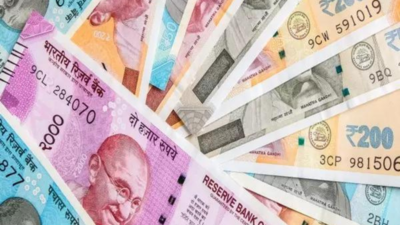
MUMBAI: The rupee breached the 85 level for the first time on Thursday as the dollar gained ground across most currencies in the wake of the US Federal Reserve indicating that there would be fewer rate cuts in future than expected.
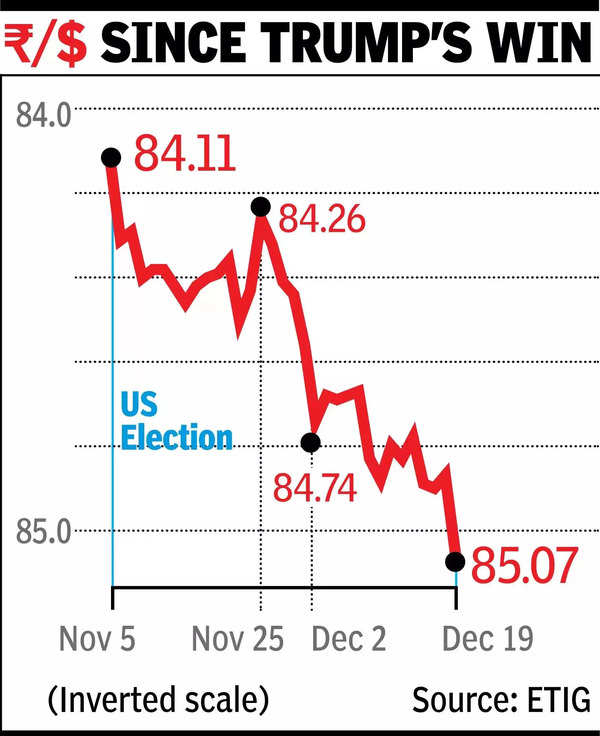
In percentage terms, rupee decline was marginal, dipping from 84.95 on Wednesday. However, with the dollar gaining against most currencies, there was concern RBI may let the currency slide. “Forex reserves are down from peak levels of over $ 700bn at around $ 655bn. Liquidity is also tight for a different set of reasons,” said Madan Sabnavis, Bank of Baroda chief economist.
Rupee’s fall has not made Indian exports more competitive: Report
Madan Sabnavis, chief economist of the Bank of Baroda, said, “More likely these currency movements will be compared across other currencies too in order to gauge how the rupee is positioned. But for sure, there will be volatility for some more time, and it may not be a sober Christmas for the markets.”
According to Reuters data, the rupee’s drop to 85 from 84 has taken place in about two months, while the decline to 84 from 83 took nearly 14 months. It took the currency 10 months to decline to 83 from 82. The rupee decline was less compared to fall in the value of the Korean won, the Malaysian ringgit, and the Indonesian rupiah — which were down 0.8%-1.2% on the day. The rupee closed at 85.07 on Thursday. The rate cut by the US Fed roiled markets with most Asian currencies sliding against the dollar.
A weaker rupee makes imports more expensive and pushes up headline inflation, but it also makes exports more competitive and helps manage the trade deficit. For individuals, it benefits non-resident Indians who sent $129 billion home this year, but it is a disadvantage for Indians who spent nearly $31 billion on travel, education and investments overseas. Currency dealers noted that the rupee’s movement is not significant enough to impact foreign travel decisions but may slightly curb spending.
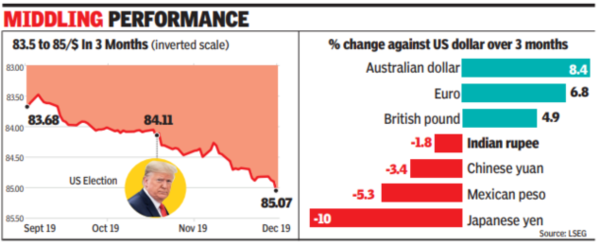
According to the treasury head of a private bank while the rupee has crossed a psychological threshold by breaching 85, looking at forward rates from a year ago, the rupee is exactly where it was expected to be. The currency is likely to remain rangebound.
Trump taking office is the next key event, but the extent to which his proposed policies will be implemented remains uncertain, as many of them are counterintuitive. Tariffs could exert upward pressure on inflation, and while a stronger dollar may reduce headline inflation, it will not significantly enhance US competitiveness since Chinese imports would become more attractive. Crisil in a report following the trade deficit notes that the Indian rupee’s value against other currencies has dropped (nominal depreciation), but this hasn’t made Indian goods more competitive in the global market. This is because even though the rupee appears weaker, its “real” value, which accounts for inflation and trade competitiveness, has actually increased.
The fight in the House turned ugly as both sides made allegations of assault. latest news india

Disgusting scenes unfolded in Parliament on Thursday after the Bharatiya Janata Party (BJP) and the Congress accused each other of assault and harassment and lodged contrary complaints with the police, leading to an unprecedented breakdown of decorum and clashes between the government and the opposition. The tension between them increased.
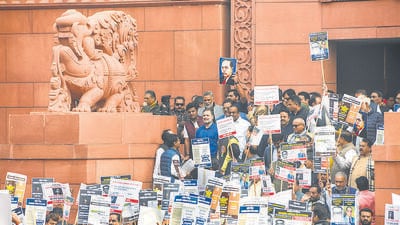
The ruling party accused the leader of the opposition in the Lok Sabha Rahul Gandhi At least one MLA was pushed and injured, while another was injured, while the Congress denied the allegations and said that BJP MLAs blocked Gandhi’s way and pushed Congress chief Mallikarjun Kharge, causing injury to his knee. It took effect.
The dispute began near the stairs of Parliament’s Makar Gate, the entry and exit gate reserved for MPs, when members National Democratic Alliance (NDA) and the Indian National Development Inclusive Alliance (INDIA) were holding concurrent protests over the legacy of constitutionalist BR Ambedkar. The BJP was accusing the previous Congress governments of insulting the first Law Minister of India. Bharat Block The members were demanding the resignation of Union Home Minister Amit Shah over his remarks on Ambedkar earlier this week. A day ago, there was a jam in both the houses of the Parliament on this issue.
There was chaos when both the parties came face to face on Thursday morning. The BJP alleged that two of its MLAs – Farrukhabad MP Mukesh Rajput and Balasore MP Pratap Chandra Sarangi – were injured when Gandhi pushed them while they were inside Parliament. Both were admitted to Ram Manohar Lohia Hospital in Delhi and Prime Minister Narendra Modi spoke to them on phone.
Separately, S Phangnon Konyak, a woman BJP MLA in the Rajya Sabha, said she was “uncomfortable” with Gandhi’s behaviour, while Congress member Hibi Eden described the allegation as completely fabricated.
“The decoration has gone down to the wire. Democracy has been torn apart and tarnished. There is no other example like the hooliganism of Rahul Gandhi and the Congress Party. Such conduct has never been seen in the parliamentary history of India,” said Union Agriculture Minister Shivraj Singh Chouhan.
But the Congress denied this version of events and said that three MPs from the ruling party assaulted Gandhi and refused to give way to him. The party said BJP members attacked Kharge and pushed him, causing him to lose his balance and suffer injuries to both his knees. He also accused the BJP of leveling false allegations against the leader of the opposition in the Lok Sabha.
“I was trying to enter Parliament and BJP MPs were stopping, pushing and threatening me,” Gandhi told reporters. He also alleged that the BJP was attacking Shah over his comments on Ambedkar. Trying to divert attention from the allegations against him.
Congress leader Priyanka Gandhi Vadra said that Rahul Gandhi is being targeted. He said, “To save Amit Shah’s skin, they have started this conspiracy that ‘bhaiya’ has pushed someone.”
Both parties lodged complaints with the police, and complained against each other to the respective Chairmen in the Lok Sabha and Rajya Sabha.
Former Union Minister Anurag Thakur said that the BJP members lodged a complaint at the Sansad Marg police station and booked them under sections 109 (attempt to murder), 115 (voluntarily causing hurt), 117 (voluntarily causing grievous hurt), 125 (acts Demanded first information report under. Endangering the life or personal safety of others), sections 131 (use of criminal force), 351 (criminal intimidation) and 3(5) (common intention) of the Indian Judicial Code.
Congress filed a complaint signed by members Digvijay Singh and Rajiv Shukla, among others, saying they were protesting in Parliament when BJP members attacked Mallikarjun Kharge, Neeraj Dangi and others.
“The BJP MPs used physical force on Mr Kharge by pushing him on the ground. This resulted in physical injuries to Mr. Kharge, Neeraj Dangi and others…The persons involved in committing the crime against Mr. Kharge can be identified from the video evidence being shared with the present complaint,” he wrote in the complaint.
Congress asked Delhi Police to register an FIR under sections including causing hurt, using criminal force, assault etc.
“Complaints have been received and are being investigated legally,” said a senior police officer with knowledge of the matter.
The controversy comes in the backdrop of the controversy that erupted over Shah’s comments on Ambedkar earlier this week. Responding to the debate on completion of 75 years of the Constitution on Tuesday, Shah had attacked the Congress and alleged that the opposition party had repeatedly insulted Ambedkar. “It has become a fashion to say Ambedkar, Ambedkar, Ambedkar…If he had taken God’s name so many times, he would have got a place in heaven for seven births…” he said.
India Bloc parties shared clips of the first part of his statement, demanding Shah’s resignation and an apology for the charge of insulting the creator of the Constitution. They held protests across the country and Kharge warned that his party would launch a national movement on the issue.
BJP has already rejected Congress’s allegations. Modi accused the Congress of spreading malicious lies to hide its years of misdeeds and insult to Ambedkar. Addressing a press conference, Shah accused the Congress of “distorting” his statement in the Rajya Sabha to create the “illusion” that he had insulted Ambedkar.
An unprecedented scene was seen in the Parliament complex on Thursday morning which increased political tension.
At 10 am, a group of National Democratic Alliance (NDA) MPs gathered near Makar Dwar carrying placards to protest against the Congress. A short distance away from Makar Dwar, where a statue of Ambedkar stood obscured by winter fog, opposition MPs gathered to attack Shah.
By 10.40 am the campus was echoing with contradictory slogans, when the two rivals came face to face, leading to a scuffle. What happened over the next 10 minutes remained unclear and both sides accused the other of instigating the attack.
At 10.50 am, Sarangi, a piece of gauze placed on his left temple, was put in an ambulance and taken to RML Hospital. Rajput, who also complained of injuries, was taken to the same hospital.
BJP member Nishikant Dubey publicly accused Gandhi of pushing Sarangi. “Aren’t you ashamed Rahul, you are indulging in rowdy behavior (‘hooliganism’). You pushed an old man,” an angry Dubey told Gandhi.
“He pushed me,” Gandhi protested to Dubey and walked away after a cursory glance at Sarangi.
“Rahul Gandhi pushed an MP, who fell on me and I got injured,” Sarangi told reporters.
But members of the India Bloc defended Gandhi. “I know Rahul Gandhi. He will not push anyone; Jammu and Kashmir Chief Minister Omar Abdullah said, he is not the kind of person who behaves badly or rudely with anyone… No one, leave alone an MP, can push anyone on the road.
Later, both the Houses witnessed huge uproar amid slogans of “Jai Bhim” from both the sides and were adjourned without any discussion.
Congress MPs later met Lok Sabha Speaker Om Birla and submitted a complaint against the BJP members. Konyak said in the Rajya Sabha that Gandhi came “very close” to him during a “peaceful protest” and shouted at him. He accused her of conduct inappropriate to his position as leader of the opposition, saying he made her uncomfortable.
Dhankhar said she received a message from Konyak on the incident and she also met him in his chamber. “I am looking into it. She was literally in tears,” he said in the House.
Later in the day, Congress MP Hibi Eden wrote to Birla and refuted the allegations. “I was present with the Honorable Leader of the Opposition during the entire event and at no point did Shri Rahul Gandhi ji come close to the person making the allegations. The allegation on Shri Rahul Gandhi of being insensitive towards the rights of women and Scheduled Tribes is another fake claim and at no point did Rahul Gandhi ji say, do or express any statement, action or word which would prove derogatory to the complainant. It may have happened,” he said. Letter.
Hemang Joshi, who filed the complaint against Gandhi, said, “When I saw Gandhi going away…I called him and asked him to see how Sarangi was injured…but he looked unconcerned and said that Sarangi had injured him. Pushed…how can he say such things?”
Maruti Suzuki Wagon R’s 25th Anniversary: Why Most Indian Buyers Love THIS ‘Tall Boy’ | Auto News

Maruti Suzuki Wagon R: Anyone can say anything about the Maruti Suzuki Wagon R, make fun of it, or criticize it, but one cannot deny the fact that it is among the best-selling cars in the country. Not just now, but ever since it was introduced in 1999 as the ‘Tall Boy’, Wagon R has been a favorite car for the common people. It has been the highest-selling car in India for the last three consecutive financial years – FY22, FY23, and FY24 – reflecting its popularity and timeless significance.
After receiving several updates and generation changes over its long successful journey, catering to the needs of the masses, the 2024 Wagon R continues to hold onto its core value of spaciousness and comfort. In the past 25 years, it has evolved in terms of design, features, and performance. Its second generation arrived in 2008 and the third generation model was launched in 2019, which later received an update in 2022.
Now, Maruti Suzuki is celebrating 25 remarkable years of the Wagon R in India, with over 32 lakh customers. Here are 5 reasons why Maruti Wagon R is so popular:
Affordable Price: Wagon R offers great value for money with budget-friendly pricing.
Spacious Interior: Its tall-boy design provides more headroom and comfortable seating for families.
Fuel Efficiency: The car is known for its excellent mileage, making it cost-effective for daily use.
Low Maintenance: Maruti’s reliable service network and affordable parts keep maintenance costs low.
Features: Considering the price range in which Wagon R is available, it offers almost all the necessary features, like a touchscreen, Android Auto and Apple CarPlay, and others.
Partho Banerjee, Senior Executive Officer, Marketing and Sales, Maruti Suzuki India Limited, said, “The WagonR’s 25-year legacy is a testament to the deep connection that we have established with over 32 lakh customers over the years.”
“The fact that approximately 44% of our sales come from first-time buyers, and roughly one in every four customers chooses to repurchase the Wagon R”, he added.
Currently, the Maruti Wagon R is priced between Rs 5.54 lakh and Rs 7.33 lakh (ex-showroom). It is available with two petrol engine options – 1.0L and 1.2L – producing 66bhp/89Nm and 89bhp/113Nm, respectively. It also comes with a CNG powertrain that produces 57 PS and 82 Nm.
Cyclone Chido death toll in Mozambique rises to 73 | News

At least 66 of the deaths occurred in the northern Cabo Delgado province, national disaster centre says.
The death toll from Cyclone Chido in Mozambique has increased to 73, the National Institute of Risk and Disaster Management has said.
At least 66 of the deaths occurred in the northern Cabo Delgado province, the disaster centre said on Thursday.
Four were killed in Nampula province and three in Niassa, further inland, it said, adding that one person was missing.
More than 540 people were reported injured by the cyclone, which brought winds of approximately 260 kilometres per hour (161 miles per hour) and heavy rainfall of about 250 millimetres (10 inches) in 24 hours, the centre said.
Chido made landfall in Mozambique on Sunday after tearing through the Indian Ocean island of Mayotte, where there are fears that hundreds of people may have been killed.

More than 39,100 homes were destroyed and more than 13,400 others partially destroyed, it said. More than 329,500 people were affected by the storm, Mozambique’s disaster centre noted.
Chido struck a part of northern Mozambique that is regularly battered by cyclones and is already vulnerable because of conflict and underdevelopment.
UNICEF’s Mozambique spokesman Guy Taylor said the situation across large swaths of northern Mozambique can be described as “devastation”.
“This is an area of the country where many, many people are already living in extremely precarious circumstances. Mozambique is a country where we already have 3.4 million children in need of humanitarian assistance,” he told Al Jazeera.
“Even before this crisis, many people, including children, families, have lost everything. We saw houses, whole villages completely smashed to smithereens, really. So people need shelter.”
After sweeping over Mozambique, the cyclone moved into Malawi where it killed 13 people and injured dozens of others, according to that country’s disaster management agency.
Destruction in Mayotte
Meanwhile, at least 31 people have been confirmed dead in the French overseas territory of Mayonette, and more than 1,500 people were injured, including more than 200 critically, French authorities said.
France has requested 10,000 tents and emergency accommodation from the European mechanism to aid Mayotte, said the French Ministry for Europe and Foreign Affairs.
People on storm-ravaged Mayotte implored French President Emmanuel Macron to do more to help on Thursday, as he toured the overseas territory.

Winds howled at more than 220km/h (136mph) and peeled the roofs and walls from homes that collapsed around the people sheltering inside.
In the shantytown Kaweni, on the outskirts of the capital Mamoudzou, a swath of hillside homes was reduced to scraps of corrugated metal, plastic, piles of bedding and clothing, and pieces of timber marking the frame where homes once stood.
The Indian constitution — violated

Just outside the two-platform Parbhani railway station in Maharashtra’s Marathwada region flutters the Indian national flag mounted on a pole. Beyond the tea shops selling misal pav and hotels catering to travellers, in front of an Art Deco building, is a statue of Dr. B.R. Ambedkar, who headed the drafting committee of the Constitution of India. Behind the statue are more symbols of the Indian republic: a replica of the Ashoka Chakra that forms the central symbol of the national flag, and the Ashoka Pillar, the original erected in Sarnath, Uttar Pradesh, where Buddha gave his first sermon. In front is the Constitution, now covered in a blue cloth, the colour of Ambedkar’s Scheduled Castes Federation of India flag. From the statue, the Doctor Line market begins, extending about 3 km up to Gandhi Park.
Dilip Ragade, 55, who runs a newspaper stand next to the statue, recalls a scuffle between a man and an autorickshaw driver between 4 p.m. and 5 p.m. on December 10. “At first, I thought he had pulled something out of the autorickshaw and thrown it on the road. Later, I realised that it was the replica of the Constitution. The autorickshaw driver had confronted the man,” he says. Soon, a crowd of about 200 people gathered and the man was thrashed, say witnesses. People ran towards the market spreading the word, and shops began to shut.
The police, the District Collector, and Ambedkarite leaders showed up and took the badly injured man to hospital, says Ragade. The man was arrested and the police told people that he was mentally ill and had not done the damage on purpose. Ambedkarites, however, were not convinced. They blocked the Nandigram Express for at least 30 minutes. Additional Superintendent of Police (ASP) Yashwant Kale says the train left Parbhani station only after the Government Railway Police dispersed the crowd.
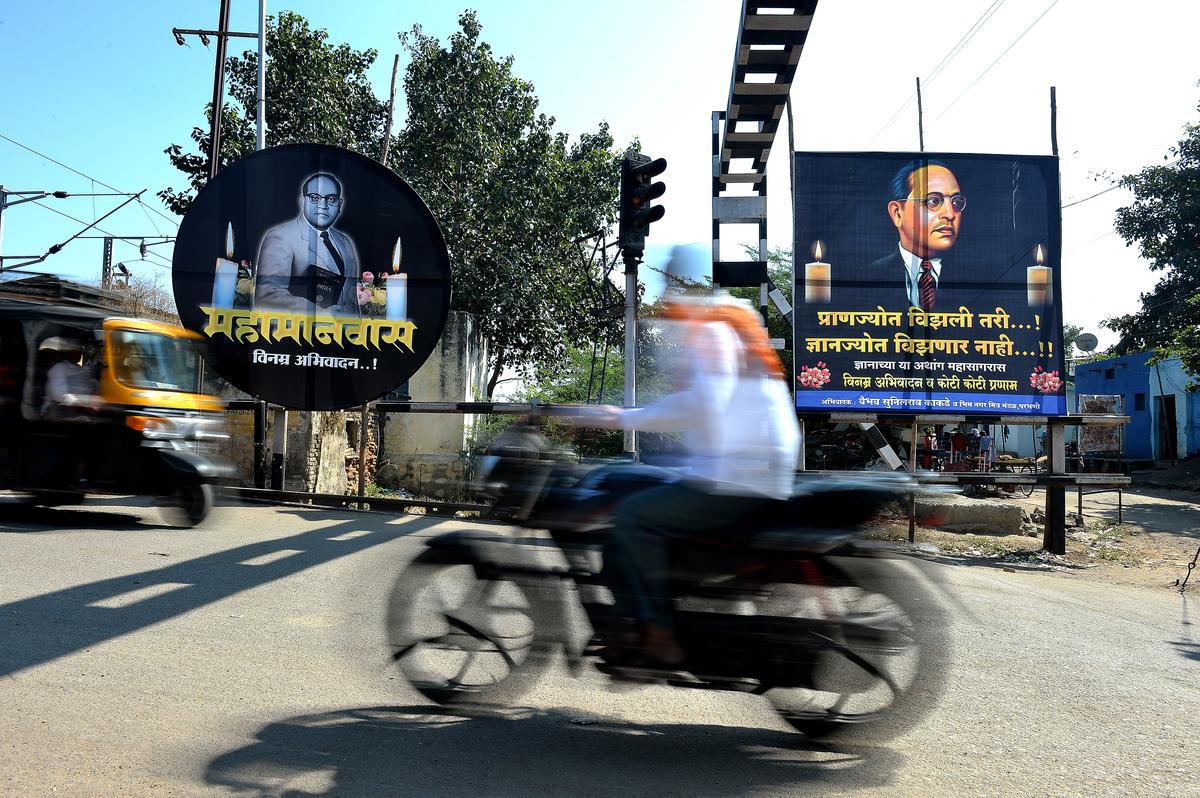
A hoarding seen to pay tribute to Dr. B.R. Ambedkar on his death anniversary (6th December) at Bhim Nagar, Parbhani.
| Photo Credit:
VIJAY SONEJI
The next day, following protests by Ambedkarites, there was stone pelting and arson, followed by a crackdown by the Parbhani police. Somnath Suryavanshi, 35, who had come from Pune for his law entrance examination, was allegedly picked up from where he was staying. He died in judicial custody a few days later.
Ambedkarites claim people not from their community joined the protests so the blame for the violence would fall on them. They say the “police brutality” was a reflection of how Dalits are treated in society.
Protests of different kinds
Earlier in the day on December 10, Hindu Sakal Samaj, a right-wing outfit, had taken out a morcha (march) condemning the atrocities against Hindus in Bangladesh, which has a prominent border with India. It took place a few metres from the Ambedkar statue where the statue of 17th-century Maratha king Chhatrapati Shivaji, a symbol of Maratha pride, is located. There was not much movement in the city during the morcha, say the residents of Parbhani. Ambedkarites claim several people delivered provocative speeches. This right-wing event combined with the desecration of the Constitution’s replica angered Dalits, many of whom are Ambedkar’s followers. Around 8 p.m. that night, the administration organised a shanti samiti baithak (peaceful meeting). Here, Ambedkarite leaders said they would carry out a protest at five locations in Parbhani the next day. They would also submit a letter to the Collector putting forth their demands, which included charging the man and his ‘accomplices’ under the stringent Unlawful Activities (Prevention) Act, 1967, and making him undergo a polygraph test to find out the ‘mastermind’ behind the act of vandalism. That night, the city went to sleep peacefully.
The following day, Ambedkarite organisations called for a bandh. These included the Republican Sena led by a grandson of Ambedkar; the Republican Party of India (A) led by Union Minister of State for Social Justice and Empowerment Ramdas Athawale; and the Buddhist Society of India, founded by Ambedkar himself, who had converted to Buddhism.
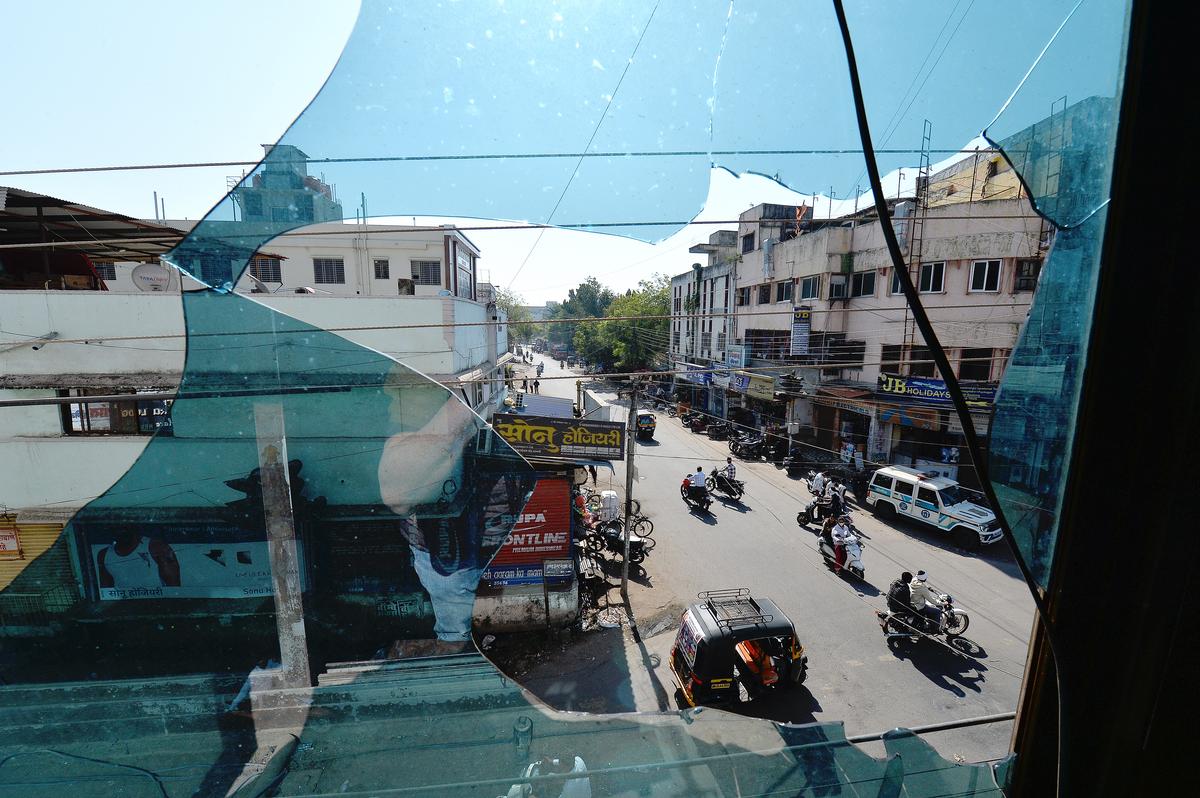
A view from a glass window that was damaged during the riots that erupted on December 11.
| Photo Credit:
VIJAY SONEJI
Ambedkarite groups began protests across the city around 8 a.m. People gathered in groups ranging from 200 to 1,000. Seven groups peacefully submitted the charter of demands to the Collector. The police say the eighth group got disruptive, forcing its way into the Collector’s office. Soon, they say, violence erupted in the market, about 600 metres from the office. There was stone pelting and arson, followed by the firing of tear gas shells, say witnesses.
A city unsettled
Ambedkarites say the police reacted violently. A 32-year-old demonstrator says, “The police first stopped us from reaching out to the Collector. That is why we agitated and some of us got on top of the police van to raise slogans. Now, they are looking for me everywhere.” She has been in hiding after a video featuring her protesting went viral. Infuriated, she says, “We agitated for something that has given us a dignified life.” She says a few men wearing masks and holding lathis had joined the protesters. “The people of Ambedkar Basti did not have these when they left.”
Eight FIRs were registered, over 200 people booked, and 50 arrested, including minor girls from Dalit bastis (neighbourhoods) in Parbhani such as Gautam Nagar, Priyadarshini Nagar, Rahul Nagar, and Bhim Nagar. The police booked people on charges of rioting, assault on public servants, promoting enmity, and damaging public property. “Two police vans, two four-wheelers, 18 two-wheelers, and hundreds of shops were damaged. Nine police personnel were injured. Five women were released a day after detention,” says the ASP. “So far, 27 people have been arrested,” he says.
On December 11, orders were issued under Section 163 of the Bharatiya Nagarik Suraksha Sanhita, preventing the assembly of five or more people. Social activists and locals have criticised the administration for taking a whole day to do this. “The State Reserve Police Force (SRPF) unit was stationed a few kilometres from here in Hingoli, yet the police did not act,” says a 49-year-old retailer in the area. The SRPF was deployed the next day after 2 p.m.
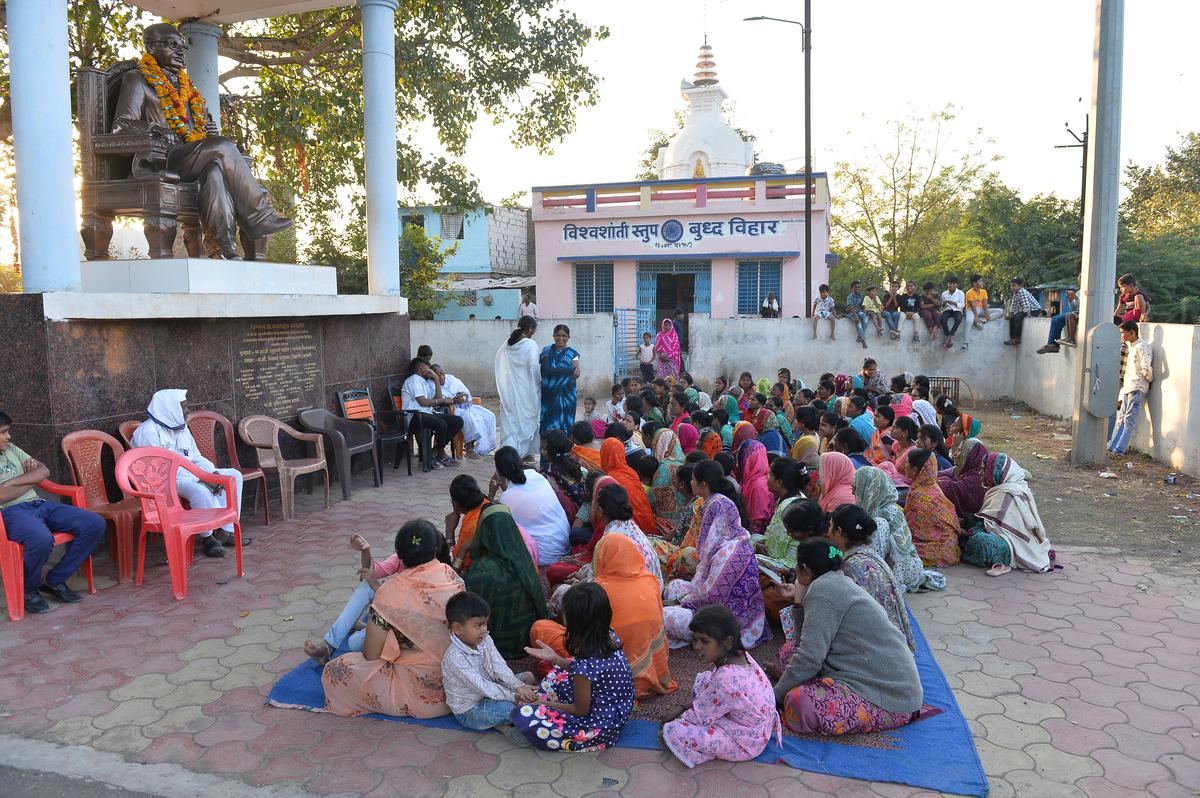
Women in Bhimnagar gather at community temple in Parbhani on December 14.
| Photo Credit:
VIJAY SONEJI
Vijay Wakode, an Ambedkarite leader, who died of a heart attack while protesting against the death of Somnath, had said the protest was peaceful until 1 p.m. “Then things went haywire and we cancelled the rally scheduled to be held after the protest,” he had said, adding that people not part of the Ambedkar movement got mixed in the crowd, making Ambedkarite organisations the scapegoat “to malign us”.
During the Maharashtra Assembly’s winter session in Nagpur, the Opposition slammed the Mahayuti government over “poor law and order” in the State. In response, Chief Minister Devendra Fadnavis said, “The government will never do anything against the Constitution and the insult of it will not be tolerated.”
Meanwhile, newly appointed Minister and MLA from Jintur in Parbhani Meghana Bordikar told mediapersons that “Suryawanshi’s death was due to a heart attack”. She also defended the police, saying, “They arrested the accused immediately.”
A market on edge
One of the shops that was damaged belonged to Kapil Chonde, 25. As news of the violence spread, he quickly bundled up sweaters, caps, and dark glasses that lay on his makeshift platform under a tarpaulin tied between an electric pole and bamboo struts. On seeing the mob rush in his direction, he sought safety in a pucca shop, but a lot of his goods were burnt. “The crowd was massive; they could have burnt anything that came in its way. The anger was visible and the police were hiding,” Chonde says, two days after the incident, distraught. He estimates his loss at ₹40,000. He has taken a loan of ₹60,000 and wonders how he will pay it back.
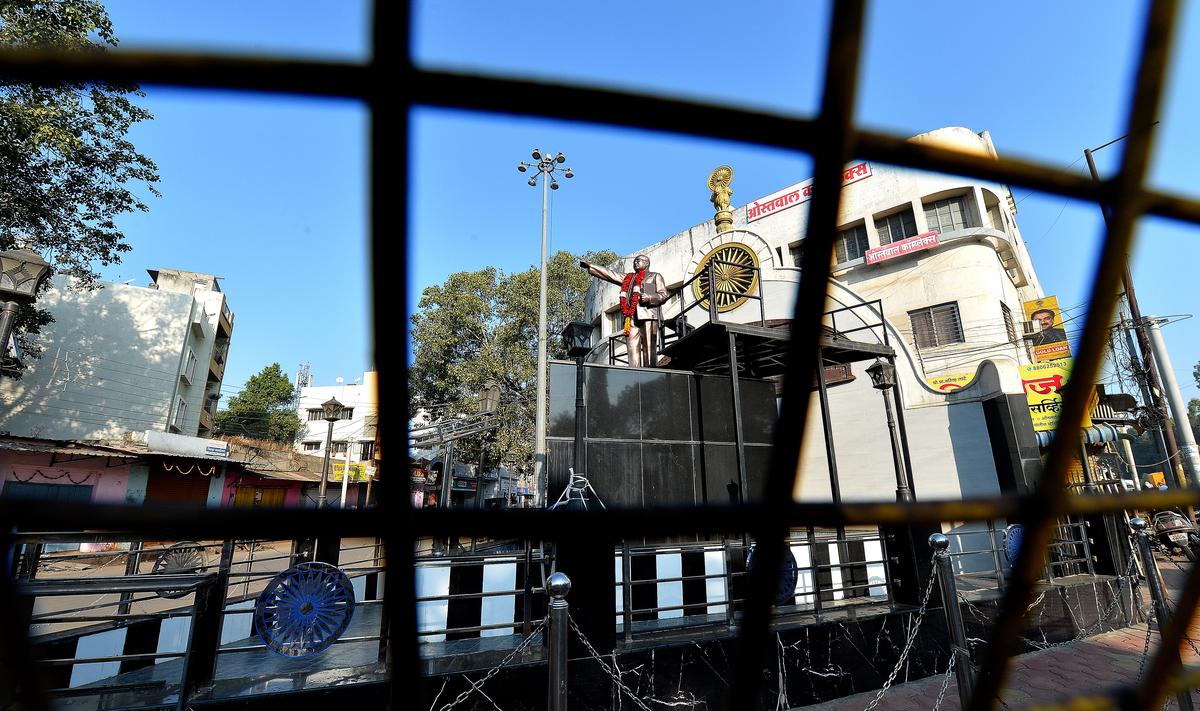
Dr. B.R. Ambedkar’s statue at Station Road in Parbhani.
| Photo Credit:
VIJAY SONEJI
Several traders are grappling with the task of assessing the extent of damage. Boards were damaged, doors bashed in, pushcarts broken, and bits thrown into the gutter. The Parbhani police estimate that property worth at least ₹30 lakh was damaged. Doctor Line has shops owned by a variety of trading communities from different ethnicities and religions. However, Kashinath Shinde, 45, one of the owners, says, “Most shops are of the Maratha community. The violence was targeted at them as the perpetrator is a Maratha.”
The area around the Ambedkar statue has been cordoned off with barricades. Riot Control Police vans are stationed at the opposite end of the road. At least 10 police personnel are deployed every 300 metres, and police vans stationed at every kilometre, with patrolling every half an hour. The government also suspended Internet services for two days.
Rumours abound in the city. One talks about the arrest of a 10-year-old girl, another the custodial death of a woman. The moment a rumour is spread, the shutters of shops go down. This happens a couple of times. The police announce on loudspeakers that these claims are untrue.
Dalits traumatised
In Dalit settlements, people are gripped with fear of getting picked up by the police. Kalawanti Dabade, 50, a daily wage earner, says, “The police are searching every house and taking our children.” A demonstrator from Bhim Nagar says, “We started pelting stones when the police resorted to lathi charge and opened tear gas. We missed our exams because they are looking for us and many of us are in hiding.” His body is covered with black and green scars that he says are a result of the lathi charge. “The government hospital refused to take me in, saying I was a rioter.”
Vachala Manavte, 53, was hospitalised after she was released from jail on December 12. She works at a nearby hospital and was allegedly thrashed for recording a video of the police while they were detaining youth in Priyadarshini Nagar. “After dragging me there, they threw me in the lock-up and slapped and kicked me. They were trying to retrieve my mobile phone’s password to delete the video,” she says.
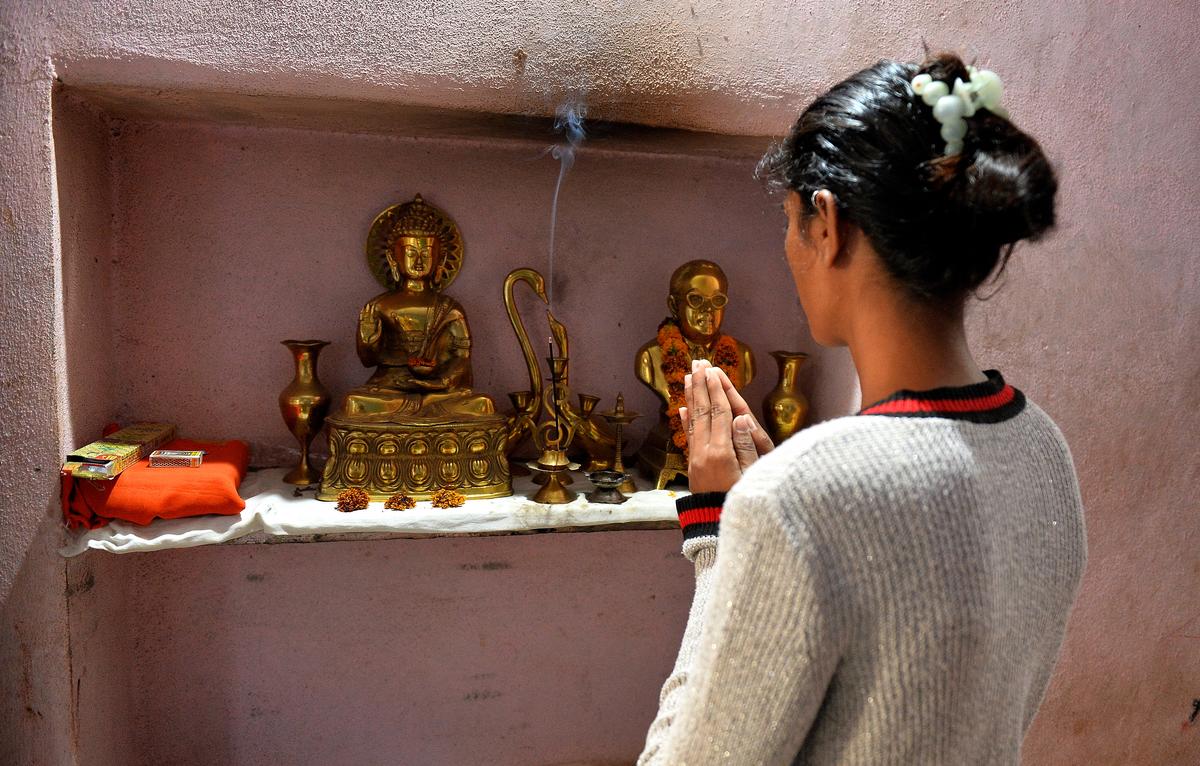
A victim of the violence offers prayers in front of statuettes of Buddha and
Dr. B.R. Ambedkar at her home in Parbhani, Maharashtra.
| Photo Credit:
VIJAY SONEJI
Rutuja, 20, and Pooja, 27, along with two minor sisters, aged 14 and 12, from Bhim Nagar were taken into custody. “They treated us like animals and humiliated us for being Dalit. I could actually relate to Jai Bhim (a Tamil movie on a tribal woman fighting for justice). They asked us to kneel and not look up,” says Rutuja, adding that the police also took her hall ticket for her first-year BA exams. Pooja tells a similar story. The minor girls’ mother has sent them to Nanded to avoid harassment by the police.
Politicians have been visiting the area following the violence. Athawale visited the Ambedkar statue, garlanded it, met officials in-charge of the administration, and residents of Bhim Nagar. Sujat Ambedkar, the great-grandson of Ambedkar, also garlanded the statue and visited Bhim Nagar.
On December 17, Prakash Ambedkar, Vanchit Bahujan Aghadi chief and Sujat’s father, posted a video on X and wrote: “A mother of a newborn was brutally assaulted by the police in her house. She had locked herself in the bathroom to save herself from the violence, but the police broke the door down and brutally beat her up.”
Conspiracy theories
The man who desecrated the Constitution is from Mirzapur village in Parbhani district and worked at grocery shops in Parbhani. His father-in-law, who asked not to be named, says his younger son was the first to receive a call from the police informing them about the incident. He adds that he will accept what the law decides. “For the last two months, he had been hospitalised in Akola (about 200 km from Parbhani) and arrived in the city on the day of the incident,” he says. “For the past 16 years, he has been under treatment for mental health issues.” A doctor confirms this.
Ambedkarite organisations believe the man was used. “This could be a conspiracy to create a rift between Marathas and Dalits. The police must probe this under the Supreme Court’s observation,” Bhimrao Hattiambire, an Ambedkarite leader from Parbhani, says.
However, District Collector Raghunath Gawade calls this a “mere coincidence” and dismisses such a possibility. “Prima facie there is no correlation between the two incidents. We are investigating this angle. This was a huge but unintentional mistake.”
Somnath’s brother Premnath Suryawanshi is now fighting for justice. His lawyer, Pawan Jondhale, says Somnath had no role in the events of December 11 and was picked up with other men from Shankar Nagar, where a number of Dalits live. “He came to Parbhani from Pune to fulfil his dream of becoming a lawyer,” he says. “He did odd jobs, from driving to labour work, and supported his family.”
Vilas Kale, who calls himself a Parbhanikar, sits outside a restaurant whose board was damaged in the violence. In February, during the Urs (death anniversary of a Muslim holy man) of Hazrat Sayyed Shah Turabul Haq Baba, which saw the participation of both Hindus and Muslims, tensions over the molestation of a woman resulted in stone pelting. “The Urs was cut short by four days citing law and order issues,” he says. “Parbhani has always been sensitive.”
Published – December 20, 2024 12:40 am IST
Syria’s new ruler is politically astute

When I left London almost two weeks ago after the rebel coalition captured Aleppo – a stunning victory dwarfed by what followed – I thought I would be reporting a shooting war.
The group known as Hayat Tahrir al-Sham, or HTS, was sweeping all before it, but I assumed that the regime would fight, as it did not stop doing as it was losing ground in the years before the Russians intervened in 2015 to bomb Syrian towns and villages to rubble.
Almost a decade later, it was clear that Bashar al-Assad’s Russian, Iranian and Lebanese allies had other wars to think about.
But while the regime struggled with unwilling conscripts, it could always find Syrians who were prepared to fight and die for it, even at the height of the war after 2011, when rebels controlled much of Damascus outside the city centre and the road to Beirut.
I visited those men on the front line many times.
Many of the most effective units were led by officers from Assad’s own Alawite community.
In Aleppo in around 2015 an Alawite general handed out glasses of perfectly distilled arak, poured from bottles that once held Jack Daniels.
Proudly, he said the arak, an aniseed based spirit popular across the Middle East, came from the Assad family’s home town in the hills behind the port of Latakia. Outside, his unit was pounding the rebel-held east side of the city.
Not all were Alawites. In Jobar, a district on the edge of central Damascus, a Christian officer loyal to Assad from the Syrian Arab Army took me into the tunnels they had dug under the ruins to attack rebels.
He told how the rebels also had tunnels and how sometimes they would break into each other’s, killing in the darkness.
The young man had a crucifix tattooed on his wrist and another hanging around his neck, and he talked about how he had to fight to protect his community against jihadi extremists on the other side.
My instincts about the fighting spirit of Assad’s depleted band of loyalists could not have been more wrong.
On Saturday 7 December I went to sleep after hearing the news that Homs had fallen.
By the time I woke up Bashar al-Assad was on his way to Russia and rebel fighters were starting to celebrate on the streets of Damascus.

 EPA
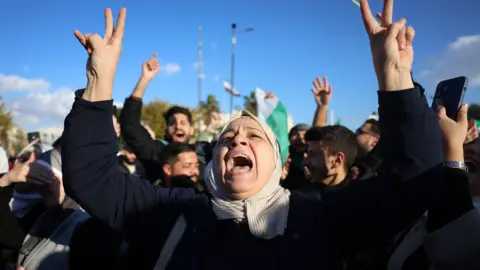
EPAThey shot more bullets into the air in celebration than they fired in anger at Assad’s loyalists, who were running for their lives.
I saw hundreds of cars queuing to leave at the border with Lebanon, full of disgruntled, defeated men and frightened families.
Rank and file soldiers dumped their uniforms and weapons without firing a shot and went home.
The Assad regime crumpled, hollowed out by corruption, cruelty and brutal disdain for the lives of Syrians. Even Assad’s own Alawite community did not fight for him.
That was why on Thursday evening this week, instead of sheltering from shells and bullets on some freezing street in Homs or Hama, as I’d expected, I walked through the marble halls of the presidential palace in Damascus with Ahmed al-Sharaa, Syria’s de facto leader.
He has given up his uniform, and swapped his wartime pseudonym, Abu Mohammed al-Jolani, for his real name.
Many Syrians doubt his claim that he has also swapped his old jihadist beliefs for a more tolerant form of Syrian religious nationalism.
It is true that he broke with al Qaeda in 2016, after a long career as a jihadist fighter in Iraq and Syria. But as I found in Assad’s palace, Ahmed al-Sharaa, a tall, quietly spoken man in his early forties, is reluctant to get too specific about the Syria he wants.
He comes across as highly intelligent and politically astute. Like many astute politicians, he often does not give a straight answer to a straight question.
He denied he wanted Syria to become a Middle Eastern Afghanistan.
The Taliban, he said, ruled “a tribal society. Syria is entirely different.” Syria’s new rulers would respect its culture and history.
When I asked whether women would have the freedoms they have come to expect here, he said 60 per cent of students in universities in Idlib, his powerbase, were female.
But he tried not to answer a question about mandating hijab – Islamic dress – for women.
Damascus has been buzzing with rumours of bearded HTS men ordering women to cover their hair.
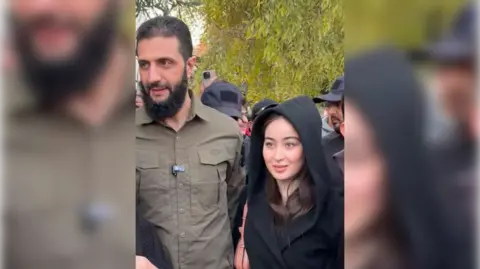
I pointed out that there had been a big row on social media after a woman asked for a selfie with him and then pulled up her hood when she took the photo.
Conservatives criticised al-Sharaa for consenting to pose with a woman who was not part of his family. Liberals saw her hood as a dark omen of Syria’s future.
 X
XIf he was exasperated by the question he did not show it.
“I did not force her. But it’s my personal freedom. I want photos taken for me the way that suits me. I did not force her. That’s not the same as having a law about it that applies countrywide. But there is a culture in this country that the law needs to recognise.”
Al Sharaa was referring to the fact that many Syrians, not just in the majority Sunni Muslim community, are pious.
Many women wear hijab. The point, secular Syrians would say, is to be able to choose.
In half a century of Assad rule, Syrians developed survival strategies which often included hiding their own feelings and doing what was expected of them.
Shocked, nervous, secular Syrians showed me videos on their phones of mass prayers outside universities when the students went back last Sunday.
Was it, they asked, real piety or young people doing as they were told because that is how it’s been here for their whole lives?
It will all, al-Sharaa said, be a matter for a new constitution to be decided by a panel of legal experts.
Al-Sharaa’s critics will point out that as things stand, he chooses who gets on to the committee that he says will be writing new laws as well as a new constitution.
Ahmed al-Sharaa wanted to talk most about the old regime’s oppression of the people.
“The Syrian problems are far too bigger than the issues you are asking about. Half the population was kicked out of Syria or forcibly displaced from their houses.
“They were targeted with barrel bombs and unguided dumb bombs and over 250 chemical attacks. Many Syrians drowned at sea trying to escape to Europe.”
He recognised that Syria has no chance of starting to stabilise and rebuild if sanctions are not lifted.
Sanctions were aimed originally at the Assad regime. To keep them, he said, meant treating the victim the same as the oppressor.
He denied the group he leads is a terror organisation, which at the moment is the position of the UN and most of the world’s strongest countries.
Visits by foreign diplomats suggest changing both the sanctions and terrorist listings could be feasible.
 Reuters
He was dismissive when I pointed out I knew diplomats had told him that changing that status would depend on proof he was keeping his promise to respect minority rights and run an inclusive political process.
“What matters to me is that the Syrian people believe me. We promised the Syrian people to liberate them from this criminal regime and we did that. This is what matters to me first and last.
“I don’t very much care about what will be said about us abroad. I’m not obliged to prove to the world that we work seriously to achieve the interests of our people in Syria.”
During the last two weeks, I have heard many Syrians say that they want to be left alone to try to rebuild their country.
That sounds like a pipe dream.
The war destroyed much of the country, but it also drained away Syria’s sovereignty.
Bashar al-Assad became a client of Iran and Russia and fled the country when they stopped supporting him.
The US is in the north-east, to hunt remnants of Islamic State and to protect its Kurdish allies.
Turkey controls much of the north-west and has its own Arab-led militia.
There are signs that the Turks, who have a close relationship with HTS, are preparing a renewed assault on Syrian Kurds who have a close relationship with Kurdish separatists inside Turkey.
Israel, currently as aggressive as it has been for many years, has most overtly exploited the vacuum of power it saw in Syria.
It continues to bomb the remains of the state’s military infrastructure and taking more Syrian land to add to the Golan Heights which it has occupied since 1967.
The Israelis, as ever, justify their actions as self-defence.
The UN special envoy to Syria Geir Pedersen told me that Israel’s actions were “irresponsible.” Israel, he said should not act in a manner that could “destabilise this very, very fragile transitional process.”
 EPA
EPAAhmed al-Sharaa knows he cannot stand up to Israel’s US-backed power.
“Syria is exhausted from the war regardless of whether Israel is strong or not. Syria needs to get stronger and more developed. We don’t have any plans of aggression against Israel. Syria will not be a threat to Israel or anyone.”
Ahmed al-Sharaa’s agenda is overflowing.
Syria is a broken country that he says he wants to repair and revive, full of challenges that might make his task impossible.
HTS is not the only armed group in Syria and there are some that want to destroy his fledgling administration. Enemies of HTS in the Islamic State network might try destabilising attacks.
The desire Syrians have for vengeance against Assad’s killers – and the ex-president himself – could explode into destructive public rage if HTS cannot show that it is bringing to justice the men who kept their boots on Syrian throats for so long.
Ahmed al-Sharaa, correctly, sees Syria as a fulcrum at the heart of the Middle East.
“Syria is an important country with a strategic location, very influential in the world, look how America is present in it on the one hand, Russia on the other hand and regional countries such as Turkey, Iran and Israel as well.”
He says that is why the outside world should help Syria recover.
It is also why powerful states might not let that happen.
