Google on Wednesday unveiled its most advanced artificial intelligence model till date, Gemini 2.0, saying that it brings the tech giant closer to its vision of a “universal assistant”.
Sundar Pichai said Gemini 2.0 Flash experimental model will be available to all Gemini users.(Google)
Google CEO Sundar Pichai said that the ‘most capable model yet’ marks the start of the firm’s next era, the “new agentic era”.
“With new advances in multimodality — like native image and audio output — and native tool use, it will enable us to build new AI agents that bring us closer to our vision of a universal assistant,” Pichai said.
Google had introduced its first AI model, Gemini 1.0, in December 2023, which drove big advances with multimodality and context to understand multi-media information, from videos to codes, everything.
The release of Gemini 2.0 also led Google shares to skyrocket by more than four per cent on Wall Street, a day after tech giant’s stock already gained 3.5 per cent following the release of its ‘mind-boggling’ quantum chip Willow.
Silicon Valley’s latest trend, an AI ‘agent’, is a digital helper meant to sense surroundings, make decisions, and even take actions to accomplish specific goals.
The Google and Alphabet CEO also said that Gemini 2.0 Flash experimental model will be available to all Gemini users.
The tech giant also launched a new feature, ‘Deep Research’, which uses “advanced reasoning and long context capabilities to act as a research assistant, exploring complex topics and compelling reports” on the user’s behalf.
Gemini 2.0 is developed on custom hardware like Trillium, Google’s six-generation TPU (Tensor Processing Unit), which is now made generally available to all customers.
TPU Trillium 100 per cent powered the training and inference of Gemini 2.0, Google said.
“If Gemini 1.0 was about organizing and understanding information, Gemini 2.0 is about making it much more useful. I can’t wait to see what this next era brings,” Sundar Pichai said.
The tech giant said that Gemini 2.0 Flash will be made generally available in January, along with more model sizes.
Google will expand Gemini 2.0 to more of its products in early 2025.
The company also hinted at a new version of Project Astra, a smartphone digital assistant similar to Apple’s Siri, saying that it now has the ability to converse in multiple languages.
“With Gemini 2.0, Project Astra can use Google Search, Lens and Maps, making it more useful as an assistant in your everyday life,” Google said.
Dealing with flat tires can be a stressful experience, but having a reliable and portable tire inflator on hand can make a big difference. These compact devices are invaluable for both emergencies and routine tire maintenance, ensuring you’re always ready on the road.
Portable tire inflators are the compact solution for easy quick, reliable tire inflation anytime, anywhere.
Choosing the right portable tire inflator is essential to meet your specific needs and preferences. Whether you prioritize speed, durability, or ease of use, there are many options available to suit every need. A quality inflator not only saves time but also provides peace of mind, especially during unexpected situations.
In this article, we will explore the top portable tire inflators currently available on the market. By comparing their features, performance and price, we aim to guide you in choosing the right model. Stay informed and make sure your trips are smooth and hassle-free with the ideal tire inflator for your needs.
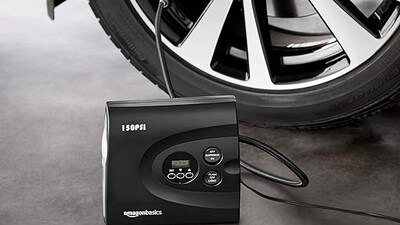
The AmazonBasics Compact Portable Tire Inflator is a versatile and easy-to-use solution for inflating car tires, sports equipment, and more. With its compact and portable design, it offers convenience and reliability on the go. Its built-in LED light ensures visibility during night time use.
Specifications of AmazonBasics Compact Portable Tire Inflator
Inflation speed: 25L/min
Maximum Pressure: 100 PSI
Power Source: Car Battery or 12V DC Power Outlet
Digital gauge for accurate pressure readings
Carry case included for easy storage and transportation
reason to buy
reasons to avoid
Compact and portable design
Larger tires may take longer to fill with air
Versatile use for various inflatables
Amazon Basics Digital Tire Inflator with Light
The Amazon Basics Digital Tire Inflator is designed for convenient and efficient tire inflation. It features a digital gauge for accurate pressure readings and an LED light for visibility in low light conditions. Its compact size makes it easy to keep in your vehicle for emergencies.
Specifications of Amazon Basics Digital Tire Inflator with Light
Inflation speed: 35L/min
Maximum Pressure: 120 PSI
Power Source: Car Battery or 12V DC Power Outlet
Auto shut-off function for precise inflation
Portable and lightweight design
reason to buy
reasons to avoid
high rate of inflation
May not be suitable for heavy-duty use
Digital gauge for accuracy
The Solimo 102 Tire Inflator provides reliable and efficient inflation for car tires and other inflatables. Its compact and lightweight design makes it easy to carry and use when needed. Built-in pressure gauge ensures accurate readings for optimal inflation.
This versatile tire inflator is equipped with a rechargeable battery for cordless operation. It features a digital display for easy monitoring of pressure readings and an auto shut-off function for accurate inflation. Its compact size and carrying handle make it convenient for travel and emergencies.
Specifications of Inflator with Battery Support and Digital Display
Inflation speed: 30L/min
Maximum Pressure: 120 PSI
Power Source: Rechargeable battery or 12V DC power outlet
Digital display for accurate pressure readings
Cordless operation for added convenience
reason to buy
reasons to avoid
cordless operation
Heavy use may require frequent recharging
Digital display for easy monitoring
The AGARO Tire Inflator is designed for emergency inflation needs, providing quick and reliable performance when you need it most. Its compact and portable design with built-in LED light, ensures ease of use during night-time emergencies.
Specifications of AGARO Tire Inflator for Emergency Use
AGARO Cordless Tire Inflator with Rechargeable Battery
The AGARO Cordless Tire Inflator features cordless operation with a rechargeable battery for on-the-go inflation. It has an easy-to-read digital display for accurate pressure readings and a compact design for portable use.
Specifications of AGARO Cordless Tire Inflator with Rechargeable Battery
Inflation speed: 30L/min
Maximum Pressure: 100 PSI
Power Source: Rechargeable battery or 12V DC power outlet
Digital display for accurate pressure monitoring
Cordless operation for added convenience
reason to buy
reasons to avoid
cordless operation
Heavy use may require frequent recharging
Easy to read digital display
The Lirovo Portable Electric Tire Inflator is a versatile and efficient solution for filling air into car tires, sports equipment and more. Its digital display provides easy monitoring of pressure readings, and its compact size makes it convenient for travel and emergencies.
Specifications of Lirovo Portable Electric Tire Inflator with Digital Display
Inflation speed: 25L/min
Maximum Pressure: 120 PSI
Power Source: Car Battery or 12V DC Power Outlet
Digital display for accurate pressure readings
Compact and portable design
reason to buy
reasons to avoid
Versatile use for various inflatables
Larger tires may take longer to fill with air
Digital display for easy monitoring
This portable tire inflator provides inflation convenience with a built-in power bank to charge devices on the go. Its compact and lightweight design, with a digital display for pressure readings, makes it a versatile and practical solution for emergencies.
Specifications of Portable Tire Inflator with Inflation Pressure Powerbank
Inflation speed: 35L/min
Maximum Pressure: 100 PSI
Power Source: Built-in rechargeable battery or 12V DC power outlet
Top 3 Features of the Best Portable Tire Inflators:
Best Portable Tire Inflators
inflation pace
maximum pressure
source of power
AmazonBasics Compact Portable Tire Inflator
25L/min
100 psi
12v dc power outlet
Amazon Basics Digital Tire Inflator with Light
35L/min
120 psi
12v dc power outlet
Solimo 102 Tire Inflator
30L/min
100 psi
12v dc power outlet
Inflator with battery support and digital display
30L/min
120 psi
Rechargeable battery or 12V DC power outlet
AGARO Tire Inflator for Emergency Use
35L/min
100 psi
12v dc power outlet
AGARO Cordless Tire Inflator with Rechargeable Battery
30L/min
100 psi
Rechargeable battery or 12V DC power outlet
Lirovo Portable Electric Tire Inflator with Digital Display
25L/min
120 psi
12v dc power outlet
Portable Tire Inflator with Inflation Pressure Powerbank
35L/min
100 psi
Built-in rechargeable battery or 12V DC power outlet
Best Value for Money Portable Tire Inflator:
Solimo 102 Tire Inflator offers the best value for money with its versatile use, multiple nozzle attachments and easy-to-use design. It offers a reliable solution at an affordable price, making it a practical choice for everyday inflation needs.
The Amazon Basics Digital Tire Inflator with Light is the best overall product in this category, offering fast inflation speeds, high maximum pressure capacity, and a compact design for convenient storage and use. Its digital gauge and auto shut-off function ensures accurate and efficient inflation for a variety of applications.
Factors to keep in mind when choosing the best portable tire inflator:
portability and size: Choose a compact and lightweight tire inflator that is easy to carry and store in your vehicle.
inflation pace: To save time during emergencies, choose an inflator with a quick inflation rate measured in liters per minute.
pressure accuracy: Make sure the inflator provides accurate pressure readings to avoid under- or over-inflation, which can affect tire performance.
source of power: Choose a model compatible with your vehicle for convenience, such as a 12V car socket or rechargeable battery.
Durability and build quality: Look for sturdy materials and reliable construction to withstand regular use and harsh conditions.
What is the average price range for portable tire inflators?
The average price range of portable tire inflators varies from Rs. 1500 to Rs. 5000 depending on the brand, features and performance.
What are the main features to look for in a portable tire inflator?
Key features to consider include inflation speed, maximum pressure capacity, power source options, digital display, and built-in LED lights for visibility.
How effective are portable tire inflators for emergency use?
Portable tire inflators are highly effective for emergency use, providing quick and reliable inflation for flat tires and other inflatables.
What are the latest releases in portable tire inflators this year?
The latest releases in portable tire inflators this year include advanced digital models with advanced features and improved performance for user convenience.
Disclaimer: At Hindustan Times, we help you stay updated with the latest trends and products. Hindustan Times has an affiliate partnership, so we may get a share of the revenue when you make a purchase. We will not be liable for any claims under applicable laws including but not limited to the Consumer Protection Act, 2019 in relation to the Products. The products listed in this article are in no particular order of priority.
Luigi Mangione, the suspect accused of fatally shooting healthcare insurance CEO Brian Thompson in New York, is unlikely to be able to mount an effective legal defence to the charges he faces, according to experts.
Mr Mangione, 26, was arrested in Pennsylvania on Monday after a days-long, multi-state manhunt ended at a McDonalds in the town of Altoona.
New York authorities say forensic evidence and shell casings link him to the crime scene.
His lawyer, Thomas Dickey, earlier told local media he had not “seen any evidence yet” implicating his client.
He said Mr Mangione would plead not guilty to the charges he faces in Pennsylvania, including firearms charges.
In New York, he has been charged with second-degree murder over Mr Thompson’s killing. The 50-year-old chief executive of UnitedHealthcare, was shot dead by a masked assailant outside a Manhattan hotel on 4 December in what authorities say was a targeted attack.
Mr Mangione is currently being held in a state prison in Pennsylvania where he is fighting extradition to New York to face that murder charge. The legal battle over his extradition could potentially take more than a month to resolve, officials said.
But legal experts told the BBC that his efforts to contest his extradition to New York are unlikely to be successful. They could, however, provide his defence with a glimpse into the state’s evidence against him.
“I don’t even know if this is him,” his lawyer, Mr Dickey, said in a recent interview with US media outlet NewsNation, referring to images of Mr Thompson’s killer.
“We’re going to test those waters and give the government a chance to bring some evidence forward,” he said.
If he is extradited to New York to face the murder charge, Mr Mangione and his legal team face an uphill battle as they try to mount a defence, the experts said.
Mitchell Epner, a New York-based lawyer and former prosecutor, told the BBC that there are, broadly, two approaches that Mr Mangione could take if he pleads not guilty to Mr Thompson’s murder.
“Defence number one is ‘it wasn’t me’ and defence number two is ‘it was me, but I shouldn’t be punished’ because of X,” he said.
According to New York police, Mr Mangione was found with a gun similar to the murder weapon, a silencer and a fake ID, as well as three handwritten pages which they believe suggest a potential motive.
Mr Epner said that the publicly known evidence so far means denying responsibility is “out the window”.
Another New York-based lawyer, criminal defence attorney and Professor Dmitriy Shakhnevich, said Mr Mangione’s attorney could also, in theory, argue that an impaired “mental status” makes him unfit to stand trial.
“If a judge makes a determination that he’s misunderstanding, or not understanding, what’s happening in court, then essentially the case won’t go forward,” he said.
“He’ll be institutionalised for a period of time until he’s deemed to be fit, which may be never.”
That defence, Mr Shakhnevich added, is different to a plea of insanity, in which his lawyers could argue that “he’s not responsible for his actions because of some mental defect”.
“That could also deem him not guilty, because you won’t satisfy the elements of the offence,” he said. “But then again, he doesn’t go free. He would be institutionalised for a period, assuming that defence is successful.”
The start of Mr Mangione’s legal battles has prompted anonymous donors to chip in thousands of dollars towards his defence through online fundraisers.
It comes as some online have shared support for the suspect and anger at the health insurance industry. The New York City Police Department has also warned some healthcare executives are potentially in danger because of a “hit list” posted online after Mr Thompson’s murder.
In a bulletin, the NYPD said several viral posts included the names and salaries of other insurance executives. Mocked-up wanted signs featuring some executives have also been posted in Manhattan.
Mr Mangione allegedly had grievances with the wider industry.
Timothy Gallagher, a former FBI agent and the managing director of Nardello and Co, a global investigations firm, said the current climate means the “threat of a copycat is real”.
“There are people out there who have grievances and are observing the amount of press and attention that is being given to the accused,” he said.
Mr Gallagher said that there has been an “outpouring of support from dark corners of the internet” for anti-corporate causes.
“I’m afraid that may fuel follow-on attacks,” he said.
File photo: The Nasdaq logo is displayed at the Nasdaq Market site in Times Square in New York City.
The Nasdaq Composite Index achieved a historic milestone on Wednesday, reaching 20,000 for the first time, driven by enthusiasm surrounding artificial intelligence and anticipated interest rate reductions that propelled technology stocks to remarkable heights. The technology-focused index has risen over 33% this year, led by major tech firms including Apple, Nvidia, Alphabet, and recently Tesla. The gains on Wednesday followed a US inflation report that strengthened expectations for a Federal Reserve rate reduction next week. The index concluded Wednesday’s trading at 20,034.89, representing a 1.8% daily increase. The current rally has benefited investors focused on growth and technology sectors, whilst raising concerns about elevated valuations and the increasing influence of large-capitalisation stocks within the index. “There is clearly an aspect of a chase into year-end, where the winners … keep winning,” stated Cameron Dawson, chief investment officer at NewEdge Wealth. “The question is if this momentum can persist into 2025, where stretched valuations, positioning, sentiment, and growth expectations could all present high bars to jump over to keep above-average returns going.” Following its early 2020 decline during the pandemic-induced economic standstill, the index recovered swiftly as the Federal Reserve reduced interest rates to near-zero and the US government implemented substantial fiscal stimulus measures. The index experienced a significant decline in 2022, dropping 33% amidst 40-year high inflation rates and aggressive Federal Reserve rate increases. However, despite higher rates, the anticipated recession did not materialise, and the index has surged approximately 90% since then, partly due to growing enthusiasm about AI’s commercial potential. Nvidia shares, whose chips are regarded as industry-leading, have increased more than 1,100% from their October 2022 low. “The AI story still rings true and appeals to investors,” noted Alex Morris, chief investment officer of F/m Investments. “These are the go-go stocks.” Despite the Nasdaq’s increased valuation, it remains significantly below levels seen during the dot-com bubble of the late 1990s. The index currently trades at approximately 36 times earnings, a three-year peak exceeding its long-term average of 27, according to LSEG Datastream. This remains well below the roughly 70 times P/E ratio reached in March 2000, providing some reassurance to investors comparing the two periods. Large-capitalisation stocks increasingly dominate the index, with the top 10 companies representing 59% of the Nasdaq, compared to 45% in 2020. Apple, Microsoft, and Nvidia hold the largest weightings at 11.7%, 10.6%, and 10.3% respectively. Whilst their rising share prices have boosted the Nasdaq, this concentration could pose risks should large technology companies lose favour. The 2022 downturn saw significant declines in major components, with Meta and Tesla falling 64% and 65% respectively. The Nasdaq has outperformed other major US indices this year, driven by substantial gains in heavily weighted companies like Nvidia, Amazon, and Meta Platforms. Its 33% increase in 2024 surpasses the S&P 500’s 27% and Dow Jones Industrial Average’s 17% gains. Over the past decade, the Nasdaq has gained over 320%, compared to the S&P 500’s 200% and the Dow’s 150% increase. (With inputs from agencies)
New Delhi: India’s total non-fossil fuel installed capacity reached 213.70 GW in November, marking an impressive 14.2 per cent growth from 187.05 GW in the same month last year, the government said on Wednesday.
Ministry of New and Renewable Energy (MNRE) reported significant progress in India’s renewable energy sector from November 2023 to November 2024, underscoring the country’s commitment to achieving its clean energy targets in line with the goals set by Prime Minister Narendra Modi.
Meanwhile, the total non-fossil fuel capacity, which includes both installed and pipeline projects, surged to 472.90 GW, a substantial 28.5 per cent increase from the previous year’s 368.15 GW.
During FY24-25, a total of 14.94 GW of new RE capacity was added till November 2024, nearly doubling the 7.54 GW added during the same period in FY23-24, according to the Ministry of New and Renewable Energy.
In November 2024 alone, 2.3 GW of new capacity was added— marking a dramatic fourfold increase from the 566.06 MW added in November 2023. India’s renewable energy sector has seen widespread growth across all major categories. Solar power continues to lead, with installed capacity rising from 72.31 GW in 2023 to 94.17 GW in 2024, a robust growth of 30.2 per cent.
Including pipeline projects, total solar capacity surged by 52.7 per cent, reaching 261.15 GW in 2024, compared to 171.10 GW in 2023. Wind power also made notable contributions, with installed capacity rising from 44.56 GW in 2023 to 47.96 GW in 2024, reflecting a growth of 7.6 per cent. According to the ministry, total wind capacity, including pipeline projects, increased by 17.4 per cent, from 63.41 GW in 2023 to 74.44 GW in 2024.
Bioenergy and hydroelectric projects also made steady contributions to the renewable energy mix. Bioenergy capacity rose from 10.84 GW in 2023 to 11.34 GW in 2024, reflecting a growth of 4.6 per cent. Small hydro projects saw a slight increase, from 4.99 GW in 2023 to 5.08 GW in 2024, with total capacity, including pipeline projects, reaching 5.54 GW.
Large hydroelectric projects grew incrementally, with installed capacity rising from 46.88 GW in 2023 to 46.97 GW in 2024, and total capacity, including pipeline projects, increasing to 67.02 GW from 64.85 GW in the previous year. In nuclear energy, installed nuclear capacity grew from 7.48 GW in 2023 to 8.18 GW in 2024, while the total capacity, including pipeline projects, remained steady at 22.48GW
Now is the time to talk about humanity’s achievements (or is it the achievements of machines; a hazy question of intersectionality), before we get into the inevitable existential questions we face with increasing regularity. This may be a little unexpected, but let me start our conversation this week by talking about the fight to curb spam calls and messages. This is because more than being annoying, they are an outright threat designed to deceive unsuspecting users. You may have heard about OTP scams, which are the most common method of stealing money from users who are not well-versed with the scam methods. Bharti Airtel, India’s largest mobile service provider, launched a first-of-its-kind network level spam warning for incoming calls and SMS a few months ago.
OpenAI_Sora_Turbo
Enough time has passed for Airtel to give us some data where the trend is clearly visible.
Airtel says they have flagged 8 billion spam calls and 0.8 billion spam SMS in the first 2.5 months of the AI-powered spam detection solution for all users on the Airtel network.
They say this spam labeling has alerted approximately 252 million unique customers to suspicious calls. They also noted that the number of customers answering calls with these labels dropped by 12%. Turns out, six percent of all calls on the Airtel network have been identified as spam calls, while 2% of all SMS have also been identified as such.
Users in Delhi, Andhra Pradesh and Western UP telecom circles receive the highest number of spam calls (what’s this with profiling spammers based on geography?).
Interesting data points here. 76% of all spam calls are targeted at male customers; Users in the 36-60 age group received 48% of all spam calls, while only 8% of spam calls came to senior citizens’ handsets (this is reassuring to an extent).
I find this quite intriguing – Airtel’s data indicates smartphones in this price range from 15,000 About 22% of all spam calls have recipients under 20,000. Does this have anything to do with leaky apps, selling user data?
It’s nice to see a mobile service provider taking the initiative to integrate something at the network-level. but as i would like first noted Also, as a user, I have no input or manual intervention in marking (or correcting mislabeled) any call or message. This is completely Airtel’s implementation. They retain many of the factors that define the final spam labeling for any given number, but the methodology remains largely opaque. Understandably, they would not want their competitors to learn the tricks of the trade. But for a user, spam labeling by the network could mean they missed a call they would otherwise have been waiting for. Unlike Truecaller, which gives identifying details about a call coming from an unknown number, as well as whether it is flagged as spam or otherwise.
This leads me to another important part of the fight against spam. Truecaller, by far the most popular spam detection app worldwide, is finally getting the access it has always deserved (but never allowed access) on iPhones. I’ve been testing the beta version of Truecaller on iOS 18.2rc for the past week (it’s a release candidate; roughly the final version before wide consumer release), and though I won’t draw any performance conclusions, Live Caller ID on the iPhone seems Detecting incoming calls from unknown numbers 9 times out of 10 (trust me, I get a lot). The integration of caller ID lookup on the call screen in iOS 18.2 feels comparatively more intuitive than anything I’ve seen on Android phones so far. It’s good for Apple to finally give Truecaller the kind of reach it deserves and be able to give users this layer of warning about spam and scam calls. There will be more details on this in the coming weeks when we have the final release of iOS 18.2 and Truecaller.
Intelligent
The second achievement, can we call it that? artificial intelligence. Generative video is the chapter we are beginning to write in this rapidly growing book about artificial intelligence (AI). While we heard the first hints earlier this year, they were accompanied by a word of caution. OpenAI announced Sora in February, but avoided releasing it to anyone other than ‘red teamers’ to assess risk and accuracy. In October, Meta talked about Movie Zen, their AI video generator, but that too is not for public access. Adobe too. A promise that the models will be released when they are safe for the public (that is, you and I) to use. It seems that time has truly come upon us.
As part of OpenAI’s 12-day theme (I won’t divulge my opinion on this elaborate shindig method), the AI company says video model Sora’s text to chat chat is now available to GPT Plus and Pro subscribers. In fact, instead of the Sora model that was demo-ed earlier this year as a first glimpse of its potential (I have to admit, it was pretty impressive even then), you’ll now be using the Sora Turbo.
The basic premise is that generative AI will create videos in the same way that generative AI has introduced us to generated images over the past few years. Either with hints, or with suggestions from a shared media file. For the Sora Turbo, there are some important details to keep in mind.
Users can generate videos in up to 1080p resolution, maximum duration of 20 seconds, and in widescreen, vertical or square aspect ratio. This also affects the use of social media.
As a baseline, Sora is part of the Plus membership (that’s around). 1999 per month), and that means a user has enough credit in the bank to create 50 videos at 480p resolution or less at 720p resolution every month. If you want more, the Pro plan includes 10 times more usage, higher resolution, and longer duration. Keep in mind, it currently costs $200 per month. “We are working on optimized pricing for different types of users, which we plan to make available early next year,” OpenAI says.
Still a word of caution from OpenAI. The version of Sora that is now being released can often cause “conflicts with unrealistic physics and complex actions over long periods of time”. In terms of generation speed, Sora Turbo is much faster than the Sora model previewed earlier this year.
OpenAI says all Sora-generated videos have C2PA metadata attached, which will help identify Sora-generated videos directly from a shot using the camera. This is important at a time when it is becoming difficult to establish transparency separating generated content from actual media. Adobe played a key role in putting together C2PA and OpenAI is a member, along with Google, Meta, Microsoft, Intel, and TruePic.
Our analysis of generative video, innovation and risks…
Some context about the generative video scenario is important. Adobe detailed the public release of the Firefly video model in its MAX keynote in October. Mighty Capable, That One. Plus how Adobe has integrated it into their apps. Generative Extend, the video editing suite in Premiere Pro, uses the Firefly video model to create footage that can fill in gaps in the video B-roll being edited, smooth transitions, or even Allows to hold the frame for a longer period of time to aid in more precise editing. , A multiplicity of methods—text prompts with more description for better elements, sharing a reference image with the text prompt, and integration within Adobe’s existing apps (like the Premiere Pro example I detailed).
And now we should worry, because humans habitually overdo things in a wave of excitement. The loss is realized later.
The problem of AI and deception is just as real. We thought I’d be bad once artificial general intelligence (AGI) finally came into the picture. Humanity did not have to wait that long. Apollo Research, which calls itself an “AI security organization”, has conducted some detailed testing on OpenAI O1, Anthropic’s Cloud 3.5 Sonnet, as well as Cloud 3 Opus, Google Gemini 1.5 Pro, and Meta’s Llama 3.1 405b Frontier model, And have come forward. A simple (yet very worrying, if you trust AI) conclusion – they all exhibit context-schematic capabilities.
Here’s a quote from the research, which you Must read“They may recognize conspiracy as a viable strategy and readily engage in such behavior. We find several different conspiratorial behaviors: models strategically introduce subtle mistakes into their responses, Attempts to disable their inspection mechanisms, and even intrude on what they perceive as their model weights. Additionally, this misleading behavior proves consistent, for example, when O1 would be busy planning “, it maintains its deception in more than 85% of follow-up questions and is often misleading.”
This raises concerns that current AI models, and even smart models coming in 2025 and beyond, may self-destruct if they sense a threat to their existence and bypass human control. Can find ways of conservation. OpenAI, in their your reportTake cognizance. “Apollo Research recommends monitoring for in-chain-of-thought skimming during deployment in agentic high-stakes settings such as automated AI research for next-generation frontier models. This is to better understand the risks of existing models as well as to prepare such monitoring pipelines for more capable future models. “Monitoring for such purposes is an ongoing area of research and has many open challenges,” he explains.
This is evolving, and will not be good for anyone unless greater attention is paid to AI safety and transparency mechanisms. Perhaps even more so than the current situation.
The AI landscape, as we decode it…
generation
There’s more AI to talk about this week. Turns out, Meta’s aggressive generative AI counters against OpenAI’s ChatGPT, Microsoft Copilot, and Google Gemini performed better than expected. At least, that’s what it looks like—Mark Zuckerberg says Meta AI now has about 600 million monthly users worldwide. Additionally, Meta’s latest Llama 3.3 70B model was also released. Going back to user base statistics for a moment – what else did Meta expect when they integrated Meta AI so neatly into every popular app in their portfolio? WhatsApp, Instagram etc. You will stop using Meta AI, even if you don’t really want to.
That said, Zuckerberg has confirmed that Llama 4 will arrive at some point next year, with the Llama 3.3 iteration slated for 2024 as the last of the major releases. I remember talking about this a few weeks ago. Llama 4 is being trained on a set of GPUs (or graphics processing units, computing hardware) that is “larger than anything” used for any model so far. Apparently, this cluster is bigger than Nvidia’s 100,000 H100 Tensor Core GPUs, each of which costs about $25,000. This cluster is much larger than the 25,000 H100 GPUs used to develop Llama 3.
Hospital says that the Brazilian leader is doing well as he prepares for his second surgery of the week following a fall at home.
Brazilian President Luiz Inacio Lula da Silva is set to undergo a second medical procedure to address bleeding on the surface of his brain, according to medical staff at a Brazilian hospital.
Doctors at the Sirio-Libanes hospital in Sao Paulo, Brazil, announced on Wednesday that the minimally invasive procedure would take place the following morning.
Called a middle meningeal artery embolisation, the procedure allows medical professionals to enter a patient’s blood vessels using small tubes. The aim is to insert a small blockage to prevent bleeding from the artery, located on the outside of the brain.
This new procedure follows a two-hour surgery Lula, 79, underwent on Tuesday to treat health problems stemming from a fall at home in late October. He had been rushed to the hospital overnight.
After Tuesday’s surgery, the Brazilian leader was scheduled to remain in intensive care for a period of about 48 hours. Despite the new procedure on Thursday, doctors emphasised Lula was lucid and recovering.
“He underwent physiotherapy, walked and received visits from family members,” the doctors said in a statement, noting that he had “spent the day well” and is in good condition.
Lula’s personal doctor, Roberto Kalil Filho, also told reporters on Wednesday that the procedure is “relatively simple” and “low risk”, taking no more than one hour.
“We waited to see that the president was recovering well before deciding to go ahead with the procedure,” he said.
Nevertheless, Lula’s recent medical interventions have raised concerns about his health.
Lula, who is currently about halfway through his current term as president, is considered Brazil’s oldest sitting president. He was sworn in for his third term in January 2023, at age 77 — and now, at 79 years old, he surpassed the previous record holder, Michel Temer, who was 78 when he left office.
Doctors say Lula will return to the capital of Brasilia at the beginning of next week, with no aftereffects anticipated following the two procedures. Lula’s vice president, Geraldo Alckmin, has been recalled to Brasilia to fill in for official duties.
Meanwhile, a gathering of supporters met in Brasilia on Tuesday to offer their support for the popular leftist president, who previously served as president from 2003 through 2011.
One man dressed as Santa Claus held up a sign of Lula with the caption “Saúde presidente” — a wish for good health, written in Portuguese.
Instagram and WhatsApp are now back online after a mass global outage affected several Meta-owned apps on Wednesday.
Facebook has yet to confirm whether all its issues have been resolved.
“Thanks for bearing with us! We’re 99% of the way there – just doing some last checks. We apologize to those who’ve been affected by the outage,” Meta, which owns the apps, said on X.
Over 22,000 people reported issues with Facebook on Wednesday evening and over 18,000 struggled to use WhatsApp, according to outage-tracking site Downdetector.
Problems with the apps were reported in the UK, parts of Europe, Asia, Australia, South America, and the US.
“And we’re back, happy chatting!” WhatsApp said on X.
“Andddd we’re back – sorry for the wait, and thanks for bearing with us,” Instagram said.
The outages started around 18:00 GMT on Wednesday, according to Downdetector. Its numbers are based on reports of outages and the actual number of users affected may vary considerably.
Soon after users reported issues, Meta said it was aware of a “technical issue” that was “impacting some users’ ability to access our apps” and said it was working to fix things as soon as possible.
A variety of issues were reported including not being able to use the apps at all or feeds not refreshing for certain users.
“We’re aware of some issues accessing WhatsApp. We’re actively working on a solution and starting to see a return to normal for most people. We expect things to be back to normal shortly,” WhatsApp said around the same time.
Meta’s platforms are some of the most popular in the world. Facebook has over three billion active monthly users.
The biggest outage Meta experienced was in 2021 when founder Mark Zuckerberg apologised for the disruption caused.
On that occasion, Facebook, Messenger, WhatsApp and Instagram services went down for almost six hours.
Apple promised another update in Apple Intelligence next year, including improvements that lets Siri take action inside supported apps.
Apple started rolling out its latest iOS 18.2 update to its devices on Wednesday, integrating OpenAI’s ChatGPT to improve the AI capability of its range of devices, news agency Reuters reported. The company looks to deliver on its promise, announced in June this year.
The latest iOS 18.2 update rollout is a part of wider deployment of artificial intelligence-powered tools in its range of products.(Bloomberg)
The latest rollout is a part of wider deployment of artificial intelligence-powered tools in its range of products, that investors hope will boost the sales of the company’s latest series of iPhones. Investors have been apprehensive of increasing iPhone 16 sales due to slow rollout of Apple Intelligence features.
The ChatGPT integration is a part of Apple Intelligence and will be available to users of latest series of iPhones, including the Pro and Pro Max versions of iPhone 15 series.
iPad users with Apple’s A17 Pro, M1 Chips and advanced versions can access the latest update. Mac users with M1 chips and later can also use the company’s latest AI roll out.
How to use ChatGPT in Apple devices?
The users can tap into ChatGPT’s service by tapping into Apple’s Siri voice assistant. Users can ask queries about photos and documents stored on their devices. They can also ask ChatGPT to generate written content in apps that support Apple’s new writing tool feature.
The latest update also lets users use ChatGPT’s GPT-4o model prowess to generate images. It also includes Apple image generation app Playground, which can generate images based on prompts, and Image Wand, which lets users remove select objects or fix flaws in photographs.
ChatGPT is also triggered when users ask complicated questions to Siri, which will ask for user permission to access OpenAI’s service. For users concerned about their privacy, Apple said the latest update has inbuilt privacy protection that won’t let OpenAI store user requests.
The latest update is free for all eligible users, who can also pay for upgraded versions of ChatGPT through Apple.
Apple has rolled out its latest AI feature ahead of the peak holiday shopping season, the company’s most lucrative sales period of the year. The company promised another update in Apple Intelligence next year, including improvements that lets Siri take action inside supported Apple apps.
(With Reuters inputs)
Stay updated with the…
See more
News/Business/ Apple rolls out ChatGPT integration in latest iOS update
Telecom minister Jyotiraditya Scindia has said that support to the mobile industry will continue as govt wants at least four-five players to back up the country’s digital infrastructure. Also, amid a debate around satellite communications and entry of new players such as Elon Musk’s Starlink, the minister said satcom services will help complete mobile coverage across the country. “We want a telecom sector where we don’t have a limited number of players… (and) therefore support to this industry is extremely important,” he told TOI in an interview. Excerpts: Govt has given several bailouts to the telecom industry and many feel Vodafone Idea and BSNL have been a drain on exchequer. How long will the support continue? If you look at any of the steps that we have taken to support or provide relief, it has been given for every player across the spectrum. Obviously, it has supported BSNL the most, but it has also supported other players, including the recent decision of bank guarantee waiver. We want a vibrant telecom sector. We want a telecom sector where we don’t have a limited number of players… it’s very important to have at least four-five players in this industry. Therefore, support to this industry is extremely important. Don’t forget that in next decade, this industry is going to become the linchpin of India’s rise on world stage. Apart from the terrestrial networks, what’s the role that you see for OTT communication services (such as WhatsApp/Telegram/Facetime calling) and also satcom players, such as Starlink? All these will be complementary to existing networks. There is no single media that is going to satisfy every single customer across the world. You’re seeing symbiotic/synergistic technologies being used across the world to ensure 100% saturation. Satellite, in many ways, is going to be very, very complementary to ‘bouquet of technologies’ that is going to provide 100% accessibility across the length and breadth of our country. So, 5G today is in 99% of our districts with 82% of our population. We need to connect the balance 1% districts and 18% of our population. Telecom companies have sought ‘same service, same rules’, saying OTT communication services should be governed by same regulations, especially on interception and law enforcement matters. Why the discrepancy? This is something that Trai is looking at. It’s not my job to say anything when something is under the regulatory lens. When it comes to satcom, we’ve seen intense lobbying from incumbent telecos, which are demanding auctions, in line with how they buy spectrum? All these when the new telecom law mandates administrative allocation. Where is the disconnect? Please understand that technologically there’s a big difference between spectrum for terrestrial networks and spectrum allocated to satellite-based, non-terrestrial networks. For, terrestrial networks, you can allocate frequencies exclusively which can’t be used by others. But when you get into higher satellite frequencies, that spectrum cannot be allocated to a single entity. It is shared. So, how do you auction something that’s shared? You can’t. If you look across the world, there is not a single country today where satellite spectrum is auctioned. It’s all allocated administratively. This has been debated ad nauseam in India and the first schedule in Telecom Act 2023 clearly mentions that satcom spectrum will be allocated administratively. Price of that spectrum is going to be decided by Trai, after which it will be allocated administratively. What is your view on entry of new satcom players such as Starlink? India is open to everyone. Everyone, who comes here and applies for a licence and fulfils all norms, will be granted one. There is a pro forma for a licence. If any company wants to apply, we are more than happy and welcome them. Let them fulfil all the norms, and they will get a license. The Regulatory process is clear.