Today Gold Rate: Gold rate increased on Tuesday. The rate of 24 carat gold is ₹7796.3 per gm, up by ₹180.0. The rate of 22 carat gold is ₹7148.3 per gm, up by ₹170.0.
Gold silver image
24 carat gold’s rate has changed in the last one week by 0.22%, whereas in the last month it has changed by 1.47%. The silver rate is ₹95000.0 per kg, by ₹0.0.
Gold rate in Delhi today is ₹77963.0/10 grams. Yesterday on 09-12-2024, the price of gold was ₹77793.0/10 grams, and last week, the price on 04-12-2024 was ₹77963.0/10 grams.
Silver rate in Delhi today is ₹95000.0/Kg. Yesterday on 09-12-2024, the price of silver was ₹95100.0/Kg, and last week, the price on 04-12-2024 was ₹94000.0/Kg.
Gold rate in Chennai today is ₹77811.0/10 grams. Yesterday on 09-12-2024, the price of gold was ₹77641.0/10 grams, and last week, the price on 04-12-2024 was ₹77811.0/10 grams.
Silver rate in Chennai today is ₹102600.0/Kg. Yesterday on 09-12-2024, the price of silver was ₹102700.0/Kg, and last week, the price on 04-12-2024 was ₹102100.0/Kg.
Gold rate in Mumbai today is ₹77817.0/10 grams. Yesterday on 09-12-2024, the price of gold was ₹77647.0/10 grams, and last week, the price on 04-12-2024 was ₹77817.0/10 grams.
Silver rate in Mumbai today is ₹94300.0/Kg. Yesterday on 09-12-2024, the price of silver was ₹94400.0/Kg, and last week, the price on 04-12-2024 was ₹93300.0/Kg.
Gold rate in Kolkata today is ₹77815.0/10 grams. Yesterday on 09-12-2024, the price of gold was ₹77645.0/10 grams, and last week, the price on 04-12-2024 was ₹77815.0/10 grams.
Silver rate in Kolkata today is ₹95800.0/Kg. Yesterday on 09-12-2024, the price of silver was ₹95900.0/Kg, and last week, the price on 04-12-2024 was ₹94800.0/Kg.
The gold April 2025 MCX futures were trading at ₹78356.0 per 10 gm, up by ₹0.318 at the time of publishing.
The silver March 2025 MCX futures were trading at ₹95350.0 per kg, up by ₹0.161 at the time of publishing.
Gold and silver prices are affected by a range of factors, among them the input from major jewelers. Elements such as the global demand for gold, currency variations, interest rates, and government policies all play a role in the prices. Apart from this, international factors such as the state of the global economy and the strength of the US dollar against other currencies also exert an influence on gold rates in the Indian market.
Who is Huohuade Lutenike? The Chinese rendition of Howard Lutnick, the billionaire nominated to lead the US Commerce Department, is not well known in China. But that may eventually take shape US trade policiesEver since Donald Trump announced his choice, Chinese investors and policy-watchers have been clamoring for information. More than anything they want to know whether Mr. Lutenike would slap Mr. Trump’s proposed 60% tariff on all Chinese imports. The urgency of such efforts has increased since the President-elect launched an initial attack on November 25, announcing that he would start with an additional 10% tariff on Chinese goods from his first day in office – a figure that is expected to increase. is likely to.
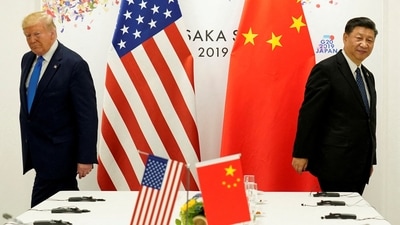
File photo: US President Donald Trump attends a bilateral meeting with China’s President Xi Jinping during the G20 leaders’ summit in Osaka, Japan on June 29, 2019. Reuters/Kevin Lamarck/file photo (REUTERS)
Other nominees are considered better. Incoming Secretary of State Marco Rubio has tried to force Chinese companies to delist from U.S. stock exchanges and impose sanctions on him in response to his helping Chinese officials as a senator. Mr Trump’s choice for national security adviser, Mike Waltz, boycotted the Beijing Winter Olympics. New Trade Representative Jameson Greer was the architect of Mr Trump’s first trade war with China.
in the face of such arroganceChinese officials have maintained silence. But the formula for trade talks has started emerging in the country. China’s leader Xi Jinping set out “red lines” in a meeting with President Joe Biden on November 16. The essence was that the Communist Party’s rule and China’s claim on Taiwan should not become a bargaining chip in the talks. Then on December 1, the tax exemption on aluminum and copper ended. Prices of battery and photovoltaic products fell from 13% to 9%. This is an amazing change. Last year, China rejected claims that it was exporting batteries and solar products at artificially low prices. Martin Linge Rasmussen of Exante Data, a research firm, says the discount cuts are the first time authorities have taken action to reduce the strength of such charges. Analysts at broker Sinolink Securities call it a “pre-emptive strike.”
At the same time, Chinese officials want to increase trade with the rest of the world. The Commerce Ministry said on November 19 that it would promote export credit and insurance and support logistics services for Chinese companies. The ministry wants to increase the number of countries from which short-term business visas can be granted. It has promised to help companies respond if “unfair foreign-trade restrictions” arise. This month it will remove tariffs on imports from some of the world’s poorest countries.
Mr Trump could target companies that help Chinese companies assemble or reship goods to third countries. For example, solar companies have set up factories in Indonesia and Laos to circumvent US tariffs on exports passing through Mexico and Vietnam. To help small businesses sell goods overseas through e-commerce platforms, Chinese local governments have set up service centers. Shanghai is setting up a “Silk Road e-commerce pilot zone” to facilitate trade with Central Asia.
The tariff workaround means existing US measures have not prevented China from increasing exports. Since the start of Mr Trump’s trade war in 2018, China’s trade surplus has more than doubled to $820bn (or 6% of GDP). Its surplus with the US remains at $340bn, roughly the same as in 2018. If Mr Trump is willing to strike a deal including limited increases in tariffs, his measures could lead to a manageable 0.4 percentage point reduction in annual Chinese GDP growth between 2027 and 2029. According to Oxford Economics, a research firm. CF40 Research, a Beijing-based think-tank, estimates that “moderate” tariffs of 10-20% would slow China’s year-on-year export growth to 1.5% next year, with no tariffs below 2.2%. Mr Trump’s promised 60% tariff hike could reduce exports by 6.5% next year, which would have a devastating effect.
Will China oppose tit-for-tat retaliation? During the first phase of the trade war, officials responded to the tariffs by imposing similar penalties on U.S. imports. This strategy was ineffective because the US is much less dependent on Chinese demand than other methods. Some expect China to allow its currency to devalue against the dollar. Although doing so would make its goods more affordable, a large decline in the yuan risks draining capital.
Instead, Chinese trade experts expect the government to focus on domestic policies as a means to counter US pressure. Lian Ping, an influential economist, has recommended that China boost wages and consumer demand to fortify itself against US economic attacks. He wrote, “Only when your body is strong and healthy can you withstand external attacks.” This could be part of China’s plan. The government has promised stimulus to improve the gloomy sentiment affecting the Chinese economy. Bankers in Shanghai quipped they were celebrating Trump’s victory in anticipation of more government spending.
business concerns
There is more to the President-elect’s China policy than tariffs. The US and China are still in the middle of a tech war that was started by Mr Trump, escalated by Mr Biden and shows no signs of stopping. Mr Biden has attempted to cut China off from inputs needed for advanced technology such as artificial-intelligence chips. Hundreds of Chinese companies have been added to the Commerce Department’s list of entities, restricting US transactions with them. In October the Treasury imposed a sweeping investment-control regime that would block most U.S. investments in Chinese AI, semiconductors and quantum computing. The Biden administration is believed to be drafting a definition of what types of AI chips companies can sell to China. Mr. Trump can make it much stricter.
Chinese companies may also soon be subject to sanctions from the Office of Foreign Assets Control (OFAC), which, unlike the Commerce Department’s list of entities, restricts their ability to use dollars. Imposing OFAC sanctions on a Chinese bank would prevent dollar transactions with other banks and possibly lead to its collapse. A former US trade official says they have been used rarely until now, but the nominations of Messrs. Rubio and Waltz suggest such measures may become more common.
China’s ability to defend against attacks is limited. Authorities have invested tens of billions of dollars in the semiconductor industry in an effort to make China self-reliant. Although it has shown progress, especially in chip-making machines, the country still does not make the most powerful chips and sources less than 15% of its chips domestically. China also depends on the dollar-based financial system. Transactions in yuan have increased over the past two years, but most still use Swift, a messaging network that is vulnerable to US influence.
Mr Xi would likely retaliate if such drastic action was taken or his red lines were crossed. For example, on December 1, China implemented new dual-use export-control rules, creating a list of military-use items that face export restrictions. Over time, China could use these to restrict exports of minerals needed for high-tech gear, such as gallium and germanium, where it dominates production. To increase pressure, Chinese regulators could identify other goods whose exports they could block without affecting domestic industries. Some antibody precursors that are used by pharmaceutical companies come particularly from China and may make good candidates.
Chinese regulators have been keen to highlight the harm this is causing. Last month China used a new tool, the foreign anti-sanctions law, to bar Skydio, America’s biggest drone maker, from selling Chinese batteries because it sells batteries to Taiwan. This law could be used to deprive dozens of American companies of the Chinese-made components they rely on. American companies may also face setbacks in China. In October an industry body called for an investigation into Intel, a US tech company, due to alleged security vulnerabilities in its chips.
China’s Commerce Ministry recently used its “unreliable entities” list to investigate PVH, the US owner of brands such as Tommy Hilfiger, because it complied with the US Uyghur Forced Labor Prevention Act, which requires companies to export their products from Xinjiang. There is a need to stop using cotton. The original bill was sponsored by Mr. Rubio. With him as Secretary of State, it is easy to see the possibility of many more skirmishes and possibly complete disregard for China’s red lines. Mr Xi is ready to talk with Mr Trump on trade. Anything beyond that runs the risk of getting out of control very quickly.
For more expert analysis of the biggest stories in economics, finance and markets, sign up money TalksOur weekly subscriber-only newsletter.
Australian police have launched an investigation after a car was set alight and houses were vandalised with anti-Israel graffiti in Sydney.
The incident has been condemned by Prime Minister Anthony Albanese as a “hate crime”. He told ABC News: “There’s no place for antisemitism in this country, or anywhere for that matter.”
It comes days after a fire engulfed a synagogue in Melbourne, causing minor injuries to one man, in what police there are treating as a probable terror attack.
Authorities in Sydney said they were seeking two people aged between 15 and 20 over the vandalism incident.
The pair had been wearing “face coverings and dark clothing” and were seen running from the scene, New South Wales Police said.
“We need public assistance to come forward and help identify those two people,” Commissioner Karen Webb told reporters.
Police said the car blaze was extinguished shortly after firefighters were called to the scene in Woollahra, a suburb in Sydney’s east, at around 01:00 local time (14:00 GMT).
Anti-Israel messages, including “Kill Israiel” [sic], were found at the scene, scrawled on the fence of two properties and cars.
Albanese said he had spoken to the Australian Federal Police (AFP) about the vandalism.
Earlier this week, the law enforcement body established a special taskforce to investigate incidents of antisemitism, including the alleged terror attack in Melbourne, and another vandalism spree that occurred in Woollahra last month. Police do not believe the two incidents in Woollahra are linked.
New South Wales Premier Chris Minns said the latest incident appeared to have been “specifically designed” to “intimidate the Jewish community in Sydney”.
“If the question is can we do more? I think the answer is yes, and I’m not closing the door to changes to the law,” he told reporters, adding that he had spoken with Israel’s Ambassador to Australia Amir Maimon.
The president of the NSW Jewish Board of Deputies, David Ossip, said his community was “deeply saddened” by what had happened, but that they would “not be cowed”.
An entity majority-owned by embattled billionaire Gautam Adani, who was indicted in US courts last month, has pulled back from a loan pact valued at $553 million from the US International Development Finance Corporation, according to a company filing. “The project will be financed through the company’s internal accruals and capital management plan. We have withdrawn our request for financing from the DFC,” read the filing issued Monday night, referencing the financing deal for a port terminal in Sri Lanka’s capital that’s being developed by Adani Ports and Special Economic Zone Ltd. The statement made no mention of the indictment of Adani, Asia’s second-richest man, and other executives of his Adani Group. They were indicted in US courts on charges last month that they paid or promised to pay more than $250 million in bribes to Indian government officials to win solar energy contracts, and concealed the plan as they sought to raise money from US investors. The company has denied the US allegations. The loan agreement for the terminal in Sri Lanka was signed last year amid US enthusiasm to offer an alternative to China for infrastructure investment in the developing world. It hadn’t yet yielded any disbursement of US financing. Still, construction has begun on the project, which also has local Sri Lankan partners. The Development Finance Corp. and the White House didn’t immediately respond to a request for comment on the withdrawal statement. Despite the indictment, the Adani Group has sought to show that it’s conducting business as usual. Its billionaire founder sat close to Indian Prime Minister Narendra Modi at a public conference Monday, where the group pledged tens of billions of dollars in fresh domestic investment. DFC officials said previously that they were conducting due diligence and assessing the ramifications of the Department of Justice indictment before any decision on finalizing or canceling the Colombo port financing agreement. Adani’s sprawling empire, which runs from construction projects to media properties, has been under fire since the DOJ’s announcement, with Kenya canceling $2.6 billion worth of airport and power transmission contracts the tycoon’s conglomerate had pitched for in the hours after the ruling.
Excerpts from recent editorials in the United States and abroad:
Editorial Roundup: United States
Dec. 6
The Washington Post on the Senate and a shrinking window to protect press freedom
In 2021, Attorney General Merrick Garland established new, but long-needed, press protections barring federal prosecutors from pursuing journalists’ communication records with confidential sources except in extreme circumstances. But these protections are only as good as the administration controlling the Justice Department.
President-elect Donald Trump, who has espoused hostility toward journalists and seeks to elevate people who share this feeling to powerful positions in government, is weeks away from taking over federal law enforcement agencies. In other words, Congress has little time left to codify Mr. Garland’s policy into law. The Senate can — and should — do that in the lame-duck session.
In January, the House of Representatives passed such a bill without opposition. The legislation — the Protect Reporters from Exploitative State Spying Act, or Press Act — would prevent the federal government from using legal tools such as subpoenas and search warrants to go after reporters’ information, except in cases where doing so would prevent violence or terrorism. The measure would also bar prosecutors from demanding that third parties, such as phone companies or internet providers, hand over journalists’ data.
That legislation has since languished in the Senate, but a spokesperson for Sen. Charles E. Schumer said the majority leader supports the bill and intends to pass it next week. Senators could attach it to the must-pass National Defense Authorization Act, which lawmakers are negotiating now. Two conservative Republicans — Lindsey Graham and Mike Lee — already support the bill, and there are probably a few others who would like to see it pass, given the broad bipartisan support it has enjoyed in previous years.
The trouble, however, is Mr. Trump. Last month, he posted an all-caps demand on Truth Social that Republicans “KILL” the bill. Although his decision to weigh in on the legislation was unexpected, his opposition is unsurprising, given his first administration’s efforts to root out government leakers by obtaining the phone and email records of reporters at multiple outlets, including The Post. His Justice Department even obtained a gag order preventing executives at the New York Times from informing editors at the paper that the government was seeking the email logs of four reporters to uncover their sources.
The president-elect’s social media missive makes it less likely that Republican senators who support the measure will back it now, but they should keep in mind that this is not a partisan issue. Administrations from both parties have pursued journalists’ sources in recent years, including the Obama Justice Department, which seized phone records of the Associated Press in 2013 and conducted electronic surveillance of Fox News’s James Rosen in an aggressive attempt to expose leakers.
Such overreach disserves the public, regardless of whether it happens under a Democratic or Republican president. Confidential sources have been critical to exposing government abuses, such as the CIA’s waterboarding of al-Qaeda prisoners. One Pulitzer Prize-winning report from Mississippi Today’s Anna Wolfe relied on confidential sources to uncover the misuse of welfare funds in the state; now she and her editor face a court order to give up their sources or risk jail time. If journalists cannot protect their sources’ identities, whistleblowers might be unwilling to reveal information the public deserves to know.
Critics of the bill, such as Arkansas Sen. Tom Cotton , contend that it would encourage more government leaks, potentially damaging national security. But over the past few years, Mr. Garland’srules do not appear to have increased controversial leaks or damaged national security.
Meanwhile, the need to protect journalists is as clear as ever. Kash Patel, whom Mr. Trump has chosen to replace Christopher A. Wray as FBI director, has said he would “come after the people in the media who lied about American citizens, who helped Joe Biden rig presidential elections.” He added, “Whether it’s criminally or civilly, we’ll figure that out.”
State and federal government accountability systems are more developed than they used to be, but they still often fall short. When they do, responsible media remain essential outlets for whistleblowers and other public-spirited individuals seeking to expose official wrongdoing. That will be true under Mr. Trump, but also under the next Democratic president. Mr. Schumer should stay firm in his stated intention to advance the Press Act before this Congress’s session ends — and the Republicans who understand its merits should support it. ONLINE: https://www.washingtonpost.com/opinions/2024/12/06/press-act-senate-schumer-journalism-garland/
Dec. 6
The New York Post on food insecurity in the US
It is an astonishingly large number: 5.3 billion. That’s how many meals were distributed by the nation’s largest domestic hunger relief organization, Feeding America, in 2023 alone. In a country of more than 330 million people, it is evidence of how widespread and persistent food insecurity remains in the United States.
Food insecurity is defined by the U.S. Department of Agriculture as the lack of access to enough food for an active and healthy life. More than 13 percent of Americans — 47 million people — experienced food insecurity in 2023; the rates are even higher in Black and Latino communities. In some of the poorest regions of America, mostly rural areas in the South, food insecurity among children is as high as 48 percent. But it is present in every county in the country.
While lawmakers in local, state and federal government struggle to find long-term solutions, Feeding America, a network of roughly 200 food banks and 60,000 food pantries and meal programs, is filling the void every day for tens of millions of Americans. It is one of the organizations supported by The New York Times Communities Fund.
Feeding America needs help to continue this essential frontline work. The average cost of a single meal may be only $3.99, but when that is multiplied by the millions of meals required, it adds up to $33 billion that families need and don’t have for groceries. After a temporary boost during the Covid pandemic, food donations and government funding have fallen off sharply, even as the demand remains steady.
Some of that demand is a lingering effect of the inflation that peaked in 2022, but some food costs are still stubbornly high.
Another problem is that nearly half of Americans who are food insecure are unlikely to qualify for federal programs like SN because many have incomes that are too high to be eligible. Most families of four that receive SN benefits have incomes below $40,560. Feeding America estimates that that leaves around 20 million people in a no man’s land, where they can neither afford sufficient food nor qualify for help to pay for it.
Racial disparities are also striking. Nationwide, roughly one-quarter of Black Americans experience food insecurity, as compared with 10 percent of white non-Hispanic Americans, according to a report by Feeding America. In some parts of the rural American South, roughly two-thirds of Black people are experiencing food insecurity.
Solving this crisis will require a host of policy responses, including expanding SN eligibility and the child and earned-income tax credits, improving access to school lunch programs and building more affordable housing, which would ease some of the pressure on family budgets. In the meantime, you can help by donating to Feeding America and similar organizations. No one should go hungry in the richest nation on Earth.
The Wall Street Journal on Trump and a path to citizenship for Dreamers
Donald Trump sat for an interview with NBC News that was released on Sunday, and most of it was focused on the usual media preoccupations of whether Mr. Trump will arrest his opponents or deport millions of illegal migrants. Readers can judge his comments.
As we read the transcript, however, the most interesting note was what the President-elect said about the so-called dreamers, who were brought here illegally as children but are now adults and still in legal limbo. Here’s the exchange:
NBC’s Kristen Welker: “What about dreamers, sir? . . . You said once back in 2017 they, quote, ‘Shouldn’t be very worried about being deported.’ Should they be worried now?”
Mr. Trump: “The dreamers are going to come later , and we have to do something about the dreamers because these are people that have been brought here at a very young age. And many of these are middle-aged people now. They don’t even speak the language of their country. And yes, we’re going to do something about the dreamers.”
Ms. Welker: “What does that mean? What are you going to do?”
Mr. Trump: “I will work with the Democrats on a plan. And if we can come up with a plan, but the Democrats have made it very, very difficult to do anything. Republicans are very open to the dreamers.”
That’s great to hear. If Mr. Trump is willing to deal on the dreamers, Democrats should shift from their first-term opposition to any immigration deal. The country will be better for it.
Bashar al-Assad’s downfall came not with a bang but a whimper. The Syrian dictator reportedly fled his home in the wake of a blitzkrieg advance by a coalition of anti-government rebels. By Sunday morning he was gone – leaving armed groups as the country’s dominant political players. A spirit of anti-Assad sentiment surged across Syria, manifesting itself through displays of both celebration and defiance. The question now is whether this unleashed energy – brutally suppressed by fear and authoritarian control – will become a unifying force in building a new nation or, rather, a precursor to deeper divisions.
The fall of the House of Assad, which has ruled Syria for more than half a century, should be a warning to dictatorial regimes. Mr Assad’s departure underscores a broader truth: societies cannot indefinitely tolerate systemic abuses, such as state-sponsored propaganda, corruption and violence. The fish rots from the head down. Mr Assad’s Syrian state collapsed from within, having spent more than a decade pursuing a reign of terror that only fuelled the very unrest it sought to suppress. The regime’s collapse raises pressing questions about Syria’s future. With weak institutions and a frail civil society, the risk of disintegration looms large.
Syria’s prospects depend on both internal and external forces, and notably on Abu Mohammed al-Jolani, the leader of Hayat Tahrir al-Sham , a former al-Qaida offshoot turned moderate Islamist faction. Credited with Mr Assad’s overthrow, Mr Jolani drove the strategic shift from jihadism to national liberation. In 2021, he declared that he had no intention of waging war against the west, and for the past five years he has overseen a semi-technocratic government in Idlib province for 3 million people under Turkish protection. HTS has avoided extreme sharia interpretations, but remains designated a terrorist group. Critics say it is corrupt and intolerant of dissent. However, Mr Jolani’s outreach to tribes, minorities and former foes has bolstered his national legitimacy, while even Moscow – once Mr Assad’s protector – may engage to secure its military bases.
Mr Jolani relies on allies, including the Turkish-backed militia groups collectively called the Syrian National Army, which has a thuggish reputation. Re-elected on a pledge to return 3 million refugees, Turkey’s president, Recep Tayyip Erdoğan, seeks stability in Syria, but fears that US-backed Kurdish regions in Syria may stir autonomy demands at home. Israel sees an Islamist-led Damascus as a threat, but finds comfort in Hezbollah’s inability to defend the Assad regime, as it prioritises the defence of its Lebanese bases. Saudi Arabia and the United Arab Emirates, with their financial resources, could aid Syria’s reconstruction, but their past support for Mr Assad complicates their role. Encouragingly, Arab leaders said they would seek to avoid reigniting a 13-year-old civil war after talks in Qatar.
Syria will never be the same. Ordinary Syrians have endured unimaginable horrors under the Assad regime. But they have written this chapter of history. Their newfound freedom is shadowed by the daunting task of rebuilding lives and infrastructure. A shared hope to avoid violent vendettas must guide efforts toward a just settlement. The Syrian people were often forsaken. In this moment of fragile hope, the world must not fail them again. A concerted international effort toward political stability, reconciliation and reconstruction is essential to ensure their sacrifices lead to a lasting peace.
The Boston Globe on holding Trump to presidential transition rules
Longstanding laws and norms govern how one presidential administration is supposed to hand off power to the next. They’re designed to ensure a smooth transfer while at the same time imposing some ethical guardrails during the interim period as incoming presidents make key personnel decisions.
President-elect Donald Trump is flouting some of those rules as he prepares to take office Jan. 20 — and by all accounts will continue flouting them, unless members of his own party start insisting.
Breaking with his predecessors, Trump is funding his transition with unlimited donations from undisclosed sources — dark money that could even include foreign donations. He’s avoided a customary arrangement that binds transition officials to ethics rules. And he tried to shield his nominees from undergoing the customary FBI background checks meant to ferret out misconduct or any red flags in their background.
Nothing about that serves the public interest.
Start with the money. To fund salaries, office space, and other expenses during their transition and inauguration, president-elects have relied on a combination of public support and disclosed private donations.
Trump’s transition has largely been funded by dark money interests, and unlike past presidents he hasn’t imposed any contribution limits or transparency requirements. The public doesn’t know who is funding the transition, or how much they’re giving.
But we can certainly guess: Trump’s deep-pocketed private-sector allies like Elon Musk, wannabe oligarchs for whom the lack of any limits or transparency amounts to an unprecedented opportunity to influence the incoming administration.
In other respects, Trump is ignoring the Presidential Transitions Act of 1963, a federal law that sets out the basic guidelines for one president to hand over power to the next. Among other things, it sets various deadlines, which presidents and candidates have always abided by in the past.
Last month the Trump transition team signed one of several required agreements with the Biden administration, blowing through the Oct. 1 legal deadline by nearly two months. That memorandum of understanding allows his transition to send landing teams of personnel to each federal agency to begin receiving briefings and other information to ease the Jan. 20, 2025 power transfer. He also begrudgingly signed an agreement allowing the normal FBI background checks into his nominees and appointees, after Senate Republicans insisted.
But Trump has refused to enter into other legally mandated agreements, including one that would release federal funding for office space, technology, and other transition needs. That’s because that pact includes strict ethics rules barring conflicts of interests by Trump and his team once sworn into office.
Instead, the Trump transition intends to implement his own ethics plan, something the law does not contemplate or allow.
Crucially, the agreements Trump refuses to sign would also provide for up to $7.2 million in federal funding for the transition in exchange for limits on outside donor contributions and disclosure requirements. By ignoring this rule, Trump can continue to raise unlimited funds to set up his administration while keeping the sources of that money under wraps.
The Biden administration and lawmakers must use every lever at their disposal to hold Trump and his incoming administration to the spirit and letter of the laws aimed at protecting the American people and national interests.
That begins with transparency from the General Services Administration, which oversees the transition, about whether Trump’s failure to follow the rule is affecting the ability of the agency to facilitate the transfer of power — a task important for ensuring the continual protection of Americans’ public health, safety, and security.
Senator Elizabeth Warren sent a letter last month to General Services Administrator Robin Carnahan asking how Trump’s refusal to follow the law has affected the transition.
Members of the Senate should also refuse Trump’s call to circumvent the confirmation requirements for members of his administration.
Trump has called for using recess appointments to put members of his cabinet who would otherwise need Senate confirmation in place without this vetting. Such appointments are meant to be used in emergency situations when the Senate is unable to convene to fill a cabinet-level vacancy – not to get around the Senate’s constitutional duty to advise and consent to these appointments.
Some Republicans, including Senator Susan Collins of Maine, have raised alarms at Trump’s approach.
“It is so important that we not shortchange the confirmation process for Cabinet appointments in particular,” Collins said in an interview with the Portland Press Herald. “I do not agree with the president that we should forgo background checks and have recess appointments where we would not have hearings on these very important appointments.”
But lawmakers should do more than disagree with Trump’s approach — they must refuse to play along.
Proposed site of shelter home at Holenfai village, Tengnoupal, Manipur on March 26, 2023
Imphal/Guwahati/New Delhi:
Five weeks before the Manipur ethnic conflict broke out in May 2023, a cabinet subcommittee comprising ministers from the three major communities visited three villages to assess the situation on “identification of immigrants/refugees from Myanmar”, from the report submitted by the subcommittee. It shows.
Tribal Affairs and Hills Minister Letpao Haokip, who is from the Kuki tribe, led the subcommittee, with Water Resources Minister Awangbo Newmai, a Naga, and Law Minister Basant Kumar Singh, a Meitei, as the two other members.
He visited three villages between March 26, 2023, and April 1, 2023, and met Myanmar citizens – including a member of parliament from the neighboring country – who were living in community halls under the supervision of village chiefs.
Kuki tribes in Manipur still follow the archaic hereditary chieftaincy system – responsible for power struggles between siblings and rapid growth of villages – which has also been abolished in neighboring Mizoram where homogeneous tribes live.
A community hall in Holenfai village, Tengnoupal, Manipur on March 26, 2023
The subcommittee never made any visit after clashes broke out on May 3, 2023, between the Meitei community and more than a dozen distinct tribes collectively known as the Kukis, who are influential in some hilly areas of Manipur.
Subcommittee chairman demanded separate administration
Letpao Haokip later joined the 10 Kuki-Zo MLAs who demanded a separate administration from Manipur. Kuki groups had raised the same demand in 2015, when nine people from their community were killed in police firing during a protest against three controversial bills introduced by the state government (then Congress party led by former chief minister Okram Ibobi Singh). It was done.
Meitei leaders say the claim by 10 Kuki-Zo MLAs and frontal groups that they had raised the demand for a separate administration only after the May 3 violence broke out was a blatant lie.
Manipur Cabinet Subcommittee members and other teams at Holenfai village, Tengnoupal, Manipur on March 26, 2023
By the time the subcommittee began its survey in late March 2023, tension was already rife in Kuki-dominated areas in southern Manipur, as the government had launched an eviction drive in K Songzang village of Churachandpur just a month earlier. The subcommittee’s visit to the three villages also coincided with sporadic protests by Kuki groups against what they called illegal eviction from the forests.
One NDTV report Citing preliminary documents filed by the subcommittee on June 21, 2023, it said more than 2,000 Myanmar nationals have settled inside Manipur and refused to move to designated shelters. They fled the war between the ruling junta and ethnic rebel groups claiming to be fighting for democracy.
Final copies of the subcommittee report with visuals of the trip, now accessed by NDTV, show that the three leaders repeatedly appealed to village heads to allow Myanmar nationals to stay in designated shelter camps once the structures were ready. Persuade.
Cabinet subcommittee at Gamphazol village in Chandel district, March 29, 2023
The subcommittee visited Holenfai village in Tengnoupal district on March 26, Gamphazol village in Chandel district on March 29 and Singhat in Churachandpur district on April 1, 2023.
“Mr. Letpao Haokip… highlighted the issue of illegal entry of Myanmar nationals into Indian territory, which has created apprehension among the general public as such immigrants are naturalized among the common native population due to similarity in culture and dialect. There is a high possibility of involvement. He further highlighted that although no such cases have been registered, it is suspected that many of them were already living in rented houses in the main Churachandpur city area. of Singhat The trip report said.
The report of the subcommittee’s visit to the first village, Holenfai, states, “Shri T. Basant Kumar Singh calls on all illegal immigrants to come forward and join the shelter homes, not to hide among the local people, in support of the humanitarian goodwill gesture extended by the Government. “Appeal to do.” He left on March 26, 2023 – said.
Border pillar at Gamphazol village
A unique problem came to light in Gamphazol village of Chandel district. The district commissioner said the IMB (India-Myanmar border) falling in Chandel district is “different from other neighboring districts” as it has a sparsely populated vast area of forest spanning 60-75 km between border pillars number 72 and 49.
Conversation at Gumphazol Community Hall on March 29, 2023
The report said, “It was also suggested that it may not be possible for a single temporary shelter to serve all such immigrants in the region and proposed such temporary shelters at Gamphazol in the northern part and Somdal in the southern part. They went.” It was said about the visit of the subcommittee to this border village on March 29, 2023. The district commissioner said he found 628 “illegal immigrants” on the stretch of IMB falling in Chandel district, of which 250 were in Gamphazol village.
Subcommittee meets Myanmar MP ousted by junta
In Holenphai, the three ministers met Thammasei Haokip, a Myanmar member of parliament before the junta overthrew the government, who told the subcommittee that he would follow all rules and regulations while being a refugee in India and would return to Myanmar once the issue was resolved. “Finished/disposed of,” the report said.
“He (Thamsi Haokip) explained that because of the military junta in his country, he has come to Manipur, the closest state to the world’s largest democratic country, in the hope of providing humanitarian support at a time when citizens cannot live outside in Myanmar. He told the state government Appealed to provide identity card and permission/facility to earn livelihood. He also said that he will go back after the issue is resolved in Myanmar.
The foreign parliamentarian asked before the subcommittee to transfer Myanmar nationals detained as illegal immigrants to the proposed shelter homes, and urged them not to be treated as illegal immigrants because they fled the junta regime , where “civilians are being killed”.
Wooden planks were laid out ready to build houses in Gamphazol by Myanmar immigrants and refugees fleeing violence in their country
Gamphazol Village, Chandel
A wooden shelter built by Myanmar refugees at Gamphazol in Chandel district
Gamphazol Village, Chandel
An activist from the Kuki tribe, who claims to know the Myanmar MP personally, told NDTV that the foreign politician has deep links with the Kuki National Army (Burma), or KNA(B). Thammasei Haokip has taken refuge in a relatively safe, wooded area on the India-Myanmar border, the source said, adding that trusting people like Thammasei Haokip is a big move for the Meitei community because of the precedent set by another Myanmar. There will be a challenge. The original leader, Thanglienpau Guite.
The Manipur government has blamed uncontrolled entry of illegal immigrants from Myanmar as one of the factors responsible for the violence. It also cites “unnatural growth of villages” due to alleged settlement of illegal immigrants by village heads.
Example set: Myanmar MP turns leader of militant group
Meitei civil society groups are sensitive to any mention of leaders of Myanmar origin in the context of Manipur. Chief Minister N Biren Singh has said that this is due to sensitivity the way thanglianpau guite The “Myanmar-born” politician, who contested MP elections in his home country and who later became the chairman of militant group Zomi Revolutionary Army (ZRA) – was welcomed by the then Congress government when P Chidambaram was the Union Home Minister. United Progressive Alliance (UPA) government.
ZRA is a signatory to the controversial Suspension of Operations (SoO) agreement, which expired in February this year.
Cabinet subcommittee and other teams at the police station at Singhat in Churachandpur district on April 1, 2023
More than two dozen Kuki-Zo rebel groups fall under two major groups – the Kuki National Organization (KNO) and the United People’s Front (UPF). The two, representing others, have signed the SOO agreement, which states that rebels must live in designated camps with weapons kept in closed storage, to be regularly monitored.
Meitei leaders have alleged that the SHO groups have been working for years to strengthen themselves by taking advantage of the ceasefire until the time came to violently attack for a breakaway land. Geopolitical analysts have speculated that Kuki armed groups were used as mercenaries to fight Meitei and Naga militants operating along the India-Myanmar border.
In a statement in June 2023, Myanmar’s government-in-exile – a month after the Manipur conflict – asked its citizens “temporarily sheltered” in India to “refrain from any actions prejudicial to the sovereignty and territorial integrity of India.” Said.”
The National Unity Government (NUG) in the statement asked Myanmar nationals taking “asylum” in India and their organizations to avoid unnecessary involvement in the politics and administrative activities of India, and asked them to live in harmony with the host communities. . NUG also appealed to Myanmar citizens not to get involved in drug trafficking.
Barrack inspection at Singhat, Churachandpur on April 1, 2023
The Manipur government announced on January 18, 2023 that it would form a subcommittee to identify “immigrants/refugees from Myanmar”; The state government announced the composition of the three-member panel on 16 February, and on 24 March ordered the police to investigate the number of immigrants from Myanmar in five districts – Tengnoupal, Chandel, Churachandpur, Pherzawal and Kamjong.
While the February 16 announcement referred to the subcommittee as a committee that would work on identifying “Myanmar immigrants/refugees” in the state, reports of the subcommittee’s visits referred to them as “illegal immigrants.” Was done.
Myanmar refugees in Mizoram
Neighboring state Mizoram has given shelter to more than 40,000 Myanmar refugees. Mizoram government sources told NDTV on November 10 that it has been almost three years since the coup in Myanmar, and in a small state like Mizoram, feeding and caring for all the displaced people and refugees remained a major challengeThere were also concerns over the increase in drug trafficking. Sources said the Mizoram government cannot thank the Central government enough for the huge help it is providing to the state in providing adequate resources to deal with the refugee crisis.
“The people of Mizoram are not immune to the tensions arising from all these efforts. There is growing discontent within our own community as well, especially among the intellectual class. Yes, we are welcoming them as brothers and sisters, but What are we getting back in return? We are getting medicines, this and that. So the frustration is growing,” the source told NDTV.
The Kuki tribes have criticized the Manipur government for not treating refugees from Myanmar humanely like in Mizoram.
There are many villages of Kuki tribes in the hills surrounding the Meitei dominated valley. More than 250 people were killed in the clashes and about 50,000 were internally displaced. The general category Meiteis want to be included in the Scheduled Tribe category, while the Kuki tribes want a separate administration from Manipur, citing discrimination against the Meiteis and unequal sharing of resources and power.
New Delhi: The total registered electric two-wheelers in the country now stands at 28,55,015, with electric four-wheelers at 2,57,169 (as on December 4), the Parliament was informed on Tuesday.
As per the Vahan portal of the Ministry of Road Transport and Highways, the total number of electric vehicles (EV) registered in Odisha stands at 1,45,479, with an adoption rate of 1.24 per cent, Minister of State for Heavy Industries and Steel, Bhupathiraju Srinivasa Varma told the Lok Sabha in a written reply.
“At present, there is no proposal under consideration in the Ministry of Heavy Industries for setting up an auto R&D cluster in the state of Odisha,” the minister informed. The consumers of EVs are incentivised through various government schemes, like the Faster Adoption and Manufacturing of (Hybrid &) Electric Vehicles in India (FAME India) Scheme.
The scheme is for a period of five years from April 1, 2019, with a total budgetary support of Rs 11,500 crore. The scheme incentivised e-2Ws, e-3Ws, e-4Ws, e-buses and EV public charging stations.
The production-linked incentive (PLI) scheme for the automobile and auto component industry in India (PLI-Auto) has a budgetary outlay of Rs 25,938 crore. The scheme proposes financial incentives to boost domestic manufacturing of AAT products with a minimum 50 per cent Domestic Value Addition (DVA) and attract investments in the automotive manufacturing value chain.
The PLI scheme for Advanced Chemistry Cell (ACC) was approved with a budgetary outlay of Rs 18,100 crore. The scheme aims to establish a competitive domestic manufacturing ecosystem for 50 GWh of ACC batteries, according to the government.
The PM Electric Drive Revolution in Innovative Vehicle Enhancement (PM E-DRIVE) Scheme has an outlay of Rs 10,900 crore and was notified on September 29, 2024. It is a two-year scheme which aims to support electric vehicles including e-2W, e-3W, e-Trucks, e-buses, e-Ambulances, EV public charging stations and the upgradation of testing agencies.
The Scheme for Promotion of Manufacturing of Electric Passenger Cars in India (SPMEPCI) was notified on March 15, 2024, to promote the manufacturing of electric cars in India. This requires applicants to invest a minimum of Rs 4,150 crore and to achieve a minimum DVA of 25 per cent at the end of the third year and a DVA of 50 per cent at the end of the fifth year.
The Ministry of Finance has reduced GST on EVs from 12 per cent to 5 per cent. The Ministry of Road Transport and Highways (MoRTH) announced that the battery-operated vehicles will be given green licence plates and be exempted from permit requirements.
MoRTH issued a notification advising states to waive road tax on EVs, which, in turn, will help reduce the initial cost of the EVs. The Ministry of Housing and Urban Affairs has also amended the ‘Model Building Bye-Laws’, mandating the inclusion of charging stations in private and commercial buildings.
Luigi Nicholas Mangione, the 26-year-old accused of fatally shooting United Healthcare CEO Brian Thompson in a Midtown Manhattan attack last week, has signalled he will fight being extradited to New York to face murder charges.
Mangione appeared in court in Pennsylvania on Tuesday, a day after he was arrested in the town of Altoona following a tip from a McDonald’s employee. He was charged with Thompson’s New York killing hours after his arrest, as well as a slate of lesser offences in Pennsylvania.
Emerging from a police car, Mangione gave a partly unintelligible message to reporters, although he made reference to an “insult to the intelligence of the American people”.
At the brief hearing, his defence lawyer, Thomas Dickey, told the court that Mangione would contest extradition to New York, requesting a hearing on the issue. He has 14 days to lodge a formal challenge to being relocated to New York, and in the meantime, he will be held in Pennsylvania without bail.
While in court, Mangione wore an orange prison jumpsuit, alternating between staring forward, looking at papers and looking back at the gallery. He was quieted at one point by his lawyer when he attempted to speak.
The court appearance came six days after a gunman fatally shot Thompson, the head of one of the largest health insurance companies in the United States, outside of a hotel in Midtown Manhattan.
The brazen nature of the attack – and the days-long manhunt – garnered national intrigue. Even while condemning the violence, many experts, doctors and US citizens said it was emblematic of the undercurrent of anger in the country towards the healthcare industry, where high costs leave many patients vulnerable to the will of insurers.
Bullet casings found at the scene of the killing bore the words “deny”, “defend” and “depose”, appearing to reference a phrase used by critics to describe how health insurers avoid claim payouts. The gunman fled via electric bike to Central Park, and later, he boarded a bus out of the city.
In the days since the attack, many have taken to social media to share accounts of insurance companies denying claims. The sentiment has led authorities to gird for copycat attacks, according to a law enforcement memo obtained by US media.
The White House has also weighed in.
“Obviously, this is horrific,” Press Secretary Karine Jean-Pierre told reporters on Tuesday. “Violence to combat any sort of corporate greed is unacceptable.”
Further details emerge
The law enforcement memo, which was based on Mangione’s writings, some of which were recovered at the time of his arrest, said that Mangione was likely motivated by what he described as “parasitic” health insurance companies and an overall disdain for corporate greed.
Authorities have said a 3D-printed gun, a suppressor and several fake IDs, including one believed to be used by the attacker to check into a hostel in New York before the shooting, were recovered when Mangione was arrested.
According to the memo, Mangione had written that the US has the most expensive healthcare system in the world and that profits of major corporations continue to rise while “our life expectancy” does not.
The document added that Mangione may have been inspired by the so-called “Unabomber” Ted Kaczynski, who he called a “political revolutionary”. Kaczynski had carried out a series of bombings from the late 1970s to mid 1990s railing against modern society, technology and the destruction of the environment. His attacks killed three.
The profile that has emerged since Mangione’s arrest also bears some similarities to Kaczynski, who was considered a maths prodigy.
Mangione comes from an influential family in Baltimore, Maryland, and was the valedictorian at an elite Baltimore prep school. He went on to earn undergraduate and graduate degrees in computer science in 2020 from the University of Pennsylvania, a prestigious Ivy League school.
Known as affable and intelligent, some friends have said in interviews with US media that Mangione’s demeanour changed after recent surgery on his spine.
“Our family is shocked and devastated by Luigi’s arrest,” Mangione’s family said in a statement posted on social media late Monday by his cousin, Delaware state legislator Nino Mangione.
“We offer our prayers to the family of Brian Thompson, and we ask people to pray for all involved.”
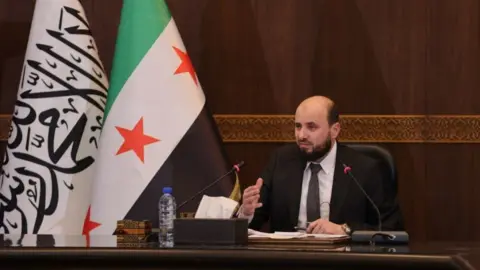
Mohammed al-Bashir chaired a meeting with ministers from both the transitional and former governments
The prime minister of Syria’s new transitional government has said it is time for people to “enjoy stability and calm” after the overthrow of President Bashar al-Assad.
Mohammed al-Bashir, the former head of the rebel administration in the north-west, was speaking to Al Jazeera after being tasked with governing until March 2025 by the Islamist militant group Hayat Tahir al-Sham (HTS) and its allies.
Bashir chaired a meeting in Damascus on Tuesday attended by members of his new government and those of Assad’s former cabinet to discuss the transfer of portfolios and institutions.
It came as the UN envoy for Syria said the rebels must transform their “good messages” into practice on the ground.
The US secretary of state meanwhile said Washington would recognise and fully support a future Syrian government so long as it emerged from a credible, inclusive process that respected minorities.
In 2011, Assad brutally crushed a peaceful pro-democracy uprising, sparking a devastating civil war in which more than half a million people have been killed and 12 million others forced to flee their homes.
Before this week, Mohammed al-Bashir was little known outside the areas dominated by HTS in the north-western provinces of Idlib and Aleppo.
According to his CV, he trained as an electrical engineer and worked at gas plants before the start of the civil war in 2011.
In January, Bashir was appointed prime minister of the Salvation Government (SG), which HTS established to run the territory under its control.
The SG functioned like a state, with ministries, local departments, judicial and security authorities, while maintaining a religious council guided by Islamic law.
Around four million people, many of them displaced from elsewhere in the country, lived under its rule.
When institutions stopped functioning in Aleppo after HTS and its allies captured the city earlier this month at the start of their lightning offensive, the SG stepped in to restore public services.
Technicians reportedly helped repair local electricity and telecommunications networks, security forces patrolled streets, medics volunteered at hospitals, and charities distributed bread.
“It is true that Idlib is a small region lacking resources, but they [SG officials] have a very high-level of experience after starting with nothing,” HTS leader Abu Mohammed al-Jolani was heard telling Assad’s former prime minister, Mohammed al-Jalali, in a video of a meeting in Damascus on Monday.
“We will benefit from your experiences. We certainly won’t ignore you,” he added.
On Tuesday, Bashir was pictured chairing a meeting of former SG ministers and ministers who served under Jalali. He was sat in front of the Syrian opposition and the HTS flags.
“[We] invited members from the old government and some directors from the administration in Idlib and its surrounding areas in order to facilitate all the necessary works for the next two months until we have a constitutional system to be able to serve the Syrian people,” Bashir told Al Jazeera afterwards.
“We had other meetings to restart the institutions to be able to serve our people in Syria,” he added.
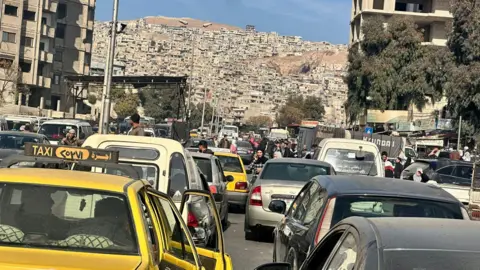
Meanwhile, life appeared to be slowly returning to normal in the capital Damascus after two days of near-shutdown.
There were many pedestrians and cars out on the streets, and some shops and restaurants were open.
People were also sweeping away spent bullet cases that littered the ground around the central Umayyad Square, where many rebel fighters fired into the air as crowds celebrated the end of Assad’s 24-year rule.
A Muslim cleric there told the BBC that Syrians were looking to the future and wanted a peaceful and united country.
“We want to establish a nation built on principles of nationalism, justice, and the rule of law, a technocratic state where institutions are respected, and equal opportunities are guaranteed for all,” Sheikh Abdul Rahman al-Kouky said.
There were many pedestrians and cars out on the streets of Damascus on Tuesday
UN special envoy Geir Pedersen told reporters in Geneva the transition needed to ensure “the representation of the broadest possible spectrum of the Syrian society and the Syrian parties”.
“If this is not happening, then we risk new conflict,” he warned.
Pedersen said the designation of HTS as a terrorist organisation by the UN, US, UK and other countries would be a “complicating factor” in efforts to find a way forward.
HTS’s precursor, al-Nusra Front, pledged allegiance to al-Qaeda in 2013. But three years later, it formally cut ties with the jihadist group.
“The reality is so far that HTS and also the other armed groups have been sending good messages to the Syrian people… of unity, of inclusiveness,” Pedersen noted.
“We gave also seen… reassuring things on the ground” in Aleppo and Hama, another major city that was captured last week, he added.
He said the most important test would be how the transitional arrangements in Damascus were organised and implemented.
“If they are really inclusive of all the different groups and all the communities in Syria… then there is a possibility for a new beginning.”
“And then I do believe that the international community will look at the [terrorist] listing of HTS again,” he added.
Later, US Secretary of State Antony Blinken in effect laid out a series of conditions which, if fulfilled, would see Syria enjoy Washington’s full recognition.
“It’s imperative that all actors involved protect civilians; respect human rights, especially of vulnerable minorities; preserve the state’s institutions, its services to help meet the needs of the Syrian; and to build towards inclusive governance,” he said.
“Statements by rebel leaders to these ends are very welcome, but of course, the real measure of their commitment is not just what they say but what they do.”
A mobile bus under this initiative will start a tour in Delhi-NCR, visiting bustling markets, to provide on-the-ground, personalised training sessions.
WhatsApp has launched the “WhatsApp Bharat Yatra,” a first-of-its-kind nationwide initiative designed to train in person small businesses on using the platform to grow and connect with customers. A mobile bus under this initiative will start a tour in Delhi-NCR, visiting bustling markets like Laxmi Nagar, Rajouri Garden, Nehru Place, and others, to provide on-the-ground, personalised training sessions, WhatsApp said in a press release.
The mobile bus tour will cover key business hubs in Haryana’s Gurugram, Uttar Pradesh’s Noida, and eventually other cities like Agra, Lucknow, Indore in Madhya Pradesh, and Gujarat’s Ahmedabad. (Pixabay/File)
The mobile bus tour will cover key business hubs in Haryana’s Gurugram, Uttar Pradesh’s Noida, and eventually other cities like Agra, Lucknow, Indore in Madhya Pradesh, and Gujarat’s Ahmedabad. The key key hubs the journey will cover in Gurugram and Noida include Sapphire Mall and Atta Market
Through interactive demos, businesses will learn how to set up a WhatsApp Business Profile, create catalogs, and craft effective ads to boost sales and customer engagement, the messaging app said.
‘Small businesses backbone of India’s economy’
“Small businesses are the backbone of India’s economy,” said Ravi Garg, Director of Business Messaging at Meta India. “With the right digital tools, they can drive India’s digital transformation. The WhatsApp Bharat Yatra is our way of supporting these businesses with the skills they need to thrive in the digital age.”
This initiative comes on the heels of new updates for small businesses on WhatsApp, including Meta Verified for credibility, customised messaging features, and AI-powered tools for more efficient customer engagement.
WhatsApp has previously rolled out programmes like ‘WhatsApp Se Vyapaar’ and strategic partnerships to further empower India’s SMBs.
By directly addressing the digital needs of small businesses, the WhatsApp Bharat Yatra aims to have a long-lasting impact on India’s entrepreneurial ecosystem.
Stay updated with the…
See more
News/Business/ WhatsApp launches ‘Bharat Yatra’ to empower small businesses across India