New Zealand has announced plans to ban greyhound racing, citing an “unacceptably high” rate of injuries.
The sport has long faced criticism in the country, with some breeders accused of mistreating or doping the animals.
The government plans to wind down the industry over the next 20 months, to allow time for the rehoming of racing dogs and for people in the industry to transition to other jobs.
Apart from New Zealand, commercial greyhound racing is allowed in Australia, Ireland, the UK and the US.
“Despite significant progress made by the greyhound racing industry in recent years, the percentage of dogs being injured remains persistently high and the time has come to make a call in the best interest of the animals,” Racing Minister Winston Peters said in a statement on Tuesday.
“This is not a decision that is taken lightly but is ultimately driven by protecting the welfare of racing dogs,” he said.
The government on Tuesday introduced a bill to prevent the unnecessary killing of racing dogs, which “will be passed under urgency”, said Peters, who is also New Zealand’s deputy prime minister.
Further legislation will be tabled to enable the end to greyhound racing, he said.
There have been three reviews of the greyhound racing industry over the past decade, all recommending significant changes.
In 2021, 232 racing greyhounds died and 900 suffered injuries, according to local media reports.
The industry was placed “on notice” by the government in September that year, but the deaths and injuries continued. Animal rights group Safe logged more than 2,500 injuries and nearly 30 deaths in the two-and-a-half years that followed.
A key task now is to rehome the estimated 2,900 racing greyhounds that remain in the country.
Animal rights groups which have long fought for the industry to be closed cheered Tuesday’s announcement, with Safe calling it a “monumental win for animal rights”.
New Zealand’s oldest animal welfare charity SPCA said it is “esctatic” at the move and called on other countries that allow greyhound racing to follow suit.
However Greyhound Racing New Zealand, an industry association comprising greyhound racing clubs across the country, said it is “devastated” by the government’s proposal.
“The greyhound racing community is left reeling from the announcement, with many voicing concerns over the potential cultural and economic void this decision will create,” said the association’s chairman Sean Hannan.
Greyhound racing accounts for 8.5% of New Zealand’s NZ$1.3b ($760m; £595) racing industry, with just over 1,000 full-time jobs, data showed.
“The government’s decision to close the industry is profoundly disappointing, as it overlooks the meaningful progress we have achieved,” said Hannan, who also urged the government to reconsider its decision.
Taipei, Taiwan – China has launched an antitrust investigation into chip giant Nvidia in what appears to be Beijing’s latest act of retaliation against Washington’s sanctions on Chinese tech companies.
Chinese state media said on Monday that the California-based chipmaker was being investigated by the State Administration for Market Regulation for potentially violating China’s antimonopoly laws.
Regulators will also review the company’s $6.9bn acquisition of Mellanox Technologies, an Israeli-American supplier specialising in computer networking products, state media reports said, without providing further details.
Chinese regulators approved the deal in 2020 with several restrictive conditions, including a provision that Nvidia would not discriminate against Chinese suppliers.
Nvidia, which designs advanced chips used to power artificial intelligence (AI), is one of the world’s most valuable companies, with a market capitalisation of more than $3.4 trillion.
The company’s dominance in the AI chips, however, has drawn scrutiny from regulators, including in the United States.
Earlier this year, the US Department of Justice launched its own antitrust investigation into Nvidia, the tech news outlet The Information reported in August, citing people familiar with the matter.
Shares of Nvidia closed 2.55 percent lower on Monday following the news of Beijing’s probe.
Nvidia did not immediately respond to a request for comment.
China’s antimonopoly probe comes a week after the US Department of Commerce announced its third round of export controls aimed at keeping advanced technology out of the hands of the Chinese chip industry.
The restrictions added 140 additional Chinese companies to the department’s Entity List of blacklisted firms.
In what has become a tit-for-tat exchange of trade restrictions, Beijing last week banned exports of gallium, germanium and antimony – which are used in the production of chips, solar panels and electric vehicle (EV) batteries, among other technologies – to the US.
Ian Chong, a Singapore-based political scientist focusing on security issues, said Beijing’s recent moves are more symbolic than damaging.
“The PRC will often target symbolic companies or goods and make a bigger show of it than is often the case,” Chong told Al Jazeera, using the acronym of the People’s Republic of China.
“Nvidia is so restricted from selling in the PRC market anyway, so I’m not sure what the actual restrictions will do.”
Chong said the restrictions were reminiscent of Beijing’s previous bans on Australian wine and Japanese seafood, which were used to signal anger at Canberra and Tokyo.
In both cases, the bans did not include critical exports like minerals or electronics.
Gallium and germanium are also imported by the US from other countries, including Taiwan, Canada, South Korea, Japan and Belgium, according to the supply chain consulting firm TECHCET, which has said that only antimony is likely to be difficult to substitute.
Nvidia has worked around US export controls in the past by designing separate chips for China, where it still earns 15 percent of its revenue.
The company has plans to partner with the Chinese company Inspur to distribute a new China-only AI chip in the second quarter of 2025, the Reuters news agency reported, citing unnamed sources familiar with the news.
Nvidia is not the only company Beijing has targeted in its trade war with Washington.
In October, the Cybersecurity Association of China recommended a security review for Intel products and accused the company of installing backdoor surveillance features.
Last year, Chinese regulators barred products from the US memory chipmaker Micron from key infrastructure after the company failed a security review.
Both investigations followed probes by the US and other countries into Chinese tech companies Huawei and ZTE.
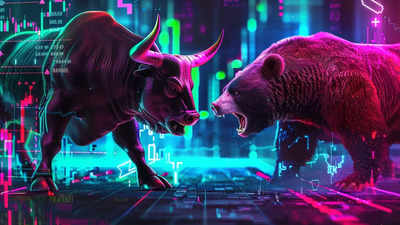
Angel One’s Technical Analyst Rajesh Bhosale noted Nifty’s strong recovery from 23,263, with recent small body candles suggesting market consolidation. (AI image)
Stock market today: Indian equity benchmark indices, BSE Sensex and Nifty50, opened in flat in trade on Tuesday. While BSE Sensex was around 81,500 levels, Nifty50 was above 24,600. At 9:17 AM, BSE Sensex was trading at 81,495.18, down 13 points or 0.016%. Nifty50 was at 24,614.90, down 4 points or 0.017%. On Monday, Indian benchmark indices declined for the second consecutive day, with FMCG and auto stocks leading the downturn. LKP Securities’ Senior Technical Analyst Rupak De noted the sideways trading pattern, attributing it to traders’ cautious stance. He expects this trend to continue due to the week’s lack of significant events. “Technically, Nifty has initial support around 24,470. A break below this level could trigger a correction of 200-250 points. On the higher end, the 24,700-24,750 zone is expected to act as a resistance,” De said. Angel One’s Technical Analyst Rajesh Bhosale noted Nifty’s strong recovery from 23,263, with recent small body candles suggesting market consolidation. US indices declined, with Nvidia’s drop affecting tech stocks. Asian markets showed mixed performance, with Chinese stimulus hopes boosting sentiment. The Hang Seng futures rose 3.4%, whilst Japan’s Topix increased 0.4%. FIIs purchased shares worth Rs 724.27 crore, whilst DIIs sold Rs 1,648.07 crore worth of shares.
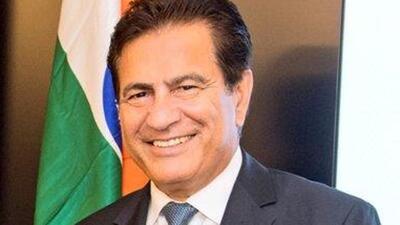
Mukesh Aghi is the chair of the US-India Strategic Partnership Forum (USISPF). Aghi, who shares close relationships with top decision-makers in both countries, has played a key role in deepening India-US ties as he has helped governments, and the private sector build on convergences.
Aghi has played a key role in deepening India-US ties. (@MukeshAghi Official X account)
In a recent conversation with HT at his office in Washington DC, Aghi spoke about Donald Trump’s return to power and its impact on the world and India.
How is Trump 2.0 going to be different from Trump 1.0?
Mukesh Aghi: Trump 2.0 will avoid all the mistakes he made in 1.0. He is going to come with a clearly-defined agenda. He will come with clearly-defined people and he will have an execution plan which is 30, 60 and 90 days. So, you will see a Trump administration which won’t be floundering but will focus on execution and efficiency.
In terms of the policy focus, Trump has spoken about mass deportation, tariffs and ending wars. What are the big changes that you expect?
– The US spends roughly a trillion dollars on its defence budget. It has around 750 bases around the world. Trump is going to question that. Do we need these bases? Do we need to be out in all these wars? I think you will see a massive shift taking place from that perspective.
Second, he wants to create jobs at home, and he thinks that the best way to create jobs at home is to stop importing and start manufacturing. So, he will put tariffs. The biggest supplier of goods to the US is China. So, he will put higher tariffs on China hoping that some manufacturers will move back and that’s going to create jobs. There will be challenges because all indications are once you put tariffs, it drives inflation. Once it drives inflation, the Fed will keep the interest rate high. When you keep the interest rate high, the dollar gets stronger. So, it gets much more expensive to export from the US side also. So there has to be a balance.
You will see a stress point happening with China because the Chinese economy is not what it was during first Trump term. That time, it was booming. Now, it is struggling. Real estate assets are in a downward spiral. Its deficit has gone up. China is at a weak stage economically at the moment, but it’s a country which has its own ambition to be the dominant power.
Trump’s China approach: “There will eventually be a deal”
Trump’s appointees for NSA and Secretary of State have had very strong and critical views on China. His vice president has spoken about how China has taken away jobs from middle America. This is what his base believes, and this was the core of his campaign in both 2016 and 2024. At the same time, Trump has taken a U-turn on TikTok ban. Elon Musk, who has strong business interests in China, in his orbit. Do you think that the Trump administration is going to take a strong line on China, or do you think that there will be some escalation of tensions followed by a possible deal?
– We have to understand Trump’s endgame; create jobs here in America. And he feels creating jobs here is mainly through manufacturing. So, to bring back manufacturing, he will raise the tariff. He is going to put a lot of pressure on US companies to relocate their supply chain. He’s going to put a lot of pressure on the Chinese. And at some stage when you see a massive disruption happening with the high tariffs, it’s going to have an impact on US companies immediately because complex supply chain comes from both US and also international markets. So, if you start putting tariffs on them, US exports become expensive. So, he will have to make a deal.
Now in the case of China, yes, if the Chinese put a good value proposition together on the table, he will make a deal. But you have to understand that the last time he made a deal where China committed to $200 billion procurement of goods, nothing was bought. So, he is very, very conscious that whatever the Chinese say, they may not do what they say. So, I think there’ll be a lot of skepticism on part of Trump. But he will make a deal eventually.
So, if China offers him a sweet economic deal, does Trump give China strategic space in the region and allow China to do what it wants to do, say in Philippines or in other parts of the region? Are you apprehensive of that kind of deal?
– It could happen. You have to understand if there is a deal which benefits Trump and United States, he will make a deal because he will look at not the long-term, but he will look at short-term to mid-term. How does it impact him, his legacy and also the United States itself. So, if the deal is good enough, I think he’ll take it.
How is the immigration issue going to pan out given the promise of mass deportation and willingness to impose national emergency and the use of military powers?
– You have two kinds of immigration, legal and illegal. Illegal is mainly blue collar workers who are doing low-end jobs from picking up berries in farmland to washing dishes and restaurants. There is a lot of pressure for Trump to bring that under control. We have around 16 million illegal immigrants in the country and so that has to be dealt with. Now can you basically use military to drive that? Yes, there’s a possibility, but then you’re going to have massive chaos. There’ll be lawsuits, so that’s going to slow down the process.
Then you have legal immigration. We have a shortage of skilled resources. If you want to bring manufacturing back, you have got to figure out how you’re going to basically bring resources. Take the Chips Act and all the semiconductor plants coming into Ohio, Arizona and New York. The biggest challenge is not the capital, it’s the people, it’s the talent. And so, we have to sort that out through legal immigration. So hopefully the Congress will come to the table. With Republicans in majority in both the Senate and the House, and with the president Republican, they’ll make a deal. Look at the talent which is graduating from STEM programmes here who can be, on day one, tax-paying citizens, why not grab them? So, I see a potential possibility of having a deal on the legal immigration side and chaos on the illegal immigration side.
The US-India track: “Flip the game plan, position India as US plus one”
Let me move to India. India managed the first Trump administration better than most other countries. There has been great bonhomie between the prime minister and the president elect. They were also on a call immediately after his election. The optics seem right. What are the possibilities and opportunities you see for the relationship and what are the challenges?
– So, you have to look at it geopolitically. You have a country which has 1.4 billion people. It’s a country whose economy is growing at 7-7.5%. It will grow to a five trillion dollar economy by 2027. The purchasing power of citizens is going up by 15% annually. And we are seeing a nation which China will never treat as an equal partner and is going to stand up to China. So, there is a clear geopolitical alignment between US and India to deal with China. That’s one aspect.
The second aspect is economic. You have a large number of Fortune 500 companies which have their manufacturing in China. As the stress point goes up, as tariffs come in, they have to decrease the supply chain dependence. So, the question really becomes is do they bring that to US, or do they take it elsewhere too? And I think India becomes a potential option from that perspective because it’s not just only about building in India but also going after the Indian market. The classic example is Apple. Apple today is exporting 25% of its iPhone 16, but Apple’s domestic revenue has crossed $5 billion.
So, companies are saying, okay, I will do what you call as the China plus one strategy. That is, I will look for an alternative. But you have to understand that US companies will not leave Chinese market. What they will do is have enough manufacturing in China for the Chinese market but go to other geographies to look at for the market of that geography or the rest of the world.
But I think the other factor which you have to keep in mind is it is no longer a China plus one strategy. I think what India has to do is the US plus one strategy. Flip the whole game-plan and say, okay, how do I integrate myself into the global supply chain where I build components in India and those components are finally get assembled in the US. Global supply chain is tied to national security now and India is a geopolitical partner from a Quad perspective.
So, it will now become secure sourcing, no more friendshoring, no more outsourcing. There will be secure sourcing partnerships, with countries where you have a strategic geo-alignment and at the same time can show how they can support you on a US plus one strategy. So, I see the trend taking place very, very fast, especially after the Inauguration.
That’s very interesting. So how does India pitch to American companies to come and invest in India, when Trump is going to turn to them and say, invest in US?
– Well, you can’t move 100% of the manufacturing line to the US. India can talk to, say, a chip company and say we will do all the design and then do part of the fabrication and then do the packaging and testing in the US itself. So overnight, you cannot move 100% of your manufacturing to the US. You need partners who are willing to play by the rules and be part of the integrated global supply chain. And that’s where India becomes critical. So, India has to basically pitch and position the US plus one strategy and India becomes the plus one in supporting Trump’s ambition of bringing the manufacturing back to the US
The trade battles: “India should proactively propose a trade, tech, supply chain deal to Trump”
That strategy can work if the second component works — trade. If you want smooth and secure supply chains from India to US, you need a trading arrangement that is smoother than what exists right now isn’t it? So, two questions. One, what do you see the Trump administration doing? They have already said they’re going to impose 10 to 20% tariff across the board that includes India. And two, what do you think India should do to maybe preemptively deal with this issue or if tariffs are imposed then subsequently deal with this issue?
– India should not have a knee-jerk reaction. I think India should look at how do you basically integrate this relationship in every aspect. Don’t have insular deals. Combine three aspects. One is technology transfer, continue with that; two, make a trade deal; and three, become US plus one manufacturing in the supply chain. So, what happens is if India makes component in a global supply chain; there’s zero duty coming to the US. It is three different plays. You got to combine them into one and work with the Trump administration from that perspective.
So, trade, investment and technology together?
– Absolutely.
And you think India should make a proposal of that sort of a comprehensive economic deal?
– Be proactive. Don’t be reactive because the moment you start being reactive, it becomes more complex. Put a pitch on the table once the administration is announced. I think there is an issue of speed. You have to understand that Trump is going to come with a game plan. He’s going to come with the policies. He is going to be with a team whose job is to execute very, very fast with speed. So, India has to do the same thing, have a game plan, come to the DC and execute from that perspective.
I remember in the first Trump administration, India was very keen to do a mini trade deal and was willing to basically go beyond where it has ever gone on the agriculture side or on some other aspects. I think today India is much stronger, with a much more confident political leadership. And so, I think India can take the lead and provide the leadership and make a package deal with the Trump administration.
The tech synergy: “Musk’s demand on spectrum is a stress point”.
Export control restrictions have inhibited the deepening of tech ties. Do you see Trump with his very fiercely American nationalist orientation and political commitment, opening up technology to a partner like India?
– I strongly believe this is a fantastic opportunity for India to work with the Trump administration and see how you can streamline ITAR (International Traffic in Arms Regulations) because that is the biggest constraint of technology exports to the rest of the world. I am not saying open it for the rest of the world. But see how you can streamline that because Trump is going to come in with a sledge hammer and make a change in this town with policies and processes which has hampered the growth of the US economy and US exports. So, I think it’s a very good opportunity for India to create awareness that this is one of the impediments which stops trade between the two countries.
Given Musk’s role in Trump’s orbit, what is it that India should be doing on EVs, space and spectrum?
– So, I think immediately what I see is the current battle in India is on spectrum, should it be auctioned or allocated. Elon Musk wants it allocated whereas the Indian players, who paid a lot of money, are saying auction is the way to go forward. And so, I think right there you will see a stress point coming in. But I think the Indian administration has to decide what’s good for the country and take it from there.
I think on the EV side, India went out of its way to open up the market for Elon Musk and he, basically, for whatever reason, and I think here the Chinese outplayed India, delayed the whole process. I strongly believe Elon Musk will come to India with Tesla, he will come with his charging station, charging technology and he will also come with his storage capacity capability. These guys will come in from a market opportunity perspective.
On space, there is a potential to collaborate. At the end of the day, India can launch satellites at one-tenth of the cost that US does. And so, they can and will collaborate. It’s a win for both.
Any final piece of advice to your friends in Delhi on how they should deal with President-elect Trump?
– I think it’s an opportunity for India to leverage the incoming government. India can play a pivotal role rebuilding America. A classic example is that 39% of the prescription drugs come from India and that saves hundreds of millions of dollars in savings itself. India can play the same role on the defence side. It can play the same role further on the R&D side. My advice to friends in Delhi is take this as an opportunity, find a creative solution, align yourself with what Trump is trying to achieve, which is America First. We are not saying we have become subservient to America. You can still marry Atmanirbhar Bharat with America first. There is a lot of space for to succeed together.
A 26-year-old man has been charged with murder over last week’s fatal shooting of UnitedHealthcare CEO Brian Thompson in New York City.
Luigi Mangione was taken into custody at a McDonald’s in the town of Altoona, Pennsylvania, about 280 miles (450km) west of New York City on Monday after a customer at the fast-food outlet recognised him.
He was found in possession of a 3D-printed gun and a handwritten document that indicated “motivation and mindset”, according to police.
Mr Mangione then appeared in a Pennsylvania court to be arraigned on five initial counts and was denied bail.
Just hours later, New York investigators charged Mr Mangione with murder and four other counts including firearms charges.
Mr Thompson, 50, was fatally shot in the back last Wednesday morning outside the Hilton hotel in Midtown Manhattan where UnitedHealthcare, the medical insurance giant he led, was holding an investors’ meeting.
Police say he was targeted in a pre-planned killing.
The shooting triggered a huge manhunt, with New York City investigators using one of the world’s largest digital surveillance systems as well as police dogs, drones and divers in a Central Park lake to search for the attacker.
Mr Mangione is in jail in Pennsylvania, where he was formally charged with possession of an unlicensed firearm, forgery and providing false identification to police.
He was handcuffed at the wrists and ankles when he appeared in court there earlier on Monday.
Wearing jeans and a dark blue jersey, Mr Mangione appeared calm during the hearing, occasionally looking around at those present, including the media.
But it was ultimately a McDonald’s customer in Altoona that recognised the suspect from media coverage and alerted an employee, who then tipped off the police.
When police arrived, Mr Mangione showed them a fake New Jersey driver’s licence with the name Mark Rosario, said court papers.
He “became quiet and started to shake” when an officer asked if he had been to New York recently, the criminal complaint adds.
When he was told he would be arrested if he lied about his name, he gave his real name, according to the court papers.
Asked why he lied, he told officers that “I clearly shouldn’t have”.
A search of his backpack uncovered a 3D-printed pistol, a 3D-printed silencer and a loaded magazine with six rounds of 9mm ammunition.
Prosecutors said he was also carrying a US passport and $10,000 cash, $2,000 of it in foreign currency, though Mr Mangione disputed the amount in court.
Investigators revealed that finding him was a complete surprise, as they did not have his name on a list of suspects before Monday.
Mumbai: The Indian stock market opened flat on Tuesday as selling was seen in Nifty’s auto, energy, private bank and Infra sector in early trade.
At around 9:23 am, Sensex was trading at 81,533.01 after gaining 24.55 points or 0.03 per cent, while the Nifty was trading at 24,633 after rising 14.05 points or 0.06 per cent.
The market trend remained positive. On the National Stock Exchange (NSE), 1,508 stocks were trading in green, while 667 stocks were in red.
Experts said that the market is likely to move in a narrow consolidation pattern in the near-term. There are no major triggers that can push the market into a new bull orbit.
“There are no major triggers that can cause a deep correction from the current levels. Within the range, there are significant down moves and up moves. FMCG stocks are facing selling pressure due to the tepid growth phase they are going through,” they added.
Nifty Bank was up 11.15 points or 0.02 per cent at 53,418.90. Nifty Midcap 100 index was trading at 59,045.35 after gaining 46.60 points or 0.08 per cent. Nifty Smallcap 100 index was at 19,584 after gaining 55.40 points or 0.28 per cent.
In the Sensex pack, Power Grid, JSW Steel, Infosys, Asian Paints, SBI, Tata Motors, Bajaj Finance, HCL Tech and Sun Pharma were the top gainers. Whereas, M&M, Titan, Maruti, Tech Mahindra, UltraTech Cement and TCS were the top losers.
In Asian markets, Jakarta and Bangkok were trading in red. while China, Hong Kong, Seoul and Japan were trading in green. The US stock markets closed in red on the previous trading day.
Foreign institutional investors (FIIs) bought equities worth Rs 724.27 crore on December 9, while domestic institutional investors sold equities worth Rs 1,648.07 crore on the same day.
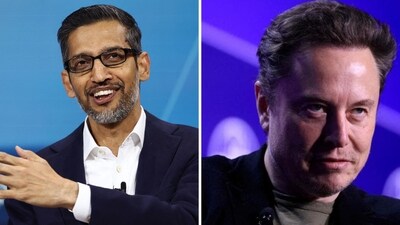
Google is turning heads with the announcement of its new quantum chip, Willow. One of the individuals “wowed” by this innovation is the world’s richest man, Elon Musk. Taking to X, he showed interest in Google Quantum AI’s latest quantum chip and engaged in a virtual conversation with Sundar Pichai.
Alphabet and Google CEO Sundar Pichai’s virtual conversation with Space X CEO Elon Musk intrigued many. (AFP, Reuters)
Alphabet and Google CEO Sundar Picha piqued Musk’s interest when he shared the news of Willow on X. The Space X CEO promptly posted his one-word reaction—“Wow.” Pichai upped the ante by suggesting that maybe one day they can place a “quantum cluster in space with Starship.” He referred to SpaceX’s starship, which, according to the official website, is “designed to carry both crew and cargo to Earth orbit, the Moon, Mars, and beyond.”
Sundar Pichai and Elon Musk’s conversation:
In his post, Pichai introduced Willow to the world, calling it a “new state-of-the-art quantum computing chip with a breakthrough that can reduce errors exponentially.” He further shared a few words about the quantum chip’s exceptional performance. Reacting to the post, Musk wrote, “Wow.”
In response, Pichai posted, “We should do a quantum cluster in space with Starship one day.” Musk responded, “That will probably happen,” and discussed a cosmic philosophy, referencing Kardashev scale.
Take a look at how the conversation continued:
Sundar Pichai’s post about Willow. (X)
Elon Musk’s response and Sundar Pichai’s reaction:
Conversation between Elon Musk and Sundar Pichai. (X)
What happened next?
Elon Musk and Sundar Pichai’s X conversation on Willow. (X)
What did social media say?
Expectedly, this conversation between the tech geniuses captured the attention of social media users, who posted their opinions in the comments section.
Space entrepreneur and engineer James Yenbamroong reacted to the conversation and wrote, “Quantum mechanics in action. Will be keen to see it in space application soon. Quantum cluster space data center sounds like the way to go forward! Keep it coming.”
Praising X, an individual commented, “This conversation right here is the reason why X is superior to every other social media or news app.” A third expressed, “Space solar is nice but you still need to get the energy to earth. Personally I say, in the short term, use nuclear fission and also scale production of newer conventional solar panels.
A fourth joined, “This is the kind of tech breakthrough that makes your hair stand on end. Quantum computing was always the Sword of Damocles hanging over cryptography and it just took a massive step closer. If Willow can solve in 5 minutes what a supercomputer takes 10^25 years to crack, Bitcoin’s encryption is definitely on borrowed time. Buckle up. The future of decentralized finance may need a post-quantum overhaul & fast.”
About Willow:
Google announced in a blog post that Willow “demonstrates error correction and performance that paves the way to a useful, large-scale quantum computer.”
What are your thoughts on this conversation between Elon Musk and Sundar Pichai?
A real-life “Succession” battle for Rupert Murdoch’s media empire has ended with a Nevada court commissioner denying the billionaire’s bid to change a family trust and give control to his eldest son.
The case pitted the 93-year-old against three of his children over who would gain the power to control News Corp and Fox News when he dies.
It has been reported that Mr Murdoch wanted to amend a family trust created in 1999 to allow his son Lachlan to take control without “interference” from his siblings Prudence, Elisabeth and James.
A Nevada commissioner ruled Mr Murdoch and Lachlan had acted in “bad faith” and called the efforts a “carefully crafted charade”, according to the New York Times.
In a statement, a spokesperson for Prudence, Elisabeth and James said: “We welcome Commissioner Gorman’s decision and hope that we can move beyond this litigation to focus on strengthening and rebuilding relationships among all family members.”
Adam Streisand, a lawyer for Mr Murdoch, told the New York Times they were disappointed and planned to appeal.
The BBC has contacted Mr Streisand for comment.
The famous family was one of the inspirations behind the hugely popular TV series Succession – something the Murdochs have always refused to comment on.
But according to the New York Times report, which is based on a copy of the sealed court ruling, the billionaire’s children had started discussing their father’s death and how they would handle it after an episode of the HBO series where “the patriarch of the family dies, leaving his family and business in chaos”.
The episode led to Elisabeth’s representative to the trust writing a “‘Succession’ memo” that sought to prevent this from happening in real life, said reports.
Mr Murdoch, who has been married five times, also has two younger children, Grace and Chloe, who do not have any voting rights under the trust agreement.
The case was launched after Mr Murdoch decided to change the trust over worries about a “lack of consensus” among the children, the Times reported.
Lachan is thought to be more conservative than his siblings and would preserve the legacy of his media brands.
From the 1960s, Mr Murdoch built a global media giant with major political and public influence.
His two companies are News Corporation, which owns newspapers including the Times and the Sun in the UK and the Wall Street Journal in the US, and Fox, which broadcasts Fox News.
Mr Murdoch had been preparing his two sons to follow in his footsteps, beginning when they were teenagers, journalist Andrew Neil told the 2020 BBC documentary The Rise of the Murdoch Dynasty.
“Family has always been very important to Rupert Murdoch, particularly from the point of view of forming a dynasty,” the former Sunday Times editor said.
In 1999, the Murdoch Family Trust, which owns the media companies, was supposed to largely settle the succession plans.
It led to Mr Murdoch giving his eldest children various jobs within his companies.
The trust gives the family eight votes, which it can use to have a say on the board of News Corp and Fox News.
Mr Murdoch currently controls four of those votes, with his eldest children being in charge of one each.
The trust agreement said that once Mr Murdoch died, his votes would be passed on to his four eldest children equally.
However, differences in opinions and political views were said to lead to a family rift.
The battle over changes to the trust were not about money, but rather power and control over the future of the Murdoch empire.
The commissioner’s ruling is not final, the Times reports. The court filing acts as a recommended resolution but a district judge will still weigh in and could choose to rule differently.
Additional reporting by Michelle Fleury and Charlotte Edwards
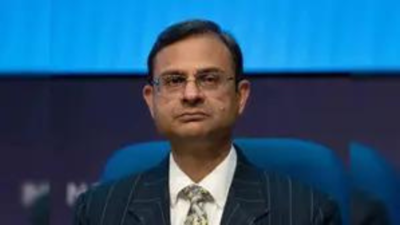
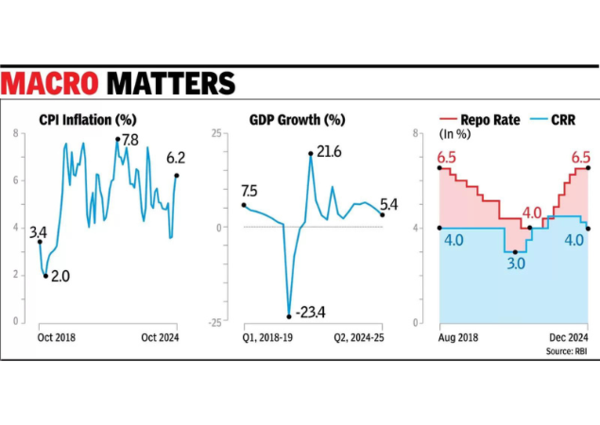
MUMBAI: RBI’s incoming governor Sanjay Malhotra faces the challenge of balancing economic growth, inflation, and exchange rate stability – a battle that outgoing governor Shaktikanta Das was still fighting. At the same time, he has to deal with regulatory reforms affecting bank lending, curbing digital fraud, and addressing retail financial product mis-selling. The rupee has come under severe pressure following the US elections, with the dollar gaining strength and FPIs selling stocks. At the same time, senior ministers in govt have called for softer interest rates to support investments. For a central banker, the concept of the impossible trinity refers to the idea that they cannot pursue independent monetary policy, manage the exchange rate, and allow free flow of capital.
Macro matters
Forex dealers said that the rupee had weakened in the non-deliverable forward market on Monday, which may result in a weak opening on Tuesday. While RBI is under pressure to cut rates in Feb given the slowdown in the economy in the second quarter, any pressure on the exchange rate would make this difficult. In a note released earlier this month, Rahul Bajoria, an economist with the Bank of America, highlighted RBI’s “three-body problem” as it navigates slowing growth, elevated inflation, and exchange rate pressures. On the regulation side, Malhotra faces the challenge of implementing key regulatory changes. This includes requiring banks to make provisions for bad loans based on expected credit losses, which would hit their bottom line as well as their ability to lend in the short term but put them in a better position to deal with defaults in the future. RBI had also proposed to bring down bank exposure to project loans by requiring lenders to make hefty provisions for projects that do not get completed on time – thus completely discouraging banks from project loans. However, govt still sees a role for banks in funding investments by corporates. On the retail side, while the banking system has taken major steps on the digital front, a side effect has been a growing number of online frauds. While banking systems are secure, people are losing money to confidence tricksters who fool consumers into believing that they are remitting money to genuine billers or govt. The cyber cells of police authorities are overrun with complaints about digital fraud, and RBI is under pressure to curb these. Another issue on the retail side has been the misselling of insurance and other financial products by banks.