Tuesday, September 29, 2026
Home Blog Page 7079

Home loans may become more affordable and boost the real estate sector, experts say

0
Home loans may become more affordable and boost the real estate sector, experts say


The Reserve Bank of India’s (RBI) December 2024 monetary policy decision will make home loans cheaper and benefit India’s real estate sector, according to several industry experts.

The central bank's monetary policy committee (MPC) decided to keep the repo rate unchanged at 6.5% for the 11th consecutive time, but slashed the cash reserve ratio (CRR) by 50 basis points, bringing it down to 4%(Representational Image/Pixabay)
The central bank’s monetary policy committee (MPC) decided to keep the repo rate unchanged at 6.5% for the 11th consecutive time, but slashed the cash reserve ratio (CRR) by 50 basis points, bringing it down to 4%(Representational Image/Pixabay)

Also Read: Myntra enters quick-commerce market with M-Now, to deliver goods in 30 minutes 

While the policy “will make home loans cheaper for home buyers, lending rates for developers, too, would come down,” said Gurpal Singh Chawla, MD of TREVOC. “Even a minor rate cut of 25 basis points will act as a major psychological booster for real estate.”

It also provides much-needed stability, especially during the festive quarter, when demand for homes is typically at its peak, according to Mohit Goel, Managing Director of Omaxe Ltd.

“This stability in home loan rates is crucial for maintaining buyer confidence and ensuring predictable repayment terms, which, in turn, boosts investment in the real estate sector,” he said.

He added that he expects a stronger sales momentum in the fourth quarter because of the “favorable conditions.”

The central bank’s monetary policy committee (MPC) decided to keep the repo rate unchanged at 6.5% for the 11th consecutive time, but slashed the cash reserve ratio (CRR) by 50 basis points, bringing it down to 4%, Governor Shaktikanta Das announced on Friday, December 6, 2024.

The CRR cut can especially be helpful in stimulating the sector since it could mean more affordable housing loans.

This came at a time of dilemma for the MPC since India’s inflation is rising and gross domestic product (GDP) growth is slowing. The repo rate on its own generally influences both of these factors in different ways.

“It shows the government is considerate of buyers’ sentiments and expectations and supports the sector’s overall growth, significantly contributing to India’s GDP and future growth prospects,” said Mohit Kalia, Vice President (Sales) Raheja Developers. “Thus, the sector shall once again reap its benefits.”

Also Read: India’s IndiGo, ranked among ‘world’s worst airlines’ in survey, reacts sharply | Top 10 carriers

India’s retail inflation rose to 6.21% in October 2024 compared to 4.87% in October 2023, primarily due to rising vegetable prices. This ended up breaching the RBI’s inflation target limit.

‘However, Aditya Kushwaha, CEO and Director of Axis Ecorp said that 2024 in general has been a landmark year for luxury housing despite all these challenges due to “evolving aspirations and global lifestyle trends.”

This means the luxury real estate grew more in 2024-25 than the affordable segment.

He added that maintaining the repo rate “reinforces financial stability, a critical driver of real estate growth, particularly in the premium and luxury segments.”

Meanwhile, the GDP growth rate slowed down to 5.4% during the second quarter of the financial year 2024-25, compared to 8.1% in the second quarter of 2023-24, due to falling growth rate in manufacturing, consumption, and mining. The RBI even cut India’s 2024-25 GDP growth forecast to 6.6% from the earlier 7.2%.

Saransh Trehan, Managing Director, Trehan Group said that the policy decision supports GDP growth by “ensuring affordable home loan rates, which are crucial for driving real estate investments.”

He emphasized that this was particularly important in high-growth areas like the National Capital Region (NCR).

Also Read: EPFO 3.0 may allow ATM withdrawal of PF, scrap 12% contribution limit: Report

“Going ahead into the new year, we hope to see the RBI and the government continue to leverage the robust growth and potential offered by real estate and agriculture sectors in particular, via a combination of policy interventions and reduced rates to form a conducive eco-system for sustained and sustainable economic growth,” said Boman Irani, President, Confederation of Real Estate Developers’ Associations of India (CREDAI).

Despite the positive sentiment, the National Stock Exchange’s (NSE) Nifty Realty index dropped, closing 0.05% in the red at 1,073.90.


Is the weather making your skin dull and dry? You may need a humidifier more than a moisturizer

0
Is the weather making your skin dull and dry? You may need a humidifier more than a moisturizer


Has your skin been feeling dry and dull lately, no matter how much moisturizer you apply? As winter progresses, the drop in humidity, combined with the heat indoors, creates an environment that sucks moisture from your skin. Moreover, the effects of pollution, poor air circulation and even some winter foods have no effect on your skin. While moisturizers provide temporary relief, they often fail to address the root cause of dryness – the dry air around you.

A humidifier is a simple yet powerful solution to deal with dry skin in harsh weather.

What if there was a way to tackle this problem at its source? This is where humidifiers come in. By maintaining the right balance of moisture in the air inside your home, they can help keep your skin hydrated and glowing. So, how to make your skin glow in winter?

We did our research and found out the many hidden factors behind dry skin, why your moisturizer isn’t working, and how humidifiers can make a real difference. And we can’t wait to share them with you! Read on and find out.

What are the causes of dry skin?

Understanding the causes of dry skin is the first step toward curing them. Let’s break it down.

environmental factors
Winter air naturally has less humidity, which means there is less moisture in the air for your skin to absorb. Have you ever noticed how tight your skin feels indoors? This is because heating systems, such as room heaters or radiators, pull even more moisture from the air, causing your skin to become dry and flaky. If you live in areas with extreme weather, the constant change between cold air outside and warm air indoors can also wreak havoc on your skin.

pollution
How often do you think that pollution is affecting your skin? Dust, smoke and small particles in the air don’t just make your face dirty; They actually weaken your skin’s protective barrier. Over time, this can lead to clogged pores, irritation and your skin being unable to retain moisture.

dietary triggers
Do you want hot coffee, salty snacks or sweet desserts in winter? Although these are comfortable, they can dehydrate your body. Caffeine is a diuretic, causing your body to lose water, while excess sugar and salt can disrupt your skin’s hydration levels. Even neglecting water intake during cold weather can make a noticeable difference.

lifestyle habits
Who doesn’t love soaking in a hot bath on cold winter mornings? Although this feels great, it strips your skin of natural oils, making it dry and itchy. Alcohol-based skin care products, which are common in many toners or cleansers, can also dry out your skin.

Also read: Is skin becoming dry due to room heater? How to stay warm, avoid health risks and protect your skin

Why isn’t your moisturizer enough?

You’re probably relying on your favorite moisturizer to keep your skin soft and glowing, but have you ever wondered why it’s not working as well as it should? The truth is that moisturizers have their limitations, and they may not address deeper problems.

Moisturizers retain moisture, but do not add hydration
Moisturizers are great at retaining the moisture already in your skin, but they don’t actually add water or hydration. If your skin is dehydrated due to environmental factors like dry air or heat, your moisturizer can only help so much.

External factors can counteract the effects of moisturizers
Even the best moisturizer may not work if your environment is working against you. Dry indoor air, pollution and extreme weather conditions can strip your skin of the moisture it already contains, rendering your moisturizer ineffective. So, no matter how much you apply, it may feel like your skin is still dry and lifeless.

Wondering if a heavy moisturizer can help?
Using thick, heavy moisturizers may seem like a good idea, especially during winter, but they can clog your pores, especially if you have oily or combination skin. These moisturizers often fail to address the root cause of your dry skin, such as dehydration or environmental damage.

How can a humidifier help deal with dry skin?

How to get rid of dry skin using a humidifier? Here is the answer to all your questions.

maintaining ideal humidity levels
Humidifiers are designed to balance the moisture in the air by releasing water vapor, which helps maintain optimal humidity levels in your home. During the colder months, heating systems can cause indoor air to become excessively dry, which can strip moisture from your skin. By using a humidifier, you can prevent this dryness by creating a more comfortable and skin-friendly environment. Maintaining humidity levels between 40-60% can reduce skin dehydration to a great extent.

Check Out These Humidifiers on Amazon You Can Buy Now

Improve skin health
When the air is too dry, your skin can quickly lose its natural moisture, leading to irritation, tightness and dullness. Humidifiers help prevent this by keeping the air moist, which helps your skin maintain hydration. It is especially beneficial for people with sensitive or dry skin, as it reduces the risk of flaking, cracks, and redness.

reducing pollutants
Dry air often contains pollutants and allergens that can irritate the skin, causing irritation or increased sensitivity. Many modern humidifiers come with built-in filters that help remove these particles from the air. By purifying the air, humidifiers reduce exposure to allergens like dust, pet dander and pollen, which can cause inflammation and aggravate skin conditions like eczema or acne.

Completing your skin care routine
A humidifier not only hydrates your skin but also increases the effectiveness of your skin care products. When the air is humid enough, your moisturizers, serums and oils work better by creating a humid environment that helps these products absorb into your skin more efficiently.

Thus adding a humidifier to your daily routine can be a game-changer in maintaining skin health, especially in drying environments.

Also read: Smog Season Wellness Guide: Fight pollution and stay healthy with air purifiers, humidifiers, and more

Ways to deal with dryness and keep your home from becoming dry

  1. Use a humidifier with a dehumidifier: Balance out excess moisture and add needed hydration for a comfortable environment.
  2. Maintain indoor plants: Plants like peace lily and spider plant purify the air and increase humidity naturally.

Check out these indoor plants to purify your indoor air

3. Improves ventilation: Open windows regularly or use an air purifier to circulate fresh, clean air.

4. Switch to non-drying cleaning products: Choose eco-friendly or hypoallergenic cleaning solutions to reduce skin irritation.

5. Stay hydrated and include hydrating foods in your diet: To keep your skin hydrated from within, eat water-rich foods like cucumber, citrus fruits and soups.

Also read: How to keep your air purifier fit during smog season: A comprehensive maintenance guide

Practical tips for healthy skin in dry weather

  1. Limit hot baths: Opt for lukewarm water to avoid stripping your skin of its natural oils.
  2. Apply moisturizer immediately after bathing: Maintain moisture by applying a thick cream or ointment while your skin is still damp.
  3. Use a hydrating mask or serum: Add a hydrating mask or serum to your skin care routine for added moisture.
  4. Choose a gentle cleanser: Avoid harsh soaps and opt for gentle, unscented cleansers to protect your skin’s natural barrier.
  5. Use a humidifier: Maintain optimal humidity levels indoors to prevent your skin from drying out.
  6. Avoid exposure to extreme cold and wind: Protect your skin from harsh outdoor elements by covering up or using protective skin care products.
  7. Moisturize twice a day: Keep your skin hydrated by applying moisturizer in the morning and evening to maintain hydration throughout the day.

Also read: Pollution Safety Tips for Kids: How to Reduce the Effects of Pollution on Your Child’s Lungs

Using a humidifier is an effective way to deal with dry skin caused by harsh weather. By maintaining optimal humidity, following up your skin care routine, and incorporating other simple tips, you can keep your skin hydrated, healthy, and glowing even in the driest conditions.

Similar articles for you

Best Indoor Plants for Your Home: Top 8 Choices for a Fresh, Green and Air Purifying Home Environment

Dehumidifier Buying Guide: How to Save Money While Getting Perfect Humidity Control

Breathe easy today with 5 life-saving air purifier features to tackle extreme pollution levels

Air purifier or humidifier? A guide to choosing the right thing for your home

FAQs on Humidifiers

  • Can a humidifier replace a moisturizer?

    No, a humidifier complements your skin care routine by creating a humid environment, but moisturizers are still essential to directly hydrate your skin.

  • What is the ideal humidity level for skin health?

    Maintaining humidity levels between 40-60% helps keep your skin hydrated and prevents it from drying out.

  • Are there any side effects of using a humidifier?

    When used properly, humidifiers are safe, but excessive moisture can promote mold growth. Regular cleaning is necessary.

  • How often should I clean my humidifier?

    To prevent bacteria and mold build-up, clean your humidifier at least once a week, following the manufacturer’s instructions.

  • Can I use a humidifier in any room?

    Yes, you can use a humidifier in any room, but it is especially helpful in bedrooms or areas where you spend a lot of time to maintain optimal skin hydration.

Disclaimer: At Hindustan Times, we help you stay updated with the latest trends and products. Hindustan Times has an affiliate partnership, so we may get a share of the revenue when you make a purchase. We will not be liable for any claims under applicable laws including but not limited to the Consumer Protection Act, 2019 in relation to the Products. The products listed in this article are in no particular order of priority.


US judge affirms Naval Academy consideration of race in admissions process | Courts News

0
US judge affirms Naval Academy consideration of race in admissions process | Courts News


Decision could tee up another battle over considerations of race in university admissions before US Supreme Court.

A federal judge has rejected a challenge to the United States Naval Academy’s practice of considering race in admissions applications, ruling that a diverse military is in the national interest.

In a decision on Friday, US District Court Judge Richard Bennett in Maryland ruled against Students for Fair Admissions, an anti-affirmative action group that has frequently turned to the courts to challenge the use of race in university admissions.

“Specifically, the Academy has tied its use of race to the realization of an officer corps that represents the country it protects and the people it leads,” Bennett wrote. “The Academy has proven that this national security interest is indeed measurable and that its admissions program is narrowly tailored to meet that interest.”

Students for Fair Admissions also brought a case challenging similar practices at Harvard University. The US Supreme Court ultimately struck down consideration of race in university admissions when it ruled in favour of the group in June 2023.

But that ruling, while broadly favourable to opponents of affirmative action, suggested that the question of race and admissions could be impacted by considerations of national security, opening the possibility of an exemption for military academies.

While opponents of affirmative action argue that such practices unfairly favour some groups over others, proponents point out that race is just one factor among many in admissions decisions.

They also argue that affirmative action efforts help to counter the cumulative impact of segregation and exclusion faced by racial minorities for much of US history.

During a two-week trial in September, lawyers for the US Naval Academy defended consideration of race in admissions by arguing that a diverse military is more strong, effective and respected.

Bennett, appointed by former President George W Bush, wrote that the defence had “established a compelling national security interest in a diverse officer corps” and that the consideration of race played only a small role in admissions decisions.

In a statement expressing disappointment with the decision, the president of Students for Fair Admissions, Edward Blum, said the organisation hopes to take the case to the Supreme Court.

“It is our hope that the US military academies ultimately will be compelled to follow the Supreme Court’s prohibition of race in college admissions,” he said.


Paytm to sell 5.4% stake in Japan’s PayPay in $250 million deal

0
Paytm to sell 5.4% stake in Japan’s PayPay in 0 million deal


Paytm to sell 5.4% stake in Japan’s PayPay in $250 million deal

MUMBAI: Paytm is selling its stake in Japan’s PayPay Corporation as part of its strategy to divest its non-core assets.
In an exchange filing on Friday, Paytm said that the board of its Singapore subsidiary has approved the sale of stock acquisition rights in PayPay. “This transaction will increase the consolidated cash balance of the company,” Paytm said without disclosing the specifics of the deal. Paytm is understood to be selling its stake in the company to SoftBank in a deal pegged at about $250 million. A spokesperson for SoftBank did not respond to queries.
Paytm, which had come under regulatory scrutiny due to non-compliance at its now wound down banking unit, has sharpened focus on its core payments and financial services businesses. In August this year, the Noida-based fintech had sold its entertainment ticketing business to Zomato in a Rs 2,048 crore deal.
In an earnings call with analysts earlier this year, Paytm CFO Madhur Deora had said that the carrying value of the firm’s stock acquisition rights in PayPay stand at nearly Rs 2,000 crore. Paytm has about a 5.4% stake in PayPay. The Japanese fintech was founded in 2018 as a joint venture between SoftBank Group and Yahoo Japan. SoftBank, which had been one of Paytm’s early backers, had tapped into the startup’s technological expertise to build PayPay’s business in Japan.
Earlier this year, SoftBank fully exited Paytm. As of Sept, the Noida-based fintech had a cash balance of Rs 10,410 crore.


South Korea President Yoon Suk Yeol apologises for martial law declaration

0
South Korea President Yoon Suk Yeol apologises for martial law declaration


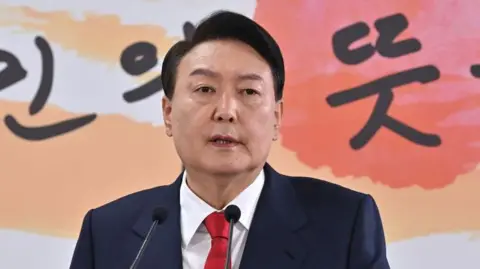
Getty Images President Yoon Suk Yeol Getty Images

President Yoon declared martial law on Tuesday, saying it was to save the country from dark forces and the threat from North Korea (file image)

South Korea President Yoon Suk Yeol has apologised for declaring martial law earlier this week and has said there will not be another such order.

The embattled leader is facing potential impeachment following Tuesday night’s declaration, which was quickly overturned in the National Assembly.

In response to the president’s address, the leader of his ruling People Power Party (PPP) told reporters that it had become impossible for Yoon to continue his normal duty.

“His early resignation is inevitable,” said Han Dong-hoon.

“I am very sorry and would like to sincerely apologise to the people who were shocked,” Yoon said in his brief televised speech.

It had been speculated that he would use the address to the nation – his first since declaring martial law – to resign but he did not do so, instead saying that he would delegate the work of stabilising the situation to his ruling party.

He also did not mention impeachment.

The opposition is pushing for a vote on the motion to impeach Yoon on Saturday. It needs at least eight members of Yoon’s party to vote in favour for the motion to pass with a two-thirds majority in the 300-seat parliament.

Opposition leader Lee Jae-myung said he was disappointed with President Yoon’s comments on Friday and that they would only increase the public’s sense of anger and betrayal.

Lee added that he would do his best to remove the president from office.

South Korea was plunged into political turmoil late on Tuesday night when Yoon made the shock martial law declaration.

He cited threats from “anti-state forces” and North Korea. However, it soon became clear that his move had been spurred not by external threats but by his own domestic political troubles.

Some lawmakers jumped over barricades and fences to get past security forces in order to convene in parliament and void Yoon’s decree.

Yoon rolled back the declaration six hours later after MPs voted it down but there had been concern he would attempt to make a second decree. Some lawmakers had been staying near the National Assembly to make sure they were there ready to void it.

Before his attempt to place the country under military rule, Yoon had been beset by low popularity ratings, corruption allegations and an opposition-led legislature that reduced him to a lame-duck leader.


Inside India’s ‘secret cold war’

0
Inside India’s ‘secret cold war’


How did you come to work on this complex topic of surveillance and the extent of Western intelligence agencies and their involvement in South Asia?

Paul McGarr, author, 'Espionage in South Asia: Britain, the United States and India's Secret Cold War' (Courtesy of Topic)
Paul McGarr, author, ‘Espionage in South Asia: Britain, the United States and India’s Secret Cold War’ (Courtesy of Topic)

I fell in love with India and its people when I traveled around the country for six months at the age of twenty. My PhD was later written on British and American reactions to the Indo-China war of 1962 and later expanded into a book, examining Anglo-American relations with South Asia between the height of independence and the Cold War in the late 1940s. The international history of was exposed. War in the late 1960s. It was published as The Cold War in South Asia: Britain, the United States, and the Indian Subcontinent, 1945–1965 (Cambridge University Press, 2013). While researching this book I came across a large amount of material in the archives of India, Britain and the US, which tells an interesting story about the hitherto hidden role played by secret intelligence agencies (British, American, Soviet, Indian and others) Is. In the Cold War of South Asia. I approached publishers with the idea of ​​writing a second book focusing on India’s secret Cold War and fortunately I received a positive response.

360pp, ₹3119; Cambridge University Press

You write that “India’s counterintelligence culture has provided and continues to provide a significant socio-political challenge to foreign intelligence agencies and governments invested in South Asia.” How have decades of Western intelligence interventions in South Asia contributed to a strong push back by Indian intelligence agencies?

Indian intelligence has always had a complex liaison relationship with foreign counterparts. Indian policy makers and intelligence officials pragmatically recognize that national security depends to some extent on effective support from external intelligence agencies. That said, Indian leaders faced the perennial challenge of how to strike an appropriate balance between maintaining national sovereignty and maintaining national security with the assistance of foreign powers. Nehru and other senior Indian policy makers accepted, albeit reluctantly, the need to provide intelligence support to the Western and, to a lesser extent, the Eastern bloc. However, there remains a suspicion, not unreasonable, that facilitating some Western intelligence intervention in India in limited and declared forms would lead to additional undeclared Western intelligence activity to which Indian policy makers would not be party to and would not acknowledge. This suspicion was heightened by revelations of CIA covert operations in Italy, Iran, Guatemala, Congo, Cuba, and elsewhere in the 1950s and 1960s.

Since 1967, when it became public that the CIA secretly funded Indian political organizations and cultural bodies, Indian policy makers began to protest more strongly against the unacceptable behavior of foreign intelligence services. . Once the genie of CIA intervention in India was out of the political bottle, intelligence politics in India demanded a strong rhetorical response from policy makers, who easily saw the CIA as a political scapegoat for domestic problems. Also saw some political benefits in using it.

What can global policymakers learn from the record of Western covert interventions in India between 1947 and the end of the Cold War in 1989?

There are many lessons to be learned. 1. Covert intelligence interventions have a long shelf life. Intelligence operations conducted in the 1950s or 1960s, which remained secret at the time, would come back to haunt Western governments and destabilize their relations with India decades later. Rarely do intelligence operations remain completely hidden for long. As a result, such activity should be conducted with extreme caution and with the acceptance that the expected benefits must ultimately outweigh the negative consequences of the risk.

2. That the local (Indian) agency can be considerable and highly effective in resisting or supporting external intelligence interference for its own, often very different purposes. In particular, Western covert propaganda campaigns in India did not reconstruct the political climate in the subcontinent and local publishers, journalists and cultural producers, whether knowingly or otherwise receiving external funding, always had no requirement or obligation to do their bidding. not realized. Alleged financial sponsor.

3. Intelligence interventions are often ineffective and/or produce negative and unintended consequences (so-called blowback). Rarely, if ever, are they the magic bullet that policymakers hope they will be.

4. External intelligence interference can adversely affect national political cultures by promoting conspiracy and confusion and undermining confidence in democracy and the legitimacy of political institutions. The CIA came to be viewed in India as a malign political actor that actively sought to subvert Indian democracy and inappropriately interfere in the country’s internal affairs.

You argue that the Indian intelligence agency was very important in the Cold War and was largely ignored. Why is it like this?

Again, several reasons. (Since the 1980s), the academic study of intelligence has flourished. As well as the publication of official histories of MI5, MI6 and GCHQ, there has been a wealth of work on every aspect of intelligence from counter intelligence to covert action and analysis to OSINT (Open Source Intelligence), providing a comprehensive overview of intelligence. Has been brought out of the bag. And yet, the overwhelming majority of books and articles published in this field are framed in narrow Anglocentric terms. Do you want to read a book on British intelligence? No problem. If you want to learn more about the CIA there is a mountain of literature available from which you can choose. If you are interested in intelligence in an Asian, African or Latin American context, until recently the options for readers were much more limited.

Access to source material has been an issue. Much material on British and American intelligence was (and continues to be) released while India’s intelligence history was kept hidden under the cloak of official secrecy. This is slowly changing, and valuable source material is becoming available in the National Archives of India and the Nehru Library, but still only in disappointingly small quantities.

What surprising findings did you find about the role of British and American intelligence agencies in post-colonial India?

Two of the most surprising findings were:

1) The extensive extent of covert cooperation between the British and American intelligence services and their Indian counterparts between the late 1940s and 1960s, with the full knowledge of Indian political leaders. This occurred not only in relation to common internal targets, such as the CPI administration in Kerala in the 1950s, but also externally against Chinese targets after 1962. The scale, scope and depth of cooperation was astonishing. In particular, in the 1960s the IB was heavily dependent on MI5 and somewhat intimidated by the British Security Service, which angered Nehru. Similarly, the IB exerted heavy pressure on CIA training and logistical support against China after 1962. This represents somewhat of a paradox. While Indian leaders publicly denounced and criticized the US for inappropriate covert interference in the domestic affairs of developing world countries, at the same time New Delhi was working closely with British and American intelligence. Perhaps, matters of pragmatism and national security considerations are outweighing ideological cohesion and international solidarity within the Global South.

2) The British and American intelligence services were willing to take the risk of carrying out extensive covert operations in India for a long time. An example shows this. The British Intelligence Research Department, a secret propaganda service with close ties to MI6, ran covert gray and black propaganda activities in India from the 1940s to the 1970s. This included reaching out to Indian journalists, politicians, military officers, intelligence officers, academics and other prominent members of Indian society. Some individuals were paid financial subsidies for their ‘services’. Had the operation been ‘blown up’, it would have had serious political consequences in India and damage to Britain’s diplomatic relations with New Delhi. It was very risky. But the rewards were incredibly low. This made little or no difference to the political landscape of India. It was surprising that the British, and sometimes the Americans, were willing to conduct intelligence operations with potentially inflammatory consequences when the potential benefits were negligible.

How have covert actions taken by Western governments in South Asia in the past affected its political landscape?

Western intelligence interventions had almost no tangible impact on India’s political landscape. There is no evidence that Western intelligence was effective in any meaningful way, for example, in swaying India away from Moscow. In fact, since 1971 exactly the opposite was true. Larger geostrategic factors (for example, Nixon’s moves toward China) have always been more influential than covert intelligence interventions in shaping internal Indian politics and external Indian diplomacy. The Indian agency was also strong enough to absorb or divert Western intelligence activity and avoid such activity having a significant impact on Indian politics. In contrast, the specter of the ‘foreign hand’ or exposure to Western intelligence interference has had social and cultural impacts on India, real and imagined, that can be seen as significant and enduring. As mentioned above, the fear of omnipotent and malevolent Western intelligence influence, which was always overstated and exaggerated, created a cycle of paranoid conspiracy and paranoia, which adversely affected the self and Indian political culture. It was a tragedy and perhaps the most consequential legacy of India’s secret Cold War.

Majid Maqbool is a freelance journalist based in Kashmir.


Haiti’s multinational police mission denies reports of unpaid wages | Conflict News

0
Haiti’s multinational police mission denies reports of unpaid wages | Conflict News


Kenyan-led force hits back after report states that nearly 20 officers have resigned from the force due to unpaid wages.

A United Nations-backed security mission to Haiti, led by Kenyan forces, has denied reports that some of its officers have gone months without pay.

In a statement on Friday, the Multinational Security Support Mission to Haiti (MSS) said that it “categorically refutes” reports that officers have not had their wages paid for three months.

“All MSS personnel have received their salaries, including monthly allowances, and no MSS officer has tendered their resignation as alleged,” the statement reads.

“MSS officers remain highly motivated and fully committed to supporting the Haitian National Police [HNP] in conducting decisive operations aimed at dismantling gang networks and restoring stability.”

The allegations of unpaid wages come as the MSS struggles to make an impact on conditions in Haiti, where armed gangs have unleashed a wave of violence, wreaking havoc on civilian life and destabilising the country.

The UN estimates as much as 85 percent of the capital of Port-au-Prince has fallen under gang control. More than 700,000 people are displaced across Haiti as a result of the violence.

The news agency Reuters reported in an exclusive story on Friday that nearly 20 Kenyan officers have resigned from the MSS over delays in pay and poor working conditions, citing three sources who spoke on condition of anonymity.

In its statement, MSS said that Reuters did not contact the mission for comment before publication, but a spokesperson for the news agency has said that Reuters stands by the story.

The mission, already heavily scrutinised due to the poor track record of foreign interventions in Haiti, has made little headway since arriving in the Caribbean island nation in June.

Difficulties related to funding have been present from the start. While originally envisioned as a policing mission staffed by 2,500 personnel, Kenya has sent only about 400 officers since June.

Questions have also emerged around the stability of funding from the United States, the primary financial supporter for the mission.

While the administration of US President Joe Biden has promoted the Kenyan-led effort, it is unclear whether that support will continue in 2025, when Biden is replaced by President-elect Donald Trump.

In response to the lack of funding, officials from the US and elsewhere have pushed for the UN to launch a peacekeeping mission in Haiti.

But a previous UN peacekeeping mission to the country ended in 2017 amid outcry over its role in re-introducing cholera to the country and allegations of sexual assault.

Security in Haiti has worsened since the assassination of former President Jovenel Moise in 2021. But even with the presence of the Kenyan force, gang violence has continued to climb, and the country continues to struggle to establish stable governance.

Haiti has not held federal elections in years, a fact the gangs have seized upon to claim legitimacy.

In addition, last month, a transitional council tasked with restoring democracy to Haiti fired interim Prime Minister Garry Conille after only six months in the post. The move spurred further questions about corruption in the transitional government – and the future of Haiti’s leadership.


Romania’s cancelled presidential election and why it matters

0
Romania’s cancelled presidential election and why it matters


Sarah Rainsford/BBC Romanians fly flags in the centre of Bucharest Sarah Rainsford/BBC

Forty-eight hours before Romanians were due to vote in a presidential election run-off, the whole process was scrapped because of an unprecedented ruling by the constitutional court.

The court’s decision to annul the first round came after a far-right independent candidate, Calin Georgescu, came out of almost nowhere to lead the first round two weeks ago amid allegations of Russian interference.

Georgescu has condemned the ruling as a coup and Romania may have to wait months to vote again.

Why this decision matters

Romania is a key Nato member on its eastern flank and shares a long border with Ukraine.

It is not the first Eastern European state to fend off Russia’s hybrid war, and the constitutional court has ruled that intelligence revelations of Russian meddling are sufficiently serious to put the presidential vote on hold.

Moldova’s recent presidential vote was held amid alleged Russian interference and voter fraud, and across the Black Sea in Georgia, the pro-Western opposition says contested elections there were hit by Kremlin meddling.

Why has the vote been annulled?

Opinion polls were almost neck and neck going into Sunday’s race. Almost 19 million Romanians were eligible to choose between Calin Georgescu and liberal mayor and former TV journalist Elena Lasconi.

Latest polls even gave Lasconi the edge in the run-off.

But then on Wednesday Romania’s outgoing President Klaus Iohannis declassified intelligence documents from the supreme council for national defence suggesting that almost 800 Tiktok accounts created by a “foreign state” in 2016 were suddenly activated last month to full capacity, backing Georgescu.

Another 25,000 TikTok accounts had become active only two weeks before the first round.

Romanian foreign intelligence said Russia was the “enemy state” involved and had engaged in hybrid attacks including tens of thousands of cyber attacks and other sabotage.

Domestic intelligence put Georgescu’s sudden surge in popularity down to a “highly organised” and “guerilla” social media campaign” that involved identical messaging and social media influencers.

TikToks promoting him were not marked as election content, violating Romania’s laws, it said, while one account paid out $381,000 (£300,000) in the space of a month to users who pushed Georgescu’s candidacy, while he said he had not paid anything for his campaign.

That decision to declassify intelligence documents changed everything.

Judges from the constitutional court met on Friday to consider a large number of requests to annul the first round.

It was a complete about-turn from a decision four days before that approved the initial 24 November vote after a complete recount of 9.4 million votes.

What does the ruling say?

In its single-page judgement, the constitutional court says that in order to ensure the fairness and legality of the electoral process it has unanimously decided to annul the entire vote and the government must establish a new date for a re-run.

The court says cites its role under the constitution “to guard the observance of the procedure” of presidential elections.

It stresses the decision is final and binding.

The president in Romania wields considerable power as commander-in-chief of the armed forces and with the task of appointing the prime minister.

Who is Calin Georgescu?

Calin Georgescu, who calls himself a university teacher, was a relative unknown in the presidential race.

He denies he is a fan of Vladimir Putin, although he sees the Russian leader as a “patriot and a leader” and wants to put an end to political and military aid to Ukraine.

“Zero. Everything stops,” he told the BBC’s Sarah Rainsford. “I have to take care just about my people. We have a lot of problems ourselves,” in words that reflect his Romania-first stance.

He says while Romania should remain in international organisations such as the EU and Nato, it must end its “subservient” role.

He also condemns allegations that Russia was behind his electoral success as intelligence “lies”.

A 62-year-old agricultural engineer by profession, he held high-ranking civil service jobs years ago at Romania’s environment and foreign ministries.

He is also a conspiracy theorist who believes Man never landed on the Moon and the Covid-19 pandemic never happened, despite the seven million deaths worldwide, reported by the World Health Organization.

Read more: Far-right candidate vowing to end aid to Ukraine

What do Romanians think?

Romanians are split over the constitutional court decision.

“Today the Romanian state trampled democracy underfoot,” liberal candidate Elena Lasconi complained.

Crin Antonescu, former leader of the National Liberal party however welcomed the court ruling and said he could not understand Lasconi’s reaction. “This is exactly right, to start [the whole race] again from scratch,” he told Romanian media.

There has been anger from supporters of Calin Georgescu.

“We are witnessing a lying political class scared of losing power and capable of any injustice to keep their power and positions,” Eugen, an entrepreneur in the western city of Timisoara told the BBC.

Romanians who have been unenthusiastic about both candidates are unsure whether to be glad they do not have to decide on Sunday, or concerned for the future of Romanian democracy.

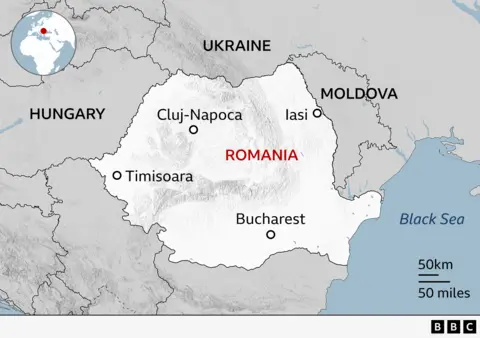
Map showing Romania and its main cities

What happens now?

The election starts all over again in three or four months’ time, to give candidates a chance to gather endorsements to run.

In the meantime, incumbent President Klaus Iohannis has said he will remain in post until the next president is elected.

There is no reason why Georgescu cannot run again, although he may face criminal proceedings as a result of the allegations made against him which he denies.

Romania has only just held parliamentary elections in which the centrist parties did better than expected. The Social Democrats are likely to led the next coalition government.

However, three far-right parties between them polled 32% of the vote, and one of them, George Simion’s AUR, came second.

Another factor of uncertainty is how Georgescu supporters will react to the annulment.

Will they take to the streets, or look to support Calin Georgescu or another nationalist candidate when Romania eventually returns to the ballot box.


Ceat to acquire Michelin’s Camso brand for $225 million

0
Ceat to acquire Michelin’s Camso brand for 5 million


Ceat to acquire Michelin's Camso brand for $225 million

MUMBAI: Domestic tyre maker Ceat, an RPG-Harsh Goenka group company, will acquire Camso brand that has an off-highway tyre business from global major Michelin for $225 million, translating to about Rs 1,900 crore. Under the deal, Ceat will also acquire two Sri Lanka-based manufacturing facilities from Michelin, a French tyre maker.
Camso is a Canadian brand that makes tyres for tractors, harvesters, bulldozers and other off-highway vehicles which command higher margins compared to tyres for passenger vehicles and two wheelers. Michelin had in 2018 acquired the brand for nearly $1.5 billion.
“The Camso brand is an excellent fit with the growth strategy of Ceat’s off-highway tyre business, thereby improving our margin profile,” Arnab Banerjee, MD & CEO at Ceat, was quoted as saying in a company release.

'Brand are highly complimentary'

Over the last decade, Ceat has been focusing on building its off-highway and tracks (OHT) business, which now consists of over 900 product offerings and covers around 84% of the range requirement in the agricultural segment, the release said. Camso will give Ceat the ability to widen its product base into tracks and construction tyres. The acquisition will give Ceat access to a global customer base including over 40 international original equipment manufacturers and premium international OHT distributors. “Ceat brings in the ability for Camso to expand to other segments such as agriculture tyres. Both brands are highly complementary in their positioning and capabilities,” a Ceat release said.
Ceat is one of India’s leading tyre companies that manufactures tyres for passenger cars, two-wheelers, trucks, buses, light commercial vehicles and off-highway vehicles. It caters to leading OEMs as well as domestic and international markets, exporting to 110+ countries, the release from the company said. Camso, meanwhile, is one of the leaders in the OHT market. Ceat and Camso together could have the synergies to expand to other segments such as agriculture tyres. In Friday’s relatively flat session, Ceat’s stock on BSE closed a marginal 0.2% up at Rs 3,092.


Cyclone Fengal: The cyclone that battered Tamil Nadu

0
Cyclone Fengal: The cyclone that battered Tamil Nadu


On the evening of December 1, 2024, a family of four and three of their neighbours huddled together under a metal roofed single-room house, in VOC Nagar, a residential area at the foot of the Arunachala hill in Tiruvannamalai district. They listened as torrential rains brought by Cyclone Fengal pounded the district in interior Tamil Nadu.

S. Meenakshi, 27, who lives opposite the house, recalls the tragedy that occurred shortly after. Her sister, R. Meena, 26, and Meena’s husband, N. Rajkumar, 32, both brick kiln workers, had returned home the previous evening as their workplace, located 20 kilometres from the temple town, had flooded. Meenakshi says the couple had been working in the brick kiln for a few years and had often stayed there for weeks to complete tasks before returning to VOC Nagar.

That Sunday was special for Rajkumar as he had come back to his children — 9-year-old Goutham and 7-year-old Iniya — after working tirelessly for a month at the kiln, she says. Meenakshi’s daughter, Ramya, 13, had also gone to Rajkumar’s house along with two neighbours — Vinothini, 14, and Maha, 10.

“Around 4.30 p.m., we heard a deafening sound. Meena called out to me and I rushed out,” says Meenakshi. “The next few moments were a blur. A heap of mud, boulders, and debris came rolling down the hill. Meena rushed inside to bring the children out but it was too late. My sister’s home was buried,” she says, sobbing.

All the seven occupants were instantly killed. Other houses in the neighbourhood were completely or partially destroyed. Relatives searched for loved ones in the slush amid relentless rains until a rescue team, led by Tiruvannamalai Collector D. Baskara Pandian, reached the site. They evacuated nearly 250 families from the hills, moved them to community halls in Tiruvannamalai town, and gave them food and medicines.

The seven bodies were recovered after a nearly 20-hour operation by a 170-member team, including 35 personnel of the National Disaster Response Force, and a sniffer dog the next evening. “When the team retrieved two bodies from the spot, they saw that Rajkumar had been holding Iniya tightly,” recalls a senior official.

A trail of destruction

While heavy rainfall during the northeast monsoon is common at this time of the year in Tamil Nadu, the State and the Union Territory of Puducherry did not expect Cyclone Fengal to cause such widespread devastation when it crossed the eastern coast on the night of November 30, 2024. On December 1, 2024, unusually heavy rainfall (40 cm to 50 cm) was recorded in many places in Puducherry and the northern and northwestern parts of Tamil Nadu. Among the coastal districts, Chennai was less affected.

The cyclone then slowly drifted westward, dumping rains, causing floods, submerging acres of crops, damaging civic infrastructure, and displacing thousands of people. When it later moved inland, it pummelled several districts. Mailam in Villupuram district received 51 cm of rainfall on December 1 and Uthangarai in Krishnagiri district received 50 cm on December 2. Some areas of Villupuram such as Kedar and Soorapattu received more than 33 cm of rainfall on a single day.

Widespread floods hit Uthangarai, Pochampalli in Krishnagiri

D. Vasanthkumar, 51, of Muthu Nagar in Nellikuppam, Cuddalore district, spent an entire night on the stairway leading to his terrace as floodwater had entered his house. “Local officials gave us flood alerts at 8 p.m. asking us to evacuate the street. But the water level rose rapidly in the area and a few of us were stranded. It took two days for the floodwater to recede,” he says. While Vasanthkumar managed to salvage important documents that were lying in his loft, he lost most of his electronic devices.

In his letter to Prime Minister Narendra Modi this week, Chief Minister M.K. Stalin said 12 lives were lost in the cyclonic storm that had wreaked havoc in 14 districts. Villupuram, Tiruvannamalai, and Kallakurichi received more than 50 cm of rainfall in a single day, which was equal to an entire season’s share. He noted that more than 2.11 lakh hectares of agricultural and horticultural land had been inundated and nearly 963 cattle had died. About 9,500 km of roads, 1,847 culverts, and 417 tanks had been damaged. Stalin said that the cyclone had overwhelmed the State’s resources and requested the Centre to release ₹2,000 crore from the National Disaster Response Fund to assist rehabilitation efforts.

Besides compensation for damaged crops, the Tamil Nadu government announced relief of ₹2,000 per family in the districts of Villupuram, Cuddalore, and Kallakurichi on December 3. Stalin also donated one month’s salary towards the Chief Minister’s Relief Fund to execute relief measures in the six worst-affected districts. On December 6, the Union Home Ministry approved the release of ₹944.80 crore to the Tamil Nadu government as the Central share from the State Disaster Response Fund to help the people affected by the cyclone.

Puducherry Chief Minister N. Rangaswamy announced relief assistance of ₹5,000 to all ration cardholders affected by the cyclone in the UT and ₹30,000 per hectare to affected farmers.

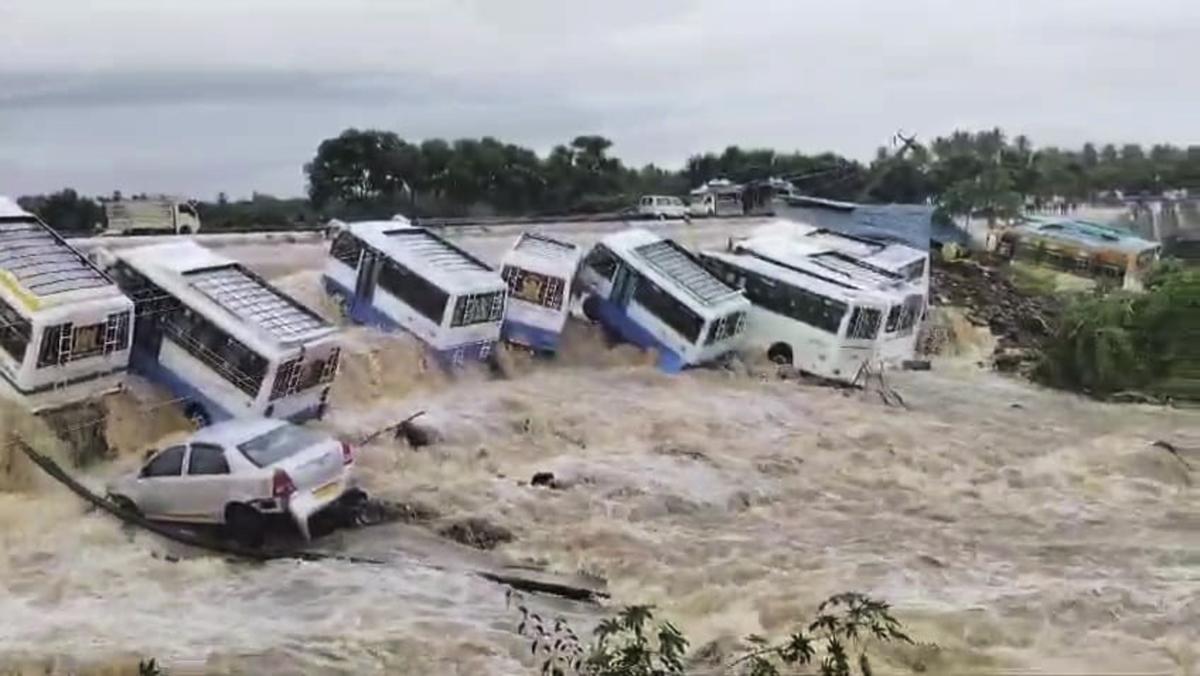
Vehicles in the Uthangarai area of Krishnagiri following heavy rainfall on December 2, 2024.

Vehicles in the Uthangarai area of Krishnagiri following heavy rainfall on December 2, 2024.
| Photo Credit:
PTI

Crops under water

Four days after the rains subsided, Villupuram, a predominant agricultural district, is struggling to return to regular life. Nearly 80,520 hectares of crops are damaged, many lakes have breached their banks, and the Malattaru and Then Pennai rivers are brimming with floodwater.

V. Tamilarasi, 64, of Pillur village in Villupuram taluk, is searching for someone to help her clear the deposits of sludge that cover her agricultural land. Flash floods in the Then Pennai river submerged crops. She has also lost two goats.

“I cultivated black gram and casuarina plantations in three acres. The crop is submerged under six feet of water. I spent ₹2 lakh for cultivation. I don’t know how I am going to manage the loss,” she worries.

Villages such as Pillaiyarkuppam and Arasamangalam have become small islands. They did not have power and communication networks for three days, which left many stranded or confined to their houses without water or food.

“The district previously experienced such large-scale floods in 1972. This time, I was caught unawares. While village administrative officers helped us, officials and elected representatives came much later,” Tamilarasi says.

The situation was no different in the urban stretches of Villupuram. S. Neela, 55, of Ashakulam, spent nearly a day cleaning the muck and waste that floodwater had brought into her house on December 1.

“Our street had waist-deep water. My family of four managed with 20 litres of packaged water for three days. We had to put up with the sewage that had mixed with the stagnant water for three days. We all worked together to drain the water as we didn’t get immediate help,” she says.

R.T. Murugan, district secretary, Tamil Nadu Vivasayigal Sangam (All India Kisan Sabha), says, “Crops in various parts were on the verge of drying for want of water until the downpour. We have not seen such water flow in the Malattaru and Then Pennai rivers in December. I was preparing for paddy harvest for Pongal and recently sowed black gram in an acre. I face a loss of ₹50,000 as floodwater marooned my land. Poorly maintained water bodies in villages too led to quick damage.”

Several residents say they want Villupuram to be declared as a disaster-affected district.

Floodwaters in Puducherry

Puducherry heaved a sigh of relief after the storm passed through the region on December 1, but was hit by another disaster when water was discharged from the brimming dams of Tamil Nadu, particularly the Sathanur dam in Tiruvannamalai on December 2.

The discharge of 1.68 lakh cubic feet per second (cusecs) of floodwater from the Sathanur dam sparked a political debate. The Opposition parties blamed the ruling Dravida Munnetra Kazhagam government for the deluge in the northern districts without prior notice. Refuting the claims of a self-created disaster, Water Resources Minister Duraimurugan noted that sufficient flood warnings had been given and flood discharge was planned considering the safety of the dam and the lives of the people.

The Water Resources Department noted that uncontrolled Thenpennai river catchment worsened the flood situation. Record-breaking rainfall in Krishnagiri and flash flood in tributaries such as Koraiyar and Kallar accelerated flow in the river that was already in spate. There is no mechanism to gauge rainfall or the floodwater generated in the Then Pennai’s tributaries.

A senior Water Resources Department official says Sathanur reservoir received an inflow of 40,000 cusecs within four hours from December 1 night. The reservoir did not have sufficient storage capacity to store the entire inflow, he adds. “We adhered to the rules and there was no lag in flood warning. After 1972, when the dam discharged nearly 2.57 lakh cusecs, this is the second time that such a high quantum of surplus water was released,” the official says.

However, G. Jayakumar of Pananhuppam, Villupuram district, who helped people reach relief camps, says, “Flood warnings did not reach the villages (A.K. Kuchipalayam and Kallipattu) close to the riverbanks. Residents assumed it would be another normal rain spell. Many left behind their belongings and cattle to save their lives.”

When the Water Resources Department team visited Villupuram, they were aghast at the damage. “We could not identify boundaries of water bodies and roads. The district is generally mostly dry in December. The teams are now assessing the damage,” the official says.

In Sathanur village, S. Arul, president of the village panchayat, rescued several elderly residents from huts that were submerged in floodwater and shifted them to a school. “They also lost important documents in the floods,” he says.

Predicting the path of a cyclone

Many officials say it is difficult to be fully prepared for a cyclone that causes such extensive damage. This is especially because it is difficult for weather models to pick up extreme weather events at a particular place, according to meteorologists.

Cyclone Fengal remained a low-pressure system after forming in the far eastern Indian Ocean on November 14 and became a depression in the Bay of Bengal only after 10 days. It moved relatively slowly for another week before the India Meteorological Department (IMD) said it had become a cyclone. On November 28, the IMD announced that Cyclone Fengal would cross the north Tamil Nadu-Puducherry coasts on the morning of November 30. The cyclone moved at a leisurely pace. While fast-moving cyclones tend to retreat quickly, slow-moving ones weaken into a deep depression, dumping unprecedented amounts of rainfall.

S. Balachandran, Additional Director General of Meteorology, Regional Meteorological Centre, Chennai, says the cyclone had undergone changes in its intensity over the ocean due to multiple factors. “The Regional Meteorological Centre had given sufficient forecasts and rainfall alerts for north Tamil Nadu on November 30 and December 1. Most of the forecasts were accurate. But in Krishnagiri and Dharmapuri, the prediction on rainfall intensity went off the mark,” he says.

The storm remained stalled over the ocean for six hours. It moved slowly towards the north and then slightly towards the east before moving towards the west and crossing the coast.

“The reason for the cyclone remaining stationary is a bit obscure and there are no immediate explanations for it,” says Y.E.A. Raj, former Deputy Director General of Meteorology, Chennai. “Though the clouds associated with the cyclonic storm were floating over the land, the centre of the cyclonic storm was close to the ocean and was able to draw a lot of moisture from the ocean. Since it got fed with all that moisture, it retained its intensity. This triggered a high amount of rainfall.”

Pointing out that the global warming and climate variability are likely to increase such unpredictable local weather patterns, G. Sundararajan of Poovulangin Nanbargal, a group advocating environmental protection in Tamil Nadu, says, “There is an urgent need to bridge gaps in last mile communication on flood warnings and weather alerts. We also need to map landslide susceptibility in all the districts so that we are better prepared for such disasters.”

lakshmi.k@thehindu.co.in; madhavan.d@thehindu.co.in