Monday, September 28, 2026
Home Blog Page 7084

Memphis rejects federal calls for police oversight after Tyre Nichols probe | Police News

0
Memphis rejects federal calls for police oversight after Tyre Nichols probe | Police News


Police practices in the US city came under scrutiny following the fatal law enforcement beating of Tyre Nichols in January 2023.

Officials in Memphis, Tennessee, have pushed back against calls for greater oversight of the city’s police force after a report by the United States Department of Justice found widespread and discriminatory use of force practices.

In a news conference on Thursday, Mayor Paul Young said that the city has been taking steps to address police abuses but is sceptical of entering a binding agreement with the federal government, known as a consent decree.

“We believe we can make more effective and meaningful change by working together with community input and independent national experts than with a bureaucratic, costly and complicated federal government consent decree,” Young said.

The Justice Department released the investigation, carried out by its civil rights division, on Wednesday.

The 73-page report found that Black people in Memphis are arrested or penalised for loitering and curfew violations at 13 times the rate for white people. Local law enforcement also cites or arrests Black people for disorderly conduct at 3.6 times the rate for white people.

Most notably, the investigation concluded that Memphis Police Department (MPD) officers “regularly escalate” situations involving nonviolent offences.

“MPD officers resort to force likely to cause pain or injury almost immediately in response to low-level,
nonviolent offenses, even when people are not aggressive,” the report explained.

But the report added that police officers accused of beating people in restraints or handcuffs face little accountability from supervisors.

The Justice Department’s investigation was initiated after a video emerged of Memphis police beating a 29-year-old Black man named Tyre Nichols in 2023.

Nichols was pulled from his car during a traffic stop, and when he broke free and fled, five officers pursued him into a residential neighbourhood where his mother lived.

They pulled Nichols to the ground, hitting and kicking him while he called out to his mother for help.

That beating is one of several instances of police abuse that have sparked nationwide protests and calls to address discrimination in the US policing and the criminal justice system.

In October, a federal jury convicted three police officers of charges related to the beating. An autopsy found Nichols died from repeated blows to the head.

Black residents of the city and criminal justice activists say they had been expressing their frustration with police practices for years before the fatal beating of Nichols.

But city officials have sought to walk a line between acknowledging the thorny issues around policing and committing to enforceable changes.

Memphis City Attorney Tannera Gibson said in a letter to the Justice Department that the city is not ready to discuss potential reforms with the police department, stating that authorities need time to look through the findings.

Gibson also suggested that the investigation had been rushed, since it “only took 17 months to complete, compared to an average of 2-3 years in almost every other instance”.

In a news conference on Thursday, Assistant Attorney General Kristen Clarke from the Justice Department’s Civil Rights Division called the probe “comprehensive and exhaustive”.

“The people of Memphis deserve a police department and city that protects their civil and constitutional rights, garners trust and keeps them safe,” said Clarke.


US says Chinese hack of global telecom providers is ‘ongoing,’ Trump and Vance affected: Report

0
US says Chinese hack of global telecom providers is ‘ongoing,’ Trump and Vance affected: Report


The US government is investigating a major breach of global telecommunications systems from a Chinese government-linked hacking group called Salt Typhoon, according to a report by Politico.

US President Joe Biden (Right) and China's President Xi Jinping (Left)(AFP)
US President Joe Biden (Right) and China’s President Xi Jinping (Left)(AFP)

Also Read: Bitcoin crosses $100,000 for first time on optimism over Donald Trump’s crypto plans

Officials have warned this is “ongoing” and most likely larger in scale than previously thought, according to the report which added that this was first announced publicly in October after it was detected in late spring and early summer.

Among those affected include President-elect Donald Trump and Vice President-elect JD Vance, in both cases before the election.

The victims to the hack include mostly political or government-linked individuals present in the “Capital Region,” impacted by stolen call records from telecom companies.

The hacking effort targeted as many as 80 telecommunications companies and internet service providers, including AT&T, Verizon and T-Mobile in the US to gain access to political leaders’ and national security data.

Also Read: ‘Doubt on its credibility’: IndiGo on AirHelp rating it among the worst airlines in the world

The report quoted Jeff Greene, executive assistant director of cybersecurity at the Cybersecurity and Infrastructure Security Agency, and a senior FBI official as urging Americans to use encrypted communications wherever possible.

This comes after the CISA, the FBI, the National Security Agency, and partner agencies in New Zealand, Australia and Canada jointly released an alert warning of the same on Tuesday.

However, the UK was the only nation in the Five Eyes intelligence-sharing group which did not sign on to the alert.

Apart from this, the Chinese hackers had also accessed and copied US court orders, which the FBI official said were attained through the Communications Assistance for Law Enforcement statute program.

Also Read: OpenAI CEO Sam Altman predicts this technology will be more ‘significant’ than AGI: Report


Tsunami warning cancelled after magnitude 7 earthquake hits California

0
Tsunami warning cancelled after magnitude 7 earthquake hits California


A strong 7.0 magnitude earthquake has struck off the coast of northern California, according to the US Geological Survey.

A tsunami warning was initially issued along the coasts of both northern California and southern Oregon – an area that includes about 4.7 million people – but has since been rescinded.

The earthquake’s epicentre hit closest to the town of Ferndale, California, a small city in Humboldt County about 260 miles (418km) north of San Francisco.

The Humboldt County Sheriff’s Office of Emergency Services said they had not immediately received any reports indicating widespread damage.

Typically, after an earthquake first responders in the area will survey buildings and roads to look for any damage and examine structural integrity.

While the earthquake does not seem to have caused huge destruction, one resident of Ferndale who spoke to the BBC in the minutes following the quake said the inside of the building she was in “looks like a bomb has gone off in every room”.

Olivia Cobian, the innkeeper at the Gingerbread Mansion Inn in Ferndale, said the inside of the inn now “looks like a warzone”.

“We have huge cast iron fireplaces that have been lifted up and moved over, everything’s fallen over, broken”.

More than 10,000 people have been without power in Humboldt County since the earthquake struck, according to poweroutage.us.

Multiple aftershocks have also been reported since the initial earthquake, which struck around 10:44 local time (18:44 GMT).

Some areas, including the city of Berkeley in northern California, issued an evacuation order due to the threat of a possible tsunami.

“EVACUATE NOW,” an X post from the city warned. “People in the Tsunami Zone are in IMMEDIATE DANGER and MUST EVACUATE NOW. Stay east of 7th St. This is a lawful order to leave now.”

Kayla Aihara was staying at a hotel in Half Moon Bay, California and got the back-to-back alerts about the earthquake and potential tsunami.

Before the tsunami warning was cancelled, workers at the hotel had told her to vacate a gym and go to higher ground out of fear of the tsunami’s impacts.

Some vacated outside and she said multiple people crowded near the shoreline of the Pacific Coast hotel, watching the waves and waiting to see any hints of a tsunami.

California Governor Gavin Newsom was briefed on the earthquakes and was meeting with state emergency officials to help coordinate the response.

The US West Coast is the confluence of a number of the Earth’s tectonic plates, and tremors are not uncommon. But a strong 7 magnitude quake isn’t typically seen in the region. Experts say there are between 10 and 15 earthquakes of this magnitude that hit globally each year.

The area has been struck by a number of major earthquakes, including a 1994 quake that hit Northridge, in the Los Angeles area, killing dozens of people and injuring thousands more, as it wrought billions of dollars of damage to homes and infrastructure.


Rupee recovers from all-time low, rises 3 paise to close at 84.72 against US dollar

0
Rupee recovers from all-time low, rises 3 paise to close at 84.72 against US dollar


Rupee recovers from all-time low, rises 3 paise to close at 84.72 against US dollar

The rupee recovered from its all-time low level and settled for the day with gains of just 3 paise at 84.72 (provisional) against the US dollar in a range-bound trade on Thursday, amid a positive trend in domestic equities. Forex traders said the Indian rupee recovered slightly on strength in the domestic markets and overnight decline in crude oil prices. However, a positive US dollar capped a sharp upside.
At the interbank foreign exchange, the rupee opened at 84.72, moved in a narrow range and touched an intraday high of 84.70 and a low of 84.74 against the greenback.
On Wednesday, the rupee slumped by 7 paise to hit its lowest-ever closing level of 84.75 against the US dollar.
“We expect the rupee to trade with a negative bias on the strong dollar and worries over economic slowdown. However, weakness in crude oil prices and fresh FII outflows may support the rupee at lower levels,” said Anuj Choudhary – Research Analyst at Mirae Asset Sharekhan.
Choudhary further added that traders may take cues from weekly unemployment claims and trade balance data from the US. “USD-INR spot price is expected to trade in a range of Rs 84.50 to Rs 84.95,” he said.
Moreover, market participants are also awaiting cues from the upcoming Reserve Bank of India (RBI) monetary policy on Friday, which will likely focus on balancing inflation and growth.
The Reserve Bank’s high-level panel on Wednesday started deliberations on the bi-monthly monetary policy amid expectations of status quo on interest rate as the retail inflation is above the upper tolerance level of the central bank.
The decision taken by the RBI Governor Shaktikanāta Das headed six-member Monetary Policy Committee (MPC) will be announced on Friday.
Meanwhile, the dollar index, which gauges the greenback’s strength against a basket of six currencies, was trading lower by 0.16 per cent at 106.15.
Brent crude, the global oil benchmark, rose by 0.53 per cent to USD 72.69 per barrel in futures trade.
On the domestic equity market front, the 30-share benchmark index Sensex closed 809.53 points, or 1 per cent higher, at 81,765.86. The Nifty rose 240.95 points, or 0.98 per cent, to settle at 24,708.40 points.
Foreign Institutional Investors (FIIs) were net buyers in the capital markets on Wednesday, as they purchased shares worth Rs 1,797.60 crore, according to exchange data.


Are Tier-II Cities the Next Real Estate Hotspots? Data Shows Promising Growth | Real Estate News

0
Are Tier-II Cities the Next Real Estate Hotspots? Data Shows Promising Growth | Real Estate News


As top-tier cities grapple with the dual challenges of overburdened amenities, rising pollution, and relentless congestion that turns every breath into a struggle, many residents find themselves longing for the simplicity and charm of their hometowns and villages. Increasingly, those living in Tier-I cities are seeking refuge from the chaos, either by retreating to the hills or returning to Tier-II cities for a better quality of life.

This shift is reflected in a recent report by PropEquity, a leading real estate data analytics firm. The report highlights that weighted average housing prices in 23 Tier-II cities surged by up to 65% from January to September this year, with price declines observed in only five cities.

Notably, Jaipur experienced the highest price growth, with the weighted average prices for newly launched housing projects rising 65% to Rs 6,979 per square foot during this period. In contrast, the average rate in Jaipur last year was Rs 4,240 per square foot, underscoring the growing demand for real estate in Tier-II cities as people seek alternatives to urban congestion.

Samir Jasuja, Founder & CEO of PropEquity said, “Tier II cities have seen renewed interest from developers, corporates, financial institutions and investor community. The cheap availability of land in these cities followed by the massive development of connectivity infrastructure and strong demand has led to an increased supply of premium and luxury housing.”

As per the data of north India, Agra saw an increase of 59 per cent in prices, followed by Chandigarh 34 per cent, Bhiwadi 25 per cent, Indore 20 per cent, Dehradun 14 per cent, Ludhiana 11 per cent and Lucknow 1 per cent. However, Bhopal saw a decline of 5 per cent while Mohali and Sonepat witnessed a fall of 8 per cent and 26 per cent, respectively.

Yashank Wason, Managing Director, Royal Green Realty hailed the growth saying that the remarkable 65% rise in housing prices in top tier II cities, underscores the growing demand for quality living spaces in these emerging markets. “In Delhi’s neighbourhood, Bahadurgarh is gaining prominence. It benefits from infrastructure upgrades, including improved road networks, and metro connectivity. Indore has also turned out to be a prominent tier 2 city real estate hub since it features a booming IT and educational sector, infrastructure, and diverse options.” 

In South India, Guntur led the way with a 51% increase in housing prices, followed by Mangalore at 41%, Visakhapatnam at 29%, Vijayawada at 21%, Coimbatore at 11%, Goa at 6%, and Kochi at 2%. On the other hand, Trivandrum experienced a 4% decline, while Mysore saw a sharper fall of 14%.

In West India, Gandhi Nagar recorded a 19% rise in housing prices, followed by Surat at 14%, Nagpur at 12%, Vadodara at 10%, and both Nashik and Ahmedabad at 4%. In East India, housing prices rose by 15% in Bhubaneswar and 14% in Raipur, reflecting steady growth in these cities.

Commenting on the report, Madhur Gupta, CEO Hero Realty, said that the influx of employment opportunities, lower cost of living, and affordable housing are key factors driving real estate demand and supply in Tier 2 cities, driven by strong buyer sentiment. “The media is influencing this trend by promoting elevated lifestyles and gated amenities, creating new aspirations in Tier 2 and Tier 3 cities, and driving demand growth. Developers are introducing high-priced inventory in response to this aspired lifestyle and increased affordability, fuelled by the expansion of industries such as IT/ITES and smart city initiatives. Chandigarh has emerged as a frontrunner, leading market size expansion among top Tier 2 cities,” he said.

The experts added that this surge highlights buyers’ trust in tier II cities, meant for investment and premium living. With hyper-congestion and dwindling quality housing supply in Tier-1 cities, the next generation of homebuyers is focusing on Tier-2 cities for a modern urban lifestyle, they said.


Cuba restores power grid but planned outages to resume amid energy crisis | Politics News

0
Cuba restores power grid but planned outages to resume amid energy crisis | Politics News


School and work activities resume, but Cuban authorities say policy of rolling, five-hour daily blackouts will continue.

Authorities say Cuba’s national electricity grid has been reconnected but is still struggling to meet demand after a nationwide blackout left millions of people without power for hours.

The National Electric Union (UNE) said on Thursday that it had boosted generation to 1,450 megawatts (MW), still less than half the typical peak demand of 3,200MW.

“The [grid] is operating normally now, but because of a generation deficit we don’t have sufficient capacity to cover demand,” said Lazaro Guerra, who oversees the sector for Cuba’s Ministry of Energy.

This week’s nationwide blackout — the third in less than two months — occurred in the early hours of Wednesday after the Antonio Guiteras power plant in Matanzas, the country’s top electricity producer, shut down.

That triggered a chain reaction, overwhelming an already strained power system and leaving the capital, Havana, in the dark.

Cuba’s oil-fired power plants are decades old and struggling to operate, but this year brought additional struggles, as oil imports from Venezuela, Russia and Mexico dwindled.

About half of the Caribbean nation’s power generation facilities are offline for maintenance or broken down, and a majority of Cuba’s residents suffer hours-long, rolling blackouts on a daily basis even when the grid is functional.

On Thursday, classes and work activities gradually returned to normal after the nationwide blackout.

Power had returned to all of Havana’s “circuits”, the local electric company said, and all of its hospitals were back online.

But the Cuban authorities said they will continue their current practice of implementing daily, five-hour power outages by block or zone as they have been doing for the past few months amid the energy crisis.

The Cuban power grid collapsed multiple times in October as fuel supplies dwindled and Hurricane Oscar struck the far-eastern end of the island, prompting authorities to close schools and nonessential workplaces.

In November, Hurricane Raphael knocked out the grid again as it made landfall on the island as a Category 3 storm.


Losing the edge of the sea: Andhra Pradesh village becomes victim of coastal erosion

0
Losing the edge of the sea: Andhra Pradesh village becomes victim of coastal erosion


Every time a cyclone warning comes, fear and anxiety begin to take root inside him, rising and falling just like waves hitting the shore, not more than a kilometer away from his own home.

Housewife Chellaboyina Venkata Lakshmi is not new here. It has been 30 years since he came to Chinna Golapalem, a remote village in Krithivenu mandal of Krishna district of Andhra Pradesh.

An abiding fear of uncertainty overwhelms her heart as she wonders if the sea is moving toward land. Although she says that the sea has never harmed the people here, she still cannot rule out the possibility of it happening in the future.

“The sea is Gangamma (Goddess Ganga) for us. We are not afraid of the sea. But water is extremely powerful. If it’s her (Gangamma), our entire village will be submerged in water within no time,” says Venkata Lakshmi. Her husband is a daily wage laborer, and her two sons are employed; One is in Hyderabad and the other lives with them.

Other women and some men in the village support his contradictory statements about the sea being harmless and the possibility of it destroying their homes. There is a reason for that.

Village sarpanch Penumala Sunil says coconut, cashew and casuarina trees have been slowly destroyed by the sea over a long time, most of them in the last 16 years.

Experts say two factors contribute to erosion here: wave activity and land subsidence.

The sarpanch says that out of the 8,000 acres of agricultural land in the village, where coconut, casuarina and cashew trees are grown, trees on 1,200 acres of land belonging to about 600 farmers have been destroyed.

“Most of them are small farmers, having one or two acres of land. Some of them have more than 100 acres of land,” he adds. Only 20% of the village’s population, which is 8,138 as per the 2011 census, own land here, he says, while the rest are fishermen.

livelihood challenges

The two main occupations of the village people are fishing and agriculture. The villagers say that on the one hand, the sea is destroying their crops, and on the other hand, the amount of fishing in Upputeru Creek has reduced significantly, they are worried that their two primary sources of livelihood are gradually diminishing. Due to which many people are being forced to migrate to cities and towns. In search of work.

China Golapalem is an island village surrounded by the Bay of Bengal on one side and Upputeru Creek on the other. Upputeru is the only outlet of Kolleru Lake into the Bay of Bengal, which travels 60 km before joining the sea near Chinna Golapalem.

Geography changed

The village is connected to the mainland by a bridge over the bay. “The village was not always an island,” says Borra Veeraswamy, 57, a government teacher here. Recalling the 1970s when he was a child, he says: “There used to be a ‘dandu dari’ here. , which was a route built for the movement of soldiers from Machilipatnam to the village during the British rule. Now the path is nowhere visible.” He says, the geography of the village changed after the construction of a new branch of the Upputeru channel.

The explanation for this can be found in a research paper titled ‘The Circulation and Flow Regime of Upputeru, Outlet Channels of Kolleru Lake, India’ published in 2019 by Professor PSN Acharyulu of the Department of Meteorology and Oceanography, Andhra Pradesh and four others . The university says that in 1973, a new channel was dug to address the flooding problem of the original Upputeru channel, which the newspaper says was narrow and shallow.

“The last time desilting work was done was in 1996. If the government starts desilting work again, there will be no erosion.”penumala sunilSarpanch, Chinna Golapalem

Many paddy fields depended on the road to Upputeru. However, because it was narrow, the channel would flood during the monsoon season as huge amounts of water flowed into Kolleru Lake, submerging the fields. This required the creation of a new channel or mouth. The original route covered a distance of 12 km around the village to reach the sea, while the new route, which was built in Losari, a village in Bhimavaram mandal of the same district, was a direct line to the sea. It is 4.4 km long.

“After the construction of the new branch, the village became cut off from the mainland. It became a man-made island,” says the teacher. Although the village was not at risk from sea erosion due to being an island, the change in geography increased the problem.

According to the research paper, one cause of erosion is the effect of wave currents and convergence and divergence activity of waves during the south-west and north-east monsoons. It states that wave convergence (concentration of energy) occurs between the mouths of two channels located 7 km apart. “The convergence of waves in the area between the two mouths of the river is significant. “Since wave convergence causes higher wave energy, the area between river mouths shows erosion,” the paper says.

In between the two estuaries, along a 7 km long coastline, lies the village of Chinna Golapalem. Today, when one strolls along the main road of the village surrounded by dense and tall coconut trees, one cannot distinguish Upputeru from the sea. There is water on all three sides, there is a danger of it entering the ground. Already, many uprooted coconut trees can be seen floating in the sea.

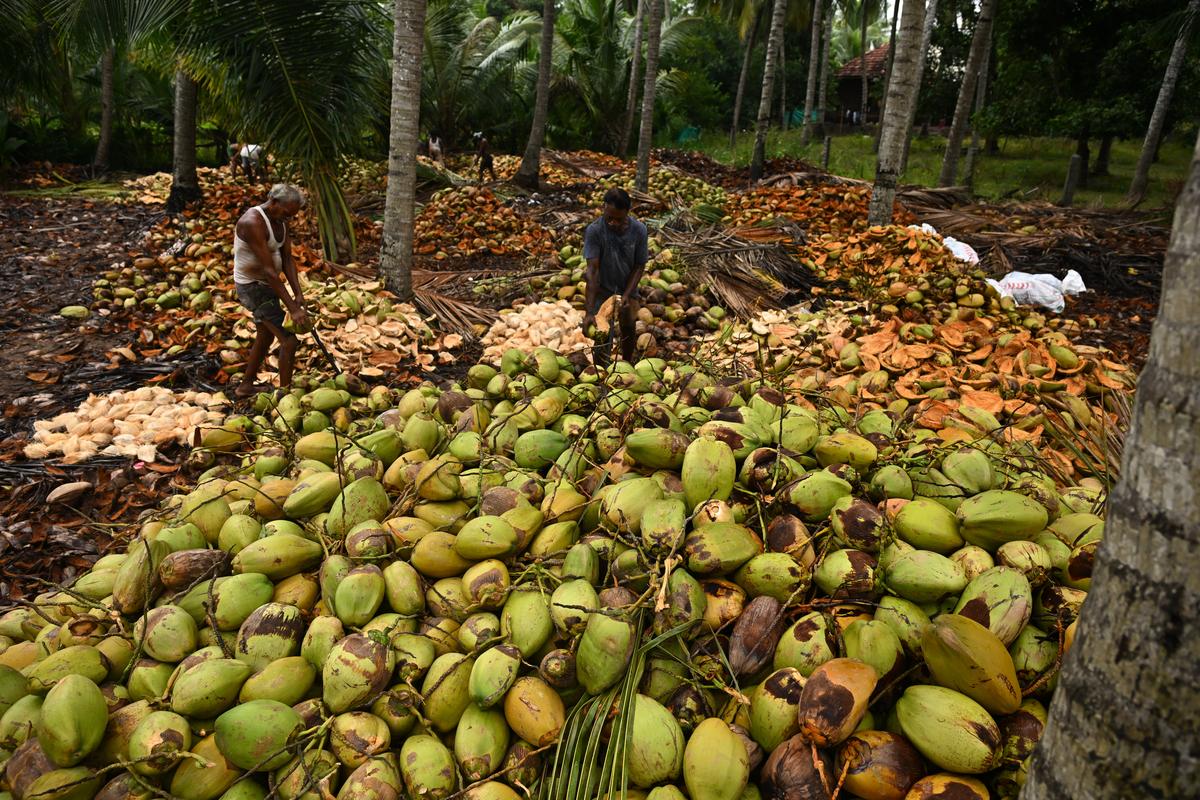
Workers sorting and peeling coconuts in an orchard in Chinna Golapalem. Hulled coconuts are sold in the markets of Machilipatnam and Vijayawada in Andhra Pradesh.

Workers sorting and peeling coconuts in an orchard in Chinna Golapalem. Hulled coconuts are sold in the markets of Machilipatnam and Vijayawada in Andhra Pradesh. , Photo Courtesy: KVS Giri

Veeraswamy used to have 5 acres of leased land inherited from his ancestors, about 500 meters from the sea. Of these, three acres of coconut trees have been destroyed in the last three years. There are about 70 trees in one acre, and the investment per acre is about ₹50,000. It takes 5 years to get the yield.

“If the trees were alive, I would have got ₹10,000 from an acre whenever we went for harvesting, which is once in two months. The loss is huge,” he says.

Veeraswamy says that before reaching Veeraswamy’s land, the sea had first encroached upon another farmer’s land, which was located 250 meters from the sea. “Now we are worried about the remaining two acres. The trees fall here twice a month, on full moon and new moon days, when the tide is high. The number of trees falling during cyclones is also increasing,” says Veeraswamy.

“We have been thinking of relocating for almost 30 years. We stayed here because we have our own house here,” says Venkata Lakshmi. “However, we asked our pregnant daughter-in-law not to stay here with us as the road connecting the village to the bridge is rough.” Villagers says that apart from obvious erosion, bad roads, street lights and lack of water supply are causing many people to refuse to marry their daughters to men here.

62 year old fisherman N. Veeraraju has lost 100 acres of land here, where he used to grow both coconut and casuarina trees. Despite heavy losses, people refuse to leave the village. “We have never depended only on agriculture. We are all also involved in fishing and selling tree products,” he says. However, falling catches have recently compounded their problems, he says.

“Here we are all fishermen. Why would we be afraid of water? We are only worried about the falling trees”N. veerarajuFisherman of Chinna Golapalem

When asked if he was not afraid of further intrusions into the sea, he replied, “We are all fishermen here. Why would we be afraid of water? We are only worried about the falling trees.” Furthermore, unlike Venkata Lakshmi, most villagers do not think the sea will advance into their village.

The sea was never a problem for them.

Villagers including the Sarpanch say that the cause of erosion is not the sea but the two Upputeru channels.

“Both the channels receive silt from many places as many water factories are located nearby. The garbage gets accumulated at the mouth of two channels, due to which the water flows onto our land. The last desilting work was done in 1996. If the government does the desilting work again, there will be no erosion,” he said, adding that he has also written a letter to Machilipatnam Member of Parliament (MP) Vallabhaneni Balashowri to resolve the issue. ,

other factors

However, experts have something else to say. EAS Sarma, former Secretary to the Government of India, says that the construction of the new Upputeru Channel remains the main cause of land erosion in the village, but possible land subsidence due to natural gas extraction in the area cannot be ruled out. Sea level rise could be a third factor, he said.

VVSS Sarma, chief scientist, regional centre, Visakhapatnam, National Institute of Oceanography, says the topography of the land is the most important factor. “It is true that land subsidence makes the situation worse by changing the topography. We have records from 1850 that sea levels are rising but at a very low rate. Currently, sea levels are rising by about 4 mm per year,” he says.

According to Veerraju, when he was young, earlier there was a difference of 1-2 meters in the height of land and sea. Now this difference has gradually reduced. According to a geologist working on the Upputeru system on condition of anonymity, Chinna Golapalem is located on a sand dune.

“If we go by what the villagers are saying, there are indications that the land is slowly sinking. Recently, we have seen sea water ingress into Kolleru Lake. Ideally, it is the Kolleru that should be discharged into the sea. If the reverse is happening, land subsidence could be one reason,” says the geologist.

While villagers say the MP has promised to look into the issue, Mr Sarma says measures should have been taken when coastal erosion was first reported. He says one solution, if possible, is to grow mangroves.

Krishna district Collector DK Balaji and MP Mr Balashowari were not available for comment.

Although the sea is not stopping swallowing land, farmers and fishermen are unaware of the bigger issues pointed out by experts. They are holding on to the hope that the process of desilting Upputeru will put an end to their problems.


Mafia-employed nun among 25 arrested in northern Italy

0
Mafia-employed nun among 25 arrested in northern Italy


A nun is among 24 people arrested in northern Italy in connection with a mafia investigation, Italian police have said.

The nun, named in Italian press as Sister Anna Donelli, was arrested for allegedly acting as a go-between for the ‘Ndrangheta mafia and its jailed gang members.

Police also arrested two politicians and seized more than €1.8m (£1.5m) worth of assets in raids across several towns in the Lombardy and Veneto regions, as well as Calabria in the south.

The arrests are a result of a four-year investigation into the ‘Ndrangheta, which is one of Europe’s most influential and dangerous criminal organisations.

Statements released by the coalition of law enforcement agencies behind the sting detail allegations that the nun leveraged her position as a volunteer at the prison.

The Brescia Carabinieri said she was an unsuspecting figure, whose religious role allowed her “free access to the penitentiary facilities”.

Police statements did not identify the politicians or any others targeted in the investigation.

The operation is continuing, with hundreds of police officers conducting searches across northern Italy.

They are aided by sniffer dog units searching for weapons and drugs, as well as “cash dogs” which are trained to search for cash, police said.

Investigators allege the group primarily used scrap metal trade businesses as a front to launder money, totalling approximately €12m in laundered cash, prosecutors said.

Originating in the impoverished region of Calabria, the ‘Ndrangheta is considered one of the world’s most dangerous criminal organisations.

In November last year, more than 200 people were sentenced to a total of more than 2,200 years in jail in one of Italy’s biggest mafia trials for generations.


Living under a dust blanket

0
Living under a dust blanket


On the outskirts of Khatoli Ahir village in Haryana’s Mahendragarh, an old banyan tree, spread with age, is covered with a thick layer of fine grey dust. Not far from the State boundary of Rajasthan, the tree that appears snow-clad, bears silent testimony to the ordeal of thousands of families across a dozen villages in the region. Here, people are constantly exposed to the harmful dust and noise emanating from the scores of stone crushers running with never a pause.

Seated on a cemented platform below the tree, 60-year-old Gyarsi Lal, diagnosed with tuberculosis a year ago, is resigned to his fate. “Court mein case jeet liya. Mamla Supreme Court tak chala gaya. Phir bhi band nahi hue. Hamari kya aukat hai. Hum to mazdoor hain; hamari koi nahi manega (We won the case in court. The matter went to the Supreme Court, yet these units did not shut down. What is our status? We are labourers; no one will listen to us),” says Lal.

His family is among the 80-odd Scheduled Caste families in Khatoli Ahir, who were allotted free plots by the Haryana government on panchayat land on the outskirts of the village in 2012. This was under the Indira Gandhi Awas Yojana, a social welfare programme to give marginalised communities free land.

Of these, only about 20 families shifted into houses they constructed on these plots. They are the worst hit with a crusher unit across the road from where they stay. “This crusher was set up in 2019. It has been five years. It stops only when there is a power cut. We keep the doors and windows shut, but the dust enters through the cracks. Everything inside, even the utensils in the kitchen, remain covered with layers of dust. We don’t just breathe this dust in, but also end up eating it,” says Suresh Kumar, sitting next to Lal. He claims that tuberculosis has claimed two lives. “Sab dus saal pehle mar jayenge (Everyone will die 10 years earlier),” he adds.

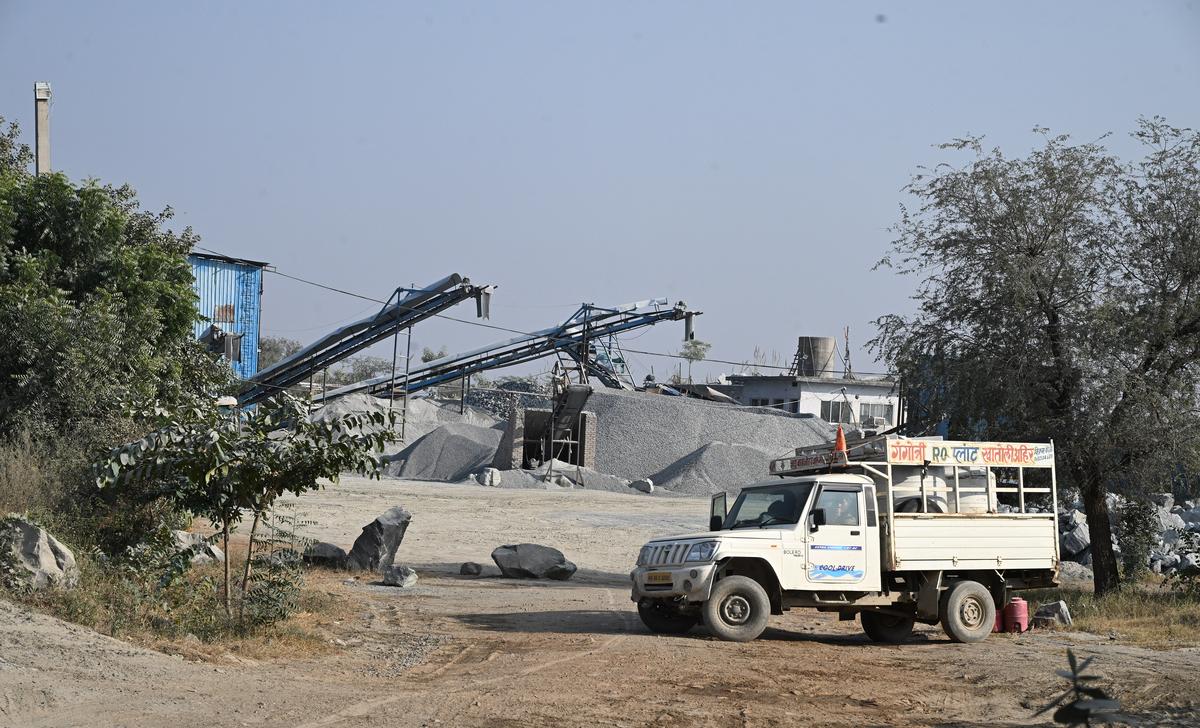
A stone crushing unit in Mahendragarh.

A stone crushing unit in Mahendragarh.
| Photo Credit:
SUSHIL KUMAR VERMA

After villagers went to court in 2018 against the crushers, Mahendragarh district officials submitted a joint committee report before the National Green Tribunal (NGT) in 2019, saying there were 158 crushers in the district. “Following this, the NGT ordered closure of 72 units. But another report two years later said there were 162 crushers with 107 in Nangal Choudhary sub-division,” says Tejpal Yadav, 32, who belongs to Khatoli Jaat village, but works as a teacher of mathematics at an IIT coaching institute near Jaipur in Rajasthan.

He has been fighting against the crushers both inside and outside court for almost a decade. He says that there were only three or four villages with crusher zones in Nangal Choudhary in 2015, but by 2021 they were spread across 10 villages.

The Regional Officer of the Haryana State Pollution Control Board, Mahendragarh, Krishan Kumar, claims there are currently only 81 stone crushers in the district. “Many crushers have shut down in compliance with the Supreme Court and NGT orders,” he says, adding the department also shut some down for violations. He says there are regular inspections and units are fined if they are found not complying.

Health hazard

Vijender, 55, another resident at the settlement, got a skin allergy three years ago, like many fellow villagers. “I sneeze all day. My eyes are always watery and my nose is constantly running. This crusher was running last night as well despite the Supreme Court ban due to high pollution levels in NCR,” he says. Up to 55% of Haryana falls under the National Capital Region that experienced high pollution levels in November, with GRAP IV restrictions kicking in, putting a pause on running diesel-fuelled vehicles and construction-related activity.

People across ages at the settlement show symptoms of dust-related ailments, including laboured breathing, itchy eyes, and skin allergies. Sifting through a heap of prescriptions from different hospitals, Bharat Singh, 34, says his five-year-old daughter has developed a kidney-related ailment, which doctors say could be caused by constant exposure to the harmful dust.

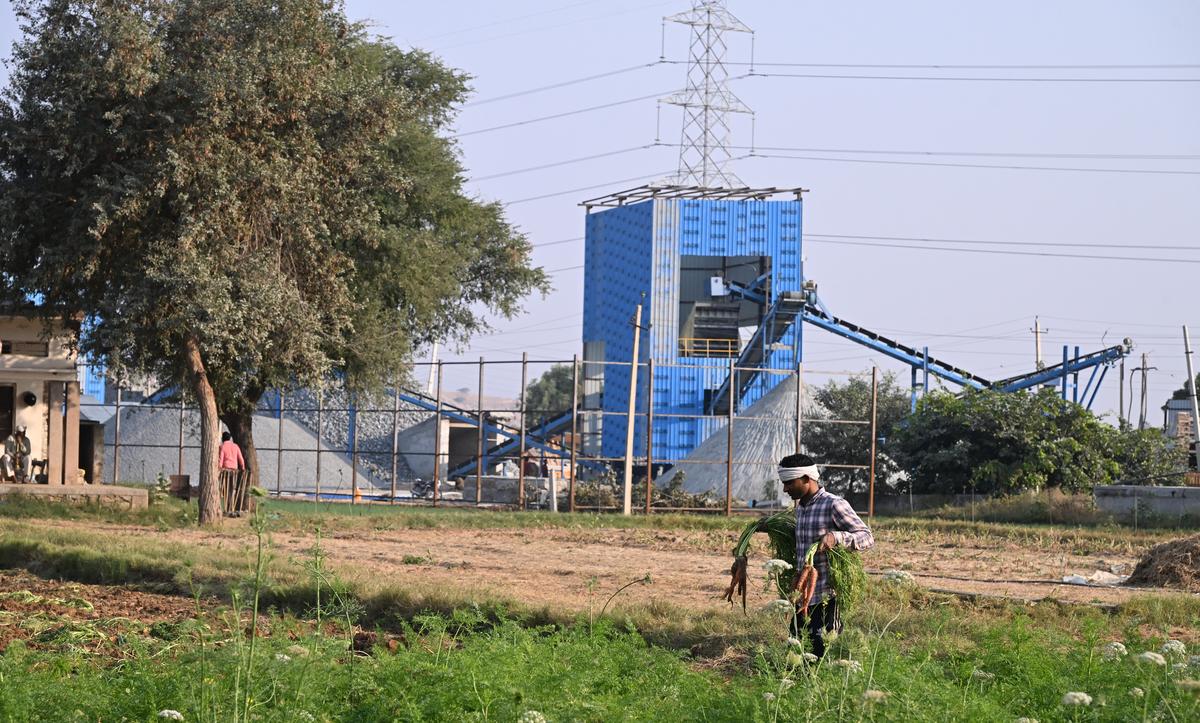
Crushing of stones happens very close to agricultural field in Mahendragarh, which impacts crop production.

Crushing of stones happens very close to agricultural field in Mahendragarh, which impacts crop production.
| Photo Credit:
SUSHIL KUMAR VERMA

A daily wager, he has worn his financial resources thin to ensure the best possible treatment for her, and has been consulting paediatricians in Jaipur. “Antim also experiences difficulty in breathing after meals. She develops red spots on her skin sometimes. A couple of children from 8 to 10 years in the neighbourhood too have eye-related issues. We don’t have the income and the resources to shift elsewhere,” says the father.

Manisha, 27, says her two children too have developed skin allergies. “The doctor advises us to keep them away from the dust. But we have nowhere to go,” says the mother.

Babli, 42, a mother of three, says she is tired of dusting and cleaning. “At least two people must clean all day long. First with a dry cloth, then with wet cloth,” she says, with the women around her nodding.

Talking with her face covered with a veil, Nirmala, 37, says rising health bills have messed up their budgets and they are forced to cut all other expenses to pay for medicines and doctors’ fees. “A few big landlords have made fortunes by renting out their land to these stone-crusher units. They live in palatial homes while we suffer,” she says. Nirmala recalls the summer of 2023, when the women blocked the road seeking closure of the crusher unit next to their settlement, but the police threatened them and forced them to lift the dharna.

“Sagai wale aate hai aur chai peekar wapas chale jate hain. Kehte hai yahan to unki ladki mariz ho jayegi (People come with marriage proposals, but return after drinking tea. They say that their daughter will become a patient here),” quips Sunita, 45, as the women around her burst into laughter.

Stone dust everywhere

The road to Dholera, a village next to Khatoli Ahir, is dotted with trees on both sides, all covered in thick layers of grey stone dust. Just a kilometre away from a stone-crushing zone with about 50 units, the round-the-clock movement of dumper trucks carrying construction material from the crushing units and mines has damaged road, making it difficult for small passenger vehicles to ply.

Here too people say they wake up to thick layers of dust inside their houses and on the terraces, with the village surrounded by the crushers. There is a permanent haze in the air throughout the year. Many families — at least those who could get jobs — have left the village over the years, to settle in less polluted places.

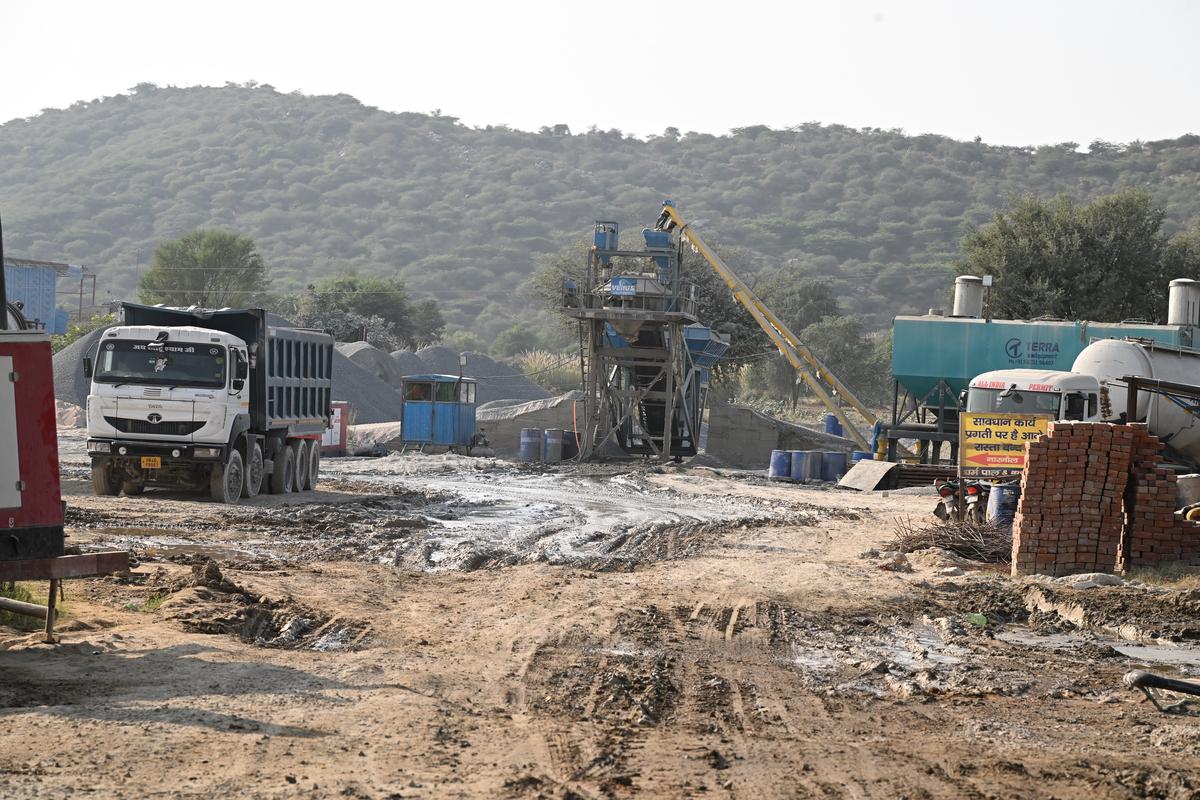
The village roads damaged by dumper trucks carrying construction material from the crushing units and mines.

The village roads damaged by dumper trucks carrying construction material from the crushing units and mines.
| Photo Credit:
SUSHIL KUMAR VERMA

Many like Rajender, 52, a farmer, sitting among a group of villagers outside a barber’s shop, have no choice. “This is not possible without the patronage of the local authorities and politicians. The dumpers are overloaded and uncovered, and water sprinklers are not used at crushing sites,” he says.

The Narnaul Civil Surgeon’s report to the Haryana State Pollution Control Board in 2021, conceded that the number of air-borne diseases almost doubled in this region within a span of nine years. While 2011 saw 21,329 cases, there were 42,309 cases in 2019, a couple of years after stone crusher units started mushrooming in Mahendragarh district, especially the Nangal Choudhary sub-division.

The report was prepared in compliance with a 2020 NGT order, after the court heard a host of petitions against stone crushers, including that of Tejpal vs State of Haryana and Others. Tejpal disputes the district health official’s numbers, saying that the actual number could be far higher. He says that breathing-related ailments are a common cause of death among the elderly in this part of the district. “At condolence meets, I often get to hear that the deceased, mostly the elderly, had a breathing issue. If a proper medical check-up is done, I am sure more half of the population in the region will be diagnosed with tuberculosis,” says Tejpal.

A fight for survival

Besides health and the environment, stone cutting impacts agriculture and the Aravali mountain range. People living in Nangal Choudhary, across villages, claim that the thick layers of dust settle on crops, more so in winter. It has impacted agricultural output despite the land being fertile and well-irrigated.

Ravinder Singh, president of the Mahendergarh Crushers and Labour Association, an unregistered body representing a dozen units, denies charges of pollution and violation of environmental rules.

“Most units are run by locals and adhere to norms like sprinkling water. It is the only industry in this region and also a source of employment for people.” He blames dumper trucks from crushing sites in Rajasthan that pass through this region, claiming they are overloaded. “Our share of dumpers on this route is only one-fourth, but we are blamed,” he says.

Tejpal’s older brother Ajay Yadav, a former journalist, chuckles. “Our fight against the powerful stone crushing and mining mafia can be made into a documentary. It is a mass movement.” He talks about how the duo went from village to village to hold meetings and distribute pamphlets to create awareness.

“After every NGT order, we had to hold demonstrations to get it implemented. We were first lured with money, but when we did not budge, we got death threats,” he says. He laments that this region has no history of mass movements, except Rao Tula Ram from Rewari, whose rebellion against the British was a part of the 1857 revolt. “We did not get the kind of support from people as we thought we would,” says Ajay.

The duo got sucked into a long battle against the stone crushers in 2016 when Tejpal, teaching at a coaching institute in Rajasthan’s Sikar, noticed the gradual mushrooming of these units and growing pollution levels in the region. “When I would come home on my motorcycle over the weekend, I began to notice the dust. I worried about the people living here. It motivated me to fight,” he says.

Leaves covered with the dust from stone crushing units.

Leaves covered with the dust from stone crushing units.
| Photo Credit:
SUSHIL KUMAR VERMA

“To begin with I mobilised people here against it. We held demonstrations, wrote to the authorities and political representatives. When all our pleas fell on deaf ears, I decided to move the NGT in 2018,” he remembers. His strategy was to first get a closure order in his village and then, based on those orders, seek directions against illegally run stone crushers across the district.

In a first major victory for the duo, the NGT, in its order on July 27, 2019, based on the report of the local authorities that 72 stone crushers were not complying with the siting norms, directed the “immediate closure of all illegally operating polluting stone crushers in the area and initiation of action by way of prosecution and recovery of compensation”.

In December 2020 and January 2023, the NGT observed the citizens’ right to breathe fresh air. It fixed ₹20 lakh compensation against each stone crusher operating in the area on the “polluter pays” principle. “But the orders are yet to be implemented fully even as stone crushers continue to play havoc with the lives of inhabitants, their livelihood, and the environment,” says Tejpal.

While the battle continues, Tejpal says his weekends and holidays are devoted to preparing for the legal battle ahead and holding nukkad sabhas (neighbourhood meetings) to create awareness. “A substantial chunk of my earnings also goes towards this fight, including the fee for the lawyers,” he says.

“I also contested the Assembly election from the Swaraj India party in 2019 at the insistence of political activist Yogendra Yadav, who contacted me after the NGT order in 2019 was widely reported,” he says. While he lost the election, he took the opportunity to visit 140 villages, whereas earlier he had gone to about 35, to spread awareness among people in the area.


Avoiding ATM fake shutter fraud: Why some ATMs will now retract cash as per RBI mandate

0
Avoiding ATM fake shutter fraud: Why some ATMs will now retract cash as per RBI mandate


Avoiding ATM fake shutter fraud: Why some ATMs will now retract cash as per RBI mandate
ATMs are equipped with a mechanism that automatically retrieves unattended currency notes. (AI image)

ATM cash retraction new rules: The Reserve Bank of India has now partly reversed its January 2012 directive that had mandated disabling of cash retraction in ATMs. The original decision was taken to prevent fraudulent activities at ATMs.
ATMs are equipped with a mechanism that automatically retrieves unattended currency notes if customers fail to collect them within a specified time.
Earlier, when cash was retracted, the system would record it accordingly. However, this feature was misused by individuals who would collect partial amounts whilst allowing the system to log a complete retraction. The discontinuation of this feature successfully prevented such incidents.

New ATM fraud

  • Recently, a new type of fraud has surfaced where criminals install counterfeit covers on ATM dispensing slots to trap cash. After customers leave the ATM assuming a transaction failure, these individuals collect the trapped money.
  • The reintroduction of cash retraction functionality provides customers additional protection against such deceptive practices.

The National Payments Corporation of India has in a letter communicated to all National Financial Switch members that industry stakeholders, including banks and ATM manufacturers, provided their suggestions for addressing the fake shutter overlay issue, which were subsequently forwarded to RBI.
Also Read | UPI Lite new rules 2024: RBI increases UPI Lite wallet, transaction limits – here’s what UPI users should know
Banking officials have indicated that the retraction feature will be selectively implemented only in ATMs identified as vulnerable to fraudulent activities.
Meanwhile, banks are reducing the number of ATMs and cash recycler machines, despite record-high cash circulation levels. This shift reflects the growing prominence of digital payments and the widespread adoption of UPI for everyday transactions.
According to Reserve Bank of India data, the country’s ATM network decreased to 215,000 in September 2024, compared to 219,000 in the previous year.
The most significant reduction occurred in off-site ATMs, with numbers declining to 87,638 in September 2024 from their highest point of 97,072 in September 2022.
This reduction in ATMs coincides with cash circulation reaching ₹34.70 lakh crore, doubling since demonetisation. Cash transactions still dominated, representing 89% of all transactions in FY22.
The ATM business has become less profitable due to RBI-imposed restrictions on free transactions, requirements for ATM interoperability, and minimal growth in interchange fees.