Monday, September 28, 2026
Home Blog Page 7083

RBI Monetary Policy: Central Bank Maintains Status-Quo For Borrowers; Keeps Key Interest Rates Unchanged At 6.5% | Personal Finance News

0
RBI Monetary Policy: Central Bank Maintains Status-Quo For Borrowers; Keeps Key Interest Rates Unchanged At 6.5% | Personal Finance News


New Delhi: The Reserve Bank of India kept the key interest rates unchanged for the 11th consecutive time on Friday.

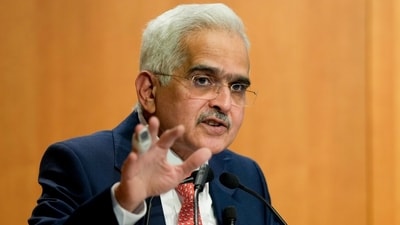
RBI Governor Shaktikanta Das, announcing the outcome of the three-day Monetary Policy Committee (MPC) meeting said that the repo rate has been kept unchanged at 6.5 percent.

Announcing the fifth bi-monthly monetary policy for the current financial year, RBI Governor Shaktikanta Das said the Monetary Policy Committee (MPC) has decided to keep the repo rate unchanged at 6.5 percent.

The RBI has maintained status quo on benchmark interest rate since February 2023.

This was the second meeting of the reconstituted MPC. The three newly appointed external members are Ram Singh, Saugata Bhattacharya and Nagesh Kumar.


California shooting suspect used fake story to gain access to school

0
California shooting suspect used fake story to gain access to school


A gunman in the US state of California who shot and injured two children aged six and five at a school before fatally shooting himself used a “guise” to gain access to the school.

The children are in critical but stable condition and were being treated at a trauma centre, officials said on Thursday.

The attack happened on Wednesday at a school affiliated with the Seventh-Day Adventist Church near Oroville, California, about 55 miles (89km) from Sacramento.

Investigators said they believe the gunman targeted the school because of its affiliation with the church and was motivated as a response to the war in Gaza.

The sheriff on Thursday said a note was found detailing the gunman’s motive. The note said he sought to carry out the “child executions” as a “response to America’s involvement with Genocide and Oppression of Palestinians along with the attacks towards Yemen”.

Authorities said the gunman had a lengthy mental health and criminal history, which included charges of theft, fraud and forgery over the years.

The shooting occurred shortly after 13:00 local time (21:00 GMT) at the Feather River School of Seventh-Day Adventists.

Butte County Sheriff Kory Honea said the gunman, Glenn Litton, 56, had scheduled a meeting with a school administrator to discuss enrolling a student – the ruse police say he used to get into the school.

The meeting was seemingly cordial and Litton went on a tour, Sheriff Honea said, but things took a turn when the gunman walked towards a bathroom and started opening fire. The gunfire hit students outside a classroom, striking two kindergarten-aged children.

The gunman then turned the handgun on himself, police said. He was found dead by first responders with the firearm near his body.

The school’s remaining 35 children were later transferred to a church, where they were reunited with their families.

Sheriff Honea said on Wednesday that the young victims had “very, very serious” injuries.

“I’m thankful that they are still alive but they have a long road ahead of them.”

Sheriff Honea previously said investigators “have received some information that leads us to believe that the subject responsible for the shooting targeted this school because of its affiliation with the Seventh-Day Adventist Church”.

He previously noted authorities believed the shooting was an isolated incident, but a state-wide alert was sent to other schools affiliated with the Seventh-Day Adventist Church out of an abundance of caution.

The church is a Protestant Christian denomination with over 21 million members worldwide. There are one million members of the church in North America, according to the North American Division of Seventh-Day Adventists.


Life in a treacherous terrain affected by Maoism in Karnataka

0
Life in a treacherous terrain affected by Maoism in Karnataka


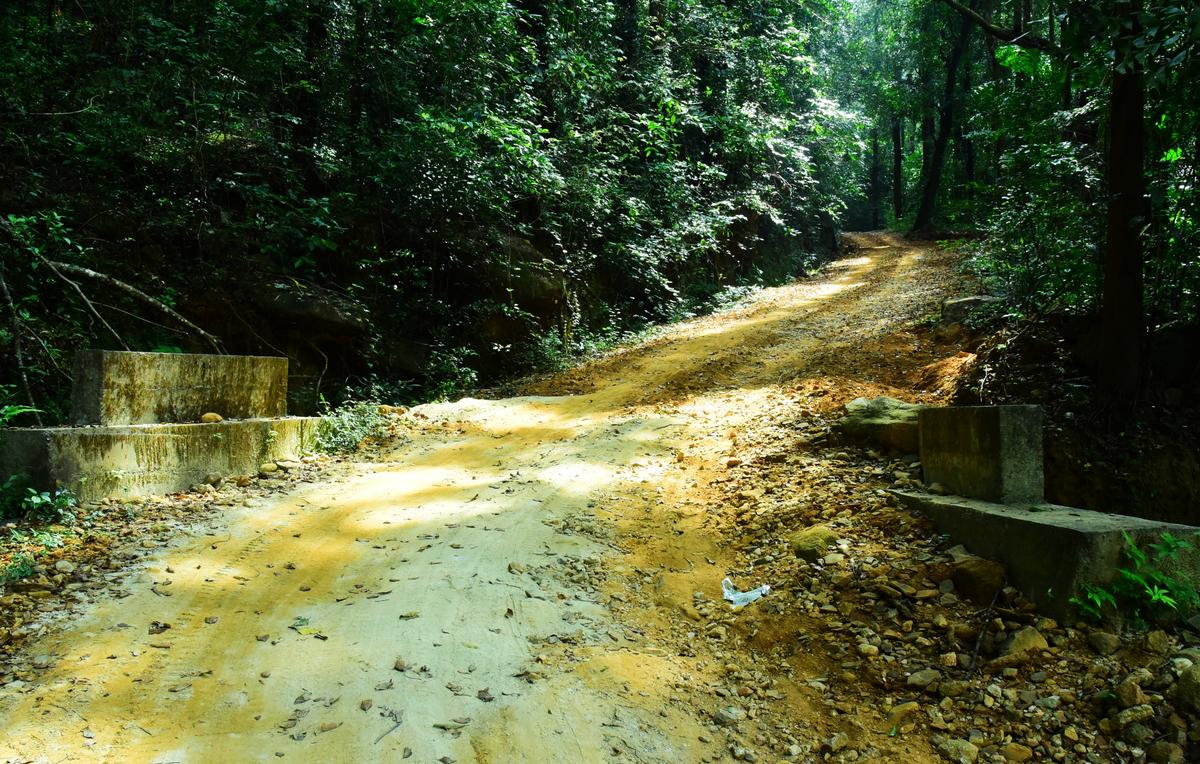
For nearly three decades, 60-year-old Raju Gowda, a tribal leader of the Malekudiya community, has been fighting for the improvement of roads in the Naadpal Gram Panchayat limits in Hebri taluk of Udupi district of Karnataka. Only narrow mud roads connect many of the hamlets that dot this Western Ghats region to the mainland.

One such road goes to the three now-vacant houses of three brothers at Peetabailu, where Maoist leader Vikram Gowda was killed in an alleged encounter with Anti-Naxal Force (ANF) personnel on November 18. The village is nestled in a valley at the foot of two hills.

It is impossible, Raju Gowda admits, for the government to spend crores of rupees to take permanent measures for improving the undulating narrow roads. These houses are located on patches of revenue land in the Someshwara Wildlife Sanctuary (of Kudremukh Wildlife Division) where there is a bar on paving roads. “The basic thing we ask the government is to put a layer of mud over the road to make it easy for residents to walk or use their vehicles. Vehicles of those who have licence to move wooden logs in the forest also use these roads,” he says.

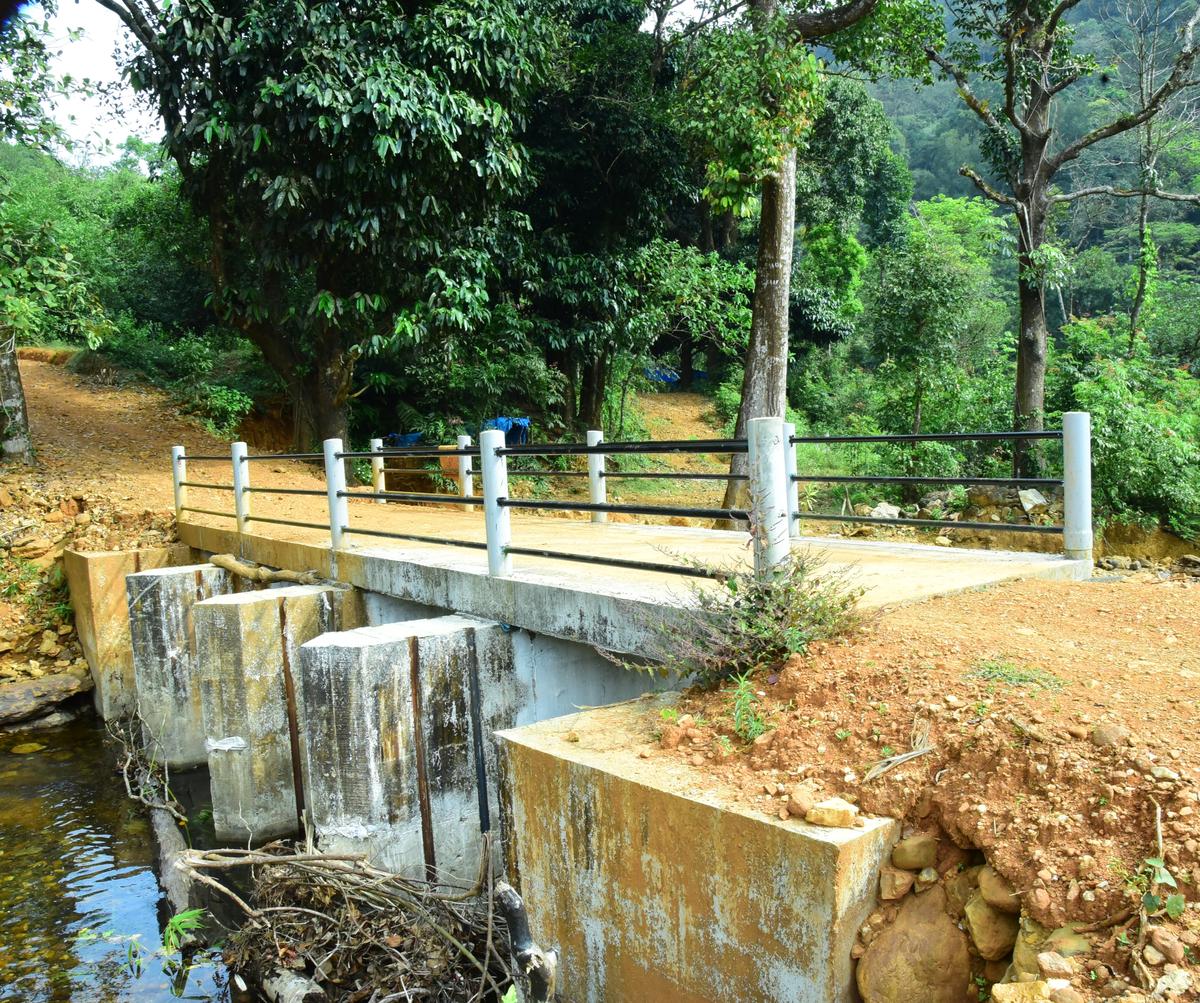
A bridge across a stream on the road leading to Jayant Gowda’s house at Peetabailu. The bridge, which replaced the wooden makeshift structure, is among the few permanent constructions in the vicinity of the encounter spot.

A bridge across a stream on the road leading to Jayant Gowda’s house at Peetabailu. The bridge, which replaced the wooden makeshift structure, is among the few permanent constructions in the vicinity of the encounter spot.
| Photo Credit:
UMESH S. SHETTIGAR

In the late 1990s and early 2000s, attempts made by the government to relocate tribal residents in these areas fuelled the Maoist movement in Karnataka. After over two decades, the Maoist movement may have suffered a severe setback, but the fear of displacement remains. The latest looming threat, according to tribal community leaders, has been the Kasturirangan committee report on the Western Ghats, even though Karnataka has rejected it.

With a number of petitions, the government, through the Naadpal Gram Panchayat, has been regularly sanctioning amounts ranging between ₹50,000 and ₹1 lakh for putting layers of mud on roads. Showing recently done levelling work for the 100-metre-long road with a steep ascent leading to 12 houses of the community members, Raju Gowda says he and a few other villagers, along with ANF staffers, worked for about seven days to remove the mud by the roadside to level the stretch.

“At the end of this work, each villager who worked on the road earned ₹5 per day,” says the elder, whose main earning comes from ferrying people and carrying construction material in this undulating terrain in his jeep. His vehicle is among the three jeeps and two autorickshaws in the gram panchayat, which the villages are all heavily dependent on during health emergencies and other needs.

“We are only raising our concerns to get relief from the government. We have not favoured Maoists using arms against the government for the fulfilment of our demands,” Raju Gowda is keen to clarify while taking the team of The Hindu in his vehicle to Peetabailu from Kabbinale near Hebri. 

Houses in these villages use solar lights provided by the government since power lines are not allowed to be drawn. The villages were provided with water supply lines by the Naadpal Gram Panchayat in 2022-23 as part of a drinking water scheme. The government also recently built a bridge across a stream, which serves just a handful of houses in the area. Apart from villagers, ANF personnel were involved in building the bridge. They have also built a house for a naati vaidya (a village doctor) and painted a house of a physically challenged person. These are among the few permanent works done in the entire area.

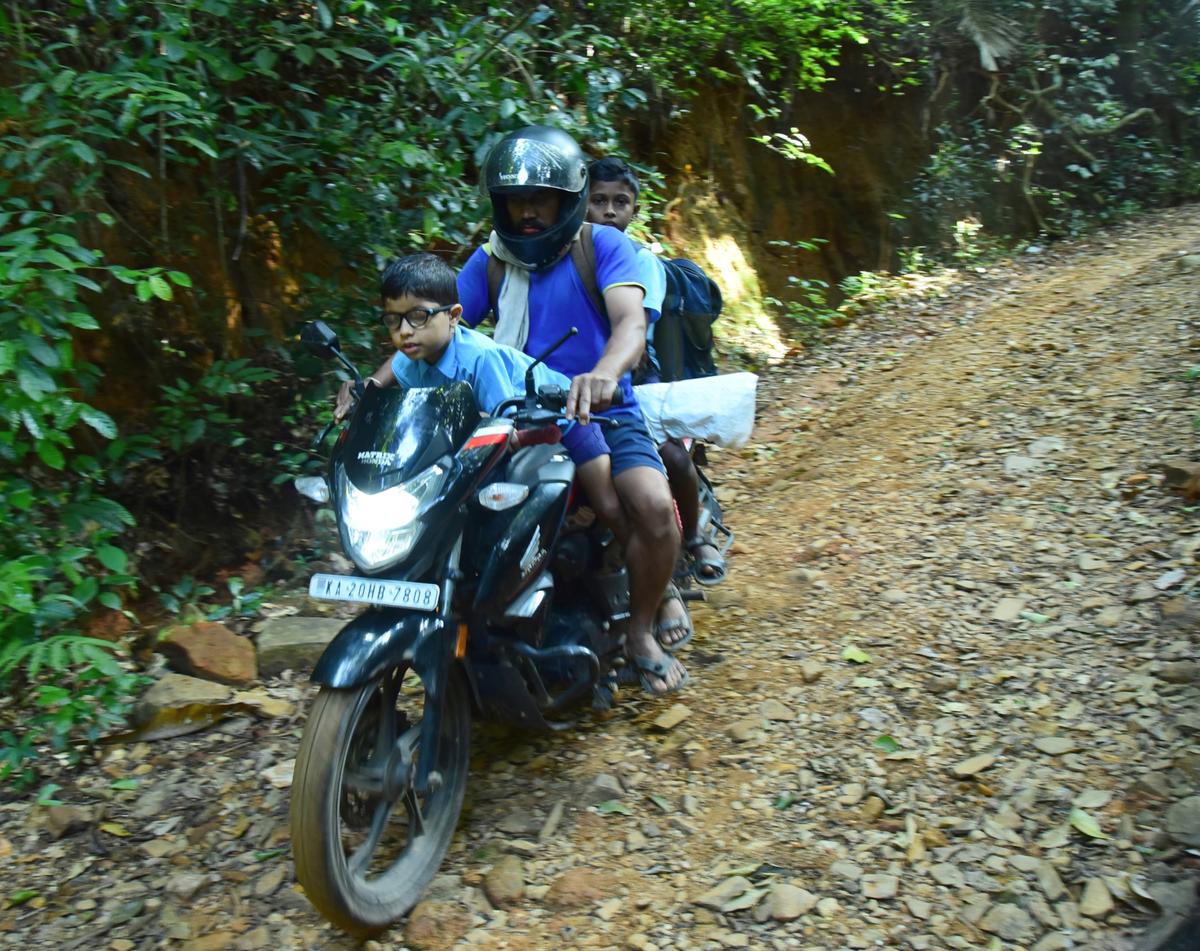
People living in areas in Someshwara Wildlife Sanctuary limits in Naadpal Gram Panchayat have a hard time riding and trekking through the undulating rocky terrain to reach school, health centre or a grocery store.

People living in areas in Someshwara Wildlife Sanctuary limits in Naadpal Gram Panchayat have a hard time riding and trekking through the undulating rocky terrain to reach school, health centre or a grocery store.
| Photo Credit:
UMESH S. SHETTIGAR

The encounter and after

It was in Peetabailu that Vikram was shot dead by ANF personnel. Police sources say they had a tip-off that a Maoist team, active in the area recently, would come to the village and they waited there and confronted Vikram when he turned up. The police claim that while Vikram was killed in the encounter, his associates vanished into the forest. The police recovered a 9-mm carbine from Vikram.

Civil liberties activists have demanded a probe into the encounter as per the National Human Rights Commission norms, which has not been initiated so far.

After a lull of many years, when Maoist activists from the State moved to the Wayanad-Kannur rural beltin neighbouring Kerala, a team of eight activists, who call themselves the Kabini Dalam, had been seen multiple times in Karnataka since March 2024. The members of this team include Mundagaru Lata alias Likkamma, John alias Jayanna, Vanajakshi, and Sundari from the State, Jisha from Kerala, and Ramesh from Tamil Nadu, apart from Vikram, sources say.

While there have been rumours in the area that some of these Maoists wanted to surrender, Banjagere Jayaprakash, a member of the Karnataka State committee to oversee the implementation of the rehabilitation policy to surrender/assimilate left-wing extremists (LWEs), says there had been no feelers from the Maoists. “Neither Vikram Gowda nor anyone else contacted us. Post the encounter killing, we have renewed our efforts, but there has been no response,” he told The Hindu. The ANF claims that the Kabini Dalam was trying to re-establish its base in Karnataka.

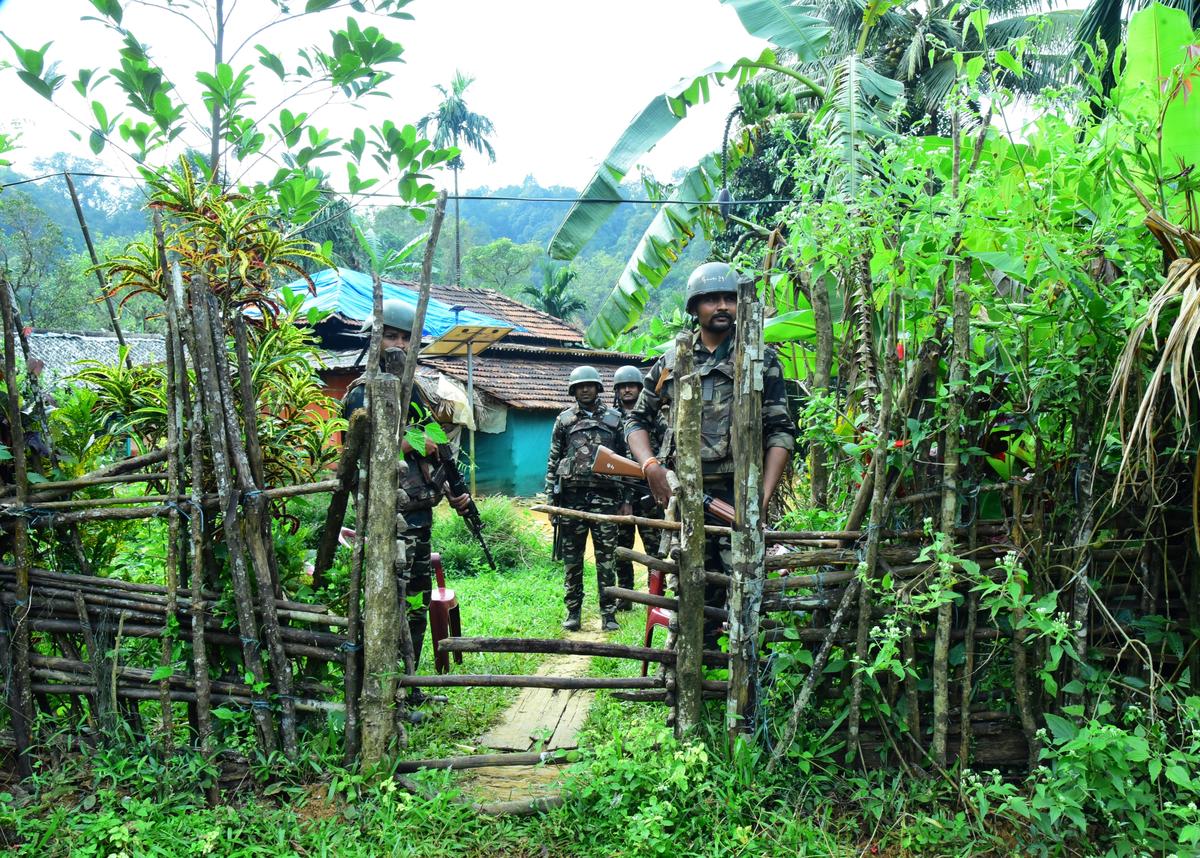
Anti-Naxal Force personnel outside a house at Peetabailu in Naadpal Gram Panchayat limits in Hebri taluk of Udupi district. 

Anti-Naxal Force personnel outside a house at Peetabailu in Naadpal Gram Panchayat limits in Hebri taluk of Udupi district. 
| Photo Credit:
UMESH S. SHETTIGAR

What the fight meant

Vikram was not a stranger to Peetabailu. He hailed from Kudlu, near the famous trekking spot Kudlu falls, in the same Naadpal Gram Panchayat. Villagers have faint memories of Vikram’s regular visits in his childhood to the annual fair of the revered spirit Odamraya Daiwa. They had also seen Vikram take part, as a member of the Karnataka Vimochana Ranga, in agitations held two decades ago in the anti-Kudremukh National Park movement.

Sadashiva Gowda, a resident of Kuchhooru, near Vikram’s village Kudlu says Vikram was a well-behaved boy. “He worked as a supplier in a hotel in the area. As he was quite outspoken in meetings, forest officials and the police started targeting him. Vikram openly interacted with people who empathised with forest dwellers’ fight against displacement. For this, the police had assaulted him several times. This angered him and may have eventually prompted him to take up weapons,” he says.

Vikram went underground in 2002 and by the time he was killed, he had over 110 cases against him — 64 in Karnataka and 50 in Kerala — including three murder cases, of two alleged police informers and a police constable. 

“He saw a tragic end. But it is because of his fight as a member of the Karnataka Vimochana Ranga that we are still in our land. If he had not done it, we would have been displaced long back,” Sadashiva Gowda says.

He says the primary need of forest dwellers is proper roads. “We have to trek a minimum of 3 km to drop and bring back our children from school. As no earthmovers are allowed in the forest area, roadworks are done manually by all of us. The nearest health facility is at least a one-hour trek away,” says Sadashiva Gowda.

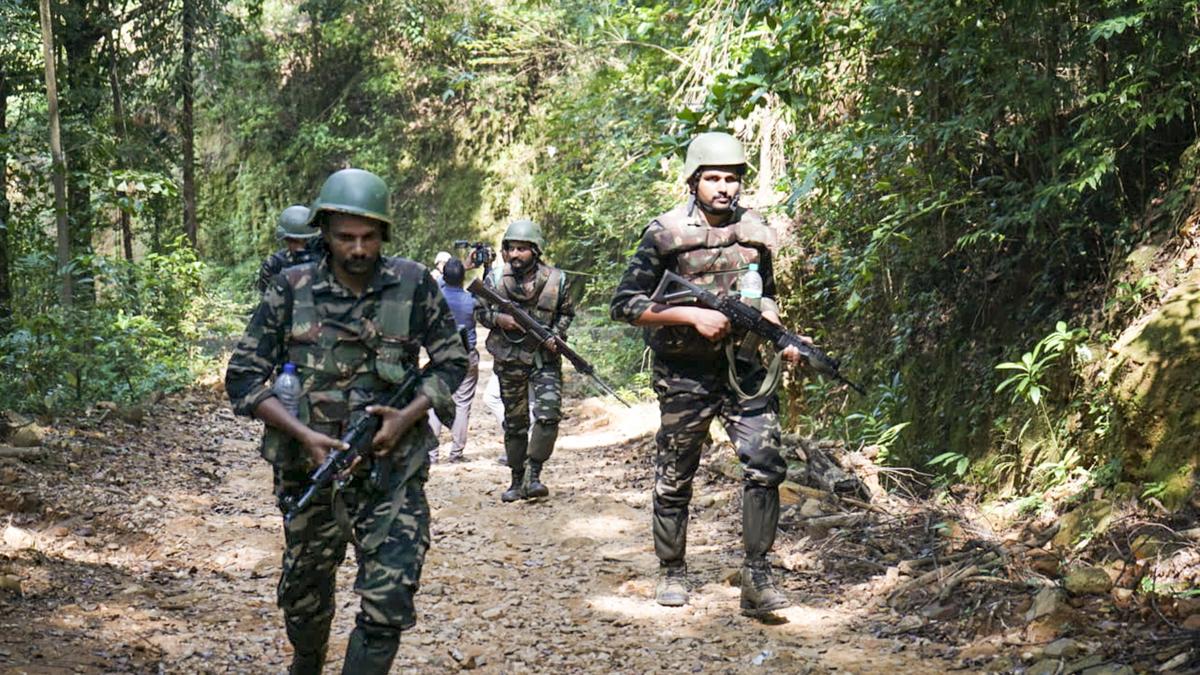
A file photo of security personnel during a combing operation in Kabbinale forest area in Udupi district.

A file photo of security personnel during a combing operation in Kabbinale forest area in Udupi district.
| Photo Credit:
PTI

Harsh realities

The situation is no different in other areas on the foothills of the Western Ghats.

When The Hindu visited an anganwadi in one such village, Yadagunda in Chikkamagaluru district, the centre had only one child. “Three children attend the school regularly, but today only one child is here,” said anganwadi teacher Girija. The centre serves children from Bittumakki, Horale, Yadagunda, and Kadegundi villages.

It functions from the building that was part of the government primary school, which no longer exists. The few schools that were functioning earlier have closed down due to decreasing admissions. As transport is a big issue in the region with no bus service yet, parents put their children in residential schools in nearby towns after they turn six.

Local people argue that the harsh realities of the locality had a direct link to the spread of the Maoist movement in the area. Yadagunda is the place from where two women, Horale Jaya and Komala, joined the Maoist movement two decades ago and returned home under the State government’s rehabilitation policy. Mundagaru Lata (part of the Kabini Dalam), who is still active in the movement, is a native of Mundagaru, a nearby village. She and other suspected Maoists recently visited a family at Kadegundi. This led senior police officials rushing to the place.

“The officers reached the place easily as it was not raining. During the rainy season, no vehicle navigates these narrow, slushy lanes,” says Rame Gowda, a local resident. Whenever a family member falls sick, they have to hire a four-wheel drive vehicle to carry them. Those who cannot afford vehicles have to carry the patients on their shoulders.

A 100-m stretch of road leading to 12 houses of Malekudiyas at Kuchhoor near Peetabailu was levelled recently and a roadside drain was constructed by forest dwellers using funds given by the State government.

A 100-m stretch of road leading to 12 houses of Malekudiyas at Kuchhoor near Peetabailu was levelled recently and a roadside drain was constructed by forest dwellers using funds given by the State government.
| Photo Credit:
UMESH S. SHETTIGAR

People within the Kudremukh National Park area are facing more restrictions. The residents of Vinoba Nagar, once a colony of labourers working for the now-closed Kudremukh Iron Ore Company Limited (KIOCL), have no power connection. Except for the street lights, they have no power supply. A few of them have drawn electricity lines from the street lights. They do not have records for the place where they have built their huts. Following repeated appeals, the government has identified land near Kalasa, around 20 km away, for their rehabilitation. However, the procedure to allot them sites has not been completed.

Mani, a native of Tamil Nadu, says he came to Kudremukh for a daily wage of ₹5. As the company closed in 2005, he lost the job. With no place to return, he stayed in the labour colony with his family.

“Around four years ago, a community toilet was built for the colony. But we never use it as there is no water supply. Imagine our plight during heavy rain,” says Chandramma, a native of Ballari district who continues to live in what was once a labour colony.

Of the over 1,350 families living in the park limits, around 600 have submitted applications seeking rehabilitation. However, the rest have refused to move. The Maoists have always opposed the eviction of people from the park limits. A few youths from the region became left-wing extremists by joining the protests against the restrictions on the local people in the name of a national park.

Improve living conditions 

The only way to end the Maoist movement in Karnataka is to solve problems being faced by tribals living in the western ghats, and encounters are no solution, says Banjagere Jayaprakash. Some members of the rehabilitation committee he is part of recently visited Peetabailu and adjoining villages, following Vikram’s encounter. 

“The daily life of tribals in these areas has become an ordeal. Complaints of harassment from the Forest Department — cases being filed and hefty fines being levied over the collection of minor forest produce — are routine. Most of them still do not have any land documents. These villages are so remote that they have to walk 8 km one way to even work as manual labour. None of the government schemes have reached them. Except for solar lighting and heating, no development initiatives have reached them,” Jayaprakash says.

“As these are declared forest areas, no work can be taken up under the Mahatma Gandhi National Rural Employment Guarantee Scheme (MGNREGS) as well. Even allowing the MGNREGS work will improve their conditions to some extent,” he argues.

Appeal to Maoists

He has also appealed to Maoists to abjure the armed struggle. “We will make our best efforts to coordinate with the government, ensure a safe passage, and work with the government for a speedy trial in cases,” Jayaprakash says. 

Trials dragging on for years have been a deterrent to surrender. Seven Maoist activists remain active in the State, security agencies maintain.

Director-General of Police (Internal Security) Pranob Mohanty says that the government is keen to bring the remaining Maoists into the mainstream.  

Sirimane Nagaraj, a former Maoist who joined the mainstream in 2014, says that the State, society, and the CPI (Maoist) party were all responsible for the tragic turn of events. “The Maoists have to give up guns. The China model which was adopted is not the right way to fight injustices, experience has taught us,” he says. 

‘Did not want to orphan brother’

Suguna, the younger sister of Vikram, says she has fond memories of the time she had spent along with Vikram and their younger brother Suresh Gowda at their ancestral house at Kudlu.

The family claimed Vikram’s body and performed the last rites on their one-acre ancestral land. “We did not want to orphan our brother,” Suguna says.


Business News Live Today December 6, 2024: RBI monetary policy meeting: Will governor Shaktikanta Das announce a rate cut? What to expect?

0
Business News Live Today December 6, 2024: RBI monetary policy meeting: Will governor Shaktikanta Das announce a rate cut? What to expect?


Business News Live: Get real-time updates on the biggest news from the world of business, stock market and more.

Business News Live Today December 6, 2024: RBI monetary policy meeting: Will governor Shaktikanta Das announce a rate cut? What to expect?

Latest news on December 6, 2024: Shaktikanta Das, governor of the Reserve Bank of India (RBI).

Business News LIVE Updates Today: Follow for stories on Bill Gates, Elon Musk, Mukesh Ambani, Gautam Adani as we bring you everything that is happening in the world of business. Track latest gold and silver prices as well here. Stay on top of all things business with us. Disclaimer: This is an AI-generated live blog and has not been edited by Hindustan Times staff.…Read More

Follow all the updates here:

Dec 6, 2024 8:04 AM IST

Business News LIVE Updates : RBI monetary policy meeting: Will governor Shaktikanta Das announce a rate cut? What to expect?

  • Reserve Bank governor Shaktikanta Das, headed a six-member Monetary Policy Committee (MPC), started its meeting on Wednesday.


Read the full story here


US judge rejects Boeing plea deal in fatal MAX 737 crashes | Aviation News

0
US judge rejects Boeing plea deal in fatal MAX 737 crashes | Aviation News


A United States federal judge has rejected a deal that would have let Boeing plead guilty to a felony conspiracy charge and pay a fine for misleading US regulators about the 737 Max jetliner before two of the planes crashed, killing 346 people.

US District Judge Reed O’Connor in Texas on Thursday said that diversity, inclusion and equity – or DEI – policies in the government and at Boeing could result in race being a factor in picking an official to oversee Boeing’s compliance with the agreement.

The ruling creates uncertainty around the criminal prosecution of the aerospace giant in connection with the development of its bestselling airline plane.

The judge gave Boeing and the Justice Department 30 days to tell him how they plan to proceed. They could negotiate a new plea agreement, or prosecutors could move to put the company on trial.

The Department of Justice said it was reviewing the ruling. Boeing did not comment immediately.

Paul Cassell, an attorney for families of passengers who died in the crashes, called the decision an important victory for the rights of crime victims.

“No longer can federal prosecutors and high-powered defense attorney craft backroom deals and just expect judges to approve them,” Cassell said. “Judge O’Connor has recognized that this was a cozy deal between the government and Boeing that failed to focus on the overriding concerns – holding Boeing accountable for its deadly crime and ensuring that nothing like this happens again in the future.”

Many relatives of the passengers who died in the crashes, which took place off the coast of Indonesia and in Ethiopia less than five months apart in 2018 and 2019, respectively, have spent years pushing for a public trial, the prosecution of former company officials, and more severe financial punishment for Boeing.

The deal the judge rejected was reached in July and would have let Boeing plead guilty to defrauding regulators who approved pilot-training requirements for the 737 Max nearly a decade ago. Prosecutors said they did not have evidence to argue that Boeing’s deception played a role in the crashes.

The role of DEI

In his ruling, O’Connor focused on part of the agreement that called for an independent monitor to oversee Boeing’s steps to prevent violation of anti-fraud laws during three years of probation.

O’Connor expressed particular concern that the agreement “requires the parties to consider race when hiring the independent monitor … ‘in keeping with the [Justice] Department’s commitment to diversity and inclusion.’”

O’Connor, a conservative appointed to the bench by former President George W Bush, questioned Justice Department and Boeing lawyers in October about the role of DEI in the selection of the monitor. Department lawyers said selection would be open to all qualified candidates and based on merit.

Indonesia plane
Boeing’s 737 MAX was involved in fatal crashes in 2018 and 2019, including the loss of Lion Air Flight 610 with 189 people on board [File: Beawiharta/Reuters]

The judge wrote in Thursday’s ruling that he was “not convinced … the Government will not choose a monitor without race-based considerations”.

“In a case of this magnitude, it is in the utmost interest of justice that the public is confident this monitor selection is done based solely on competency. The parties’ DEI efforts only serve to undermine this confidence in the government and Boeing’s ethics and anti-fraud efforts,” he wrote.

O’Connor also objected that the plea deal called for the government to pick the monitor and for the appointee to report to the Justice Department, not the court. The judge also noted that Boeing would have been able to veto one of six candidates chosen by the government.

Todd Haugh, a business law and ethics expert at Indiana University, could not recall any previous corporate plea deals that were rejected over DEI. He said the larger issue was how the deal took sentencing power away from the court.

“That is a legitimate argument from which to reject a plea agreement, but this particular judge has really stood on this DEI issue,” Haugh said. “It comes through loud and clear in the order.”

The ruling leaves prosecutors in a bind because they can’t simply ignore a government DEI policy that goes back to 2018, he said.

Prosecutors also must weigh the risks and uncertain outcomes before pushing for a trial.

Boeing negotiated the plea deal only after the Justice Department determined this year that Boeing violated a 2021 agreement that had protected it against criminal prosecution on the same fraud-conspiracy charge.

Boeing lawyers have said that if the plea deal was rejected, the company would challenge the finding that it violated the earlier agreement. Without the finding, the government has no case.

The judge helped Boeing’s position on Thursday, writing that it was not clear what the company did to violate the 2021 deal.

The Justice Department accused Boeing of defrauding Federal Aviation Administration (FAA) regulators, who approved pilot-training requirements for the 737 Max.

Acting on Boeing’s incomplete disclosures, the FAA approved minimal, computer-based training instead of more intensive training in flight simulators. Simulator training would have increased the cost for airlines to operate the Max and might have pushed some to buy planes from rival Airbus instead.

Outraged families

When the Justice Department announced in 2021 that it had reached a settlement and would not prosecute Boeing for fraud, families of the victims were outraged. Judge O’Connor ruled last year that the Justice Department broke a victims-rights law by not telling relatives that it was negotiating with Boeing, but said he had no power to overturn the deal.

The 2021 deferred-prosecution agreement was due to expire in January, and it was widely expected that prosecutors would seek to permanently drop the matter. Just days before that, however, a door plug blew off a 737 Max during an Alaska Airlines flight over Oregon.

That incident renewed concerns about manufacturing quality and safety at Boeing and put the company under intense scrutiny by regulators and lawmakers.

The case is just one of many challenges facing Boeing, which has lost more than $23bn since 2019 and has fallen behind Airbus in selling and delivering new planes.

The company went through a strike by factory workers that shut down most plane production for seven weeks earlier this year and announced that it would lay off 10 percent of its workers, about 17,000 people. Its shares have plunged about 40 percent in less than a year.


Cyberattacks to spike in 2025; healthcare and finance sectors at risk: Report | India News

0
Cyberattacks to spike in 2025; healthcare and finance sectors at risk: Report | India News


Cyberattacks to spike in 2025; healthcare and finance sectors at risk: Report

NEW DELHI: A recent report by the Data Security Council of India and Seqerite raised serious concerns about the increasing vulnerability of the finance and healthcare sectors to cyberattacks. The India Cyber Threat Report 2025 revealed that these industries would be at an alarming risk because of AI-powered threats and deepfake technologies in the upcoming year.
The report, which studied over 18 industries, highlighted the changing strategies of cybercriminals, with a particular emphasis on the growing threat of AI-driven attacks.
It said, “Artificial Intelligence (AI) will be used to develop highly sophisticated phishing campaigns utilising deepfake technology and personalized attack vectors, making them harder to detect. AI-driven malware will adapt in real-time to evade traditional security measures, while data poisoning attacks will compromise the integrity of critical AI systems in sectors such as healthcare and autonomous transportation.”
The report warned that deepfake technology would allow cybercriminals to facilitate much more compelling social engineering attacks by generating fake video and audio content to manipulate individuals into disclosing sensitive information or unknowingly executing malware.
Supply chain loopholes
It also revealed how the fusion of AI and supply chains loopholes could lead to new types of cyber threats as AI driven approaches could be used to take advantage of already compromised development resources and hardware manufacturing processes in order to launch intricate attacks and insert malicious codes.
AI embedded tools
With groundbreaking advancements in AI technology and its tools becoming more accessible to a wider population, attackers can easily invade a large section of the audience. This invasion is likely to set off a series of ransomware attacks, where imposters would demand payment to restore the sensitive data.
Poorly secured internet devices
The rise in internet enabled devices has also prompted a new way to carry out cyber attacks by exploiting the vulnerabilities in poorly secured tools using large-scale botnets. Cybercriminals often exploit these poorly secured devices to carry out Distributed Denial-of-Service (DDoS) attacks, which are likely to disrupt essential services in industries such as manufacturing and healthcare that depend on edge computing.
Imposing government platforms
Hybrid threats may also evolve into a great threat with the integration of fake government service applications and fraud investment platforms. Cybercriminals are expected to develop sophisticated applications that imitate government benefit systems and investment platforms. By leveraging social engineering, influencer marketing, and advanced malware, they plan to execute large-scale financial fraud and identity theft, targeting both public welfare recipients and retail investors.
Cryptoattacks
The growing prevalence of cryptocurrency mining is also expected to trigger a rise in cryptojacking attacks, a practice where malware secretly takes control of computing resources to mine cryptocurrencies without the user’s awareness.
Avoiding cyberattacks
According to the report, the evolving threat landscape in 2025 demands the chief information security officers (CISOs) to revise their cybersecurity strategies as traditional security models are increasingly ineffective against the emerging quantum threats and AI-driven attacks.
It also suggested using AI and ML (machine learning) for threat detection and response.
“The increasing complexity of cyber threats–such as zero-day exploits, polymorphic malware, and advanced persistent threats (APTs)–requires the automation and speed that AI-driven systems provide. CISOs should, therefore, prioritise…adopting AI-enhanced security operations…leveraging ML for predictive threat intelligence…automating incident response,” it said.
The report emphasized the importance of prioritizing not just prevention, but cyber resilience, as an urgent necessity. It stressed that organizations must stay alert and adaptable to safeguard themselves from emerging threats, as the cyber threat landscape continues to evolve rapidly.
Sangamesh S, VP and head of Seqrite Labs told PTI, “Therefore, it is very important for the enterprises to strengthen their detection capabilities, incident response and focus on cyber resiliency. By adopting a proactive approach to cybersecurity, organisations can mitigate risks and safeguard their critical assets.”
“Critical infrastructure sectors in India, including healthcare, finance, and energy, will remain prime targets for cybercriminals. These attacks will aim to disrupt services, steal sensitive data, and exploit geopolitical tensions, emphasizing the need for robust security frameworks and continuous monitoring to protect essential services,” the report said.
The report was launched at the 19th edition of DSCI’s Annual Information Security Summit (AISS) 2024. It surveyed 204 organisations and their C-suite executives. DSCI is a not-for-profit, industry body on data protection in India, set up by nasscom. Seqrite is the enterprise arm of cybersecurity firm Quick Heal Technologies.


Citizens may be in danger if Yoon Suk Yeol stays: PPP chief

0
Citizens may be in danger if Yoon Suk Yeol stays: PPP chief


South Korea’s ruling party chief has called for President Yoon Suk Yeol to “suspend his duties soon”, saying that citizens could be in “great danger” if he remained in power.

Han Doong-hoon, the leader of the People Power Party (PPP), added that his party had received “credible evidence” that Yoon had ordered the arrest of key politicians on “anti-state charges”.

His comments, made at an emergency party meeting on Friday, appear to be a departure from his earlier stand that his party would block the opposition’s impeachment motion, which is due to be put to the vote on Saturday.

The opposition needs at least eight ruling party MPs to back the impeachment motion for it to succeed.

Han expressed concerns that “extreme actions” – such as the martial law declaration on Tueaday – could be repeated if Yoon remains in office.

“[These will] putting the Republic of Korea and its people at great risk,” he said.

He added that his party had learned about plans to jail the arrested politicians in a detention centre in Gwacheon, a city south of Seoul.

Meanwhile, ruling party MP Cho Kyung-tae became the first ruling party MP to publicly voice his support for Yoon’s impeachment.

“The choice is between standing on the side of the people by suspending the president’s duties or becoming an ally of the forces that imposed martial law is a matter for politicians to judge,” Cho said.

“I hope that all the politicians of the People’s Power will stand on the side of the people,” he said.

Additional reporting by Hosu Lee in Seoul


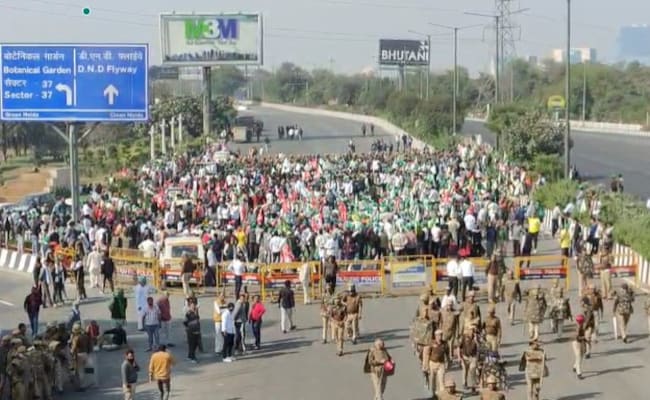
Security has been tightened at Shambhu border in view of farmers marching towards Delhi today.

0
Security has been tightened at Shambhu border in view of farmers marching towards Delhi today.


Security has been tightened at Shambhu border in view of farmers marching towards Delhi today.

More than 100 farmers are preparing to march towards Delhi on Friday for their demands.

New Delhi:

Ahead of the farmers’ march to Delhi on Friday, security has been tightened at the Shambhu border on NH-44, with Haryana and Punjab police deploying significant resources to control the growing crowd of protesters.

More than 100 farmers are preparing to march towards Delhi on Friday for their demands.

On Thursday, Haryana Police strengthened the barricades near the border, adding three new layers to the already extensive seven-layer setup including walls, wire netting and movable traffic barriers featuring iron nails and barbed wire. A tent was also set up as part of the preparations.

Several unions, including Bharatiya Kisan Union-Ekta and others from Haryana, are rallying under the banners of Kisan Mazdoor Morcha (KMM) and Samyukta Kisan Morcha (Non-Political) to put forward their demands during the march.

Farmers from Punjab’s districts like Tarn Taran, Amritsar, Firozpur, Bathinda, Sangrur and Patiala as well as Haryana’s districts like Ambala and Sirsa continue to arrive at the protest site at Shambhu border.

Dialogue is the only way to resolve the issues of farmers, who should talk to Agriculture Minister Shivraj Singh Chouhan, Minister of State for Rural Development Kamlesh Paswan said on Thursday, as he extended his hand towards the protesting farmers in Punjab. . Haryana border.

“No other government has done as much work for farmers as the Modi government has done. We have helped them in every field,” Mr Paswan told reporters at a press conference here.

He said, “I would urge them (farmers) that our Agriculture Minister Shivraj Singh Chauhan is very accessible, for anyone who wants to discuss any issue, there cannot be a better place than this to discuss.”

Protests that upset others will not help, Mr Paswan said, adding that farmers’ issues can only be “resolved through dialogue”.

Meanwhile, while addressing the press conference at Shambhu border, farmer leader Sarwan Singh Pandher said that the farmers will move towards Delhi.

The farmers, gathered under the banner of Samyukta Kisan Morcha (Non-Political) and Kisan Mazdoor Morcha, had earlier announced a foot march to the national capital. They have many demands, including the demand for legal guarantee of minimum support price for crops.

Farmer leader Sarwan Singh Pandher said a ‘jatha’ of 101 farmers will start a foot march to Delhi from the Shambhu border protest site at 1 pm on Friday.

However, the Ambala district administration has issued an order under Section 163 of the Indian Civil Security Code (BNSS), prohibiting any unlawful assembly of five or more persons in the district.

According to the order issued by the Deputy Commissioner, there has been a ban on taking out any procession on foot, vehicle or other means till further orders.

Police in Ambala also issued an alert on Thursday regarding the farmers’ plan to march to Delhi and sent senior officers to the border to assess the security situation there.

Central paramilitary forces have also been deployed along with multi-layer barricading on the Haryana border.

The Ambala district administration on Wednesday asked farmers to reconsider their march and consider any action only after taking permission from Delhi Police.

Meanwhile, addressing a press conference at the Shambhu border on Thursday, Mr Pandher said, “The jatha will march towards Delhi (on Friday). What the government will do is for them to decide. We will march towards Delhi at 1 pm.” Will begin our march.” From Shambhu Seema.”

He also said that if the government stops them from holding the march, it would be a “moral victory” for the farmers.

“Their leaders at the Center and in the states have been regularly saying that if farmers do not bring tractor-trolleys, there should be no objection. So if we go to Delhi on foot, there should be no reason to stop the farmers.” He added.

The farmers, gathered under the banner of Samyukt Kisan Morcha (Non-Political) and Kisan Mazdoor Morcha, had earlier announced a foot march to the national capital demanding legal guarantee of minimum support price for crops, among several other demands.

They have been camping at Shambhu and Khanauri border points between Punjab and Haryana since February 13 after security forces stopped their march towards Delhi.

Invoking Section 163 of the BNSS, the Ambala Deputy Commissioner-cum-District Magistrate, in an order dated November 30, prohibited unlawful assembly of five or more persons and taking out processions on foot, in vehicles or by any other means.

“There is apprehension that a large number of protesters will come from Punjab and Haryana and gather at Shambhu border to proceed towards Delhi. Therefore, appropriate steps need to be taken at the border points and within the district, including issuing prohibitory orders.” Under Section 163 of the BNSS, so that movement of any such person is not allowed without prior permission,” the order said.

It says, “Any person or group on foot or in vehicles who may be used to cause damage to public/private property and/or confront law enforcement agencies, thereby disrupting the maintenance of peace and public order.” Maybe, has been banned.”

It said that this order will not apply to police and other public servants deployed on duty to maintain law and order.

“This order will come into effect from November 30, 2024, and will continue until further orders,” it said.

“There is information that the agitators may gherao Parliament or permanently camp on the national highways leading to the National Capital Region,” the order said. The order said the agitators have informed the Haryana Police. No permission has been taken under Section 69 of the Act.

Speaking to journalists in Ambala on Thursday, Superintendent of Police Surinder Singh Bhoria appealed to all the farmers to maintain peace and seek permission to march to Delhi.

“I want to assure everyone that the district police have made adequate arrangements to maintain law and order,” he said.

When Bhoria was told that farmer leaders have said that 101 of them will march to Delhi peacefully, he said, “As I have told you, it is our collective responsibility to follow the law. Whatever the provisions of the law , they should.” be followed.”

Mr Pandher, on his part, told reporters, “This is not the Punjab-Haryana border, but looks like an international zone. If they (the authorities) have their way, they will not allow even a single bird to cross the border. They are our We are being treated as if we are enemies of another country, whereas we are citizens of this land who want to march peacefully to the national capital with our demands.

Pandher said, “The first batch leaving from Shambhu border has been named ‘Marjeevada Jatha’. It will include 101 farmers who will march towards Delhi on foot from Shambhu border.”

Referring to the recent meeting held between a delegation of farmers and Ambala SP, Pandher said, ‘There was a proposal for talks from the government, on which we said that farmers are ready for talks only when the proposal is made by the Center or Came from the Chief Minister. “Minister’s office in Haryana or Punjab.”

Responding to a question, Pandher said that after the first batch, other batches will also move towards the national capital in the subsequent days.

Responding to another question, he said that if the Haryana government uses force to stop the first ‘batch’ of 101 farmers from marching towards Delhi, “it will only expose the government”.

“If they have deployed central forces, drones or are testing water cannons, it shows that they intend to stop us,” he said.

Pandher said, “Tomorrow the martyrdom day of Guru Teg Bahadur Ji will be celebrated at both Shambhu and Khanauri border points. The jatha will be dedicated to the martyrdom of Guru Teg Bahadur Ji.”

Earlier on Thursday, Punjab DIG (Patiala Range) Mandeep Singh Sidhu and SSP (Patiala) Nanak Singh had met Pandher and Surjit Singh Phul at Shambhu border.

Sidhu said the farmers have assured the police that they will maintain peace and will not include tractor-trolleys in the march.

Farmer leaders had earlier announced that the first ‘jatha’ of farmers would be led by Satnam Singh Pannu, Surinder Singh Chautala, Surjit Singh Phool and Baljinder Singh.

Meanwhile, SKM leader Jagjit Singh Dallewal continued his fast unto death at Khanauri border point on Thursday.

Apart from MSP, farmers also demand farm loan waiver, pension for farmers and farm laborers, no hike in electricity tariffs, withdrawal of police cases (against farmers) and “justice” for the victims of 2021 Lakhimpur Kheri violence. Are doing.

Restoring the Land Acquisition Act, 2013 and compensating the families of farmers killed during the previous agitation in 2020-21 are also part of their demands.

(Except for the headline, this story has not been edited by NDTV staff and is published from a syndicated feed.)


Telangana Spotlight: After 10 years, Hyderabad Metro Rail Phase 2 becomes operational

0
Telangana Spotlight: After 10 years, Hyderabad Metro Rail Phase 2 becomes operational


Later this month, the bustling streets of Hyderabad’s old city will see the rumble of diggers – not for routine road works, but to mark a transformative step in the city’s urban transit story.

The much-awaited Phase II of the Hyderabad Metro Rail (HMR) project is about to begin, starting with the demolition of around 400 properties along the 3.5 km stretch from Darulshifa to Shalibanda.

This marks the beginning of land acquisition for the long-pending Metro overhead line connecting Mahatma Gandhi Bus Station (MGBS) to the proposed Chandrayangutta Junction station, a distance of 7.5 km.

Following the demolition, roads will be repaired while barricades will be erected to manage traffic and a geotechnical study will be conducted next month. These preparatory activities will pave the way for the construction of huge pillars and bridges over which the metro rail tracks will be laid.

This metro line is part of the five new corridors proposed by the current Congress government in Telangana, spanning 76.4 km at an estimated cost of ₹24,269 crore. The project, to be undertaken as a joint venture between the state government and the Centre, involves a significant loan component of ₹11,653 crore (48%). In the financial partnership, the State will contribute ₹7,313 crore (or 30%) and the Center will contribute ₹4,230 crore (or 18%), along with a sovereign guarantee.

It’s been a long wait – 10 years to be precise – but the wheels of Hyderabad’s metro rail expansion are finally turning again. The recommendation comes seven years after HMR started the first phase of commercial operations across three corridors comprising 57 stations: the 29-km Red Line from Miyapur to LB Nagar, the 29-km Blue Line from Nagole to Rayadurg and the 11-km Jubilee Bus Line. Green Line from station to MGBS. These corridors were opened in phases starting in November 2017, with the final extension from JBS to MGBS being inaugurated in February 2020.

Chief Minister A., ​​who is driving this new momentum. Revanth Reddy, who has taken a pragmatic approach to the revised blueprint of the Metro. Under his leadership, the project implementing agency, Hyderabad Airport Metro Limited (HAML) has been tasked with integrating the existing metro lines into a seamless circular loop. This includes connecting the terminal stations at Nagole and LB Nagar and connecting all corridors extending up to Rajiv Gandhi International Airport (RGIA) at Shamshabad on the outskirts of Hyderabad to the proposed metro route.

“When we launched the first phase in 2017, we were the second largest metro rail network in the country after Delhi Metro,” says NVS Reddy, managing director of HMR and HAML.

“Now, we are at the third position with the expansion of Delhi Metro by 415 km and Bengaluru by 74 km. If we delay further, we risk slipping to ninth place, as Mumbai, Chennai and other cities are investing heavily, between ₹50,000 crore and ₹1 lakh crore, on building new metro lines,” he said. Let us tell.

According to him, metro projects spanning about 980 km are currently under construction in 19 cities of the country.

outline

As the person who drove the first phase of HMR from concept to commissioning, NVS Reddy is confident of delivering this expansion within four years once the JV and loan agreement is finalized. He says taking advantage of the latest construction technologies, including the use of U-shaped girders for viaducts, can speed up the process.

“Except for the old city extension of about six km, where properties are being acquired under the Land Acquisition Act, very little private land is required for the second phase. Right of way (ROW) is easily available in most of the proposed corridors, and we plan to use government land for stations, parking and depots,” he explains.

Expressing confidence that the Center will soon give approval for the joint venture, he says, “The work will first start in the old city, and we will ensure that none of the 106 religious and heritage structures are disturbed. Engineering solutions will allow us to bypass these sites. “Property owners in the area are being generously compensated, with ₹65,000 per square yard being offered against the official rate of ₹23,000 per square yard.”

Similar to the first phase of HMR, the second phase will feature a large-scale elevated bridge, except for an underground extension of 1.6 km inside the RGIA. All the proposed new lines are extensions of the existing 69.2 km from phase one: the Red Line from Miyapur to Patancheru, the Blue Line from Rayadurg to Kokapet, and the Green Line from MGBS to Chandrayangutta.

The airport will be accessible from all three metro lines, with seamless connections through the extension connecting Nagole and LB Nagar stations. A twin station will be set up at Nagole to serve Blue Line passengers heading towards the airport, while Green Line passengers can board at Chandrayanagutta Interchange station. People on the Red Line will have the option to join the route at MGBS or LB Nagar.

What distinguishes the second phase is its completely new financial model, which is different from the first phase, which was executed as the world’s largest public-private partnership (PPP) metro project.

In the first phase, the government invested ₹2,970 crore, of which ₹1,204 crore was provided by the Center as ‘viability gap funding’, and the concessionaire, L&T Metro Rail Hyderabad (L&TMRH) invested ₹17,974 crore. .

“The first phase of HMR is the only metro rail project to be operated under the PPP model among the 23 ongoing metro ventures in the country,” explains KVB Reddy, CEO and Managing Director, L&TMRH.

“We secured a loan of ₹11,000 crore from banks led by State Bank of India at 10% interest rate. Although we are the best in managing operating expenses, we have incurred losses due to high interest rates on capital investments. However, we have reduced our debt through financial re-engineering and reduced our interest rate to 6%,” he revealed.

joint venture model

What makes phase two economically viable is the Centre’s joint venture model, which includes sovereign guarantee. This important provision allows loans to be secured from multilateral agencies such as the World Bank, Asian Development Bank or Japan International Cooperation Agency at an interest rate of only 2%.

Managing Director of HMR says that these loans come with long repayment periods and moratorium for the first few years.

However, this sovereign guarantee does not extend to the private sector. “More PPP projects can succeed if such an option is made available to them,” said the L&TMRH CEO.

L&TMRH is set to step in as the EPC (engineering, procurement and construction) contractor for the second phase once the tenders are issued, expected sometime next year. “We are ready to be a part of the development story of Telangana. We have the full spectrum of expertise – civil, electrical, signaling and communications. Only rolling stock needs to be purchased. No other firm has this capability. We have 2,500 engineers working on minimizing construction time. If RoW is provided we can deliver much faster,” says KVB Reddy.

Meanwhile, the first phase of the Hyderabad Metro has grown rapidly, now carrying around 4.75 lakh passengers daily, with a peak ridership of 5.64 lakh. This is a significant increase from the initial 20,000 passengers when operations began in November 2017.

Currently, 57 three-coach train sets run daily, serving 1,075 trips with a frequency of 2.5 to 5 minutes during peak hours and 7 to 10 minutes during non-peak hours.

Furthermore, the system maintains an impressive punctuality rate of 99.86%.

For the second phase, HAML has ‘conservatively’ estimated that the five new routes, once operational, can easily handle eight lakh passengers per day, which is likely to increase to 10 lakh. This estimate is not far-fetched given the ridership increases seen in other cities. Following the expansion of metro lines with better inter-connectivity, daily ridership in Bengaluru, Nagpur and Pune has doubled – from 60,000 to 1.5 lakh and even 7.5 lakh. Metro Rail officials say that after the addition of new lines, the number of daily passengers in Chennai has also increased from 40,000 to 2 lakh.

Reshaping urban travel

The government’s recent announcements regarding phase two have also raised anticipation among passengers. “I have been using the Metro since the commencement of phase one, but since it currently ends at Miyapur, I am forced to take an autorickshaw to reach my home in Madinaguda. The proposed expansion of Patancheru will be a boon for many residents of this part of the city, connecting us to other suburbs,” said management consultant U. Krishna says Veda (54).

Residents of the old city, sidelined in the first phase, are particularly optimistic. “We are hopeful that the metro will finally meet our needs,” says MA Haq, 50, a private company employee. “Many employees, students and others live near bus and railway stations or in areas like Hi-Tech City and Raidurg. They use existing services to reach, but from far-flung places like Malakpet or MGBS. Everyone is looking forward to the new services and will welcome it with open arms.”

But, of course, not everyone is completely satisfied with the routes proposed for phase two. Citizens like M. Sampath Reddy and BJP leader S. Malla Reddy are urging the government to include other fast-growing residential areas like Medchal via Kompally, Shameerpet via Thumkunta, Suraram-Gandimisamma and ECIL-Keesara.

Kanchana, another resident, questions why Mehdipatnam was left out of the plan.

When asked about these concerns, NVS Reddy clarifies, “There are a lot of demands from different sectors, but we cannot cover every route at once. Since 2017, the Center has made RoW – a wide road with space for utilities like power, telecom and water pipelines – a pre-condition for approving metro rail projects. We will consider other areas in later stages as the city continues to expand.”

focus area

Residents also highlight other challenges that need to be addressed. B.Rajendra Prasad of Saroornagar stressed the importance of improving first and last mile connectivity in residential colonies in collaboration with Telangana State Road Transport Corporation (TGSRTC) and other transport agencies.

Similarly, graduate student MA Hadi advocates a common ticketing system integrating all modes of public transportation.

Another frequent concern among commuters is the lack of adequate parking facilities, which many believe requires immediate attention.

The Center has mandated the implementation of the National Common Mobility Card for all public transport systems, with the aim of rolling it out across the country next year, Metro Rail officials said. However, negotiations with TGSRTC on route and service integration have not yet progressed. Officials believe the intervention of top political leaders could accelerate cooperation and pave the way for seamless connectivity.

“Private players are allowed to operate shuttle services between specific destinations, but only TGSRTC is allowed to provide pick-and-drop services at multiple points,” an official clarified.

With regard to parking facilities, lessons from the first phase are being used.

For the second phase, officials plan to secure enough land to provide adequate parking at the proposed 54 stations across five corridors.

NVS Reddy is optimistic about the progress of the second phase and says it will be an easier task than the first phase, which took seven years to complete.

“The Chief Minister is monitoring the work closely. They have conducted 10 reviews and also ensured release of funds for initial works,” he says.

Encouraging public participation, the HMR chief invited citizens to contribute to the project by suggesting station locations, numbers of stations and even their names, underscoring the collaborative spirit driving the expansion of the metro rail. Have done.


Is Tim Cook Ready To Step Down? Apple CEO Shares His Thoughts | Economy News

0
Is Tim Cook Ready To Step Down? Apple CEO Shares His Thoughts | Economy News


New Delhi: Tim Cook, who has been leading Apple as CEO for the past 13 years continues to inspire curiosity about how long he plans to stay in the role. In a candid interview with Wired, Cook addressed the frequently asked question, saying, “It’s a privilege of a lifetime to be here. And I’ll do it until the voice in my head says, ‘It’s time.’

During the interview with Wired, Cook said “It’s hard to imagine life without Apple, because my life has been wrapped up in this company since 1998, which has been the overwhelming majority of my adult life. And so I love it,”. He also added that he’ll begin planning for his next chapter only when he feels it’s time to step down, but for now, that time hasn’t come.

Tim Cook shared his deep connection with Apple and acknowledged that it’s hard for him to envision life without the company. He explained that Apple has been such a central part of his personal and professional life for so long, it’s become an inseparable part of who he is.

Journey with Apple

Tim Cook’s journey with Apple has spanned over two decades and his passion for the company remains unwavering. He joined Apple in 1998, marking the start of a journey that has shaped much of his adult life. Cook reflected, saying, “My life has been wrapped up in this company since 1998,” emphasizing how closely his personal and professional growth are tied to Apple.

Under Tim Cook’s leadership, Apple introduced groundbreaking products like the AirPods and the Apple Watch. However, Cook has also raised concerns about the growing issue of excessive screen time. He pointed out, “If you’re looking at your phone more than you’re looking in somebody’s eyes, that’s a problem.”