Monday, September 28, 2026
Home Blog Page 7088

Amnesty International accuses Israel of committing genocide in Gaza | Israel-Palestine conflict News

0
Amnesty International accuses Israel of committing genocide in Gaza | Israel-Palestine conflict News


Human rights group Amnesty International has concluded that Israel’s war on Gaza meets the legal threshold for genocide in a damning new report.

The report published on Thursday, titled, “You Feel Like You Are Subhuman”: Israel’s Genocide Against Palestinians in Gaza, is the culmination of months of research by Amnesty, including extensive witness interviews, analysis of “visual and digital evidence”, including satellite imagery, and statements made by senior Israeli government and military officials.

Amnesty said the Israeli military has committed at least three of the five acts banned by the 1948 Genocide Convention, including indiscriminate killings of civilians, causing serious bodily or mental harm, and “deliberately inflicting on Palestinians in Gaza conditions of life calculated to bring about their physical destruction”.

“Month after month, Israel has treated Palestinians in Gaza as a subhuman group unworthy of human rights and dignity, demonstrating its intent to physically destroy them,” said Agnes Callamard, secretary-general of Amnesty International.

“Our research reveals that, for months, Israel has persisted in committing genocidal acts, fully aware of the irreparable harm it was inflicting on Palestinians in Gaza,” Callamard said.

“It continued to do so in defiance of countless warnings about the catastrophic humanitarian situation and of legally binding decisions from the International Court of Justice [ICJ] ordering Israel to take immediate measures to enable the provision of humanitarian assistance to civilians in Gaza,” she said.

“Our damning findings must serve as a wake-up call to the international community: this is genocide. It must stop now,” she added.

Callamard said that taking into “account the pre-existing context of dispossession, apartheid and unlawful military occupation” in which the Israeli military’s crimes against the civilian population of Gaza have been committed, “we could find only one reasonable conclusion: Israel’s intent is the physical destruction of Palestinians in Gaza”.

‘Seismic, shameful failure’

The Israeli military’s argument that it is lawfully targeting Hamas and other fighters who are located among the civilian population of Gaza – and that it is not deliberately targeting the Palestinian people – does not stand up to scrutiny, Amnesty said.

“The presence of Hamas fighters near or within a densely populated area does not absolve Israel from its obligations to take all feasible precautions to spare civilians and avoid indiscriminate or disproportionate attacks,” the rights group said.

“Regardless of whether Israel sees the destruction of Palestinians as instrumental to destroying Hamas or as an acceptable by-product of this goal, this view of Palestinians as disposable and not worthy of consideration is in itself evidence of genocidal intent,” it said.

Amnesty also said that it found “no evidence” that the reported diversion of humanitarian aid by armed groups in Gaza “could explain Israel’s extreme and deliberate restrictions on life-saving humanitarian aid” to the civilian population of the war-torn territory.


Israeli authorities have yet to respond to the Amnesty report.

Officials in Israel have consistently rejected allegations of committing genocide in Gaza, claiming they are acting in self-defence following the Hamas-led October 7 attacks and that criticising their war is anti-Semitic.

The Amnesty report, however, also states that the crimes documented in Gaza were often “preceded by officials urging their implementation”.

More than 100 statements by Israeli military and government officials were reviewed in the report that “dehumanised Palestinians, called for or justified genocidal acts or other crimes against them”.

Of those statements, 22 were made by senior officials in charge of managing the war on Gaza and “appeared to call for, or justify, genocidal acts, providing direct evidence of genocidal intent”.

“This language was frequently replicated, including by Israeli soldiers on the ground” who made calls to “erase” Gaza and celebrated “the destruction of Palestinian homes, mosques, schools and universities”, Amnesty said.

Amnesty’s Callamard said the international community was also guilty of a “seismic, shameful failure” in Gaza by failing to “press Israel to end its atrocities”.

By delaying calls for a ceasefire in Gaza and continuing to send weapons to Israel, the international community’s failure “will remain a stain on our collective conscience”, Callamard said.

“Governments must stop pretending they are powerless to end this genocide, which was enabled by decades of impunity for Israel’s violations of international law,” she said.

“States need to move beyond mere expressions of regret or dismay and take strong and sustained international action, however uncomfortable a finding of genocide may be for some of Israel’s allies.”


Denied Loan Due To Low CIBIL Score? Here’s How To Improve Your Credit Score Quickly | Personal Finance News

0
Denied Loan Due To Low CIBIL Score? Here’s How To Improve Your Credit Score Quickly | Personal Finance News


Low CIBIL Score In India: Getting denied for a loan can be a frustrating experience, especially when you need financial assistance. A low credit score is a common reason for loan or credit card rejection. Maintaining a good credit score is crucial for getting approvals from lenders.

Unfortunately, many people overlook this and apply for loans or credit cards without checking their credit scores, leading to unnecessary rejections. Lenders often view a low score as a risk, making it harder for you to access credit. However, being denied doesn’t mean the end of the road. 

Meanwhile, Congress MP Karti Chidambaram has raised the issue in the parliament. He stated that “Every time we go to a bank and tell them, ‘I have paid my loan on time,’ they respond, ‘No, your CIBIL score is bad.’ We don’t know how to approach CIBIL. For farmers, when they receive a subsidy from the government and use it to repay the loan, CIBIL does not update it. Similarly, if you settle with the ARC, CIBIL still does not update it. There needs to be greater transparency. The government has missed an opportunity to make life easier by reforming these systems instead of just tinkering around the edges.”

Moreover, it is important to note that CIBIL has an entire section dedicated to dispute resolution, available for both customers and businesses. The dispute resolution process is offered free of charge. There are ways to improve your credit score and increase your chances of loan approval in the future. 

CIBIL Score Breakdown: Where Do You Stand?

Usually, a credit score or CIBIL score ranges from 300 to 900. The upper limit shows that you have handled your credit well in the past whereas the lower limit shows that you cannot be trusted with credit. Most lenders approve loan applications of people with their credit scores higher than 750.

How To Identify Good, Fair And Bad Credit Score 

Your CIBIL score reflects your creditworthiness. Scores above 800 are excellent, 750-800 are good, 700-750 are fair, and 650-700 are poor. Excellent and good scores enhance loan approval chances, while fair scores may require improvement. Poor scores indicate financial struggles, leading to loan denials or higher interest rates. 

How To Improve Your CIBIL Score Quickly

Pay Bills on Time: Ensure timely payment of loans, EMIs, and credit card dues to avoid late payment penalties, which can hurt your score.

Reduce Credit Utilization: Aim to use less than 30% of your credit card limit to show responsible credit usage.

Clear Outstanding Debts: Pay off outstanding balances on loans or credit cards to improve your score.

Check Your CIBIL Report: Regularly monitor your CIBIL report for errors or discrepancies and get them corrected.

Avoid Multiple Credit Applications: Too many inquiries in a short period can negatively impact your score. Apply only when necessary.

Maintain a Healthy Credit Mix: A balanced mix of secured and unsecured credit can improve your score.

Keep Old Accounts Open: Length of credit history matters, so keep your older credit card accounts active. 


Seven wild moments from its turbulent history

0
Seven wild moments from its turbulent history


Getty A picture of a bitcoin with a sharply rising graph behind itGetty

The price of Bitcoin has for the first time broken past the $100,000 mark, hitting a new record high.

The value of the world’s biggest cryptocurrency has been boosted by hopes US President-elect Donald Trump will adopt crypto-friendly policies.

The milestone was reached hours after Trump said he would nominate former Securities and Exchange Commission (SEC) commissioner Paul Atkins to run the Wall Street regulator.

Mr Atkins is seen as being far more pro-cryptocurrency than the current head of the SEC, Gary Gensler.

The $100,000 milestone prompted celebrations from cryptocurrency fans around the world.

Bitcoin’s wildly fluctuating value has always attracted interest, with its backers reacting with delight when it has passed previous price thresholds – and defiance during its slumps.

But this particular landmark has been especially keenly anticipated. For weeks charts, memes and predictions have swirled around social media about when the price would hit the figure thought to be one of the holy grails of the crypto world.

Millions of viewers even tuned in to online watch parties as the price hovered close to $100k.

The value of a single bitcoin is one of the barometers of optimism in the cryptocurrency industry which is now estimated to be worth $3.3tn, according to analysis firm Coin Market Cap.

Trump’s election victory last month was the catalyst for the latest surge.

The president-elect has vowed to make the US “the crypto capital of the planet” – a remarkable turnaround given as recently as 2021 he was calling Bitcoin a “scam.”

Also remarkable is just how Bitcoin’s price has rocketed. A valuation of $100k represents a 40% increase on election day in the U.S. and more than double the price it started the year at.

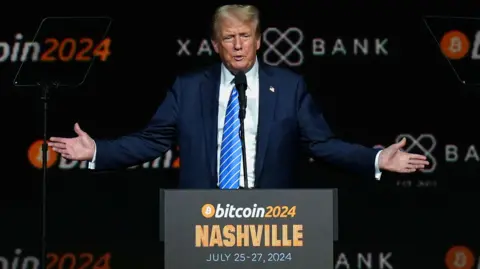
Reuters Republican presidential nominee and former U.S. President Donald Trump gestures at the Bitcoin 2024 event in Nashville, Tennessee, U.S., July 27, 2024.Reuters

But there’s lots more to Bitcoin than the dizzying changes in its value.

From its enigmatic inventor to the bringing down of the so-called Crypto King, it’s a story with many twists and turns, which has seen the making – and losing – of huge fortunes.

So here’s the BBC’s list of the seven wildest moments – so far – in Bitcoin’s tumultuous history.

1. The mysterious creator of Bitcoin

Despite its enormous profile, no-one actually knows for sure who invented Bitcoin. The idea for it was posted on internet forums in 2008 by someone calling themselves Satoshi Nakamoto.

They explained how a peer-to-peer digital cash system could work to enable people to send virtual coins over the internet, just as easily as sending an email.

Satoshi created a complex computer system that would process transactions and create new coins using a huge network of self-appointed volunteers around the world who used special software and powerful computers.

But he – or they – never revealed their identity, and the world has never worked it out.

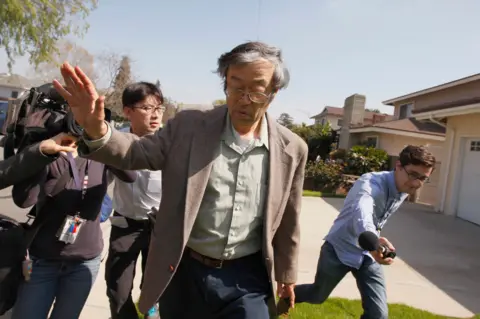
Reteurs dorian nakamotoReteurs

Dorian Nakamoto was wrongly accused of being Bitcoin’s inventor

In 2014, Japanese-American man Dorian Nakamoto was pursued by reporters who thought he was the elusive Bitcoin creator, but it proved to be a false lead caused by some mistranslated information.

Australian computer scientist Craig Wright said it was him in 2016 – but after years of legal battles, a High Court judge concluded he was not Satoshi.

Earlier this year, a Canadian Bitcoin expert called Peter Todd strongly denied being Satoshi, while in London this month a British man, Stephen Mollah, claimed he was – but no-one believed him.

2. Making history with pizza

Bitcoin now underpins a two trillion-dollar cryptocurrency industry – but the first recorded transaction using it was the purchase of pizza.

On 22 May 2010, Lazlo Hanyecz, offered $41 worth of Bitcoin on a crypto forum in return for two pizzas.

A 19-year-old student obliged and the day went down in history for fans of the currency as #BitcoinPizza day.

A source of memes for those in crypto community, it also showcased the power of Bitcoin – an internet money that could genuinely buy items online.

Criminals must have been watching too, because within a year the first darknet marketplace was launched selling drugs and other illegal goods in exchange for Bitcoin.

The deal looks pretty bad for Lazlo now too. If he had held onto those coins they would now be worth hundreds of millions of dollars!

3. Becoming legal tender

In September 2021, President Nayib Bukele of El Salvador, central America, made Bitcoin legal tender.

Hairdressers, supermarkets and other shops had to accept Bitcoin by law, alongside its main currency, the US dollar.

Many Bitcoin enthusiasts and reporters visited the area, briefly boosting tourism to the country.

While President Bukele hoped the move would increase investment in his country and cut costs for citizens exchanging money, it did not become as popular as he hoped.

He is still hoping it will take off but for now the US dollar still remains king in the country.

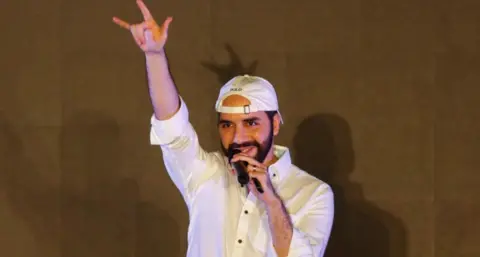
Reuters nayib bukeleReuters

President Nayib Bukele plans to build a city called Bitcoin City, as he pushes his nation to use the digital currency

As well as the huge amount of public money President Bukele spent on trying to make people embrace Bitcoin he also, controversially, bought more than 6,000 bitcoins over the past few years.

The president spent at least $120m buying up bitcoins at various prices in the hope of making a profit for his cash-strapped country.

It started to look good for him in December 2023 when, for the first time, his stash skyrocketed in value.

A website built by Dutch software engineer Elias Zerrouq is tracking the country’s Bitcoin holdings and currently estimates that the coins have risen 98% in value.

4. Kazakhstan’s crypto boom and bust

In 2021, Kazakhstan became a hotspot for Bitcoin mining – the process of crunching through the complex calculations that underpin crypto transactions.

These days it takes warehouses full of the latest computers running all day and all night, but the reward is brand new bitcoins for those companies that take part.

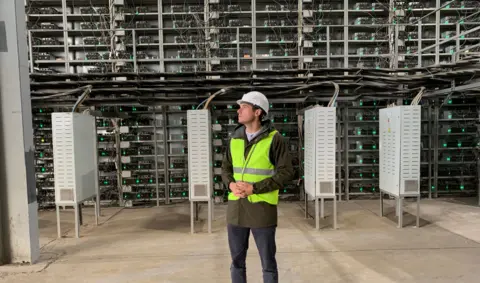
bitcoin mine kazakhstan joe tidy

BBC reporter Joe Tidy visited one of Kazakhstan’s giant bitcoin mines during the boom

Warehouses of computers require lots of power – and many businesses moved to Kazakhstan where electricity was abundant thanks to huge coal reserves.

At first the government welcomed them with open arms as they brought investment.

But too many miners arrived and put huge strain on the electricity grid, putting the country at risk of blackouts.

Within a year, Kazakhstan’s Bitcoin mining industry went from boom to bust as the government imposed restrictions and increased taxes to curb the growth.

Around the world it is estimated that the Bitcoin network uses as much electricity as a small country, raising concerns about its environmental impact.

5. Bitcoins in the rubbish dump

Imagine having a crypto wallet worth more than $100m (£78m) – and then accidentally throwing away a hard drive containing the login details.

That’s what James Howells, from south Wales, says happened to him

The very nature of crypto means that recovery is not as easy as resetting your password. With no banks involved – there is no customer support helpline.

James Howells james howells bitcoinJames Howells

James Howells said he wants to donate a quarter of the money to the people of Newport

Unfortunately for him, his local council in Newport refused to let him access the landfill site where he says the device ended up – even after he offered to donate 25% of his Bitcoin stash to local charities if they let him.

He told the BBC: “It was a penny dropping moment and it was a sinking feeling.”

6. Crypto King fraudster

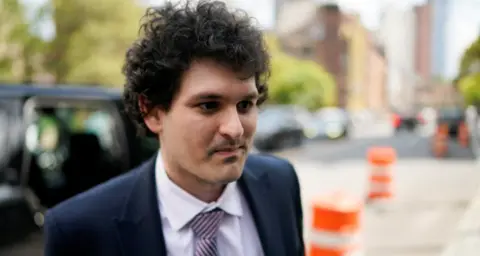
No one has lost as much Bitcoin as former billionaire crypto mogul, Sam Bankman-Fried. The founder of the massive crypto firm FTX was nicknamed the Crypto King and loved by the community.

FTX was a cryptocurrency exchange that allowed people to trade normal money for cryptocurrencies like Bitcoin.

reuters bankman friedreuters

His empire was worth an estimated $32bn and he was flying high until everything came crashing down within days.

Journalists had discovered that Bankman-Fried’s company was financially shaky and had been illegally transferring FTX customer funds to prop up his other company, Alameda Research.

Just before his arrest at his luxury apartment complex in the Bahamas in December 2022 he spoke to reporters. He told the BBC: “I don’t think I committed fraud. I didn’t want any of this to happen. I was certainly not nearly as competent as I thought I was.”

After being extradited to the US he was found guilty of fraud and money laundering and was jailed for 25 years.

7. Investment bank boom

Despite all the turmoil, Bitcoin continues to attract attention from investors and big companies.

In fact, in January 2024, some of the biggest financial firms in the world added Bitcoin to their official asset lists as Spot Bitcoin ETFs. These are like stocks and shares, linked to the value of Bitcoin but you don’t have to personally own any.

Customers have been pouring billions into these brand new products. Companies including Blackrock, Fidelity and GrayScale, have also been buying up Bitcoins in their thousands, pushing up its value to record highs.

It is a huge milestone for crypto with some fans believing that Bitcoin is finally being taken as seriously as the mysterious Satoshi imagined.

Nonetheless, few would back against more wild moments as the Bitcoin story continues to unfold.


Reliance’s Viacom18 acquires Jiohotstar.com website domain: Report

0
Reliance’s Viacom18 acquires Jiohotstar.com website domain: Report


Reliance’s subsidiary Viacom18 Media Pvt Ltd now owns the jiohotstar.com website domain which puts to end months of legal and commercial disputes, according to a Business Standard report.

At the moment, Manish Painuly, senior director at Viacom18, is listed as the registrant and administrative contact for the domain, according to the latest WHOIS records.

Also Read: Several accepted candidates back out of PM Internship scheme. Here’s why

At the moment, Manish Painuly, senior director at Viacom18, is listed as the registrant and administrative contact for the domain, according to the report which cited the latest WHOIS records.

WHOIS is an internet protocol that can be used to dig into databases and find a website’s users or assignees.

Painuly is a senior director at Viacom18 who has been there for more than 16 years and at the moment, works with digital transformation, according to his LinkedIn profile.

The domain is registered under Viacom18 Media Pvt Ltd, which is headquartered in Mumbai, Maharashtra, the report read.

Also Read: IndiGo sues Mahindra Electric for using ‘6e’ in name of its new car: Report

History of the jiohotstar.com domain dispute

The jiohotstar.com domain was first registered by a Delhi-based engineer who asked Reliance to fund his education at Cambridge University in exchange for it.

The domain registration happened when Reliance Jio and Disney+ Hotstar were in talks of a potential merger.

After Reliance refused, he sold the domain to Dubai-based siblings Jainam and Jivika. They transferred the domain to Reliance free of cost, calling the entire ordeal an act of “Seva” and denying any payment or pressure from the conglomerate.

Also Read: Should you buy an electric car in 2025? Government may make it cheaper

Viacom18 operates channels like Colors, MTV India, Nickelodeon, and VH1, with its digital arm being JioCinema which has gained significant traction after signing a deal to become the official IPL digital streaming partner.

The company is a joint venture between Reliance Industries’ TV18 and Paramount Global (formerly known as ViacomCBS), offering content across television, digital platforms, and film production.


Mexico announces largest fentanyl seizure in its history, amid US pressure | Drugs News

0
Mexico announces largest fentanyl seizure in its history, amid US pressure | Drugs News


Mexico has announced its largest-ever seizure of the synthetic opioid fentanyl, as cross-border pressure mounts for the country to crack down on drug trafficking into the United States.

In a statement on Wednesday, Omar Garcia Harfuch, Mexico’s secretary of security and citizen protection, said the haul came after authorities took “two separate actions” in the coastal state of Sinaloa.

“In Sinaloa, the largest historical seizure of fentanyl was achieved,” Garcia Harfuch explained, saying that “more than a tonne of fentanyl pills” were intercepted.

Two men were also arrested and firearms were confiscated. “These actions will continue until the violence in the state of Sinaloa decreases,” he said.

Separately, the Mexican government also announced it had detained more than 5,200 migrants and asylum seekers a day earlier, on Tuesday, as they headed towards the US border.

Both actions are likely to be seen as efforts to placate the incoming administration of President-elect Donald Trump in the US.

Trump has threatened to slap an onerous 25-percent tariff on goods from Mexico and Canada unless both countries take actions to tamp down drug trafficking and immigration across their shared borders with the US.

Speaking to The Associated Press (AP) news agency, security analyst David Saucedo indicated that he believes Mexico’s efforts on Wednesday are the result of “pressure from Washington”.

“It is clear that the Mexican government has been managing the timing of fentanyl seizures,” Saucedo said.

“But under the pressure by Donald Trump, it appears President Claudia Sheinbaum’s administration is willing to […] increase the capture of drug traffickers and drug seizures that Washington is demanding.”

For her part, Sheinbaum, who was inaugurated as Mexico’s president in October, framed the fentanyl seizure as an effort long in the making.

“This is an investigation that had been going on for some time, and yesterday, it bore fruit,” she said on Wednesday.

Sheinbaum and Trump spoke last week about efforts to stop migration northwards as well, though the two leaders emerged with different accounts of the conversation.

Trump wrote on social media that Sheinbaum had “agreed to stop Migration through Mexico, and into the United States, effectively closing our Southern Border”.

Sheinbaum, however, clarified she desired “not to close borders but to build bridges”. She did, however, affirm that her government would prevent so-called migrant caravans — large groups of migrants who band together for safety — from reaching the border.

Fentanyl, meanwhile, is the primary cause of overdose deaths in the US. The US Drug Enforcement Administration describes the synthetic opioid as “100 times more potent” than morphine.

In a 12-month period from 2020 to 2021, the US Centers for Disease Control and Prevention (CDC) found that deaths linked to synthetic opioids had risen more than 55 percent in the country.

Trump’s incoming vice president, Senator JD Vance, often spoke about his own family’s experiences with addiction on the campaign trail as the Republican ticket sought the White House.

But statistics from Mexico’s government had shown a slump in fentanyl seizures leading up to Wednesday’s announcement. During the first half of 2024, Mexico’s federal law enforcement seized 130 kilogrammes, or 286 pounds, down 94 percent from the amount seized a year prior.

Violence in Sinaloa is also a factor. Since the capture of Ismael “El Mayo” Zambada, a Sinaloa Cartel kingpin, in the US, rival factions have been seeking to fill the power vacuum left in his absence.

Speaking to AP, Saucedo explained that authorities ultimately need to address the root causes of the fentanyl trade for the trafficking to stop.

“It’s a very very big seizure,” Saucedo said of Wednesday’s haul. “But if they don’t dismantle the labs, this kind of production will continue.”


Offline UPI caphiked to Rs 1,000

0
Offline UPI caphiked to Rs 1,000


Offline UPI caphiked to Rs 1,000

MUMBAI: The Reserve Bank of India (RBI) on Wednesday announced an increase in the transaction limit for offline digital payments made through UPI Lite.
The changes, with an immediate effect, raise the per-transaction limit from Rs 500 to Rs 1,000 and the overall limit from Rs 2,000 to Rs 5,000.
UPI Lite is a streamlined version of the Unified Payments Interface designed for small-value transactions. It functions as an on-device wallet within the users’ existing UPI app – like Google Pay, PhonePe, or BHIM.
Users can add funds to the UPI Lite account from their linked bank accounts and use the balance to make quick and easy small payments without having to enter the UPI Pin for every transaction.
By processing these transactions offline, UPI Lite reduces the dependence on real-time bank systems.
This leads to quicker payments and fewer failures, especially in areas with spotty internet connectivity. It also reduces clutter on the users’ bank statement.


Five areas Mumbaikars need the government to focus on. mumbai news

0
Five areas Mumbaikars need the government to focus on. mumbai news


Mumbai: With a population of about 21 million people, and ranking third among the world’s cities in terms of the number of billionaires (386 according to the latest Hurun Rich List), Mumbai suffers from a number of challenges. While the new metro lines, coastal road, Atal Setu and Goregaon Mulund Link Road are promising development, the city is also beset with issues related to infrastructure, transport and public service. As the new government takes shape, here are five things it needs to focus on.

Mumbai, India - December 3, 2024: Preparations for the swearing-in ceremony at Azad Maidan in Mumbai, India on Tuesday, December 3, 2024. (Photo-Anshuman Poyrekar/Hindustan Times) (Hindustan Times)
Mumbai, India – December 3, 2024: Preparations for the swearing-in ceremony at Azad Maidan in Mumbai, India on Tuesday, December 3, 2024. (Photo-Anshuman Poyrekar/Hindustan Times) (Hindustan Times)

Mumbai needs corporators

The country’s richest civic body and its life force – the Brihanmumbai Municipal Corporation (BMC) – has been functioning without corporators for the last three years. The absence of 227 sitting corporators, the longest vacancy in the 150-year history of the civic body, has had a significant impact on governance and the lives of the people.

Unlike MLAs and MPs, councilors are the most accessible elected representatives, often the first point of contact during a crisis.

BMC elections have not been held in the last three years, mainly due to legal challenges over issues such as demarcation of ward boundaries, increase in the number of wards and corporators and holding elections in 92 municipal councils and panchayats without OBC quota. ,

While most of the legal issues have been addressed, the state government has shown little interest in holding elections (although they are conducted by the State Election Commission, the timing is effectively decided by the state government).

Now, with Mahayuti’s impressive victory in the assembly elections, BMC officials are optimistic that the long-awaited civic elections will be held soon.

Since March 2022, the Municipal Corporation Commissioner has served in several key roles – state-appointed administrator, de facto mayor and head of the standing committee. As a result, the system of checks and balances has been replaced by a single decision-making authority, where proposals for the betterment of the city are made, approved and executed by the Municipal Corporation Commissioner alone.

Former Congress corporator Asif Zakaria called corporators “the bridge connecting BMC to citizens”; There is no accountability from the administration in his absence.”

more metro lines

The promise of a well-oiled metro networking 337 km of the Mumbai Metropolitan Region (MMR) inspired optimism among Mumbaikars when the project was launched in 2008. Sixteen years later, the Mumbai Metro Rail Corporation Limited, 50 kilometers long. The Chief Minister will have to ensure that work is expedited on at least 125 km more to connect Greater Mumbai with MMR.

The 125-km network will have five metro lines, which will reduce passenger load from suburban railways. These lines are expected to carry a cumulative 4.5 million passengers per day, although actual ridership numbers are likely to vary once the routes become operational.

Currently, five metro lines exist only on paper.

The 125 km long line includes the 35 km long Airport Line connecting Chhatrapati Shivaji Maharaj International Airport to Navi Mumbai International Airport (Metro 8), the 9.20 km long Gaimukh-Shivaji Chowk/Kashi Mira line (Metro 10), the 12.70-km long . Wadala to Chhatrapati Shivaji Maharaj Terminus Line (Metro 11), 23 km Shivaji Chowk/Kashi Mira to Virar Line (Metro 13) and 45 km Kanjurmarg to Badlapur Line (Metro 14).

Dhawal Ashar, Program Head of Integrated Transport at the World Resources Institute, said: “Over the next five years, the MMR is set to expand public transport capacity like never before with over 300 km of metro and hopefully over 10,000 buses. However, to realize the full potential of this potential, the focus needs to be on creating people-friendly infrastructure for all road users; The declining infrastructure for pedestrians is a matter of concern.”

Fast-Tracking MUTP

Although Mumbai’s dense suburban rail network is constantly being upgraded and improved, two phases (3 and 3A) of the Mumbai Urban Transport Project (MUTP), which are currently running at a cost of approx. Monetary stimulus is required from the state to fast track projects worth Rs 45,000 crore.

Estimated cost of MUTP-3 Out of which Rs 10,947 crore Rs 6,129 crore will be raised through debt, while the Union Railway Ministry and the state will have to spend the remaining amount on 50:50 cost-sharing.

A railway official told HT that Indian Railways has been consistently funding projects, but the state government has not been as consistent. The official said that when Uddhav Thackeray was the chief minister, the funding was allegedly stopped due to different political arrangements in the state and the Center and the then CM’s own cautious working style. When Eknath Shinde took command, it gradually gained momentum. “However, the pace of fund disbursement remains inconsistent since the focus is on building metro lines,” the official said.

Some of the major projects planned under MUTP-3 include procurement of 47 AC local trains and quadrupling of Virar and Dahanu Road lines. MUTP-3A includes procurement of 191 AC rakes, renovation of 19 stations and new tracks on the Western and Central lines and extension of the Harbor Line from Goregaon to Borivali.

Nandkumar Deshmukh, president of the Federation of Suburban Railway Passengers Association, blamed red-tapism for the frequent clashes between the railways and the state government. He hopes that things will move forward faster now.

More Best Buses

Brihanmumbai Electricity Supply and Transport (BEST) Undertaking completed 150 years in May. But with the declining fleet size and mounting losses over the years, the undertaking was in no mood to celebrate.

The transport branch has been struggling to survive for a few decades. This year it has sought grants An investment of Rs 2,812 crore will be made from its parent body – Greater Mumbai Municipal Corporation – to increase the fleet size from the current 2,913 to 8,000 by March 2026. Of the existing fleet, the undertaking owns 1,013 buses, while the remaining 1,900 buses are on lease.

Citizen transport forum, Amchi Mumbai, Amchi BEST (AMAB) has been pushing for the need of 6000 buses to cater to the population of Mumbai for almost a year now.

Every year, BEST seeks financial assistance from the civic body, but “availability of funds remains a challenge, to the extent that we have approached financial institutions for credit lines”, said a BEST official on condition of anonymity. But said. Due to lack of funds the undertaking was forced to hire buses. The leased fleet faced some struggles when one operator shut down buses and took 280 buses off the road, affecting half a million passengers recently.

Passengers and BEST unions alike have called for an overhaul of BEST. As Mumbai Metro lines become operational, last mile connectivity becomes important to discourage people from taking private transport.

Another issue hampering the expansion plans to serve 3.2-3.5 million passengers daily is the non-availability of new buses despite placing orders. BEST has proposed to add 1,200 double-decker A/C e-buses, 2,100 single-decker A/C e-buses and 2,650 single-decker A/C e-buses. While orders for 200 A/C double-decker e-buses were placed with Switch Mobility, the manufacturer has supplied only 50 buses so far – rising manufacturing costs have put the rest of the orders on hold for almost a year. The undertaking is also struggling to procure 2,100 single-decker e-buses from Olectra Greentech, which has supplied only 300 buses so far.

The dwindling fleet will only mean that more people will switch to self-owned vehicles or use cabs, leading to more congestion on Mumbai’s already jammed roads.

Fleet expansion is the key to BEST’s revival, but the buses should be owned and operated by the transport utility and not through contractors. The performance of the contractors has proved disappointing,” said AMAB convenor Hussain Indorewala. “While BEST is already an arm of BMC, its budget should be merged with BMC, the way the Indian Railways budget was merged with the Union budget,”

Old Sobo buildings need revival

There are more than 19,000 derelict buildings in South Mumbai, of which only one-third have been rebuilt. The remaining 13,000 buildings older than 80 years are awaiting reconstruction. Over the past three decades, a handful of buildings have collapsed every monsoon, causing loss of lives. Residential buildings constructed before 1960 in Maharashtra are called cess properties because they pay cess (also called repair fund) to the government.

The new government needs to immediately address the plight of lakhs of residents living in these cessed buildings. Along with embarking on the redevelopment of Dharavi, one of Asia’s largest slums, the state will also need to focus its attention on revitalizing South Mumbai through policy interventions that are beneficial to its residents.

Eknath Rajpure, who heads residents’ organization MHADA Sangharsh Kriti Samiti and himself a resident of one of the 388 dilapidated MHADA buildings, said the government is promoting cluster redevelopment, where multiple plots have been merged (Bhendi Bazaar , Kamathipura, BDD) Chawl and Abhyudaya Nagar), the small plots on which their buildings stand in South Mumbai have not been attractive to builders. “The state should amend the existing development control and promotion rules to make such stand-alone buildings viable for developers and bring a change in the lives of people,” Rajapure said.


French government collapses after no-confidence vote in PM Michel Barnier

0
French government collapses after no-confidence vote in PM Michel Barnier


The French government has collapsed after Prime Minister Michel Barnier was ousted in a no-confidence vote.

MPs voted overwhelmingly in support of the motion against him – just three months after he was appointed by President Emmanuel Macron.

Opposition parties had tabled the motion after the former Brexit negotiator controversially used special powers to force through his budget without a vote.

It marks the first time the country’s government has collapsed in a no-confidence vote since 1962.

The development will further France’s political instability, after snap elections in summer led to no single group having a majority in parliament.

MPs were required to either vote yes or abstain from Wednesday’s vote, with 288 votes needed for the motion to pass. A total of 331 voted in support of the motion.

Barnier is now obliged to present the resignation of his government, and the budget which triggered his downfall is defunct.

However, he is likely to stay on as caretaker prime minister while Macron chooses a successor.

Both the left and far right had tabled motions of no-confidence after Barnier pushed through reforms to social security by invoking presidential decree on Monday, after failing to win enough support for the measures.

The left-wing alliance New Popular Front (NFP), which won the most seats in the parliamentary elections, had previously criticised Macron’s decision to appoint centrist Barnier as prime minister over its own candidate.

Alongside the far-right National Rally (RN), it deemed Barnier’s budget – which included €60bn (£49bn) in deficit reduction – unacceptable.

Marine Le Pen, the RN leader, said the budget was “toxic for the French”.

Ahead of the vote, Barnier told the National Assembly that voting him out of office would not solve the country’s financial problems.

“We have reached a moment of truth, of responsibility,” he said, adding that “we need to look at the realities of our debt”.

“It is not a pleasure that I propose difficult measures.”

In an interview with French broadcaster TF1 on Wednesday, Le Pen said there was “no other solution” than to remove Barnier.

Asked about the French president’s prospects, she replied: “I am not asking for the resignation of Emmanuel Macron.”

However, Le Pen added that “if we do not respect the voice of voters and show respect for political forces and respect for elections”, then pressure on the president will “obviously be stronger and stronger”.

Macron, who has returned to France following a state visit to Saudi Arabia, is due to give a televised speech to the nation on Thursday evening.

He is not directly affected by the result of the vote, as France votes for its president separately from its government.

Macron had said he would not resign whatever the outcome of Wednesday’s vote.

He is expected to name a new prime minister swiftly to avoid the embarrassment of a non-existent government – not least because US President-elect Donald Trump is due in Paris this weekend for the reopening of the Notre-Dame cathedral.

No new parliamentary elections can be held until July, so the current deadlock in the Assembly – where no group can hope to have a working majority – is set to continue.


Centre To Auction 27 Coal Blocks For Commercial Mining | Economy News

0
Centre To Auction 27 Coal Blocks For Commercial Mining | Economy News


New Delhi: The Ministry of Coal will launch the 11th round of Commercial Coal Mine auctions on Thursday (December 5) in which 27 coal blocks are being offered across various states to promote regional economic growth and create employment opportunities, according to an official statement issued on Wednesday. 

Building on the success of previous rounds, the Ministry continues its efforts to unlock India’s vast coal reserves and enhance energy security, the statement said.

Union Minister of Coal and Mines G. Kishan Reddy, will launch the auctions in the national capital in the presence of Minister of State for Coal and Mines Satish Chandra Dubey, and Secretary of Coal Vikram Dev Dutt.

In this round, 20 coal mines will be offered for bidding, comprising 10 fully explored and 10 partially explored blocks. Additionally, 7 coal mines from the second attempt of Round 10 will also be on offer, including 4 fully explored and 3 partially explored blocks.

All these mines consist of non-coking coal, catering to India’s growing energy demands, the official statement said. Furthermore, during the event, the Ministry of Coal will execute Coal Mine Development and Production Agreements and Coal Block Development and Production Agreements for nine coal mines.

These mines are projected to generate annual revenue of approximately Rs 1,446 crores at peak-rated capacity and create around 19,063 employment opportunities.

Adding further, Coal Block Development and Production Agreements will be handed over to the successful bidders of the 10th tranche, reinforcing the government’s commitment to enhancing coal production and energy security, according to the statement.

Commercial coal mine auctions have introduced several key reforms. There are no restrictions on the sale or utilisation of coal. Notably, eligibility criteria have been eliminated, removing any technical or financial barriers for participation.

In addition, a strategic shift from the notified price to the National Coal Index ensures transparency and fairness, establishing a market-driven pricing mechanism.

The amendment of mineral laws has been instrumental in unlocking the coal sector, providing an equitable playing field for both public and private sector players and allowing auctions for various purposes, including own consumption and sale.

To simplify and accelerate mine operationalization, the Ministry has implemented the Single Window Clearance System (SWCS) portal. This platform offers a seamless process for obtaining necessary approvals, ensuring ease of doing business and boosting coal production through a single gateway.

These reforms underline the Ministry’s dedication to building a resilient and progressive coal sector. Comprehensive details about the mines, auction process, and timelines are available on the MSTC auction platform. The auctions will be conducted through a transparent online process, employing the Percentage Revenue Share model, the statement added. 


How a child volunteer from Nagpur won, lost and then got his state back. latest news india

0
How a child volunteer from Nagpur won, lost and then got his state back. latest news india


Devendra Fadnavis dominated the Maharashtra political stage with his regular “exposes” of alleged corruption in irrigation projects between 2009 and 2014, targeting Ajit Pawar, Chhagan Bhujbal and Sunil Tatkare of the Nationalist Congress Party (NCP), who were then Were in power in partnership. Congress.

Devendra Fadnavis is going to take oath as the Chief Minister of Maharashtra on Thursday. (Raj ke Raj/HT Photo)
Devendra Fadnavis is going to take oath as the Chief Minister of Maharashtra on Thursday. (Raj’s Raj/HT Photo)

Fadnavis’s attack on corruption charges, including Mumbai’s Adarsh ​​apartments, was so effective that it became a national talking point, and one of the factors in the United Progressive Alliance (UPA) government’s eventual ouster from power in 2014. Emerged.

On Thursday, Fadnavis, 54, will be sworn in as Maharashtra chief minister for the third time – and next to him, sworn in as his deputy will be former CM Eknath Shinde, and leader Fadnavis once frequently targeted, Ajit Pawar.

Nagpur man Fadnavis’ rise to power in the state, and consequently as one of the most powerful leaders in the country, has been both meteoric and fraught. His father Gangadhar Fadnavis, an old Jan Sangh loyalist, was a Legislative Council member who was arrested during the Emergency. Young Fadnavis, who was only eight years old at the time, was so enraged by the arrest that he left his convent school because it was named after then Prime Minister Indira Gandhi, and instead entered Saraswati Vidyalaya in Shankar Nagar, Nagpur. Took. Apart from his late father, his aunt Shobhatai, who was the MLA from Chandrapur, was another seminal influence on him.

Read this also ‘Dada has experience’: Eknath Shinde, Ajit Pawar’s spat brings laughter

“Devendra was from the Dharam Peth branch of the RSS. He and his brother Ashish joined when they were little boys and they used to religiously attend the RSS winter camp in Khapri,” says senior Sangh worker Avinash Sangvai. He recalls that while older workers like him had to supervise the child volunteers, “Devendra, though young himself, would do our work; His leadership qualities were evident even then.” This haste became more evident when Fadnavis became a councilor of Nagpur Municipal Corporation at the age of 22 and mayor of the city at the age of 27.

In 1999, he was elected Member of the Legislative Assembly from Nagpur West, which he represented three times, before contesting from Nagpur South-West, from where he won three more times. Former BJP national general secretary (organisation) Sanjay Joshi said that Fadnavis was selected and groomed by the RSS from an early age. “His commitment to the ideology and caring for all regardless of caste, creed or religion was instilled in him at an early age.”

enter the big league

When the BJP was in turmoil after the death of Gopinath Munde in a car accident in 2014, there was a sudden leadership vacuum in the party in Maharashtra. When Narendra Modi came to power just days later, he turned to his “young friend Devendra” to take over the state leadership of the BJP. But as soon as the biggest opportunity of his career opened for Fadnavis, there was a chink in his armour. The BJP appointed a team of Eknath Khadse, Sudhir Mungantiwar, Vinod Tawde, Pankaja Munde and Fadnavis to lead the party in the assembly elections to be held in a few months. The party also decided for the first time to break away from its ally Shiv Sena and contest the elections independently.

But when the results came, she fell 22 seats short of a simple majority and took outside support from the NCP for a month before striking a deal with the Shiv Sena. The first alienation from his ideological partner, and the gradual sidelining of Khadse, Tawde and Munde, were all attributed to Fadnavis’s ambition.

Read this also Devendra Fadnavis: 5 facts about the BJP leader who is set to become Maharashtra Chief Minister again

In his first term as Chief Minister, he brought freshness and youthful energy to the Chief Minister’s office by initiating several major infrastructure projects for the state, including metro lines for Mumbai and the Mumbai-Nagpur Samriddhi Mahamarg to boost the rural economy. His government offered large-scale loan waivers to farmers and created a rural irrigation grid for Marathwada under a scheme called Jal Yukt Shivar. But the doubt remained that he would face no obstacles on his way to the top. In the 2019 assembly elections, BJP and Shiv Sena contested the elections as a pre-poll alliance, but the alliance soon fell apart with the Sena demanding the top post. Fadnavis’s misguided attempt to form government with a breakaway faction of the Ajit Pawar-led NCP in the early hours of October 24, 2019, tarnished his image and destroyed his goodwill. “Me Punha Yein” (I will come back), his cinematic line while leaving office after 80 hours as Chief Minister, became the subject of countless memes.

Once again on the opposition benches, Fadnavis became a formidable opponent for the newly formed MVA. He led a high-decibel campaign against alleged corruption during Covid, created a conspiracy theory over the suicide of actor Sushant Singh Rajput, and brought the MVA government on the backfoot by alleging that police informer Mansukh Hiren’s body was found hours before His life was in danger. Washed up on the shore. The whole fiasco of gelatin sticks being found outside Mukesh Ambani’s house led to the then Mumbai Police Commissioner making sensational claims of corruption against MVA Home Minister Anil Deshmukh, who ultimately had to resign. In March 2022, Fadnavis handed over to MPs on the floor of the House a pen drive containing 125 hours of audio recordings, allegedly secured by IPS officer Rashmi Shukla, which contained evidence of an MVA conspiracy to frame opposition leaders like Girish Mahajan. It was claimed to present. cases.

The playbook was familiar: relentless attacks on the government, only this time every allegation was amplified by an army on social media.

The attack on MVA was as overt as it was covert. In June 2022, Fadnavis was part of an extraordinary midnight coup that split the Shiv Sena and resulted in the fall of the 21-month-old MVA government. But in this moment of victory there was also a setback for him. Instead of Fadnavis taking over as chief minister, as was widely expected, rebel soldier Eknath Shinde was appointed chief minister, with Fadnavis asked to serve as his deputy chief minister.

In the face of this apparent disdain, Fadnavis relied on his old RSS training, and despite initially being refused the deputy’s job, decided to toe the party line. Sandeep Joshi, a friend from his Nagpur days, said, “His demeanor is calm and his nature is calm, which allows him to make a comeback without any fanfare.”

what lies ahead

The RSS training also meant that Fadnavis, who took part in the Ram Janmabhoomi movement in Ayodhya in 1992, took action against beef consumption, sale and transportation as one of his first decisions after taking charge as CM in 2014. Was banned. In the recent assembly elections, he had participated. He called that campaign “Dharma Yudh” (holy war), and repeatedly raised the issue of “vote jihad”. As part of the investigation into the Bhima-Koregaon violence on January 1, 2018, Fadnavis also took action against what he termed “urban Naxalites”. As part of this action, activists, lawyers and academics were put in jail. For six years he has been waiting for the case against him to begin.

Fadnavis’s first challenge in his first term as Chief Minister was to control the Maratha movement. The seemingly leaderless movement brought the state to a brief standstill with massive marches across Maharashtra. His government had made provisions for 12% and 13% quota for the community in education and jobs respectively, which were ultimately struck down by the Supreme Court in 2021. The Maratha demand for reservation, which continues to persist, will remain one of their biggest challenges upon their return. Chief Minister. And in this he will face Sharad Pawar, who is considered one of the forces behind the rise of Maratha leader Manoj Jarange-Patil. Pawar often took aim at Fadnavis, citing his Brahmin roots and minister Anaji Pant, who conspired against Maratha king Shivaji and Sambhaji.

Actually, Fadnavis became the second youngest CM of the state after Sharad Pawar. YearHe is often compared to the latter in terms of his acumen and political adeptness. However, unlike Pawar, Fadnavis may be less cautious. At a public meeting ahead of the 2019 assembly elections, Fadnavis declared that the Sharad Pawar era was “over” in the state, but was left stunned when Pawar held the MVA together. This battle for supremacy between the two now seems to be going in favor of Fadnavis. He not only broke Pawar’s party, but also returned as chief minister to potentially serve a second five-year term, which even Pawar could not do.