Monday, September 28, 2026
Home Blog Page 7102

The secrets of EVM are being revealed: Answers to 21 questions. india news

0
The secrets of EVM are being revealed: Answers to 21 questions. india news


Secrets of EVM are being revealed: Answers to 21 questions
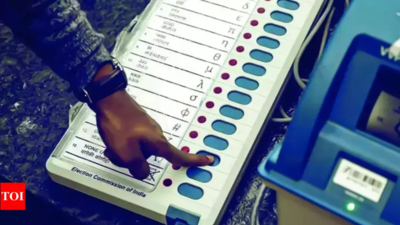
electronic voting machine

Q1: Pre-programmed chips for party favors

How can we be sure that the chip inside is not pre-programmed in favor of a particular party?
Answer: EVM has microcontroller one time programmable (OTP), meaning it can be programmed only once. This programming is strictly monitored
technical expert committeeAnd the source code is audited by independent experts. Before each election, mock polls involving over 1,000 votes are conducted, allowing political parties to verify that the voting pattern has been recorded accurately. Therefore it is impossible to program it in advance to benefit someone.

Q2: Insider tampering before election day

What stops an insider from tampering with the machine before election day?
Answer: EVMs are stored in secure strong rooms with 24/7 CCTV surveillance and armed security of multiple independent (Central and State) agencies. They have tamper-evident seals with unique serial numbers, and the two-step randomization process ensures that no one knows until the last moment which EVM will be used where. Pre-poll checks are conducted in the presence of representatives of several political parties to verify the integrity of the machines.

Q3: Wireless Hacking

Can’t machines be hacked through wireless signals or Bluetooth?
Answer: Indian EVMs have no wireless components, including no internet connectivity, Bluetooth or external ports. They are designed as “air-gapped”, meaning they are physically isolated from any network, making them immune to remote hacking attempts.

Q4: Tampering with storage

How do we know that votes are not being changed when the machines are in storage?
Answer: EVMs are stored in secure rooms:

  • Three-tier security including armed forces
  • A double-lock system where the keys are held by different officials
  • Party representatives can put their seal of approval
  • Continuous log of any access attempts

Any unauthorized access will trigger an alarm and require the presence of authorized personnel and party representatives.

Q5: Replacement from duplicate machines

What will happen if someone replaces the original EVM with a duplicate machine?
Answer:Each EVM has a unique serial number, digital signature, holographic seal and key code. During First Level Check (FLC), these identifiers are verified and documented in the presence of party representatives. These details can be cross-referenced before the voting begins to ensure authenticity.

Q6: Magnetic interference

Can strong magnets or electromagnetic pulses manipulate polling data?
Answer: The EVM is designed with electromagnetic shielding, meeting military-grade standards. They are immune to electromagnetic fields up to 6 Tesla, surpassing the strength of MRI machines. This ensures that external magnetic fields cannot alter the stored vote data.

Q7: Outreach for illiterate voters

How can illiterate voters ensure that their vote will go to the candidate of their choice?
Answer: EVMs have large, clear symbols and party names with audible beep confirmation for each vote. Voter-verifiable paper audit trail ,VVPAT) provides visual confirmation of the vote cast. Additionally, Braille signs assist visually impaired voters.

Question 8: Preventing multiple votes

How can we prevent multiple votes from being registered when no one is watching?
Answer: EVMs are designed to allow only one vote per voter. The control unit enables voting only after the Presiding Officer presses the “Ballot” button, and it is mandatory to wait for 5 seconds between votes. This mechanism ensures that each vote is recorded individually and prevents multiple voting without detection.

Q9: Software update or malicious code insertion

Could malicious code be inserted during maintenance or software updates?
Answer: EVMs do not accept software updates after manufacturing. The program is burned into the OTP chip, which cannot be modified once set. There are no external input ports, and maintenance is entirely physical and mechanical, ensuring that no software changes can be made.

Q10: Fault detection

How will we verify if there is a machine malfunction during voting?
Answer: EVMs have continuous self-diagnosis features and provide visual and audio indicators for any errors. If a malfunction is detected, the machine is locked to preserve vote data, and backup machines are immediately available to prevent disruption.

Q11: Battery failure

What happens if the battery dies during voting—are votes lost?
Answer: EVMs have a robust battery system with 48 hours of backup and non-volatile memory that retains data without power outages. Redundant power systems ensure that even in the event of battery failure, vote data remains intact.

Q12: Conditional Programming

Can the machine be programmed to transfer votes after a certain number of votes?
Answer: No, the OTP chip cannot be reprogrammed and it records each vote as exactly cast without any conditional logic. security protocol To prevent such changes, multiple layers of verification ensure the integrity of the voting process.

Question 13: VVPAT integration

How does VVPAT integration ensure voter verification?
Answer: VVPAT provides a physical paper trail that voters can view and verify immediately after casting their vote. This paper record is stored securely and can be used for audits or recounts, adding an additional layer of transparency and trust to the electoral process.

Q14: Security protocol

What security protocols are in place to protect EVMs from tampering?
Answer: EVMs are designed with a number of security features, including:

  • tamper-evident seals
  • encryption of vote data
  • Regular audits and checks by independent agencies
  • Secure Supply Chain Management

These measures ensure that any attempt at tampering will be immediately detected and the validity of the machine will be lost.

Q15: Display unit security

Can someone hack the machine through the display unit?
Answer: The display unit is entirely output only and has no input capabilities. It is hardwired to display information and cannot be used as an interface for programming or altering the operation of the machine.

Question 16: Climate Resilience

How are EVMs protected from extreme climatic conditions?
Answer: The EVM is designed to operate in a wide range of temperatures (from -10 °C)
+55°C) and high humidity levels (up to 95%). They are also tested for resistance to heavy rains, ensuring reliability in the diverse Indian climate.

Q17: Direct memory access

What would happen if someone tried to directly access the machine’s memory chip?
Answer:Memory is encrypted using AES-256 and physically secured within the machine. Tamper-evident seals cover the memory area, and any attempt to directly access the memory will damage the seals and be immediately detected, rendering the machine invalid for use.

Question 18: Result transmission security

Can votes be changed during the results transmission process?
Answer: The results are first physically recorded on the EVMs and then transmitted through secure channels. Multiple copies of the results, including the VVPAT paper trail, are maintained, which can be used for cross-verification. This redundancy ensures that any attempts to alter the results will be detected during transmission.

Question 19: Random Sampling in VVPAT Verification

How do we know that a random sample of VVPAT slips is truly random?
Answer: This process uses computerized random number generation, and the selection is done in the presence of representatives of all political parties. This ensures transparency and fairness in the sampling method.

Q20: Manufacturer inspection

What stops manufacturers from building hidden backdoors into EVMs?
Answer:The manufacturing process is overseen by several agencies, including independent safety auditors. Components are verified at each stage, and the final assembled units undergo extensive testing by various teams to ensure there are no vulnerabilities or backdoors.

Q21: Battery charge level

Does the varying level of battery capacity (charge level) in EVMs at the time of counting of votes indicate any possibility of hacking?
Answer: From a technical engineering perspective, the allegation fundamentally misunderstands the EVM power architecture. The “99%” display is not a battery charge percentage, but rather a voltage threshold indicator that shows “99%” whenever the battery voltage remains within the optimal operating range of 7.4V – 8.0V. This is purely an administrative feature to indicate the proper working voltage level. EVMs use non-rechargeable alkaline batteries (7.5V/8V configuration), with vote data stored in non-volatile EEPROM memory, meaning that vote storage and counting is completely independent of the state of the battery. The power system is completely isolated from the vote recording circuit, making it technically impossible for battery condition to affect the vote pattern or counting sequence. Furthermore, the data integrity of each EVM can be verified through VVPAT audit trails, irrespective of power conditions. Therefore, any correlation between battery display readings and voting patterns is technically impossible given the basic architecture and security protocols of EVMs.
conclusion
Indian EVMs, especially the M3 model combined with VVPAT, incorporate a number of security measures and safeguards to ensure the integrity and transparency of the EVMs. electionThrough rigorous testing, multiple layers of verification, and strong security protocols, these machines provide a reliable and trustworthy voting system.
(The views of senior IPS officer and cyber security expert Brijesh Singh are personal.)




Golden Age Walk: Bengaluru’s Golden Age Walk aims to restore the city’s rich heritage

0
Golden Age Walk: Bengaluru’s Golden Age Walk aims to restore the city’s rich heritage


Last updated:

The Golden Path, or Palace-to-Palace Corridor, is a 4.7 kilometer route that starts from Tipu Sultan’s Summer Palace in Chamarajpet and ends at the Bangalore Palace near Mekhri Circle. This historical expanse traverses iconic sites, heritage buildings and forgotten gems

Architects and conservationists have been pushing for the implementation of this project, which highlights 500 years of Bengaluru's history. symbolic image/x

Architects and conservationists have been pushing for the implementation of this project, which highlights 500 years of Bengaluru’s history. symbolic image/x

Basavanagudi will be developed as a heritage corridor under a proposal by Karnataka Deputy Chief Minister DK Shivakumar. Brand Bengaluru The initiative has rekindled interest in the city’s age-old cultural heritage. The announcement has prompted heritage enthusiasts to advocate for the long-pending project, Swarna Marg, or the Golden Route, which aims to preserve and showcase Bengaluru’s rich historical narrative.

Architects and conservationists are pushing for the implementation of the project, which highlights the 500-year history of Bengaluru – from its founding by Kempegowda in 1537 to its emergence as the Silicon Valley of India.

The Golden Path, or Palace-to-Palace Corridor, is a 4.7 kilometer route that starts from Tipu Sultan’s Summer Palace in Chamarajpet and ends at the Bangalore Palace near Mekhri Circle. This historical expanse traverses iconic sites, heritage buildings and forgotten gems.

‘A time capsule’

Urban expert and architect Naresh Narasimhan, who conceptualized the project in collaboration with INTACH, describes the corridor as a time capsule. He explains how the project advocates declaring the entire corridor a heritage area, thereby preventing new construction or demolition of existing structures.

“This corridor between Tipu’s palace and the Wodeyar’s palace has 53 heritage structures. “Each structure has a story to tell that also reflects the essence of Bengaluru’s history,” Narasimhan told News18.

The Golden Path initiative also aims to bring to light lesser known aspects of Bengaluru’s history. For example, the importance of Avenue Road in the heart of Bengaluru, which was a major axis of the city during the Third Anglo-Mysore War, when the British planned to attack Bengaluru. The battle fought between the British and the Mysoreans on the Avenue Road, or Shahaji Bhonsle, father of Chhatrapati Shivaji Maharaj, received Bengaluru as a jagir from the Bijapur Sultanate and settled here in the mid-17th century. His son, Shivaji, married Saibai Nimbalkar in Bengaluru before returning to his northern territories.

Stories buried by time include the forgotten tomb of Hyder Ali’s maternal uncle at Cumberpet and the grand armory of Tipu Sultan. Each of these sites represents a chapter in the city’s vibrant history but suffers from neglect.

Basavanagudi, one of the oldest planned areas of the city, was designed by Scottish engineer Standish Lee in 1896. Its unique drainage system and wide roads made it an ideal locality, and it was once home to peacocks and lush greenery. Today, only 15 of the 800-1,000 historic bungalows spread across Bengaluru still exist.

Basavanagudi and other historical areas of Bengaluru still boast of architectural marvels such as the Bengaluru Gayana Samaj and Tipu’s Armoury. However, neglect and urbanization have left many such treasures in disrepair or fallen to modern development.

“Tipu’s armory has been neglected and needs to be well maintained as part of our history. People who come to Bengaluru think it is only Whitefield or Electronic City, but there is a lot in our city that is deeply embedded in history and that can be permanently highlighted for the future,” Mansoor Ali, a said the architect-turned-historian who is curating the heritage. Padayatra to preserve and promote the rich culture of Bengaluru.

‘broken’ past

Ali, co-founder of Bengaluru by Foot, walks around the city sharing stories from the founding of Bengaluru by Kempegowda to the British-era town planning, which worked effectively until the 1970s and 1980s but has since seen rapid decline. There has been a decline.

“In places like Basavanagudi, we have Gavi Gangadhareshwar temple, Bull temple and others. The state government comes up with ideas to save such heritage structures, but they remain just ideas and never come to fruition. Ideas are born when a particular political party is in power, but once it changes, the idea becomes history.”

For example, a move was taken to save the 100-year-old structure that was the first residence of HV Nanjundaiah, founder-president of Kannada Sahitya Parishad. Later it was donated to the government to start a Government Girls High School and there were plans to make it a museum in Malleshwaram.

“It was the brainchild of Malleshwaram MLA and then BJP minister Ashwath Narayan, but nothing has happened for the last five years, and the project is in limbo. If the Congress, which is in power now, talks about Basavanagudi and making it a heritage corridor, we don’t know what will happen to it if the government changes,” Mansoor said.

In 2014, the government faced public outcry over its proposal to demolish Balabrui House, a heritage building, to construct an MLAs’ club house. The plan was eventually cancelled, but the incident exposed the fragility of Bengaluru’s heritage. However, with Balabrui House now set to serve as the home of MLAs, health experts are working on its interiors and structural upgrades.

preserving the heritage

Groups such as Bengaluru by Foot and Bygone Bengaluru have taken up the cause of reviving the city’s heritage. Through curated walks and social media campaigns, they aim to rekindle public interest in Bengaluru’s past.

Ali recalled a heritage walk, House of Malgudi, which he organized till five years ago, which included historical areas like Malleshwaram (Mal) and Basavanagudi (Gudi), from where the name Malgudi originated, but now This is a thing of the past. He says, most of the houses were demolished after the Covid pandemic. These include the houses of Justice Nitur Srinivasa Rao in Basavanagudi and Villa Pottipati in Malleshwaram. Ali explains that this walk is not just about the buildings but reflects the spirit of the bygone era.

The Golden Path and similar initiatives face significant challenges including encroachment, poor maintenance and lack of government funding. The Tipu Sultan Arsenal, a UNESCO recognized site at Kalasipalyam, lies amid garbage and broken footpaths, reflecting the neglect of most prominent heritage sites.

“Foreign citizens are in awe of Tipu’s rockets and missiles, but when they visit the armory, it is in such a dilapidated condition, and the attitude towards it so dirty that we feel ashamed. We have such world famous structures hidden behind the garbage of modern times, Ali lamented.

“Minto Hospital, one of the leading eye hospitals in the state, has walkable footpaths in front. Vani Vilas Children’s Hospital, which was built with funds donated by private citizens like Chintalapalli Venkatamuniah Setty, Sajjan Rao, SVS Setty etc., suffered damage due to the metro construction. A wing on the southern side collapsed as a result of metro tunneling work,” Ali explained, underscoring the urgent need for preservation. “Without immediate action, we risk losing more of Bengaluru’s history. There is a need for a holistic plan, not just for Basavanagudi, but the entire city.”

Narasimhan said, there is an urgent need for Bengaluru Heritage Protection Act. “Without a legal framework, these buildings will continue to disappear, taking with them the stories of the past,” he said.

Deputy CM Shivakumar said, as minister in-charge of Bengaluru, he was committed to preserving Basavanagudi, the birthplace of Vrishabhavati, which holds immense cultural significance. There was also a demand for revival of Vrishabhavati river.

The Vrishabhavati, which is currently little more than a dirty drain carrying sewage and waste water from the city, originates from the Bull Temple at Basavanagudi and flows through south and west Bengaluru before joining the Arkavathi near Kanakapura.

Narasimhan believes that the K-100 waterway project, which runs from Shantala Silk Junction in Majestic to Koramangala in BTM and drains into Bellandur Lake, covering a distance of 12 km, is a good example of how the Vrishabhavati can be transformed. How can be developed and kept free from sewage.

news India Golden Age Walk: Bengaluru’s Golden Age Walk aims to restore the city’s rich heritage


US President Joe Biden pardons son Hunter despite pledging not to | Politics News

0
US President Joe Biden pardons son Hunter despite pledging not to | Politics News


BREAKING,

Outgoing US president says his son was ‘selectively’ and ‘unfairly’ prosecuted due to his family name.

United States President Joe Biden has pardoned his son Hunter ahead of his sentencing on gun and tax convictions despite a previous pledge not to use his presidential powers to grant him a reprieve.

Biden said on Sunday that his son had been “singled out” and “selectively, and unfairly” prosecuted due to his family name.

“There has been an effort to break Hunter – who has been five and a half years sober, even in the face of unrelenting attacks and selective prosecution,” Biden said in a statement released by the White House.

“In trying to break Hunter, they’ve tried to break me – and there’s no reason to believe it will stop here. Enough is enough.”

Biden’s decision comes weeks before Hunter Biden was set to face sentencing for a string of felonies related to making a false statement about his drug use during a gun background check and failing to pay at least $1.4m in taxes.

In justifying his decision, Biden said that people are “almost never” brought to trial for wrongly filling out a gun purchase form and that those who pay their taxes late usually receive “non-criminal resolutions”.

“For my entire career I have followed a simple principle: just tell the American people the truth. They’ll be fair-minded. Here’s the truth: I believe in the justice system, but as I have wrestled with this, I also believe raw politics has infected this process and it led to a miscarriage of justice – and once I made this decision this weekend, there was no sense in delaying it further,” Biden said.

“I hope Americans will understand why a father and a President would come to this decision.”

In June, Biden had flatly ruled out the possibility of granting his son a pardon or commuting his sentence.

“I said I will abide by the jury decision. I will do that and I will not pardon him,” Biden had said.

The White House had reiterated Biden’s intention not to pardon his son as recently as November 8, when press secretary Karine Jean-Pierre told reporters: “Our answer stands, which is no.”


ITR Filing Deadline For FY 2023-24 Extended For THESE Taxpayers; Check Eligibility, And Penalty | Personal Finance News

0
ITR Filing Deadline For FY 2023-24 Extended For THESE Taxpayers; Check Eligibility, And Penalty | Personal Finance News


Income Tax Return Filing Deadline: The Central Board of Direct Taxes (CBDT) has extended the deadline for filing income tax returns to December 15, 2024, for the financial year 2023-24 (assessment year 2024-25). This extension applies to taxpayers engaged in international transactions or specified domestic transactions requiring reports under Section 92E of the Income-tax Act, 1961.

Meanwhile, for those obligated to file a report under Section 92E, the due date for filing returns under Section 139(1) remains November 30, 2024. Adding further, the extension has been granted to taxpayers falling under clause (aa) of Explanation 2 to sub-section (1) of Section 139, pushing the deadline to 15th December 2024.  

Missed The Section 92E Deadline? Know the Penalty 

According to income tax laws, a penalty of Rs 1 lakh is levied on the entities who fail to file the report of the chartered accountant by the October 31 due date. 

Eligibility Criteria For Filing Reports Under Section 92E 

The Entities involved in specific domestic or international transactions during a financial year must file a report from a chartered accountant with the income tax department by October 31 using Form 3CEB. 

Meanwhile, Section 92E covers transactions like buying, selling, or leasing tangible or intangible assets, business dealings involving income, profits, or losses, and money lending or borrowing. If the total value of these transactions exceeds Rs 20 crore, transfer pricing regulations apply. 


Fireworks shot at police and water cannon sprayed in Tbilisi

0
Fireworks shot at police and water cannon sprayed in Tbilisi


Protesters have been out in the Georgian capital, Tbilisi, for a fourth night after the country’s bid to join the European Union was put on hold by the ruling party, Georgian Dream.

Fireworks were shot towards riot police on the steps of parliament and a water cannon was fired at demonstrators.

The country’s pro-Western president, Salome Zourabichvili, who was due to step down from her post this month, has told the BBC she will stay in the role until new parliamentary elections are held and called the current parliament “illegitimate”.

Georgian Dream has denied allegations of voting irregularities


Notes that touch the heart of the Republic. latest news india

0
Notes that touch the heart of the Republic. latest news india


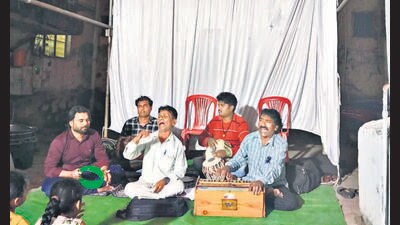
It gets night early here. The yellow haze of a lone dirty streetlight struggles to dispel the darkness. It is only 10 o’clock at night but as the cold in the chawl increases, the streets are becoming increasingly empty. The only sign of life next to a clump of huts is where six men are tuning their instruments, the centerpiece an old harmonium held together by a patchwork of black tape. With a makeshift canopy above their heads and a lime-green carpet spread out in front of them, the men gather together for warmth and prepare their repertoire. In front of the troupe a slow crowd of people devoid of even basic glamor is gathering – all middle-aged, all poor, all raring to go.

Gautam Awadh's troupe is hired by grassroots communities to mark various occasions such as Republic Day, weddings or funerals. (HT photo)
Gautam Awadh’s troupe is hired by grassroots communities to mark various occasions such as Republic Day, weddings or funerals. (HT photo)

Such scenes are not uncommon in the interior of India, where folk artists often hold all-night shows or jalshas. But Gautam Awadh’s group is different. There will be no devotional songs or stories of divine miracles in his performance. Instead, over the next few hours, Awad and his musicians will sing about India’s founding document, using Marathi poems and folk songs to highlight how the Constitution has changed the lives of India’s marginalized castes. “In India, a rag picker can become a ruler – this is the miracle of the Constitution. This is our first song,” said Awad, whose troupe is hired by grassroots communities to mark various occasions like Republic Day, weddings or funerals.

This is not an economically profitable activity; When Awad started singing about the Constitution in 1968, the one-night stand became a fascinating 60. Today, it could be anywhere in between 2,000 more 4,000. Yet, the expanse of Maharashtra is filled with folk shaheers or folk artists who travel from village to village singing about the Constitution. His untrained voices and the sound of his harmonium have created a strong grassroots link between the Constitution and the common people whose lives it rules.

“It is a long tradition, as old as the Constitution. Through their words, these artists are viewing the Constitution not just as a legal document but as a social code of equality and self-respect, said Milind Awad, professor at Jawaharlal Nehru University.

Folk arts for social change

The practice of writing and performing songs and poems about the Constitution came to prominence during the 1950s when a young republic was coming to terms with the new social and moral codes unveiled by the document. Far from mainstream appreciation, these folk artists commanded loyal followers in the hinterland. “Maharashtra has a history of folk art like Tamasha, from where genres like Jalsa were born. The lavani that is popular today is also a branch of the same tree,” said Atul Yerekar, a doctoral candidate at the Tata Institute of Social Sciences, Mumbai.

His father, Sahebrao Yerekar, is one of the most famous exponents of this genre, who turned to questions of similarity in devotional songs under the tutelage of the 19th-century reformist Jyotiba Phule, who used songs and poetry to highlight rationalism. Did. A resident of Parbhani district, Yerekar senior was a disciple of the Ambedkarite Marathi poet Vamandada Kardak and started singing hymns in praise of the Constitution at the age of 12. “We had a troupe of nine people – playing the tabla. Harmonium, banjo, drums and chorus. The demonstrations usually last till night and include songs and drama based around the Constitution,” he said.

Unlike mythological plays or devotional songs, the Constitution was a much more serious subject – but according to Yerekar senior the singers used the extraordinary life of Dr BR Ambedkar to make a connection.

“Babasaheb’s image was enough to attract people. We will include his life story in our songs – the discrimination he fought and the challenges he overcame. And we’ll talk about how the Constitution made it possible for people like us to go where we want and hold our heads high.”

This was a time of intense conflict and songs about the Constitution were often seen by upper caste groups as a proxy for Dalit assertion, leading to violent reactions. “Every week, there was some or the other clash. People will abuse, file cases against us. There used to be fights after the programs because the upper castes did not believe that we had organized our own cultural programs. They beat us,” Yerekar Sr. said.

‘Challenge the dominant culture’

In the quest to convey the message of the Constitution to the people, each generation of activists faced its own challenges. For lyricist Sambhaji Bhagat, whose life was made famous by the 2014 National Award-winning film Court, that obstacle came in the form of communalism and cultural dominance that threatened to erase the lives of marginalized castes in the 1990s.

“Whether it was the Babri Masjid demolition or brutal caste attacks, we campaigned to protect the Constitution. We would go from door to door and sing songs; And we don’t drink water until we touch five houses and talk to them about the Constitution,” Bhagat said.

His booming voice and signature locks are now a mainstay of the Marathi theater scene; Bhagat moved to Mumbai in the 1980s and lived in the now-demolished Siddharth Vihar hostel, where he gave talks about the Constitution and liberation from the center of anti-caste ideas. “From that experience, it was clear to me that we have to talk to the youth about the Constitution. So we started Insaniyat ki Pathshala (School of Humanity), where we held an hour-long class every Sunday in the slums, and talked to the children about the Precepts, including songs and games,” he said. .

For him, the power of the common man lies in challenging the dominant culture. “Look at us, we are little men with insignificant lives. We have neither money nor influence. But we have songs and constitution. To better humanity, this is enough,” he said.

great art comes from struggles

Many of the men and women who sing about the Constitution come from poor families and marginalized backgrounds, their poems inspired not by legal knowledge but by the grassroots changes – such as the abolition of untouchability – that the Constitution brought about.

“Their constitutionality goes beyond legal procedural text. They are helping to replace the general understanding of caste society with a new good understanding of rules and system. Milind Awad said, “These songs are a celebration of those oppressed by social inequalities and caste.”

Rekha Bharti is one of them. A resident of Chhatrapati Sambhaji Nagar, Bharti started singing at the age of eight and using the Qawwali style, has since made a name for herself with her troupe – Rekha Bharti Ani Sanch – which she formed in 1991. Sakhubai Salve is the second one. The 60-year-old woman is illiterate, but often jokes about how she can perform any song by keeping it on her personal computer – her mind.

For female singers, rejection often comes from within their families, said Samiksha Bamne, a female poet whose troupe – Sanvidh Sanskruti Jalsha – presents short plays about the Constitution. “Many members of my own group face pressure to leave the stage, and certainly, among our generation, these forms of art are not seen as good,” the law student said. “There is a fear that the tradition is waning, although some of our most enthusiastic listeners are domestic workers and women victims of violence.”

carrying on the legacy

It’s now a few minutes before midnight and Gautam Awad’s energy is slowing down a bit. As the old man stops to take a sip of water, his younger colleague Rajesh Tupe takes out the big notes. He is 29 years old, one of the handful of youngsters who are carrying on the tradition of writing songs about the Constitution. But he is not happy.

“Violence may have reduced but the prejudice of the ancient era has not ended. There is still no intermarriage or intermingling between the higher castes and our castes; They do not allow us to enter temples. Even if our keyboard artists play tunes in praise of Baba Saheb, they are attacked. No matter how much you try, they don’t understand (you can try to make them understand, but they won’t understand).

But Gautam Awadh advises to remain calm. The elder has lived through the turbulent times of the 1970s and 80s, when Dalit communities were attacked just for invoking the Constitution, where a movement demanding renaming of a university to include Dr Ambedkar lasted for 16 years. It took four lives and was sung against the social strictures of caste that often invite violence.

“We were scared but we never stopped singing. After all, this is our Constitution,” he said. Pointing to the half-full glass of water still in his hand, he recalled the time when he was 20 and he was slapped in the middle of a show in his aunt’s village because He had dared to ask for a glass of water from the common well. , “The village bullies thought they would stop us,” he said, laughing.

“But what is more powerful than the Constitution?”


GST mop-up fourth highest ever but red flags in laggard states

0
GST mop-up fourth highest ever but red flags in laggard states


The Goods and Services Tax (GST) revenue in November grossed over ₹1.82 lakh crore, the fourth highest monthly collection ever that also crossed the ₹1.80 lakh crore mark for the fifth time in 88 months since July 2017, despite major states such as Andhra Pradesh, Rajasthan and Chhattisgarh showing a dip in growth.

₹1.82 lakh crore, the fourth highest monthly collection ever. (Ministery of Finance X)” title=”The goods and services tax (GST) revenue in November grossed over ₹1.82 lakh crore, the fourth highest monthly collection ever. (Ministery of Finance X)” /> The goods and services tax (GST) revenue in November grossed over <span class=₹1.82 lakh crore, the fourth highest monthly collection ever. (Ministery of Finance X)” title=”The goods and services tax (GST) revenue in November grossed over ₹1.82 lakh crore, the fourth highest monthly collection ever. (Ministery of Finance X)” />
The goods and services tax (GST) revenue in November grossed over ₹1.82 lakh crore, the fourth highest monthly collection ever. (Ministery of Finance X)
Gross GST revenue collection in November increased by 8.5% to ₹1,82,269 crore compared to ₹1,67,929 crore collected in the same month of the previous year, while the net collection after refunds saw an 11.1% jump at ₹1,63,010 crore as against ₹1,46,786 crore, due to strong domestic business activity as compared to external sector growth.

Also read: GST collection rises 9% on domestic demand

The net revenue in the month saw double-digit growth mainly because refunds contracted by 8.9% from ₹21,143 crore in November 2023 to ₹19,259 crore in November 2024, according to government data released on Sunday.

Experts expressed concern over poor collections in some of the key states, especially in the light of the second quarter (Q2 of FY25) gross domestic product (GDP) growth data published on Friday. India’s GDP growth slowed to a seven-quarter low at 5.4% in Q2 of the current financial year, mainly because of global headwinds.

“The slower single-digit growth in some large states like Haryana (2%), Punjab (3%), UP & MP (5%), Tamil Nadu (8%), Telangana (3%) as well the negative growth in Rajasthan (-1%), AP ( -10%), Chhattisgarh (-1%) would be an area of concern as these states have significant manufacturing presence and considerable economic impact,” Deloitte India partner MS Mani said.

Saurabh Agarwal, tax partner at consultancy firm EY, sounded caution. “Considering the recent GDP data for the September 2024 quarter, we anticipate a slowdown in tax collections over the next four months. The global geopolitical scenario and potential consumer spending cuts could further exacerbate short-term economic growth,” he said. “However, the uptick in collections from states like Jammu & Kashmir, Bihar, Sikkim, Mizoram, Tripura, Assam, and Odisha points towards positive economic momentum in these regions,” he added.

Experts bank on strong domestic consumption to close the current financial year with record overall GST collections. “The domestic GST revenue growth of 10% plus in [the first eight months of] FY25 seems to support the GDP data which indicates an increase in domestic consumption… The projected GDP growth of 7% in FY25 augurs well for GST collections in the remaining four months of the current fiscal year, considering the fact that the collections in the first 8 months of FY25 have exceeded those of FY25 by more than ₹1 lakh crore,” Mani said.

Also read: India’s GDP growth slows to 5.4% in Q2, below RBI estimate: Govt data

According to the latest GST data, cumulative revenues in the eight months of FY25 increased by 9.3% on an annualised basis to ₹14,56,711 crore, with strong domestic transactions of ₹11,04,817 crore (a 10.3% year-on-year jump). Collections of gross import revenue during this period showed only 6.3% y-o-y growth at ₹3,51,894 crore. Similarly, net collections in April-November 2024 saw a single-digit annualised growth of 9.2% at ₹12,90,616 crore because of low 3.2% growth in revenues through imports.


Negotiators fail to agree on UN treaty to curb global plastic pollution | Climate News

0
Negotiators fail to agree on UN treaty to curb global plastic pollution | Climate News


As the threat from plastic pollution mounts, countries could only agree to postpone negotiations to a later date.

Countries negotiating a global treaty to curb plastic pollution have failed to reach an agreement, with more than 100 nations advocating for a cap on plastic production and a handful of oil-producing countries only willing to target plastic waste.

The fifth United Nations Intergovernmental Negotiating Committee (INC-5) meeting in Busan, South Korea was intended to be the final session. It was hoped the meeting would produce a legally binding global treaty.

If successful, it would have marked the most significant global climate pledge since the Paris Climate Accords in 2015, but the group of nations could only agree on Sunday to postpone negotiations to a later date.

Saudi Arabia, in particular, was accused of standing in the way. The country strongly opposed efforts to reduce plastic production and used procedural tactics to delay progress.

“It is clear that there is still persistent divergence,” Inger Andersen, executive director of the UN Environment Programme, told the Reuters news agency.

One plan that received significant international support was proposed by Panama on Thursday. If adopted, it would have established a pathway for a global production reduction target, but it did not specify what that target would look like. Another proposal did not mention production caps at all.

Panama’s delegation head, Juan Carlos Monterrey Gomez, lambasted the postponement of negotiations.

“Every day of delay is a day against humanity,” he said. “Postponing negotiations does not postpone the crisis.”

Based on current trends, plastic production is on track to triple by 2050.

“Every day that governments allow polluters to continue flooding the world with plastic, we all pay the price. This delay comes with dire consequences for people and the planet, ruthlessly sacrificing those on the front lines of this crisis,” Graham Forbes, Greenpeace’s delegation head to the global plastics treaty, said in a statement.

“This week, over 100 member states, representing billions of people, rejected a toothless deal that would have accomplished nothing and stood before the world committing to an ambitious treaty. Now, it’s time they stand by this promise and deliver.”

The environmental group GAIA told Reuters that “there is little assurance that the next INC will succeed where INC-5 did not”.

The postponement comes just days after the turbulent conclusion of the 29th UN Climate Change Conference (COP29) in Baku, Azerbaijan.

At COP29, countries pledged $300bn annually to address climate change. However, this plan fell far short of the $1.3 trillion requested by developing nations, which are disproportionately affected by the climate crisis.


Rate cut looks uncertain despite slowing growth

0
Rate cut looks uncertain despite slowing growth


Rate cut looks uncertain despite slowing growth

MUMBAI: Despite growth numbers coming in sharply lower and all-round calls for reduction in interest rates to support growth, the monetary policy committee (MPC) will find reducing rates a challenge.
Lower-than-expected Q2 GDP growth numbers at 5.4% have increased pressure on RBI‘s MPC to reduce interest rates even as the expectation of a softer policy led to bond yields falling on Friday.

Rate cut looks uncertain despite slowing growth.

The rate-setting panel has also faced pressure from govt, with commerce minister Piyush Goyal suggesting that food prices should be excluded from consideration and finance minister Nirmala Sitharaman advocating for softer rates to boost investment and growth.
But while monetary policy cannot impact the prices of tomatoes, onion or potatoes, it can reduce demand and bring down overall prices which will soften headline inflation.
According to Shreya Sodhani, economist with Barclays, RBI is expected to keep policy rates unchanged this week despite weaker growth, ‘according primacy to price stability’. “We highlighted that a weaker-than-expected Q3 GDP print may prompt the MPC to ease monetary policy, but the timing would depend on the outlook of growth and inflation,” Sodhani said in a report.
In the MPC meeting in Oct, of the three newly inducted external members, Nagesh Kumar was the only one who called for an immediate 25 basis point rate cut. Earlier in Aug, outgoing members Jayanth Varma and Ashima Goyal had voted for a rate cut. Varma was strident in advocating for lower rates and had said that the status quo in rates undermines India’s growth potential.
“The outlook for H2 FY25 is decidedly mixed. We foresee a likely improvement in rural demand owing to the robust growth in kharif foodgrain output and upbeat outlook for rabi crops amid replenished reservoir levels, as well as expectations of a back-ended pick up in govt capex,” Aditi Nayar, chief economist with Icra, said. But in light of the spike in inflation, Icra expects the MPC to cut rates in Feb at the earliest if inflation recedes.While not many expect RBI to cut the repo rate there is an expectation that it will take measures to ease liquidity and bring down interest rates in the money market.


Bowen: Syria’s rebel offensive is astonishing

0
Bowen: Syria’s rebel offensive is astonishing


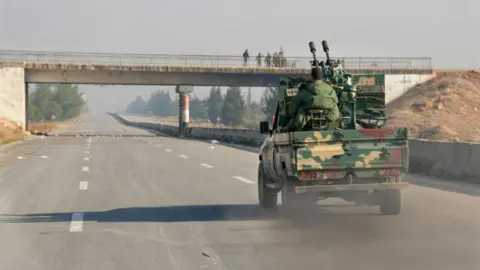
Getty Images Rebel forces drive down a highway in SyriaGetty Images

The reignited war in Syria is the latest fallout from the turmoil that has gripped the Middle East since the Hamas attacks on Israel on 7 October last year.

The attacks, and Israel’s response, upended the status quo. Events in Syria in the last few days are more proof that the war gripping the Middle East is escalating, not subsiding.

During a decade of war after 2011, Bashar al-Assad’s rule survived because he was prepared to break Syria to save the regime he had inherited from his father.

To do that he relied on powerful allies, Russia, Iran and Lebanese Hezbollah. They intervened on his side against rebel groups that ranged from the jihadist extremists of Islamic State to militias supported by the US and the rich Gulf monarchies.

Now Iran is reeling from severe blows inflicted by Israel, with US support, on its security in the Middle East. Its ally Hezbollah, which used to send its best men to fight for the Assad regime in Syria, has been crippled by Israel’s attacks. Russia has launched air strikes in the last few days against the rebel offensive in Syria – but its military power is almost entirely earmarked to fight the war in Ukraine.

The war in Syria did not end. It dropped out of the place it used to occupy in headline news, partly because of turbulence across the Middle East and beyond, and because it is almost impossible for journalists to get into the country.

In places the war was suspended, or frozen, but Syria is full of unfinished business.

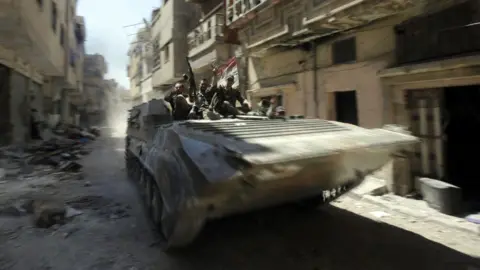
Getty Images A tank drives through ruined streetsGetty Images

Syria erupted into civil war following anti-regime protests in 2011

The Assad regime has never regained the power it had used to control Syria before 2011, the year of the Arab uprisings, though it still kept a gulag of Syrian prisoners in its jails.

Even so, until the last few days, the regime of President Bashar al-Assad controlled the major cities, their surrounding countryside and the main highways connecting them.

Now a coalition of rebel groups, led by Hayat Tahrir al-Sham (HTS), has broken out of Idlib, the province along the border with Turkey that it controls, and in only a few days since 27 November swept away Syrian troops in a series of “astonishing” events, as one senior international diplomat told me.

Two days into the offensive, they were posting photos of fighters who had taken the ancient citadel of Aleppo, which had been an impregnable base for government troops between 2012 and 2015, when the city was divided between rebels and regime forces.

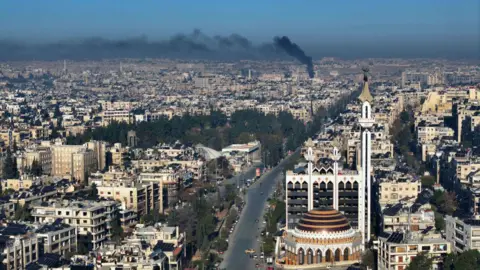
Getty Images A birds-eye picture of Aleppo with black smoke rising above the city. Getty Images

Rebel forces stormed Aleppo in recent days – and now control most of the city

The atmosphere in Aleppo seems calm after the rout of government troops. One photo on social media showed uniformed and armed rebel fighters queuing for fried chicken at a fast-food outlet.

HTS has roots in al-Qaeda, though it broke with the group in 2016 and at times has fought its rump loyalists. But HTS is still designated as a terrorist group by the UN Security Council and countries including the US, the European Union, Turkey and the UK. (The Syrian regime calls all its opponents terrorists.)

The leader of HTS, Abu Mohammad al-Jawlani, has a long history as a jihadist leader in Iraq and Syria. In recent years, though, he has moved away from strict jihadist ideology to try to broaden the appeal of his group.

The rebranding is also being used to attract support for the offensive, which HTS calls Operation Repelling the Aggression. That name, and its official announcements, avoid jihadist language and Islamist references.

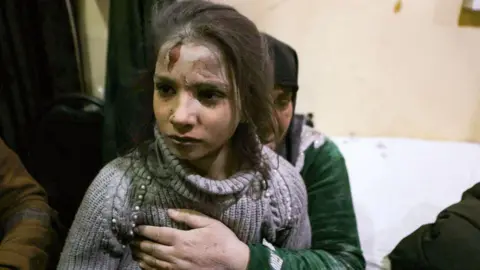
Getty Images A young girl with an injured head, covered in dust. Getty Images

Air strikes have targeted rebel groups in the city of Idlib, a stronghold of HTS, in recent days, injuring civilians

Neutral language, according to Mina al-Lami, the jihadist media specialist at BBC Monitoring, is designed to distance what’s happening from the jihadist past of HTS and present the offensive as a joint rebel enterprise against the regime.

Syrians are generally repelled by extreme religious rhetoric. As jihadist groups came to dominate the rebellion after pro-democracy demonstrations were crushed after the first year or so of war after 2011, many Syrians either stayed neutral or sided reluctantly with the regime because they feared the murderous jihadist ideology of Islamic State.

The offensive led by HTS comes out of the splintered political landscape of northern Syria. Much of the north-east is controlled by the Syrian Democratic Forces (SDF), a group led by Kurds and supported by the United States, which stations around 900 troops in the area.

Turkey is a big player, controlling borderlands where it has deployed its own regular troops as well as the militias it sponsors. Sleeper cells drawn from the remnants of Islamic State sometimes mount deadly ambushes on roads through the Syrian desert.

Reports from Syria say that the rebel forces have captured significant supplies of military equipment, including helicopters, and are pressing on towards Hama, the next significant city on the road to Damascus.

Without a doubt the regime and its allies will be working to steady themselves and to hit back, especially with air power. The rebels do not have an air force, though in another sign of the way that unmanned aerial vehicles are revolutionising warfare, there are reports that they used a drone to kill a senior regime intelligence official.

The renewed fighting in Syria is causing international alarm. The UN envoy to Syria, Geir Pedersen, issued a statement saying that “the latest developments pose severe risks to civilians and have serious implications for regional and international security… No Syrian party or existing group of actors can resolve the Syrian conflict via military means”.

Pedersen added that there had been “a collective failure to bring about a genuine political process” to implement UN Security Council resolution 2254, which was passed in 2015. That laid out a roadmap for peace, with the principle in the text that “the Syrian people will decide the future of Syria”.

The objective was a future shaped by free elections and a new constitution. But that meant Assad and his family giving up a country that they treated for years as their personal fief. More than half a million dead attest to their determination not to let that happen.

It is too soon to write the Assad regime off. It has a core of genuine support. Some Syrians see it as the least bad option – better than the jihadists who came to dominate the rebellion. But if other anti-Assad groups – and there are many – rise up, his regime will once again be in mortal danger.